


Overview
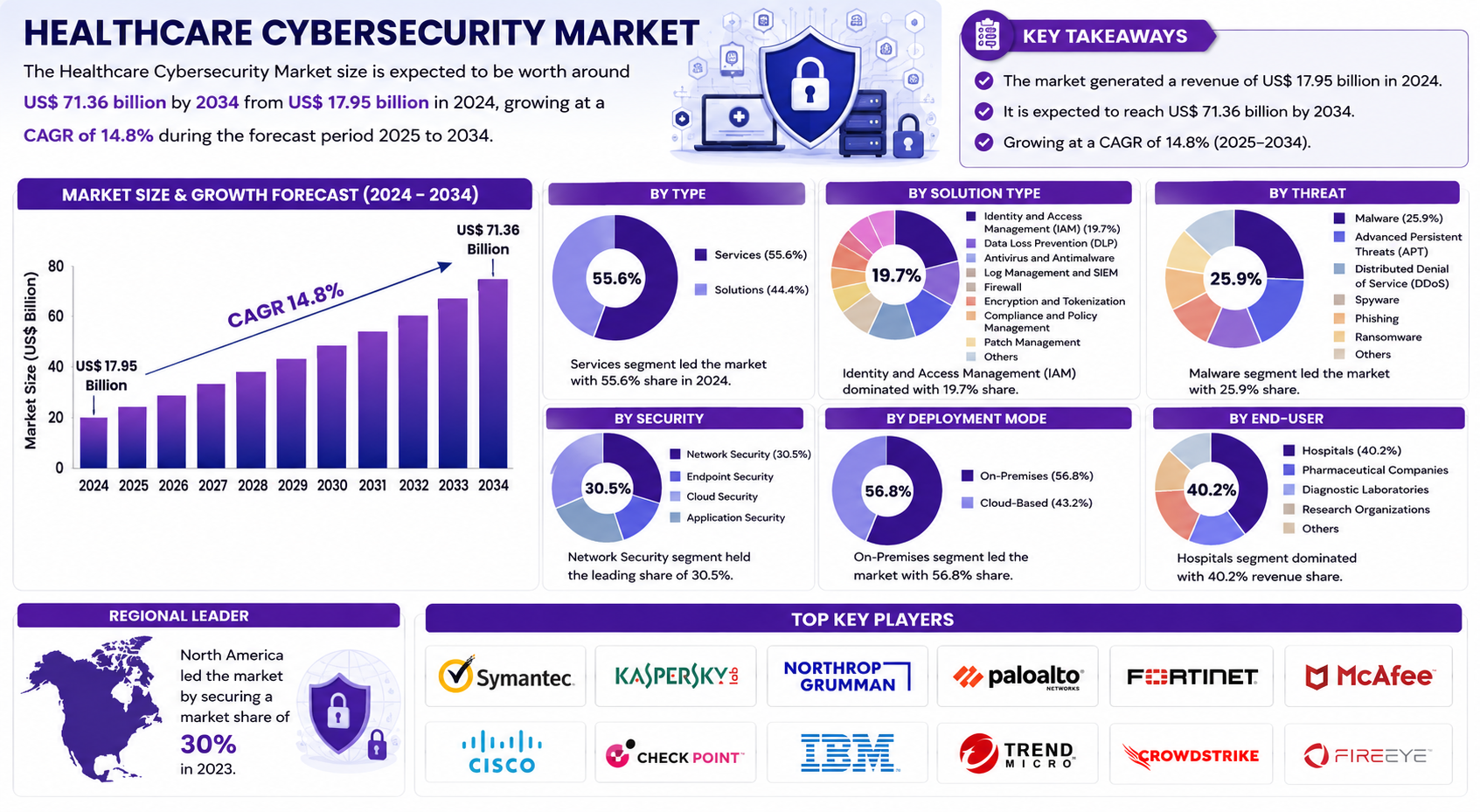
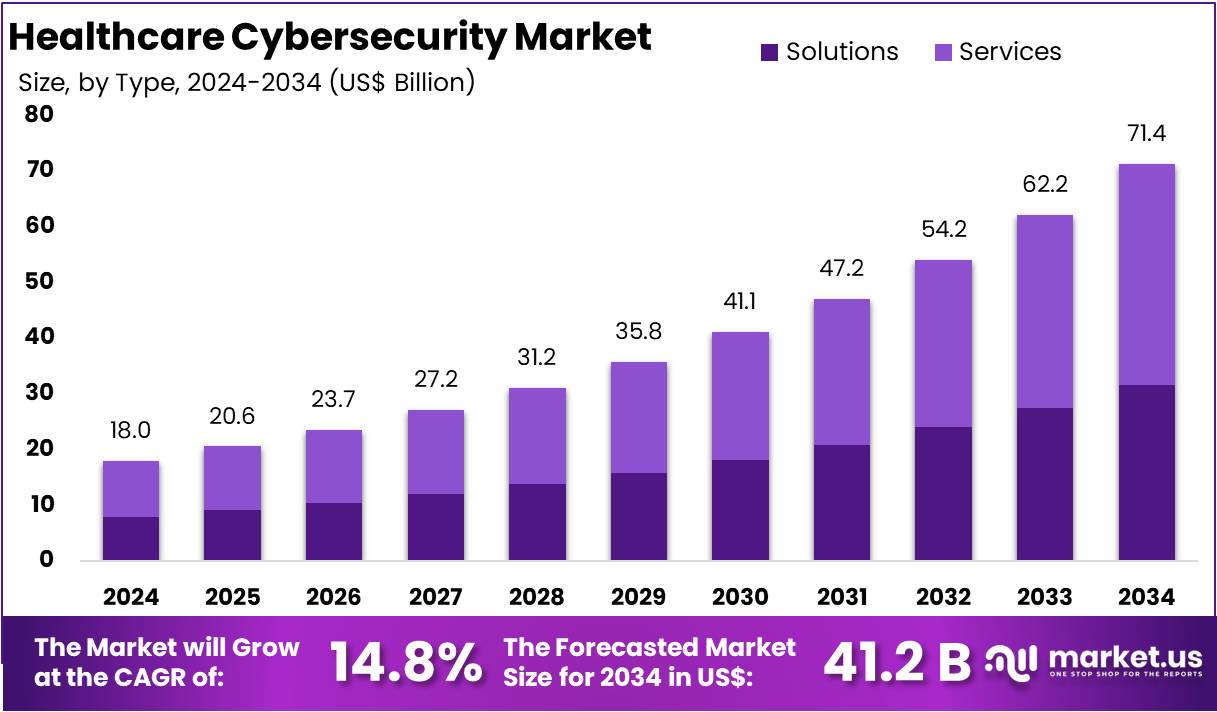
The Healthcare Cybersecurity Market size is expected to be worth around US$ 71.36 Billion by 2034 from US$ 17.95 Billion in 2024, growing at a CAGR of 14.8% during the forecast period 2025 to 2034.
The growing adoption of digital health platforms, electronic health records (EHRs), connected medical devices, and cloud-based healthcare services has increased the need for stronger cybersecurity solutions across healthcare organizations. Healthcare providers are focusing on protecting sensitive patient information, maintaining system availability, and reducing risks associated with ransomware, phishing, and unauthorized access.
The U.S. Food and Drug Administration (FDA) has emphasized cybersecurity throughout the lifecycle of connected medical devices, highlighting the importance of secure design, risk management, and continuous monitoring to improve patient safety.
Healthcare cybersecurity solutions include network security, endpoint protection, identity and access management, data encryption, threat detection, and incident response systems. The rising number of healthcare data breaches is encouraging hospitals and technology providers to strengthen security infrastructure. In 2024, a major healthcare cyberattack involving Change Healthcare affected more than 100 million individuals, demonstrating the significant impact cyber threats can have on healthcare operations and patient data protection.
Government agencies are also increasing cybersecurity guidance and regulatory efforts. The FDA issued updated recommendations in 2025 for medical device cybersecurity, including requirements related to cybersecurity risk assessment and documentation for connected devices. As healthcare systems continue adopting artificial intelligence, telehealth, and Internet-connected medical technologies, demand for advanced cybersecurity solutions is expected to expand, supporting improved resilience, compliance, and protection of critical healthcare infrastructure.
Key Takeaways
- In 2024, the Healthcare Cybersecurity Market generated US$ 17.95 billion in revenue, growing at a CAGR of 14.8% and is expected to reach US$ 71.36 billion by 2034.
- The Type segment is categorized into Solutions and Services, with Services leading the market in 2024 by capturing a 55.6% market share.
- The Solution Type segment includes Identity and Access Management (IAM), Data Loss Prevention (DLP), Antivirus and Antimalware, Log Management and SIEM, Firewall, Encryption and Tokenization, Compliance and Policy Management, Patch Management, and Others. IAM dominated the segment with a 19.7% market share.
- The Threat segment consists of Malware, Advanced Persistent Threats (APT), Distributed Denial of Service (DDoS), Spyware, Phishing, Ransomware, and Others. Malware held the leading position with a 25.9% market share.
- The Security segment is divided into Network Security, Endpoint Security, Cloud Security, and Application Security. Network Security dominated the segment with a 30.5% market share in 2024.
- The Deployment Mode segment includes On-Premises and Cloud-Based solutions, with On-Premises leading the market by accounting for a 56.8% market share in 2024.
- The End-User segment comprises Hospitals and other healthcare organizations, with Hospitals emerging as the dominant segment and holding a 40.2% revenue share.
- Regionally, North America led the Healthcare Cybersecurity Market with a 30% market share in 2023, supported by increasing healthcare digitization and rising cybersecurity investments.
Statistical Information
- The U.S. Department of Health and Human Services (HHS) reported that the Change Healthcare cyberattack affected approximately 192.7 million individuals, making it the largest healthcare data breach reported in the United States and highlighting the urgent need for stronger cybersecurity, identity management, and ransomware protection systems.
- The HHS Office for Civil Rights (OCR) breach portal has recorded more than 8,000 healthcare data breaches affecting over 1 billion individuals since tracking began, showing the increasing scale of healthcare data protection challenges and the need for advanced security monitoring solutions.
- Healthcare organizations face significant cyber exposure through hacking and IT incidents, with HHS breach analytics showing 4,590 hacking/IT incidents among reported healthcare breaches, making cyberattack prevention, endpoint security, and network protection major priorities for healthcare providers.
- FDA cybersecurity analysis of medical device safety communications identified 18 cybersecurity-related safety communications involving healthcare infrastructure and medical devices, with approximately 94% of identified vulnerabilities classified as high-risk, increasing demand for medical device cybersecurity testing and protection solutions.
- HHS cybersecurity guidance identifies 10 essential cybersecurity practices for healthcare organizations, including vulnerability management, multifactor authentication, incident response planning, and network segmentation, creating opportunities for cybersecurity vendors providing compliance and risk management solutions.
- Healthcare data breaches often involve large-scale exposure of sensitive information, and HHS breach records show individual incidents affecting hundreds of thousands of patients, including healthcare network incidents impacting 240,961 individuals and other provider breaches affecting 169,626 individuals.
- Connected medical devices are becoming a major cybersecurity focus as healthcare facilities increasingly rely on network-enabled technologies. FDA has emphasized that vulnerabilities in devices such as patient monitors, infusion systems, and connected equipment can create risks related to unauthorized access, operational disruption, and patient safety.
Market Segmentation Analysis
Type Analysis
The Services segment dominated the Healthcare Cybersecurity Market in 2024, accounting for a 55.6% market share. The growth is driven by increasing demand for managed security services that help healthcare organizations protect sensitive patient information and meet regulatory requirements.
Many providers are outsourcing cybersecurity operations to specialized firms offering continuous monitoring, threat detection, incident response, and compliance support. The rising complexity of cyber threats and shortage of cybersecurity expertise are further increasing the adoption of security-as-a-service models across healthcare systems.
Solution Type Analysis
Identity and Access Management (IAM) emerged as the leading solution type segment in 2024, capturing a 19.7% market share. IAM solutions are essential for healthcare organizations to control access to confidential patient records and prevent unauthorized data usage.
The increasing adoption of electronic health records (EHRs), digital healthcare platforms, and connected systems has strengthened demand for secure authentication, role-based access control, and user activity monitoring. Growing compliance requirements and data privacy concerns are further supporting IAM adoption.
Threat Analysis
Malware dominated the Healthcare Cybersecurity Market in 2024, holding a 25.9% market share. Healthcare organizations remain attractive targets for cybercriminals due to the valuable nature of medical data and the need for uninterrupted services. Malware attacks, particularly ransomware, can disrupt critical healthcare operations by blocking access to essential systems and patient information.
As healthcare facilities continue digital transformation, the growing risk of cyberattacks is increasing investments in advanced threat detection, prevention, and response solutions to strengthen cybersecurity defenses.
Security Analysis
Network Security led the Healthcare Cybersecurity Market in 2024, accounting for a 30.5% market share. The increasing use of interconnected healthcare networks, medical devices, and digital patient information systems has created a strong need for advanced network protection. Network security solutions, including firewalls, intrusion detection systems, and secure connectivity tools, help prevent unauthorized access and cyber threats.
As healthcare organizations expand digital infrastructure, strengthening network defenses has become essential for protecting sensitive data and maintaining operational reliability.
Deployment Mode Analysis
Cloud-Based deployment dominated the Healthcare Cybersecurity Market in 2024, capturing a 56.8% market share. The growing adoption of cloud computing in healthcare is driven by the need for scalable, flexible, and cost-effective security solutions.
Cloud-based cybersecurity services allow organizations to protect patient data while reducing dependence on traditional infrastructure. Features such as encryption, multi-factor authentication, and automated security updates provided by cloud platforms are encouraging healthcare providers to shift toward cloud-based deployment models for improved protection.
End-User Analysis
Hospitals represented the leading end-user segment in the Healthcare Cybersecurity Market in 2024, holding a 40.2% market share. Hospitals are frequent targets for cyberattacks due to the large volume of sensitive patient information and the critical nature of healthcare services.
The increasing implementation of electronic health records (EHRs), connected medical devices, and digital systems has created greater cybersecurity requirements. Hospitals are adopting comprehensive security solutions to protect networks, maintain data privacy, ensure compliance, and preserve patient trust.
Regional Analysis
North America is leading the Healthcare Cybersecurity Market, supported by increasing cyber threats, advanced healthcare infrastructure, and strong regulatory focus on protecting patient information. The growing adoption of electronic health records (EHRs), telehealth platforms, cloud-based healthcare systems, and connected medical devices has increased the need for advanced cybersecurity solutions across healthcare organizations.
The U.S. Department of Health and Human Services (HHS) has introduced Healthcare Sector Cybersecurity Performance Goals to help organizations strengthen cyber resilience and protect patient health information.
Rising ransomware attacks and healthcare data breaches are major factors driving cybersecurity investments in the region. HHS has highlighted ransomware as a significant risk for healthcare providers and has emphasized stronger security practices, including risk management, endpoint protection, and vulnerability reduction. Additionally, regulations such as HIPAA continue to encourage healthcare organizations to adopt comprehensive cybersecurity frameworks for safeguarding sensitive health data.
Key market trends in North America include increasing adoption of artificial intelligence-based threat detection, cloud security platforms, identity and access management solutions, and Zero Trust security models. As healthcare providers continue digital transformation initiatives, demand for scalable cybersecurity technologies is expected to grow, strengthening the region’s position in the global healthcare cybersecurity landscape.
Business Opportunities
The Healthcare Cybersecurity Market presents significant business opportunities as healthcare organizations increase investments in protecting sensitive patient data and critical digital infrastructure. Rising adoption of electronic health records (EHRs), telehealth services, cloud platforms, and connected medical devices is creating demand for advanced cybersecurity solutions, including identity management, endpoint protection, threat intelligence, and data encryption technologies.
The U.S. Department of Health and Human Services (HHS) has identified cybersecurity preparedness, vulnerability management, and stronger access controls as key priorities for healthcare organizations, creating opportunities for cybersecurity providers and managed security service companies.
Companies can explore growth opportunities through AI-powered threat detection, automated security monitoring, and security-as-a-service models that support healthcare providers with limited cybersecurity expertise. Cloud security solutions, Zero Trust frameworks, and compliance management platforms are also gaining importance as healthcare systems modernize their technology infrastructure.
Additional opportunities exist in cybersecurity consulting, employee training, incident response services, and medical device security as connected healthcare technologies expand. Partnerships between cybersecurity firms, hospitals, and technology providers can help develop specialized solutions for ransomware prevention, regulatory compliance, and real-time threat monitoring.
With healthcare organizations facing increasingly complex cyber risks, investment in scalable and proactive security solutions is expected to remain a major growth opportunity.
Emerging Trends
- Artificial Intelligence-Based Cyber Threat Detection: Healthcare cybersecurity is increasingly adopting AI and machine learning tools to identify suspicious activities, analyze large volumes of security data, and automate responses. AI-driven security platforms help hospitals detect threats faster and reduce manual workload. As healthcare AI adoption grows, protecting sensitive clinical data and AI systems is becoming a major priority.
- Zero Trust Security Framework Adoption: Healthcare organizations are moving toward Zero Trust models where every user, device, and application requires continuous verification before accessing healthcare systems. HHS cybersecurity analysis shows that more than 90% of surveyed hospitals use multifactor authentication, reflecting the rising importance of stronger identity-based security approaches.
- Medical Device Cybersecurity Advancement: Connected medical devices are becoming a major cybersecurity focus as hospitals increasingly use network-enabled equipment. The FDA highlights that devices such as pacemakers, insulin pumps, and patient monitors require stronger protection because software vulnerabilities can affect safety, data privacy, and device performance.
- Cloud Security and Digital Infrastructure Protection: Healthcare providers are expanding cloud adoption for storing health information, supporting telehealth, and managing digital services. This trend is increasing demand for encryption, access management, and continuous monitoring solutions that protect healthcare workloads across cloud environments.
- Healthcare Cybersecurity Workforce and Training Expansion: Organizations are increasing cybersecurity awareness programs as employees remain an important defense layer against cyber risks. HHS reported that 86% of surveyed hospitals provide cybersecurity training to users, showing stronger focus on workforce preparedness and security culture.
Use Cases
- Protection of Electronic Health Records (EHRs): Cybersecurity solutions are widely used to secure electronic health records by controlling user access, encrypting patient information, and monitoring suspicious activities. Identity management and authentication tools help healthcare providers protect confidential medical data while maintaining compliance with privacy requirements.
- Security of Connected Medical Devices: Hospitals use cybersecurity solutions to monitor and protect connected devices such as patient monitors, infusion pumps, and wearable healthcare technologies. FDA emphasizes that internet-connected medical devices require cybersecurity controls throughout their lifecycle to reduce risks from unauthorized access and software vulnerabilities.
- Ransomware Prevention and Incident Response: Healthcare organizations deploy endpoint security, threat intelligence, backup systems, and incident response platforms to reduce ransomware damage. These solutions help maintain hospital operations, protect patient information, and support faster recovery during cybersecurity incidents.
- Telehealth Platform Security: The expansion of remote healthcare services has increased the need for secure communication channels, encrypted patient interactions, and protected remote access systems. Cybersecurity tools help telehealth providers safeguard virtual consultations, digital records, and connected patient monitoring data.
- Third-Party and Healthcare Supply Chain Protection: Hospitals are strengthening vendor security management because healthcare ecosystems depend on multiple technology suppliers. HHS reported that only 49% of surveyed hospitals indicated adequate supply chain risk management coverage, creating demand for vendor assessment platforms, monitoring tools, and compliance solutions.
Recent Developments
- In February 2026, Palo Alto Networks completed the acquisition of CyberArk, adding identity security as a core platform capability. The company highlighted that machine identities now exceed human identities by more than 80:1, increasing the importance of identity protection across healthcare and other highly regulated sectors.
- In April 2025, Palo Alto Networks announced an agreement to acquire Protect AI to strengthen AI security capabilities by protecting AI models, applications, APIs, and machine-learning environments. The acquisition supports healthcare organizations adopting AI-based technologies while addressing emerging cybersecurity risks around clinical AI applications and sensitive healthcare data.
- In March 2025, Microsoft expanded its healthcare cybersecurity capabilities through Microsoft Security solutions, including Microsoft Defender, Microsoft Sentinel, and data governance technologies. These solutions support healthcare organizations with cloud security, threat monitoring, compliance management, and protection of sensitive health information across digital healthcare environments.
- In January 2025, CrowdStrike and Cognizant announced a strategic partnership to deliver AI-powered cybersecurity transformation services through the CrowdStrike Falcon platform. The collaboration focuses on improving threat detection, security operations, cloud protection, and incident response capabilities for organizations managing complex digital environments, including healthcare providers.
Conclusion
The Healthcare Cybersecurity Market is expected to experience strong growth as healthcare organizations increasingly adopt digital health platforms, cloud services, connected medical devices, EHRs, and artificial intelligence. Rising ransomware attacks, data breaches, and regulatory requirements are driving investments in advanced security solutions, particularly identity and access management, network security, threat detection, and managed services.
North America remains a leading regional market due to advanced healthcare infrastructure and strong cybersecurity initiatives. Increasing demand for Zero Trust, AI-based threat detection, cloud security, and medical device protection is expected to create significant opportunities for cybersecurity providers. Overall, continuous technological adoption and evolving cyber risks will sustain market expansion through 2034.




















