


Overview
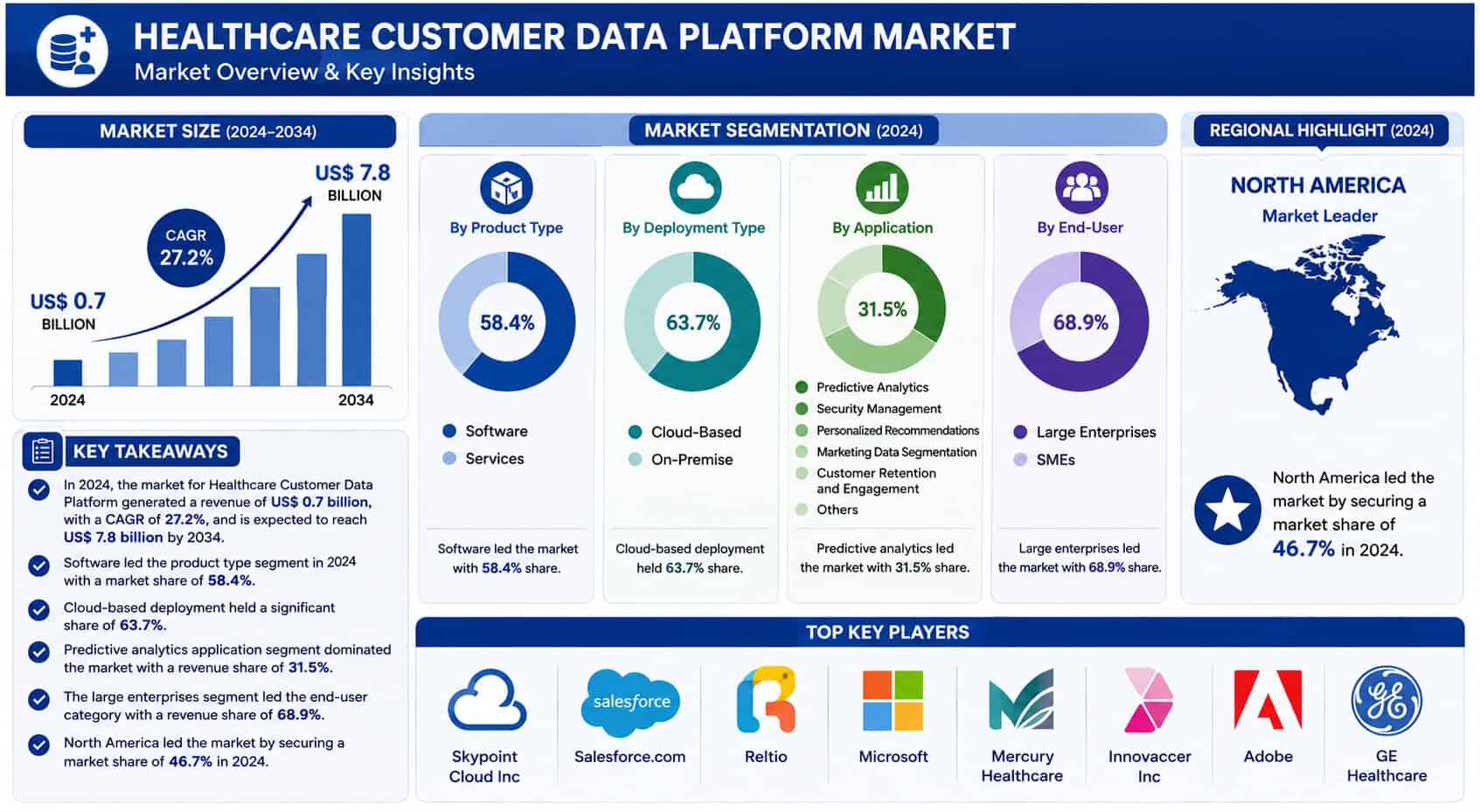
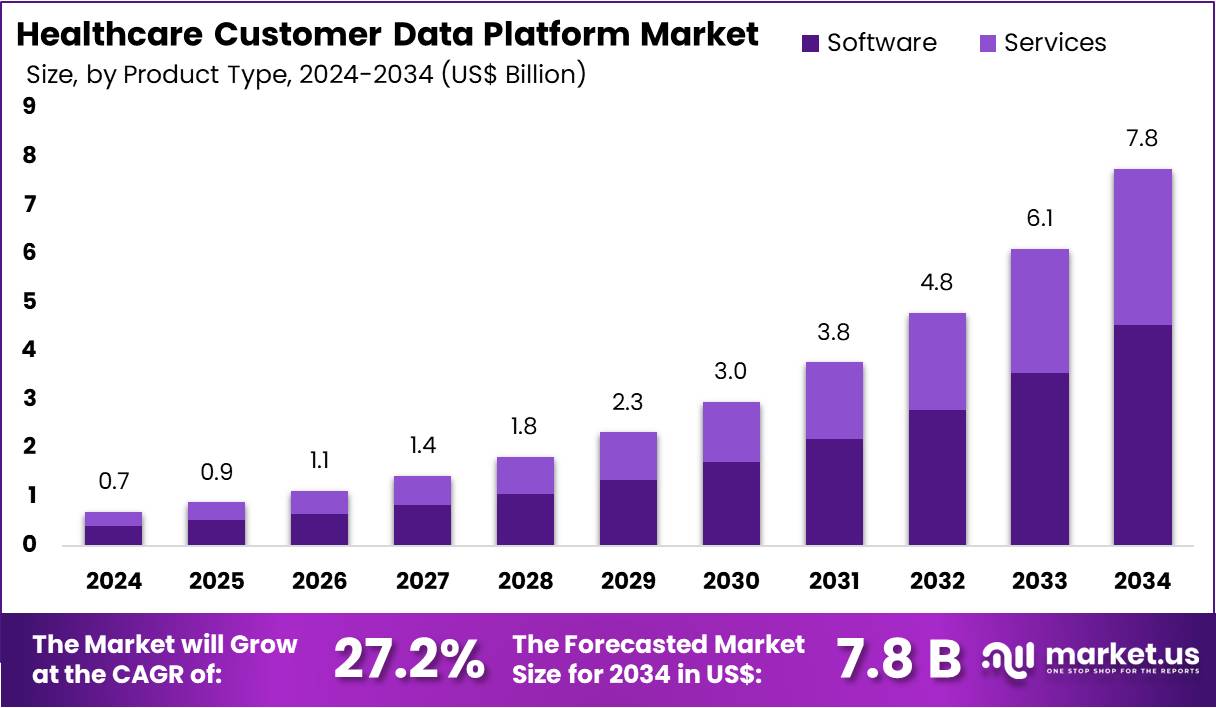
The Healthcare Customer Data Platform Market Size is expected to be worth around US$ 7.8 Billion by 2034 from US$ 0.7 Billion in 2024, growing at a CAGR of 27.2% during the forecast period 2025 to 2034.
The healthcare industry is undergoing a significant shift toward connected, data-driven patient engagement as providers, payers, and healthcare organizations seek to unify information across clinical, administrative, and consumer touchpoints. Healthcare Customer Data Platforms (CDPs) are increasingly relevant because they can consolidate information from electronic health records, patient portals, claims systems, digital health applications, websites, and other engagement channels to create a more comprehensive view of individual patients.
The expansion of digital health infrastructure is strengthening the need for interoperable data management. According to the U.S. Office of the National Coordinator for Health Information Technology (ONC), 95.0% of U.S. office-based physicians had adopted electronic health records in 2024, while 83.6% were using certified EHR systems. This expanding digital footprint creates greater volumes of patient information that healthcare organizations need to organize, connect, analyze, and use responsibly.
Patient-facing digital capabilities are also becoming more widespread. ONC reported that 7 in 8 U.S. hospitals enabled API-based app access to patient information in 2024, supporting greater digital engagement and information exchange.
Regulatory initiatives are further supporting market development. CMS requires impacted payers to provide patient information through FHIR-based Patient Access APIs, while newer interoperability policies are expanding data-sharing requirements. In addition, ONC’s USCDI framework and TEFCA are supporting standardized and secure healthcare information exchange.
Key Takeaways
- In 2024, the Healthcare Customer Data Platform Market generated US$ 0.7 billion in revenue, growing at a CAGR of 27.2%. The market is projected to reach US$ 7.8 billion by 2034.
- By product type, the market is segmented into software and services, with software leading the segment. It accounted for a 58.4% market share in 2024.
- By deployment type, the market is categorized into on-premise and cloud-based solutions. Cloud-based deployment dominated with a 63.7% market share in 2024.
- By application, the market includes predictive analytics, security management, personalized recommendations, marketing data segmentation, customer retention and engagement, and others. Predictive analytics led with a 31.5% revenue share.
- By end user, the market is divided into large enterprises and SMEs. Large enterprises dominated the segment, accounting for a 68.9% revenue share in 2024.
- Regionally, the Healthcare Customer Data Platform Market is analyzed across major regions, with North America holding the leading position. The region accounted for a 46.7% market share in 2024.
Statistical Information
- 59% of U.S. individuals had multiple online medical records or patient portals in 2024, spanning primary-care providers, other healthcare providers, insurers, laboratories, pharmacies, and hospitals. This highlights a clear need for unified patient-data platforms.
- Only 7% of individuals used a portal-organizing app in 2024 to combine medical information from different portals, up from 2% in 2022. The gap indicates substantial opportunity for solutions that simplify fragmented health-data access.
- 57% of U.S. individuals accessed their online medical records through an app in 2024, compared with 38% in 2020. The shift toward mobile access supports demand for platforms that connect patient data across digital channels.
- 87% of individuals encouraged by their healthcare provider to use a patient portal accessed it, compared with 57% of those who were not encouraged. This demonstrates the importance of personalized engagement strategies in driving digital-health adoption.
- Approximately 9 in 10 U.S. hospitals enabled patient access to health information through APIs in 2024, while about 7 in 10 hospitals used standards-based APIs such as FHIR. This creates strong opportunities for interoperable customer-data solutions.
- Two-thirds of U.S. hospitals enabled patients to submit patient-generated health data to EHRs in 2024. About three-quarters of hospitals supporting this capability used standards-based APIs, expanding the volume and diversity of data available for integration.
- 66% of physicians surveyed by the AMA reported using AI in their practices in 2024, up from 38% in 2023. Growing clinical AI adoption increases the importance of connected, structured, and reliable healthcare data.
- 84% of physicians identified EHR integration as an important requirement for advancing AI adoption, while 87% emphasized data-privacy assurances. These findings reinforce opportunities for CDPs combining interoperability, analytics, and strong data governance.
Market Segmentation Analysis
Product Type Analysis
The software segment accounted for a 58.4% market share, supported by rising demand for advanced healthcare data management, integration, and analytics capabilities. Healthcare organizations are increasingly adopting software platforms that consolidate information from electronic health records, patient portals, claims systems, and digital health applications. These solutions enable real-time insights that support clinical decision-making, patient risk assessment, and operational efficiency.
Growing adoption of artificial intelligence and machine learning is further enhancing software capabilities by enabling predictive analytics and personalized engagement. In addition, increasing requirements for data security, interoperability, and regulatory compliance are encouraging providers and payers to invest in scalable and customizable software solutions, strengthening the segment’s position in the market.
Deployment Type Analysis
The cloud-based segment held a significant 63.7% market share, driven by healthcare organizations’ growing need for flexible, scalable, and accessible data management infrastructure. Cloud platforms enable providers and payers to store and process large volumes of information generated through electronic health records, connected devices, telehealth platforms, and digital applications. Their ability to support remote access, rapid deployment, system integration, and real-time data sharing makes cloud solutions increasingly attractive.
The expansion of virtual care and digital healthcare services is further increasing demand for cloud-based platforms. Additionally, cloud infrastructure can support interoperability and analytics while reducing the need for extensive on-premise hardware, helping healthcare organizations modernize their data environments.
Application Analysis
The predictive analytics segment held the largest revenue share at 31.5%, reflecting the growing importance of data-driven decision-making across healthcare organizations. Predictive analytics enables providers to identify high-risk patients, anticipate potential health events, and support timely interventions. Integration with electronic health records, claims information, wearable devices, and other data sources allows organizations to generate actionable insights from diverse datasets.
Advancements in artificial intelligence and machine learning are improving the accuracy and efficiency of predictive models, supporting applications such as population health management, resource allocation, and patient engagement. As healthcare organizations increasingly focus on improving outcomes while controlling costs, predictive analytics is becoming an important component of customer data platforms and digital healthcare strategies.
End-User Analysis
The large enterprises segment dominated the market with a 68.9% revenue share, supported by substantial investments in digital transformation and advanced healthcare data infrastructure. Large hospitals, healthcare networks, payers, and integrated delivery organizations manage extensive and complex datasets, increasing their need for centralized platforms capable of integrating information across multiple systems.
Customer data platforms can support population health management, patient segmentation, risk assessment, and personalized engagement at scale. Growing requirements for interoperability, data security, and regulatory compliance are also encouraging large organizations to strengthen their data management capabilities. Furthermore, investments in cloud migration, artificial intelligence, and machine learning are enabling enterprises to improve operational efficiency and support more informed clinical and business decisions.
Regional Analysis
North America dominated the Healthcare Customer Data Platform Market with a 46.7% revenue share in 2024, supported by strong healthcare interoperability initiatives and widespread digital health infrastructure. CMS continues to promote secure electronic health information exchange through FHIR-based APIs, while its interoperability programs emphasize better access to patient data and more efficient care coordination. In February 2026, HHS reported that nearly 500 million health records had been exchanged through TEFCA, highlighting the region’s expanding health-data ecosystem.
Asia Pacific is expected to register the fastest CAGR during the forecast period, driven by expanding digital health adoption, stronger health information systems, and increasing emphasis on interoperability. WHO reports that at least 80% of countries in its South-East Asia Region had drafted or completed national digital health strategies, supporting improvements in health information systems and digital innovation.
WHO also highlights growing regional efforts around data standards, interoperability, analytics, and secure digital health infrastructure, creating favorable conditions for customer data platforms.
Business Opportunities
The Healthcare Customer Data Platform Market presents significant opportunities for technology providers as healthcare organizations increasingly seek unified, interoperable patient-data environments. CMS requires impacted payers to make claims, encounter, and clinical information available through FHIR-based Patient Access APIs, creating demand for platforms capable of integrating and standardizing data from multiple sources.
A major opportunity lies in AI-powered analytics and personalization, enabling providers and payers to identify patient risks, segment populations, improve engagement, and support data-driven care decisions. Integration with EHRs, claims, wearable devices, and digital health applications can further expand platform capabilities. CMS is also advancing interoperability requirements for Provider Access APIs, creating opportunities for vendors offering secure data-exchange solutions.
Cloud-based CDPs represent another attractive opportunity because they can provide scalable infrastructure, real-time analytics, and easier integration across distributed healthcare systems. Additionally, the expansion of TEFCA and broader health-information exchange creates opportunities for vendors specializing in secure data connectivity, privacy, governance, and interoperability. HHS reported that one billion health records had been exchanged through TEFCA by June 2026, underscoring the expanding healthcare data ecosystem.
Emerging Trends
- AI-ready customer data is becoming a major trend. The AMA found that 81% of physicians used AI professionally in 2026, more than double the 2023 level. This is increasing demand for clean, connected patient data that can support AI-assisted documentation, care planning, research summaries, and clinical workflows.
- AI-enabled interoperability is gaining momentum. ONC’s HTI-5 proposal seeks to establish a new foundation for AI-enabled interoperability through modernized standards and certification. This trend is encouraging healthcare technology vendors to connect customer-data platforms with standardized health-information exchange infrastructure.
- Healthcare data standards are continuously expanding. ONC released Draft USCDI Version 7 in January 2026, adding new data elements to improve interoperability for patient care. Regular updates indicate that CDPs will increasingly need flexible architectures capable of incorporating evolving clinical data standards.
- Bulk healthcare-data exchange is emerging as an important capability. CMS is promoting FHIR Bulk Data exchange to support the transfer of complete data records while reducing pressure on existing systems. This creates opportunities for CDPs to process large datasets for population management and analytics.
- Privacy and AI governance are becoming central purchasing considerations. In the AMA’s 2026 survey, 86% of physicians identified data privacy as important for broader AI adoption, while 88% emphasized safety and efficacy validation. Healthcare CDPs therefore need stronger governance, security, transparency, and responsible-AI capabilities.
Use Cases
- Personalized AI health assistants are becoming a practical use case for unified customer data. CMS’s Medicare App Library includes conversational AI assistants designed to provide personalized guidance using secure access to medical history, supporting symptom checking, care planning, and chronic-disease management.
- Digital patient check-in and automated information exchange offer another application. CMS is promoting FHIR-based tools that can eliminate manual check-in forms by securely exchanging patient information and retrieving visit summaries, allowing CDPs to connect administrative and clinical data at the point of care.
- Remote patient monitoring data integration is an expanding use case. HHS describes RPM as using connected devices such as smart scales, blood-pressure monitors, and heart-rate monitors to send health information to providers. CDPs can consolidate these readings with clinical records for continuous care management.
- Diabetes and obesity management represents a targeted application for customer data platforms. CMS identifies personalized coaching, medication information, laboratory results, nutrition, activity tracking, reminders, and alerts as components of digital prevention and management tools. CDPs can bring these data streams together for individualized support.
- Population health and financial analytics can benefit from bulk FHIR integration. CMS states that Bulk FHIR supports sharing data with population-health tools and financial systems. CDPs can use this capability to consolidate large datasets for risk identification, utilization analysis, care coordination, and organizational decision-making.
Recent Developments
- In June 2026, Salesforce selected Viatris as a global customer for Agentforce Life Sciences, using the platform to support customer engagement across its global operations. Salesforce’s healthcare and life-sciences offering combines unified data, AI agents, and engagement capabilities to connect commercial and medical activities.
- In May 2026, Innovaccer acquired CaduceusHealth, adding a revenue-cycle platform managing approximately $240 million in managed revenue. The acquisition expands Innovaccer’s Gravity-based healthcare AI infrastructure into autonomous revenue-cycle workflows and strengthens its ability to connect financial and clinical data.
- In May 2026, Laboratoires Pierre Fabre selected Salesforce Agentforce Life Sciences for Customer Engagement for more than 4,000 internal users, building on Agentforce Service and Data 360 to unify medical and dermo-cosmetic operations globally. Pierre Fabre expects the platform to improve HCP satisfaction by up to 20%.
- In May 2026, Reltio became an SAP company after SAP completed its acquisition of Reltio, following the March agreement. Reltio’s data-management capabilities are being integrated into SAP Business Data Cloud to help organizations connect SAP and non-SAP data and create AI-ready enterprise information.
- In April 2026, Adobe and Alluvium announced a healthcare collaboration combining Adobe Experience Platform’s patient-demand intelligence with Alluvium’s provider-capacity data. Alluvium provides real-time provider availability across 30+ EMR systems, allowing health systems to compare patient demand with available clinical capacity.
- In March 2026, Microsoft expanded Dragon Copilot at HIMSS 2026, reporting that more than 100,000 clinicians were using the solution. Dragon Copilot brings patient information, clinical content, and partner AI capabilities together across EHRs and other applications to reduce information fragmentation.
- In March 2026, Innovaccer and Coforge launched G-Forge, a joint initiative combining Coforge’s healthcare transformation expertise with Innovaccer’s AI infrastructure and data platform. The partnership focuses on helping healthcare organizations integrate siloed data and scale AI across clinical, financial, and administrative operations.
Conclusion
The Healthcare Customer Data Platform Market is positioned for strong expansion as healthcare organizations increasingly prioritize unified data, interoperability, AI, and personalized patient engagement. Growing adoption of cloud infrastructure, FHIR-based APIs, predictive analytics, and digital health applications is creating new opportunities for healthcare providers, payers, and technology vendors.
Regulatory initiatives and expanding health-information exchange are further strengthening demand for secure and scalable data platforms. At the same time, increasing AI adoption is encouraging organizations to invest in high-quality, connected, and governed data environments. As healthcare systems continue their digital transformation, customer data platforms are expected to become increasingly important for improving engagement, operational efficiency, care coordination, and data-driven decision-making.




















