


Overview
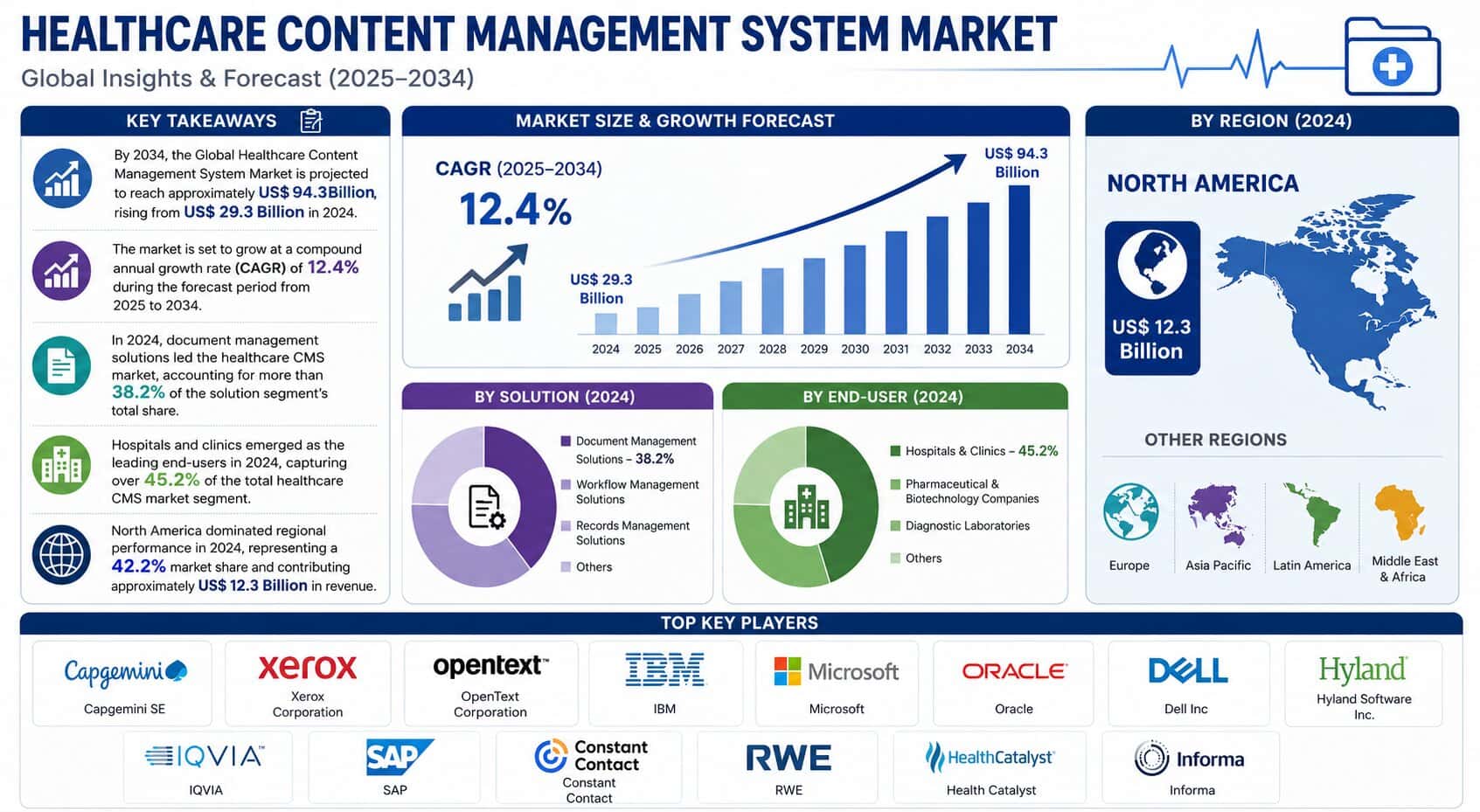
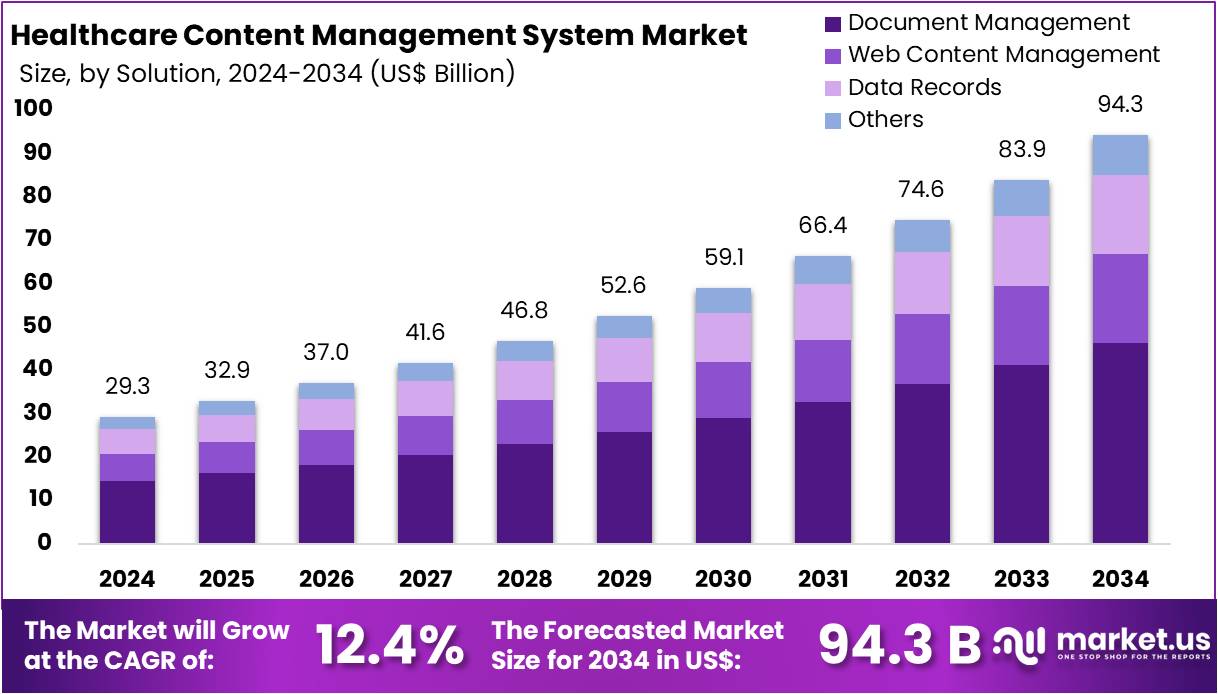
The Global Healthcare Content Management System Market Size is expected to be worth around US$ 94.3 Billion by 2034, from US$ 29.3 Billion in 2024, growing at a CAGR of 12.4% during the forecast period from 2025 to 2034. North America held a dominant market position, capturing more than a 42.2% share and holds US$ 12.3 Billion market value for the year.
The healthcare sector is increasingly prioritizing digital content management as hospitals, health systems, insurers, and other healthcare organizations generate and exchange growing volumes of clinical, administrative, and patient-related information. Healthcare content management systems help organizations organize, store, retrieve, secure, and distribute digital content while supporting integration with electronic health records and other health information technologies.
The growing emphasis on interoperability is creating additional opportunities for healthcare content management solutions. The U.S. Centers for Medicare & Medicaid Services (CMS) continues to promote secure electronic health information exchange through its interoperability initiatives, while the Office of the National Coordinator for Health Information Technology (ONC) advances standards designed to support nationwide access, exchange, and use of electronic health information.
Healthcare data exchange is also expanding at scale. In June 2026, the U.S. Department of Health and Human Services announced that the Trusted Exchange Framework and Common Agreement (TEFCA) had reached 1 billion health records exchanged, highlighting accelerating demand for secure and connected health information infrastructure. These developments are encouraging healthcare organizations to modernize content workflows, strengthen information governance, improve accessibility, and support more coordinated, data-driven care.
Key Takeaways
- The Global Healthcare Content Management System Market is projected to reach approximately US$ 94.3 Billion by 2034, up from US$ 29.3 Billion in 2024.
- The market is expected to expand at a CAGR of 12.4% during the forecast period from 2025 to 2034, driven by increasing healthcare digitalization.
- In 2024, document management solutions dominated the solution segment, accounting for more than 38.2% of the total segment share.
- Hospitals and clinics led the end-user segment in 2024, capturing over 45.2% of the overall healthcare CMS market.
- North America held the leading regional position in 2024, accounting for 42.2% of the market and generating approximately US$ 12.3 Billion in revenue.
Statistical Information
- 99% of U.S. hospitals enabled patients to electronically view their health information in 2024, while 96% enabled electronic downloading, showing a mature market for patient-facing content management and secure information-access solutions.
- In 2024, 85% of U.S. hospitals allowed patients to electronically transmit health information in a structured format, creating opportunities for platforms that manage inbound patient documents and structured data.
- 87% of hospitals enabled patients to access their health information through apps in 2024, supporting opportunities for CMS platforms that connect repositories with mobile applications and third-party digital-health technologies.
- Patient-generated data capabilities reached 62% of U.S. hospitals in 2024, up from 54% in 2021, increasing demand for systems that can capture, organize, classify, and integrate patient-generated information.
- 60% of hospitals often used state, regional, or local health information exchanges to send summary-of-care records in 2025, while 55% often used EHR-vendor networks, creating opportunities for cross-network content integration.
- National networks connecting different EHR vendors were used by 60% of hospitals to often send summary-of-care records in 2025, up substantially from 20% in 2018, supporting demand for interoperable document-exchange platforms.
- On the receiving side, 59% of hospitals often used EHR-vendor networks to receive summary-of-care records in 2025, while 54% often used national cross-EHR networks, highlighting opportunities for automated content ingestion and reconciliation.
- 19% of U.S. hospitals reported a possible instance of information blocking in 2025, down by more than half from 2021. This creates opportunities for compliance monitoring, information-governance, audit trails, and secure exchange solutions.
- 57% of physicians surveyed by the American Medical Association identified reducing administrative burdens through automation as the biggest opportunity for healthcare AI, directly supporting demand for automated documentation, workflow, and content-processing technologies.
- Physicians surveyed through the AMA Organizational Biopsy reported spending an average of 13 hours per week on indirect patient-care activities, including documentation, order entry, referrals, and test-result interpretation, creating a clear commercial opportunity for workflow automation and intelligent content-management tools.
Market Segmentation Analysis
Solution Analysis
In 2024, Document Management dominated the Healthcare Content Management System market, capturing more than 38.2% of the solution segment. Its leadership reflects the growing shift from paper-based records to digital documentation across hospitals and clinics. These systems enable faster document retrieval, improve information accessibility, support regulatory compliance, and enhance clinical workflows.
Web Content Management followed as the second-leading solution, supported by increasing adoption of patient portals, telehealth platforms, and digital health education. Data Records Management also continued to gain traction as healthcare organizations manage expanding volumes of patient histories, laboratory reports, and diagnostic images. Workflow automation and digital asset management further support billing, compliance, and administrative operations.
End-user Analysis
In 2024, Hospitals and Clinics represented the leading end-user segment, accounting for more than 45.2% of the Healthcare Content Management System market. Their dominance is driven by the need to securely manage large volumes of clinical, administrative, and diagnostic information. CMS platforms improve record accessibility, streamline documentation, reduce manual processes, and support coordinated patient care. Increasing regulatory requirements around healthcare data privacy and security are further encouraging adoption.
Ambulatory Surgical Centers (ASCs) ranked as the second-largest end-user group, using CMS solutions to manage outpatient documentation, billing, and operational workflows. Diagnostic laboratories, long-term care facilities, and other healthcare organizations are also gradually adopting these systems to strengthen data storage, archiving, and information-sharing capabilities.
Regional Analysis
In 2024, North America dominated the Healthcare Content Management System market, accounting for 42.2% of the market and generating approximately US$ 12.3 Billion in revenue. The region’s strong position is supported by widespread digital health adoption, established healthcare IT infrastructure, and increasing emphasis on secure health information exchange. In the U.S., the Office of the National Coordinator for Health Information Technology (ONC) continues to advance nationwide, standards-based health information exchange and interoperability.
The CDC’s 2026 National Electronic Health Records Survey also continues to track EHR adoption and health information exchange among U.S. physicians. In Canada, the government introduced the Connected Care for Canadians Act in 2026 to strengthen secure information exchange and common digital health standards. These initiatives are expected to support continued demand for content management, interoperability, secure archiving, and digital patient information solutions across North America.
Business Opportunities
The Healthcare Content Management System Market offers strong opportunities for vendors developing interoperable, FHIR-enabled content platforms that connect EHRs, payer systems, health information exchanges, and patient-facing applications. CMS continues to advance FHIR-based APIs and modern data standards, increasing demand for solutions that can securely exchange and manage healthcare information.
A particularly attractive opportunity is electronic prior authorization and clinical document exchange. CMS is expanding interoperability requirements and has proposed broader use of FHIR standards for prior authorization transactions and attachments, including clinical documents, PDFs, and text files. This creates room for businesses offering AI-powered document classification, automated data extraction, workflow automation, secure archiving, compliance monitoring, and API integration. CMS also announced an Electronic Prior Authorization Acceleration initiative involving 29 healthcare organizations, highlighting growing collaboration between providers, EHR developers, and digital health companies.
Opportunities are also emerging in patient-access portals, automated records retrieval, digital consent management, and cross-organizational information exchange, enabling healthcare organizations to reduce administrative workloads while improving data accessibility and coordination.
Emerging Trends
- AI-Assisted Content Creation: AI is moving into routine healthcare documentation, including clinical notes, discharge instructions, care plans, chart summaries, and patient communications. In 2026, 81% of physicians surveyed by the AMA reported using AI professionally, strengthening demand for CMS platforms that can organize and manage AI-generated content.
- FHIR-Based Content Exchange: Healthcare content systems are increasingly being designed around FHIR APIs to support standardized data exchange between providers, payers, EHRs, and digital-health applications. CMS is continuing to expand FHIR requirements, including new interoperability provisions for prescription-drug prior authorization.
- AI Governance and Data Privacy: As AI-generated healthcare content expands, organizations are placing greater emphasis on privacy, validation, and responsible technology management. The 2026 AMA survey found 86% of physicians considered data privacy important for broader AI adoption, increasing demand for secure content controls and governance features.
- Real-Time Health Information Exchange: Nationwide health information exchange is moving toward faster, more connected access to records. In June 2026, HHS announced that TEFCA had reached 1 billion health records exchanged, supporting continued development of platforms for secure document sharing and information retrieval.
- Automated Administrative Workflows: Healthcare organizations are increasingly using AI and automation to reduce documentation and administrative workloads. The AMA found 57% of physicians identified administrative-burden automation as AI’s biggest opportunity, supporting demand for automated content routing, classification, and workflow management.
Use Cases
- Clinical Documentation Management: Healthcare CMS platforms can capture and organize physician notes, care plans, discharge instructions, and other clinical documents generated during patient encounters. This supports faster retrieval, standardized documentation, and smoother information flow between clinical teams and healthcare departments.
- Prior Authorization Documentation: CMS platforms can collect clinical records, supporting documents, PDFs, and other information required for prior authorization. New CMS proposals specifically support exchanging attachments through FHIR-based standards, creating opportunities for automated document collection and submission.
- Patient Portal Content: Content management systems can centralize patient-facing information such as care instructions, educational materials, appointment documents, and personalized communications. This allows healthcare organizations to deliver consistent information across portals and digital channels while improving patient access to relevant healthcare content.
- Health Information Exchange: CMS platforms can serve as a central layer for exchanging clinical documents between hospitals, physicians, payers, and health information networks. TEFCA’s expanding nationwide infrastructure creates opportunities for secure retrieval, routing, and management of records across different healthcare organizations.
- AI-Generated Content Review: Healthcare organizations can use CMS platforms to manage human review of AI-generated medical content before it becomes part of the official record. This creates workflows for approval, version control, audit trails, permissions, and correction of AI-generated notes or summaries.
Recent Developments
- In June 2026, Capgemini became the first company to receive SAP’s Sovereign Cloud Partner designation, strengthening its position in sovereign cloud and AI transformation. The designation supports secure deployment of enterprise cloud and AI capabilities in regulated environments where data residency and control are critical.
- In June 2026, Health Catalyst completed the sale of Vitalware for US$ 147 million in total cash consideration, using the proceeds and existing cash to fully repay its credit facility. The transaction strengthens Health Catalyst’s financial position and allows greater focus on its AI and core healthcare technology strategy.
- In June 2026, Microsoft and Mayo Clinic announced a collaboration to develop a frontier AI model for healthcare, combining Mayo Clinic’s clinical expertise and de-identified longitudinal health data with Microsoft’s AI, cloud, engineering, and superintelligence capabilities.
- In March 2026, OpenText introduced Fax Aviator for healthcare, applying AI to fax-driven workflows such as patient referrals, prior authorizations, and medical-record processing. The solution provides intelligent classification, routing, summarization, and automated handling of healthcare documents.
- In January 2026, IQVIA and Boehringer Ingelheim announced a long-term global collaboration using IQVIA’s Data-as-a-Service platform to transform commercial data management. The solution will support integrated data across 59 countries, including product mastering, reporting, analytics, and data-driven decision-making.
- In August 2025, Oracle enhanced its Clinical One Data Collection solution with AI-enabled EHR interoperability, expanded data-collection capabilities, and safety integration. The update is designed to improve clinical-trial data workflows and connect electronic health information with research processes.
- In June 2025, IQVIA launched new NVIDIA-powered AI agents for life sciences and healthcare, designed to automate workflows and accelerate access to insights. The agents target areas where healthcare and life-sciences organizations manage complex information, analytics, and operational processes.
- In April 2025, IBM and Box announced a partnership integrating IBM watsonx models with Box AI for enterprise content-generation and productivity workflows. The collaboration enables organizations to apply AI to enterprise content while strengthening governance and management of information.
Conclusion
The Healthcare Content Management System Market is evolving as healthcare organizations prioritize secure, connected, and efficient information management. Rising adoption of AI, FHIR-based interoperability, electronic prior authorization, and automated documentation is creating new opportunities for technology providers.
CMS continues to advance standards-based health information exchange, including FHIR APIs and interoperability frameworks, supporting broader integration across providers, payers, EHRs, and digital-health platforms. With growing demand for streamlined workflows, stronger data governance, patient access, and secure content exchange, healthcare organizations are increasingly investing in solutions that improve information availability while reducing administrative complexity.




















