


Overview
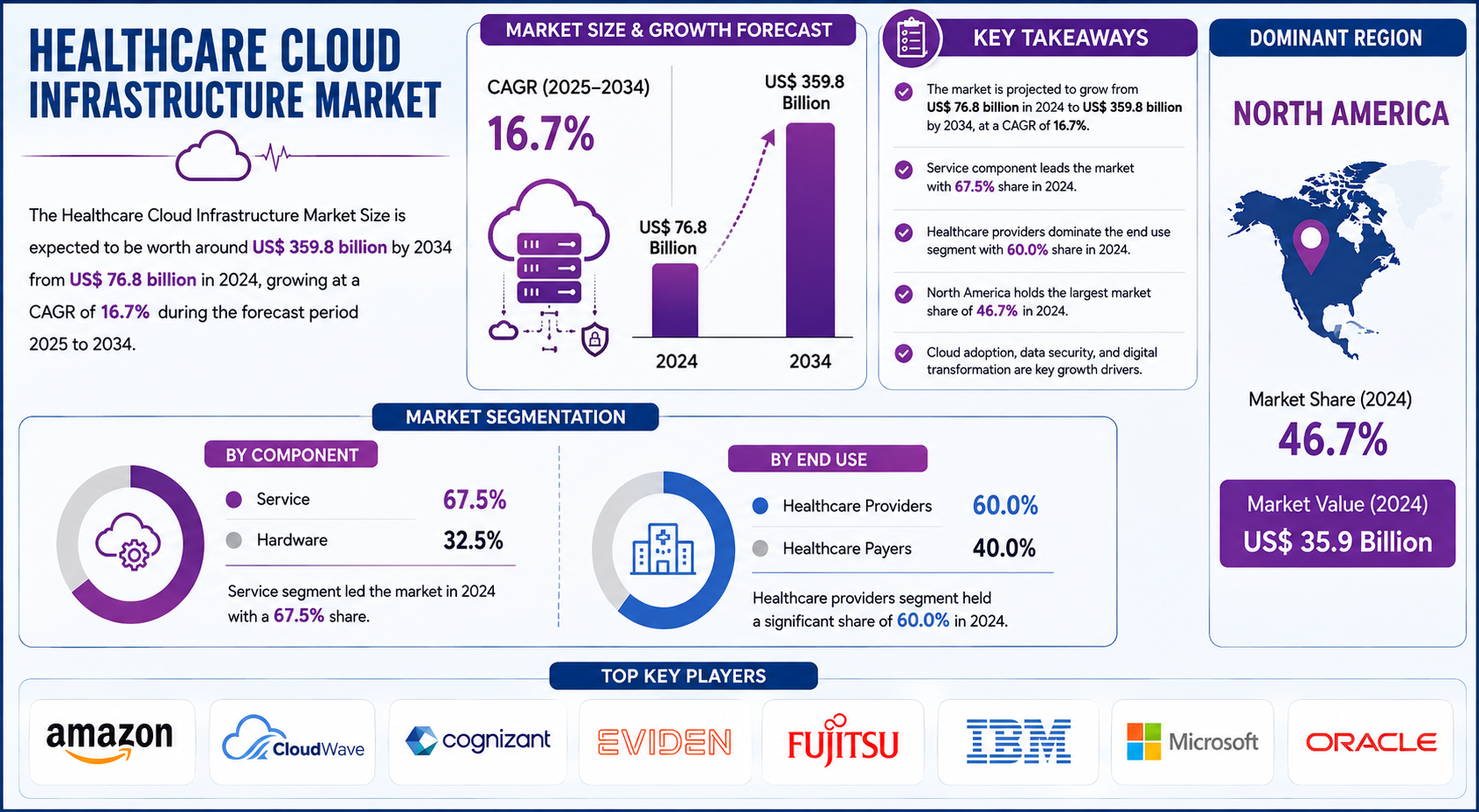
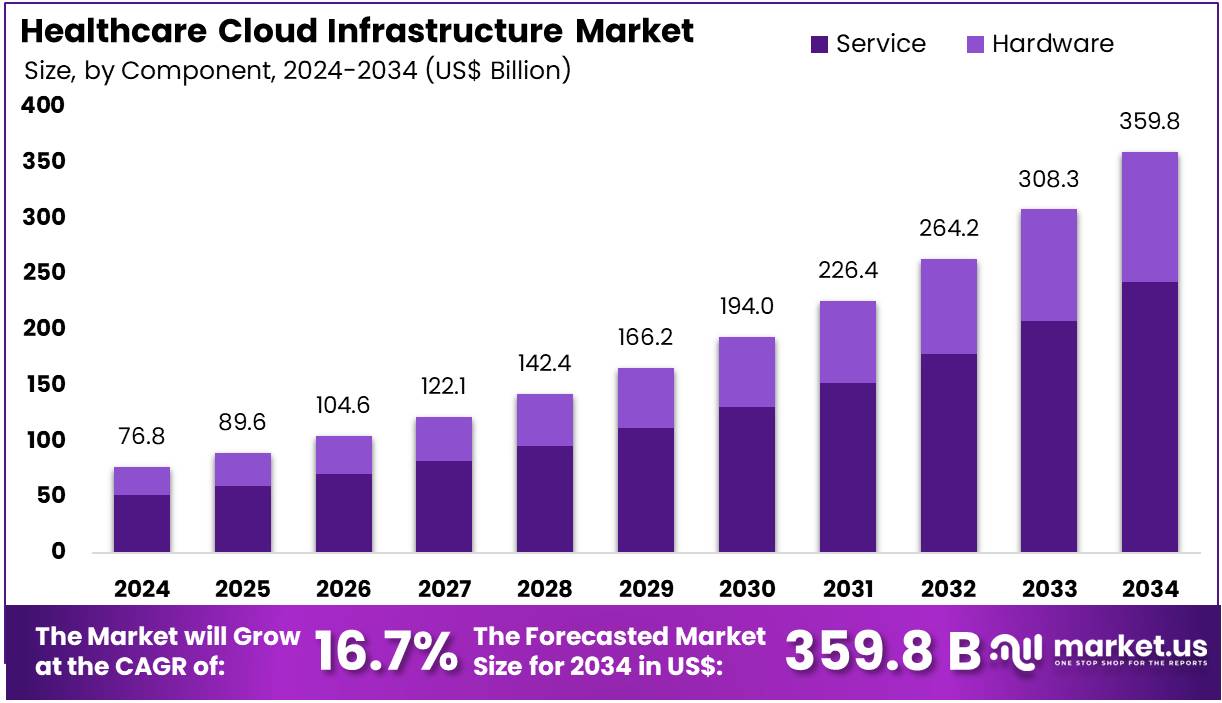
New York, NY – August 11, 2026 – The Healthcare Cloud Infrastructure Market Size is expected to be worth around US$ 359.8 Billion by 2034 from US$ 76.8 Billion in 2024, growing at a CAGR of 16.7% during the forecast period 2025 to 2034. North America held a dominant market position, capturing more than a 46.7% share and holds US$ 35.9 Billion market value for the year.
The healthcare industry is rapidly shifting toward cloud-based infrastructure as hospitals, research institutions, and healthcare providers seek more flexible, secure, and efficient ways to manage growing volumes of digital health information. Cloud infrastructure enables organizations to store electronic health records (EHRs), medical imaging data, analytics platforms, and artificial intelligence applications while improving accessibility and operational efficiency. The U.S. Department of Health and Human Services (HHS) recognizes cloud computing as an important component of health information technology, supporting electronic storage, processing, and exchange of healthcare data while emphasizing privacy and security requirements.
The increasing adoption of telehealth, remote patient monitoring, connected medical devices, and data-driven clinical decision-making is creating greater demand for reliable cloud environments. Healthcare organizations are also focusing on interoperability and secure data exchange to improve patient outcomes and streamline workflows. HHS and the Office of the National Coordinator for Health IT (ONC) continue to promote nationwide health information exchange and data accessibility initiatives to support a more connected healthcare ecosystem.
Cloud security remains a major priority as healthcare systems manage sensitive patient information. HHS guidance highlights that healthcare entities using cloud services must implement appropriate safeguards and comply with HIPAA requirements when handling electronic protected health information (ePHI).
Additionally, HHS reported that more than 21% of its systems were already using cloud environments during fiscal year 2020, reflecting continued government adoption of cloud technologies. As healthcare providers continue investing in digital infrastructure, cloud platforms are expected to play a central role in enabling AI-powered healthcare, advanced analytics, and secure data-driven services worldwide
Key Takeaways
- In 2024, the healthcare cloud infrastructure market generated revenue of US$ 76.8 billion and is projected to expand significantly at a CAGR of 16.7%, reaching an estimated value of US$ 359.8 billion by 2034.
- Based on components, the healthcare cloud infrastructure market is segmented into services and hardware, with the service segment dominating in 2024 by accounting for a leading 67.5% market share.
- By end use, the market is categorized into healthcare providers and healthcare payers, where healthcare providers emerged as the dominant segment, capturing a substantial 60.0% share of the market in 2024.
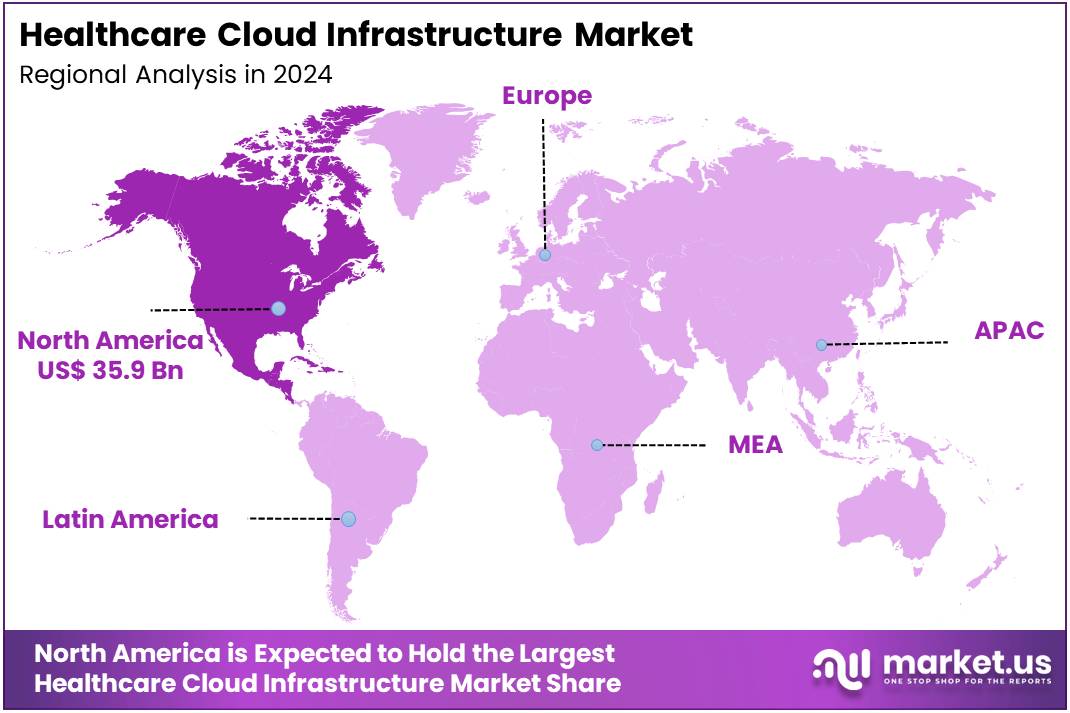
- Regionally, North America maintained a leading position in the healthcare cloud infrastructure market in 2024, holding a significant 46.7% market share due to strong adoption of cloud-based healthcare technologies and digital health solutions.
Statistical Information
- The Office of the National Coordinator for Health Information Technology (ONC) reported that more than 99% of U.S. non-federal acute care hospitals had adopted a certified Electronic Health Record (EHR) system by 2024, creating a large digital data foundation that requires scalable cloud infrastructure for storage, interoperability, and analytics.
- According to ONC data, the use of the same EHR developer across inpatient and outpatient settings increased from 62% of hospitals in 2010 to approximately 89%-91% in 2024, showing rising demand for unified healthcare data environments that can be supported through cloud-based platforms.
- The American Hospital Association (AHA) IT survey data analyzed by ONC showed that healthcare organizations have moved toward highly integrated digital systems, with nearly all hospitals reporting electronic patient record adoption in 2024, increasing opportunities for cloud providers offering secure healthcare data management and analytics solutions.
- The Privacy Rights Clearinghouse reported that 4,080 data breach events affected at least 375 million individuals in 2025, highlighting the growing requirement for advanced cloud security, identity management, encryption, and compliance solutions for healthcare organizations handling sensitive patient information.
- The healthcare industry’s increasing reliance on digital records is creating demand for cloud-based disaster recovery solutions. ONC data shows that U.S. hospitals have moved from fragmented paper and electronic systems toward nearly universal certified EHR adoption, increasing the need for reliable cloud backup and business continuity infrastructure.
- Healthcare interoperability is becoming a major cloud adoption driver as hospitals increasingly connect inpatient and outpatient systems. In 2024, 91% of hospitals used the same EHR developer across care settings, supporting demand for cloud platforms that enable secure data exchange and centralized healthcare information management.
- Cybersecurity investment represents a major opportunity area for healthcare cloud infrastructure companies. A healthcare data breach analysis recorded 192.7 million individuals affected by the Change Healthcare cyberattack, demonstrating the scale of risk associated with healthcare data environments and the need for stronger cloud security architectures.
- The expansion of certified digital health systems in U.S. hospitals is increasing demand for AI-ready cloud infrastructure. With over more than 90% of hospitals using certified EHR technology, healthcare providers have greater access to structured clinical data that can support cloud-based artificial intelligence, predictive analytics, and population health management applications.
Market Segmentation Analysis
Component Analysis
The Service segment is expected to dominate the healthcare cloud infrastructure market with a 67.5% share, driven by increasing adoption of scalable and cost-efficient cloud solutions. Healthcare organizations are utilizing cloud services for EHR management, data analytics, and patient care applications while improving data security, accessibility, and regulatory compliance. The rising demand for real-time healthcare data processing and seamless digital workflows is further supporting segment growth.
End-Use Analysis
Healthcare Providers are projected to account for 60.0% of the market share due to growing cloud adoption among hospitals, clinics, and diagnostic centers. Cloud infrastructure helps providers manage increasing patient data volumes, enhance operational efficiency, reduce costs, and support telemedicine and remote monitoring solutions. The ongoing shift toward digital healthcare is expected to accelerate adoption across this segment.
Regional Analysis
North America Leads the Healthcare Cloud Infrastructure Market
North America dominated the healthcare cloud infrastructure market, accounting for a 46.7% share in 2024, supported by rapid digital healthcare adoption, increasing EHR implementation, and strong demand for secure data management platforms. Healthcare organizations across the region are adopting cloud solutions to improve interoperability, analytics capabilities, and operational efficiency.
The U.S. Department of Health and Human Services (HHS) highlights cloud computing as a key technology for managing electronic protected health information (ePHI) while maintaining HIPAA privacy and security requirements. The continued expansion of health IT systems, value-based care models, and AI-driven healthcare applications is expected to further strengthen cloud infrastructure adoption across hospitals and healthcare networks in the region.
Asia Pacific Expected to Register the Fastest Growth
Asia Pacific is projected to experience the highest growth rate during the forecast period due to increasing government-led digital health initiatives, rising healthcare data generation, and expanding adoption of cloud-based solutions. Countries including India, China, and Singapore are investing in digital healthcare ecosystems to improve electronic health records, data exchange, and healthcare accessibility.
India’s Ayushman Bharat Digital Mission has accelerated digital health adoption, with more than 100 crore health records linked through ABHA, supporting a connected healthcare ecosystem. Growing healthcare modernization efforts and demand for scalable IT infrastructure are expected to drive cloud adoption throughout the Asia Pacific region.
Business Opportunities
The healthcare cloud infrastructure market presents significant business opportunities as healthcare organizations increasingly modernize their digital ecosystems. Cloud service providers can capitalize on rising demand for secure infrastructure solutions that support electronic health records (EHRs), medical imaging, analytics, and artificial intelligence applications. Healthcare entities require scalable platforms that improve data accessibility while maintaining compliance with regulations such as HIPAA, creating opportunities for specialized healthcare cloud security and compliance services.
Companies can also expand through healthcare-focused cloud platforms designed for telemedicine, remote patient monitoring, and connected medical devices. The growing adoption of AI-driven healthcare applications creates opportunities for cloud providers to offer high-performance computing, data management, and analytics capabilities. Additionally, partnerships with hospitals, health systems, and life sciences organizations can accelerate cloud migration and digital transformation initiatives.
Emerging markets, particularly Asia Pacific, offer further growth potential due to government-backed digital health programs and increasing demand for affordable healthcare IT infrastructure. Cloud vendors can develop localized solutions supporting interoperability, health information exchange, and national digital health initiatives. As healthcare organizations continue shifting from traditional IT environments toward flexible cloud-based models, opportunities will expand across cloud services, cybersecurity, AI infrastructure, and healthcare data management solutions.
Emerging Trends
- AI-powered healthcare cloud platforms: Healthcare organizations are increasingly adopting cloud environments to support artificial intelligence, machine learning, and advanced analytics. The FDA has authorized more than 1,000 AI-enabled medical devices, increasing demand for cloud systems that can process large clinical datasets, train algorithms, and deliver AI-assisted healthcare solutions efficiently.
- Hybrid and multi-cloud healthcare strategies: Hospitals are moving toward hybrid cloud models to balance scalability, security, and regulatory compliance. Cloud infrastructure allows healthcare providers to combine private and public environments while protecting sensitive patient information. HHS confirms that healthcare cloud services can range from storage solutions to complete application and infrastructure platforms.
- Cloud-based healthcare cybersecurity advancement: Data protection is becoming a major trend as healthcare systems store more patient information digitally. Organizations are investing in encryption, identity management, access control, and threat monitoring solutions to maintain HIPAA compliance and reduce cybersecurity risks associated with cloud adoption.
- Healthcare interoperability through cloud platforms: Cloud infrastructure is supporting connected healthcare ecosystems by enabling secure data exchange between hospitals, providers, and applications. The OECD reported that 27 countries have adopted national health interoperability strategies, highlighting global movement toward standardized digital health data environments.
- Edge computing integration with healthcare clouds: Healthcare providers are combining edge computing with cloud platforms to process data closer to connected devices. This trend supports faster responses for medical monitoring, imaging, and IoT applications where real-time data analysis is important for clinical decisions.
Use Cases
- Electronic Health Record (EHR) management: Cloud infrastructure is widely used for storing, managing, and accessing electronic health information. Healthcare cloud platforms support scalable EHR systems, allowing providers to improve data availability, collaboration, and workflow efficiency while maintaining privacy and security requirements under HIPAA regulations.
- Remote Patient Monitoring (RPM): Cloud platforms enable connected medical devices to transmit patient information from homes to healthcare providers for continuous monitoring. CMS reported that Medicare remote patient monitoring payments exceeded US$ 500 million in 2024, showing increasing adoption of technology-enabled care models.
- Telehealth service delivery: Healthcare cloud infrastructure supports video consultations, digital communication, and remote healthcare applications by providing flexible computing resources. NIST highlights that healthcare delivery organizations increasingly rely on telehealth and RPM ecosystems but require strong cybersecurity controls to protect patient data.
- Medical imaging storage and analytics: Cloud platforms are being used for managing large medical imaging files such as radiology scans. Healthcare providers use cloud-based storage and analytics tools to improve image accessibility, support collaboration among specialists, and enable AI-assisted diagnostic workflows.
- Population health management and clinical analytics: Healthcare organizations use cloud infrastructure to combine clinical, operational, and patient data for predictive analytics and improved care planning. These platforms help identify healthcare trends, support disease management programs, and improve resource allocation across healthcare networks.
Recent Developments
- In May 2025, Oracle Health, Cleveland Clinic, and G42 announced a strategic partnership to develop an AI-powered global healthcare delivery platform using Oracle Cloud Infrastructure, Oracle AI Data Platform, and Oracle Health applications. The initiative combines cloud infrastructure, healthcare data integration, and AI capabilities to support scalable healthcare delivery and advanced clinical analytics.
- In March 2025, Cleveland Clinic and G42 established an AI collaboration agreement to accelerate healthcare AI adoption through joint evaluation of AI projects and healthcare technology opportunities. The partnership supports development of advanced healthcare solutions by combining clinical expertise with artificial intelligence and digital infrastructure capabilities.
- In February 2025, Amazon Web Services (AWS) announced that Montefiore Health System selected AWS as its strategic cloud provider in the United States to migrate a major portion of its technology portfolio, including Epic electronic health record applications, to AWS Cloud. The collaboration focuses on improving healthcare system resilience, analytics, research capabilities, scalability, data security, and patient care innovation.
- In February 2025, Microsoft expanded its healthcare cloud infrastructure capabilities through Azure for mission-critical healthcare workloads, highlighting enhanced support for Epic EHR environments, AI-driven healthcare analytics, and secure data management. Microsoft reported that Azure increased scalability for Epic Chronicles Operational Database workloads to 65 million global references per second, representing a 171% improvement compared with 2023.
Conclusion
The healthcare cloud infrastructure market is entering a period of strong transformation as healthcare organizations increasingly adopt cloud-based solutions to manage growing digital health data, enhance operational efficiency, and support advanced technologies. The integration of artificial intelligence, electronic health records, remote patient monitoring, and interoperability solutions is creating new opportunities for cloud providers and healthcare stakeholders.
Growing cybersecurity requirements and regulatory compliance needs are further driving demand for secure cloud platforms. With continuous investments from technology leaders and expanding digital healthcare initiatives worldwide, cloud infrastructure is expected to remain a critical foundation for future healthcare innovation, data-driven care delivery, and connected healthcare ecosystems.




















