


Overview
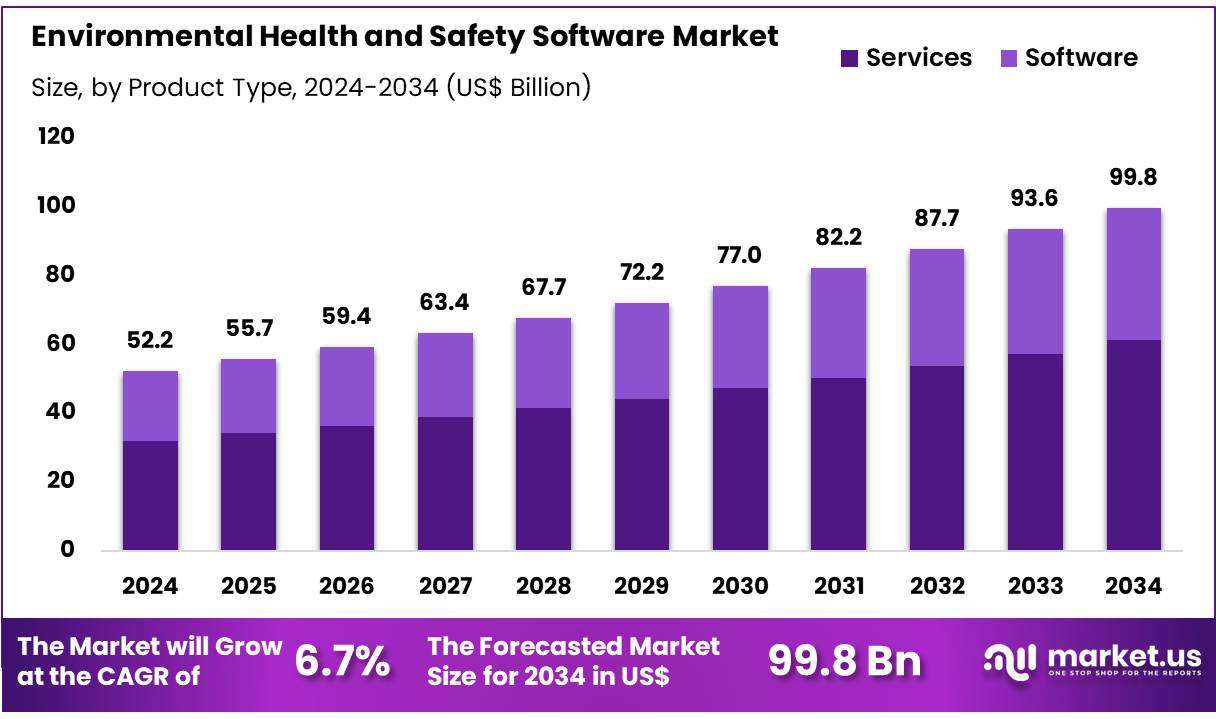
Global Environmental Health and Safety Software Market size is expected to be worth around US$ 99.8 Billion by 2034 from US$ 52.2 Billion in 2024, growing at a CAGR of 6.7% during the forecast period 2025 to 2034. In 2024, North America led the market, achieving over 38.6% share with a revenue of US$ 20.1 Billion.
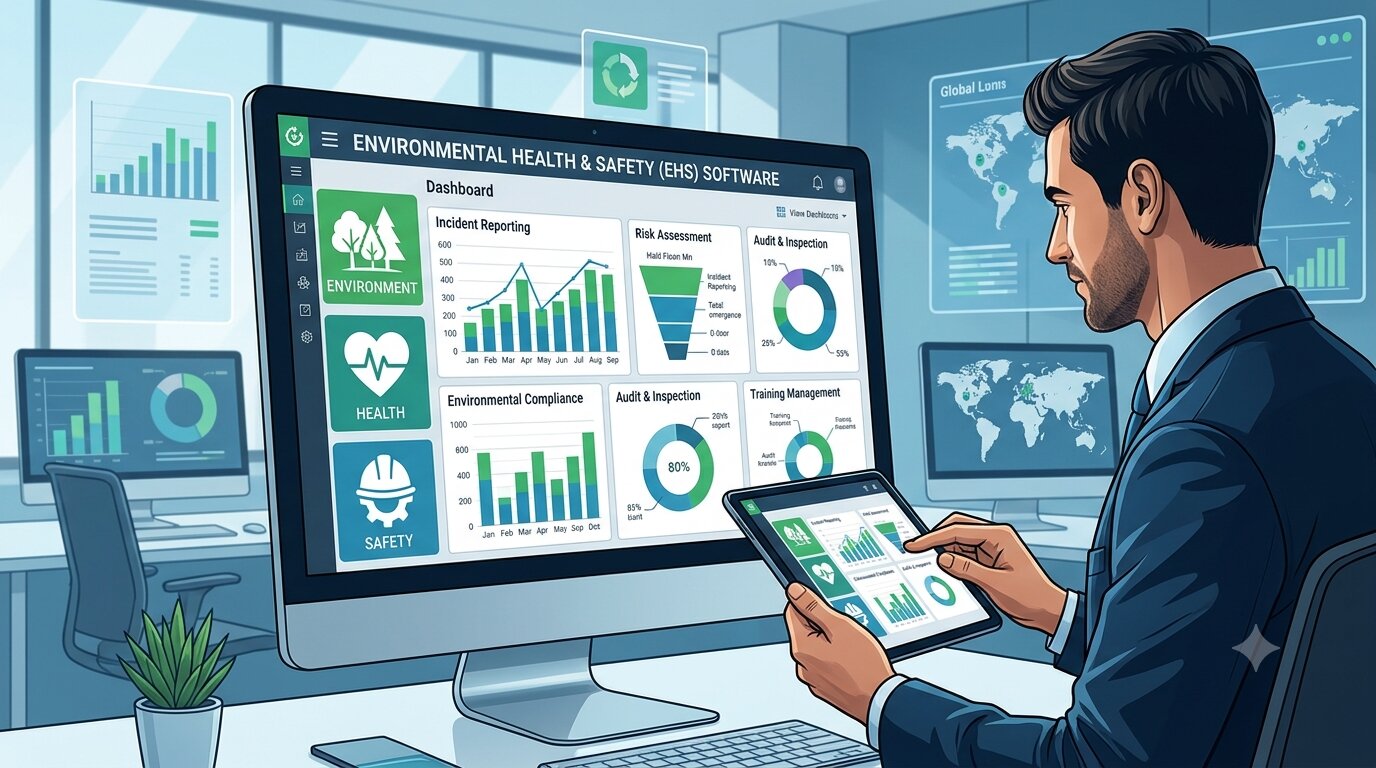
The Environmental Health and Safety (EHS) Software Market is witnessing steady growth as organizations prioritize workplace safety, regulatory compliance, and environmental responsibility. Businesses are increasingly replacing manual safety management processes with digital solutions that streamline incident reporting, risk assessments, compliance documentation, and audit management.
Rising industrialization, stricter environmental regulations, and greater awareness of employee health and safety are encouraging organizations to invest in advanced EHS software. These platforms help companies improve operational efficiency while reducing workplace hazards and compliance risks.
Modern EHS software is evolving with technologies such as cloud computing, artificial intelligence, predictive analytics, mobile applications, and Internet of Things (IoT) integration. These capabilities enable real-time monitoring, automated reporting, predictive risk analysis, and centralized management across multiple business locations. Organizations are also integrating EHS software with enterprise resource planning (ERP) and workforce management systems to gain better visibility into safety performance and support faster decision-making.
The market is further expanding as companies strengthen their sustainability initiatives and environmental performance reporting. Industries including manufacturing, construction, energy, chemicals, healthcare, mining, and transportation are adopting EHS platforms to manage complex regulatory requirements while improving operational resilience.
Growing demand for digital transformation, proactive risk management, and transparent environmental reporting is expected to support continued market growth, making EHS software an essential tool for organizations seeking safer workplaces, stronger compliance, and long-term sustainable operations.
Key Takeaways
- In 2024, the Environmental Health and Safety Software Market was valued at US$ 52.2 billion and is projected to reach US$ 99.8 billion by 2033, growing at a CAGR of 6.7%.
- By product type, the market is segmented into software and services, with the services segment accounting for the largest share of 61.3% in 2024.
- Based on deployment mode, the market is categorized into cloud and on-premises, with cloud-based solutions leading the market with a 67.5% share in 2024.
- By end user, the market includes chemical & petrochemical, telecom & IT, healthcare, general manufacturing, energy & mining, construction, and others. The chemical & petrochemical segment dominated with a 27.3% market share in 2024.
- North America emerged as the leading regional market, capturing 38.6% of the global Environmental Health and Safety Software Market in 2024.
Statistical Information
- The U.S. Occupational Safety and Health Administration (OSHA) conducted 34,625 workplace inspections in FY 2024, including 17,170 programmed and 17,455 unprogrammed inspections, reflecting continued enforcement of workplace safety regulations and increasing the need for digital EHS compliance solutions.
- In FY 2024, OSHA received 7,509 complaint-based inspections and 6,340 referral inspections, highlighting ongoing workplace hazard reporting and the growing importance of incident management and compliance software.
- The U.S. Environmental Protection Agency (EPA) concluded 1,851 civil enforcement cases in FY 2024, marking one of its strongest enforcement years and reinforcing the need for organizations to strengthen environmental compliance management.
- EPA completed more than 8,500 inspections in FY 2024, representing nearly a 10% increase over FY 2023, demonstrating stronger oversight of industrial facilities and environmental compliance.
- EPA enforcement actions eliminated 227 million pounds of pollution in FY 2024, underscoring the increasing focus on environmental monitoring, emissions management, and sustainability reporting.
- EPA compliance and enforcement activities helped reduce approximately 2.7 million metric tons of carbon dioxide-equivalent emissions in FY 2024, encouraging organizations to adopt software for emissions tracking and environmental performance management.
- In FY 2024, 53% of EPA inspections were conducted in communities overburdened by pollution, reflecting a stronger regulatory emphasis on environmental justice and compliance transparency.
- Cority reported that more than 750 global enterprises use its Environmental Health and Safety and sustainability platform, collectively processing over 20 million data points annually to support safety, compliance, and operational decision-making.
- According to Cority’s 2026 State of EHS Technology Report, 95% of senior EHS leaders said employees are using AI tools outside approved systems, while only 5% reported that AI is fully integrated into their EHS workflows, highlighting significant opportunities for secure AI adoption in workplace safety management.
Regional Analysis
North America held the largest share of the Environmental Health and Safety Software Market
North America captured 38.6% of the market in 2024, driven by stringent workplace safety and environmental regulations. The U.S. Occupational Safety and Health Administration (OSHA) conducted 34,625 federal workplace inspections in FY 2024, highlighting active enforcement of occupational safety standards.
The U.S. Environmental Protection Agency (EPA) also carried out thousands of compliance inspections and enforcement actions to reduce pollution and improve environmental performance. These regulatory initiatives encourage organizations to implement EHS software for incident reporting, regulatory compliance, risk management, and environmental monitoring, while supporting cloud-based digital transformation across industries.
Asia Pacific is expected to witness the fastest growth
Asia Pacific is anticipated to record the highest CAGR due to rapid industrialization and stronger environmental and workplace safety regulations. Governments in China, Japan, India, and other regional economies are expanding occupational safety programs and environmental compliance measures.
Regulatory agencies continue promoting digital reporting, emissions monitoring, and workplace risk management to improve industrial safety. Rising investments in smart manufacturing, sustainable operations, and industrial automation are further increasing demand for EHS software across manufacturing, construction, energy, chemicals, and healthcare sectors, supporting long-term regional market growth.
Emerging Trends
- Digital injury reporting and predictive safety analytics are becoming standard: Organizations are adopting EHS software to analyze workplace incidents before they become major accidents. OSHA’s Severe Injury Dashboard contains more than 105,000 severe injury reports collected since 2015, giving companies valuable data to identify recurring hazards and strengthen preventive safety programs.
- Electronic compliance reporting is accelerating cloud-based EHS adoption: OSHA now requires certain establishments with 100 or more employees in designated industries to electronically submit detailed injury and illness records through its Injury Tracking Application (ITA). This is increasing demand for cloud-based compliance and automated reporting platforms.
- Environmental compliance is becoming more data-driven: Companies are increasingly integrating emissions, waste, and environmental monitoring into EHS software as regulators require better reporting. EPA’s stronger compliance activities and digital reporting initiatives are encouraging organizations to centralize environmental data for faster audits and sustainability management.
- Connected worker technologies are improving workplace safety: Industries are integrating wearable devices, IoT sensors, and connected-worker platforms with EHS software to monitor worker fatigue, ergonomics, hazardous environments, and equipment conditions in real time, enabling quicker safety interventions and reducing operational risks.
- AI-powered hazard identification is gaining momentum: Organizations are increasingly using artificial intelligence to detect safety trends, prioritize inspections, automate incident classification, and improve risk prediction. AI helps safety teams process large volumes of workplace data faster, supporting proactive decision-making and continuous safety improvements.
Use Cases
- Manufacturing companies use EHS software to reduce serious workplace injuries: Manufacturers use incident tracking, digital inspections, and corrective action management to prevent recurring accidents. OSHA’s 2024 Severe Injury Report recorded 9,034 severe injury reports, including 7,327 hospitalizations and 2,426 amputations, emphasizing the need for preventive digital safety systems.
- Large enterprises automate regulatory reporting: Organizations use EHS software to automatically prepare OSHA records, inspection documentation, and compliance reports. Electronic submission requirements reduce paperwork, improve reporting accuracy, and simplify regulatory compliance across multiple facilities.
- Chemical and industrial facilities monitor environmental performance continuously: Industrial plants use EHS software to track emissions, hazardous materials, waste generation, and permit compliance. Continuous environmental monitoring helps companies identify compliance issues early while improving sustainability reporting and operational transparency.
- Construction companies improve field safety through mobile applications: Construction teams use mobile EHS platforms for real-time hazard reporting, digital safety checklists, worker observations, and inspection management. This enables faster communication between field workers and safety managers while improving compliance with workplace safety regulations.
- Multi-site organizations centralize enterprise risk management: Companies operating multiple facilities use EHS software to combine inspection records, incident investigations, audit findings, corrective actions, and safety metrics into one platform. Centralized dashboards improve management visibility, standardize compliance processes, and support faster business decisions.
Conclusion
The Environmental Health and Safety (EHS) Software Market is set for sustained growth as organizations increasingly prioritize workplace safety, environmental compliance, and operational efficiency. Rising regulatory enforcement, cloud adoption, artificial intelligence, predictive analytics, and IoT integration are transforming how businesses manage health, safety, and sustainability programs.
Industries such as manufacturing, construction, energy, chemicals, healthcare, and mining continue to invest in digital EHS platforms to streamline compliance, reduce risks, and improve decision-making. With stronger government oversight, growing sustainability commitments, and continuous technological innovation, EHS software is expected to remain a critical enterprise solution, enabling organizations to build safer workplaces, improve environmental performance, and achieve long-term business resilience.




















