


Overview
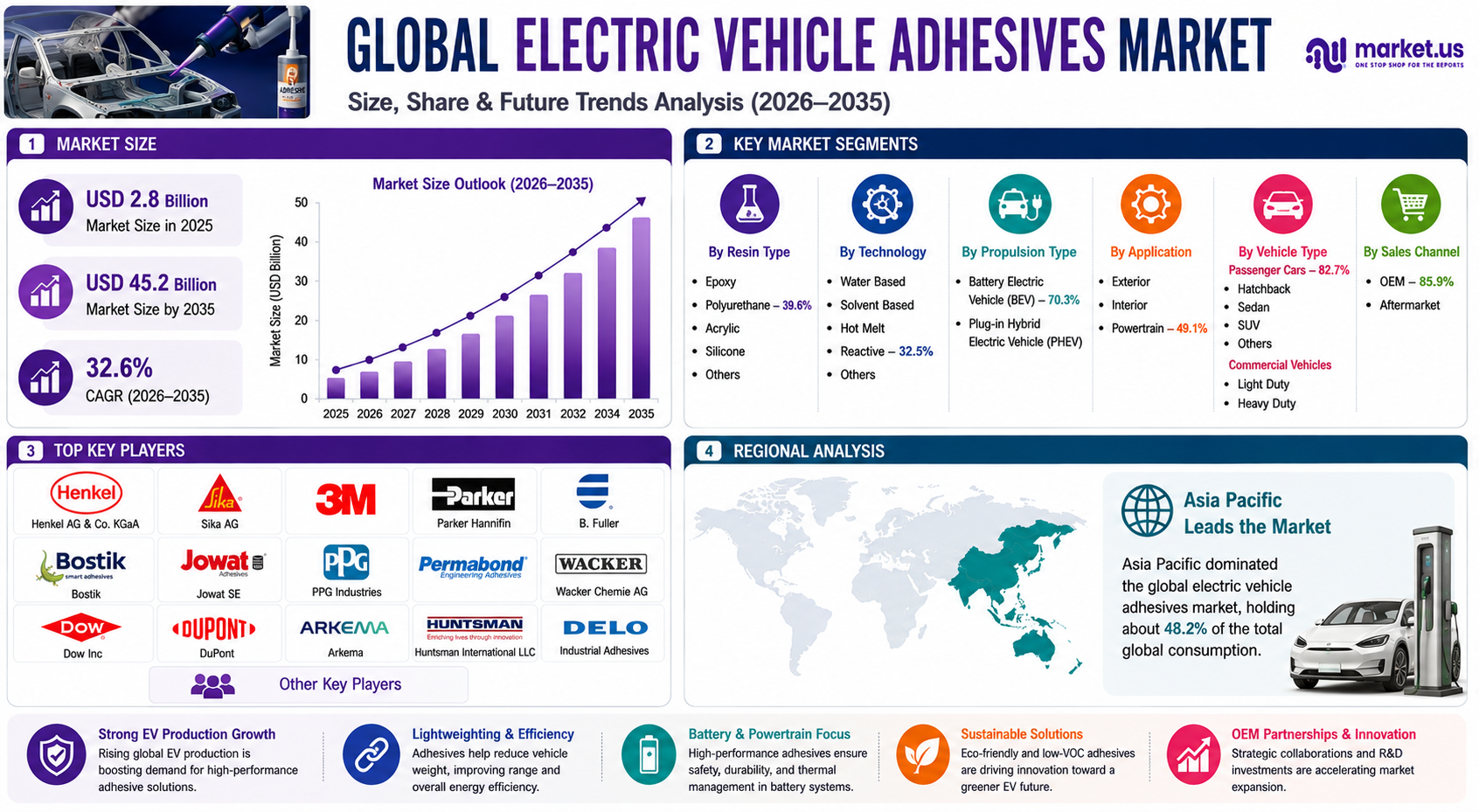
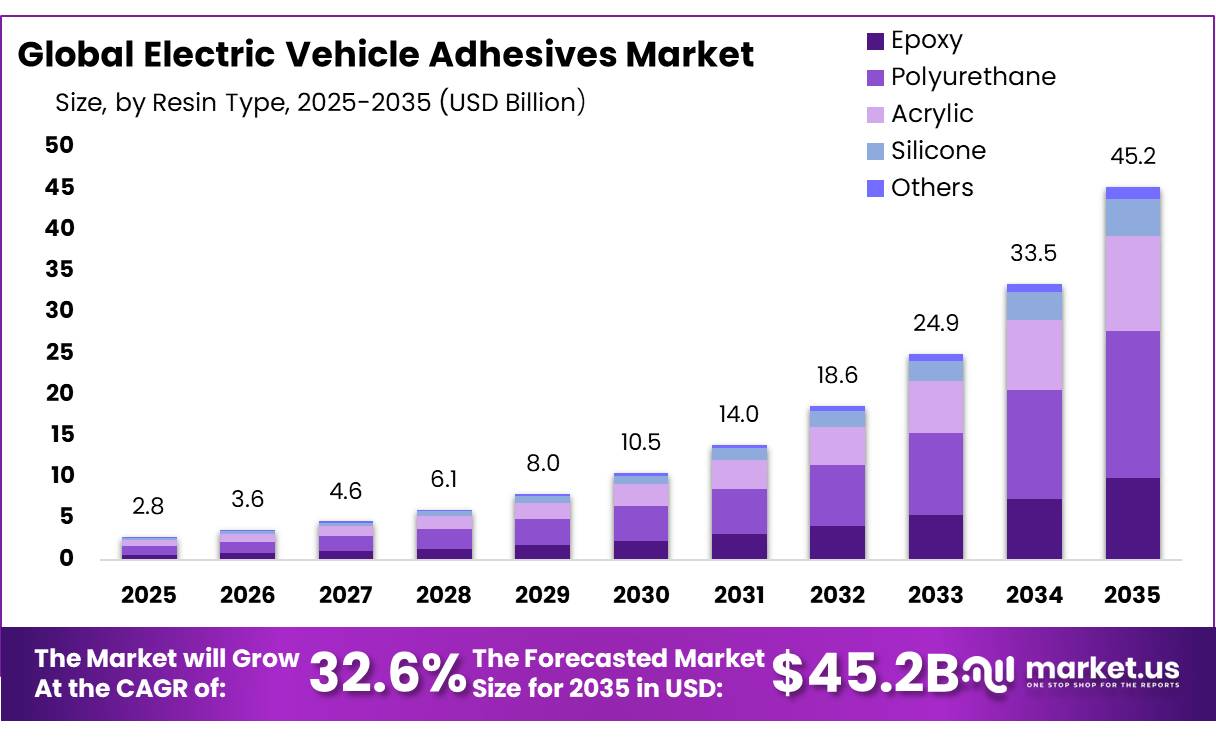
New York, NY – Sep 02, 2026 – The Electric Vehicle Adhesives market was valued at USD 2.8 billion, and between 2026 and 2035, this market is estimated to register a CAGR of 32.6%, reaching about USD 45.2 billion by 2035. In 2025, Asia Pacific held a dominant market position, capturing more than a 48.2% share, holding USD 1.4 Billion revenue.
- The International Energy Agency reported that global electric-car sales exceeded 20 million units in 2025, equal to 25% of new-car sales, while EV battery deployment reached about 1.2 TWh, rising almost 30%.
Momentum continued in 2026: EVs represented 24% of global car sales in the first half, and the IEA now expects the full-year share to reach 29%. Adhesive demand is also supported by larger battery systems, faster charging, vibration control, sealing, and safety requirements. The U.S. Department of Energy notes that a 10% vehicle-weight reduction can improve fuel economy by 6%–8%, strengthening the case for bonded lightweight structures.
At the same time, battery recycling rules are encouraging more serviceable bonding solutions. As electric mobility expands, adhesive suppliers are becoming increasingly important to battery safety, structural integration, manufacturing efficiency, thermal performance, and end-of-life design across passenger and commercial vehicle platforms.
Key Takeaways
- The global electric vehicle adhesives market was valued at USD 2.8 billion in 2025.
- The global market is projected to grow at a CAGR of 32.6% and is estimated to reach USD 45.2 billion by 2035.
- On the basis of resin type, polyurethane resins dominated the market, constituting 39.6% of the total market share.
- Based on the technology, the reactive technology dominated the electric vehicle adhesives market, with a substantial market share of around 32.5%.
- Based on the propulsion type, the electric vehicle adhesives for battery electric vehicles (BEV) led the market, comprising 70.3% of the total market.
- Among the applications of electric vehicle adhesives, the powertrain is the most considerable within the market, accounting for around 49.1% of the revenue.
- Based on the vehicle type, the electric vehicle adhesives for passenger cars led the market, comprising 82.7% of the total market.
- Among the sales channels, OEMs are the most considerable within the market, accounting for around 85.9% of the revenue.
- In 2025, the Asia Pacific was the most dominant region in the electric vehicle adhesives market, accounting for 48.2% of the total global consumption.
Statistical Information
- Global electric-car manufacturing reached nearly 22 million vehicles in 2025, increasing by more than 25% from the previous year. Approximately one-quarter of these vehicles were traded internationally.
- The IEA reported that global electric-car sales surpassed 20 million units in 2025, increasing 20%, while electric vehicles represented 25% of worldwide new-car sales. Battery-electric vehicles represented 65% of all electric-car sales, demonstrating the scale of the fully electric vehicle base requiring battery-pack, structural, thermal, and electrical bonding materials.
- Global EV battery deployment reached approximately 1.2 TWh in 2025, increasing almost 30% from the previous year and reaching more than 7 times its 2020 level.
- In 2025, the average battery-electric car contained a battery of close to 70 kWh in the European Union, below 60 kWh in China, and approximately 90 kWh in the United States.
- Lithium iron phosphate batteries accounted for more than 55% of globally deployed EV batteries in 2025, increasing from nearly 50% in 2024.
- The IEA also reported that LFP battery packs were more than 40% cheaper per kWh than NMC alternatives on average in 2025.
- China accounted for approximately 70% of electric-car production and more than 80% of battery-cell production in 2025. It also produced about 85% of global cathode active material and more than 90% of anode active material used in electric-car batteries.
- European battery-electric passenger-car adoption strengthened substantially. Eurostat recorded 1.89 million new battery-only electric passenger-car registrations across the EU in 2025, representing an increase of 29.7%.
- The battery-electric passenger-car fleet reached approximately 7.59 million vehicles, increasing 31.5% from 5.77 million one year earlier.
- Electrification continued during the first half of 2026. Battery-electric cars represented 20.7% of new EU passenger-car registrations through June, compared with 15.6% in the corresponding period a year earlier.
- In August 2026, the U.S. Department of Energy announced USD 500 million for 7 selected projects covering critical-mineral processing, battery manufacturing, and battery recycling capacity.
Market Segmentation Analysis
Resin Type Analysis
Polyurethane Resins Hold a Prominent Position in the Electric Vehicle Adhesives Market
In the resin type category, polyurethane holds the leading position, accounting for approximately 39.6% of the Electric Vehicle Adhesives Market. Its strong presence is supported by a favorable combination of flexibility, durability, impact resistance, and compatibility with different automotive materials. Polyurethane adhesives can effectively bond aluminum, engineered plastics, composites, and other lightweight materials widely used in modern electric vehicles.
Technology Analysis
Reactive Technology Leads the Electric Vehicle Adhesives Market
Within the technology category, reactive technology holds a dominant market position with approximately 32.5% share. Reactive adhesives are widely preferred in electric vehicle production because they develop strong chemical bonds after curing, providing high mechanical strength and long-term durability. These adhesives are particularly suitable for demanding applications involving battery assemblies, vehicle structures, electric powertrain components, and thermal-management systems. Their cross-linked structure provides resistance to vibration, heat, moisture, chemicals, and changing environmental conditions experienced during vehicle operation.
Propulsion Type Analysis
Battery Electric Vehicles Account for the Largest Share of Electric Vehicle Adhesive Demand
By propulsion type, Battery Electric Vehicles (BEVs) represent the dominant segment, accounting for approximately 70.3% of the Electric Vehicle Adhesives Market. BEVs require comparatively extensive adhesive usage because their architecture includes large battery packs, thermal-management systems, electric motors, power electronics, lightweight body structures, and high-voltage components. Advanced adhesives are used for cell and module bonding, battery enclosure assembly, sealing, structural reinforcement, vibration reduction, and electrical insulation.
Application Analysis
Powertrain Applications Represent the Leading Segment of the Electric Vehicle Adhesives Market
In terms of application, powertrain accounts for the largest share of approximately 49.1% of the Electric Vehicle Adhesives Market. Electric powertrain systems include battery packs, electric motors, inverters, power electronics, cooling systems, and related high-voltage assemblies, creating numerous bonding and sealing requirements. Adhesives used in these applications provide structural strength, electrical insulation, vibration damping, thermal resistance, and protection against environmental exposure.
Vehicle Type Analysis
Passenger Cars Hold the Largest Share of the Electric Vehicle Adhesives Market
By vehicle type, passenger cars represent the dominant segment, accounting for approximately 82.7% of the Electric Vehicle Adhesives Market. The segment benefits from the comparatively high production and sales volumes of electric sedans, hatchbacks, crossovers, and SUVs. Adhesives are extensively incorporated into passenger EVs for battery pack assembly, structural bonding, body panels, interiors, glazing, sealing, and thermal-management applications.
Sales Channel Analysis
OEMs Represent the Primary Sales Channel for Electric Vehicle Adhesives
Within the sales channel category, OEMs account for approximately 85.9% of the Electric Vehicle Adhesives Market, making them the leading distribution channel. Adhesives are primarily consumed during original vehicle and battery manufacturing, where they are incorporated into structural assemblies, battery packs, thermal-management systems, powertrain components, interiors, and exterior parts. Automotive manufacturers often specify adhesive technologies during the vehicle design and engineering stages because bonding performance must meet requirements for durability, safety, automation, weight reduction, and compatibility with multiple materials.
Regional Analysis
Asia Pacific Accounted for the Largest Share of the Global Electric Vehicle Adhesives Market
In 2025, Asia Pacific held the leading position in the global Electric Vehicle Adhesives Market, accounting for approximately 48.2% of total global consumption. The region’s dominance is mainly supported by its large-scale electric vehicle and battery manufacturing base, which generates substantial demand for adhesives used in structural bonding, battery pack assembly, sealing, electrical insulation, and thermal management.
According to the International Energy Agency, China represented around 60% of global electric car sales in 2023, reflecting the significant concentration of EV production and consumption within the region. Asia Pacific also hosts a well-established network of automotive OEMs, lithium-ion battery manufacturers, component suppliers, and specialty material producers. This integrated manufacturing ecosystem supports high-volume use of advanced adhesive technologies across EV production lines, strengthening the region’s position as the largest market for electric vehicle adhesives.
Emerging Trends
1. Thermally Conductive Battery Adhesives: Battery thermal management is becoming a central adhesive requirement as pack sizes increase. IEA reported EV battery deployment of 1.2 TWh in 2025, while NHTSA notes temperature control directly affects battery performance and lifespan, supporting thermally conductive bonding materials.
2. Lightweight Multi-Material Bonding: Automakers are bonding aluminum, composites, and high-strength steels to reduce mass without adding fasteners. The U.S. Department of Energy states that a 10% vehicle-weight reduction can improve fuel economy by 6%–8%, strengthening demand for structural adhesive joining technologies.
3. Design for Recycling and Debonding: Battery regulations are pushing adhesive developers toward serviceable and recyclable designs. EU rules require minimum recycled content in EV batteries from 2031, including 16% cobalt and 6% lithium, while lithium recovery targets rise to 80%, encouraging easier disassembly.
4. Adhesives for Electric Commercial Vehicles: Electric truck adoption is widening the addressable market beyond passenger cars. IEA reported more than 400,000 electric trucks sold globally in 2025, double the prior year, while battery-electric models represented 97% of electric truck sales, increasing heavy-duty bonding needs.
5. Localization of Battery Material Supply: New battery factories are creating opportunities for locally qualified adhesive suppliers. In August 2026, the U.S. Department of Energy announced USD 500 million for 7 projects covering critical minerals, battery manufacturing, and recycling, strengthening domestic EV-component production ecosystems.
Use Cases
1. Battery Cell and Module Bonding: Adhesives secure cells and modules while helping control vibration, shock, and heat transfer inside EV battery packs. With global EV battery deployment reaching 1.2 TWh in 2025, high-volume battery assembly is creating large, repeatable bonding requirements for automakers.
2. Battery Pack Sealing: Pack sealing adhesives help protect high-voltage components from moisture, dust, and environmental exposure while supporting enclosure integrity. NHTSA highlights battery temperature and safety management as critical EV considerations, making durable sealing especially important across vehicles designed for long service lives.
3. Body-in-White Lightweight Bonding: Structural adhesives can join aluminum, high-strength steel, and composites while reducing reliance on heavier mechanical fasteners. DOE reports that a 10% vehicle-weight reduction can improve fuel economy by 6%–8%, supporting adhesive use in lightweight EV body structures and closures.
4. Thermal Interface Bonding: Thermally conductive adhesives and gap fillers connect battery components to cooling plates and help move heat away from cells. U.S. battery-electric vehicles averaged about 90 kWh battery capacity in 2025, increasing the importance of consistent thermal interfaces across large packs.
5. Electric Truck Structural Assembly: Heavy-duty EVs require strong bonding across large battery trays, enclosures, roofs, panels, and composite parts. IEA reported electric truck sales above 400,000 units in 2025, with battery-electric vehicles accounting for 97% of those sales, expanding industrial adhesive applications.
Recent Developments
Henkel invested approximately USD 30 million to double its Brandon, South Dakota facility from 35,000 sq. ft. to 70,000 sq. ft. for EV thermal-management and adhesive production. In January 2026, Henkel agreed to acquire ATP Adhesive Systems, which generated around EUR 270 million in 2025 sales and employed approximately 700 people. In May 2026, it launched 2 new EV thermal-interface products, including Loctite TLB 9270APS polyurethane thermally conductive adhesive.
In February 2026, Sika agreed to acquire Akkim, which generated approximately CHF 220 million in 2025 sales and operates 2 large production facilities, with another site being developed. In June 2026, Sika showcased battery structural bonding, thermal-interface, encapsulation, and housing-sealing technologies at Battery Show Europe, an event expecting more than 1,100 exhibitors and 21,000 visitors.
Parker research has shown that a 2 W/m·K, 1 mm liquid gap filler can deliver thermal impedance comparable with a 4 W/m·K thermal pad. By August 2026, Parker reported record fiscal-year sales of USD 21.5 billion, increasing 8.3%, providing additional scale for its electrification and engineered-material businesses.
In March and June 2026, Arkema again highlighted Bostik’s thermal-interface materials, structural adhesives, gasketing products, and controlled-debonding solutions for battery manufacturing. Bostik’s wider business employs more than 7,000 people across more than 50 countries and generates approximately EUR 2.7 billion in annual sales, giving it a substantial global platform for EV adhesive commercialization.
In June 2026, PPG expanded its Battery Show presentation around thermal management, dielectric isolation, repairability, precision application, and battery fire protection. PPG reported USD 15.9 billion in 2025 sales, with organic sales increasing 2%, while its Industrial Coatings business recorded market-share gains in Automotive OEM applications.
Conclusion
The Electric Vehicle Adhesives market is positioned for expansion as EV production, battery deployment, lightweighting, and thermal-management requirements increase worldwide. Global electric-car sales exceeded 20 million units in 2025, while EV battery deployment reached 1.2 TWh, creating a base for structural, sealing, insulating, and thermally conductive adhesives.
Growth will increasingly depend on materials that combine strength, flexibility, safety, and manufacturing speed with easier repair and recycling. Asia Pacific remains the largest demand center, Europe is strengthening through rapid EV adoption, and North America continues investing in battery capacity. Adhesive innovation will therefore remain closely linked to future EV platform development.




















