


Report Overview
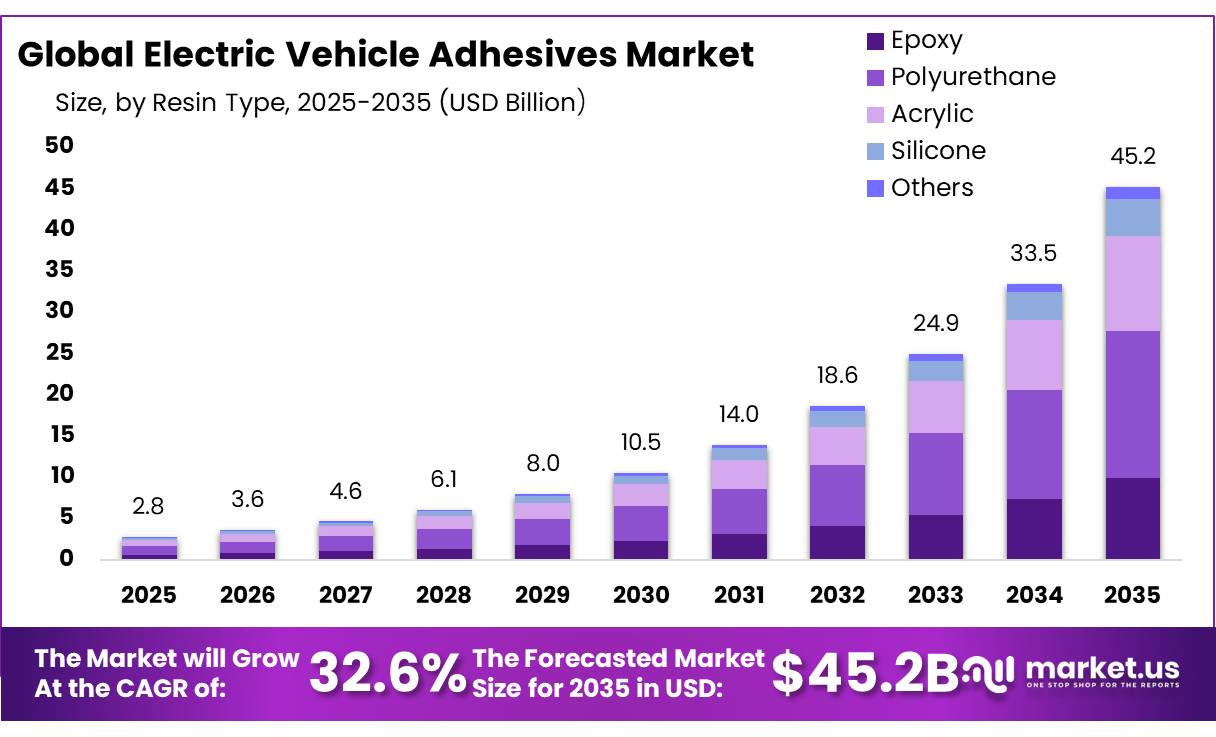
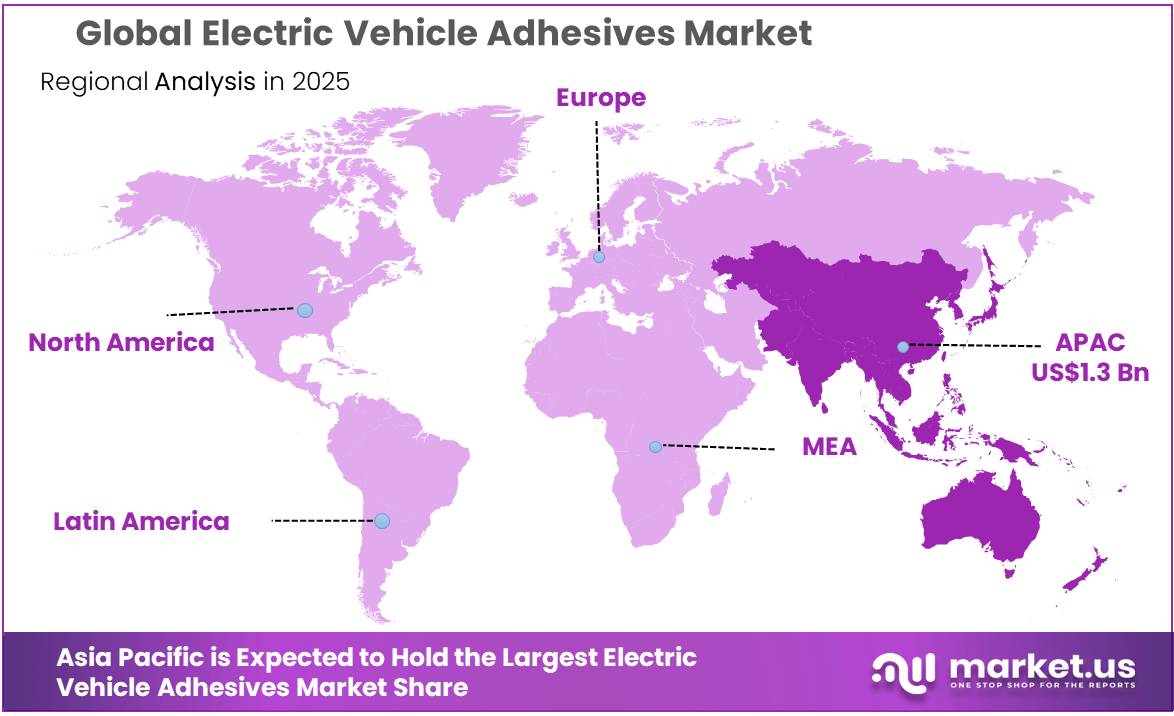
In 2025, the Global Electric Vehicle Adhesives Market was valued at USD 2.8 billion, and between 2026 and 2035, this market is estimated to register a CAGR of 32.6%, reaching about USD 45.2 billion by 2035. In 2025, Asia Pacific held a dominant market position, capturing more than a 48.2% share, holding USD 1.4 Billion revenue.
Electric vehicle adhesives are becoming essential materials in battery packs, body structures, electric motors, power electronics, and thermal-management systems. Epoxy, polyurethane, acrylic, silicone, and hybrid adhesives are increasingly replacing or supporting welding, bolts, and mechanical fasteners. They help bond aluminum, steel, composites, and polymer components while improving stiffness, sealing, vibration control, electrical insulation, and heat transfer. Sika reports that its thermal-conductive adhesive systems can provide conductivity of up to 2.0 W/m·K, supporting cell fixation and heat transfer inside EV batteries.
- The International Energy Agency reported that global electric-car sales exceeded 20 million units in 2025, increasing 20%, with electric vehicles accounting for 25% of new car sales worldwide. Nearly 22 million electric cars were manufactured globally during the same year, increasing more than 25% from the previous year. Larger production volumes directly expand consumption of structural adhesives, battery sealants, gap fillers, and thermal-interface bonding materials.
Battery expansion represents the strongest demand driver. Global EV battery deployment reached 1.2 TWh in 2025, rising almost 30% year over year and standing more than 7 times above its 2020 level. Light-duty vehicles represented more than 85% of EV battery deployment. The IEA expects deployment to approach 3 TWh by 2030, creating a much larger application base for cell-to-module, cell-to-pack, cooling-plate, enclosure, and crash-structure adhesives.
Chemical companies are responding with higher-performance materials. In May 2026, Henkel introduced Bergquist TGF 2030APS with thermal conductivity of 1.7 W/m·K and dispensing rates above 40 cc/sec. It also launched Loctite TLB 9270APS, a polyurethane adhesive providing 2 W/m·K thermal conductivity and around 40–45 minutes of working time for cell-to-pack designs. Such developments show how adhesives are moving beyond basic joining toward combined structural bonding and thermal management.
Government policy is also supporting manufacturing investment. The U.S. Department of Energy provides USD 3 billion through its Battery Manufacturing and Recycling Grants program and has already awarded USD 1.82 billion to 14 projects supporting battery materials, components, manufacturing, and recycling. These investments can increase domestic battery assembly capacity and, in turn, demand for bonding, sealing, potting, and thermal-interface materials.
Key Takeaways
- The global electric vehicle adhesives market was valued at USD 2.8 billion in 2025.
- The global market is projected to grow at a CAGR of 32.6% and is estimated to reach USD 45.2 billion by 2035.
- On the basis of resin type, polyurethane resins dominated the market, constituting 39.6% of the total market share.
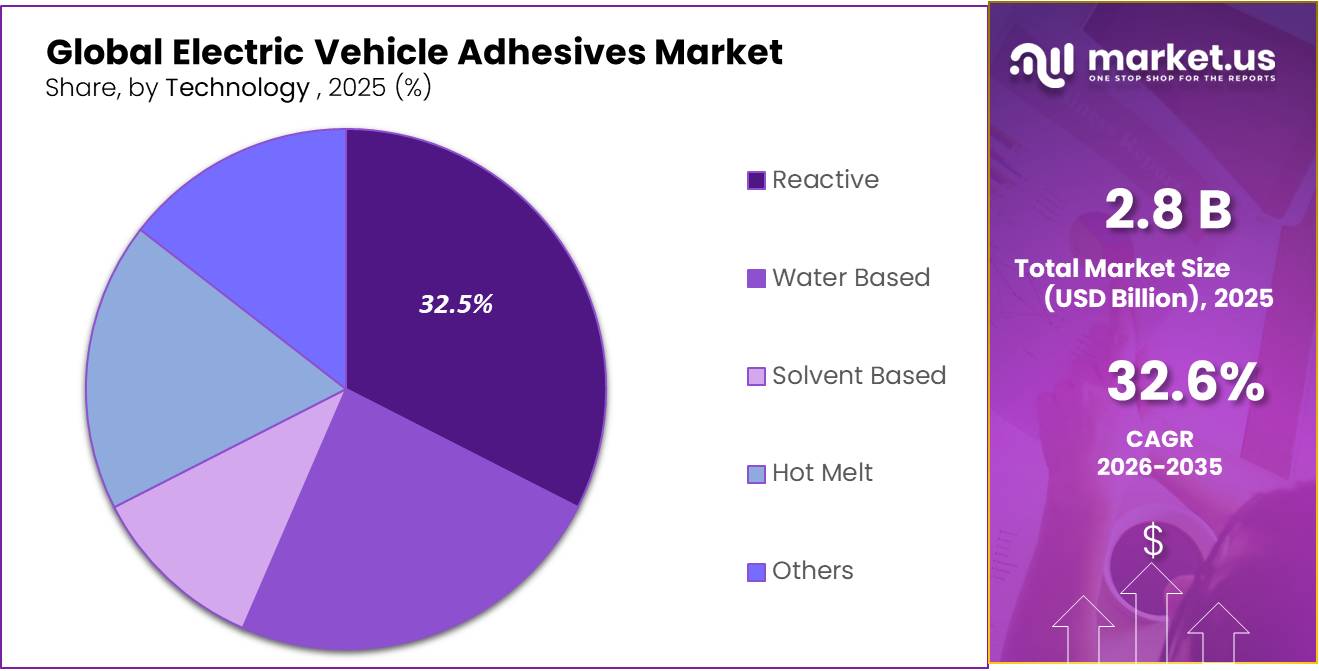
- Based on the technology, the reactive technology dominated the electric vehicle adhesives market, with a substantial market share of around 32.5%.
- Based on the propulsion type, the electric vehicle adhesives for battery electric vehicles (BEV) led the market, comprising 70.3% of the total market.
- Among the applications of electric vehicle adhesives, the powertrain is the most considerable within the market, accounting for around 49.1% of the revenue.
- Based on the vehicle type, the electric vehicle adhesives for passenger cars led the market, comprising 82.7% of the total market.
- Among the sales channels, OEMs are the most considerable within the market, accounting for around 85.9% of the revenue.
- In 2025, the Asia Pacific was the most dominant region in the electric vehicle adhesives market, accounting for 48.2% of the total global consumption.
Resin Type Analysis
Polyurethane Resins are a Prominent Segment in the Market.
Polyurethane represents the dominant segment within the resin type category of the electric vehicle adhesives market, accounting for approximately 39.6% of the total share. This leadership position is supported by its strong balance of flexibility, durability, and multi-substrate compatibility, making it highly suitable for the complex material combinations used in electric vehicle structures. Its effective adhesion to aluminum, composites, and engineered plastics supports widespread use in both structural and non-structural applications, including battery enclosures, interior assemblies, and exterior components.
The material’s ability to absorb vibration and withstand thermal cycling is particularly important in electric drivetrains and battery systems, where operational stresses are consistently high. Polyurethane adhesives also offer good resistance to moisture and environmental exposure, enhancing long-term vehicle performance and reliability. In addition, relatively faster curing behavior compared to several high-strength alternatives supports integration with automated production lines and high-volume OEM manufacturing processes. Increasing deployment in sealing, bonding, and noise, vibration, and harshness (NVH) control applications further reinforces its strong position across global electric vehicle manufacturing ecosystems.
Technology Analysis
Reactive Technology Dominated the Electric Vehicle Adhesives Market.
Reactive technology accounts for approximately 32.5% of the electric vehicle adhesives market, making it the leading segment within the technology category. Its dominance is supported by superior bonding performance, particularly in high-stress automotive applications such as battery systems, structural assemblies, and powertrain components. Reactive adhesives undergo chemical curing after application, forming strong cross-linked structures that enhance thermal stability, mechanical strength, and resistance to vibration and environmental exposure.
This makes them highly suitable for electric vehicles, where durability and safety under fluctuating operating conditions are critical. Additionally, their compatibility with automated dispensing systems and fast-curing characteristics supports efficient integration into high-volume OEM manufacturing processes, reinforcing their widespread adoption across EV production lines.
Propulsion Type Analysis
Electric Vehicle Adhesives for Battery Electric Vehicle (BEV) Held a Major Share of the Market.
Battery Electric Vehicle (BEV) represents the dominant segment within the propulsion type category, accounting for approximately 70.3% of the electric vehicle adhesives market. This dominance is driven by the extensive use of adhesives in BEV-specific architectures, particularly in battery pack assembly, thermal management systems, and lightweight body structures.
BEVs rely heavily on multi-material designs to offset battery weight and improve driving range, increasing the need for high-performance bonding solutions. Adhesives used in BEVs provide structural integrity, vibration resistance, and electrical insulation, which are critical for high-voltage systems. The growing global shift toward full electrification, supported by regulatory emissions targets and OEM platform transitions, continues to reinforce BEV-led demand for advanced adhesive technologies.
Application Analysis
Electric Vehicle Adhesives Are Mostly Utilized for Powertrain.
Powertrain represents the dominant segment within the application category, accounting for approximately 49.1% of the electric vehicle adhesives market. This leadership is primarily driven by the critical role adhesives play in electric drivetrain systems, including battery packs, electric motors, power electronics, and thermal management assemblies.
These components require high-performance bonding solutions that ensure structural integrity, vibration damping, electrical insulation, and resistance to elevated operating temperatures. Adhesives are increasingly preferred over mechanical fasteners in powertrain applications due to their ability to reduce weight and distribute stress more evenly across joints. Growing electrification of drivetrains and rising complexity of battery-integrated architectures continue to reinforce strong adhesive consumption in this segment.
Vehicle Type Analysis
Electric Vehicle Adhesives for Passenger Cars Held a Major Share of the Market.
Passenger Cars represent the dominant segment within the vehicle type category, accounting for approximately 82.7% of the electric vehicle adhesives market. This dominance is driven by the high production volume and rapid electrification of passenger vehicle platforms, particularly in hatchbacks, sedans, and SUVs. Adhesives are extensively used in passenger electric vehicles for structural bonding, battery enclosure assembly, interior fitting, and exterior panel integration.
The shift toward lightweight, multi-material vehicle designs in this segment has significantly increased reliance on advanced adhesive solutions to enhance energy efficiency, crash performance, and noise reduction. Additionally, strong consumer adoption of electric passenger vehicles, supported by regulatory emission targets and expanding charging infrastructure, continues to reinforce sustained demand for high-performance adhesive systems in this segment.
Sales Channel Analysis
Electric Vehicle Adhesives Are Mostly Sold to OEMs.
OEM represents the dominant segment within the sales channel category, accounting for approximately 85.9% of the electric vehicle adhesives market. This dominance is attributed to the extensive use of adhesives during original vehicle assembly, where they are integrated into structural bonding, battery pack assembly, thermal management systems, and interior and exterior component installation.
OEM production environments increasingly rely on advanced adhesive technologies to support lightweight vehicle architectures, multi-material bonding, and automated manufacturing processes. Adhesives are directly incorporated into EV platforms during design and engineering stages, ensuring optimized performance and safety compliance. The growing scale of electric vehicle manufacturing by automotive OEMs globally continues to reinforce the reliance on factory-installed adhesive systems, while aftermarket applications remain comparatively limited to repairs and maintenance activities.
Key Market Segments
By Resin Type
- Epoxy
- Polyurethane
- Acrylic
- Silicone
- Others
By Technology
- Water Based
- Solvent Based
- Hot Melt
- Reactive
- Others
By Propulsion Type
- Battery Electric Vehicle (BEV)
- Plug-in Hybrid Electric Vehicle (PHEV)
By Application
- Exterior
- Interior
- Powertrain
By Vehicle Type
- Passenger Cars
- Hatchback
- Sedan
- SUV
- Others
- Commercial Vehicles
- Light Duty
- Heavy Duty
By Sales Channel
- OEM
- Aftermarket
Driver Analysis
EV Output and Battery-Capacity Scale-Up
Rising EV production is the largest volume driver because every battery-electric vehicle requires several adhesive families across the cell, module, pack, enclosure, cooling system, body-in-white, power electronics, sensors, and interior assemblies, and global electric-car output reached nearly 22 million units in 2025, more than 25% above 2024.
Global EV sales exceeded 20 million units in 2025, representing roughly one in four new cars sold worldwide, and the International Energy Agency expects sales to approach 23 million in 2026, equivalent to around 28% of global light-vehicle sales. Battery manufacturing is scaling even faster than vehicle demand: global lithium-ion nameplate capacity surpassed 4 TWh by the end of 2025, up about 30% year on year, while average battery prices fell 8% during 2025 as manufacturing efficiency improved and competition intensified.
This combination changes adhesive economics: lower battery-cell cost pushes OEMs to focus more aggressively on pack integration, assembly speed, crash performance, thermal control, and warranty durability, all of which increase the value of structural epoxies, polyurethane sealants, thermally conductive gap fillers, dielectric adhesives, fire-protection coatings, and pressure-sensitive tapes. A typical EV can require 15-30 kg of adhesives and sealants across body, battery, and electronics, versus approximately 10-18 kg in a conventional internal-combustion vehicle; where module-to-pack and cell-to-pack architectures are adopted, battery-related adhesive content can rise by a further modeled 20-40%.
The commercial model consequently shifts from component-level supply toward platform-level material qualification, with adhesive manufacturers needing regional technical centers near Chinese, North American, European, Korean, and Japanese gigafactories to secure multi-year design-in positions, supporting a +1.6 percentage-point uplift to baseline CAGR during 2026-2028.
Drivers Impact Analysis
| Driver | (~) % Impact on CAGR Forecast | Geographic Relevance | Impact Timeline |
|---|---|---|---|
| EV output and battery-capacity scale-up | +1.6% | China, EU, North America, Korea, Japan | Short term (≤ 2 years) |
| Cell-to-pack structural bonding | +1.4% | China, North America, EU, Korea | Medium term (2-4 years) |
| Thermal-runaway safety upgrades | +1.3% | China core, EU, North America | Short term (≤ 2 years) |
| Mixed-material lightweight vehicle design | +1.0% | China, EU, North America, Japan | Medium term (2-4 years) |
| Battery passport and repairability traceability | +0.8% | EU core, EU import suppliers | Medium term (2-4 years) |
| Fast-charge thermal management | +0.7% | China, Korea, Japan, North America | Long term (≥ 4 years) |
Restraint Analysis
Epoxy and Isocyanate Volatility
EV adhesive manufacturers remain materially exposed to price instability in bisphenol-A epoxies, epoxy hardeners, polyols, methylene diphenyl diisocyanate, toluene diisocyanate, acrylic monomers, silicones, thermal fillers, flame retardants, and specialty additives, because battery-grade structural, thermal, dielectric, and fire-barrier products use significantly more engineered feedstocks than conventional trim adhesives.
Industry analysis identifies MDI, TDI, bisphenol-A epoxy resins, and acrylic monomers as highly sensitive to crude-oil pricing, refinery disruptions, and competing construction, electronics, and packaging demand; MDI spot prices reportedly moved by roughly 40% during 2024 after unplanned outages in China. The exposure is amplified by the commercial structure of automotive supply: an OEM adhesive qualification can last 12-24 months and a vehicle platform typically carries the selected product for five to eight years, while annual or multi-year supply agreements may limit pass-through mechanisms, forcing formulators to absorb sudden 10-25% raw-material spikes or renegotiate at the risk of losing specification status.
A 15% increase in resin and hardener costs can cut gross margin on a battery-grade structural adhesive by a modeled 300-700 basis points where fixed conversion costs and field technical support remain constant; thermal fillers and flame-retardant packages may add further 5-12% cost exposure. Suppliers must use index-linked contracts, dual sourcing, backward integration, regional production, and formula designs tolerant to alternative grades, but customer requalification of any substitute can take 6-12 months; therefore, feedstock volatility is estimated to impose a -1.1 percentage-point short-term drag on achievable market CAGR globally.
Restraint Impact Analysis
| Restraint | (~) % Impact on CAGR Forecast | Geographic Relevance | Impact Timeline |
|---|---|---|---|
| Epoxy and isocyanate volatility | -1.1% | Global, APAC, EU, North America | Short term (≤ 2 years) |
| Permanent bonding impairs recycling | -1.0% | EU core, China, North America | Medium term (2-4 years) |
| Long OEM validation cycles | -0.9% | China, EU, North America, Korea | Medium term (2-4 years) |
| Thermal-safety formulation cost | -0.8% | China core, EU, North America | Short term (≤ 2 years) |
| Automated dispensing yield losses | -0.7% | China, Korea, EU, North America | Medium term (2-4 years) |
| Regional compliance fragmentation | -0.5% | EU, China, US, Japan, Korea | Long term (≥ 4 years) |
Opportunity Analysis
Debond-on-Demand Battery Adhesives
Debond-on-demand adhesive systems represent the clearest future white space because current cell-to-pack and pack-to-body adhesives maximize permanent strength, crash durability, and thermal performance but are not designed for clean cell recovery, module repair, second-life remanufacture, or high-value recycling; the opportunity arises only when suppliers engineer bonds that remain durable during 8-15 years of vehicle use yet release predictably through a controlled thermal, electrical, ultraviolet, chemical, or electromagnetic trigger.
A 2026 study of a heat-triggered primer demonstrated approximately 98% reduction in initial joint strength after activation at 150°C, allowing room-temperature component separation, illustrating the technical pathway for localized debonding layers rather than wholesale sacrifice of pack structural performance. This is not a current market driver because industrial-scale adoption is still limited and requires OEM redesign of pack geometry, thermal access points, repair procedures, safety protocols, and automated dismantling equipment; however, it can create a major premium-material category as the EU battery passport becomes mandatory on February 18, 2027 for EV batteries, industrial batteries above 2 kWh, and light-transport batteries sold in the EU.
Suppliers that validate a debondable system across crash, vibration, coolant exposure, dielectric strength, thermal cycling, and abuse testing can price it at a modeled 20-50% premium to a conventional structural adhesive while helping OEMs reduce pack teardown time by 30-60%, lower repair labor, and preserve higher-value aluminum, copper, and cell materials. Early specification wins in European and export-oriented Chinese vehicle programs could add approximately +1.5 percentage points to the EV Adhesives Market CAGR through 2028-2030.
Opportunity Impact Analysis
| Opportunity | (~) % Potential CAGR Upside | Geographic Relevance | Execution Window |
|---|---|---|---|
| Debond-on-demand battery adhesives | +1.5% | EU, China, North America, Japan | Medium term (2-4 years) |
| Battery-passport material data services | +1.1% | EU core, global EU suppliers | Short term (≤ 2 years) |
| Multifunctional thermal-structural adhesives | +1.2% | China, Korea, Japan, EU, US | Medium term (2-4 years) |
| Adhesive dispensing-as-a-service | +0.9% | China, EU, North America, Korea | Short term (≤ 2 years) |
| Battery repair ecosystem partnerships | +0.8% | EU, North America, China, Japan | Medium term (2-4 years) |
| Regional specialty-adhesive M&A roll-ups | +0.7% | India, Southeast Asia, Europe, North America | Long term (≥ 4 years) |
Challenges Analysis
Thermal-Mechanical Performance Trade-Offs
High thermal conductivity typically requires ceramic or metallic filler loading, but filler-rich formulations can become more brittle, more viscous, and less able to absorb the differential expansion between cells, housings, and cooling systems; silicone-based thermal adhesives using aluminum oxide, boron nitride, or graphite fillers generally achieve approximately 1.5-8 W/m·K but can sacrifice flexibility and adhesion strength as conductivity increases.
Battery packs operate from approximately -40°C to 85°C and experience rapid temperature excursions during fast charging, creating repeated coefficient-of-thermal-expansion mismatch among aluminum or steel cell cases, structural members, and thermal-management components; this mismatch generates shear and tensile stress that can progressively produce microcracks, delamination, and cohesive failure. The commercial penalty is that formulators must use complex hybrid chemistries, high-cost filler dispersion, rheology modifiers, and multi-layer material stacks to meet conflicting specifications, increasing development cycles by 12-24 months and manufacturing cost by a modeled 20-50% versus standard flexible adhesives.
Challenges Impact Analysis
| Challenge | (~) % CAGR Friction Drag | Geographic Relevance | Mitigation Horizon |
|---|---|---|---|
| Thermal-mechanical performance trade-offs | -0.9% | China, EU, North America, Korea, Japan | Long term (≥ 4 years) |
| Dispensing consistency and void control | -0.8% | China, Korea, EU, North America | Medium term (2-4 years) |
| Battery platform design churn | -0.7% | China, North America, EU, Japan | Medium term (2-4 years) |
| Battery manufacturing skills gap | -0.7% | North America, EU, India, Mexico | Long term (≥ 4 years) |
| Lifecycle durability prediction | -0.6% | Global EV manufacturing hubs | Long term (≥ 4 years) |
| Repair-and-recycling workflow integration | -0.5% | EU, China, North America, Japan | Medium term (2-4 years) |
Geopolitical Impact Analysis
Geopolitical Realignment and Supply Chain Localization Reshaping EV Adhesive Demand Dynamics.
Current geopolitical tensions are reshaping supply chain strategies and raw material sourcing patterns within the electric vehicle adhesives market. Adhesive formulations used in EV battery systems and lightweight vehicle assemblies rely on petrochemical derivatives, specialty resins, and mineral-based additives that are vulnerable to trade restrictions, shipping disruptions, and energy market volatility. The World Bank reported that energy prices increased by more than 60% in 2022 following the Russia–Ukraine conflict, affecting chemical manufacturing input costs globally. Higher energy and feedstock costs directly influence production economics for epoxy, polyurethane, and acrylic adhesive systems widely used in EV applications.
Trade policy measures are also altering regional manufacturing dynamics. In 2024, the United States increased tariffs on several Chinese electric vehicle and battery-related imports under Section 301 actions, including lithium-ion battery components. Simultaneously, the European Union launched investigations into battery supply chain dependencies and foreign subsidies linked to EV manufacturing. These developments are encouraging automotive and chemical manufacturers to localize production facilities and diversify sourcing networks. As a result, adhesive suppliers are increasingly required to establish regionally resilient supply chains capable of supporting localized EV assembly and battery manufacturing operations while reducing exposure to geopolitical disruptions.
Regional Analysis
Asia Pacific Held the Largest Share of the Global Electric Vehicle Adhesives Market.
In 2025, the Asia Pacific dominated the global electric vehicle adhesives market, holding about 48.2% of the total global consumption. Asia Pacific accounts for the largest share of global electric vehicle production, directly reinforcing demand for EV-grade adhesive systems used in structural bonding, battery assembly, and thermal management applications. The International Energy Agency reported that China alone accounted for about 60% of global electric car sales in 2023, supported by extensive domestic manufacturing capacity for both vehicles and lithium-ion batteries. This concentration of production has created a dense ecosystem of automotive OEMs, battery manufacturers, and materials suppliers requiring high-volume adhesive consumption across assembly lines.
Government-backed industrial policies further strengthen regional dominance. The Ministry of Industry and Information Technology of China has supported large-scale EV and battery manufacturing expansion through national industrial planning initiatives, while Japan and South Korea continue investments in advanced materials and battery technologies.
India’s Faster Adoption and Manufacturing of Electric Vehicles (FAME) scheme has also contributed to rising EV penetration and localized assembly activity. The combination of high vehicle output, vertically integrated battery supply chains, and expanding manufacturing infrastructure positions the Asia Pacific as the primary consumption hub for electric vehicle adhesives.
Key Regions and Countries Covered
- North America
- The US
- Canada
- Europe
- Germany
- France
- The UK
- Spain
- Italy
- Russia & CIS
- Rest of Europe
- APAC
- China
- Japan
- South Korea
- India
- ASEAN
- Rest of APAC
- Latin America
- Brazil
- Mexico
- Rest of Latin America
- Middle East & Africa
- GCC
- South Africa
- Rest of MEA
Key Players Analysis
Manufacturers of electric vehicle adhesives focus on advancing formulation technologies that meet the demanding requirements of battery systems, lightweight structures, and high-voltage electronics. A key strategic emphasis lies in developing multi-functional adhesives that combine structural bonding, thermal management, flame resistance, and electrical insulation within a single material system. Companies also invest in material compatibility testing to ensure reliable adhesion across aluminum, composites, and engineered plastics used in modern EV platforms.
Another important activity involves strengthening collaboration with automotive OEMs and battery producers during early vehicle design stages, enabling customized adhesive solutions aligned with specific platform architectures. Manufacturers are also expanding production capabilities for fast-curing and automation-compatible chemistries to support high-speed assembly lines. In addition, increased focus is placed on low-VOC and sustainable formulations to comply with environmental regulations. Continuous R&D, regional manufacturing expansion, and supply chain localization further support reliability, cost efficiency, and long-term customer integration.
The Major Players in The Industry
- Henkel AG & Co. KGaA
- Sika AG
- 3M
- Parker Hannifin
- B. Fuller
- Bostik
- Jowat SE
- PPG Industries
- Permabond
- Wacker Chemie AG
- Dow Inc
- DuPont
- Arkema
- Huntsman International LLC
- DELO Industrial Adhesives
- Other Key Players
Report Scope
| Report Features | Description |
|---|---|
| Market Value (2024) | US$2.8 Bn |
| Forecast Revenue (2034) | US$45.2 Bn |
| CAGR (2025-2034) | 32.6% |
| Base Year for Estimation | 2024 |
| Historic Period | 2020-2023 |
| Forecast Period | 2025-2034 |
| Report Coverage | Revenue Forecast, Market Dynamics, Competitive Landscape, Recent Developments |
| Segments Covered | By Resin Type (Epoxy, Polyurethane, Acrylic, Silicone, and Others), By Technology (Water Based, Solvent Based, Hot Melt, Reactive, and Others), By Propulsion Type (Battery Electric Vehicle (BEV) and Plug-in Hybrid Electric Vehicle (PHEV)), By Application (Exterior, Interior, and Powertrain), By Vehicle Type (Passenger Cars and Commercial Vehicles), By Sales Channel (OEM and Aftermarket) |
| Regional Analysis | North America – The US & Canada; Europe – Germany, France, The UK, Spain, Italy, Russia & CIS, Rest of Europe; APAC– China, Japan, South Korea, India, ASEAN & Rest of APAC; Latin America– Brazil, Mexico & Rest of Latin America; Middle East & Africa– GCC, South Africa, & Rest of MEA |
| Competitive Landscape | Henkel AG & Co. KGaA, Sika AG, 3M, Parker Hannifin, H.B. Fuller, Bostik, Jowat SE, PPG Industries, Permabond, Wacker Chemie AG, Dow Inc, DuPont, Arkema, Huntsman International LLC, DELO Industrial Adhesives, and Other Players. |
| Customization Scope | Customization for segments, region/country-level will be provided. Moreover, additional customization can be done based on the requirements. |
| Purchase Options | We have three licenses to opt for: Single User License, Multi-User License (Up to 5 Users), Corporate Use License (Unlimited Users and Printable PDF) |





































