


Report Overview
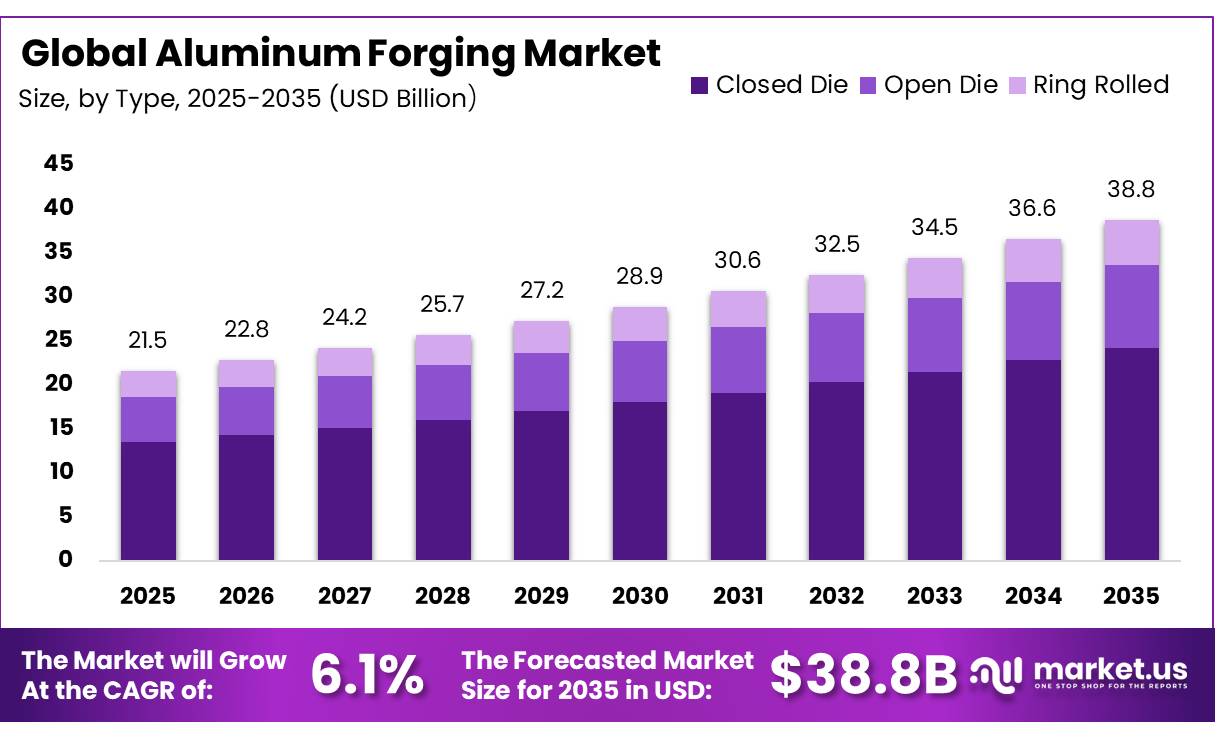
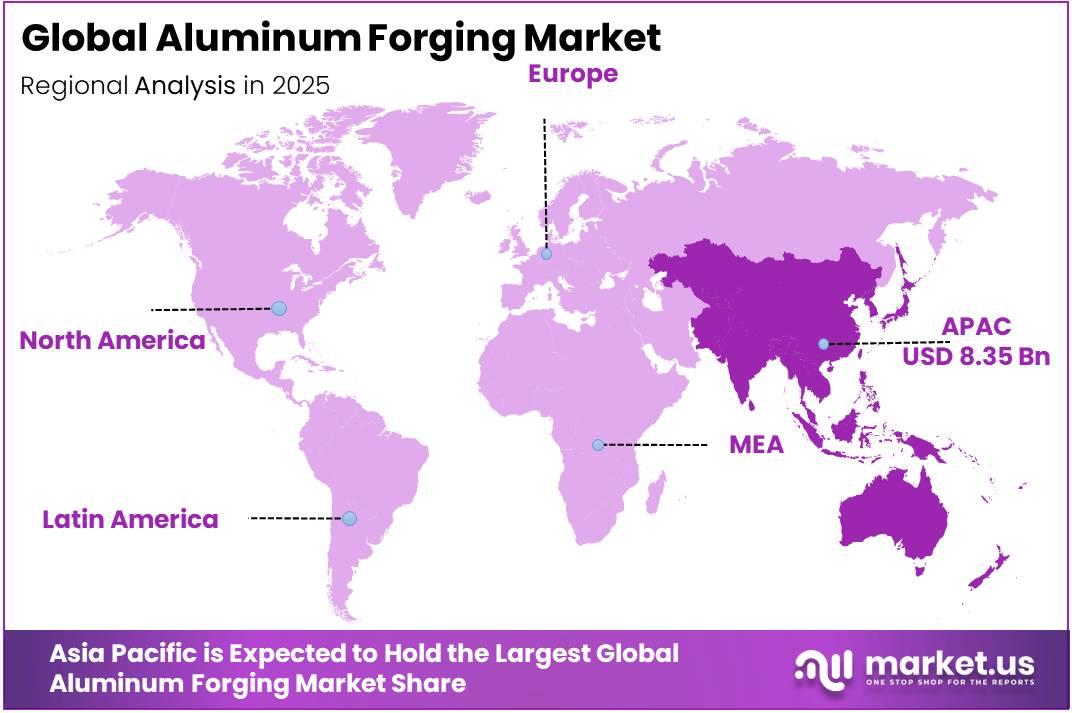
In 2025, the Global Aluminum Forging Market was valued at USD 21.5 billion, and between 2026 and 2035, this market is estimated to register a CAGR of 6.1%, reaching about USD 38.8 billion by 2035. Asia Pacific held a dominant market position, capturing more than a 38.8% share, holding USD 8.35 billion in revenue.
Aluminum forging is a specialized manufacturing activity that converts aluminum billets into high strength components through controlled compressive force. Demand is closely linked with aerospace, defense, automotive, transportation, machinery, and construction applications where low weight and mechanical reliability are important.
- The U.S. Geological Survey (USGS) placed aluminum on the 2025 List of Critical Minerals, which contains 60 minerals, reflecting its economic importance and supply chain relevance across manufacturing industries.
Key Takeaways
- The global aluminum forging market was valued at USD 21.5 billion in 2025.
- The global market is projected to grow at a CAGR of 6.1% and is estimated to reach USD 38.8 billion by 2035.
- On the basis of type, closed die forging dominated the market, constituting 62.44% of the total market share.
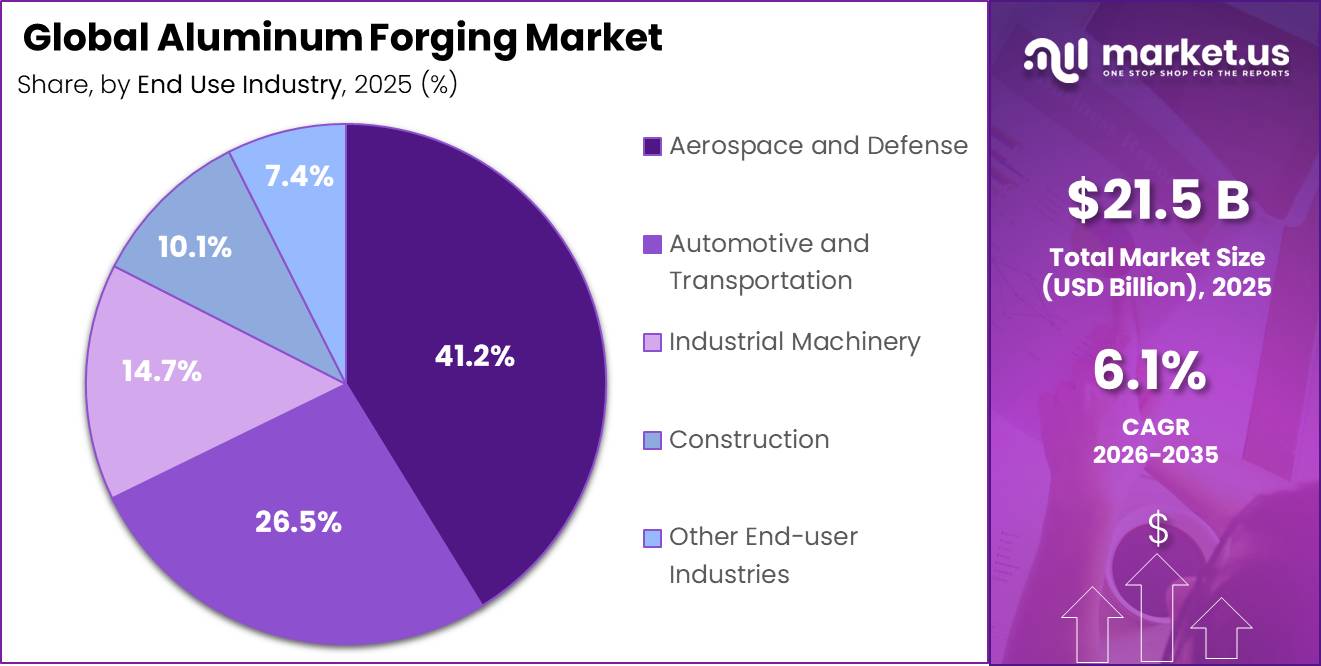
- Among the end-use industries, aerospace and defense held a major share in the aluminum forging market, accounting for 41.23% of the market share.
- In 2025, Asia Pacific was the most dominant region in the aluminum forging market, accounting for 38.78% of the total market share.
The industrial scenario remains favorable as aircraft and vehicle manufacturers expand production. Airbus delivered 793 commercial aircraft to 91 customers in 2025 and ended the year with a backlog of 8,754 aircraft. In automotive manufacturing, the International Organization of Motor Vehicle Manufacturers (OICA) reported that global vehicle production increased from 92.7 million units in 2024 to 96.4 million units in 2025, a 3.9% rise. These production volumes support demand for lightweight forged structural components.
- The U.S. Department of Energy (DOE) states that a 10% reduction in vehicle weight can improve fuel economy by 6% to 8%. The U.S. Department of Energy states that replacing heavy steel components with materials such as high-strength steel, aluminum, or glass fiber-reinforced polymer composites can decrease component weight by 10% to 60%. This creates opportunities for forged aluminum parts in electric vehicles, commercial vehicles, aircraft structures, suspension systems, and other weight sensitive applications.
Government programs are also strengthening advanced metal supply chains. The U.S. Department of Defense (DoD) stated that its Fiscal Year 2025 budget request increased casting and forging investments to more than double the previous year. Separately, in August 2025, the DoD awarded USD 10 million under the Defense Production Act to support a domestic scandium supply chain, noting that scandium alloys can replace legacy aluminum components with lightweight, high strength alternatives. Such initiatives support future alloy development and manufacturing resilience globally.
Type Analysis
Closed Die dominates with 62.44% due to its precision, repeatability, and suitability for high-volume components.
In 2025, Closed Die held a dominant market position, capturing more than a 62.44% share. Its leadership is supported by use in aerospace, automotive, defense, and machinery components that require tight dimensional control and consistent strength. Closed dies guide heated aluminum into a defined cavity, helping manufacturers produce complex shapes with limited finishing requirements. The process also supports repeat production, making it suitable for safety-critical parts such as structural fittings, suspension components, and aircraft hardware where uniform quality is important.
- In January 2026, according to the U.S. Geological Survey (USGS), domestic primary aluminum production reached 58,000 metric tons, while total aluminum recovered from scrap was 318,000 metric tons, including 179,000 metric tons recovered from new scrap. These figures provide a measurable view of aluminum availability for downstream manufacturing activities, including forging.
Open Die is the growing segment as manufacturers increasingly require larger, simpler, and lower-volume aluminum components. Its flexibility supports customized parts, shorter production runs, and components that need repeated working to improve internal structure.
End Use Industry Analysis
Aerospace and Defense dominates with 41.23% as aircraft and defense programs sustain demand for high-strength forged aluminum.
In 2025, Aerospace and Defense held a dominant market position, capturing more than a 41.23% share. The segment benefits from steady use of forged aluminum in aircraft structures, landing systems, wheels, engine supports, defense platforms, and other load-bearing components. Aerospace manufacturers favor forged parts because they provide dependable strength, structural reliability, and weight efficiency for demanding operating conditions. Continued aircraft production and defense modernization therefore support sustained aluminum forging demand across this end-use industry.
- In July 2026, according to Boeing, second-quarter commercial airplane deliveries totaled 171 units, bringing year-to-date deliveries to 314 units. Defense, Space & Security programs recorded 35 deliveries during the second quarter, taking year-to-date deliveries to 65 units.
Automotive and Transportation is the growing segment, supported by the industry’s continuing shift toward lighter vehicle structures and improved component durability. Forged aluminum is increasingly suited to suspension parts, wheels, steering components, chassis systems, and powertrain applications where strength and lower weight are important. Growing electric vehicle production and greater focus on vehicle efficiency are expected to strengthen adoption across passenger and commercial transportation applications over coming production cycles.
Key Market Segments
By Type
- Open Die
- Closed Die
- Ring Rolled
By End Use Industry
- Aerospace and Defense
- Automotive and Transportation
- Industrial Machinery
- Construction
- Other End-user Industries
Driver Analysis
EV lightweight chassis demand
EV growth increases the economic value of forged aluminum in suspension, steering, motor-mount, subframe and structural crash-management applications because each kilogram removed can either offset battery mass, improve range, or preserve payload without changing vehicle architecture. Global electric-car sales exceeded 17 million in 2024, more than 20% of all car sales, and were projected to exceed 20 million in 2025; this creates an expanding addressable production base for high-integrity parts, rather than merely a material-substitution opportunity.
The commercial model consequently shifts toward early platform co-design, dedicated die amortization and multi-year OEM nomination rather than transactional sale of commodity forgings; however, part penetration depends on securing alloy billet, machining capacity and validation capability close to EV assembly plants. This driver is assigned a +1.3 percentage-point contribution because EV production is growing materially faster than total vehicle production, while forged-content gains per vehicle remain concentrated in higher-load applications rather than the entire body-in-white.
Drivers Impact Analysis
| Driver | (\~) % Impact on CAGR | Geographic Relevance | Impact Timeline |
|---|---|---|---|
| EV lightweight chassis demand | +1.3 pp | China, India, EU, North America | Short term (≤ 2 years) |
| Vehicle CO₂ compliance lightweighting | +0.9 pp | EU core, North America, Japan, Korea | Medium term (2-4 years) |
| Aerospace fleet renewal & MRO | +1.0 pp | North America, EU, China, India, Middle East | Long term (≥ 4 years) |
| Vehicle production localization | +0.7 pp | China, India, ASEAN, Mexico, Brazil | Medium term (2-4 years) |
| Low-carbon aluminum traceability | +0.6 pp | EU, UK, North America, export Asia | Short term (≤ 2 years) |
| Precision forging & near-net shaping | +0.5 pp | Japan, Korea, China, EU, North America | Medium term (2-4 years) |
Restraint Analysis
Billet price volatility
Aluminum forging margins are exposed to a three-layer cost stack—exchange-linked primary metal, regional duty/premium and alloying-plus-conversion charges—while customer contracts commonly lock a piece price for a vehicle or aerospace program before all input movements can be passed through. This risk is structurally significant because global primary aluminum capacity was about 45.0 million tonnes in 2025 against output of 41.6 million tonnes, leaving limited effective headroom once grade, geography, power availability and billet form are considered; the United States also remained 44% net-import reliant for aluminum consumption, amplifying exposure to freight and trade-policy shifts.
A 10% movement in billet input cost therefore does not translate into a 10% selling-price adjustment for a forger: for a component where metal represents an assumed 45–60% of ex-works value, even a 10% unhedged metal increase can remove 4.5–6.0 percentage points from gross margin before energy, labor and scrap costs are considered. The modeled -1.1 percentage-point CAGR drag arises when suppliers protect cash by shortening quotation validity, increasing inventory buffers, declining fixed-price awards or deferring new-platform capacity, all of which restrict shipment growth even when OEM order books remain intact.
Restraint Impact Analysis
| Restraint | (\~) % Impact on CAGR Forecast | Geographic Relevance | Impact Timeline |
|---|---|---|---|
| Billet price volatility | -1.1 pp | Global; EU, North America, APAC | Short term (≤ 2 years) |
| Energy-cost exposure | -0.9 pp | EU core, China, India, North America | Short term (≤ 2 years) |
| Qualified aerospace bottlenecks | -0.8 pp | North America, EU, UK, APAC | Medium term (2-4 years) |
| High press-and-tooling CapEx | -0.7 pp | Global; India, ASEAN, Latin America | Medium term (2-4 years) |
| Trade barriers & localization | -0.6 pp | North America, EU, China, Mexico | Medium term (2-4 years) |
| Carbon-data compliance burden | -0.5 pp | EU, UK, export Asia, Türkiye | Short term (≤ 2 years) |
Opportunity Analysis
Low-carbon forged platforms
CBAM has applied in its definitive regime since 1 January 2026, and EU importers must submit their first annual declaration and surrender corresponding certificates by 30 September 2027, creating a near-term customer need for traceable embedded-emissions information rather than merely low-cost conversion capacity.
The unit-economics prize is material: secondary aluminum can require only 5% of the energy used in primary production and can reduce CO₂ emissions by up to 98%, so a forger able to segregate closed-loop scrap, certify alloy chemistry and electrify heating can price a lower-carbon component independently from an exchange-metal surcharge.
In an upside case, converting 15–25% of addressable European and North American output to carbon-accounted programs, with a modeled 3–7% price premium and 1–3 percentage-point scrap-yield improvement, adds approximately +1.0 percentage point to CAGR through higher revenue per kilogram and preferred-supplier conversion; the execution requirement is billet-level mass balance, auditable supplier data and contracts that share the cost of low-carbon metal rather than treating traceability as an unpaid compliance feature.
Opportunity Impact Analysis
| Opportunity | (\~) % Potential CAGR | Geographic Relevance | Execution Window |
|---|---|---|---|
| Low-carbon forged platforms | +1.0 pp | EU, North America, Japan, Korea | Short term (≤ 2 years) |
| Grid hardware specialization | +0.8 pp | China, India, EU, North America | Medium term (2-4 years) |
| Drone & AAM components | +0.7 pp | North America, EU, China, India | Medium term (2-4 years) |
| Forge-to-machined modules | +0.9 pp | Global OEM corridors | Short term (≤ 2 years) |
| Digital low-volume cells | +0.6 pp | EU, Japan, Korea, North America | Medium term (2-4 years) |
| Regional M&A roll-ups | +0.5 pp | India, ASEAN, Mexico, Europe | Medium term (2-4 years) |
Challenges Analysis
Skilled process talent gap
The critical long-term challenge is not overall headcount but the shortage of personnel able to convert metallurgical knowledge into stable press settings, die life, billet-temperature control, heat-treatment response, nondestructive-test interpretation and root-cause closure; those skills typically require 3–7 years of plant exposure and cannot be replaced immediately by automation. U.S. casting and forging sectors alone are projected to require more than 230,000 skilled-trade workers by 2033, while aerospace suppliers report that pandemic-era workforce reductions removed substantial production labor and experienced engineering capacity, slowing both new-part qualification and recurring production recovery.
The operational penalty appears as longer die-change and troubleshooting intervals, lower first-pass acceptance, extended apprentice shadowing and reliance on overtime or contract labor; a 2–4 percentage-point decline in first-pass yield on a high-value forging line can consume the margin intended for an annual customer cost-down. The -0.8 percentage-point CAGR friction reflects slower launch capacity rather than absent demand, and mitigation requires formal multi-year apprenticeship pipelines, digital work instructions, retention mechanisms for master operators, cross-training across press and heat-treatment operations, and structured capture of parameter knowledge before retirements make it unavailable.
Challenges Impact Analysis
| Challenge | (\~) % CAGR Friction | Geographic Relevance | Mitigation Horizon |
|---|---|---|---|
| Skilled process talent gap | -0.8 pp | North America, EU, Japan, India | Long term (≥ 4 years) |
| Aerospace qualification congestion | -0.7 pp | North America, EU, UK, APAC | Medium term (2-4 years) |
| Multi-tier supply opacity | -0.6 pp | Global aerospace, auto corridors | Medium term (2-4 years) |
| Scrap-alloy segregation | -0.5 pp | EU, North America, China, India | Long term (≥ 4 years) |
| Complex-part yield control | -0.6 pp | EU, Japan, Korea, North America | Medium term (2-4 years) |
| Connected-plant cyber exposure | -0.4 pp | Global; SME forging clusters | Medium term (2-4 years) |
Geopolitical Impact Analysis
Geopolitical Realignment and Trade Barriers Reshaping Aluminum Forging Supply Chains
Current geopolitical developments are reshaping the aluminum forging market through higher tariffs, sanctions, origin-based trade rules, and stronger localization efforts. Forging producers depend on stable access to aluminum billet and alloy feedstock, so changes in cross-border metal policy can quickly affect sourcing costs and supplier decisions. In June 2025, the United States increased Section 232 tariffs on imported aluminum articles and derivative aluminum articles from 25% to 50%, effective June 4, 2025.
- In February 2025, the European Union introduced a ban on imports of Russian primary aluminum under its sixteenth sanctions package. A transitional quota allows 275,000 tons over 12 months, equal to 80% of European Union imports from Russia in 2024. The European Commission also stated that Russian aluminum imports into the European Union will end by the close of 2026.
North American trade policy is adding another layer of supply-chain fragmentation. Canada states that from July 31, 2025, a 25% surtax applies to certain imported steel or aluminum goods containing aluminum smelt and cast in China. Such origin-based measures increase the importance of traceability, documentation, and supplier qualification for manufacturers purchasing aluminum inputs for forged aerospace, automotive, defense, and industrial components.
These developments are encouraging forging companies to diversify suppliers, increase regional sourcing, and reduce dependence on politically exposed trade routes. At the same time, changing tariffs and sanctions can increase raw-material cost uncertainty and extend procurement planning. Companies with flexible sourcing networks, verified material origins, and regional production capabilities are better positioned to manage disruption while meeting stricter supply-chain requirements across major aluminum forging applications.
Regional Analysis
Asia Pacific Leads the Aluminum Forging Market with 38.78% Share and USD 8.35 Billion
In 2025, Asia Pacific held a dominant position in the Aluminum Forging Market, accounting for 38.78% of global revenue and generating USD 8.35 billion. The region benefits from large automotive, aerospace, machinery, and metal-processing industries that create steady demand for lightweight forged aluminum components.
- In 2025, the International Organization of Motor Vehicle Manufacturers reported that Asia-Pacific vehicle production rose 7.6% to around 59.2 million units, representing more than 61% of global output.
China produced 34.53 million vehicles, while Japan manufactured 8.41 million units, highlighting the scale of regional transportation manufacturing. This industrial base supports demand for forged aluminum wheels, suspension parts, chassis components, structural fittings, and other high-strength applications. Expanding aircraft activity also strengthens regional prospects.
- Airbus reported in January 2026 that China’s aviation aftermarket was valued at USD 24.8 billion in 2025, reflecting a large installed aircraft base and supporting long-term demand for aerospace-grade aluminum components across the region.
Key Regions and Countries Covered
- North America
- The US
- Canada
- Europe
- Germany
- France
- The UK
- Spain
- Italy
- Russia & CIS
- Rest of Europe
- APAC
- China
- Japan
- South Korea
- India
- ASEAN
- Rest of APAC
- Latin America
- Brazil
- Mexico
- Rest of Latin America
- Middle East & Africa
- GCC
- South Africa
- Rest of MEA
Key Players Analysis
Aluminum forging manufacturers are strengthening their competitive position through advanced forging capacity, aerospace-grade quality control, machining integration, and closer alignment with transportation and defense customers. In 2026, Howmet Aerospace remained an important participant across aerospace and commercial transportation applications. Its Forged Wheels business generated USD 295 million in first-quarter 2026 sales, up 17% year over year, showing continued scale in forged aluminum transportation products.
Capacity investment and manufacturing technology are also shaping competition. In July 2026, Kobe Steel announced approximately JPY 2.07 billion of investment at its Aluminum Casting & Forging Plant at Daian Works, with a maximum government subsidy of about JPY 1.04 billion. The expansion includes advanced finishing equipment, a sand-mold three-dimensional printer, and an X-ray computed tomography scanner. Such investments strengthen production reliability, quality inspection, and aerospace supply capabilities.
Market Key Players
- Al Forge Tech Co., Ltd
- All Metals & Forge Group
- Aluminum Precision Products
- Anchor Harvey
- Anderson Shumaker Company
- Bharat Forge
- Ellwood Group Inc.
- Howmet Aerospace
- ILJIN co., ltd.
- KOBE STEEL, LTD.
- NIPPON STEEL CORPORATION
- Other Key Players
Key Development
- In March 2026, Howmet Aerospace sold its Savannah, Georgia disk forging facility for approximately USD 230 million. The facility operated within the company’s Engineered Structures segment, making the transaction directly relevant to changes in Howmet’s forging manufacturing portfolio.
- In April 2026, Howmet Aerospace completed the acquisition of Consolidated Aerospace Manufacturing (CAM) from Stanley Black & Decker for approximately USD 1.8 billion. The acquisition expanded Howmet’s portfolio of precision fasteners, fluid fittings, and engineered components used in aerospace and defense applications.
- In June 2026, Kobe Steel and Nippon Light Metal Holdings signed a basic agreement to integrate their domestic aluminum extrusion businesses, targeting establishment of the integrated business from April 2027 or later. The companies plan to combine alloy-development, processing, recycling, production, and logistics capabilities, particularly for automotive and industrial applications.
Report Scope
| Report Features | Description |
|---|---|
| Market Value (2025) | USD 21.5 Bn |
| Forecast Revenue (2035) | USD 38.8 Bn |
| CAGR (2026-2035) | 6.1% |
| Base Year for Estimation | 2025 |
| Historic Period | 2020-2024 |
| Forecast Period | 2026-2035 |
| Report Coverage | Revenue Forecast, Market Dynamics, Competitive Landscape, Recent Developments |
| Segments Covered | By Type (Open Die, Closed Die, and Ring Rolled), By End Use Industry (Aerospace and Defense, Automotive and Transportation, Industrial Machinery, Construction, and Other End-user Industries) |
| Regional Analysis | North America – The US & Canada; Europe – Germany, France, The UK, Spain, Italy, Russia & CIS, Rest of Europe; APAC– China, Japan, South Korea, India, ASEAN & Rest of APAC; Latin America– Brazil, Mexico & Rest of Latin America; Middle East & Africa– GCC, South Africa, & Rest of MEA |
| Competitive Landscape | Al Forge Tech Co., Ltd., All Metals & Forge Group, Aluminum Precision Products, Anchor Harvey, Anderson Shumaker Company, Bharat Forge, Ellwood Group Inc., Howmet Aerospace, ILJIN co., ltd., KOBE STEEL, LTD., NIPPON STEEL CORPORATION, and Other Key Players. |
| Customization Scope | Customization for segments, region/country-level will be provided. Moreover, additional customization can be done based on the requirements. |
| Purchase Options | We have three licenses to opt for: Single User License, Multi-User License (Up to 5 Users), Corporate Use License (Unlimited Users and Printable PDF) |





































