


Report Overview
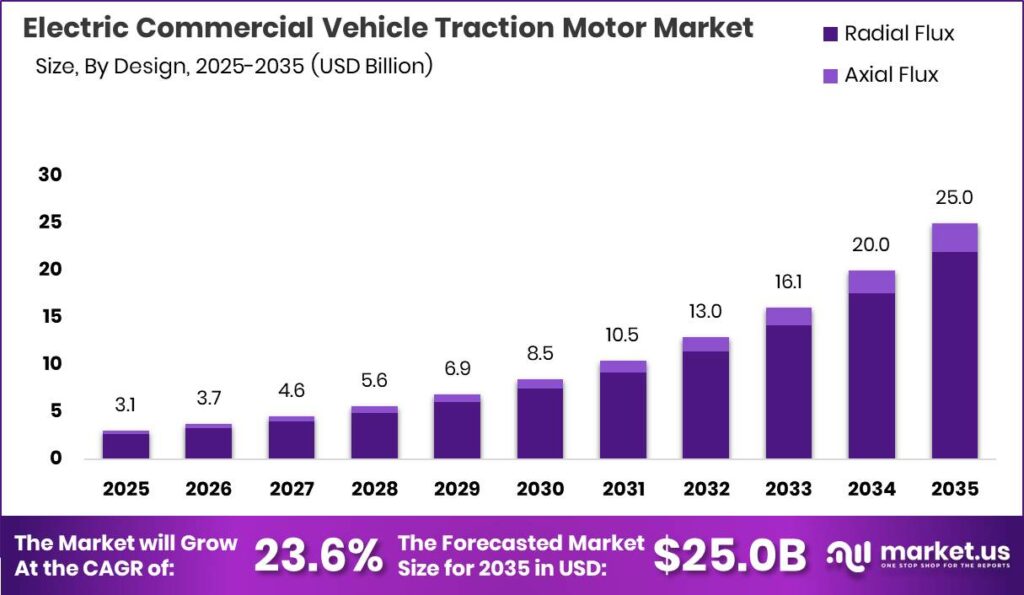
Global Electric Commercial Vehicle Traction Motor Market size is expected to be worth around USD 25.0 Billion by 2035 from USD 3.1 Billion in 2025, growing at a CAGR of 23.6% during the forecast period 2026 to 2035.
The electric commercial vehicle traction motor converts stored electrical energy into mechanical torque that drives wheels in trucks, vans, and buses. This market spans multiple motor architectures, power bands, and vehicle classes. Consequently, fleet operators now choose motor configurations based on duty cycle, payload, and route length rather than a single standard design.
Key Takeaways
- Global Electric Commercial Vehicle Traction Motor Market size is expected to reach USD 25.0 Billion by 2035, up from USD 3.1 Billion in 2025.
- The market is expected to expand at a CAGR of 23.6% between 2026 and 2035.
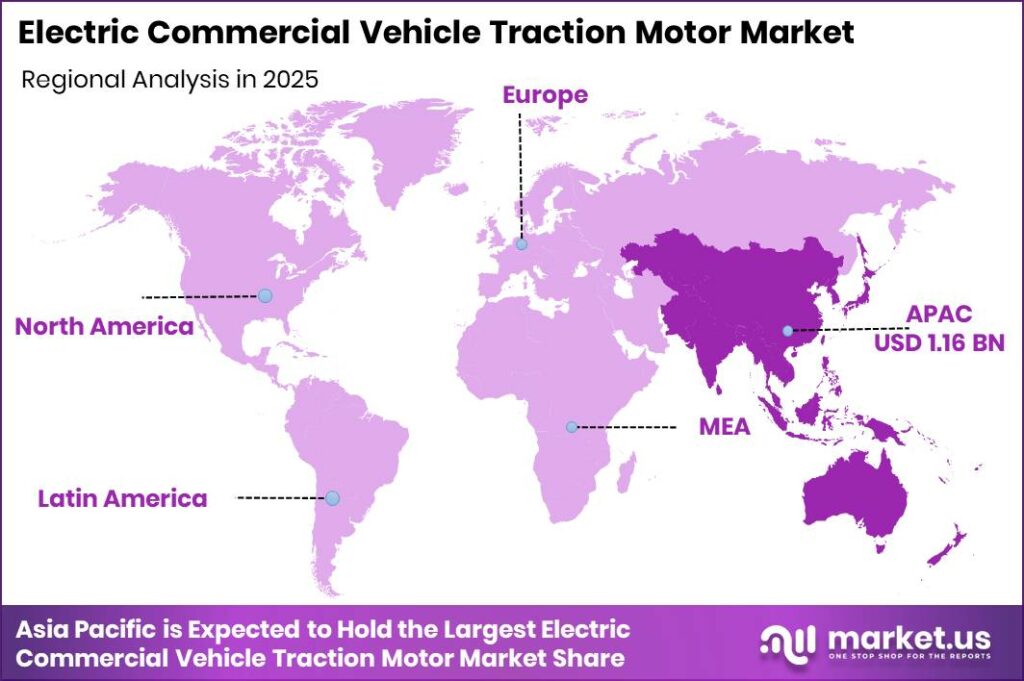
- Asia Pacific led the market in 2025 with a share of 38.00%, valued at USD 1.16 Billion.
- Pickup Trucks dominated the By Vehicle Type segment with a share of 31.00%.
- The 100 to 200 kW power band led the By Power Output segment with a share of 37.00%.
- Permanent Magnet Synchronous Motor led the By Motor Type segment with a share of 42.30%.
- Radial Flux design led the By Design segment with a share of 88.00%.
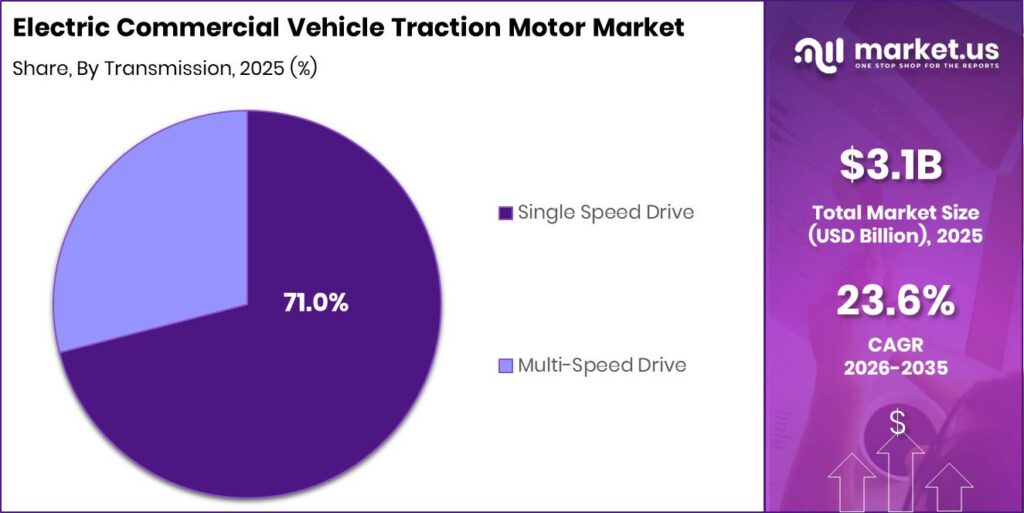
- Single Speed Drive led the By Transmission segment with a share of 71.00%.
Governments are tightening commercial fleet emission rules across major economies, and this regulatory pressure is reshaping motor sourcing decisions. Fleet operators face compliance deadlines that push them toward electrified powertrains faster than voluntary adoption alone would allow. This creates urgent procurement cycles for traction motor suppliers serving truck and bus manufacturers.
A 2025 peer reviewed electric bus study found that optimized driving and battery management reduced modeled battery capacity loss by 13.8%, easing degradation concerns for fleet buyers. This means transit operators can extend replacement cycles and lower total cost of ownership. The same optimization increased modeled battery service life by 25%, from 5.35 years to 6.69 years. As a result, motor and battery management system suppliers gain a stronger sales argument against diesel incumbents.
BorgWarner secured new integrated drive module business awards from a major North American OEM in February 2026, expanding supply of its traction motor based electric drive systems for electrified trucks. This signals that established Tier 1 suppliers are converting emission compliance pressure into confirmed production contracts. Fleet electrification demand is therefore translating directly into motor unit volume growth across commercial vehicle platforms.
Vehicle Type Analysis
Pickup Trucks dominates with 31.0% due to rising last mile delivery fleet conversions.
In 2025, Pickup Trucks held a dominant market position in the By Vehicle Type segment of Electric Commercial Vehicle Traction Motor Market, with a 31.0% share. According to World Bank transport data, commercial pickup registrations in developing economies grew alongside rising last mile logistics investment. This growth pushes traction motor suppliers to prioritize compact, high torque designs. Fleet buyers gain access to lower operating costs as pickup electrification scales faster than heavier vehicle classes.
Trucks in the medium and heavy duty class carry freight over longer distances and require sustained torque output. As reported by UNIDO manufacturing statistics, heavy commercial vehicle output rose across major manufacturing hubs as electrified drivetrain orders increased. This shift raises component demand for high durability motor windings. Suppliers who scale heavy duty motor lines first will capture early freight electrification contracts.
Vans serve urban parcel delivery and require frequent stop start operation that stresses motor thermal limits. Data from ITC Trade Map shows rising cross border shipments of electric van components into logistics hubs. This trend increases demand for compact motors tuned for repeated acceleration cycles. Vendors offering thermally optimized van motors gain preferred status with parcel delivery fleets.
Buses and Coaches require continuous high output motors for scheduled passenger routes. This segment favors durability over compactness because transit authorities plan for long service intervals. Instead of chasing volume, suppliers serving this segment compete on reliability guarantees and total lifecycle support contracts with municipal transit agencies.
Power Output Analysis
100 to 200 kW dominates with 37.0% due to balanced torque for mixed urban routes.
In 2025, 100 to 200 kW held a dominant market position in the By Power Output segment of Electric Commercial Vehicle Traction Motor Market, with a 37.0% share. Figures from IEA electrification tracking show this power band matches typical urban delivery van and light truck torque needs. This balance reduces battery pack size while maintaining route flexibility. Fleet planners favor this band because it lowers upfront vehicle cost without sacrificing daily range.
Motors rated below 100 kW serve light duty commercial vans and three wheelers with short urban routes. As per our research, compact motor adoption is rising fastest in dense city delivery networks where parking and maneuverability matter more than raw power. This creates demand for lightweight, cost efficient motor designs. Suppliers targeting this band compete primarily on price rather than performance specifications.
The 200 to 400 kW band serves heavier trucks that require stronger acceleration under load. Based on IEA data, this band draws increasing interest from regional freight operators upgrading from diesel platforms. This means suppliers must balance higher torque output against battery drain concerns. Manufacturers offering efficient power electronics in this band gain an edge in freight conversion tenders.
Motors above 400 kW power buses, coaches, and heavy haul trucks, alongside the remaining lower volume applications within this segment collectively holding the balance of share not captured by the leading power bands.
Motor Type Analysis
Permanent Magnet Synchronous Motor dominates with 42.3% due to superior torque density in compact housings.
In 2025, Permanent Magnet Synchronous Motor held a dominant market position in the By Motor Type segment of Electric Commercial Vehicle Traction Motor Market, with a 42.3% share. Corporate annual reports from major Tier 1 suppliers confirm rising PMSM production capacity investment through 2025. This design delivers strong torque density within compact housings suited to commercial platforms. Fleet buyers benefit from reduced vehicle weight and improved energy efficiency per delivery cycle.
AC Induction Motor designs avoid rare earth magnet dependence and offer strong reliability under continuous high temperature operation. According to national statistical office data on industrial motor output, induction motor manufacturing capacity remains steady across established manufacturing regions. This creates a hedge against magnet supply disruption for cost sensitive fleet operators. Suppliers offering induction alternatives serve buyers prioritizing supply chain stability over peak efficiency.
DC Traction Motor designs remain relevant in legacy retrofit applications and lower cost vehicle segments. This creates a smaller niche for conversion specialists rather than original equipment manufacturers. Instead of competing on innovation, suppliers in this category focus on affordability for fleets upgrading older vehicle platforms.
Design Analysis
Radial Flux dominates with 88.0% due to established manufacturing tooling and lower unit cost.
In 2025, Radial Flux held a dominant market position in the By Design segment of Electric Commercial Vehicle Traction Motor Market, with an 88.0% share. Patent database filings show radial flux designs account for the majority of new commercial motor patents filed through 2025. This reflects decades of established manufacturing tooling that lowers unit production cost. Suppliers scaling radial flux lines benefit from faster time to market than newer architectures.
Axial Flux motors use a flatter housing that improves power density in space constrained vehicle platforms. As reported by patent database records, axial flux patent filings are rising faster in percentage terms than radial flux filings, though from a smaller base. This creates opportunity in premium bus and coach applications where cabin space matters. Vendors who commercialize axial flux at scale can command a price premium in space limited platforms.
Transmission Analysis
Single Speed Drive dominates with 71.0% due to simpler drivetrain reducing maintenance costs.
In 2025, Single Speed Drive held a dominant market position in the By Transmission segment of Electric Commercial Vehicle Traction Motor Market, with a 71.0% share. Regulatory filings tied to commercial vehicle type approval show single speed configurations dominate new electric truck and van homologations. This simpler drivetrain reduces maintenance costs and mechanical failure points. Fleet operators favor single speed systems because they lower downtime across delivery schedules.
Multi Speed Drive systems suit heavy haul and mountainous route applications requiring wider torque bands. Industry trade association benchmarking indicates multi speed adoption concentrates among long haul freight operators rather than urban fleets. This creates a specialized demand pocket for suppliers serving cross country logistics companies. Vendors offering multi speed gearboxes compete on efficiency across variable terrain rather than upfront cost.
Key Market Segments
By Vehicle Type
- Pickup Trucks
- Trucks (Medium duty and Heavy duty)
- Vans (Light Vans and Full size Vans)
- Buses and Coaches
By Power Output
- Less than 100 kW
- 100 to 200 kW
- 200 to 400 kW
- Above 400 kW
By Motor Type
- Permanent Magnet Synchronous Motor (PMSM)
- AC Induction Motor
- DC Traction Motor
By Design
- Radial Flux
- Axial Flux
By Transmission
- Single Speed Drive
- Multi Speed Drive
Regional Analysis
Asia Pacific Dominates the Electric Commercial Vehicle Traction Motor Market with a Market Share of 38.0%, Valued at USD 1.16 Billion
Asia Pacific held the leading position in the Electric Commercial Vehicle Traction Motor Market in 2025, capturing 38.0% share worth USD 1.16 Billion. Dense commercial vehicle manufacturing bases in China, Japan, and India drive this concentration. In December 2025, Uno Minda completed acquisition of the remaining 49.9% stake in Uno Minda Buehler Motor Pvt. Ltd. This move strengthens regional traction motor manufacturing capacity and signals consolidation among domestic suppliers serving fleet electrification demand.
North America is emerging as the fastest growing region as fleet operators respond to tightening emission compliance timelines. This shift pushes Tier 1 suppliers to expand local production rather than rely on imported components. Consequently, regional motor assembly investment is accelerating faster than in previously established manufacturing regions, creating new supplier qualification opportunities for companies entering the North American commercial fleet market.
Key Regions and Countries
North America
- US
- Canada
Europe
- Germany
- France
- The UK
- Spain
- Italy
- Rest of Europe
Asia Pacific
- China
- Japan
- South Korea
- India
- Australia
- Rest of APAC
Latin America
- Brazil
- Mexico
- Rest of Latin America
Middle East and Africa
- GCC
- South Africa
- Rest of MEA
Market Dynamics
Market Opportunity Analysis - Underserved power bands and design architectures offer entry points for new entrants.
The Above 400 kW power band remains underexploited relative to the dominant 100 to 200 kW band. This band serves buses, coaches, and heavy haul trucks where torque requirements exceed mainstream motor output. Consequently, suppliers building high output motor platforms face less crowded competition. This creates room for specialized entrants to secure long term transit and freight contracts.
Axial Flux design holds only a small share against Radial Flux, leaving significant white space in premium applications. This gap exists because established tooling favors radial architectures over newer designs. However, buses and coaches with limited cabin space reward flatter axial flux housings. Investors backing axial flux specialists gain exposure to a design category still early in adoption.
Middle East and Africa remains a comparatively underdeveloped region within this market structure. This creates opportunity for suppliers establishing early distribution partnerships before regional fleet electrification accelerates. Instead of competing in saturated Asia Pacific and European markets, new entrants can build regional relationships ahead of demand growth. Early market entry lowers customer acquisition cost before competitors arrive.
Technology and Innovation Landscape - Direct cooling and magnet reduction reshape motor design priorities.
Direct oil cooling architectures are becoming central to managing thermal derating in duty intensive routes. Manufacturers pairing this cooling method with wide bandgap SiC based inverters extend motor performance under sustained load. This means buyers gain access to motors that maintain output during repeated stop start cycles. Suppliers investing in cooling innovation reduce warranty claim exposure over the vehicle lifecycle.
Rare earth free motor architectures, including ferrite based and switched reluctance designs, are gaining engineering attention as magnet supply tightens. These designs reduce magnet content substantially while axial flux topologies improve power density. This shift lowers exposure to rare earth price volatility for manufacturers adopting these architectures early. Buyers gain pricing stability as magnet dependent competitors face continued input cost pressure.
SiC inverter integration is lifting motor efficiency across new commercial vehicle platforms. This technology pairs naturally with higher power density motor designs entering production. Manufacturers combining SiC inverters with optimized winding designs deliver stronger range per battery kilowatt hour. Fleet operators adopting SiC equipped platforms gain lower energy costs across daily delivery routes.
Drivers
Heavy duty emission mandates are compressing OEM compliance timelines across major markets. The US EPA finalized Phase 3 greenhouse gas standards in March 2024, phasing in from model year 2027. The European Commission’s amended CO2 rules under Regulation 2024/1610 mandate a 45% fleet average emissions cut by 2030. This compression is pulling forward traction motor order books by an estimated 18 to 24 months.
Tier 1 suppliers are locking multi year capacity reservations and accelerating dedicated e-axle production lines rather than shared platforms. IEA electrification tracking confirms rising commercial fleet order backlogs disclosed in recent supplier earnings calls. This shift compresses time to market from roughly 36 months to under 24 months. Suppliers reallocating capital toward dedicated motor lines gain first mover advantage as compliance deadlines approach.
| Driver | (~) % Impact on CAGR Forecast | Geographic Relevance | Impact Timeline |
|---|---|---|---|
| Heavy-duty emission mandates (EPA Phase 3, EU HDV CO2 rules) | +3.2% | Global (North America, Europe, Asia Pacific) | Short term (2 years or less) |
| TCO parity of BEV trucks in urban and last-mile duty cycles | +2.8% | Global | Short term (2 years or less) |
| China NEV scale production compressing PM motor unit costs | +2.5% | Asia Pacific | Short term (2 years or less) |
| E-commerce driven last-mile fleet electrification | +2.0% | North America, Europe, Asia Pacific | Short term (2 years or less) |
| SiC inverter integration lifting motor efficiency | +1.8% | Global | Medium term (2 to 4 years) |
| Commercial clean vehicle purchase incentives | +1.5% | North America, Europe | Short term (2 years or less) |
Restraints
Rare earth export licensing is freezing permanent magnet supply for motor manufacturers. China’s Ministry of Commerce expanded export controls in December 2024, requiring case by case licensing on neodymium iron boron magnet shipments. This bottleneck stretched magnet procurement lead times from roughly 8 to 10 weeks to 20 to 24 weeks. Spot prices increased between 30% and 40% during this period.
This supply freeze compresses margins on motor assemblies by an estimated 200 to 350 basis points. Manufacturers are deferring new permanent magnet production line investment as a result. Several companies are accelerating qualification of induction and wound rotor alternatives instead. This pivot represents a near term structural hard stop on order fulfillment rather than a gradual drag on production schedules.
| Restraint | (~) % Impact on CAGR Forecast | Geographic Relevance | Impact Timeline |
|---|---|---|---|
| Rare earth magnet export licensing controls | -2.5% | Global (magnet import-dependent regions) | Short term (2 years or less) |
| High commercial fleet financing rates | -1.8% | Global, acute in North America and Europe | Short term (2 years or less) |
| Cross-border tariffs on EV components | -1.6% | North America, Europe | Short term (2 years or less) |
| Policy incentive rollback risk | -1.5% | North America | Short term (2 years or less) |
| Copper price volatility raising winding costs | -1.2% | Global | Short term (2 years or less) |
Challenges
Thermal derating limits sustained torque delivery on duty intensive routes. Continuous high torque operation on stop start delivery and transit routes drives winding temperatures past thresholds near 180 degrees Celsius. This triggers automatic power derating events during peak demand periods. Documented efficiency loss under sustained thermal stress reaches 8% to 12%, alongside elevated warranty claim rates.
Manufacturers must shift toward direct oil cooling architectures paired with wide bandgap SiC based inverters. These engineering changes extend redesign cycles by 12 to 18 months according to Tier 1 supplier investor disclosures. This friction does not halt current sales activity. Instead, it continuously narrows the achievable performance ceiling until thermal management platforms mature across the fleet base.
| Challenge | (~) % CAGR Friction Drag | Geographic Relevance | Mitigation Horizon |
|---|---|---|---|
| Motor thermal derating in duty cycles | -1.0% | Global, acute in high-ambient regions | Medium term (2 to 4 years) |
| Rare-earth-free motor transition friction | -0.9% | Global | Long term (4 years or more) |
| Power electronics talent shortage | -0.8% | Global | Medium term (2 to 4 years) |
| Absent standardized motor certification norms | -0.7% | Global | Medium term (2 to 4 years) |
| Depot charging sequencing lag | -0.6% | Global | Medium term (2 to 4 years) |
| Long-haul duty-cycle range mismatch | -0.5% | North America, Europe | Medium term (2 to 4 years) |
Opportunities
Rare earth free architectures represent unexploited white space beyond today’s permanent magnet baseline. Current growth remains anchored on conventional rare earth motors, while ferrite based and axial flux designs remain sub scale across major commercial platforms. Reducing magnet content by an estimated 60% to 80% could cut per unit material cost by roughly 15% to 25%. Axial flux topologies offer power density gains of 20% to 30% that shrink required battery pack size.
Margin expansion potential follows from bypassing rare earth price exposure entirely. The US Department of Energy Vehicle Technologies Office roadmap projects scaled tooling and supply chain qualification within a 2 to 4 year window. This means capturing this white space requires deliberate design qualification investment now. Suppliers who move early avoid passive dependence on existing platform momentum.
| Opportunity | (~) % Potential CAGR Upside | Geographic Relevance | Execution Window |
|---|---|---|---|
| Commercialization of rare-earth-free and axial-flux motor architectures | +2.2% | Global | Medium term (2 to 4 years) |
| Localization of magnet and motor manufacturing in tariff-shielded regions | +1.6% | North America, Europe | Medium term (2 to 4 years) |
| Battery swapping and motor-as-a-service e-axle models | +1.8% | Asia Pacific, Europe | Medium term (2 to 4 years) |
| Aftermarket motor remanufacturing and circular recycling | +1.5% | Global | Long term (4 years or more) |
| Adjacent off-highway electrification (mining, airport ground support, agriculture) | +1.3% | North America, Europe | Long term (4 years or more) |
| M&A roll-up of independent motor and e-axle suppliers | +1.2% | Global | Medium term (2 to 4 years) |
Key Company Insights
ZF Friedrichshafen AG holds a structural advantage through its CeTrax platform, which delivers 210 kW of continuous output for buses. Its dual motor CeTrax 2 drive reaches 380 kW continuous power for intercity coaches. The company’s AxTrax 2 LF bus axle also consumes approximately 20% less energy than its predecessor. This efficiency gap positions ZF favorably against rivals still selling older axle generations to transit operators.
Robert Bosch GmbH unveiled a direct-cooled electric motor for heavy duty commercial vehicles at ACT Expo 2026, delivering up to a 90% continuous-to-peak power ratio. This ratio improves sustained performance for electric trucks and buses under demanding routes. However, Bosch faces pressure from rivals like MAHLE, whose MCT motor eliminates up to 3 kg of rare earth magnets per vehicle while delivering 370 kW peak output, creating competitive risk in magnet-light motor design.
Key Players
- ZF Friedrichshafen AG
- Robert Bosch GmbH
- Dana Limited
- Magna International Inc.
- Nidec Corporation
- ByD Co., Ltd.
- Allison Transmission Holdings, Inc.
- Siemens AG
- ABB Ltd.
- BorgWarner Inc.
- Hitachi Astemo, Ltd.
- Valeo SA
- Danfoss Editron
- Voith GmbH & Co. KGaA
- Schaeffler AG
Recent Developments
- June 2026: Astemo Ltd. announced that its latest three in one electric drive system, integrating a high efficiency traction motor, inverter, and gearbox, was adopted for Nissan’s next generation EV platform through JATCO, expanding commercialization of its advanced traction motor technology.
- March 23, 2026: Bosch Limited and Tata AutoComp Systems formed a 50:50 joint venture to manufacture electric motors and eAxle systems for battery electric vehicles, including commercial vehicle applications, with production scheduled to begin in 2026.
- July 2025: Astemo announced a £100 million investment in its Bolton Plant, UK facility to establish a dedicated production line for electric vehicle inverters, supporting expansion of its electrified powertrain and traction motor business.
Geopolitical Impact Analysis
Global trade tensions are directly reshaping traction motor component sourcing strategies. According to World Trade Organization tariff filings, cross border duties on EV components have raised landed costs for magnet and motor imports into North America and Europe. This tariff pressure compounds rare earth supply tightness already affecting magnet procurement. Manufacturers are therefore accelerating localization of motor assembly closer to end markets to avoid compounding cost exposure.
Shipping disruption is adding further pressure to component delivery timelines. As reported by the World Shipping Council, container transit delays have stretched cross Pacific shipping schedules during periods of regional rerouting. This means motor manufacturers face longer lead times for imported subassemblies from Asian production hubs. Consequently, Tier 1 suppliers are qualifying secondary component sources to protect production continuity against further transit volatility.
Report Scope
| Report Features | Description |
|---|---|
| Market Value (2025) | USD 3.1 Billion |
| Forecast Revenue (2035) | USD 25.0 Billion |
| CAGR (2026-2035) | 23.6% |
| Base Year for Estimation | 2025 |
| Historic Period | 2020-2024 |
| Forecast Period | 2026-2035 |
| Report Coverage | Revenue Forecast, Market Dynamics, Market Opportunity Analysis, Technology and Innovation Landscape, Competitive Landscape, Recent Developments |
| Segments Covered | By Vehicle Type (Pickup Trucks, Trucks, Vans, Buses and Coaches), By Power Output (Less than 100 kW, 100-200 kW, 200-400 kW, Above 400 kW), By Motor Type (PMSM, AC Induction Motor, DC Traction Motor), By Design (Radial Flux, Axial Flux), By Transmission (Single Speed Drive, Multi-Speed Drive) |
| Regional Analysis | North America (US and Canada), Europe (Germany, France, The UK, Spain, Italy, and Rest of Europe), Asia Pacific (China, Japan, South Korea, India, Australia, and Rest of APAC), Latin America (Brazil, Mexico, and Rest of Latin America), Middle East and Africa (GCC, South Africa, and Rest of MEA) |
| Competitive Landscape | ZF Friedrichshafen AG, Robert Bosch GmbH, Dana Limited, Magna International Inc., Nidec Corporation, ByD Co., Ltd., Allison Transmission Holdings, Inc., Siemens AG, ABB Ltd., BorgWarner Inc., Hitachi Astemo, Ltd., Valeo SA, Danfoss Editron, Voith GmbH & Co. KGaA, Schaeffler AG |
| Customization Scope | Customization for segments, region / country-level will be provided. Additional customization can be done based on requirements. |
| Purchase Options | We have three licenses to opt for: Single User License | Multi-User License (Up to 5 Users) | Corporate Use License (Unlimited User and Printable PDF) |





































