


Report Overview
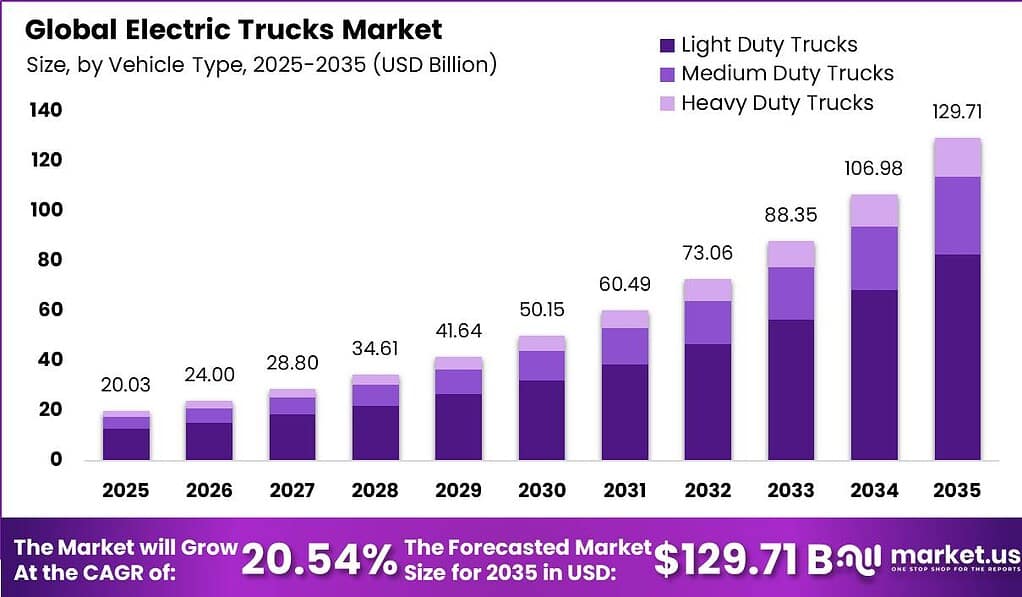
Global Electric Trucks Market size is expected to be worth around USD 129.71 Billion by 2035 from USD 20.03 Billion in 2025, growing at a CAGR of 20.54% during the forecast period 2026 to 2035. Data from IEA shows global electric truck sales more than doubled in 2025 compared with 2024, reaching 9% of all truck sales worldwide. This inflection signals that fleet operators and logistics companies must accelerate procurement planning now to avoid paying higher costs as scale drives up demand for battery supply and charging infrastructure.
The electric trucks market covers battery-electric, hybrid-electric, and hydrogen fuel cell commercial vehicles designed to replace diesel powertrains across freight, logistics, and municipal applications. This market spans light duty trucks used in urban delivery, medium duty trucks handling regional freight, and heavy duty trucks operating long-haul and intermodal routes. Propulsion technology, vehicle range, application type, and vehicle weight class define the core structural segments that shape investment decisions across this market.
Key Takeaways
- The Global Electric Trucks Market was valued at USD 20.03 Billion in 2025 and is forecast to reach USD 129.71 Billion by 2035, growing at a CAGR of 20.54%.
- Light Duty Trucks dominate the By Vehicle Type segment with a 63.90% share, reflecting the scale of urban last-mile and delivery fleet electrification.
- Battery Electric Vehicle (BEV) leads the By Propulsion Type segment with a 65.00% share, driven by the maturity of lithium-ion battery technology and expanding charging networks.
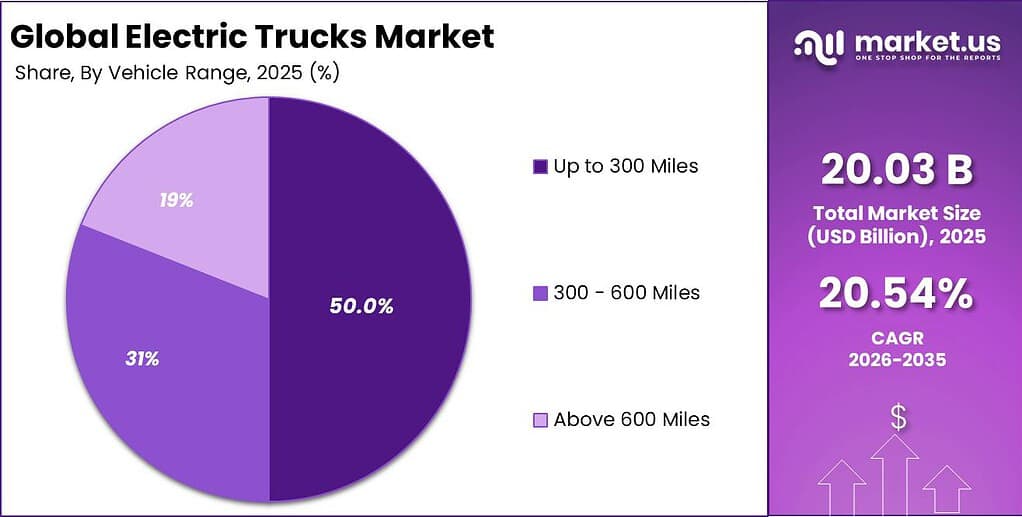
- The Up to 300 Miles range band holds the largest share in the By Vehicle Range segment at 50.00%, matching the operational profiles of most urban and regional fleet cycles.
- Last-Mile Delivery leads the By Application segment with a 24.20% share, anchored by e-commerce volume growth and urban emission restrictions.
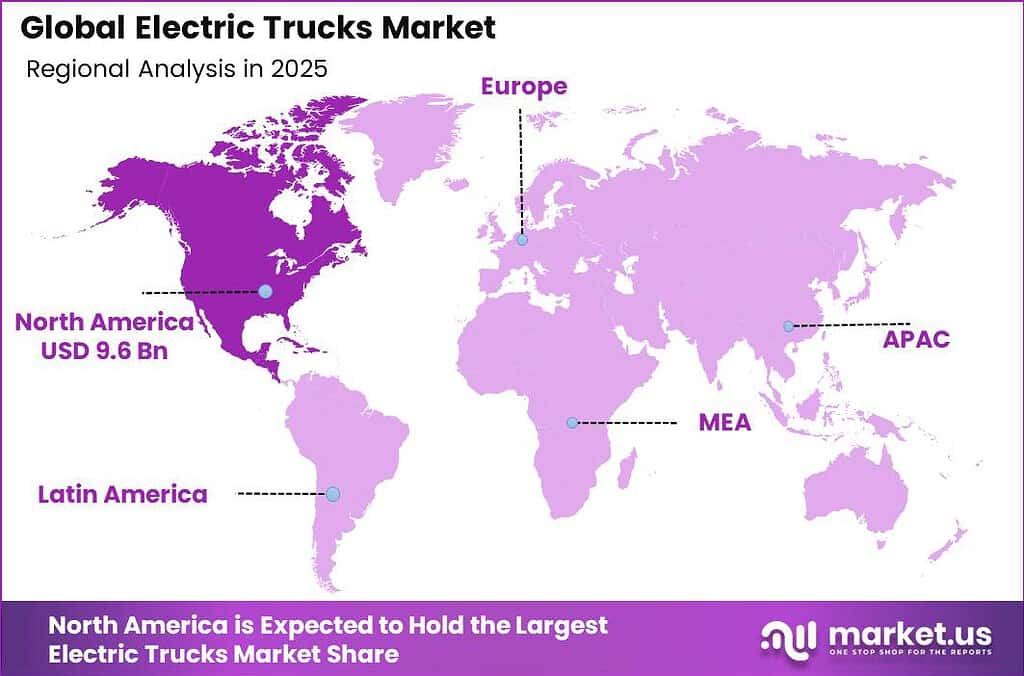
- North America dominates the regional landscape with a 48.00% share, valued at USD 9.60 Billion in 2025.
Government investment and binding emissions regulation now function as primary demand accelerators across major markets. As per our research, the United States, European Union, and China have each embedded electric truck adoption targets within their broader freight decarbonization frameworks, creating mandatory timelines that force fleet operators to act rather than wait. This regulatory pressure converts latent interest in electric trucks into contracted purchase orders, giving manufacturers a firmer demand signal to scale production capacity.
As per our research, in August 2025, India’s NITI Aayog proposed saturating 5 cities with 100% electric buses, paratransit, and e-freight vehicles, signaling the start of a government-led electric truck push in one of the world’s largest commercial vehicle markets. India’s entry into structured policy support broadens the total addressable market beyond the current China, EU, and US concentration. This means suppliers and infrastructure investors now have a fourth major market with a defined adoption roadmap to plan around.
According to IEA data, the direct fuel costs of operating a battery electric heavy-duty truck run almost 70% lower than the diesel equivalent in China and about one-third lower in the EU and US. This total cost of ownership advantage is now large enough to survive fuel price fluctuations and policy uncertainty. As a result, logistics operators managing large fleets face a financial case for electrification that is independent of subsidy support, which structurally strengthens long-run demand. In 2024, American companies deployed more than 15,000 medium- and heavy-duty electric vehicles onto US roads, confirming that conversion from commercial interest to large-scale fleet deployment is already underway.
Vehicle Type Analysis
Light Duty Trucks dominates with 63.90% due to high urban delivery fleet volumes.
In 2025, Light Duty Trucks held a dominant market position in the By Vehicle Type segment of the Electric Trucks Market, with a 63.90% share. According to the International Trade Administration, urban parcel and e-commerce delivery volumes drove the deployment of light commercial electric vehicles, with the US alone registering hundreds of thousands of light duty commercial vehicle units annually. Fleet operators running high daily mileage in urban zones achieve the fastest payback on electric light trucks, making this the segment with the lowest adoption barrier and the clearest near-term returns for manufacturers and charging infrastructure providers.
Pickup Trucks represent a fast-growing sub-segment within light duty vehicles, backed by strong North American consumer and fleet demand for capable electric alternatives to conventional half-ton workhorses. According to the Edison Electric Institute, fleet electrification programs at utilities and municipalities have begun targeting pickup trucks for service and inspection roles, where route predictability aligns well with current battery range. Delivery Vans and Panel Vans round out the light duty tier, with last-mile logistics operators deploying these platforms at depot scale, creating concentrated charging demand at distribution centers and enabling operators to negotiate bulk energy pricing.
Medium Duty Trucks represent the fastest-growing sub-segment in this market, capturing regional distribution and vocational roles where heavier payloads than light duty trucks are needed but long-haul range is not required. According to ICCT’s July 2025 technical briefing on India’s electric truck transition, EKA’s 7T rigid electric truck carries a 129 kWh battery and delivers a 200 km range, illustrating how medium duty platforms are being engineered for predictable regional routes. Box Trucks and Utility Trucks drive medium duty adoption in food service, construction supply, and municipal utility sectors, where operators benefit from lower maintenance costs and fixed depot charging.
Heavy Duty Trucks anchor long-haul and intermodal freight applications and represent the segment with the largest per-unit revenue contribution, even as their overall share within the electric truck market remains below light and medium duty categories. According to corporate annual reports and SEC filings from major OEMs, production commitments for electric semi-trailer trucks have accelerated across North America, Europe, and China. Dump Trucks and Refuse Trucks serve specialized vocational functions where fixed routes and depot-based operations reduce range anxiety, making them structurally well-suited for early electrification despite their high gross vehicle weights.
Propulsion Type Analysis
Battery Electric Vehicle (BEV) dominates with 65.00% due to mature lithium-ion battery supply chains.
In 2025, Battery Electric Vehicle (BEV) held a dominant market position in the By Propulsion Type segment of the Electric Trucks Market, with a 65.00% share. According to IEA Global EV Outlook 2026, battery-electric heavy trucks captured 22% of new heavy-duty sales in China in H1 2025, up from approximately 9% in H1 2024, demonstrating how fast BEV share can shift once charging infrastructure and cost structures align. Manufacturers with established lithium-ion supply chains are positioned to benefit most from this share acceleration, as battery procurement scale directly translates into lower unit costs and higher production margins.
Lithium-ion NMC Battery and Lithium Iron Phosphate (LFP) Battery are the two dominant chemistry sub-segments within BEV, each offering a different balance of energy density and cycle durability. According to UNIDO industrial output data, LFP battery production has grown sharply in China, where domestic chemistry advantages give Chinese OEMs a cost edge over NMC-focused competitors in Western markets. Fleet operators choosing between NMC and LFP must weigh range requirements against cycle life and thermal stability, a decision that directly shapes total cost of ownership over a five to seven year fleet replacement cycle.
Hybrid Electric Vehicles (HEV), covering both Plug-in Hybrid Powertrain and Mild Hybrid Powertrain variants, serve as a transitional category for fleet operators unable to commit to full electrification due to range requirements or depot charging constraints. According to the World Bank’s transport sector data, hybrid commercial vehicles have found a structural role in markets where grid reliability is insufficient for depot charging and where route variability makes pure-BEV range planning difficult. This segment retains commercial relevance in emerging markets and mixed-terrain freight corridors where full electrification infrastructure has not yet been deployed.
Hydrogen Fuel Cell Electric Vehicles (FCEV) represent the fastest-growing propulsion sub-segment, with Hydrogen Storage Tank Systems and Fuel Cell Stack components forming the core technology architecture. According to the IEA, FCEV trucks are being positioned for long-haul and heavy payload applications where battery weight and charging time create operational penalties. Several national governments in Europe and Asia have committed hydrogen infrastructure investment specifically for freight corridors, creating a defined but narrow execution window for early movers in FCEV truck manufacturing and hydrogen logistics supply.
Vehicle Range Analysis
Up to 300 Miles dominates with 50.00% due to match with urban and regional duty cycles.
In 2025, the Up to 300 Miles range band held a dominant market position in the By Vehicle Range segment of the Electric Trucks Market, with a 50.00% share. According to the ITU and national customs databases tracking commercial EV registrations, the majority of urban and regional freight routes fall within this band, making sub-300-mile battery configurations the commercial sweet spot for most current fleet operators. Manufacturers who optimize battery weight and cost for this range tier capture the largest addressable share of the electric truck replacement cycle in depot-based logistics operations.
The 300 to 600 Miles range band is the fastest-growing category in this segment, reflecting an expansion of use cases beyond urban delivery into regional haul and intermodal connections. According to corporate annual reports from major OEMs, several heavy-duty electric truck platforms targeting this range band are now entering commercial production, with battery architecture advances enabling the jump without proportional weight penalties. Fleet operators managing mixed urban and regional routes are increasingly specifying trucks in this range to consolidate their electric and diesel fleets into a single platform, reducing operational complexity and driver retraining costs.
The Above 600 Miles range band addresses long-haul freight, where battery size and charging time historically created the greatest barriers to electrification. According to Scania’s published MCS technical documentation, the Megawatt Charging System supports up to 3.75 MW per connector, enabling a truck battery to charge from 20% to 80% in under 30 minutes, which fits within mandatory EU and US driver rest periods. This charging speed development makes above-600-mile electric trucks operationally viable for the first time on long-haul corridors, opening a previously locked segment to electrification investment.
Application Analysis
Last-Mile Delivery dominates with 24.20% due to fixed urban routes and depot charging fit.
In 2025, Last-Mile Delivery held a dominant market position in the By Application segment of the Electric Trucks Market, with a 24.20% share. According to UN Comtrade trade flow data for light commercial electric vehicles, e-commerce and parcel delivery operators have deployed electric vans and light trucks at scale in urban logistics networks across North America, Europe, and China. E-commerce Delivery and Parcel and Package Delivery are the two primary sub-segments driving this share, with major logistics operators placing large forward purchase commitments to meet urban emission zone requirements.
Long-Haul Freight encompasses Intermodal Freight and Cross-Border Freight applications, where payload capacity, range, and uptime requirements have historically favored diesel powertrains. According to ITC Trade Map data on commercial vehicle trade flows, cross-border electric truck deployments remain limited by inconsistent charging standards and regulatory differences between countries, creating a structural constraint on adoption in this sub-segment. Operators investing early in long-haul electric trucks will face higher operational complexity but gain first-mover positioning as infrastructure and standards converge over the next three to five years.
Municipal and Utility Services is the fastest-growing application in this market, covering Refuse Trucks and Street Sweepers operating on fixed daily urban routes with predictable depot return cycles. According to UNIDO municipal equipment output statistics, refuse truck replacement cycles in Europe and North America are now aligning with electric powertrain availability, creating a procurement wave that is accelerating this segment’s share gain. The fixed-route and depot-charging profile of municipal fleets eliminates the range anxiety barrier, making this one of the structurally easiest segments to electrify at scale.
Refrigerated Trucks and Specialty Vocational Vehicles represent the remaining application categories, where additional power draw from cooling systems and specialized equipment creates unique battery sizing and thermal management challenges. According to FAO cold chain logistics data, the refrigerated freight sector has begun piloting electric truck deployments on short-haul routes where the energy cost of refrigeration is predictable and manageable within current battery capacities. These sub-segments hold significant long-term potential but require tailored engineering solutions before they achieve mainstream adoption rates.
Key Market Segments
By Vehicle Type
- Light Duty Trucks
- Pickup Trucks
- Delivery Vans
- Panel Vans
- Medium Duty Trucks
- Box Trucks
- Utility Trucks
- Heavy Duty Trucks
- Semi-Trailer Trucks
- Dump Trucks
- Refuse Trucks
By Propulsion Type
- Battery Electric Vehicle (BEV)
- Lithium-ion NMC Battery
- Lithium Iron Phosphate (LFP) Battery
- Hybrid Electric Vehicle (HEV)
- Plug-in Hybrid Powertrain
- Mild Hybrid Powertrain
- Hydrogen Fuel Cell Electric Vehicle (FCEV)
- Hydrogen Storage Tank Systems
- Fuel Cell Stack
By Vehicle Range
- Up to 300 Miles
- 300 – 600 Miles
- Above 600 Miles
By Application
- Last-Mile Delivery
- E-commerce Delivery
- Parcel and Package Delivery
- Long-Haul Freight
- Intermodal Freight
- Cross-Border Freight
- Municipal and Utility Services
- Refuse Trucks
- Street Sweepers
- Others
- Refrigerated Trucks
- Specialty Vocational Vehicles
Regional Analysis
North America Dominates the Electric Trucks Market with a Market Share of 48.00%, Valued at USD 9.60 Billion
North America holds the largest share of the global electric trucks market at 48.00%, valued at USD 9.6 Billion in 2025. This position reflects the scale of US fleet electrification commitments, federal clean truck incentive programs, and the density of logistics infrastructure that supports depot-based charging deployment. Fleet operators in the US benefit from a mature financing ecosystem and a competitive OEM landscape, making North America the single most important market for manufacturers targeting volume-scale commercial truck electrification.
Europe represents the fastest-growing regional market, driven by binding CO2 standards for new heavy-duty vehicles that create non-discretionary fleet replacement timelines. As reported by ICCT, nearly 24,000 electric trucks and buses were registered across Europe in 2025, a 60% increase from 2024, with zero-emission trucks reaching a sales share of 4.5%, up from 2.5% in 2024. In the EU-27 specifically, 9,000 zero-emission medium trucks and vans were sold out of 42,800 total units in 2025, representing a 21% share, up from 10% the prior year. In June 2025, Denmark expanded its national electric truck funding scheme from DKK 75 Million to DKK 425 Million for 2025 to 2026, and extended eligibility to companies using leased vehicles, broadening access beyond owner-operators and accelerating fleet conversion rates across smaller logistics businesses.
Asia Pacific, led by China, is delivering the most dramatic volume growth of any region. According to IEA data, battery-electric heavy trucks captured 22% of new heavy-duty truck sales in China in the first half of 2025, rising from approximately 9% in H1 2024, and climbed further to 28% of new sales by August 2025. This trajectory places China on course to account for the majority of global electric truck volume within this forecast period, giving Chinese OEMs a cost and scale advantage that will shape competitive dynamics in export markets across Southeast Asia, Latin America, and the Middle East.
Key Regions and Countries
North America
- US
- Canada
Europe
- Germany
- France
- The UK
- Spain
- Italy
- Rest of Europe
Asia Pacific
- China
- Japan
- South Korea
- India
- Australia
- Rest of APAC
Latin America
- Brazil
- Mexico
- Rest of Latin America
Middle East and Africa
- GCC
- South Africa
- Rest of MEA
Market Dynamics
Market Opportunity Analysis - Underserved range segments and emerging market policy waves unlock next-phase adoption
The Above 600 Miles range band remains largely underserved despite the deployment of MCS charging infrastructure capable of delivering 3.75 MW per connector and charging a truck battery from 20% to 80% in under 30 minutes. Long-haul operators have historically treated range as a disqualifying barrier. However, as MCS infrastructure scales along primary freight corridors, this segment will become commercially accessible, rewarding OEMs and charging network developers who establish depot and corridor positions now before competition intensifies.
The Municipal and Utility Services application is the fastest-growing segment by adoption rate, yet per-unit infrastructure investment in fleet electrification for municipal operators remains below the spending levels seen in private logistics. A large purpose-built public truck charging station in the US costs USD 20 to 60 Million depending on scale and grid works. Municipal procurement cycles and public budget timelines have slowed charging infrastructure deployment for this segment, creating an entry window for infrastructure developers and financing intermediaries who can structure public-private partnerships around municipal fleet electrification programs.
India represents the clearest underexploited geographic opportunity in this market. Medium Duty Trucks serving regional Indian freight routes are beginning to gain structured policy attention, with EKA’s 7T electric truck platform demonstrating operational viability at 200 km range per charge. The Indian government’s proposed e-freight vehicle saturation program across 5 cities creates a defined policy trigger that does not yet have a corresponding private charging infrastructure commitment. Investors and OEMs entering India’s electric truck segment now face a first-mover landscape with limited incumbent competition and a growing subsidy framework.
The Hydrogen Fuel Cell Electric Vehicle sub-segment remains underpenetrated relative to its stated potential in long-haul and heavy payload roles. National hydrogen infrastructure commitments in Europe and several Asian markets provide a policy foundation, but commercially deployed hydrogen truck corridors are still limited. By contrast, battery-electric platforms are scaling rapidly across the same routes, compressing the window for FCEV to establish a structural role. Early movers in hydrogen truck manufacturing who secure anchor customer commitments and co-invest in hydrogen supply infrastructure will define whether this sub-segment achieves durable market share or remains a niche.
Technology and Innovation Landscape - Charging speed, powertrain efficiency, and lifecycle cost advantages redefine electric truck competitiveness
The Megawatt Charging System represents the most significant charging technology advancement in this market cycle. According to Scania’s MCS technical documentation, MCS supports up to 3.75 MW per connector, roughly 10 times faster than the CCS2 standard which typically delivers up to 350 to 400 kW. This speed advantage directly solves the operational objection that charging time cannot fit within logistics schedules, enabling heavy-duty trucks to recharge during mandatory driver rest periods and removing the last major operational barrier to long-haul electrification at scale.
Battery electric truck maintenance costs represent a structural cost advantage that compounds over the asset lifecycle. According to ICCT data, battery-electric trucks carry the lowest per-kilometre maintenance costs of any powertrain in the US at approximately $0.11/km versus $0.15/km for diesel and $0.19/km for natural gas, making EV maintenance costs an estimated 40% lower than an equivalent internal combustion engine fleet overall. This cost differential widens as fleet age increases, giving operators who electrify earlier a compounding margin advantage over diesel-incumbent competitors.
Regenerative braking technology delivers a specific and quantifiable maintenance benefit that strengthens the total cost of ownership case for electric truck fleets. According to 7gen comparative EV and ICE maintenance analysis, regenerative braking reduces brake wear by 50 to 70% on electric trucks, enabling EV brakes to last up to 200,000 km, more than triple the lifespan typical of diesel-powered vehicles. This extended brake life directly reduces scheduled maintenance downtime and replacement part costs, two of the highest-frequency cost items in commercial fleet operations.
Lifecycle emissions performance is now a quantifiable metric that affects fleet procurement decisions, not just a sustainability claim. As reported by go-e magazine data, electric trucks cut CO₂ emissions by 60 to 90% over their operational lifecycle and produce zero tailpipe emissions, with premium models in 2026 offering a range of up to 400 to 500 miles. Corporates with science-based emissions targets are now specifying lifecycle CO₂ performance in fleet RFPs, making emissions reduction a procurement criterion that advantages electric truck manufacturers who can demonstrate verified lifecycle data.
Drivers
Global electric truck sales more than doubled in 2025, reaching 9% of all truck sales worldwide and surpassing approximately 400,000 units for the first time. This fifth consecutive year of growth has moved electric trucks from pilot fleets into meaningful shares of new registrations across leading markets. Policy scenarios from IEA and major transport analysts indicate that electric vans, trucks, and cars could together exceed a 50% share of global sales by around 2035, confirming that today’s 9% truck share is an early inflection point rather than a ceiling.
| Driver | (~) % Impact on CAGR Forecast | Geographic Relevance | Impact Timeline |
|---|---|---|---|
| Rapid growth in electric truck sales share | +4.5% | Global | Short term (≤ 2 years) |
| EU and national CO2 standards for heavy-duty vehicles | +3.0% | Europe | Medium term (2–4 years) |
| Favorable total cost of ownership vs diesel | +2.8% | Asia, Europe | Medium term (2–4 years) |
| Fleet electrification commitments by logistics operators | +2.2% | North America, Europe | Medium term (2–4 years) |
Restraints
Electric trucks carry an upfront purchase-price premium over comparable diesel units in most markets. Targeted subsidies bridge only a portion of this gap. As per our research, one incentive scheme caps support at roughly 10% of ex-factory cost, covering approximately 15% of the price delta between diesel and electric trucks. This leaves the majority of the premium for fleet operators to absorb, and capital budgeting rules, credit access limits, and conservative risk thresholds slow large-scale diesel fleet replacement even where lifetime savings are clear.
Total cost of ownership analyses confirm per-truck savings of approximately USD 157,126 over six years for long-haul duty cycles, with payback achieved after roughly 1,051,200 kilometres. This payback horizon remains too long for operators managing short asset replacement cycles or thin credit margins. This restraint compresses near-term adoption and subtracts an estimated 3.8% from the baseline CAGR of 20.54%, without reversing overall market growth.
| Restraint | (~) % Impact on CAGR Forecast | Geographic Relevance | Impact Timeline |
|---|---|---|---|
| Upfront cost gap and limited incentive coverage | -3.8% | Global | Short term (≤ 2 years) |
| Battery and component supply prioritized for passenger EVs and AI | -2.6% | Global | Medium term (2–4 years) |
| Sparse heavy-duty charging infrastructure on freight corridors | -2.1% | North America, emerging markets | Medium term (2–4 years) |
Challenges
European CO2 standards for new heavy-duty vehicles mandate a 45% reduction in average emissions from large trucks and buses by 2030, rising to 65% by 2035 and approximately 90% by 2040 versus 2019 baselines. Several major manufacturers are already on track to meet the initial 15% reduction target for 2025. This creates an ongoing revenue opportunity in compliance-aligned product lines, as OEMs that hit interim targets ahead of schedule can redirect capital into the next compliance tier rather than remediation.
Aligning product planning, production capacity, and fleet offerings with progressively stricter trajectories requires sustained investment and complex portfolio management across electric, fuel cell, and efficiency-enhanced conventional models. Some policy and industry groups are urging interim targets as high as 65% by 2030 and full zero-emission sales by 2040 for all truck types. This regulatory path imposes continuous compliance risk and capital-allocation trade-offs, creating a friction drag on the market’s maximum achievable growth of roughly 2.9% against the baseline CAGR of 20.54%.
| Challenge | (~) % CAGR Friction Drag | Geographic Relevance | Mitigation Horizon |
|---|---|---|---|
| Stringent multi-stage CO2 reduction trajectories for HDVs | -2.9% | Europe | Long term (≥ 4 years) |
| Operational integration of electric trucks into existing logistics networks | -2.0% | Global | Medium term (2–4 years) |
| Grid capacity and depot electrification constraints | -1.7% | North America, Europe | Medium term (2–4 years) |
Opportunities
Large-scale rollout of megawatt-level depot chargers and corridor fast-charging for heavy trucks represents the largest untapped opportunity in this market. Fleet operators running intensive duty cycles can fully exploit operating-cost advantages once charging infrastructure is in place, shortening payback periods toward the 3 to 4 year range highlighted in multiple total cost of ownership analyses. Building high-capacity charging at key freight depots and highway nodes enables margin expansion through lower fuel and maintenance costs as a fraction of revenue.
This infrastructure build-out requires coordinated multi-year investment and policy support rather than incremental truck-by-truck decisions, creating sizable white space in the electric trucks addressable market. Corridor megawatt charging networks carry realistic potential to add around 3.4% upside to the baseline CAGR of 20.54% if executed at scale in leading freight corridors. Innovative financing and fleet-leasing models can add a further 2.7% potential CAGR upside by unlocking adoption among operators constrained by capital budgets rather than operational conviction.
| Opportunity | (~) % Potential CAGR Upside | Geographic Relevance | Execution Window |
|---|---|---|---|
| Depot and corridor megawatt charging networks for heavy trucks | +3.4% | North America, Europe, China | Medium term (2–4 years) |
| Innovative financing and fleet-leasing models to bridge upfront cost | +2.7% | Global | Short term (≤ 2 years) |
| Route-optimized TCO-driven electrification in regional haul segments | +2.1% | Asia, Europe | Medium term (2–4 years) |
Key Company Insights
BYD Company Limited holds the strongest structural position in the global electric truck market, with vertically integrated battery, powertrain, and vehicle manufacturing giving it a cost floor that competitors cannot easily match. BYD’s in-house LFP battery production insulates its margins from third-party supply volatility. Based on real-world operational data from 10 battery electric trucks across 471,102 data entries, the economic driving speed of a battery electric truck is 52.02 km/h, at which minimum energy consumption reaches 0.53 kWh/km, a benchmark that BYD’s platform engineering targets directly.
AB Volvo (Volvo Group) holds a differentiated position through its early commitment to heavy-duty long-range electric trucks, with production spanning both Europe and North America. Volvo’s established dealer and service network across key freight markets provides a deployment advantage that pure-EV startups cannot replicate quickly. In May 2026, Volvo Trucks announced a global product launch of new battery-electric heavy-duty trucks, including a long-range model with up to 700 km electric range on one charge, to be produced in Gothenburg and Ghent, with rollout starting in 2026.
Key Players
- BYD Company Limited
- AB Volvo (Volvo Group)
- Ford Motor Company
- Rivian Automotive, Inc.
- Dongfeng Motor Corporation
- Daimler Truck AG
- Tesla, Inc.
- PACCAR Inc.
- Scania AB
- Tata Motors Limited
Recent Developments
- May 2026: Volvo Trucks announced a global product launch of new battery-electric heavy-duty trucks, including a long-range model with up to 700 km electric range on one charge, to be produced in Gothenburg and Ghent with rollout starting in 2026.
- August 2025: Huawei opened a heavy-duty truck megawatt supercharging station in Beichuan, China, with 18 bays rated at 1.44 MW and 108 bays at 600 kW, capable of serving around 700 trucks per day and delivering over 300,000 kWh of energy daily, at a construction cost of USD 20.9 Million.
Geopolitical Impact Analysis
Trade policy tensions between the US and China are reshaping the competitive structure of the electric truck market. According to WTO trade monitoring data, US tariffs on Chinese electric vehicles have reached levels that effectively price Chinese-manufactured electric trucks out of direct export competition in North America. This creates a protected demand environment for US and European OEMs in their home markets, but it also raises battery and component input costs, since Chinese suppliers account for a dominant share of global lithium-ion cell and LFP cathode material production, and tariff pass-through is adding cost pressure to non-Chinese manufacturers.
Energy price volatility driven by geopolitical disruptions in key fossil fuel supply regions is accelerating the total cost of ownership advantage for electric trucks. According to IMF commodity market data, diesel price swings of 20 to 30% within single calendar years have become more frequent since 2022, compressing diesel fleet operator margins unpredictably. By contrast, electricity prices for industrial consumers in major markets have shown lower volatility over the same period. This asymmetry in energy price risk is pushing fleet operators toward electric trucks as a hedge against diesel price uncertainty, adding a geopolitical risk-management dimension to procurement decisions that reinforces the structural demand outlook.
Report Scope
| Report Features | Description |
|---|---|
| Market Value (2025) | USD 20.03 Billion |
| Forecast Revenue (2035) | USD 129.71 Billion |
| CAGR (2026-2035) | 20.54% |
| Base Year for Estimation | 2025 |
| Historic Period | 2020-2024 |
| Forecast Period | 2026-2035 |
| Report Coverage | Revenue Forecast, Market Dynamics, Market Opportunity Analysis, Technology and Innovation Landscape, Competitive Landscape, Recent Developments |
| Segments Covered | By Vehicle Type (Light Duty Trucks, Medium Duty Trucks, Heavy Duty Trucks), By Propulsion Type (Battery Electric Vehicle, Hybrid Electric Vehicle, Hydrogen Fuel Cell Electric Vehicle), By Vehicle Range (Up to 300 Miles, 300 to 600 Miles, Above 600 Miles), By Application (Last-Mile Delivery, Long-Haul Freight, Municipal and Utility Services, Others) |
| Regional Analysis | North America (US and Canada), Europe (Germany, France, The UK, Spain, Italy, and Rest of Europe), Asia Pacific (China, Japan, South Korea, India, Australia, and Rest of APAC), Latin America (Brazil, Mexico, and Rest of Latin America), Middle East and Africa (GCC, South Africa, and Rest of MEA) |
| Competitive Landscape | BYD Company Limited, AB Volvo (Volvo Group), Ford Motor Company, Rivian Automotive Inc., Dongfeng Motor Corporation, Daimler Truck AG, Tesla Inc., PACCAR Inc., Scania AB, Tata Motors Limited |
| Customization Scope | Customization for segments, region / country-level will be provided. Additional customization can be done based on requirements. |
| Purchase Options | We have three licenses to opt for: Single User License | Multi-User License (Up to 5 Users) | Corporate Use License (Unlimited User and Printable PDF) |





































