


Report Overview
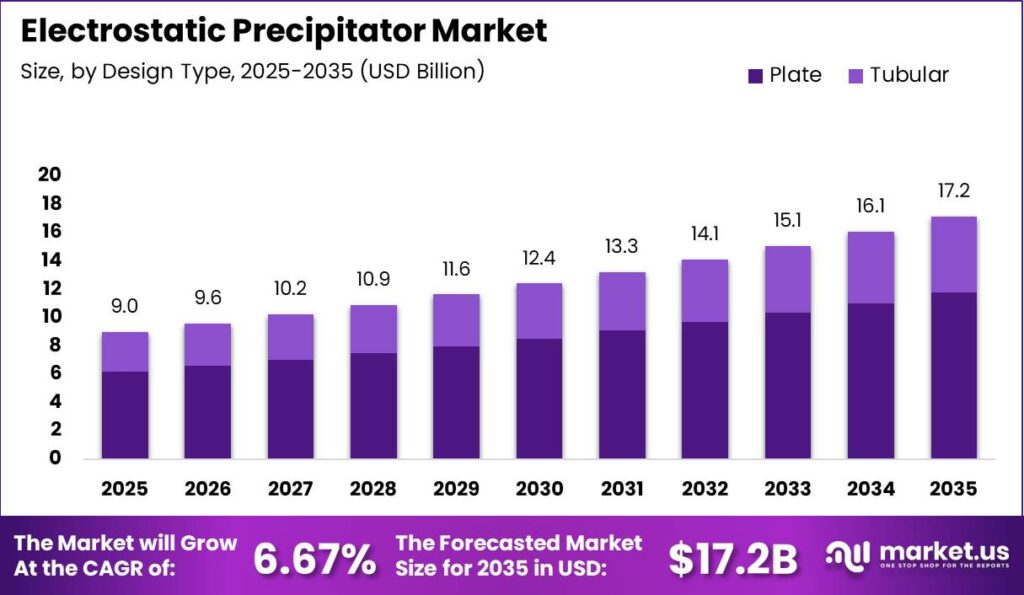
Global Electrostatic Precipitator Market size is expected to be worth around USD 17.2 Billion by 2035 from USD 9.00 Billion in 2025, growing at a CAGR of 6.67% during the forecast period 2026 to 2035.
The Electrostatic Precipitator Market encompasses industrial particulate collection systems that use high-voltage electric fields to remove dust, ash, and aerosol contaminants from flue gas streams. These systems serve power generation, metals processing, cement production, and chemical manufacturing. The market spans four core segment groups: design type, collection type, component, and end-use application. Vendors supply complete units, individual components, and lifecycle services including installation, maintenance, and digital monitoring software.
Key Takeaways
- The global Electrostatic Precipitator Market is valued at USD 9.00 Billion in 2025 and is forecast to reach USD 17.2 Billion by 2035 at a CAGR of 6.67%.
- By Design, Plate type dominates with a 68.60% share, driven by superior collection plate surface area in large-scale utility installations.
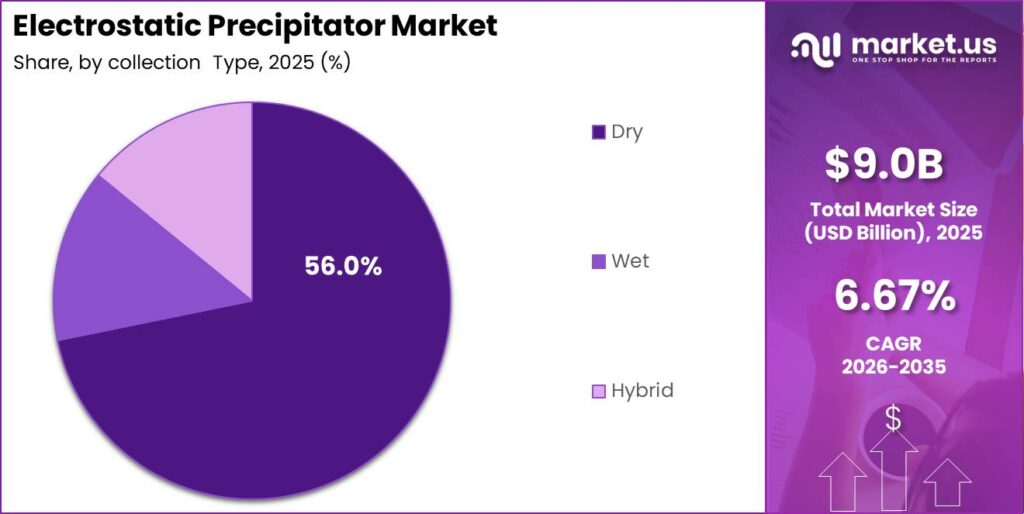
- By Collection Type, Dry collection leads with a 56.00% share, reflecting its entrenched position in coal-fired and industrial power applications.
- By Component, Hardware holds the largest segment share at 51.10%, anchored by discharge electrodes, collection plates, and power supply units.
- By Application, Power Generation commands a 39.80% share, with coal-fired and biomass plants representing the core installed base.
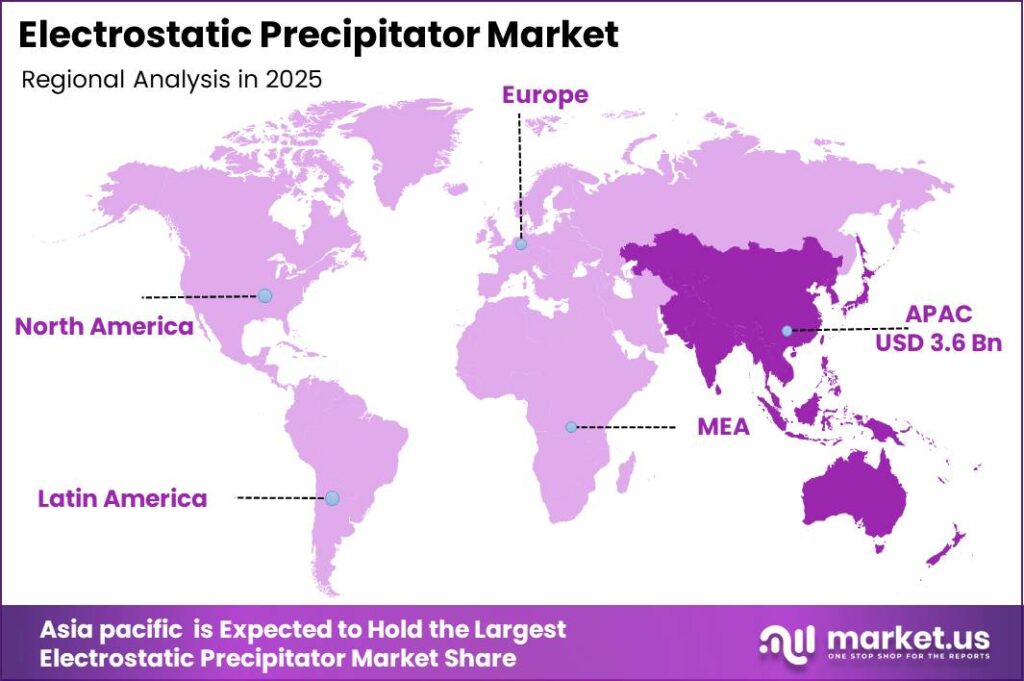
- Asia Pacific leads all regions with a 40.50% share, valued at USD 3.60 Billion, driven by industrial expansion in China and India.
As per our research, approximately 95% of utility particulate control systems in the United States use electrostatic precipitators for fly ash collection from coal-fired power plants. This near-universal adoption reflects decades of infrastructure lock-in at the utility level. New entrants face a service and retrofit opportunity rather than a greenfield displacement challenge, making aftermarket positioning more commercially viable than competing on new-unit sales alone.
Data from the US EPA shows dry wire-pipe ESPs achieve 99.0% to 99.9% removal efficiency when newly installed, with inlet concentrations measured at 510 to 1,400 mg/Nm³ reduced to as low as 2.3 to 6.4 mg/Nm³ at outlet in fluidized-bed combustion applications. This performance range gives end-users a quantifiable compliance baseline against tightening filterable PM standards. Vendors that can certify outlet performance within this range will hold a direct procurement advantage as regulatory thresholds compress further across North America and Europe.
In April 2026, Babcock and Wilcox secured more than USD 21 million in fuel-switching technology awards while reporting increased demand for its environmental products and plant services. This signals that industrial clients are actively funding emission control upgrades alongside fuel transition programs. Suppliers that bundle precipitator servicing with fuel-switching advisory services will capture incremental contract value beyond standard maintenance agreements.
Design Analysis
Plate dominates with 68.60% due to large-area ash collection in utilities.
In 2025, Plate Electrostatic Precipitators held a dominant market position in the By Design segment of the Electrostatic Precipitator Market, with a 68.60% share. The US Energy Information Administration recorded over 200 gigawatts of coal-fired generating capacity still operating across Asia and North America as of 2024, nearly all fitted with plate-type collection geometry. This entrenched base translates directly into a multi-decade retrofit and service pipeline that competitors cannot displace without matching flat-plate fabrication scale.
Tubular Electrostatic Precipitators represent the fastest-growing design configuration. The International Energy Agency catalogued over 2,000 active industrial chemical and petrochemical processing sites globally requiring aerosol and acid-mist control, applications where tubular geometry provides superior concentric flow uniformity. This structural fit between tubular design and corrosive-gas processing environments positions vendors with tubular fabrication capability to capture premium-specification orders as chemical output capacity expands across Asia and the Middle East.
Collection Type Analysis
Dry collection dominates with 56.00% due to coal-plant fly-ash compatibility.
In 2025, Dry Electrostatic Precipitators held a dominant market position in the By Collection Type segment of the Electrostatic Precipitator Market, with a 56.00% share. The US EIA reported that coal and biomass combustion accounted for approximately 36% of global electricity generation as of 2023, sustaining large-volume dry-collection demand across Asia, Eastern Europe, and parts of Latin America. This generation base sustains procurement volumes for rigid electrode and weighted wire dry ESP configurations across multiple utility and industrial verticals.
Rigid Electrode Dry ESPs represent one established sub-type within the dry collection segment. UNIDO industrial output data shows steel and cement combined employed over 3,500 large-format kilns and smelters globally that require high-temperature dry particulate control. This concentration of heavy-industrial capacity means rigid electrode configurations command long-term service contracts, making them low-churn revenue assets for vendors with established field-engineering teams.
Weighted Wire Dry ESPs serve utility and mid-scale industrial boiler applications where cost-per-unit-throughput drives procurement decisions. The World Bank’s energy infrastructure data identifies over 900 active thermal power units in South and Southeast Asia operating below 300 MW capacity, a size class where weighted-wire configurations offer procurement cost advantages over rigid electrode designs. This capacity tier represents the primary volume growth pocket for competitively priced dry ESP equipment in emerging markets.
Wet Electrostatic Precipitators address corrosive and sticky aerosol streams where dry designs fail. Hybrid configurations combining dry and wet stages represent the fastest-growing collection type. The IEA tracked over 600 waste-to-energy and industrial biomass plants operating or under construction in Europe and Japan as of 2024, many requiring wet or hybrid particulate control for variable-moisture flue gas. Flooded wet ESP and dry-wet hybrid configurations hold the remaining share of this segment collectively, serving chemical and non-ferrous smelting applications.
Component Analysis
Hardware dominates with 51.10% due to scale of physical collection infrastructure.
In 2025, Hardware held a dominant market position in the By Component segment of the Electrostatic Precipitator Market, with a 51.10% share. UN Comtrade trade flow data shows global exports of industrial air-pollution control equipment parts, including discharge electrodes and collection plates, exceeded USD 4.2 billion annually as of 2023 under HS code 8421. This volume reflects the scale of physical infrastructure requirements across power and heavy industry, making hardware the structural revenue anchor for ESP manufacturers worldwide.
Services represent a high-recurring-revenue sub-segment within the component landscape. The International Trade Administration reported that aftermarket services for air pollution control systems account for approximately 30% to 40% of total lifecycle equipment spend in mature industrial markets. Installation and commissioning, along with maintenance and retrofit services, generate contract-based cash flows that stabilize supplier revenues against new-unit order cyclicality, a structural advantage over pure equipment fabrication businesses.
Software is the fastest-growing component sub-segment. ITU data on industrial digitization identifies over 18,000 large industrial sites globally having adopted some form of connected emissions monitoring as of 2024. Predictive maintenance and emissions monitoring software platforms convert ESP sensor data into subscription revenue, creating a recurring income layer that is structurally decoupled from new-unit capital cycles and commands materially higher margins than hardware fabrication.
Application Analysis
Power Generation dominates with 39.80% due to coal fleet’s high flue-gas volume.
In 2025, Power Generation held a dominant market position in the By Application segment of the Electrostatic Precipitator Market, with a 39.80% share. The IEA Global Energy Review documented that coal-fired power capacity globally totaled approximately 2,130 gigawatts as of 2023, representing the largest single source of industrial fly-ash particulate requiring collection. Coal-fired plants and biomass and waste-to-energy facilities together sustain the highest single-segment procurement volume for large-format plate-type and rigid-electrode ESP configurations.
Metal Processing and Steel applications represent a structurally significant secondary market. World Steel Association production data shows global crude steel output reached 1,888 million tonnes in 2023, with sinter plants and electric arc furnace off-gas among the highest-volume particulate-generating processes. This production scale sustains steady demand for high-temperature, high-capacity dry ESPs, and the ongoing capacity buildout in South and Southeast Asia extends this demand into new greenfield installations over the medium term.
Chemicals and Petrochemicals represent a precision-specification application requiring corrosion-resistant wet or hybrid ESP configurations. UNIDO chemical sector output data identifies over 1,200 large-scale refining and petrochemical complexes operating across Asia, the Middle East, and North America that require acid-mist and fine-aerosol control. Cement and Lime is the fastest-growing application segment, driven by construction capacity expansion across South Asia, and along with Chemicals and Petrochemicals holds the remaining application share collectively.
Key Market Segments
By Design
- Plate
- Tubular
By Collection Type
- Dry
- Rigid Electrode Dry ESP
- Weighted Wire Dry ESP
- Wet
- Rigid Electrode Wet ESP
- Flooded Wet ESP
- Hybrid
- Dry-Wet Hybrid Configuration
By Component
- Hardware
- Discharge Electrodes
- Collection Plates
- Power Supply Units
- Rapping Systems
- Services
- Installation and Commissioning
- Maintenance and Retrofit
- Software
- Predictive Maintenance Software
- Emissions Monitoring Software
By Application
- Power Generation
- Coal-Fired Power Plants
- Biomass and Waste-To-Energy Plants
- Metal Processing and Steel
- Chemicals and Petrochemicals
- Cement and Lime
Regional Analysis
Asia Pacific Dominates the Electrostatic Precipitator Market with a Market Share of 40.50%, Valued at USD 3.6 Billion
Asia Pacific holds the leading regional position in the global Electrostatic Precipitator Market, supported by the region’s concentration of coal-fired power capacity and heavy industrial output. As per our research, the region generated a market value of USD 3.6 Billion in 2025 on a 40.50% share. China and India anchor this dominance through large-scale thermal power fleets, steel sinter plants, and cement kilns, all of which require continuous high-capacity particulate control systems. Vendors with established manufacturing and field-service presence in these two countries hold a structural procurement advantage over international competitors shipping from outside the region.
Based on our research data, total ESP collection efficiency reached 99.2% to 99.8% during biomass and recovered-fuel combustion, and collection efficiency for particles in the difficult 0.1 to 2 μm size range measured at 96% to 97%. These performance benchmarks are directly relevant to Europe, where the EU’s circular-economy directives are accelerating waste-to-energy plant commissioning. Europe therefore represents the fastest-growing regional market, as its shift away from coal toward biomass and waste combustion generates demand for high-specification, corrosion-resistant ESP systems that command premium per-unit pricing.
North America maintains a structurally large installed base driven by its utility coal fleet, positioning the region as a major retrofit and service market rather than a greenfield opportunity. Latin America and the Middle East and Africa hold smaller collective shares, though industrial expansion in Brazil, Mexico, and Gulf petrochemical clusters is creating incremental demand for both new installations and emissions-control upgrades across cement, chemicals, and non-ferrous metals sectors.
Key Regions and Countries
North America
- US
- Canada
Europe
- Germany
- France
- The UK
- Spain
- Italy
- Rest of Europe
Asia Pacific
- China
- Japan
- South Korea
- India
- Australia
- Rest of APAC
Latin America
- Brazil
- Mexico
- Rest of Latin America
Middle East and Africa
- GCC
- South Africa
- Rest of MEA
Market Dynamics
Market Opportunity Analysis - Underserved industrial verticals and high-growth emerging regions offer entry points beyond the legacy coal-utility base
The Cement and Lime application segment is the fastest-growing end use in the Electrostatic Precipitator Market yet remains underserved relative to its installed base potential. Asia Pacific accounts for the largest regional share at 40.50%, but South and Southeast Asian cement capacity continues to expand faster than emission-control infrastructure. Vendors that position dry high-temperature ESP configurations specifically for cement kiln retrofits in India and Indonesia will capture first-mover share before global competitors fully redirect capacity from coal-utility order pipelines.
The Software component sub-segment is the fastest-growing within the component landscape, yet its penetration of the existing hardware-heavy installed base remains early-stage. Over 18,000 large industrial sites globally had adopted connected emissions monitoring as of 2024, per ITU data, but the majority of the installed ESP fleet still operates without predictive maintenance software layers. This gap represents a low-capital, high-margin expansion opportunity for vendors with existing field-service relationships and access to ESP sensor data streams.
The Wet and Hybrid collection type sub-segments collectively address corrosive, variable-moisture, and acid-mist applications that dry configurations cannot serve. Chemical and petrochemical complexes across the Gulf and North America represent an underexploited procurement base for wet precipitator configurations. These facilities require premium-specification corrosion-resistant units that command higher per-unit realized pricing. New entrants with wet ESP fabrication capability will face less incumbent competition than in the dry utility segment, where long-standing supplier relationships dominate procurement decisions.
Latin America and the Middle East and Africa hold smaller collective regional shares but carry meaningful growth potential as industrial infrastructure investment expands. Brazil’s growing steel and cement output and Gulf petrochemical capacity additions are creating new greenfield ESP installation requirements outside the Asia Pacific and North America markets where incumbents concentrate. Vendors that establish early distribution and field-service partnerships in these regions will build structural barriers before larger competitors redirect sales resources from contracting Western markets.
Technology and Innovation Landscape - Digital power supplies, IoT monitoring, and computational design optimization redefine ESP performance and service economics.
The migration from transformer-rectifier sets to high-frequency power supplies is the most commercially immediate technology transition in the ESP sector. High-frequency power supplies improve collection efficiency by reducing ripple voltage across discharge electrodes, which directly lowers particulate re-entrainment and outlet emissions. Vendors that offer high-frequency power supply retrofits alongside existing plate or tubular ESP configurations can accelerate aftermarket revenue without requiring full system replacement, a significant commercial advantage in markets where operators face compliance deadlines.
Industrial IoT sensor integration for real-time spark rate, opacity, and emissions monitoring is converting ESP operation from reactive maintenance into continuous performance management. This integration allows plant operators to detect collection field degradation before it triggers compliance violations, reducing unplanned downtime and regulatory penalty exposure. Vendors that embed proprietary IoT monitoring hardware into their ESP units create a data-driven switching cost, making replacement with a competitor’s system commercially unattractive once the monitoring layer is established.
Computational fluid dynamics-based ESP design optimization is enabling vendors to improve gas flow distribution inside precipitator housings without adding physical collection fields. This reduces material cost per unit while achieving higher collection efficiency, directly compressing fabrication cost and improving bid competitiveness. Companies investing in CFD-based engineering capability differentiate on technical performance in specification-led procurement processes where project engineers evaluate gas-flow uniformity data as a primary selection criterion alongside price.
Advanced discharge electrode retrofitting addresses two performance constraints simultaneously: energy consumption and particulate re-entrainment. Replacing legacy discharge electrodes with precision-geometry alternatives allows existing ESP housings to meet tighter PM standards without full system rebuilds. This creates a repeatable, medium-ticket aftermarket revenue stream for vendors with electrode fabrication capability, and it shortens the compliance pathway for plant operators facing the tightened fPM limits now active across North American and European regulatory frameworks.
Drivers
The US EPA MATS revision published in April 2024 cut the filterable PM standard from 0.030 to 0.010 lb per MMBtu and reduced the toxic-metals limit by 67% across all coal units. EPA compliance modeling attributed approximately 770 tons of annual PM2.5 abatement and around 96 million dollars in yearly compliance spend to this rule. This spend base channels directly into precipitator rebuilds and rigid-electrode conversions, shifting vendor revenue models from one-time equipment sales toward recurring performance-upgrade and parts-service contracts.
Aftermarket service contracts in this segment commonly run 10 to 15 margin points above new-unit fabrication, insulating suppliers from coal-fleet contraction that would otherwise compress the baseline 6.67% CAGR trajectory. Parallel EU industrial-emissions BREF tightening, tracked under the European Environment Agency inventory, reinforces this dynamic across European markets. Vendors that pivot quickly toward upgrade and service contracting will defend revenue as greenfield volumes shift from mature coal markets toward Asian industrial verticals.
| Driver | (~) % Impact on CAGR Forecast | Geographic Relevance | Impact Timeline |
|---|---|---|---|
| Tightening filterable PM emission limits | +2.3% | North America, EU, China | Short term (2 years or less) |
| Cement and steel capacity buildout in Asia | +1.9% | India, Southeast Asia, China | Medium term (2 to 4 years) |
| Continuous emission monitoring mandates | +1.1% | North America, EU | Short term (2 years or less) |
| Retrofit of aging installed fleet | +0.9% | Global | Medium term (2 to 4 years) |
| Metallurgical and non-ferrous smelting demand | +0.7% | China, India, CIS | Long term (4 years or more) |
Restraints
Accelerating coal-plant closures in mature economies remove the single largest historical installed base for large-format precipitators before replacement demand can absorb the loss. The IEA’s power-sector tracking confirms that firmed renewables now undercut new coal on levelized cost across most OECD grids. National commitments under UNFCCC nationally determined contributions target developed-world coal phase-out around 2030, and each retired utility-scale boiler eliminates a multi-decade service annuity worth significant recurring revenue to incumbent ESP suppliers.
US EIA generator retirement schedules show that many operators facing the 0.010 lb per MMBtu threshold elect closure over retrofit, compressing order-book visibility for suppliers dependent on Western utility flue-gas work. This forces margin defense through redeployment toward Asian industrial verticals or acceptance of CapEx deferral. Suppliers that fail to diversify their application mix beyond coal utilities risk backlog contraction and stranded engineering overhead that drags realized growth below the baseline 6.67% CAGR trajectory.
| Restraint | (~) % Impact on CAGR Forecast | Geographic Relevance | Impact Timeline |
|---|---|---|---|
| Coal-fired capacity retirements | -2.1% | North America, Western Europe | Medium term (2 to 4 years) |
| High upfront capital cost per unit | -1.4% | Global, emerging markets acute | Short term (2 years or less) |
| Elevated interest rates on CapEx financing | -0.9% | Global | Short term (2 years or less) |
| US federal air-toxics standard rollback | -0.8% | United States | Medium term (2 to 4 years) |
| Substitution by fabric filter systems | -0.6% | North America, EU | Long term (4 years or more) |
Challenges
The largest ongoing friction is the technical difficulty of capturing submicron particulate to regulator-grade levels. Peer-reviewed combustion research indexed in ScienceDirect shows PM1 fractions can rise by 16% to 17% across certain control-device outlets. Conventional dry precipitators struggle below the PM2.5 band, where hybrid electrostatic-fabric configurations reach 96% to 98% removal versus standalone units, per US EPA control-technology fact-sheet data. This performance gap limits achievable growth as emission targets migrate toward ultra-low thresholds.
Meeting tightened filterable-PM regimes catalogued in European Environment Agency emission inventories often requires added collection fields, pushing unit fabrication costs higher and lengthening qualification testing before a plant can certify compliance. This re-engineering cost load diverts capital from volume production. Vendors must invest in hybrid and pulse-energized architectures alongside discharge-electrode geometry R and D, an investment burden that shaves incremental points off the maximum attainable CAGR relative to the 6.67% baseline.
| Challenge | (~) % CAGR Friction Drag | Geographic Relevance | Mitigation Horizon |
|---|---|---|---|
| Fine PM2.5 collection efficiency gap | -1.3% | Global, ultra-low-emission zones | Medium term (2 to 4 years) |
| Steel plate and electrode input volatility | -0.9% | Global | Short term (2 years or less) |
| Specialized field engineering shortage | -0.7% | North America, EU, Gulf | Long term (4 years or more) |
| High-resistivity ash operational tuning | -0.6% | India, China | Medium term (2 to 4 years) |
| Long installation and commissioning cycles | -0.5% | Global | Medium term (2 to 4 years) |
Opportunities
The highest-upside white space is the migration of precipitator demand from declining coal combustion into waste-to-energy and biomass power. Municipal waste incineration is scaling under EU circular-economy and landfill-diversion directives tracked by the European Environment Agency. Japanese and Southeast Asian municipal programs, reflected in national environment ministry permitting data, are commissioning new thermal-treatment lines that each require particulate control. This adjacency offers gross-margin expansion potential of roughly 8 to 12 points above commodity coal-boiler work.
Corrosion-resistant materials and integrated gas conditioning support per-unit realized pricing materially above standard thermal-power units, per equipment-maker investor disclosures in the pollution-control segment. This unit-economic shift converts single-sale transactions into specification-led, service-attached contracts. Suppliers that move into waste-to-energy and biomass before the execution window closes will capture incremental upside above the 6.67% baseline and insulate revenue from the structural decline of their legacy coal-utility installed base.
| Opportunity | (~) % Potential CAGR Upside | Geographic Relevance | Execution Window |
|---|---|---|---|
| Waste-to-energy and biomass adjacency | +1.8% | EU, Japan, Southeast Asia | Medium term (2 to 4 years) |
| Digital predictive-maintenance monetization | +1.4% | Global | Short term (2 years or less) |
| Emerging-market industrial white space | +1.2% | Africa, South Asia, LatAm | Long term (4 years or more) |
| Service and spares aftermarket roll-ups | +0.9% | Global | Medium term (2 to 4 years) |
| Wet precipitator niche for acid-mist capture | +0.6% | China, Gulf, North America | Long term (4 years or more) |
Key Company Insights
Babcock and Wilcox Enterprises, Inc. holds a long-established position in air pollution control through its electrostatic precipitator and wet gas scrubbing product lines. The company’s existing dry wire-pipe ESPs operate at 90.0% to 99.9% collection efficiency, providing a defensible performance baseline for retrofit contracts. In July 2025, the company completed the sale of its Diamond Power International business to Andritz AG for approximately USD 177 million, sharpening its strategic focus on environmental and emission-control technologies.
Bharat Heavy Electricals Limited (BHEL) occupies a structurally advantaged position in the Indian and South Asian ESP market through its state-linked procurement relationships and domestic fabrication scale. The company’s existing dry wire-plate ESPs operate at 90.0% to 99.9% collection efficiency across its installed industrial base. Wet ESPs in primary copper production achieve 99.0% total PM removal and 99.1% PM2.5 removal in comparable heavy-industry applications, setting a performance benchmark that BHEL’s portfolio increasingly targets as Indian non-ferrous smelting capacity expands.
Key Players
- Babcock and Wilcox Enterprises, Inc.
- Bharat Heavy Electricals Limited (BHEL)
- General Electric Company
- Siemens AG
- Alstom SA
- FLSmidth and Co. A/S
- Mitsubishi Heavy Industries, Ltd.
- Thermax Limited
- Fujian Longking Co., Ltd.
- Hamon and Cie (International) SA
Recent Developments
- December 2025: Babcock and Wilcox received a USD 40 million contract to supply its advanced Wet Gas Scrubbing (WGS) technology for a major Canadian petroleum refinery, expanding its industrial flue-gas cleaning portfolio that complements electrostatic precipitator systems.
- January 2026: Babcock and Wilcox selected Siemens Energy to supply steam turbine generator sets for a 1 GW power project supporting AI data centers, reinforcing collaboration between two leading power and environmental technology providers.
- March 2026: Babcock and Wilcox received full notice to proceed on a USD 2.4 billion power generation project for Base Electron, creating opportunities for deployment of the company’s emissions-control technologies, including particulate control systems.
Geopolitical Impact Analysis
According to WTO trade monitoring data, average industrial tariff rates on steel mill products rose by more than 20 percentage points across key trade corridors between 2022 and 2025, with US Section 232 steel tariffs sustained at 25%. Steel plates and discharge electrodes are the primary material inputs in ESP fabrication. This tariff environment compresses fabrication margins for vendors sourcing imported steel, forcing either domestic sourcing premiums or upward price adjustments on new-unit contracts that slow procurement decisions among cost-sensitive industrial buyers.
As reported by the World Shipping Council, average container freight rates on Asia-to-Europe corridors remained more than 150% above pre-2020 baseline levels through 2024, adding material logistics cost to ESP component imports. UNCTAD’s global trade data identifies that over 12% of industrial equipment shipments experienced route disruption through the Red Sea corridor in 2024, directly affecting delivery schedules for large-format ESP components moving between Asian fabrication hubs and European or Middle Eastern project sites. This distribution volatility extends project commissioning timelines and increases working-capital requirements for vendors managing international installation contracts.
Report Scope
| Report Features | Description |
|---|---|
| Market Value (2025) | USD 9.00 Billion |
| Forecast Revenue (2035) | USD 17.2 Billion |
| CAGR (2026-2035) | 6.67% |
| Base Year for Estimation | 2025 |
| Historic Period | 2020-2024 |
| Forecast Period | 2026-2035 |
| Report Coverage | Revenue Forecast, Market Dynamics, Market Opportunity Analysis, Technology and Innovation Landscape, Competitive Landscape, Recent Developments |
| Segments Covered | By Design (Plate, Tubular), By Collection Type (Dry: Rigid Electrode Dry ESP, Weighted Wire Dry ESP; Wet: Rigid Electrode Wet ESP, Flooded Wet ESP; Hybrid: Dry-Wet Hybrid Configuration), By Component (Hardware: Discharge Electrodes, Collection Plates, Power Supply Units, Rapping Systems; Services: Installation and Commissioning, Maintenance and Retrofit; Software: Predictive Maintenance Software, Emissions Monitoring Software), By Application (Power Generation: Coal-Fired Power Plants, Biomass and Waste-To-Energy Plants; Metal Processing and Steel; Chemicals and Petrochemicals; Cement and Lime) |
| Regional Analysis | North America (US and Canada), Europe (Germany, France, The UK, Spain, Italy, and Rest of Europe), Asia Pacific (China, Japan, South Korea, India, Australia, and Rest of APAC), Latin America (Brazil, Mexico, and Rest of Latin America), Middle East and Africa (GCC, South Africa, and Rest of MEA) |
| Competitive Landscape | Babcock and Wilcox Enterprises, Inc., Bharat Heavy Electricals Limited (BHEL), General Electric Company, Siemens AG, Alstom SA, FLSmidth and Co. A/S, Mitsubishi Heavy Industries, Ltd., Thermax Limited, Fujian Longking Co., Ltd., Hamon and Cie (International) SA |
| Customization Scope | Customization for segments, region / country-level will be provided. Additional customization can be done based on requirements. |
| Purchase Options | We have three licenses to opt for: Single User License | Multi-User License (Up to 5 Users) | Corporate Use License (Unlimited User and Printable PDF) |





































