


Report Overview
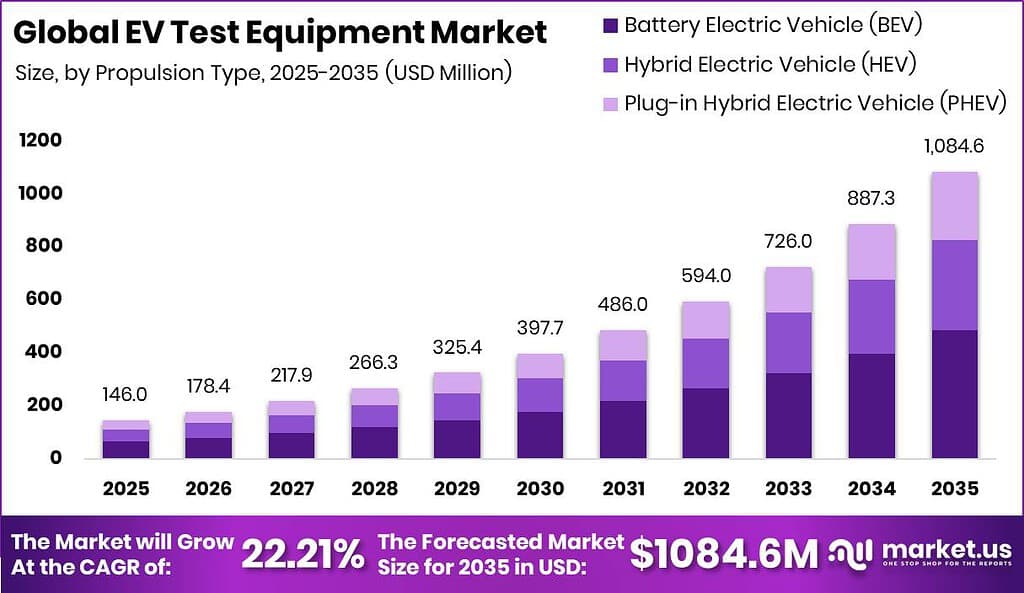
Global EV Test Equipment Market size is expected to be worth around USD 1,084.6 Million by 2035 from USD 146.0 Million in 2025, growing at a CAGR of 22.2% during the forecast period 2026 to 2035. This growth rate places the EV Test Equipment Market among the fastest-expanding segments in automotive technology infrastructure globally. Capital commitments from OEMs and Tier-1 suppliers are accelerating test lab buildouts across every major manufacturing region.
The EV test equipment market covers specialized instruments and systems used to validate, certify, and optimize electric vehicles and their core components. This market spans powertrain dynamometers, battery cyclers, EMC chambers, onboard charger testers, and EV charging validation systems. Buyers include automotive OEMs, independent test laboratories, regulatory bodies, and Tier-1 component suppliers who need traceable, standards-compliant test data before vehicles reach production.
Key Takeaways
- The global EV Test Equipment Market is valued at USD 146.0 Million in 2025 and is forecast to reach USD 1,084.6 Million by 2035.
- The market grows at a CAGR of 22.2% from 2026 to 2035.
- By Propulsion Type, Battery Electric Vehicle (BEV) dominates with a 44.80% share.
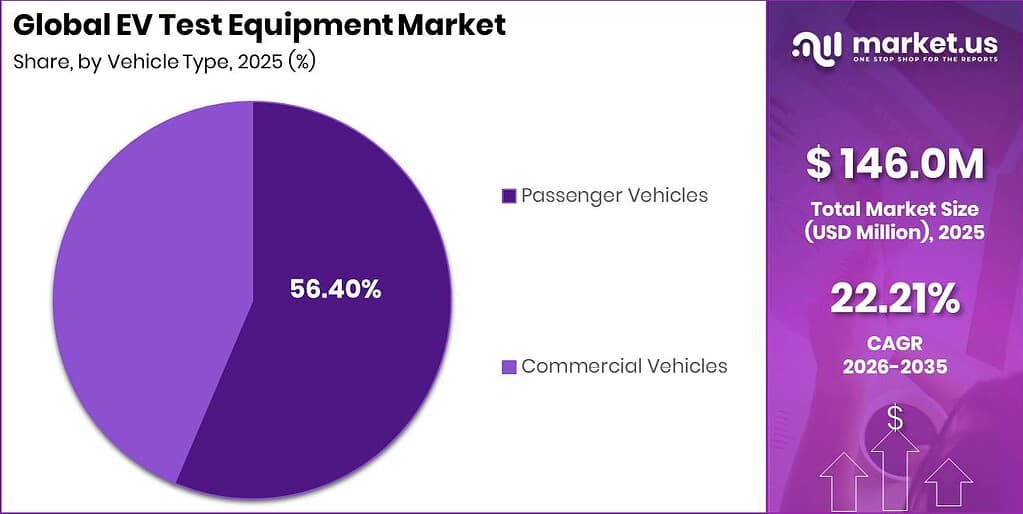
- By Vehicle Type, Passenger Vehicles holds the largest segment with a 56.40% share.
- By Equipment Type, Powertrain Testing leads with a 47.00% share.
- By Vehicle Class, Mid-Priced vehicles represent the dominant segment at 53.00%.
- Asia Pacific dominates the regional landscape with a 42.60% market share, valued at USD 62.20 Million in 2025.
AVL’s 2025 launch of the E-STORAGE BTE combined battery tester and emulator, which cuts battery lifecycle testing time by up to 20%, demonstrates how product innovation is directly compressing validation timelines for OEMs. This type of efficiency gain shifts purchasing decisions away from incremental upgrades toward platform replacements. Vendors offering integrated battery and motor validation in a single system will capture disproportionate share as lab consolidation accelerates.
As per our research, government mandates for EV homologation and safety certification are tightening standards compliance requirements across all major markets. Regulatory bodies in Europe, China, and North America now require documented test evidence covering battery abuse, charging interoperability, and drivetrain endurance before vehicle type approval. This regulatory pressure converts test equipment from a discretionary capital item into a non-negotiable compliance cost, structurally expanding the addressable market beyond early-adopter OEMs to include every Tier-1 supplier and contract manufacturer in the EV supply chain.
According to Market.us, the CE-6000 series ultra-high-voltage battery test systems now support output voltages up to 3,000 V with charging range from 0 V and discharge to 0 V, and negative-voltage capability in safety-focused variants. This voltage envelope directly supports 800-volt EV architectures and next-generation packs exceeding 1,000 V. Labs that cannot match this specification face disqualification from OEM validation contracts, making voltage capability a primary procurement criterion.
Powertrain Type Analysis
Battery Electric Vehicle (BEV) dominates with 44.80% due to full drivetrain electrification test complexity.
In 2025, Battery Electric Vehicle (BEV) held a dominant market position in the By Propulsion Type segment of the EV Test Equipment Market, with a 44.80% share. BEVs require the most comprehensive test coverage because every traction function relies on battery and motor performance with no combustion fallback. A DEKRA electric powertrain test bench validates electric motors and axles up to 399 kW and 20,000 rpm, covering performance, durability, and homologation under laboratory conditions. This test complexity drives sustained capital investment in BEV-specific equipment and gives vendors offering full-range powertrain test platforms a clear procurement advantage.
Hybrid Electric Vehicle (HEV) testing occupies a structurally distinct position because test systems must validate both combustion and electric drivetrain modes, including energy recovery and mode-switching performance. An Indian government specification issued in March 2025 for an EV motor testing setup requires a minimum continuous power of 9.0 kW, continuous torque of 55 Nm, and a rated speed of approximately 1,500 rpm for AC dynamometer configurations. This requirement level confirms that even entry-grade motor test benches must meet precise government-defined parameters, creating a compliance-driven floor for HEV test equipment specifications across emerging-market procurement programs.
Plug-in Hybrid Electric Vehicle (PHEV) represents the fastest-growing propulsion type in the test equipment segment, driven by expanding PHEV model launches across China and Europe where dual-mode powertrains are gaining regulatory support. PHEV validation requires simultaneous verification of AC charging behavior, electric-only range under battery drain, and combustion handoff logic, increasing the instrument count per vehicle program. According to the International Trade Administration, PHEV production lines in Asia are adding battery validation stations at a rate that outpaces conventional HEV lab expansion, signaling near-term demand concentration in combined powertrain-battery test configurations for PHEV platforms.
Vehicle Type Analysis
Passenger Vehicles dominates with 56.40% due to high-volume OEM certification program scale.
In 2025, Passenger Vehicles held a dominant market position in the By Vehicle Type segment of the EV Test Equipment Market, with a 56.40% share. Passenger vehicle programs generate the largest per-OEM test equipment spend because each new model requires full battery, motor, EMC, and charging certification before type approval. The ITU reports that connected vehicle deployments, which increasingly overlap with passenger EV programs, now exceed 400 million units globally, creating a parallel demand layer for communication and interoperability test equipment tied to passenger EV platforms. Vendors who bundle EMC and charging test capability with powertrain validation will capture the widest share of passenger vehicle lab contracts.
Commercial Vehicles represent the fastest-growing vehicle type in EV test equipment demand, reflecting the rapid electrification of trucks, buses, and delivery fleets where duty-cycle severity creates unique validation requirements. Commercial EV powertrains operate at higher continuous power ratings and require extended endurance testing that standard passenger vehicle test benches cannot accommodate. A Tektronix multichannel EV battery tester supports up to 3 battery cells, modules, or packs simultaneously with per-channel outputs of 4 kW, 6 kW, or 10 kW and total test power up to 30 kW, illustrating the power-scaling requirements that commercial vehicle programs impose on battery test infrastructure. Labs investing in high-power commercial EV test capacity today will secure preferred-vendor status as fleet electrification programs accelerate.
Equipment / Application Type Analysis
Powertrain Testing dominates with 47.00% due to mandatory motor and drivetrain homologation requirements.
In 2025, Powertrain Testing held a dominant market position in the By Equipment / Application Type segment of the EV Test Equipment Market, with a 47.00% share. Motor and inverter testing, and transmission testing fall within this segment and together account for the broadest instrumentation spend across OEM and Tier-1 labs. A high-precision EV traction battery testing and repair system supports 34 channels for simultaneous cell or module diagnostics, enabling multichannel synchronous testing and rapid cell balancing in high-throughput production lines. This channel density requirement confirms that powertrain test platforms must scale to production-line throughput, not just R&D sample rates, sustaining high average selling prices across the segment.
EV Battery Test Systems form the second-largest equipment group and cover cell-level testing, pack-level testing, and thermal runaway testing as distinct sub-categories with different instrument requirements. End-of-line leak testing using helium tracer gas is conducted to a threshold of 10⁻⁵ mbar·L/s, which is the minimum sensitivity required to certify liquid and atmospheric moisture leak-tightness for automotive propulsion battery packs. The LT-3000 EV battery pack leak tester operates on a universal input voltage of 100–240 VAC at 50/60 Hz and weighs approximately 7.85 kg, enabling mobile deployment across different grid environments without additional conversion hardware. This portability characteristic reduces capital outlay for contract test labs operating across multiple sites.
EV Charging Test Equipment is the fastest-growing application type, with AC Charging Test Systems and DC Fast Charging Test Systems forming its two primary sub-categories. DC fast charging validation is especially demanding because CCS-compliant systems must verify power delivery up to approximately 350 kW alongside ISO 15118 communication protocol conformance and Plug&Charge authentication. As per our research, the rapid expansion of public DC fast charging networks is forcing every major charging equipment manufacturer to qualify their hardware against interoperability test benches before commercial deployment. EV Component Testing, which includes EMC Testing and Onboard Charger Testing, handles the remaining equipment application share alongside the three primary categories named above.
Vehicle Class Analysis
Mid-Priced dominates with 53.00% due to highest EV unit volume concentration in this tier.
In 2025, Mid-Priced vehicles held a dominant market position in the By Vehicle Class segment of the EV Test Equipment Market, with a 53.00% share. This segment drives the highest absolute volume of test equipment procurement because mid-priced EV programs combine large production runs with full certification requirements. World Bank data shows that mid-income consumer segments in China, Europe, and the United States account for the majority of new passenger EV registrations, directly linking purchasing power concentration to test equipment demand in the mid-priced tier. OEMs targeting this class invest heavily in dedicated test infrastructure to support continuous model refresh cycles at scale.
Economy-class EVs occupy a structurally price-sensitive position where test equipment procurement decisions are driven by minimum compliance requirements rather than comprehensive validation coverage. Manufacturers in this class typically rely on shared test infrastructure or third-party contract labs to minimize capital outlay. UNIDO industrial output data shows that economy-segment EV assembly activity is concentrated in South and Southeast Asia, where test lab density remains below the levels required to support domestic certification at scale. This infrastructure gap creates a direct demand opportunity for portable and modular test equipment vendors targeting economy-tier production facilities in high-growth assembly markets.
Luxury EVs represent the fastest-growing vehicle class for test equipment spend on a per-unit basis, because premium OEMs run broader validation matrices covering performance, NVH, thermal management, and over-the-air software update verification as standard program requirements. Per-program test equipment budgets in the luxury tier exceed those of mid-priced programs by a material margin despite lower unit volumes. As per our research, luxury EV brands are investing in proprietary in-house test infrastructure rather than relying on shared Tier-1 facilities, which concentrates high-value equipment procurement within a small number of large OEM-owned lab buildouts and creates concentrated sales opportunities for vendors with full-range powertrain and battery test portfolios.
Key Market Segments
By Propulsion Type
- Battery Electric Vehicle (BEV)
- Hybrid Electric Vehicle (HEV)
- Plug-in Hybrid Electric Vehicle (PHEV)
By Vehicle Type
- Passenger Vehicles
- Commercial Vehicles
By Equipment / Application Type
- Powertrain Testing
- Motor & Inverter Testing
- Transmission Testing
- EV Battery Test Systems
- Cell-level Testing
- Pack-level Testing
- Thermal Runaway Testing
- EV Component Testing
- EMC Testing
- Onboard Charger Testing
- EV Charging Test Equipment
- AC Charging Test Systems
- DC Fast Charging Test Systems
By Vehicle Class
- Mid-Priced
- Economy
- Luxury
Regional Analysis
Asia Pacific Dominates the EV Test Equipment Market with a Market Share of 42.60%, Valued at USD 62.20 Million
Asia Pacific leads the global EV test equipment market because it hosts the highest concentration of EV manufacturing capacity, with China anchoring demand through its scale of battery production, motor assembly, and government-mandated vehicle homologation programs. As reported by Market.us, the region’s share of 42.60% reflects both OEM lab investment and the rapid buildout of independent test facilities serving domestic Tier-1 suppliers. This structural concentration means vendors establishing regional service and calibration networks in Asia Pacific will hold a distribution advantage that is difficult for late entrants to replicate.
North America and Europe represent the fastest-growing regions outside Asia Pacific, driven by aggressive OEM investment in domestic battery and EV assembly facilities and by stricter regulatory timelines for fleet electrification. European OEMs expanding production at facilities such as the Salzgitter battery laboratory established by AVL for Volkswagen Group’s PowerCo SE are pulling forward demand for on-site battery cell test infrastructure. Both regions are also implementing mandatory charging interoperability standards that require dedicated conformance test equipment purchases before public charger deployment, adding a second demand layer beyond traditional OEM lab investment.
Latin America and the Middle East and Africa remain earlier-stage markets where EV test equipment demand currently tracks nascent EV assembly activity rather than large-scale OEM validation programs. As per our research, both regions are beginning to attract light assembly investment from Chinese OEMs exporting complete vehicle programs, which will generate initial demand for import-clearance and after-sales diagnostic test equipment before full in-region manufacturing test labs are established. These markets represent a longer-horizon opportunity where first-mover vendors who build service partnerships with Chinese OEMs entering the region will secure early reference accounts ahead of the main demand cycle. 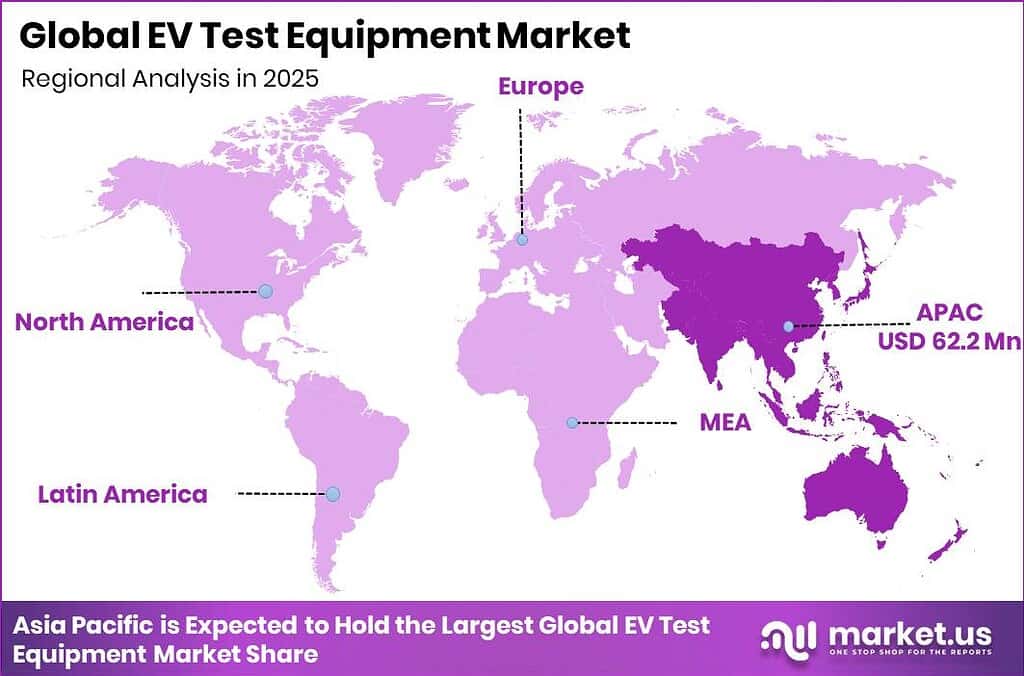
Key Regions and Countries
North America
- US
- Canada
Europe
- Germany
- France
- The UK
- Spain
- Italy
- Rest of Europe
Asia Pacific
- China
- Japan
- South Korea
- India
- Australia
- Rest of APAC
Latin America
- Brazil
- Mexico
- Rest of Latin America
Middle East and Africa
- GCC
- South Africa
- Rest of MEA
Market Dynamics
Market Opportunity Analysis - Underserved vehicle classes and emerging regional markets offer entry points for focused test equipment vendors.
The Economy vehicle class represents an underserved segment for test equipment vendors because cost-constrained manufacturers in South and Southeast Asia rely on shared or contract test infrastructure rather than dedicated in-house labs. This creates demand for portable, modular, and competitively priced test systems that meet minimum homologation requirements without full lab-scale capital investment. Vendors who design economy-tier test configurations with simplified deployment and lower power ratings will access a buyer base that current high-end platform vendors are structurally not positioned to serve.
The Luxury vehicle class, identified as the fastest-growing vehicle class in Task 2, generates disproportionately high per-unit test equipment spend because premium OEMs run broader validation matrices covering performance, thermal management, and software verification as standard requirements. However, luxury OEMs concentrate procurement within proprietary in-house facilities, limiting market access to a small number of high-value accounts. Consequently, vendors who achieve preferred-supplier status with one luxury OEM gain recurring revenue from that relationship across multiple model cycles, making early account penetration the highest-leverage commercial action in this sub-segment.
Latin America and the Middle East and Africa, identified in the regional analysis as earlier-stage markets, present a structurally distinct entry opportunity because Chinese OEM expansion into these regions generates initial demand for import-clearance and after-sales diagnostic test equipment before large-scale manufacturing test labs are established. This first wave of demand is smaller in absolute value but requires less technical depth than full OEM validation programs, making it accessible to mid-tier test equipment vendors who lack the scale to compete for Tier-1 OEM contracts in Asia Pacific or Europe. First-mover vendors building service networks in these regions will accumulate reference accounts before the primary manufacturing demand cycle arrives.
EV Charging Test Equipment, identified as the fastest-growing equipment application type, remains underpenetrated relative to its structural demand because most current charging infrastructure operators rely on bespoke conformance setups rather than standardized commercial test benches. This gap is largest in markets where DC fast charging network rollout is ahead of formal test protocol standardization, creating a window for vendors to supply conformance test equipment to charging network operators who need to qualify hardware before connecting to utility grids. The addressable opportunity in this sub-segment compounds as each new charging standard revision requires fresh round of conformance testing across the installed equipment base.
Technology and Innovation Landscape - Precision measurement, multichannel architecture, and universal power compatibility define the next competitive frontier
High-precision voltage and current measurement now defines the technical baseline for competitive EV battery test systems. Based on Market.us data, the CE-6000 series achieves voltage measurement accuracy of ±0.02% of full scale and current accuracy of ±0.05% of full scale, with a data recording frequency of 100 Hz and a current conversion time of no more than 20 ms. These specifications establish the precision threshold that OEM procurement teams are using to qualify battery test benches for next-generation 800-volt programs. Vendors whose platforms fall short of this accuracy class will face disqualification from high-value OEM lab contracts as precision requirements tighten with each new battery chemistry generation.
Cycle-life test methodology has become a standardized technical benchmark that test equipment must replicate at production scale. Battery life-cycle test protocols define discharge rates in the 1.2C to 1.4C range with cut-off voltages between 3.3 V and 3.55 V, repeated until cell capacity reaches 80% of initial value to define end-of-life. Test systems automate full electrical parameter sampling covering current, voltage, and resistance for every cycle until the 80% capacity threshold is confirmed. This automated logging requirement raises the minimum software and data-handling specification for any battery test system seeking OEM qualification, directly increasing average selling prices across the segment.
Universal input power compatibility has emerged as a key deployment differentiator for portable and mobile EV test equipment used in multi-site and cross-border test operations. Instruments built to accept 100–240 VAC at 50/60 Hz eliminate the need for voltage conversion hardware when deployed across different national grid environments, reducing total deployed cost and uptime risk. This capability is especially valuable for contract test labs and certification bodies operating across Asia, Europe, and North America, where grid standards differ. Vendors who design universal input compatibility as a baseline feature will face lower deployment friction and shorter time-to-revenue on international contracts than those offering region-specific power configurations.
Drivers
OEM demand for high-power battery and drivetrain test systems is the primary growth engine for this market. DC cyclers and emulators in commercial automotive labs now deliver between roughly 100 kW and up to approximately 2.4 MW of power for full pack testing. Ultra-high-voltage battery test systems have expanded voltage envelopes from 0 V to about 1,500 V, with some models reaching 3,000 V, directly supporting 800-volt EV architectures and packs above 1,000 V. This lifts test equipment average selling prices and drives recurring lab investment, contributing an estimated +5.0% to the baseline CAGR of 22.2%.
| Driver | (~) % Impact on CAGR Forecast | Geographic Relevance | Impact Timeline |
|---|---|---|---|
| OEM demand for high‑power battery and drivetrain test systems | +5.0% | Global | Short term (≤ 2 years) |
| Next‑generation ultra‑high‑voltage EV platforms | +4.3% | Global, led by China, Europe | Medium term (2–4 years) |
| Standards‑driven interoperability and conformance testing for DC charging | +3.0% | Global | Medium term (2–4 years) |
| Broader adoption of modular regenerative DC cyclers | +2.4% | Global | Medium term (2–4 years) |
Restraints
High capital intensity and long qualification cycles represent the most significant restraint on near-term market expansion. Battery cyclers and high-power EV test stands require procurement that covers present and future chemistries, including customized charge and discharge profiles, internal-resistance testing, and full data-logging with safety monitoring. Selecting and commissioning a new cycler platform involves validating multi-chemistry support across lithium-ion and nickel-metal hydride chemistries, which can extend qualification timelines from months to multi-year horizons in complex OEM labs.
These long decision cycles, combined with high per-channel ticket prices, restrain near-term replacement of older test benches across the installed base. Labs managing existing equipment under active amortization schedules resist early replacement even when newer platforms offer superior voltage or current capability. This behavior subtracts an estimated -4.6% from the strong baseline CAGR of 22.2%, while still leaving the market firmly in expansion mode. Vendors who offer modular upgrade paths for legacy bench integration will reduce this friction and accelerate replacement cycles.
| Restraint | (~) % Impact on CAGR Forecast | Geographic Relevance | Impact Timeline |
|---|---|---|---|
| High capital intensity and long qualification cycles for lab equipment | -4.6% | Global | Medium term (2–4 years) |
| Limited battery‑chemistry compatibility in legacy cyclers | -3.2% | Global | Short term (≤ 2 years) |
| Fragmented test procedures across OEMs and regions | -2.5% | Global | Medium term (2–4 years) |
Challenges
Ultra-high-voltage and negative-voltage safety testing creates structural technical friction that slows broad market deployment. New battery test platforms spanning from 0 V to approximately 3,000 V, including negative-voltage extension models for extreme abuse validation, require power-electronics design, insulation coordination, and protection schemes capable of handling full-scale pack energies at very high DC potentials across multiple simultaneous channels. This raises the bar for lab infrastructure, including high-voltage isolation, cooling systems, and fault-management procedures, which limits how quickly test labs can adopt next-generation platforms.
Data-management and analytics bottlenecks in multi-channel test labs compound these technical barriers by creating downstream processing constraints. CE-6000-series systems cover 800-volt EV platforms and packs above approximately 1,000 V while adding negative-voltage capability, but the volume of high-frequency test data generated by these platforms can exceed the processing capacity of legacy lab IT infrastructure. This gap between data generation speed and analytics throughput imposes a friction drag of approximately -3.0% on the market’s maximum attainable growth versus the baseline CAGR of 22.2%. Vendors who bundle integrated data platforms with hardware will differentiate on total solution value rather than instrument specifications alone.
| Challenge | (~) % CAGR Friction Drag | Geographic Relevance | Mitigation Horizon |
|---|---|---|---|
| Keeping pace with ultra‑high‑voltage and negative‑voltage safety test needs | -3.0% | Global | Medium term (2–4 years) |
| Ensuring conformance with evolving charging standards and V2G protocols | -2.4% | Global | Medium term (2–4 years) |
| Data‑management and analytics bottlenecks in multi‑channel test labs | -2.0% | Global | Long term (≥ 4 years) |
Opportunities
Standardized conformance and interoperability test benches for CCS and ISO 15118 represent a large underserved opportunity within the addressable market. CCS connectors extend Type 1 and Type 2 AC interfaces to high-power DC delivery up to approximately 350 kW, while ISO 15118 requires secure certificate-based communication between vehicles and charge-point management systems. Most ecosystem participants still rely on bespoke setups to verify compatibility across hardware and software stacks, leaving a commercially packageable gap for dedicated conformance test benches.
Developing EV test equipment suites that emulate real-world charging networks, implement full CCS and ISO 15118 protocol stacks, and automate conformance testing against CharIN and Open Charge Alliance guidelines would unlock a sizable untapped portion of the addressable market. This approach enables vendors to generate recurring revenue through value-added compliance services, not only hardware sales. Executing this opportunity could contribute an estimated upside of approximately +4.1% to the baseline CAGR of 22.2% if standardized test bench adoption scales across major charging network operators and OEM supplier qualification programs globally.
| Opportunity | (~) % Potential CAGR Upside | Geographic Relevance | Execution Window |
|---|---|---|---|
| Standardized conformance and interoperability test benches for CCS and ISO 15118 | +4.1% | Global | Medium term (2–4 years) |
| Turnkey regenerative test labs offering battery, drivetrain, and charger validation | +3.5% | Global | Medium term (2–4 years) |
| Integrated test‑data platforms with analytics for multi‑channel EV validation | +2.8% | Global | Long term (≥ 4 years) |
Key Company Insights
HORIBA, Ltd. holds a structural advantage in EV test equipment through its breadth of coverage across powertrain, emissions, and fuel cell test systems. In April 2025, HORIBA launched the entry-level C05-LT 100W PEM fuel cell test station, extending its portfolio into lower-cost research configurations. This move signals a deliberate strategy to capture emerging-market and university-sector customers who previously could not access HORIBA-grade instrumentation, widening its installed base ahead of the commercial fuel cell vehicle expansion cycle.
Chroma ATE Inc. competes through deep integration of power electronics test capability with battery formation and grading systems, giving it a distinct position in the cell-manufacturing segment of the EV test supply chain. Chroma’s platform architecture enables customers to consolidate cell-level and pack-level validation within a single vendor relationship, reducing integration risk and total cost of ownership. This consolidation advantage is most defensible in high-volume battery gigafactory environments where switching costs are high and vendor qualification timelines are long, positioning Chroma well as gigafactory buildouts accelerate across Asia and Europe.
Key Players
- HORIBA, Ltd.
- Chroma ATE Inc.
- AVL List GmbH
- National Instruments Corporation
- Keysight Technologies, Inc.
- TÜV Rheinland AG
- Dürr Group
- Intertek Group plc
- Marposs S.p.A.
- FEV Group GmbH
Recent Developments
- April 2025: AVL launched the AVL Active Load Cabinet in the North American market, a new inverter hardware testing solution designed for high-voltage functional and validation testing of EV power electronics, expanding its EV testing portfolio in North America.
- 2025: AVL completed a major project for Volkswagen Group’s PowerCo SE by establishing advanced battery cell test infrastructure at the new Salzgitter battery laboratory in Germany, supporting large-scale battery cell validation activities for the Volkswagen Group’s European gigafactory program.
Geopolitical Impact Analysis
Trade policy shifts are directly affecting the cost and availability of precision components used in EV test equipment manufacturing. According to WTO data, average tariff rates on electrical measurement instruments between major trading blocs have increased, with US Section 301 tariffs on Chinese electronics components reaching up to 25% on relevant product categories, raising landed costs for test equipment assemblers sourcing from Asia. This cost pressure forces equipment vendors to either absorb margin compression or pass increases to OEM lab customers, both of which slow order velocity and extend procurement decision timelines.
Supply chain rerouting driven by geopolitical tensions between China, the United States, and the European Union is extending lead times for high-precision analog and power electronics components critical to battery cycler and dynamometer design. As reported by UNCTAD, maritime freight disruptions and port congestion have added an average of 14 to 21 days to Asia-to-Europe transit times for industrial electronics shipments at peak disruption periods. This logistics volatility forces test equipment vendors to carry higher safety stock and extend delivery commitments to customers, increasing working capital requirements and compressing cash conversion cycles across the supply chain.
Report Scope
| Report Features | Description |
|---|---|
| Market Value (2025) | USD 146.0 Million |
| Forecast Revenue (2035) | USD 1,084.6 Million |
| CAGR (2026-2035) | 22.2% |
| Base Year for Estimation | 2025 |
| Historic Period | 2020-2024 |
| Forecast Period | 2026-2035 |
| Report Coverage | Revenue Forecast, Market Dynamics, Market Opportunity Analysis, Technology and Innovation Landscape, Competitive Landscape, Recent Developments |
| Segments Covered | By Propulsion Type (Battery Electric Vehicle, Hybrid Electric Vehicle, Plug-in Hybrid Electric Vehicle), By Vehicle Type (Passenger Vehicles, Commercial Vehicles), By Equipment / Application Type (Powertrain Testing, EV Battery Test Systems, EV Component Testing, EV Charging Test Equipment), By Vehicle Class (Mid-Priced, Economy, Luxury) |
| Regional Analysis | North America (US and Canada), Europe (Germany, France, The UK, Spain, Italy, and Rest of Europe), Asia Pacific (China, Japan, South Korea, India, Australia, and Rest of APAC), Latin America (Brazil, Mexico, and Rest of Latin America), Middle East and Africa (GCC, South Africa, and Rest of MEA) |
| Competitive Landscape | HORIBA, Ltd., Chroma ATE Inc., AVL List GmbH, National Instruments Corporation, Keysight Technologies, Inc., TÜV Rheinland AG, Dürr Group, Intertek Group plc, Marposs S.p.A., FEV Group GmbH |
| Customization Scope | Customization for segments, region / country-level will be provided. Additional customization can be done based on requirements. |
| Purchase Options | We have three licenses to opt for: Single User License | Multi-User License (Up to 5 Users) | Corporate Use License (Unlimited User and Printable PDF) |





































