


Introduction
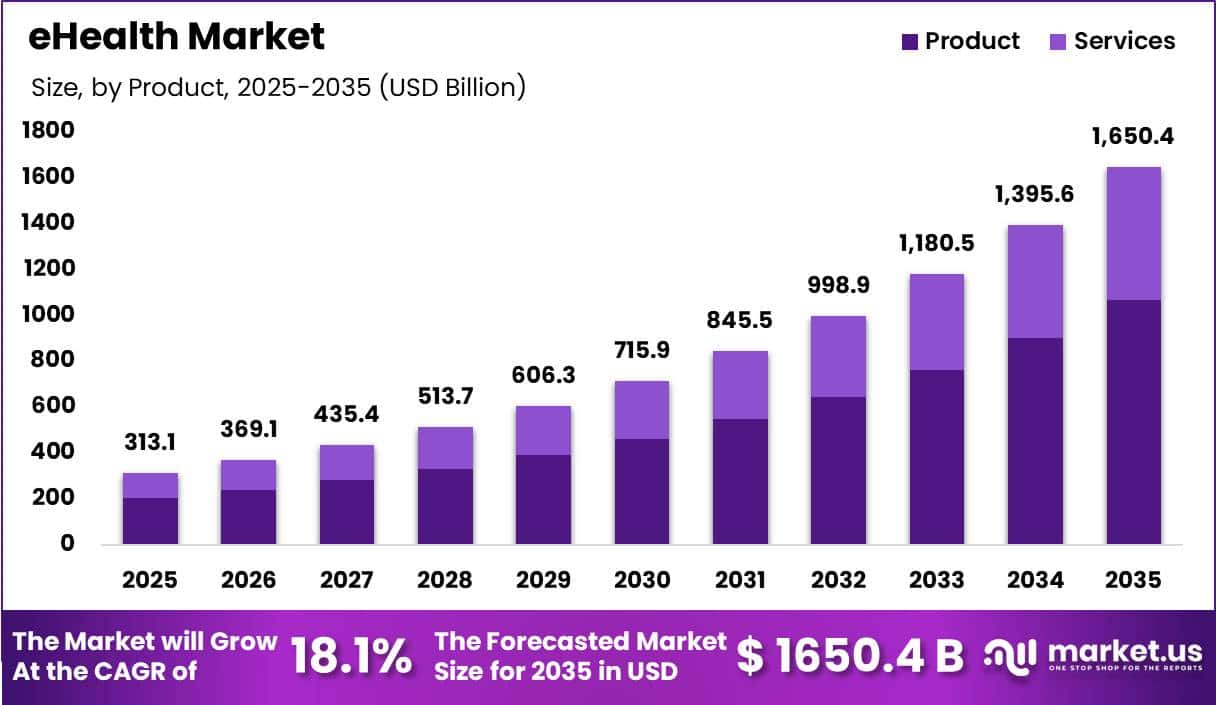
The Global eHealth Market spans clinical information systems, virtual care, connected monitoring, patient engagement, and healthcare data infrastructure. Market.us values this broad ecosystem at US$ 313.1 billion in 2025, but current company disclosures reveal uneven commercial performance across its components.
Strategic investment is shifting toward interoperable platforms, AI-enabled workflows, and longitudinal patient management, illustrated by CVS Health’s Google Cloud alliance and Philips’ expanded monitoring ecosystem. Healthcare access constraints and demand for operating efficiency support adoption, while reimbursement exposure, implementation complexity, and profitability requirements increasingly determine which business models scale.
Market Size & Statistics
- The Global eHealth Market size is expected to be worth around US$ 1,650.4 Billion by 2035 from US$ 313.1 Billion in 2025,
- The market is growing at a CAGR of 18.1% during the forecast period from 2026 to 2035.
- In 2025, North America led the market, achieving over 51.4% share with a revenue of US$ 160.9 Billion.
Australia
- 22.5% of people aged 15 and above used telehealth services in 2024–25, down from 23.6% in 2023–24 and 30.8% in 2021–22.
- Among people who used telehealth in 2024–25, 90.3% said they would use it again if offered.
- Among telehealth users in 2024–25, 80.0% said practitioners always listened carefully, 83.1% said they were always shown respect, and 78.3% said practitioners always spent enough time with them.
- Among people who needed and received professional mental-health care in 2024–25, 26.0% used telehealth at least once for that care.
United States
- 65% of individuals were offered and accessed their online medical records or patient portal in 2024, compared with 25% in 2014.
- Among individuals accessing online medical records, app-based access increased from 38% in 2020 to 57% in 2024.
- The share of individuals accessing online medical records on behalf of someone for whom they provided care or made healthcare decisions increased from 24% in 2020 to 51% in 2024.
- 59% of individuals reported having multiple online medical records or patient portals in 2024, but only 7% used an app to organise information from different records or portals in one place.
- Among individuals with a chronic condition in 2024, 81% were offered online access to their medical records, and 69% accessed their records at least once during the preceding year.
England
- The NHS App had more than 39 million registered users by December 2025; this figure represents registrations rather than monthly active users.
- Patients ordered 67.8 million repeat prescriptions through the NHS App between 1 December 2024 and 30 November 2025.
- During November 2025, patients made 20.8 million views of GP health records, managed 6.6 million hospital and other secondary-care appointments, and ordered 6.3 million repeat prescriptions through the NHS App.
Measurement basis and limitations
Market.us provides a broad market denominator but no company-level revenue bridge. Meanwhile, diversified companies generally do not disclose eHealth revenue separately, and connected-device segments include hardware and services that do not map precisely to the report’s definition. Accordingly, the following assessment uses relative positioning rather than unsupported percentage estimates.
The supplied competitive list also requires three material qualifications:
- Veradigm LLC is an operating-company reference; publicly available financial disclosures and the MDRX ticker relate to Veradigm Inc. and its consolidated businesses.
- Telecare Corporation, the US behavioral-health provider, is not Telecare Australia Pty Ltd., which Teladoc acquired in August 2025. The supplied report conflates these entities in its developments section.
- Lift Labs was acquired by Google in 2014 and should not be treated as an independent contemporary competitor. Similarly, IBM’s former Watson Health assets became Merative under Francisco Partners in 2022 and cannot be attributed to IBM’s current eHealth position.
| Company | Approximate global eHealth share | Relative market positioning and evidence |
|---|---|---|
| Koninklijke Philips N.V. | 0.30–0.70% | Major connected-monitoring and clinical-informatics participant; Connected Care reported approximately €1.184 billion in Q2 2026 sales. results. |
| Teladoc Health, Inc. | 0.70–0.95% | Large, directly measurable virtual-care specialist, with US$606.9 million in Q2 2026 revenue. |
| Medtronic plc | 0.05–0.20% | Major connected-medical-technology participant; its diabetes business generated US$843 million in Q1 FY2027, but this includes devices and consumables rather than exclusively digital services. |
| Veradigm LLC | 0.05–0.15% | Established ambulatory clinical-software, revenue-cycle, and healthcare-data participant; its network connects more than 20,000 provider practices. |
| Doximity, Inc. | 0.10–0.20% | Significant US clinician-network, digital-workflow, and pharmaceutical-engagement platform, with US$156.6 million in Q1 FY2027 revenue. |
| American Well Corporation | 0.05–0.12% | Enterprise virtual-care specialist, with US$52.0 million in Q2 2026 revenue and US$25.7 million in subscription revenue. |
| International Business Machines Corporation | 0.10–0.40% | Healthcare infrastructure, AI, consulting, and research-enablement participant rather than the current owner of the former Watson Health portfolio. franciscopartners+1 |
| Epocrates, Inc. | <0.02% | Established point-of-care clinical-reference and clinician-engagement platform within athenahealth. |
| MediSafe, Inc. | <0.02% | Specialized medication-engagement and enterprise pharmaceutical patient-support platform. |
| Orange Health Care Pvt. Ltd. | <0.01% | India-focused, digitally enabled diagnostics participant; reported FY2026 revenue of approximately ₹138 crore. |
These positions should not be converted into a 100% share distribution: the companies serve different submarkets, and their reported revenue scopes are not comparable.
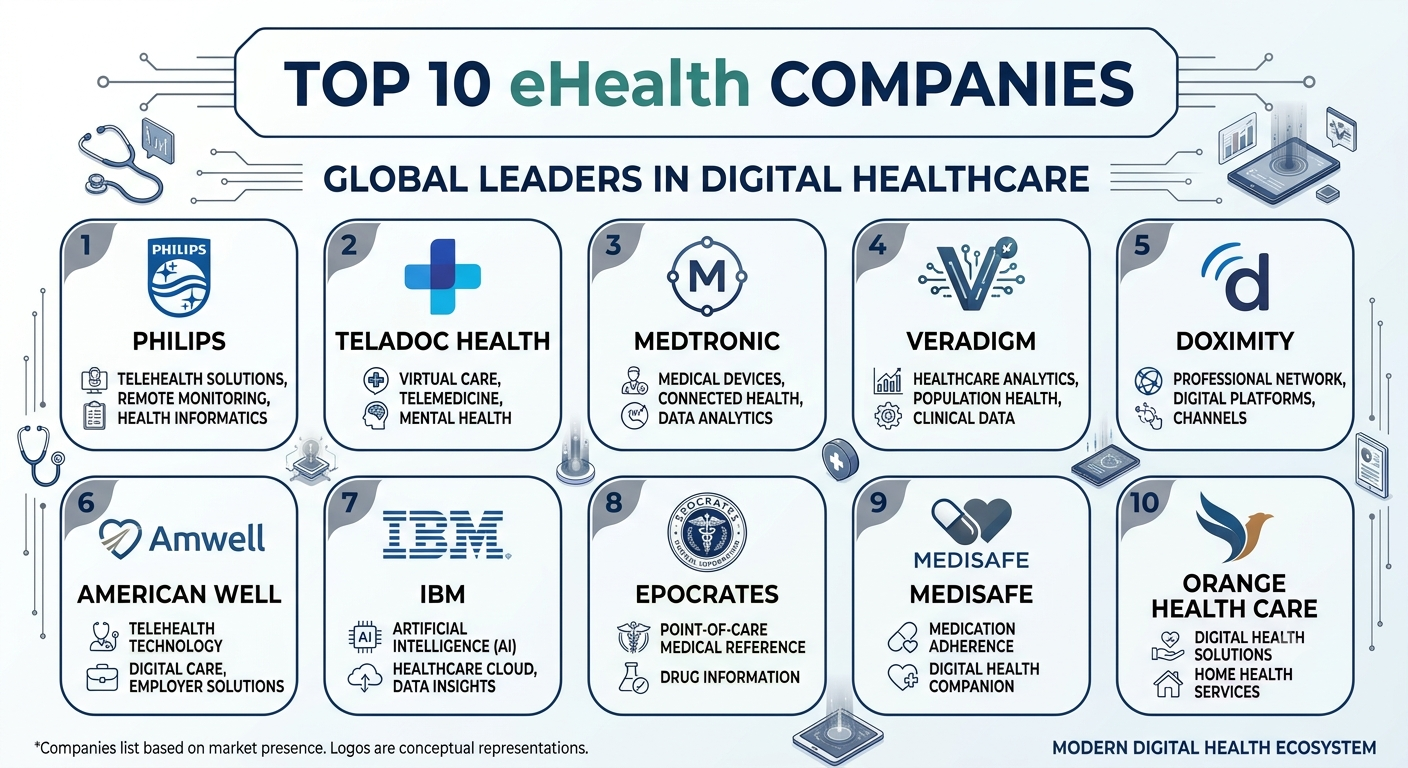
Top Companies List
The following is an analyst ranking of prominence within the supplied universe, considering relevant operating scale, platform reach, and strategic importance. It is not a verified global market-share ranking. The evidence supporting each position appears in Sections 3 and 5.
- Koninklijke Philips N.V.
- Teladoc Health, Inc.
- Medtronic plc
- Veradigm LLC
- Doximity, Inc.
- American Well Corporation
- International Business Machines Corporation
- Epocrates, Inc.
- MediSafe, Inc.
- Orange Health Care Pvt. Ltd.
Company Profiles
1. Koninklijke Philips N.V.
About Koninklijke Philips N.V.: Philips competes in eHealth through connected patient monitoring, ambulatory diagnostics, enterprise informatics, and cloud-based diagnostic workflows. Its competitive advantage lies in connecting an installed medical-device base with clinical software and third-party technologies, supporting continuous patient visibility across hospital and home settings.
Company Overview Table
| Attribute | Company Data |
|---|---|
| Company Name | Koninklijke Philips N.V. |
| Ticker Symbol | Euronext Amsterdam: PHIA; NYSE: PHG |
| Industry | Connected healthcare technology and clinical informatics |
| Headquarters | Amsterdam, Netherlands |
| Founded | 1891 |
| Founders | Gerard Philips and Frederik Philips; Anton Philips joined in 1895 |
| Current CEO | Roy Jakobs |
| Latest Quarterly Revenue | Connected Care: approximately €1.184 billion, Q2 2026 |
| YoY Revenue Growth | Connected Care: approximately 2% comparable sales growth |
| Primary Segments | Relevant operations: hospital patient monitoring, ambulatory monitoring and diagnostics, connected respiratory care, and integrated diagnostics |
The Connected Care financial measure is a relevant operating-segment proxy, not a pure software or eHealth revenue disclosure.
Financial Details
Connected Care recorded approximately €1.184 billion in Q2 2026 sales, with roughly 2% comparable growth. Adjusted EBITA margin reached 17.8%, but included approximately 6.1 percentage points from a US tariff refund. Excluding that benefit, the margin was approximately 11.7%; therefore, the headline profitability improvement should not be interpreted as entirely recurring. Connected hardware and respiratory products remain included in the segment.
Strategic Developments
- In August 2026, Philips announced monitoring collaborations with Blue Spark Technologies, Caretaker Medical, Cuviva, LifeSignals, Respiree, and smartQare, extending wearable and out-of-hospital monitoring integration.
- At HIMSS26, Philips emphasized interoperable enterprise monitoring and HealthSuite Integrated Diagnostics, connecting medical devices, imaging information, electronic medical records, and AI applications.
2. Teladoc Health, Inc.
About Teladoc Health, Inc.: Teladoc operates a diversified virtual-care platform spanning general medical consultations, chronic-condition management, mental healthcare, and enterprise virtual-care technology. Its Integrated Care and BetterHelp businesses provide multiple distribution channels, although their differing payer relationships and customer-acquisition models create materially different growth and profitability profiles.
Company Overview Table
| Attribute | Company Data |
|---|---|
| Company Name | Teladoc Health, Inc. |
| Ticker Symbol | NYSE: TDOC |
| Industry | Virtual healthcare and digital chronic-care management |
| Headquarters | New York, New York, United States |
| Founded | 2002 |
| Founders | G. Byron Brooks and Michael Gorton |
| Current CEO | Charles “Chuck” Divita III |
| Latest Quarterly Revenue | US$ 606.9 million, Q2 2026 |
| YoY Revenue Growth | −4% |
| Primary Segments | Integrated Care; BetterHelp |
Corporate and financial information reflects Teladoc’s current leadership and Q2 2026 release.
Financial Details
Q2 2026 revenue declined 4% to US$606.9 million, while adjusted EBITDA fell 5% to US$65.7 million. Integrated Care revenue increased approximately 1% to US$394.3 million, with a 16.5% adjusted EBITDA margin. BetterHelp revenue declined 12% to US$212.6 million, with a 0.2% margin. These results demonstrate why broad eHealth growth forecasts cannot be applied uniformly to individual virtual-care models.
Strategic Developments
- Teladoc acquired Telecare Australia in August 2025, adding more than 300 virtual specialists across over 30 specialties. Transaction terms were not disclosed.
- During 2026, BetterHelp continued its transition toward insurance-covered therapy; management maintained an insurance-revenue outlook of US$90 million–US$105 million for the year.
- The Australian acquisition does not involve the US-based Telecare Corporation profiled below.
3. Medtronic plc
About Medtronic plc: Medtronic participates in eHealth through digitally connected therapeutic devices, remote monitoring, and data-enabled disease management. Its diabetes operations provide a particularly visible connected-care footprint through insulin-delivery and glucose-monitoring technologies, although the ongoing MiniMed separation changes the ownership boundary of this business.
Company Overview Table
| Attribute | Company Data |
|---|---|
| Company Name | Medtronic plc |
| Ticker Symbol | NYSE: MDT |
| Industry | Connected medical technology and therapeutic devices |
| Headquarters | Ireland |
| Founded | 1949 |
| Founders | Earl Bakken and Palmer Hermundslie |
| Current CEO | Geoff Martha |
| Latest Quarterly Revenue | Diabetes business: US$843 million, Q1 FY2027 ended July 31, 2026 |
| YoY Revenue Growth | Diabetes business: 16.9% reported; 14.9% organic |
| Primary Segments | Relevant operations: connected diabetes management, remote device monitoring, and digitally enabled therapeutic systems |
The diabetes figure includes devices and consumables and is not a standalone digital-health revenue measure.
Financial Details
The diabetes business generated US$ 843 million in Q1 FY2027 revenue, increasing 16.9% as reported and 14.9% organically. The quarter contained an additional fiscal week, complicating comparisons with prior periods.
No separately disclosed revenue figure isolates software, connectivity, or remote-management services. The diabetes business’s performance should also be evaluated separately from Medtronic’s future portfolio because of the MiniMed separation process.
- Strategic Developments
Medtronic advanced the MiniMed separation during 2026, following MiniMed’s IPO and subsequent exchange-offer process. - The connected-diabetes roadmap included MiniMed Go Smart MDI, the planned MiniMed Flex system, and collaboration with Abbott on glucose-ketone sensing technology. These initiatives belong to the evolving MiniMed business perimeter.
4. Veradigm LLC
About Veradigm LLC: Veradigm supplies clinical software, revenue-cycle technology, patient engagement, and healthcare data services, with a substantial footprint among independent physician practices. Its differentiation rests on linking practice workflows with payer and biopharmaceutical data use cases through an established provider network and interoperable applications.
Company Overview Table
| Attribute | Company Data |
|---|---|
| Company Name | Veradigm LLC |
| Ticker Symbol | LLC: not separately listed; Veradigm Inc.: OTCMKTS: MDRX |
| Industry | Healthcare IT, clinical software, revenue-cycle technology, and healthcare data |
| Headquarters | Chicago, Illinois, United States |
| Founded | Business heritage dates to Allscripts, founded in 1986 |
| Current CEO | Donald “Don” Trigg, Veradigm group |
| YoY Revenue Growth | Preliminary FY2025 revenue approximately −1% at the midpoint |
| Primary Segments | Clinical and practice-management solutions; revenue-cycle solutions; payer and life-sciences data services |
The public-company reporting perimeter must not be confused with a standalone LLC financial statement.
Financial Details
The February 2026 business update estimated unaudited FY2025 revenue at US$584 million–US$589 million, approximately 1% below the midpoint of its then-estimated FY2024 range. These were preliminary annual figures, not quarterly results. Veradigm subsequently announced the filing of its 2023 and 2024 Form 10-K in May 2026, while advancing 2025 and 2026 filings. A verified current quarterly revenue figure remains Data Unavailable in the reviewed evidence.
Strategic Developments
- In May 2026, Veradigm launched Health Network Architecture for early adopters, connecting EHR, practice-management, clearinghouse, and patient-portal data.
- The announced roadmap included intelligent claim scrubbing, AI-assisted prior authorization, and clinical-trial patient matching during 2026.
- Restoring timely financial reporting remains strategically relevant to investor confidence and the assessment of operating performance.
5. Doximity, Inc.
About Doximity, Inc.: Doximity operates a US medical-professional platform combining clinical information, communications, virtual-care tools, recruitment, and pharmaceutical engagement. Its commercial model monetizes clinician access and workflow participation, while AI-assisted clinical search and documentation tools seek to deepen engagement within existing professional routines.
Company Overview Table
| Attribute | Company Data |
|---|---|
| Company Name | Doximity, Inc. |
| Ticker Symbol | NYSE: DOCS |
| Industry | Digital healthcare professional networking and clinical workflow software |
| Headquarters | San Francisco, California, United States |
| Founded | 2010 |
| Founders | Jeff Tangney, Nate Gross, and Shari Buck |
| Current CEO | Jeff Tangney |
| Latest Quarterly Revenue | US$ 156.6 million, Q1 FY2027 ended June 30, 2026 |
| YoY Revenue Growth | Approximately 7%; 7.3% using reported revenue amounts |
| Primary Segments | Relevant revenue activities: marketing, hiring, and workflow solutions |
Doximity’s revenue includes professional marketing and hiring activities and should not be interpreted entirely as clinical-care delivery revenue.
Financial Details
Doximity reported Q1 FY2027 revenue of US$156.6 million versus US$145.9 million a year earlier. Net income was US$24.3 million, representing a 16% margin. The company raised its FY2027 revenue outlook to US$671 million–US$681 million. Its operating trajectory contrasts with weaker consumer-paid virtual-care businesses, although the revenue base includes advertising and hiring rather than only care-delivery software.
Strategic Developments
- Doximity acquired Pathway Medical in August 2025, extending its medical-AI and evidence-based clinical-reference capabilities.
- During Q1 FY2027, the company highlighted Doximity Ask and record engagement with its clinical tools, linking product investment to a broader workflow strategy.
- Investment in AI usage and infrastructure remains a margin consideration alongside potential future monetization.
6. American Well Corporation
About American Well Corporation: American Well, operating as Amwell, provides enterprise virtual-care software and associated clinical services to health plans and health systems. Its platform strategy combines virtual consultations, behavioral-health programs, and partner applications, with recurring subscriptions providing a different economic foundation from visit-based clinical revenue.
Company Overview Table
| Attribute | Company Data |
|---|---|
| Company Name | American Well Corporation |
| Ticker Symbol | NYSE: AMWL |
| Industry | Enterprise virtual-care platforms and technology-enabled clinical services |
| Headquarters | Boston, Massachusetts, United States |
| Founded | 2006 |
| Founders | Ido Schoenberg and Roy Schoenberg |
| Current CEO | Ido Schoenberg |
| Latest Quarterly Revenue | US$52.0 million, Q2 2026 |
| Primary Segments | Platform subscriptions; Amwell Medical Group visit services; digital clinical programs |
Current leadership information identifies Ido Schoenberg as sole CEO; older co-CEO descriptions should not be carried forward.
Financial Details
Amwell generated US$52.0 million in Q2 2026 revenue, comprising US$25.7 million in subscription revenue and US$24.4 million in Amwell Medical Group visit revenue, plus other revenue. Gross margin was 53%, net loss was US$9.6 million, and adjusted EBITDA was negative US$1.2 million. Management increased the lower end of annual revenue guidance to US$200 million–US$205 million and retained its objective of positive operating cash flow in Q4 2026.
Strategic Developments
In its August 2026 release, Amwell highlighted the Defense Health Agency’s intent to make it a prime contractor. This was an indicated contracting
development, not evidence that all contemplated deployment had been completed.
The company continued emphasizing a unified SaaS platform and integrated behavioral-health programs while working toward cash-flow sustainability.
7. International Business Machines Corporation
About International Business Machines Corporation: IBM’s current healthcare role centers on enterprise technology, AI, hybrid-cloud infrastructure, consulting, and advanced computing research. Its eHealth relevance should be assessed through these enabling capabilities and healthcare partnerships, not through former Watson Health products that were transferred to Francisco Partners and Merative.
Company Overview Table
| Attribute | Company Data |
|---|---|
| Company Name | International Business Machines Corporation |
| Ticker Symbol | NYSE: IBM |
| Industry | Healthcare-enabling enterprise IT, AI, hybrid cloud, and consulting |
| Headquarters | Armonk, New York, United States |
| Founded | 1911 as Computing-Tabulating-Recording Company; renamed IBM in 1924 |
| Founders | Charles Ranlett Flint organized the founding consolidation |
| Current CEO | Arvind Krishna |
| Primary Segments | Relevant capabilities: healthcare AI, hybrid cloud, consulting, infrastructure, and quantum research |
IBM does not provide a separately reportable eHealth revenue measure in the reviewed healthcare disclosures.
Financial Details
Quarterly healthcare-specific revenue, growth, and operating profit are Data Unavailable. IBM’s company-wide software or consulting revenue would overstate its eHealth exposure. Furthermore, the Watson Health data and analytics assets sold in 2022—including MarketScan, Micromedex, and imaging offerings—must be excluded from IBM’s current financial footprint.
Strategic Developments
- IBM and Cleveland Clinic continued their ten-year Discovery Accelerator partnership, applying AI, hybrid cloud, and quantum computing to biomedical research and clinical-operational problems.
- In June 2026, the partners reported more than 50 supported research projects and highlighted advanced molecular-simulation work. These are research-development indicators rather than disclosed commercial eHealth revenue.
- In April 2026, IBM described its collaboration with Algorithmiq and Cleveland Clinic on quantum-enabled photodynamic-therapy research recognized in the Q4Bio Challenge.
8. Epocrates, Inc.
About Epocrates, Inc.: Epocrates provides mobile clinical-reference information and point-of-care medication intelligence within athenahealth. Its differentiation combines clinician workflow access, drug-information content, subscription products, and pharmaceutical engagement opportunities, positioning it at the intersection of clinical decision support and healthcare professional marketing.
Company Overview Table
| Attribute | Company Data |
|---|---|
| Company Name | Epocrates, Inc |
| Ticker Symbol | No current standalone listing; former Nasdaq: EPOC |
| Industry | Mobile clinical reference and point-of-care decision support |
| Headquarters | Current business announcements issued from Boston, Massachusetts |
| Founded | 1998 |
| Founders | Jeff Tangney, Richard Fiedotin, and Tom Lee |
| Current CEO | Standalone CEO: Data Unavailable; David Minkin is President and General Manager; parent CEO is Bob Segert |
| Primary Segments | Clinical subscriptions; drug-reference tools; pharmaceutical advertising and clinician engagement |
Epocrates operates as part of athenahealth rather than as a separately reporting public company.
Financial Details
Standalone quarterly revenue, growth, and profitability are Data Unavailable. Public leadership information identifies subscription and advertising businesses, but does not quantify their current financial contributions. Athenahealth’s broader EHR and revenue-cycle performance should not be allocated to Epocrates without supporting disclosure.
Strategic Developments
- In May 2026, Epocrates and DeepIntent announced programmatic access to point-of-care advertising inventory within clinician workflows.
- In September 2026, Epocrates announced a multiyear ScriptSave partnership to integrate prescription pricing and savings information into clinical drug-reference workflows.
9. MediSafe, Inc.
About MediSafe, Inc.: Medisafe develops medication-engagement software supporting treatment adherence, persistence, and personalized patient journeys. Its enterprise platform connects pharmaceutical patient-support programs with configurable digital interventions, shifting the commercial proposition beyond reminders toward orchestration, enrollment support, and measurement across the treatment lifecycle.
Company Overview Table
| Attribute | Company Data |
|---|---|
| Company Name | MediSafe, Inc |
| Industry | Digital medication engagement and pharmaceutical patient-support software |
| Headquarters | Boston, Massachusetts, United States |
| Founded | 2012 |
| Founders | Omri Shor and Rotem Shor |
| Current CEO | David “Dave” Icke |
| Primary Segments | Enterprise pharmaceutical engagement; medication management; patient-journey orchestration |
Current sources identify Dave Icke as CEO; founder Omri Shor stepped down from that role in 2025.
Financial Details
Medisafe is privately held, and verified quarterly revenue, growth, and profitability are Data Unavailable. Its July 2026 announcement described a platform trusted by more than 13 million patients, but patient reach is not equivalent to paying users or contracted enterprise revenue. Accordingly, no revenue estimate is derived from its user population.
Strategic Developments
- In July 2026, AssistRx partnered with Medisafe to strengthen patient engagement across benefits verification, prior authorization, delivery, and long-term adherence.
- The collaboration uses Medisafe’s Maestro orchestration platform for configurable patient journeys and centralized analytics.
- The company’s verified US$30 million Series C was announced in February 2021; this is historical funding context, not a recent financing round.
10. Orange Health Care Pvt. Ltd.
About Orange Health Care Pvt. Ltd.: Orange Health, operating as Orange Health Labs, combines digital ordering, at-home sample collection, laboratory processing, and electronic reporting in Indian metropolitan markets. Its operating advantage is service orchestration and turnaround speed; however, its revenue remains predominantly diagnostics revenue rather than a separately priced software business.
Company Overview Table
| Attribute | Company Data |
|---|---|
| Company Name | Orange Health Care Pvt. Ltd. |
| Industry | Digitally enabled diagnostics and consumer health services |
| Headquarters | Bengaluru, Karnataka, India |
| Founded | 2020; commercial launch in January 2021 |
| Founders | Dhruv Gupta and Tarun Bhambra |
| Latest Quarterly Revenue | Company-reported FY2026 revenue approximately ₹138 crore |
| YoY Revenue Growth | Company-reported FY2026 revenue growth approximately 65% |
| Primary Segments | At-home diagnostics; laboratory testing; digital reports; preventive diagnostics plans |
Annual operating figures come from a company-distributed announcement rather than independently audited quarterly financial statements.
Financial Details
Orange Health reported approximately ₹138 crore in FY2026 revenue and an exit annualized revenue run rate of ₹180 crore, with approximately 65% annual growth. By July 2026, its annualized run rate reportedly exceeded ₹200 crore. These run-rate figures are not recognized annual or quarterly revenue, and neither disclosure isolates a digital-platform revenue component. Quarterly profitability is Data Unavailable.
Strategic Developments
- In October 2026, Orange Health announced that its collection-centre network had reached 100 locations across Bengaluru, Mumbai, Delhi-NCR, and Hyderabad.
- The company introduced Orange One, an annual diagnostics plan, alongside NeO Reports as part of its shift toward longitudinal health management.
- Its verified Amazon Smbhav-led US$12 million financing supported product expansion, staffing, and diagnostics innovation; Y Combinator’s company profile dates this announcement to December 2024.
Conclusion:
The eHealth market is expanding, but its competitive structure is not captured accurately by a single ranking of corporate revenues. The supplied company universe combines infrastructure vendors, virtual-care operators, connected-device manufacturers, pharmaceutical-engagement platforms, diagnostics providers, and historical acquisitions.
Their financial results require different interpretation: Optum Insight demonstrates substantial technology-services scale, Doximity shows continued platform growth, while Teladoc’s BetterHelp performance illustrates pressure within consumer-paid virtual care.
Over the next 12–24 months, three structural developments are most likely:
- Platform integration will become more important than standalone functionality. CVS’s Health100 initiative, Veradigm’s network architecture, and Philips’ monitoring partnerships indicate investment in connecting existing workflows, data, and patient touchpoints.
- AI commercialization will increasingly be judged against measurable operating economics. Coding, prior authorization, clinical search, and patient-support orchestration offer identifiable workflows, but adoption alone does not establish incremental revenue or sustainable margins.
- Portfolio boundaries and reimbursement-linked distribution will reshape competitive comparisons. Medtronic’s MiniMed separation and BetterHelp’s insurance transition demonstrate that ownership structure and payment channels can materially alter a company’s apparent eHealth exposure.
The market’s trajectory is toward more connected, workflow-embedded, and enterprise-funded digital healthcare—not uniform growth across every application. Market.us’s 18.1% forecast should be treated as that publisher’s broad-market projection rather than a verified growth rate for the profiled companies.
Its source page also contains an unrelated solid-state-battery challenge section, reinforcing the need to separate extracted market statistics from independently validated company intelligence.




















