


Introduction
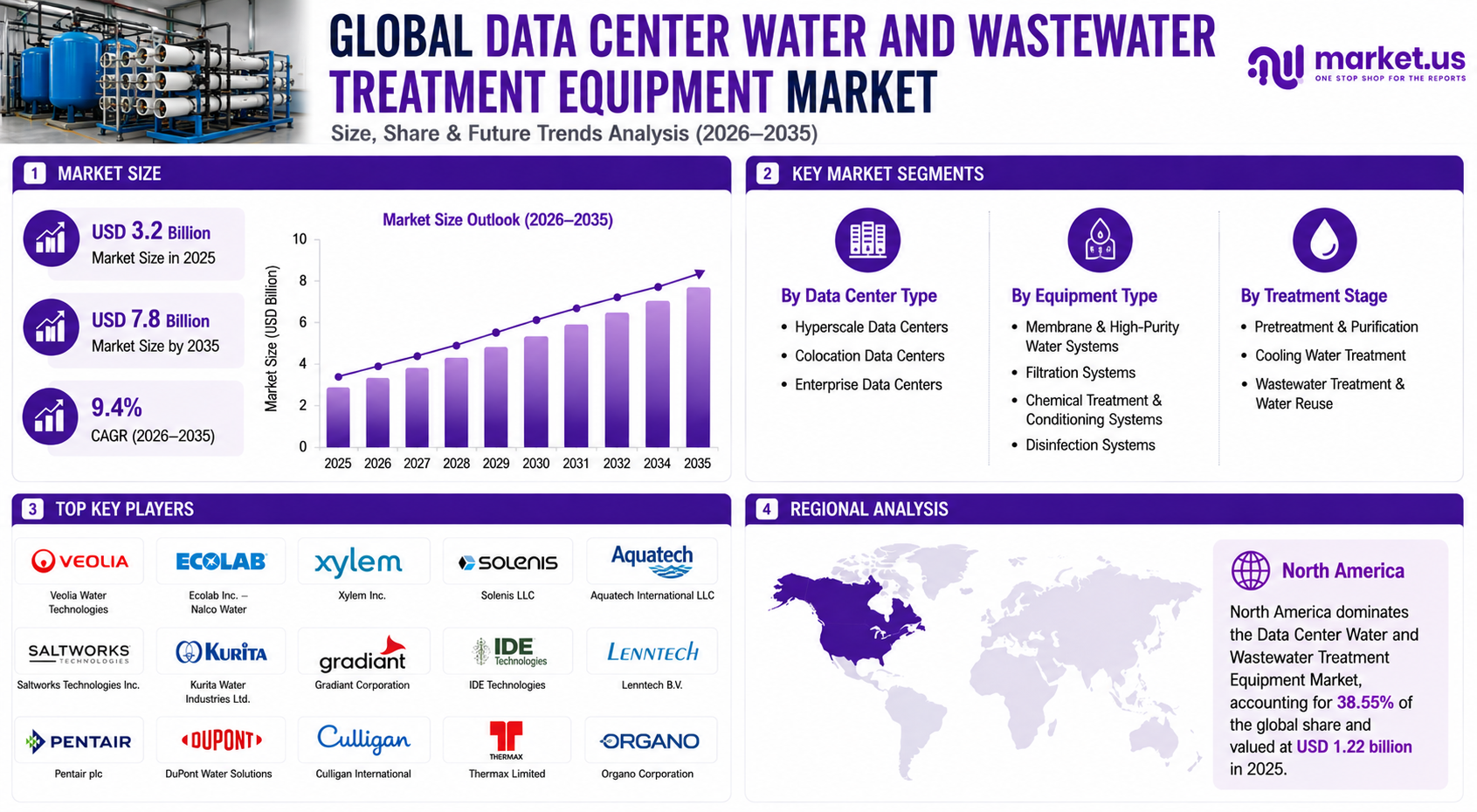
In 2025, the Data Center Water and Wastewater Treatment Equipment Market was valued at USD 3.2 billion. The market is projected to grow at a CAGR of 9.4% between 2026 and 2035, reaching approximately USD 7.8 billion by 2035. North America led the market with a 38.55% share, generating USD 1.22 billion in revenue.
The market includes reverse osmosis systems, ultraviolet (UV) disinfection units, cooling tower water treatment solutions, and wastewater recycling equipment used to manage water consumption and treatment in data centers. Rising investments in AI-driven data center infrastructure across the United States are increasing demand for advanced water treatment technologies.
- According to the Lawrence Berkeley National Laboratory under the U.S. Department of Energy (DOE), U.S. data center electricity consumption increased from 58 TWh in 2014 to 176 TWh in 2023, accounting for 4.4% of total national electricity use. The DOE projects consumption to reach 325-580 TWh by 2028, representing 6.7%-12% of U.S. electricity demand, driving greater deployment of cooling water treatment equipment.
Google reported in its 2025 sustainability disclosures that its water stewardship initiatives replenished approximately 7.7 billion gallons of water, equivalent to about 78% of its total freshwater consumption. This highlights the growing adoption of water recycling and reuse infrastructure at hyperscale data centers.
- The U.S. Environmental Protection Agency (EPA) regulates wastewater discharges through the National Pollutant Discharge Elimination System (NPDES) under the Clean Water Act, covering more than 50 industrial and commercial categories. These regulations encourage data centers using cooling towers to install compliant filtration, disinfection, and wastewater treatment systems.
On April 16, 2026, the EPA introduced Water Reuse Action Plan (WRAP) 2.0, including Action 3.10, to support state permitting of recycled water for data center cooling. Projects such as the Broad Run Water Reclamation Facility in Loudoun County, Virginia, and Google’s recycled wastewater initiative in Douglas County, Georgia, demonstrate expanding water reuse, while the National Ground Water Association (NGWA) continues to promote sustainable groundwater management alongside data center growth.
Key Takeaways
- The Global Data Center Water & Wastewater Treatment Equipment Market was valued at USD 3.2 billion in 2025.
- The global market is projected to grow at a CAGR of 9.4% and is estimated to reach USD 7.8 billion by 2035.
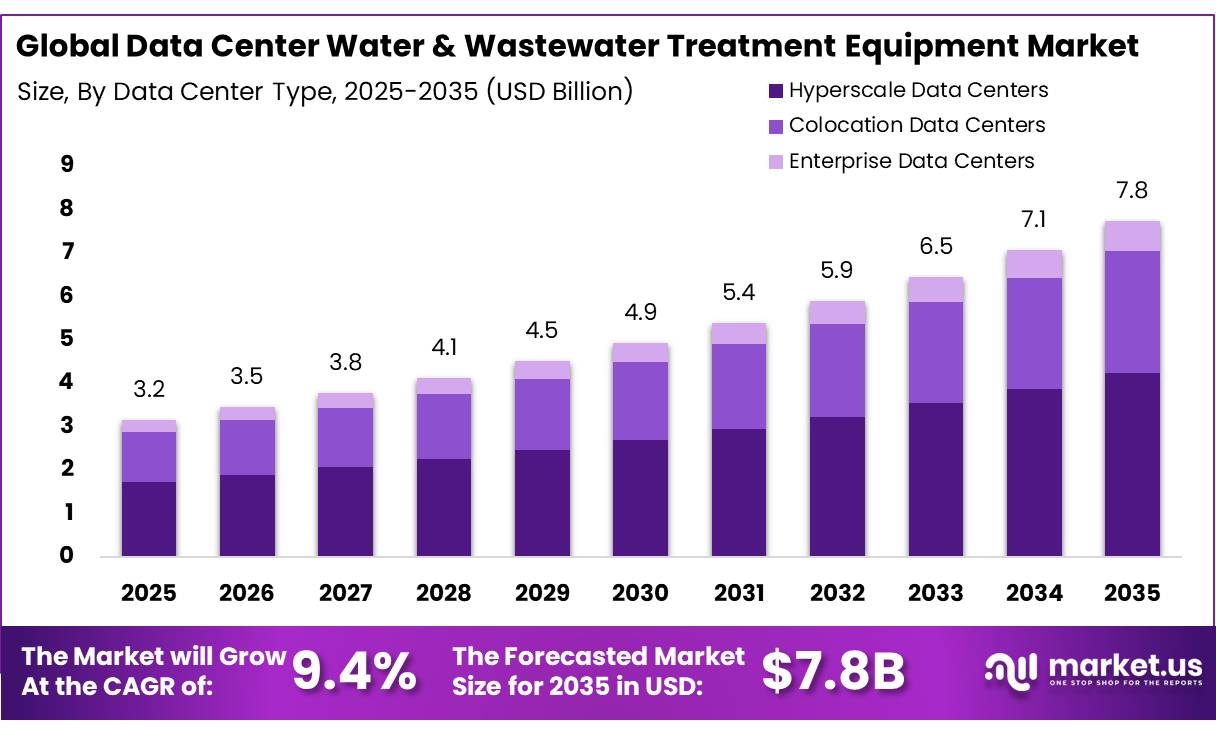
- On the basis of data center type, Hyperscale Data Centers dominated the market, constituting 54.83% of the total market share
- Based on the equipment type, Membrane & High-Purity Water Systems dominated the market, accounting for 32.0% of the total market share
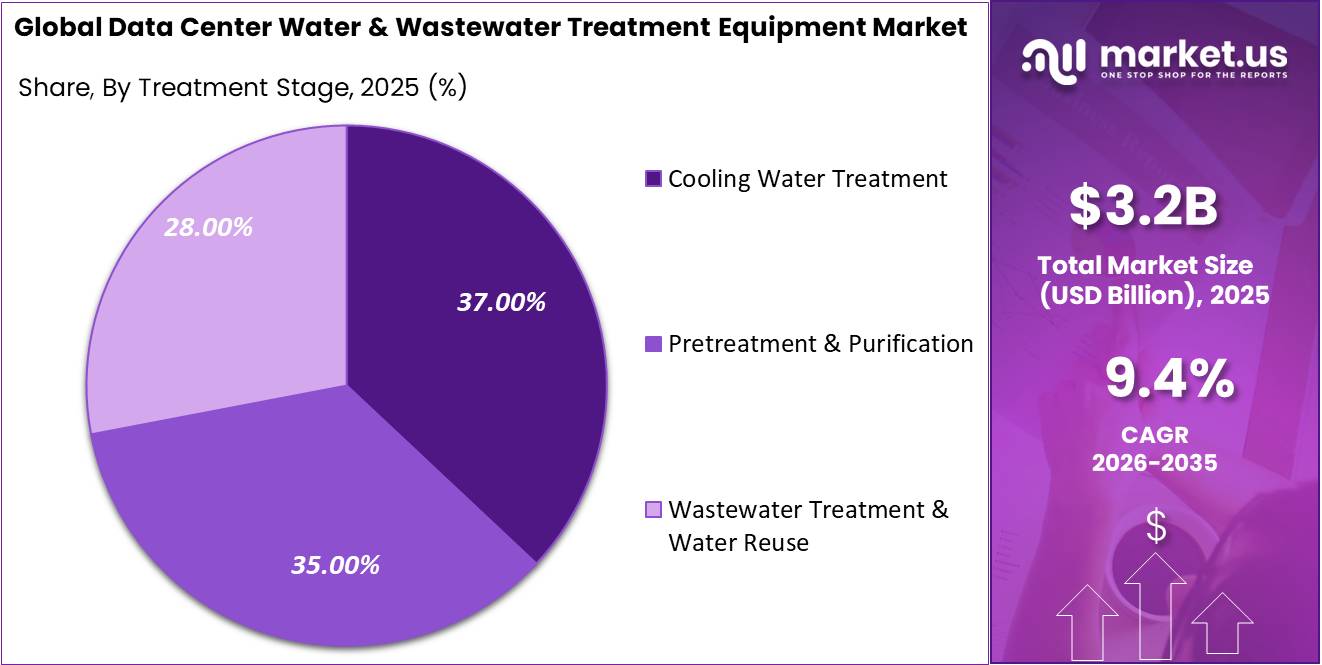
- Based on the treatment stage, Cooling Water Treatment dominated the market, accounting for 37.0% of the total market share.
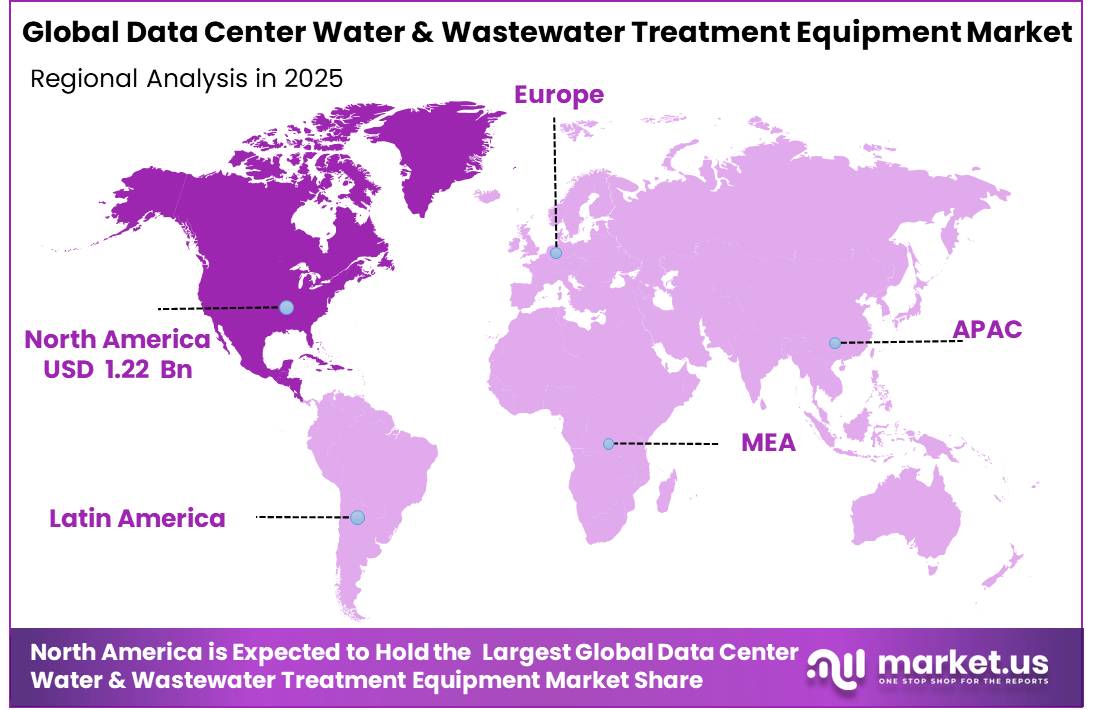
- In 2025, North America was the most dominant region in the data center water & wastewater treatment equipment market, accounting for 38.55% of the global market.
Market Segmentation Overview
By Data Center Type
In 2025, Hyperscale Data Centers held the leading position in the Data Center Water & Wastewater Treatment Equipment Market, accounting for more than 54.83% of the market share. This dominance was driven by the rapid expansion of large-scale cloud and AI data centers, which require substantial volumes of treated water for cooling and daily operations. The increasing focus on water efficiency, reuse, and regulatory compliance further supported investment in advanced water treatment systems across hyperscale facilities.
By Equipment Type
In 2025, Membrane & High-Purity Water Systems secured a dominant 32.00% share of the Data Center Water & Wastewater Treatment Equipment Market. Their strong market position was supported by the growing demand for high-quality process water used in cooling infrastructure and other critical operations. Technologies such as reverse osmosis and membrane filtration help maintain water purity, reduce scaling and corrosion, improve cooling performance, and enhance the long-term reliability of data center equipment.
By Treatment Stage
In 2025, Cooling Water Treatment accounted for more than 37.00% of the Data Center Water & Wastewater Treatment Equipment Market, making it the largest treatment stage segment. Its leadership was driven by the essential role of cooling systems in maintaining optimal temperatures for high-performance servers. Effective cooling water treatment minimizes corrosion, scaling, and biological contamination, improving system efficiency, extending equipment lifespan, and ensuring continuous data center operations.
Drivers Analysis
The rapid expansion of hyperscale and AI-powered data centers is a major growth driver for the Data Center Water & Wastewater Treatment Equipment Market. AI-optimized server racks now operate at 40-120 kW per rack, compared with 5-10 kW in traditional enterprise facilities, significantly increasing cooling and water treatment requirements. According to the U.S. Department of Energy (DOE)/Lawrence Berkeley National Laboratory, U.S. data center electricity consumption increased from 58 TWh in 2014 to 176 TWh in 2023, with demand projected to reach 325-580 TWh by 2028, driving higher demand for cooling water treatment and wastewater management systems.
Large hyperscale facilities also require substantial water resources, strengthening the need for advanced treatment technologies. A 100 MW data center can consume approximately 528,000 gallons of water per day, while major campuses use between 1.5 million and 5 million gallons daily. In 2023, Northern Virginia’s data center cluster consumed nearly 2 billion gallons of water, representing a 63% increase from 2019. This rising demand is encouraging wider adoption of reverse osmosis, cooling tower treatment, wastewater recycling, and long-term water management service contracts.
Major Challenges
Water-stress siting risk is becoming a key challenge for the Data Center Water & Wastewater Treatment Equipment Market as hyperscale and AI data centers expand into regions with limited freshwater resources. Large facilities typically consume 1-5 million gallons of water per day for cooling, while total U.S. data center water use has reached approximately 449 million gallons per day, representing around 0.3-0.4% of national water withdrawals. This is increasing pressure on water availability in regions such as Texas and Arizona, encouraging greater investment in water treatment and recycling systems.
In India, where 18% of the world’s population depends on only 4% of global freshwater resources, data center water demand is expected to reach nearly 358 billion litres annually by 2030, with 60-80% of facilities potentially facing high water stress. Operators are responding by targeting 50-70% cooling water reuse, designing treatment plants with 10-20% additional capacity, and conducting 12-18 month hydrological studies. However, these measures can increase capital costs by 8-12% per MW, extend project payback by 1-2 years, raise treated water costs by 3-6%, and cause 5-10 day delays in equipment delivery.
Business Opportunities
Reclaimed water retrofits present a significant growth opportunity for the Data Center Water & Wastewater Treatment Equipment Market, as many existing facilities still rely on conventional cooling-water treatment and municipal water supplies. The U.S. EPA’s Water Reuse Action Plan (WRAP) 2.0 encourages greater use of recycled water for data center cooling, increasing demand for advanced treatment technologies such as ultrafiltration (UF), reverse osmosis (RO), disinfection, corrosion control, and real-time water monitoring systems.
With U.S. data centers consuming more than 400 million gallons of water per day and less than one-third reportedly monitoring water usage, upgrading just 8%-12% of large facilities for reclaimed water could increase equipment spending by approximately 18%-28% per retrofitted site. These projects may also boost aftermarket chemical and maintenance revenue by 12%-16%, supporting an estimated 2.6 percentage point increase in market growth in regions experiencing rising freshwater constraints.
Use Cases
High-Purity Water Production
Modern data centers require high-quality process water to maintain reliable cooling systems and reduce equipment degradation. Membrane filtration, deionization, and reverse osmosis systems remove dissolved solids and contaminants, lowering maintenance costs and improving cooling performance. Research from the Lawrence Berkeley National Laboratory found that workload-level water use can vary by more than 10,000 times, while water consumption per kilowatt-hour differs by over 1,000 times, demonstrating the importance of efficient water treatment technologies.
Water Stewardship and Environmental Compliance
Data center operators increasingly deploy water treatment equipment to meet environmental regulations and corporate sustainability goals. Treatment systems help facilities comply with wastewater discharge requirements while supporting responsible water management. Google reported that 87% of its freshwater withdrawals in 2025 came from areas with low or medium water depletion risk, reflecting growing investment in sustainable water infrastructure and treatment solutions
Cooling Water Treatment for High-Density AI Data Centers
The rapid growth of AI and hyperscale data centers is increasing the need for advanced cooling water treatment systems. These facilities use reverse osmosis (RO), filtration, chemical dosing, and cooling tower treatment equipment to maintain water quality, reduce scaling, and improve cooling efficiency. According to the U.S. Department of Energy (DOE) and Lawrence Berkeley National Laboratory (LBNL), U.S. data center electricity consumption increased from 58 TWh in 2014 to 176 TWh in 2023 and is projected to reach 325-580 TWh by 2028, representing 6.7%-12.0% of total U.S. electricity demand. This growth directly increases demand for cooling water treatment equipment.
Environmental Compliance and Wastewater Management
Data centers use wastewater treatment equipment to ensure cooling water and process wastewater comply with environmental discharge regulations before being released or reused. Treatment systems, including filtration, reverse osmosis, and disinfection, help reduce contaminants, improve water quality, and support sustainable operations. According to the U.S. Department of Energy (DOE) and Lawrence Berkeley National Laboratory (LBNL), U.S. data center electricity consumption reached 176 TWh in 2023, accounting for 4.4% of total U.S. electricity use, and is projected to increase to 325-580 TWh by 2028. As computing capacity expands, the demand for reliable water treatment and wastewater management systems continues to grow.
Regional Analysis
North America accounted for the largest share of the Data Center Water & Wastewater Treatment Equipment Market in 2025, capturing 38.55% of the global market and reaching a value of USD 1.22 billion. The region’s strong position is supported by the continued expansion of hyperscale and enterprise data centers across the United States and Canada, driving higher demand for advanced cooling water treatment and wastewater management systems. Loudoun County, Virginia, home to one of the world’s largest data center clusters, remains a major hub for water treatment equipment deployment.
Regional demand is further strengthened by rising electricity and cooling requirements. According to Natural Resources Canada (NRCan), data centers account for approximately 1% of Canada’s annual electricity consumption, with nearly 40% of facility energy used for server cooling. In the United States, the U.S. Energy Information Administration (EIA) estimates that data center servers represented around 7% of commercial electricity consumption in 2025, while cooling requirements can be up to 2.9 times higher than those of conventional commercial buildings, supporting continued investment in water treatment infrastructure.
Recent Developments
- In April 2026, Veolia Water Technologies partnered with Amazon to supply reclaimed water for cooling at Amazon’s data centers in Mississippi. The project is expected to recycle more than 83 million gallons of potable water each year, equivalent to the annual water use of about 760 S. homes, supporting Amazon’s 2030 water-positive target.
- In November 2025, Ecolab Inc. launched its Cooling as a Service (CaaS) platform through Nalco Water. The solution integrates 3D TRASAR Technology, a smart Coolant Distribution Unit (CDU), and builds on 102 years of cooling management experience to improve cooling efficiency while reducing water and energy use.
- In May 2026, Gradiant Corporation secured Series E funding at a USD 2 billion Backed by Safar Partners and Hostplus Superannuation Fund, the investment will accelerate water and wastewater treatment infrastructure for AI data centers, semiconductor facilities, and other industrial sectors.
Conclusion
The Data Center Water & Wastewater Treatment Equipment Market is expected to grow steadily, driven by the rapid expansion of AI, cloud computing, and hyperscale data centers. Rising cooling requirements and stricter environmental regulations are increasing demand for advanced water treatment technologies, including reverse osmosis, membrane filtration, UV disinfection, and water reuse systems.
According to the U.S. Department of Energy, U.S. data center electricity consumption is projected to reach 325-580 TWh by 2028, further supporting investment in efficient cooling and wastewater treatment infrastructure. At the same time, growing adoption of reclaimed water and sustainability initiatives is expected to create long-term opportunities for equipment manufacturers and service providers




















