


Introduction
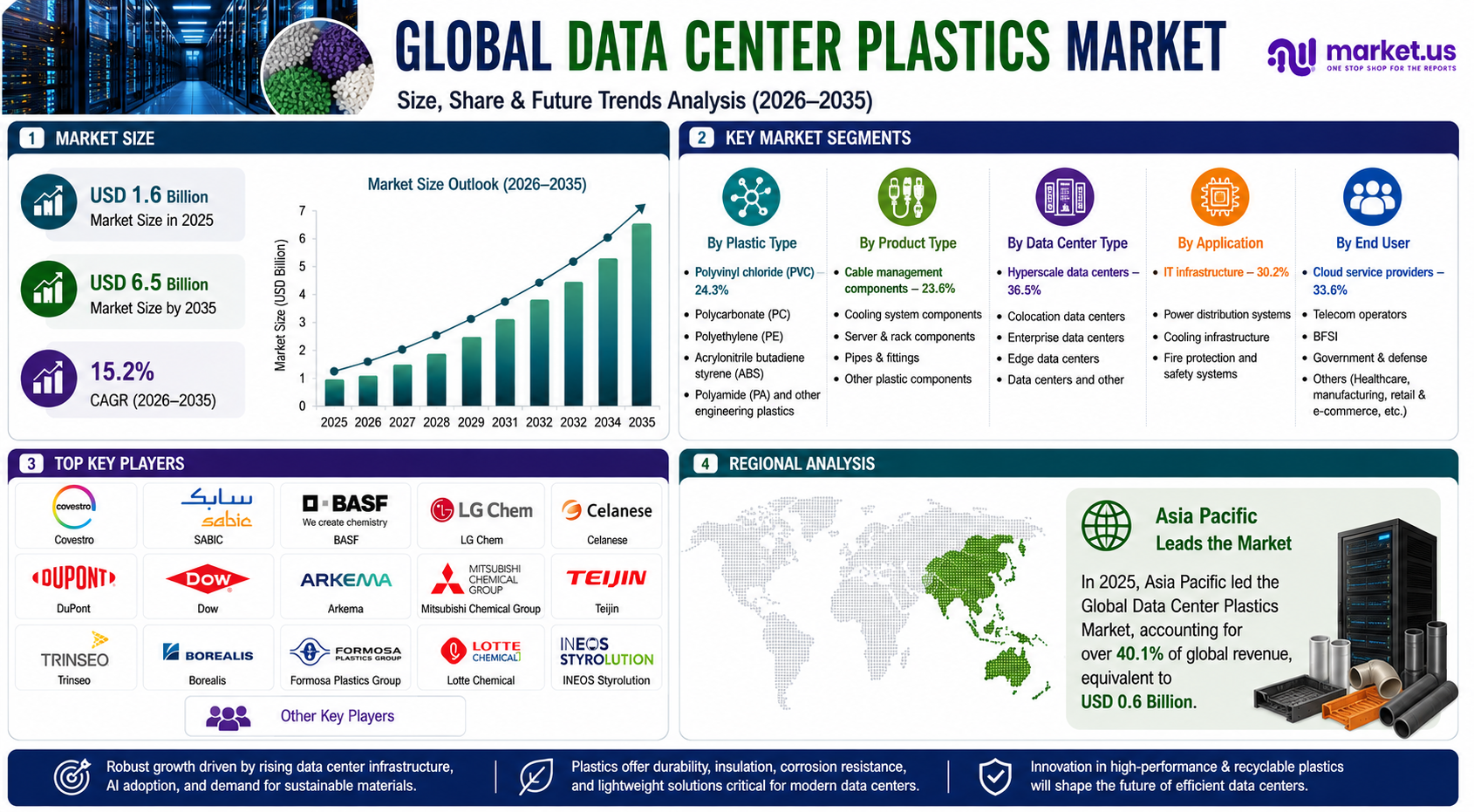
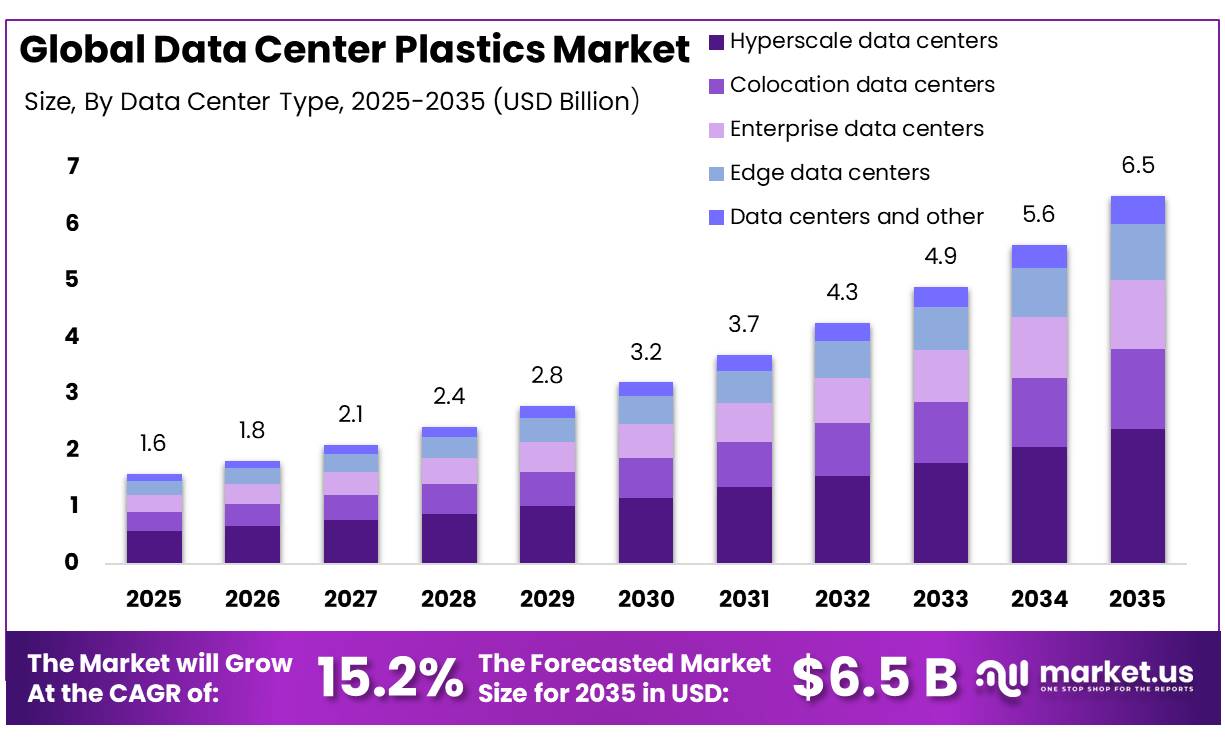
In 2025, the Global Data Center Plastics Market was valued at USD 1.6 billion and is projected to grow at a 15.2% CAGR from 2026 to 2035, reaching nearly USD 6.5 billion by 2035. Asia Pacific led the market with more than 40.1% share and around USD 0.6 billion in revenue.
Data center plastics include engineering thermoplastics, elastomers, polyurethane materials, polymer foams, and specialty compounds used in connectors, circuit boards, cable jackets, cooling systems, airflow guides, and insulation. In December 2025, SABIC expanded polyphenylene ether oligomers for high-performance multilayer printed circuit boards used in AI servers and 5G infrastructure.
Rising power and cooling needs are strengthening material demand. In April 2026, the International Energy Agency reported that global data center electricity use reached 485 TWh in 2025 and could rise to 950 TWh by 2030, equal to nearly 3% of global electricity demand.
In November 2025, ARPA-E committed USD 42 million across 15 projects under its COOLERCHIPS program, targeting cooling energy below 5% of IT load. At the same time, sustainability is becoming more important, as global e-waste reached 62 million tonnes, including 17 million tonnes of plastics, while only 22.3% was formally recycled. This is creating opportunities for recycled, low-carbon, and recyclable plastic materials in data center infrastructure.
Key Takeaways
- The Global Data Center Plastics Market was valued at USD 1.6 billion in 2025.
- The market is projected to grow at a CAGR of 15.2% and is estimated to reach USD 6.5 billion by 2035.
- On the basis of plastic type, Polyvinyl chloride (PVC) dominated the market, constituting 24.3% of the total market share.
- Based on the product type, Cable management components dominated the market, with a substantial market share of around 23.6%.
- Based on the data center type, Hyperscale data centers led the market, comprising 36.5% of the total market.
- On the basis of application, IT infrastructure dominated the market, constituting 30.2% of the total market share.
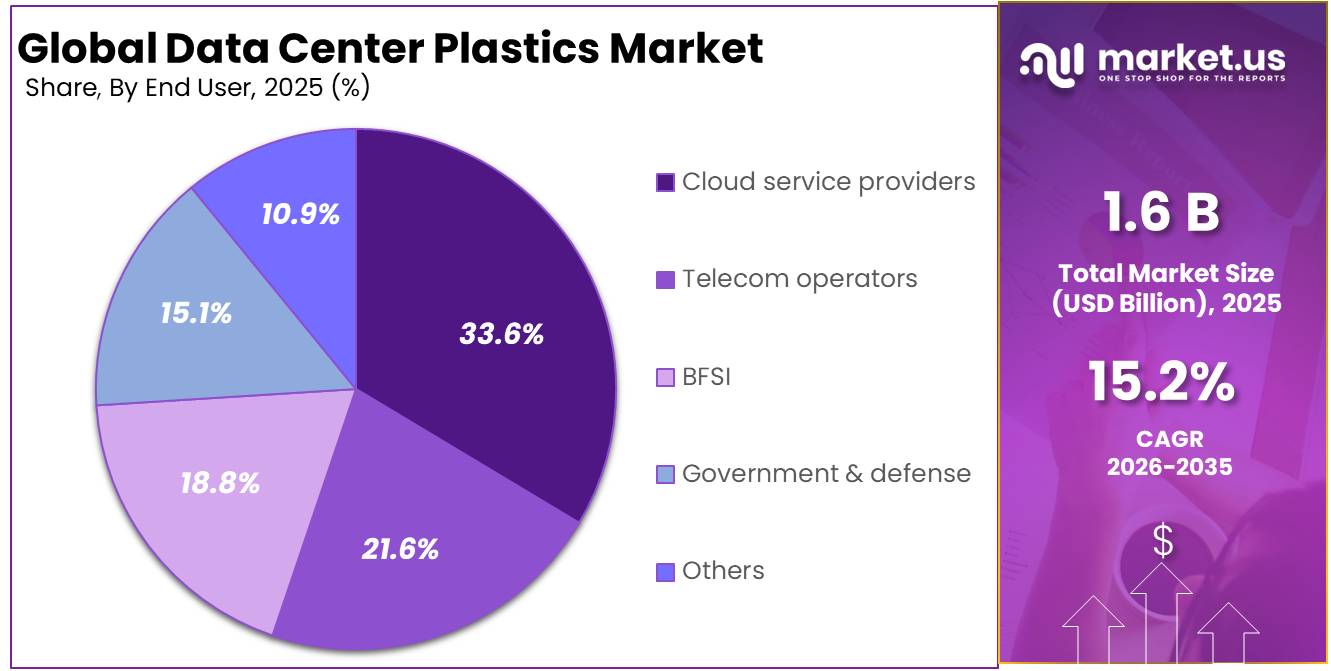
- Based on the end user, Cloud service providers dominated the market, with a substantial market share of around 33.6%.
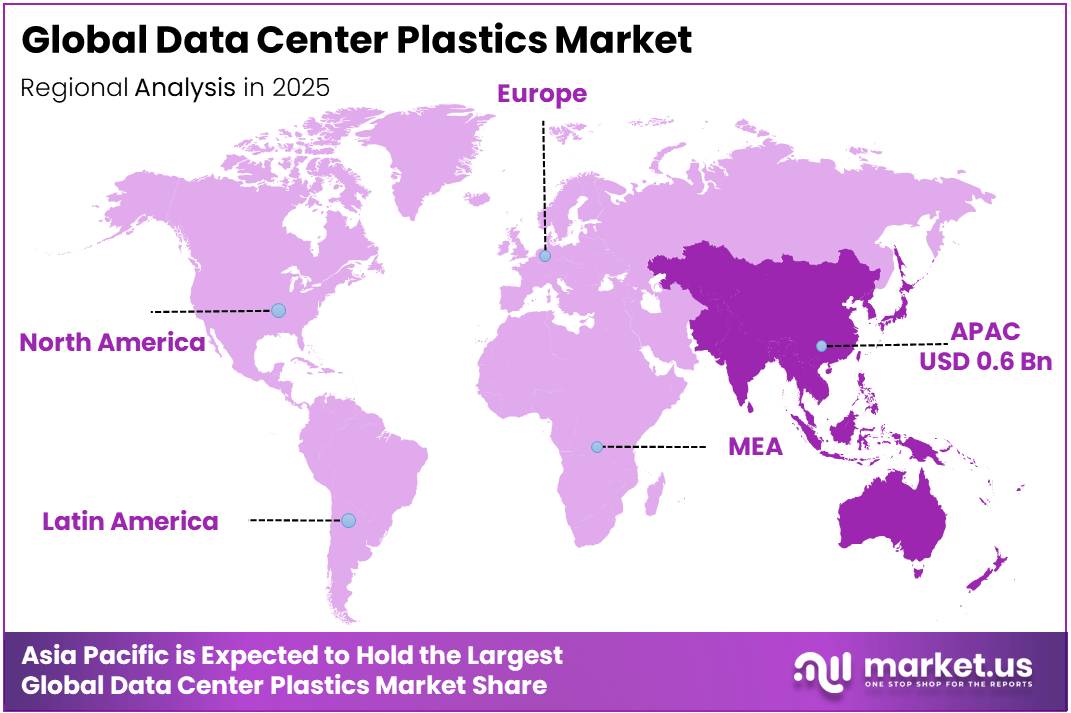
- In 2025, Asia Pacific was the most dominant region in the market, accounting for 40.1% of the total global consumption.
Market Segmentation Overview
Plastic Type Analysis
PVC leads the Data Center Plastics Market with a 24.3% share
In 2025, Polyvinyl Chloride (PVC) held more than a 24.3% share of the Data Center Plastics Market. Its leadership is supported by wide use in cable insulation, conduits, pipes, and protective electrical components. In March 2026, the European Commission’s Joint Research Centre reported that suspension PVC accounted for over 80% of the broader PVC market, with cable insulation among its key applications.
Product Type Analysis
Cable management components lead with a 23.6% share
In 2025, Cable Management Components captured more than a 23.6% share. These products include trays, conduits, ducts, ties, clips, and routing accessories used to organize and protect power and communication cables. In 2025, EU data centers consumed around 99 TWh of electricity, nearly 3% of total EU power generation, supporting demand for reliable cable-management infrastructure.
Data Center Type Analysis
Hyperscale data centers dominate with a 36.5% share
In 2025, Hyperscale Data Centers accounted for more than a 36.5% share. Their large size requires significant amounts of cabling, cooling parts, insulation, connectors, and protective housings. BASF reported that a hyperscale data center can contain about 500 to 1,000 kilometres of fiber-optic cables, creating strong demand for advanced engineering plastics.
Application Analysis
IT infrastructure leads the market with a 30.2% share
In 2025, IT Infrastructure held more than a 30.2% share. Growth is supported by increasing installations of servers, storage systems, switches, and networking equipment. Engineering plastics are widely used in connectors, cable-management parts, housings, insulation, and cooling assemblies because of their lightweight, durable, and heat-resistant properties.
End User Analysis
Cloud service providers lead with a 33.6% share
In 2025, Cloud Service Providers captured more than a 33.6% share. Large cloud facilities require extensive cooling, insulation, networking, and electrical systems. In October 2025, the European Commission’s CORDIS platform reported the development of a 40 kW immersion-cooling system, highlighting the growing use of engineered polymers and advanced thermal-management materials in cloud data centers.
Drivers
Rapid Data Center Expansion Drives Advanced Plastic Demand
The rapid construction of large data centers is a major driver for the Data Center Plastics Market. Modern facilities need large volumes of engineering plastics for cable insulation, connectors, server components, electrical housings, cooling systems, ducts, and other lightweight parts that must handle continuous heat and electrical loads. The International Energy Agency reported that global data-center electricity consumption reached about 485 TWh in 2025 and could rise to nearly 950 TWh by 2030, meaning demand may almost double within five years. AI-focused data centers are expected to increase electricity consumption around threefold during the same period.
This expansion is also visible in the United States. Lawrence Berkeley National Laboratory’s 2026 update estimates that data centers could represent about 11.8% of total U.S. electricity consumption by 2030, with scenarios ranging from 9.5% to 15.3%. More high-capacity facilities should therefore increase demand for durable, heat-resistant, electrically insulating, and lightweight plastic components.
Major Challenges
Recycling Rules Raise Costs for Data Center Plastics
A major challenge for the Data Center Plastics Market is meeting tougher recycling and chemical-safety rules without raising costs. Data center servers, cables, connectors and cooling equipment use plastic housings, insulation and flame-retardant materials that become electronic waste at replacement. The ITU reported that global e-waste reached 62 million tonnes in 2022, including 17 million tonnes of plastics, while only 22.3% of total e-waste was formally collected and recycled. This shows how difficult it remains to recover plastics from complex electronic products.
Regulation is also becoming stricter. The European Commission reported in 2025 that only 40% of WEEE was recycled in the EU, while only three Member States met the 65% collection target in 2022. The EU RoHS Directive also restricts ten hazardous substances, including brominated flame retardants and plasticisers. These requirements push suppliers toward safer, recyclable polymers, but reformulation, testing and certification can increase costs and slow material approvals
Business Opportunities
AI Data Centers Expand Demand For Advanced Plastics
The rapid build-out of AI data centers creates a strong growth opportunity for suppliers of high-performance plastics. In 2025, the International Energy Agency reported that electricity demand from data centers increased by 17%, while capital spending by five large technology companies exceeded USD 400 billion. The IEA expects global data center electricity use to roughly double by 2030 as AI computing expands. This growth can raise demand for flame-retardant polycarbonate, engineering plastics and thermoplastic materials used in server air ducts, storage trays, electrical housings, connectors, cable protection and cooling systems.
Covestro also identifies polycarbonate applications across power distribution, cooling systems and IT hardware in AI data centers. Government support strengthens this opportunity. The U.S. ARPA-E COOLERCHIPS program has committed USD 42 million across 15 projects to develop more efficient data-center cooling technologies, creating further scope for durable and heat-resistant plastic components.
Use Cases
Liquid Cooling Tubes Support High-Density AI Servers
Engineering plastics and polymer materials such as PTFE and EPDM are increasingly used in liquid-cooling tubes, hoses, seals, and coolant distribution systems. This use case is becoming more important as AI servers create higher heat loads. The IEA reported that data centers consumed around 415 TWh of electricity worldwide in 2024, with demand expected to reach about 945 TWh by 2030. Electricity use from accelerated servers is projected to increase by around 30% annually. The Open Compute Project lists PTFE tubing specifically designed for rack-to-manifold and on-blade cooling in lengths of 6 to 24 inches. Another OCP-listed EPDM cooling hose operates between -40°C and +120°C, showing the demanding conditions polymer materials must handle.
Plastic Barriers Improve Data Center Airflow Management
Flexible plastic sheets, curtains, panels, and barriers are used for hot-aisle and cold-aisle containment. These products separate server exhaust air from cooled supply air and help cooling equipment operate more efficiently. The U.S. Department of Energy specifically identifies flexible plastic barriers as one method for isolating hot and cold zones around IT racks. A DOE-supported Sabey Data Centers project using hot-aisle containment and other efficiency measures achieved a 57% reduction in energy use, while annual savings exceeded 8 million kWh. These results support continued use of lightweight, corrosion-resistant plastic containment products as data halls become larger and more power dense.
Polymer Cable Jackets Protect Dense Fiber Networks
Plastic and polymer compounds are widely used as protective jackets around fiber-optic cables. They provide insulation, flexibility, flame resistance, and physical protection while allowing very large fiber counts to fit into limited data center space. Corning’s RocketRibbon XD cable, designed for data center applications, can contain up to 6,912 fibers. The cable uses 16 routable subunits, each carrying 432 fibers, with individual fibers measuring 200 µm in diameter. Such high-density cabling creates a practical use case for flame-retardant and low-smoke polymer jacket materials, particularly in hyperscale and AI-oriented facilities where large amounts of data must move between servers, switches, and storage systems.
Plastic Insulation Supports Copper Network Cabling
Data centers also use polymer insulation and low-smoke, zero-halogen jackets around copper networking cables. These materials help electrically isolate conductors while improving fire and smoke performance inside enclosed facilities. Corning’s Category 6A data-center cable is designed for frequencies up to 550 MHz and supports Power over Ethernet technologies delivering up to 90 W. The cable uses a flame-retardant, non-corrosive LSZH jacket, illustrating how engineered polymer compounds serve both safety and communication needs. As rack densities and connected equipment increase, demand for durable insulation, jacketing, separators, and cable-management plastics is expected to remain closely linked with network expansion.
Polymer Components Enable Reliable Coolant Connections
Engineered polymers are also used around coolant connectors, flexible interfaces, seals, and tubing systems where resistance to heat, moisture, chemicals, and repeated movement is important. Open Compute Project liquid-cooling standards increasingly support these applications. One OCP blind-mate cooling connector allows radial misalignment of ±5 mm and angular misalignment of ±2.7°, helping cooling connections tolerate normal rack-installation variation. This becomes more important as direct liquid cooling expands. Uptime Institute reported that 22% of surveyed organizations were already using some direct liquid cooling in 2024, while another 61% were not yet using it but would consider adoption.
Regional Analysis
Asia-Pacific Dominates the Data Center Plastics Market with a 40.1% Share
In 2025, Asia-Pacific held the leading position in the Data Center Plastics Market, accounting for more than 40.1% of the global market and generating approximately USD 0.63 billion in revenue. The region’s strong position is supported by rising cloud computing adoption, growing artificial intelligence workloads, and continued investment in large-scale data center infrastructure. Rapid expansion of computing facilities across China, Japan, Singapore, and other Southeast Asian countries is increasing demand for plastic-based cable management systems, insulation materials, cooling components, equipment housings, and electrical protection parts. As hyperscale and cloud operators continue to expand regional capacity, the use of durable and lightweight engineered plastics across data center infrastructure is expected to remain strong.
Recent Developments
- In December 2025, Covestro AG completed its strategic ownership transaction with XRG, backed by a EUR 1.17 billion capital increase. As part of the transaction, Covestro’s capital stock increased by 10%, equivalent to approximately 18.9 million shares.
- In July 2025, BASF acquired DOMO Chemicals’ remaining 49% stake in Alsachimie, giving BASF full ownership of the French production facility for key polyamide 6.6 raw materials. BASF had previously valued its ownership interest at €52 million, while the subsequent ownership revaluation resulted in an impact of €10 million.
Conclusion
The Data Center Plastics Market is expected to benefit from the rapid expansion of AI computing, cloud services, high-density servers, and advanced cooling systems. Engineering plastics are increasingly important in cable insulation, connectors, server components, electrical housings, cooling equipment, and other parts where low weight, electrical insulation, corrosion resistance, and heat management are required. In 2026, the International Energy Agency reported that global data-center electricity consumption was about 485 TWh in 2025 and could reach roughly 950 TWh by 2030, while electricity use from AI-focused data centers is expected to triple during the same period.
In the United States, Lawrence Berkeley National Laboratory estimates that data centers could represent around 11.8% of total U.S. electricity consumption by 2030, with scenarios ranging from 9.5% to 15.3%. This strong infrastructure buildout should create steady opportunities for manufacturers of durable, flame-resistant, thermally stable, and recyclable plastic materials designed for modern data-center environments.
Looking for data tailored to your specific market, region, or business need? Request a custom report or consultation — write to us at [email protected]




















