


Report Overview
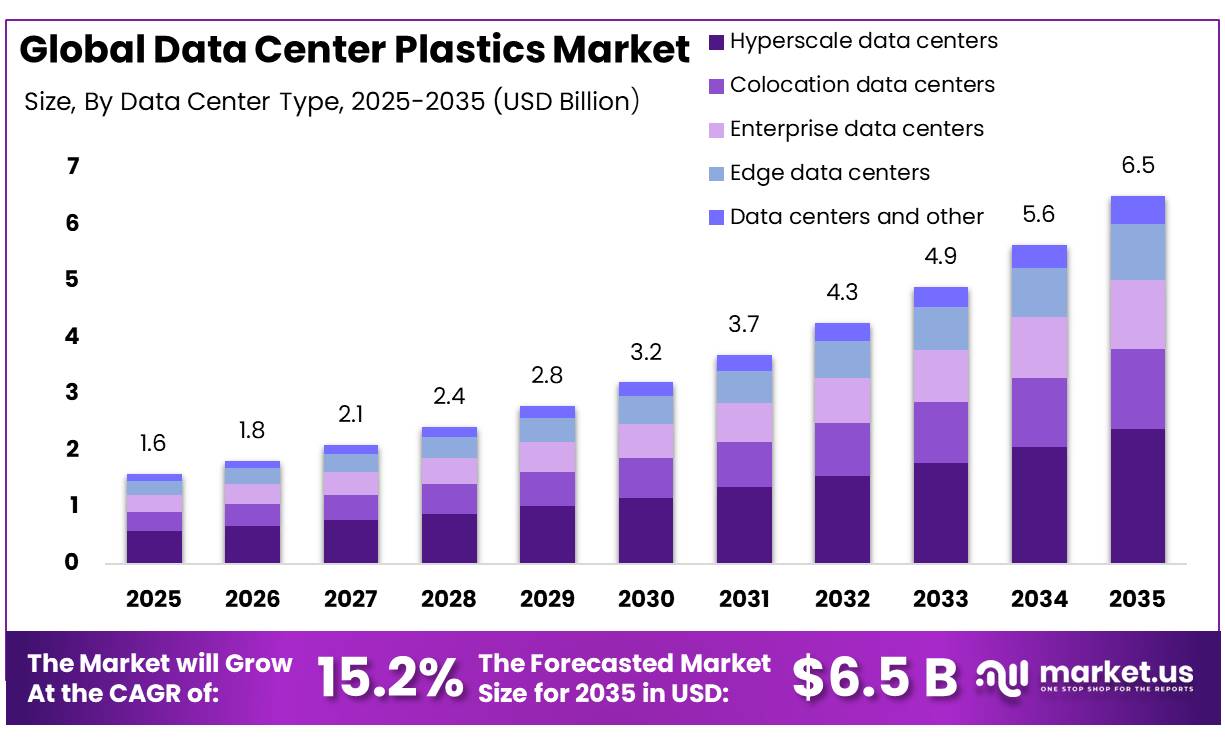
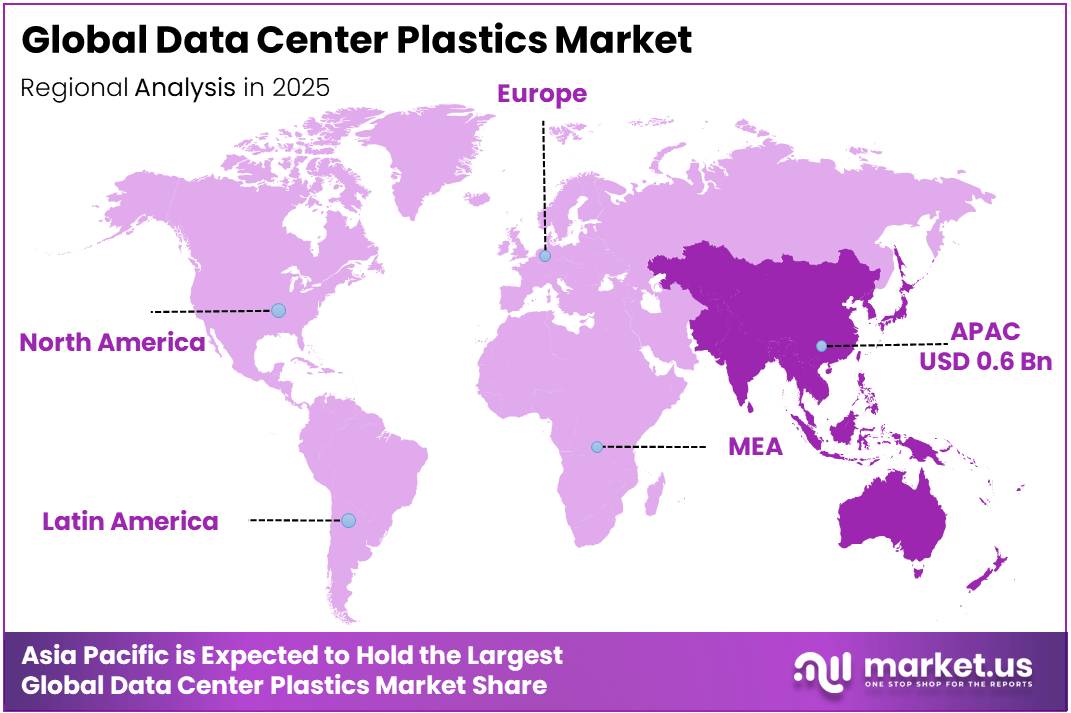
In 2025, the Global Data Center Plastics Market was valued at USD 1.6 billion, and between 2026 and 2035, this market is estimated to register a CAGR of 15.2%, reaching about USD 6.5 billion by 2035. In 2025, Asia Pacific led the market, achieving over 40.1% share with a revenue of USD 0.6 Billion.
Data center plastics comprise engineering thermoplastics, thermoplastic elastomers, polyurethane systems, polymer foams and specialty compounds used in server connectors, printed circuit boards, cable jackets, busbar covers, cooling fans, liquid-cooling fittings, airflow guides and insulation. In December 2025, according to SABIC, polyphenylene ether oligomers were being expanded to support high-performance multilayer printed circuit boards for AI servers and 5G infrastructure.
- In April 2026, according to the International Energy Agency, global data-center electricity consumption reached 485 TWh in 2025 and is projected to rise to 950 TWh by 2030, representing around 3% of worldwide electricity demand.
Key Takeaways
- The Global Data Center Plastics Market was valued at USD 1.6 billion in 2025.
- The market is projected to grow at a CAGR of 15.2% and is estimated to reach USD 6.5 billion by 2035.
- On the basis of plastic type, Polyvinyl chloride (PVC) dominated the market, constituting 24.3% of the total market share.
- Based on the product type, Cable management components dominated the market, with a substantial market share of around 23.6%.
- Based on the data center type, Hyperscale data centers led the market, comprising 36.5% of the total market.
- On the basis of application, IT infrastructure dominated the market, constituting 30.2% of the total market share.
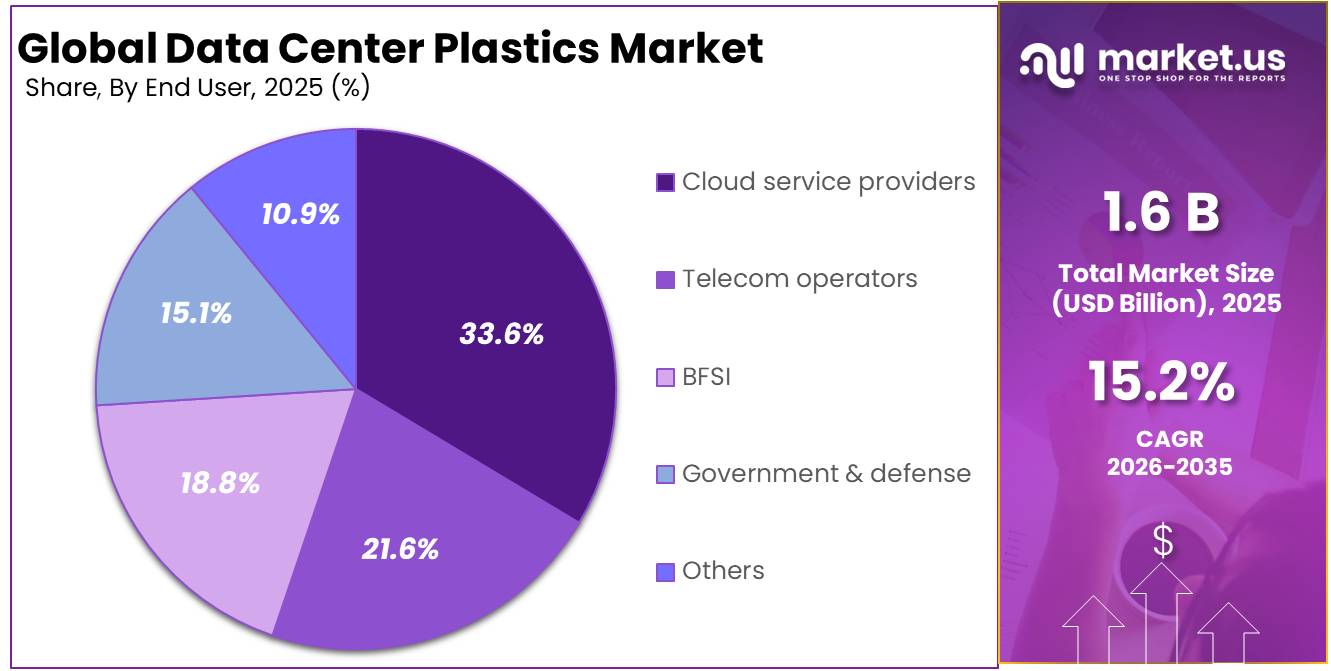
- Based on the end user, Cloud service providers dominated the market, with a substantial market share of around 33.6%.
- In 2025, Asia Pacific was the most dominant region in the market, accounting for 40.1% of the total global consumption.
Government energy data also illustrates the scale of infrastructure pressure. In December 2024, according to the U.S. Department of Energy and Lawrence Berkeley National Laboratory, U.S. data centers consumed 176 TWh of electricity in 2023, equal to 4.4% of national electricity use. Consumption was projected to reach 325 to 580 TWh by 2028, or 6.7% to 12% of U.S. electricity demand.
- In November 2025, according to ARPA-E, the COOLERCHIPS program had committed USD 42 million across 15 projects and targeted cooling energy below 5% of a typical data center’s IT load. This supports future use of coolant-resistant elastomers, thermally conductive polymer housings, insulated pipes, lightweight fan components and precision-molded liquid-cooling connectors.
Circularity will increasingly influence purchasing decisions. In March 2024, according to ITU and UNITAR, global e-waste reached 62 million tonnes in 2022, including 17 million tonnes of plastics, while only 22.3% was formally collected and recycled. E-waste is projected to reach 82 million tonnes by 2030. Future opportunities therefore include recycled-content engineering plastics, bio-attributed polymers, halogen-free flame-retardant compounds, recyclable cable materials and traceable low-carbon resins for global operators.
Plastic Type Analysis
PVC dominates the Data Center Plastics Market with a 24.3% share
In 2025, Polyvinyl chloride (PVC) held a dominant market position, capturing more than a 24.3% share. PVC maintains its strong position because it supports several essential data-center applications, particularly cable insulation and rigid products such as protective pipes and profiles.
- In March 2026, the European Commission’s Joint Research Centre stated that suspension PVC accounts for more than 80% of the broader PVC market and is used in flexible applications such as cable insulation. Its suitability for both electrical cabling and protected cable-routing infrastructure supports steady use across data-center construction and equipment installations.
Polycarbonate (PC) is the fastest growing segment. Its growth is supported by increasing demand for strong plastic components in computer systems, electrical equipment, switches and protective housings. The European Commission identifies electrical systems, office equipment, switches and equipment housings among the typical applications of polycarbonate. The U.S. Environmental Protection Agency’s research database also identifies PC as a commonly used plastic in computer and equipment housings.
Product Type Analysis
Cable management components lead the market with a 23.6% share due to the growing need for safe and organized cable routing.
In 2025, Cable management components held a dominant market position, capturing more than a 23.6% share. The segment includes cable trays, conduits, ducts, clips, ties, bushings and rack-routing accessories used to separate power and communication cables, prevent physical damage and simplify maintenance.
- A European Commission document published in 2026 also estimated that data centres consumed around 99 TWh of electricity in 2025, equal to nearly 3% of total EU power generation. This growing infrastructure load is expected to require more power and network connections, supporting continued demand for durable plastic cable-management components.
Cooling system components are the fastest growing segment in the Data Center Plastics Market. Demand is supported by the installation of air-guiding parts, fan guards, equipment housings, insulation components, drainage fittings and other replaceable parts used in modern cooling layouts. These products help facilities maintain controlled airflow around servers while allowing cooling systems to be expanded or serviced without major structural changes.
Data Center Type Analysis
Hyperscale data centers increase demand for advanced cable and insulation materials
In 2025, Hyperscale data centers held a dominant market position, capturing more than a 36.5% share. BASF Performance Materials reported that a hyperscale data center can contain approximately 500 to 1,000 kilometres of fibre-optic cables. This extensive cabling requirement supports demand for specialized polyamides and polybutylene terephthalate in precision connectors, thermoplastic polyurethane in protective cable jackets, and polyurethane systems in thermal insulation.
Colocation data centers are the fastest growing segment. Their growth is supported by enterprises that need secure computing space, cloud connectivity, and scalable infrastructure without constructing complete facilities independently. Colocation operators serve several customers within the same location, increasing the need for organized cable pathways, protective enclosures, airflow-control parts, power components, and advanced cooling equipment.
Application Analysis
IT infrastructure dominates the market with a 30.2% share due to expanding server and networking requirements
In 2025, IT infrastructure held a dominant market position, capturing more than a 30.2% share. The segment benefits from the growing installation of servers, storage systems and networking equipment in modern data centers. Engineering plastics are widely used in cable-management parts, connectors, equipment housings, cooling assemblies and electrical insulation because they offer low weight, design flexibility and resistance to heat and electricity.
Power distribution systems is the fastest growing segment. Data-center operators are increasingly adopting modular electrical systems to deliver stable power across servers, cooling equipment and network infrastructure. Plastics are used in switchgear barriers, connector housings, cable insulation, busway supports and protective enclosures because they improve safety and reduce component weight.
End User Analysis
Cloud service providers lead with a 33.6% share as large cloud facilities require extensive supporting infrastructure
In 2025, Cloud service providers held a dominant market position, capturing more than a 33.6% share. Large cloud data centres increasingly use dielectric fluids, phase-change materials and multilayer insulation materials to control heat generated by high-density servers.
- In October 2025, the European Commission’s CORDIS platform reported the development of a 40 kW data-centre immersion-cooling system using dielectric cooling fluids and newly formulated phase-change materials. This development supports demand for engineered polymers, plastic insulation components and chemical-based thermal-management materials across cloud data-centre facilities.
Telecom operators are the fastest-growing segment in the Data Center Plastics Market. Their growth is linked to the shift toward cloud-native telecom networks, edge computing and virtualized network functions. These systems require smaller and more distributed data facilities located closer to users to support faster data processing and reliable connectivity. In 2025, the European Commission released a Telco Cloud Reference Architecture that provided technical guidance for telecom operators, edge operators and cloud providers deploying scalable physical and virtual resources.
Key Market Segments
By Plastic Type
- Polyvinyl chloride (PVC)
- Polycarbonate (PC)
- Polyethylene (PE)
- Acrylonitrile butadiene styrene (ABS)
- Polyamide (PA) and other engineering plastics
By Product Type
- Cable management components
- Cooling system components
- Server & rack components
- Pipes & fittings
- Other plastic components
By Data Center Type
- Hyperscale data centers
- Colocation data centers
- Enterprise data centers
- Edge data centers
- Data centers and other
By Application
- IT infrastructure
- Power distribution systems
- Cooling infrastructure
- Fire protection and safety systems
By End User
- Cloud service providers
- Telecom operators
- BFSI
- Government & defense
- Others (Healthcare, manufacturing, retail & e-commerce, etc.)
Driver Analysis
AI rack-density raises liquid-cooling polymer content
The largest 2026 demand driver is the move from conventional air-cooled server halls toward high-density AI and accelerated-compute racks that require direct-to-chip liquid cooling, rear-door heat exchangers, more coolant distribution units, and denser fluid handling architecture. Globally, data-centre electricity demand is projected to rise from about 485 TWh in 2025 to about 950 TWh in 2030, while U.S. data centers alone used roughly 4.4% of national electricity in 2023 and are projected to reach 6.7% to 12% by 2028; that power intensity is the clearest leading indicator that rack thermal loads are moving beyond the practical limits of legacy sheet-metal-and-fan designs.
For plastics suppliers, this changes the bill of materials in favor of chemically resistant manifolds, connectors, valve bodies, insulation layers, dielectric barriers, pump housings, drip trays, and coolant-adjacent seals using high-performance polymers rather than commodity resins.
Driver Impact Analysis
| Driver | (~) % Impact on CAGR Forecast | Geographic Relevance | Impact Timeline |
|---|---|---|---|
| AI rack-density raises liquid-cooling polymer content | +2.4% | North America core, EU, East Asia, Gulf build clusters | Short term (≤ 2 years) |
| Grid constraints accelerate thermal and power-retrofit plastics demand | +1.9% | North America core, APAC corridors, Nordics, Ireland spill-over | Short term (≤ 2 years) |
| PFAS and F-gas compliance shifts coolant-loop material mix | +1.5% | EU core, U.S. regulated states, advanced APAC facilities | Medium term (2-4 years) |
| Server efficiency rules pull demand for lightweight high-spec housings and airflow parts | +1.2% | EU core, multinational OEM supply chains, export-led Asia | Medium term (2-4 years) |
| Fire protection and cable insulation upgrades expand engineered resin usage | +1.1% | U.S. hyperscale belts, EU, Japan, Singapore | Short term (≤ 2 years) |
| Public-sector sustainability and circularity standards favor recycled and traceable plastics | +0.9% | EU, North America public procurement, advanced APAC | Long term (≥ 4 years) |
Restraint Analysis
Tightening PFAS and hazardous plastic controls
For data center plastics, this translates into higher compliance costs across the value chain: resin producers face incremental environment, health, and safety (EHS) capex in the low single‑digit percentage of plant replacement value to manage emissions and waste, while converters and data center operators must adapt procurement and end‑of‑life strategies, adding an estimated 3–5 percent to delivered material costs for PFAS‑intensive compounds in the 2026–2029 window through testing, documentation, and substitution programs.
The strategic impact is twofold: first, qualification cycles for PFAS‑reduced or PFAS‑free formulations lengthen design‑in timelines by 6–18 months, delaying plastics content growth in new racks, cabling, and cooling modules, and second, liability risk pushes hyperscalers to prioritize materials with robust regulatory assurances, creating a premium–discount spread in engineering plastics where compliant grades can command price uplifts of 5–10 percent over legacy formulations, compressing OEM and integrator margins unless offset by higher service pricing.
Over a medium‑term horizon, these pressures can shave around 1.2 percentage points from baseline CAGR because they slow the rollout of innovative plastic components and divert capex toward compliance instead of capacity expansion, particularly in US and EU markets where PFAS policies and hazardous constituent rules under waste and drinking water laws are most developed.
Restraint Impact Analysis
| Restraint | (~) % Impact on CAGR Forecast | Geographic Relevance | Impact Timeline |
|---|---|---|---|
| Tightening PFAS and hazardous plastic controls | -1.2% | US, EU core, select OECD | Medium term (2–4 years) |
| Energy, carbon, and efficiency rules raising TCO | -1.0% | EU, UK, North America | Medium term (2–4 years) |
| Volatile engineering resin prices and logistics | -0.9% | Global, APAC corridors | Short term (≤ 2 years) |
| Sustainability and recyclability design constraints | -0.8% | EU, North America, developed APAC | Long term (≥ 4 years) |
| Supply chain regionalization and qualification delays | -0.8% | North America, EU, India | Medium term (2–4 years) |
| Water, land-use, and local siting restrictions | -0.7% | EU, drought-prone US, India | Long term (≥ 4 years) |
Opportunity Analysis
Waste-heat network components
The IEA expects data-center power demand to almost triple by 2035 in broader forward views, while policy commentary tied to DOE-style community energy programs increasingly frames waste heat as a community energy asset rather than a rejected byproduct.
This opens a white space where plastics suppliers can move upstream from internal facility components into neighborhood-scale thermal infrastructure, a TAM expansion that can raise revenue per megawatt of deployed IT load by an estimated 10% to 18% in qualifying campuses and widen EBITDA margins by 150 to 300 basis points when long-life specialty piping and network modules replace lower-value internal ducting mixes.
The opportunity is geographically selective because district-heating economics work best in the Nordics, parts of core Europe, the UK, and certain North American municipalities, but for participants that establish utility and EPC partnerships before standards mature, the resulting above-baseline CAGR uplift is plausibly about 1.9 percentage points through the early 2030s.
Opportunity Impact Analysis
| Opportunity | (~) % Potential CAGR Upside | Geographic Relevance | Execution Window |
|---|---|---|---|
| PFAS-free cooling polymers | +2.8% | North America core, EU, APAC advanced | Short term (≤ 2 years) |
| Low-GWP thermal loop plastics | +2.1% | U.S., EU, Gulf, Singapore | Medium term (2-4 years) |
| Waste-heat network components | +1.9% | Nordics, EU core, UK, North America selective | Medium term (2-4 years) |
| Circular retrofit resin platforms | +1.7% | EU, U.S., Japan, South Korea | Medium term (2-4 years) |
| Water-footprint compliance plastics | +1.5% | EU, India, water-stressed APAC, U.S. Southwest | Short term (≤ 2 years) |
| Modular edge micro-DC enclosures | +2.4% | India, SEA, Middle East, LatAm, Africa | Long term (≥ 4 years) |
Challenges Analysis
High‑spec resin volatility
Persistent volatility in high‑performance resins used in data center plastics such as flame‑retardant polycarbonate, ABS blends, and specialized cable jacketing compounds creates a recurring 4–7% swing in material input costs per year, translating to an estimated 1.6 percentage point drag on achievable market CAGR because procurement teams routinely over‑hedge or delay orders to manage budget variance.
On the supply side, data center plastics are indirectly exposed to tight petrochemical and critical feedstock balances highlighted in broader infrastructure and digital sustainability analyses, where government and public‑sector briefs flag multi‑year constraints in critical materials, longer transformer and switchgear lead times (often 9–12 months), and growing competition between data centers, EVs, and grid equipment for similar polymer families and additives.
These constraints mean OEMs serving racks, enclosures, structured cabling and cooling components cannot lock in multi‑year resin contracts at stable prices, forcing them to carry 8–12 weeks of safety stock and accept 3–5 day procurement and quality‑testing delays per batch, which cascades into project schedules and compresses margin buffers on large campuses.
Challenges Impact Analysis
| Challenge | (~) % CAGR Friction Drag | Geographic Relevance | Mitigation Horizon |
|---|---|---|---|
| High-spec resin volatility | -1.6% | North America core, EU hubs, APAC manufacturing belts | Medium term (2-4 years) |
| Thermal & fire compliance load | -1.3% | EU regulatory hubs, North America, Japan | Long term (≥ 4 years) |
| Circularity & EPR pressures | -1.1% | EU, UK, select US states, OECD Asia | Long term (≥ 4 years) |
| Cooling-intensive plastics redesign | -1.4% | Global AI data center clusters | Medium term (2-4 years) |
| Skilled polymer + DC talent gap | -0.9% | North America, EU, India, ASEAN | Long term (≥ 4 years) |
| Geo-logistics & permitting drag | -1.0% | India, EU, Middle East, Latin America | Medium term (2-4 years) |
Geopolitical Impact Analysis
Middle East War Raises Supply Risks for Data Center Plastics
The ongoing Middle East war is placing cost and supply pressure on the Data Center Plastics market. In July 2026, the IEA reported that oil output remained 9.4 million barrels per day below pre-war levels, while refinery operations and refined-product supplies stayed constrained. Because plastics used in insulation, cable-management parts, and cooling components rely on petrochemical feedstocks, higher energy and processing costs can move through the value chain and raise procurement expenses for data center builders. This is an inference based on energy-market conditions.
The conflict is affecting shipping routes, insurance charges, and delivery schedules. The IMF noted that rerouting tankers and vessels increases freight costs and lengthens transit times. For suppliers of PVC, polycarbonate, polypropylene, and flame-retardant compounds, longer lead times may delay equipment assembly and facility completion.
At the same time, investment in AI data centers continues to support demand. This pressure is likely to push buyers toward multiple suppliers, inventories, regional material sources, and fire-resistant plastics that can reduce replacement needs. The war is unlikely to stop growth, but it is making pricing less predictable and supply planning more important for manufacturers, contractors, and data center operators.
Regional Analysis
Asia-Pacific Leads the Data Center Plastics Market, While North America Records the Fastest Growth
In 2025, Asia-Pacific held a dominant position in the Data Center Plastics Market, capturing more than a 40.1% share and generating approximately USD 0.63 billion. The region benefits from rapid cloud adoption, expanding artificial intelligence workloads, and large-scale construction of computing facilities across China, Singapore, Japan, and Southeast Asia.
China’s Ministry of Industry and Information Technology reported that the country’s three major telecom operators provided 938,000 external-service data-center racks by the end of 2025, an annual increase of 108,000 racks. Singapore also had more than 1.4 GW of data-center capacity in 2025. This expanding infrastructure base supports demand for cable-management products, equipment housings, insulation materials, cooling components, and other engineered plastic parts required for safe and efficient operations.
North America is the fastest-growing regional market, supported mainly by accelerating development of artificial intelligence data centers, hyperscale campuses, and high-density computing infrastructure in the United States. The International Energy Agency reported that U.S. electricity demand increased by 2.1% in 2025, with expanding data centers accounting for around half of the country’s demand growth. The U.S. Department of Energy’s 2025 update estimated that data centers could represent 11.8% of total U.S. electricity consumption by 2030, with possible outcomes ranging from 9.5% to 15.3%.
Key Regions and Countries Covered
- North America
- The US
- Canada
- Europe
- Germany
- France
- The UK
- Spain
- Italy
- Russia & CIS
- Rest of Europe
- APAC
- China
- Japan
- South Korea
- India
- ASEAN
- Rest of APAC
- Latin America
- Brazil
- Mexico
- Rest of Latin America
- Middle East & Africa
- GCC
- South Africa
- Rest of MEA
Key Players Analysis
DuPont de Nemours, Inc. remains an important supplier of high-performance materials for electrical infrastructure, equipment protection, insulation, sealing, and thermal-management applications. In 2025, the company generated USD 6.849 billion in net sales and USD 1.628 billion in operating EBITDA, producing a 23.8% margin. Its Diversified Industrials segment contributed USD 3.616 billion.
Teijin Limited strengthens its position through polycarbonate, polycarbonate-ABS, PPS compounds, films, and flame-retardant materials designed for electrical and electronic applications. For the fiscal year ended March 2026, the group reported revenue of JPY 873.2 billion. It employed 15,689 people, including 8,164 in Japan and 7,525 overseas, while operating 126 group companies.
Borealis AG competes through advanced polyethylene and polypropylene compounds used in wire, cable, energy, and infrastructure systems. In 2024, it sold 3.87 million metric tons of polyolefins, representing an 11% increase from 2023, and generated EUR 566 million in net profit. The company serves customers in more than 120 countries and employs around 6,200 people.
Lotte Chemical Corporation supplies polycarbonate, ABS, PC/ABS alloys, polypropylene compounds, and flame-retardant engineering plastics for electrical and electronic products. In 2025, the company recorded consolidated revenue of KRW 18,483.0 billion, alongside a consolidated operating loss of KRW 943.6 billion for the year, its fourth consecutive year in the red. During the fourth quarter, its Advanced Materials business generated KRW 929.5 billion in revenue and KRW 22.1 billion in operating profit.
The Major Players in The Industry
- Covestro AG
- SABIC
- BASF SE
- LG Chem Ltd
- Celanese Corporation
- DuPont de Nemours, Inc.
- Dow
- Arkema S.A.
- Mitsubishi Chemical Group
- Teijin Limited
- Trinseo PLC
- Borealis AG
- Formosa Plastics Group
- Lotte Chemical Corporation
- INEOS Styrolution
- Other Key Players
Key Development
- In December 2025, Covestro AG completed its strategic ownership transaction with XRG, supported by a EUR 1.17 billion capital increase. The transaction increased Covestro’s capital stock by 10%, representing approximately 18.9 million shares.
- In July 2025, BASF purchased DOMO Chemicals’ remaining 49% stake in Alsachimie and became the sole owner of the French production operation for key polyamide 6.6 raw materials. BASF valued its earlier interest at €52 million, while the ownership revaluation generated a €10 million
Report Scope
| Report Features | Description |
|---|---|
| Market Value (2025) | USD 1.6 Bn |
| Forecast Revenue (2035) | USD 6.5 Bn |
| CAGR (2026-2035) | 15.2% |
| Base Year for Estimation | 2025 |
| Historic Period | 2020-2024 |
| Forecast Period | 2026-2035 |
| Report Coverage | Revenue Forecast, Market Dynamics, Competitive Landscape, Recent Developments |
| Segments Covered | by plastic type (Polyvinyl chloride (PVC), Polycarbonate (PC), Polyethylene (PE), Acrylonitrile butadiene styrene (ABS), Polyamide (PA) and other engineering plastics), by product type (Cable management components, Cooling system components, Server and rack components, Pipes and fittings, Other plastic components), by data center type (Hyperscale data centers, Colocation data centers, Enterprise data centers, Edge data centers, Data centers and other), by application (IT infrastructure, Power distribution systems, Cooling infrastructure, Fire protection and safety systems), and by end user (Cloud service providers, Telecom operators, BFSI, Government & defense, Others) |
| Regional Analysis | North America – The US & Canada; Europe – Germany, France, The UK, Spain, Italy, Russia & CIS, Rest of Europe; APAC– China, Japan, South Korea, India, ASEAN & Rest of APAC; Latin America– Brazil, Mexico & Rest of Latin America; Middle East & Africa– GCC, South Africa, & Rest of MEA |
| Competitive Landscape | Covestro AG, SABIC, BASF SE, LG Chem Ltd, Celanese Corporation, DuPont de Nemours, Inc., Dow, Arkema S.A., Mitsubishi Chemical Group, Teijin Limited, Trinseo PLC, Borealis AG, Formosa Plastics Group, Lotte Chemical Corporation, INEOS Styrolution, and Other Key Players |
| Customization Scope | Customization for segments, region/country-level will be provided. Moreover, additional customization can be done based on the requirements. |
| Purchase Options | We have three licenses to opt for: Single User License, Multi-User License (Up to 5 Users), Corporate Use License (Unlimited Users and Printable PDF) |





































