


Overview
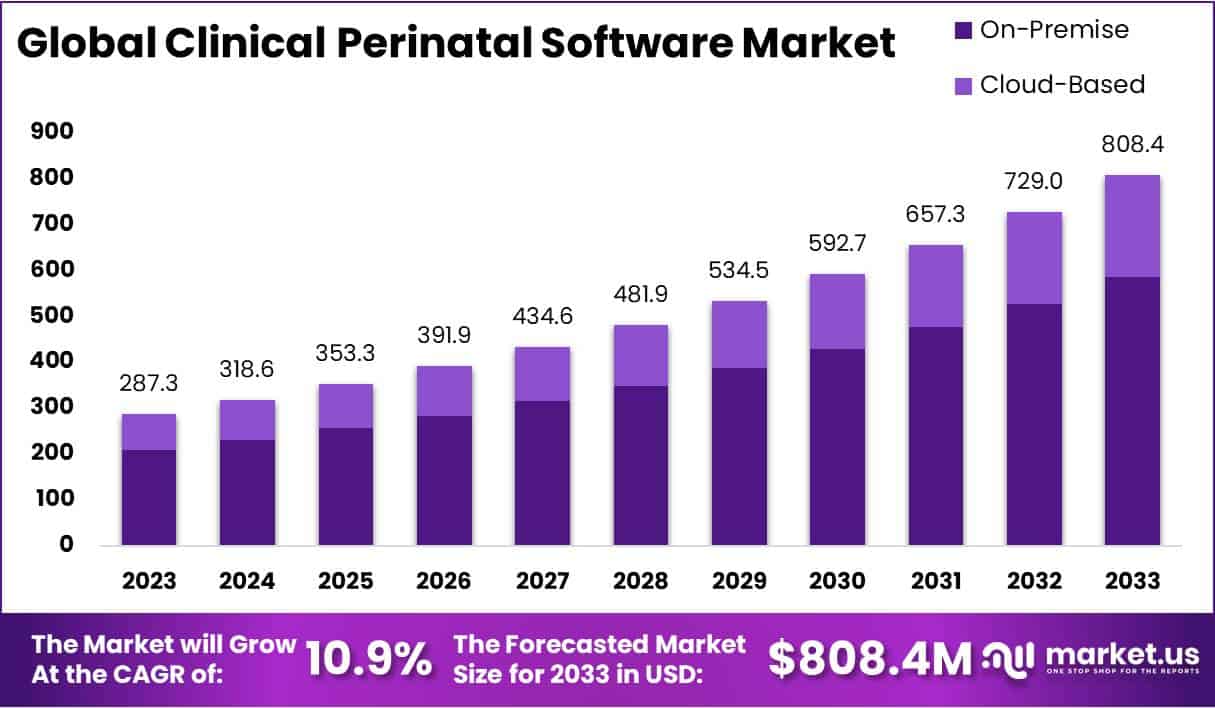
The Clinical Perinatal Software Market Size is projected to witness substantial growth, with its size anticipated to reach approximately USD 808.4 Million by the year 2033. This marks a significant increase from its valuation of USD 287.3 Million in 2023. The market is poised to experience a robust Compound Annual Growth Rate (CAGR) of 10.9% throughout the forecast period spanning from 2024 to 2033.
The clinical perinatal software market is expanding as healthcare providers increasingly adopt digital platforms to improve maternal and newborn care, strengthen clinical documentation, and support timely decision-making across pregnancy, labor, delivery, and postnatal care. Hospitals and maternity centers are investing in integrated software solutions that connect electronic health records (EHRs), fetal monitoring systems, and clinical workflows, helping clinicians reduce documentation burden while improving care coordination.
Governments and healthcare organizations are also promoting digital transformation to enhance the quality, safety, and continuity of maternal healthcare services. The growing use of standardized digital records, clinical decision support tools, and interoperable health information systems is expected to create long-term opportunities for software providers serving obstetric and neonatal care settings.
The World Health Organization (WHO) has developed Digital Adaptation Kits to help countries implement standardized digital systems for antenatal and postnatal care, reinforcing the role of software in improving maternal health services.
Healthcare systems are also emphasizing better data collection and surveillance to improve pregnancy outcomes. According to the WHO, an estimated 287,000 women died from maternal causes in 2020, highlighting the importance of stronger digital monitoring and quality improvement initiatives.
Additionally, India’s Ministry of Health and Family Welfare reported that the JANANI digital maternal healthcare platform has registered more than 1.34 crore beneficiaries and over 30 lakh pregnant women, demonstrating increasing adoption of digital maternal health records and integrated care management. These initiatives are expected to accelerate demand for advanced clinical perinatal software solutions worldwide.
Key Takeaways
- The Clinical Perinatal Software Market is projected to grow from USD 287.3 million in 2023 to USD 808.4 million by 2033, registering a CAGR of 10.9% during the forecast period from 2024 to 2033.
- In 2023, the On-Premise deployment segment accounted for more than 72.5% of total market revenue, supported by its strong data security and regulatory compliance capabilities, while the Cloud-Based segment is anticipated to witness the fastest growth over the forecast period.
- The Integrated product segment held a dominant 84.7% revenue share in 2023, reflecting increasing demand for unified clinical workflows and seamless data exchange, whereas the Standalone segment experienced slower adoption due to limited interoperability.
- Among applications, Fetal Monitoring Data Services captured 55.3% of the market in 2023, driven by the growing need for continuous fetal health monitoring, while Workflow Management Software is expected to record the highest CAGR during the forecast period.
- By end use, Hospitals and Clinics represented 63.8% of the market in 2023, supported by higher patient volumes, advanced digital infrastructure, and greater adoption of specialized perinatal software solutions.
- North America emerged as the leading regional market in 2023, securing 41.7% of the global market and generating approximately USD 197.7 million in revenue, supported by advanced healthcare systems, widespread health IT adoption, and ongoing strategic collaborations.
Statistical Information
- More than 99% of U.S. non-federal acute care hospitals had adopted certified electronic health record (EHR) systems by 2024, demonstrating the widespread digital infrastructure that supports clinical perinatal software integration, including labor and delivery documentation and maternal health records.
- 95.0% of U.S. office-based physicians were using an electronic health record system in 2024, while 83.6% had adopted certified EHR technology, creating a strong foundation for interoperable prenatal and postnatal care management.
- 99% of U.S. hospitals enabled patients to electronically view their health information in 2024, reflecting increasing patient demand for digital access to pregnancy records, laboratory results, and maternity care information through secure portals.
- 96% of hospitals allowed patients to download their electronic health information in 2024, supporting greater engagement among expectant mothers who increasingly access digital prenatal records and clinical documentation.
- 92% of U.S. hospitals offered secure electronic messaging between patients and healthcare providers in 2024, enabling obstetric teams to communicate more efficiently with pregnant patients regarding appointments, test results, and follow-up care.
- 81% of hospitals supported patient access through API-enabled mobile applications in 2024, indicating rapid adoption of interoperable digital health technologies that can connect maternity software with consumer-facing pregnancy applications.
- 70% of hospitals enabled patient access using HL7 FHIR-based applications in 2024, reflecting growing implementation of standardized interoperability frameworks essential for integrating perinatal software with hospital information systems.
- 56% of hospitals allowed patients to import medical records from external healthcare organizations into their patient portals in 2024, improving continuity of maternal care when women receive treatment across multiple providers.
- 62% of hospitals accepted patient-generated health data through connected applications in 2024, supporting remote monitoring of pregnancy-related information such as blood pressure, weight, and other maternal health indicators.
Regional Analysis
North America maintained the leading position in the clinical perinatal software market in 2023, accounting for more than 41.7% of global revenue and reaching a market value of USD 197.7 million. The region’s leadership is supported by its highly developed healthcare infrastructure, widespread implementation of electronic health records (EHRs), and strong focus on interoperability across hospitals, clinics, and maternal care facilities.
Federal initiatives led by the U.S. Department of Health and Human Services (HHS), the Office of the National Coordinator for Health Information Technology (ONC), and the Centers for Disease Control and Prevention (CDC) continue to encourage the adoption of standards-based digital health technologies that improve secure data exchange and clinical decision-making.
The region also benefits from ongoing investments in maternal and newborn healthcare, alongside the integration of advanced fetal monitoring systems and clinical workflow software. WHO’s digital health guidance and Digital Adaptation Kits further support standardized maternal and postnatal care workflows, enabling healthcare organizations to implement interoperable digital solutions more effectively.
These initiatives, combined with high healthcare spending, favorable reimbursement policies, and continuous innovation in health IT, are expected to sustain North America’s leadership and accelerate the adoption of clinical perinatal software across the region in the coming years.
Emerging Trends
- AI-powered clinical decision support is becoming a major trend as hospitals use digital tools to identify pregnancy risks earlier and improve care quality. The Oxford Maternal dataset includes 177,211 cardiotocography (CTG) recordings from 51,036 pregnancies, enabling the development of advanced AI models for fetal assessment and clinical decision support.
- Interoperability is accelerating across maternal healthcare systems as providers increasingly connect perinatal software with electronic health records using standardized data exchange frameworks. The U.S. healthcare system continues expanding certified EHR adoption and health information exchange, making integrated perinatal platforms more practical across hospitals and outpatient practices.
- Digital quality improvement programs are driving software adoption across maternity hospitals. The CDC supports Perinatal Quality Collaboratives (PQCs) in more than 40 U.S. states and territories, encouraging healthcare facilities to use digital data for improving maternal and newborn outcomes and reducing preventable complications.
- Remote maternal and fetal monitoring is gaining momentum as wearable devices and connected monitoring technologies allow clinicians to track pregnancy indicators outside hospitals. Recent clinical reviews show increasing adoption of continuous home monitoring solutions for high-risk pregnancies, improving access to timely interventions.
- Maternal surveillance systems are becoming increasingly digital as healthcare organizations strengthen data collection and reporting. The WHO’s 2024 global report reviewed 10 years of Maternal and Perinatal Death Surveillance and Response (MPDSR) implementation, highlighting broader adoption of structured digital reporting and quality improvement systems worldwide.
Use Cases
- Clinical perinatal software helps identify women needing earlier prenatal intervention. According to the U.S. CDC, 75.5% of mothers began prenatal care during the first trimester in 2024, while 17.3% started in the second trimester, encouraging providers to use digital tracking systems for timely follow-up and care coordination.
- Hospitals use workflow software to manage increasing labor interventions. CDC data show that 34.5% of singleton births in the United States involved labor induction in 2024, up from 24.9% in 2016, increasing demand for digital documentation, scheduling, and clinical decision support.
- Healthcare providers use perinatal software to improve multidisciplinary collaboration. CDC-supported Perinatal Quality Collaboratives bring together hospitals, clinicians, and public health teams to analyze standardized clinical data, helping reduce maternal complications, newborn infections, and other preventable adverse outcomes.
- Digital fetal monitoring platforms support continuous risk assessment. Advanced AI research has demonstrated that automated analysis of long-term fetal heart rate monitoring can achieve an AUC of 0.872 and 81.6% accuracy, helping clinicians detect pregnancies requiring additional attention.
- Clinical perinatal software improves care continuity through connected digital health services. Recent peer-reviewed research highlights growing use of telemedicine, mobile pregnancy applications, remote monitoring, wearables, and web-based maternal health platforms to support expectant mothers throughout pregnancy and postpartum care.
Frequently Asked Questions About Clinical Perinatal Software
- What factors are driving the growth of the clinical perinatal software market?
Market growth is supported by increasing adoption of electronic health records, greater demand for interoperable healthcare systems, improved maternal health initiatives, and the integration of clinical decision support technologies. Healthcare organizations are also investing in digital tools that improve documentation accuracy, workflow automation, and patient outcomes. - Which healthcare facilities are the primary users of clinical perinatal software?
Hospitals, maternity hospitals, birthing centers, obstetric clinics, and neonatal intensive care units are the primary users of clinical perinatal software. These facilities rely on integrated digital systems to manage maternal and fetal information, coordinate multidisciplinary care, and support timely clinical decision-making throughout pregnancy and childbirth. - What are the key features of clinical perinatal software?
Clinical perinatal software typically includes fetal monitoring integration, electronic clinical documentation, labor and delivery management, maternal and newborn records, clinical decision support, reporting, analytics, and interoperability with hospital information systems. These capabilities help clinicians deliver more coordinated and data-driven patient care. - How does clinical perinatal software improve patient care?
The software enables real-time monitoring, centralized patient records, automated documentation, and faster access to clinical information. These capabilities help healthcare professionals identify potential risks earlier, improve communication among care teams, reduce documentation errors, and support better maternal and neonatal outcomes through more informed clinical decisions. - What technologies are influencing the clinical perinatal software market?
The market is increasingly influenced by cloud computing, artificial intelligence, interoperability standards such as HL7 FHIR, clinical decision support, secure data exchange, and advanced analytics. These technologies enhance information sharing, workflow automation, predictive insights, and integration across multiple healthcare systems.
Conclusion
The clinical perinatal software market is poised for sustained growth as healthcare organizations continue to modernize maternal and newborn care through digital technologies. Increasing adoption of interoperable electronic health records, AI-enabled clinical decision support, remote fetal monitoring, and standardized digital workflows is strengthening the efficiency and quality of perinatal care. Government-led digital health initiatives and WHO guidance are further encouraging the implementation of secure, data-driven healthcare systems that improve clinical outcomes and care coordination.
As hospitals prioritize patient safety, workflow optimization, and evidence-based decision-making, demand for integrated clinical perinatal software is expected to rise steadily. Continued investments in health IT infrastructure, interoperability, and maternal health innovation will position this market as a critical component of the future digital healthcare ecosystem.




















