


Biopharma Plastic Market
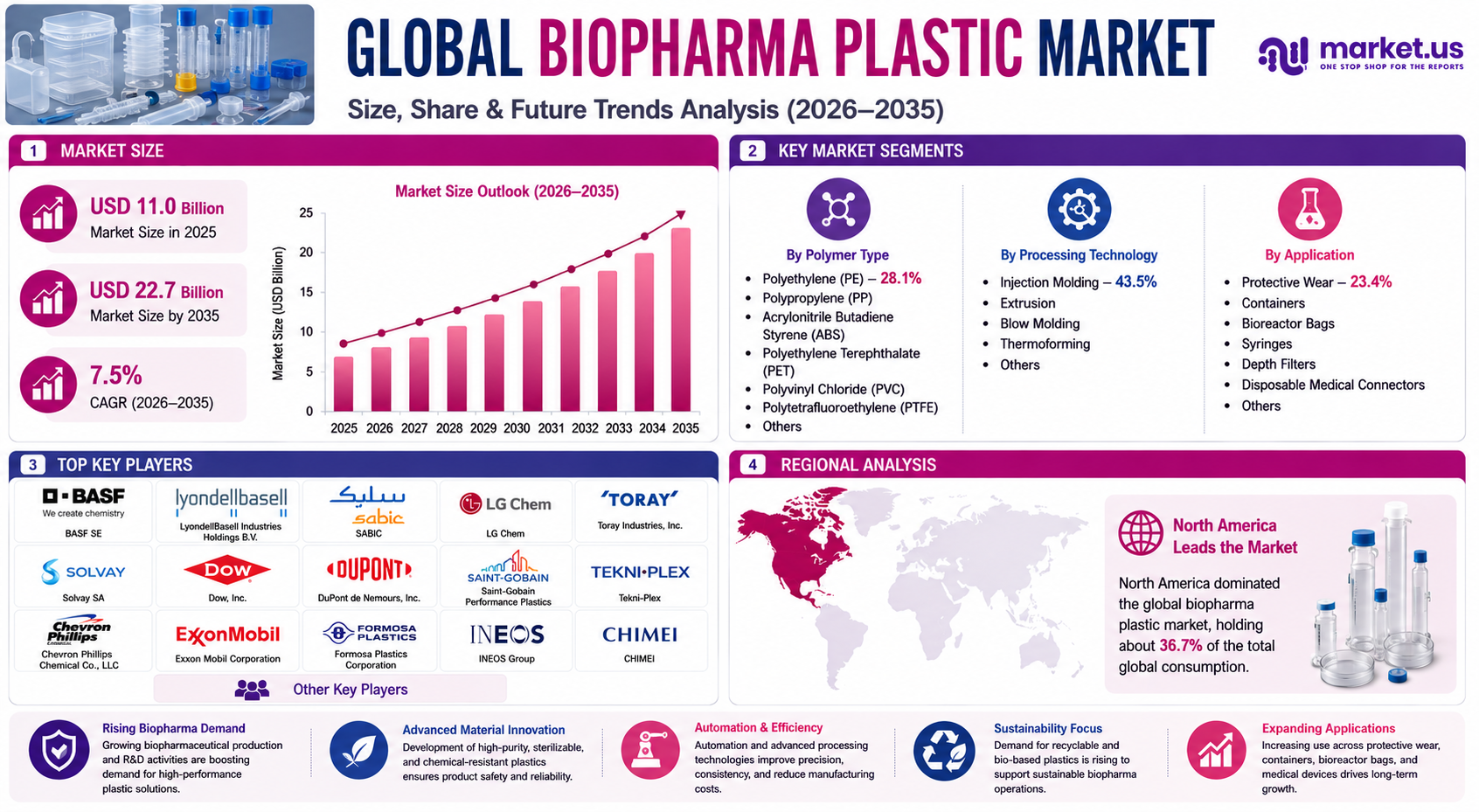
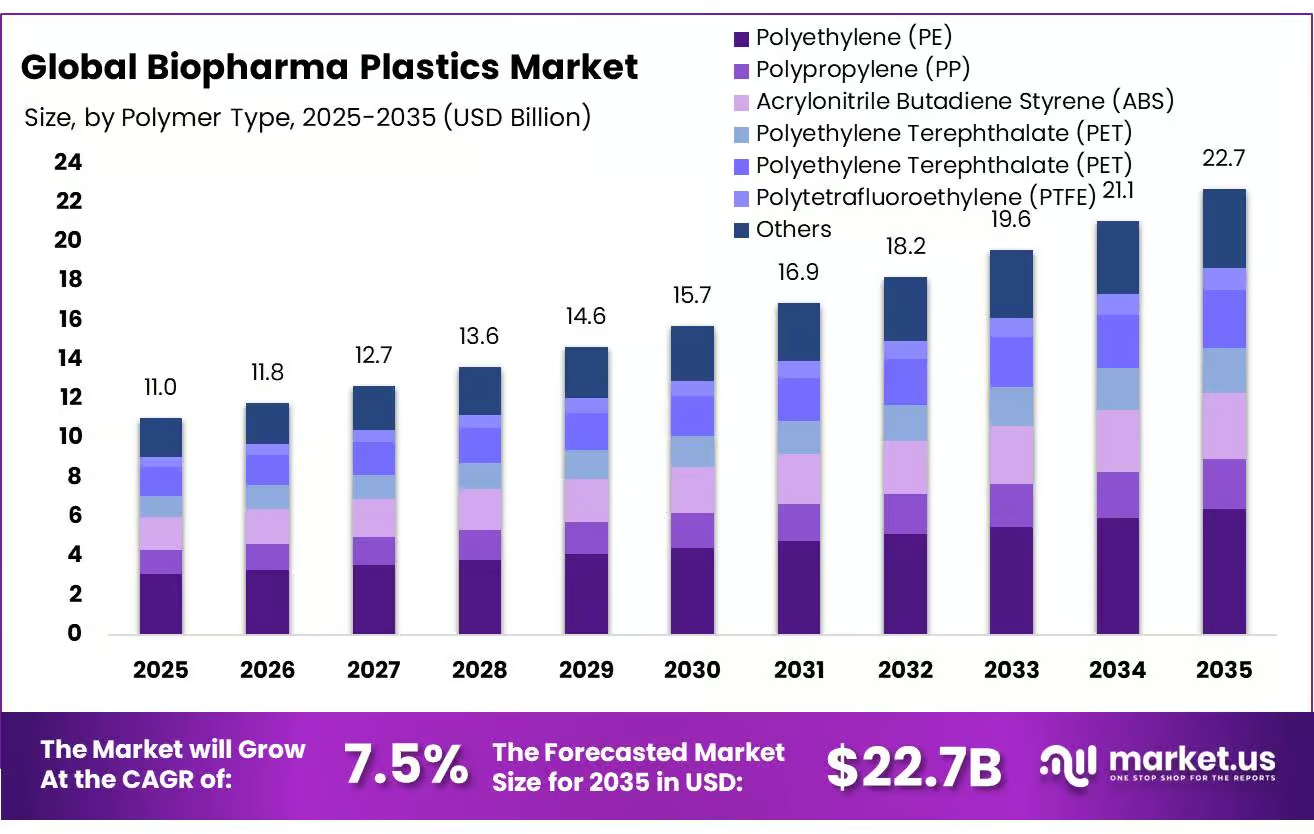
The Global Biopharma Plastic Market was valued at USD 11.0 billion in 2025 and is projected to grow at a CAGR of 7.5% between 2026 and 2035, reaching around USD 22.7 billion by 2035. North America led the market in 2025 with more than a 36.7% share, generating approximately USD 4.4 billion in revenue.
The U.S. FDA approved 46 novel drugs in 2025, including therapeutic biological products reviewed through its drug center. In Europe, biological medicines generated around EUR 95 billion in sales in 2024 and represented about 41% of pharmaceutical spending, showing the scale of biologics production that depends on sterile polymer-based processing systems.
Single-use manufacturing remains one of the strongest growth drivers. Sartorius reported EUR 2.865 billion in 2025 revenue from its Bioprocess Solutions division, increasing 9.5% in constant currencies. The company also invested around EUR 442 million in research and production infrastructure during the year.
Investment by major life-science companies is creating additional demand. In April 2025, Thermo Fisher announced a further USD 2 billion U.S. investment over 4 years, including USD 1.5 billion for manufacturing expansion and USD 500 million for research and development. The company operates 64 manufacturing facilities across 37 U.S. states, strengthening the supply base for pharmaceutical and bioprocessing materials.
Key Takeaways
- The global biopharma plastic market was valued at USD 11.0 billion in 2025.
- The global market is projected to grow at a CAGR of 7.5% and is estimated to reach USD 22.7 billion by 2035.
- On the basis of polymer type, polyethylene (PE) biopharma plastic dominated the market, constituting 28.1% of the total market share.
- Among the processing technologies, injection molding held a major share in the biopharma plastic market, 43.5% of the market share.
- Among the applications, protective wear is the most considerable within the market, accounting for around 23.4% of the revenue.
- In 2025, North America was the most dominant region in the biopharma plastic market, accounting for 36.7% of the total global consumption.
Statistical Information
- The U.S. FDA approved 46 novel drugs in 2025, while its FY2025 pharmaceutical-quality report recorded 38 Biologics License Application approvals, including 22 originator biologics and 16 biosimilars. BLA approvals have more than doubled from 18 in FY2016.
- Biosimilars are becoming an increasingly important part of U.S. biologics manufacturing. In October 2025, the FDA reported 76 approved biosimilars, while biologic medicines represented only about 5% of U.S. prescriptions but accounted for 51% of total drug spending in 2024. FDA data later showed 81 biosimilars covering 20 reference products during 2025.
- The European Medicines Agency recommended 104 medicines for marketing authorization in 2025, including 38 medicines with new active substances and 16 medicines for rare diseases. EMA also received 105 initial-evaluation applications during the year.
- The European Commission reports that health biotechnology contributes more than 80% of the nearly EUR 40 billion added to the EU economy by biotechnology. Biological medicines generated approximately EUR 95 billion in EU sales in 2024 and represented 41% of total pharmaceutical spending.
- Sartorius reported that its Bioprocess Solutions division generated EUR 2.865 billion in revenue during 2025, increasing 9.5% in constant currencies. Recurring consumables, including filters and single-use bags, represented a large majority of division sales. Underlying EBITDA reached EUR 907 million, increasing 15.2%, while the margin improved to 31.7%.
- In June 2025, Sartorius completed an expansion in Aubagne, France, where cleanroom space for single-use bioprocess products was almost doubled to around 9,000 m². The site also includes a 12,000 m² automated logistics facility and approximately 2,000 m² of new R&D laboratories, while around 1,100 employees work at the location.
- American Chemistry Council producer statistics show that North American production in 2025 included approximately 9.249 billion pounds of LDPE, 27.700 billion pounds of LLDPE, 26.370 billion pounds of HDPE, and 17.691 billion pounds of polypropylene. Total thermoplastics production reached approximately 118.729 billion pounds.
- In June 2026, surveyed production of major plastic resins reached 8.8 billion pounds, while year-to-date production totaled 53.3 billion pounds, up 6.6% year over year. Year-to-date sales and captive use reached 51.9 billion pounds, increasing 2.3%.
- Thermo Fisher announced an additional USD 2 billion U.S. investment in 2025 covering the following 4 years. The program includes USD 1.5 billion for manufacturing expansion and USD 500 million for R&D. The company operates 64 U.S. manufacturing operations across 37 states.
- In September 2025, Thermo Fisher completed its acquisition of Sanofi’s sterile fill-finish and packaging facility in Ridgefield, New Jersey. More than 200 employees joined Thermo Fisher through the transaction. Ridgefield became another U.S. sterile manufacturing location alongside facilities in Greenville, North Carolina, and Plainville, Massachusetts.
Polymer Type Analysis
Polyethylene (PE) Leads the Biopharma Plastic Market with a 28.1% Share
Polyethylene (PE) held the leading position in the biopharma plastics market, accounting for 28.1% of the segment. Its strong use is supported by good chemical resistance, flexibility, and reliable performance under sterile processing conditions. PE is widely used in bioreactor bags, tubing, connectors, disposable containers, and other single-use systems. Its compatibility with common sterilization methods also supports use across upstream and downstream bioprocessing.
Processing Technology Analysis
Injection Molding Dominates the Biopharma Plastic Market with a 43.5% Share
Injection molding accounted for 43.5% of the biopharma plastics market, making it the leading processing technology. The process is widely used to manufacture precise and complex components such as connectors, syringes, housings, and disposable medical parts. It provides consistent dimensions, efficient material use, and high production speed, which are important for regulated biopharmaceutical applications. Injection molding also supports large-scale manufacturing of single-use components while maintaining repeatable quality.
Application Analysis
Protective Wear Leads the Biopharma Plastic Market with a 23.4% Share
Protective wear represented the largest application segment in the biopharma plastics market, accounting for 23.4% of the total share. Demand is supported by strict contamination-control requirements across pharmaceutical and biopharmaceutical manufacturing facilities. Polymer materials are widely used in disposable gowns, gloves, face shields, and other protective products because they offer durability, chemical resistance, and compatibility with controlled environments.
Key Market Segments
By Polymer Type
- Polyethylene (PE)
- Polypropylene (PP)
- Acrylonitrile Butadiene Styrene (ABS)
- Polyethylene Terephthalate (PET)
- Polyvinyl Chloride (PVC)
- Polytetrafluoroethylene (PTFE)
- Others
By Processing Technology
- Injection Molding
- Extrusion
- Blow Molding
- Thermoforming
- Others
By Application
- Protective Wear
- Containers
- Bioreactor Bags
- Syringes
- Depth Filters
- Disposable Medical Connectors
- Others
Regional Analysis
North America Dominates the Global Biopharma Plastic Market with a 36.7% Share
In 2025, North America held the leading position in the global biopharma plastic market, accounting for around 36.7% of total consumption. The region’s strong position is supported by a well-established biologics manufacturing base, advanced pharmaceutical infrastructure, and strict quality requirements for sterile processing.
The United States remains a major contributor to regional demand. According to the U.S. Food and Drug Administration, more than 70% of commercial biologics production facilities in the country use single-use systems containing high-performance polymer materials.
The Following Are Some of the Major Players in the Industry
- BASF SE
- LyondellBasell Industries Holdings B.V.
- SABIC
- LG Chem
- Toray Industries, Inc.
- Solvay SA
- Dow, Inc.
- DuPont de Nemours, Inc.
- Saint-Gobain Performance Plastics
- Tekni-Plex
- Chevron Phillips Chemical Co., LLC
- Exxon Mobil Corporation
- Formosa Plastics Corporation
- INEOS Group
- CHIMEI
- Other Key Players




















