


Global Bioconcrete Market
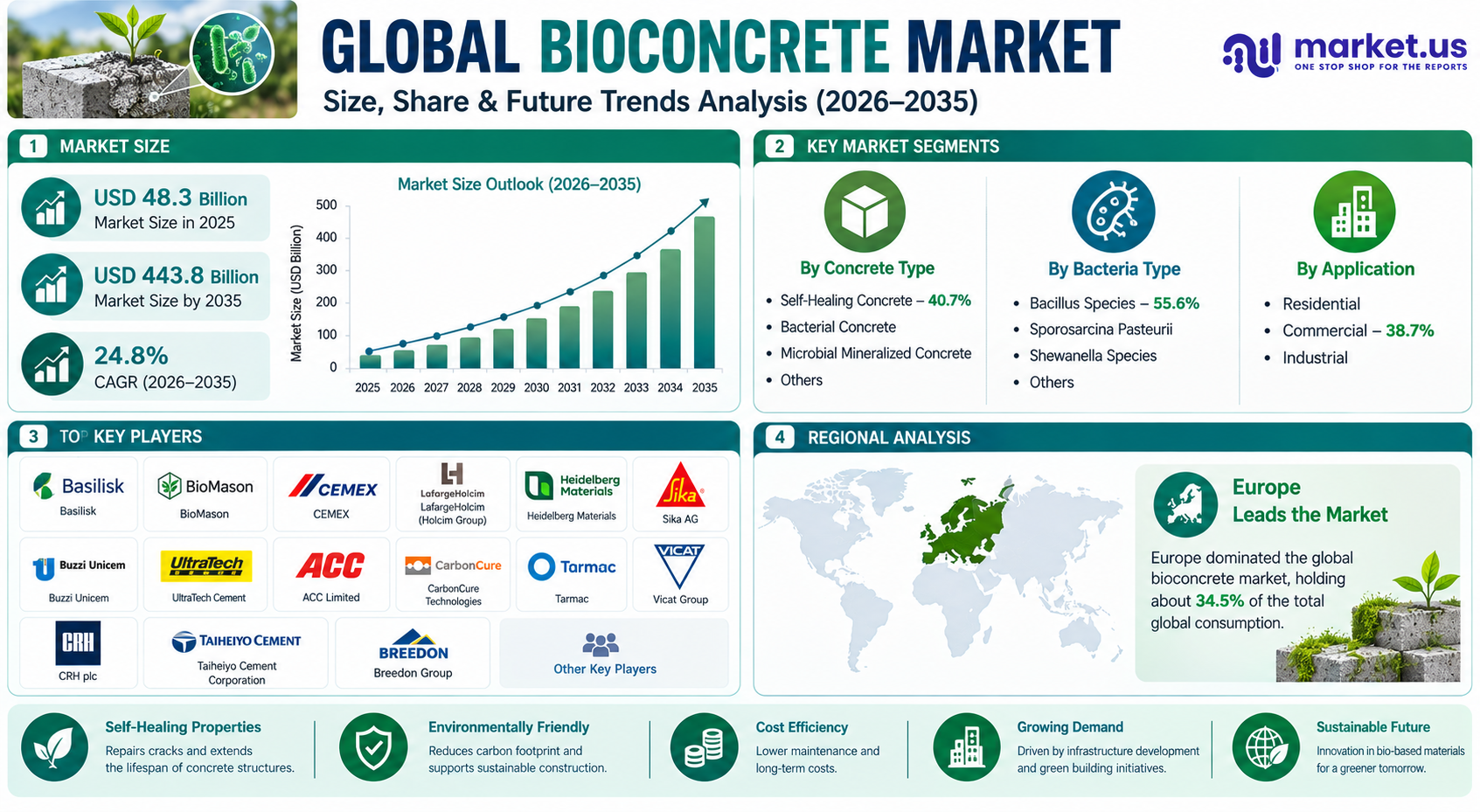
The Global Bioconcrete Market was valued at USD 48.3 billion in 2025 and is projected to grow at a CAGR of 24.8% from 2026 to 2035, reaching approximately USD 443.8 billion by 2035. Europe led the market in 2025 with more than a 34.5% share, generating around USD 0.4 billion in revenue.
Bioconcrete is emerging as an advanced construction material that uses microbial agents to support self-healing and improve the service life of concrete structures. It helps address common problems such as microcracks, moisture damage, environmental exposure, and repeated maintenance requirements.
UNEP reported in 2026 that buildings and construction contribute around 11–13% of global GDP and employ nearly 9% of the global workforce. The sector also generates about 37% of global CO₂ emissions and accounts for almost 50% of worldwide material extraction. These pressures are encouraging greater interest in durable and lower-maintenance concrete technologies.
Research activity is also supporting the commercial development of bioconcrete. The European Commission-backed MAGIC project began in October 2025 with approximately EUR 276,188 in EU funding and is scheduled to continue until September 2027. The project focuses on bio-based self-healing concrete for foundations, tunnels, retaining structures, and other geotechnical applications.
Europe provides a large potential application base for such technologies. The regional construction sector supports around 18 million jobs and contributes roughly 9% of EU GDP. This scale creates opportunities for self-healing concrete in infrastructure, commercial construction, transportation projects, and repair-intensive structures.
The EU-supported SUSTAIN project also started in October 2025 with approximately EUR 276,188 in funding. It combines microbial-induced calcite precipitation, accelerated carbonation, and recycled construction materials. The project highlights that Portland cement contributes around 8% of global greenhouse-gas emissions, while construction and demolition waste represents more than one-third of total EU waste.
Government investment in low-carbon cement is further strengthening the market environment. The U.S. Department of Energy awarded up to USD 61.7 million for a calcined-clay cement project targeting about 83% lower carbon intensity. Another commercial-scale project could receive up to USD 189 million and avoid more than 77,000 metric tons of CO₂ annually, supporting wider development of sustainable concrete technologies.
Key Takeaways
- The global bioconcrete market was valued at USD 48.3 billion in 2025.
- The global market is projected to grow at a CAGR of 24.8% and is estimated to reach USD 443.8 billion by 2035.
- On the basis of concrete type, self-healing concrete dominated the market, constituting 40.7% of the total market share.
- Based on the bacteria type, Bacillus species led the market, comprising 55.6% of the total market.
- Among the applications, the commercial sector held a major share in the bioconcrete market, 38.7% of the market share.
- In 2025, Europe was the most dominant region in the bioconcrete market, accounting for 34.5% of the total global consumption.
Concrete Type Analysis
Self-Healing Concrete Leads the Bioconcrete Market with a 40.7% Share
Self-healing concrete held the leading position in the bioconcrete market, accounting for 40.7% of the total share. Its strong adoption is linked to its ability to repair small cracks automatically and improve the service life of concrete structures. The material commonly uses bacterial spores or chemical healing agents to reduce damage caused by weather exposure, repeated loading, and environmental stress. Field studies have shown that self-healing concrete can recover up to 90% of its original strength in damaged areas, making it suitable for residential, commercial, and industrial construction where lower maintenance and longer structural life are important.
Bacteria Type Analysis
Bacillus Species Dominate the Bioconcrete Market with a 55.6% Share
Bacillus species accounted for 55.6% of the bioconcrete market, making them the most widely used bacterial type. Their popularity comes from their ability to survive harsh concrete conditions and support calcium carbonate formation, which helps seal microcracks. Bacillus-based bioconcrete has demonstrated the ability to restore up to 90% of compressive strength in damaged sections within a few weeks. These bacteria can be used across different concrete formulations, including self-healing and microbial mineralized concrete, supporting their use in commercial, residential, and industrial structures where durability and reduced repair requirements are important.
Application Analysis
Commercial Construction Leads the Bioconcrete Market with a 38.7% Share
Commercial construction represented the largest application segment in the bioconcrete market, accounting for 38.7% of total usage. Demand is supported by the need for durable and low-maintenance structures in office buildings, retail centers, institutional facilities, and other high-traffic properties. Self-healing and bacteria-based concrete can help limit microcrack growth and reduce structural deterioration over time. Field applications in Europe and North America have shown strength recovery of around 85–90% in cracked sections. Its ability to extend structural life and support sustainability targets also makes bioconcrete attractive for modern commercial building projects.
Key Market Segments
By Concrete Type
- Self-Healing Concrete
- Bacterial Concrete
- Microbial Mineralized Concrete
- Others
By Bacteria Type
- Bacillus Species
- Sporosarcina Pasteurii
- Shewanella Species
- Others
By Application
- Residential
- Commercial
- Industrial
Regional Analysis
Europe Dominates the Global Bioconcrete Market with a 34.5% Share
In 2025, Europe held the leading position in the global bioconcrete market, accounting for around 34.5% of total consumption. The region’s strong position is supported by strict sustainability requirements, aging infrastructure, and growing demand for construction materials that can improve durability and reduce long-term maintenance.
The European Commission reports that around 38% of Europe’s road network, covering more than 5.7 million kilometers, requires regular maintenance because of structural deterioration. This creates strong potential for self-healing and microbial concrete solutions that can limit crack development and extend infrastructure service life.
The Following Are Some of the Major Players in the Industry
- Basilisk
- BioMason
- CEMEX
- LafargeHolcim (Holcim Group)
- Heidelberg Materials
- Sika AG
- Buzzi Unicem
- UltraTech Cement
- ACC Limited
- CarbonCure Technologies
- Tarmac
- Vicat Group
- CRH plc
- Taiheiyo Cement Corporation
- Breedon Group
- Other Key Players



