


Report Overview
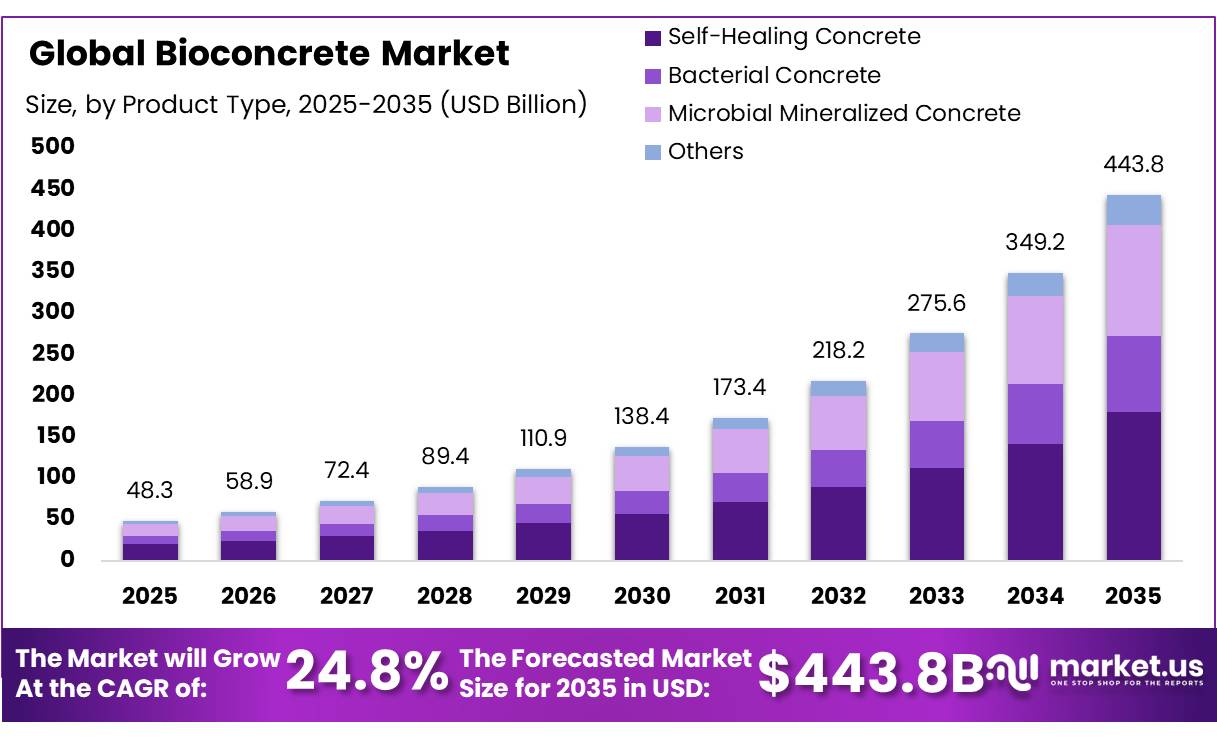
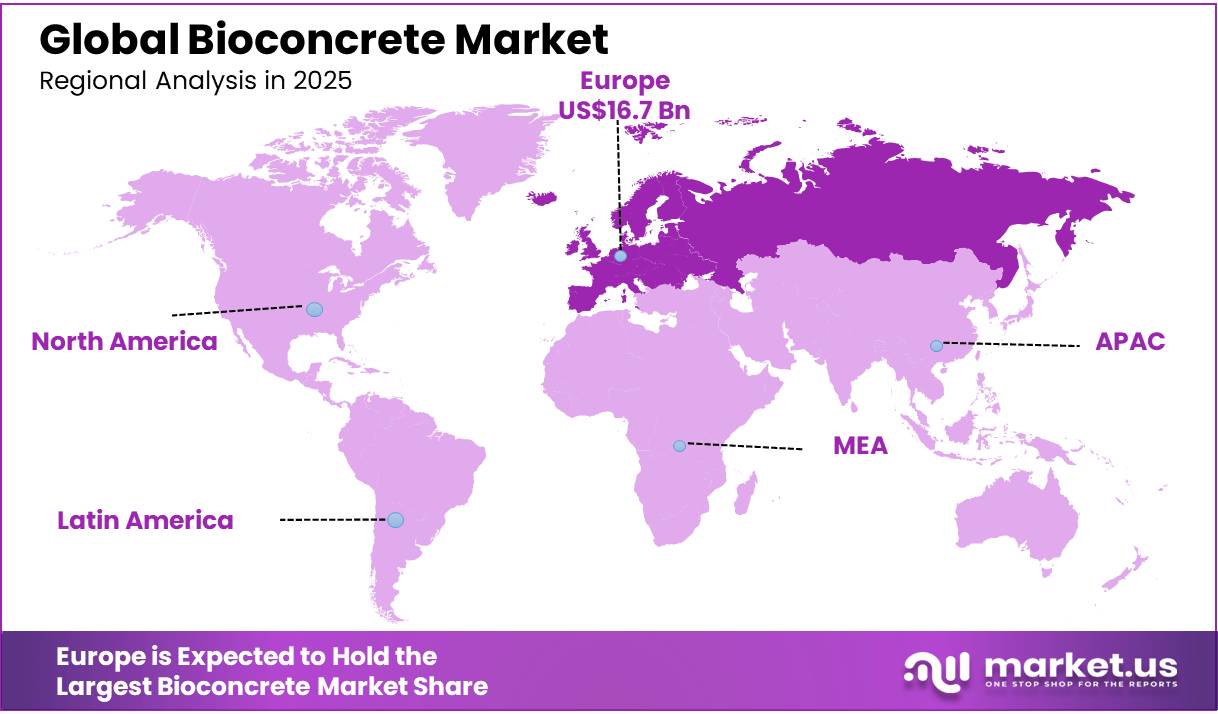
In 2025, the Global Bioconcrete Market was valued at USD 48.3 billion, and between 2026 and 2035, this market is estimated to register a CAGR of 24.8%, reaching about USD 443.8 billion by 2035. In 2025, Europe held a dominant market position, capturing more than a 34.5% share, holding USD 0.4 Billion revenue.
Bioconcrete represents an innovative shift in construction materials, integrating microbial agents to enable self-healing and extend the lifespan of concrete structures. The material addresses critical infrastructure challenges, including microcracks, environmental degradation, and frequent maintenance needs.
- UNEP reported in 2026 that buildings and construction represent 11–13% of global GDP, employ around 9% of the global workforce, generate approximately 37% of global CO₂ emissions, and account for nearly 50% of global material extraction. These figures are encouraging contractors and material suppliers to evaluate longer-lasting concrete technologies that can reduce repeated repairs and replacement.
Key Takeaways
- The global bioconcrete market was valued at USD 48.3 billion in 2025.
- The global market is projected to grow at a CAGR of 24.8% and is estimated to reach USD 443.8 billion by 2035.
- On the basis of concrete type, self-healing concrete dominated the market, constituting 40.7% of the total market share.
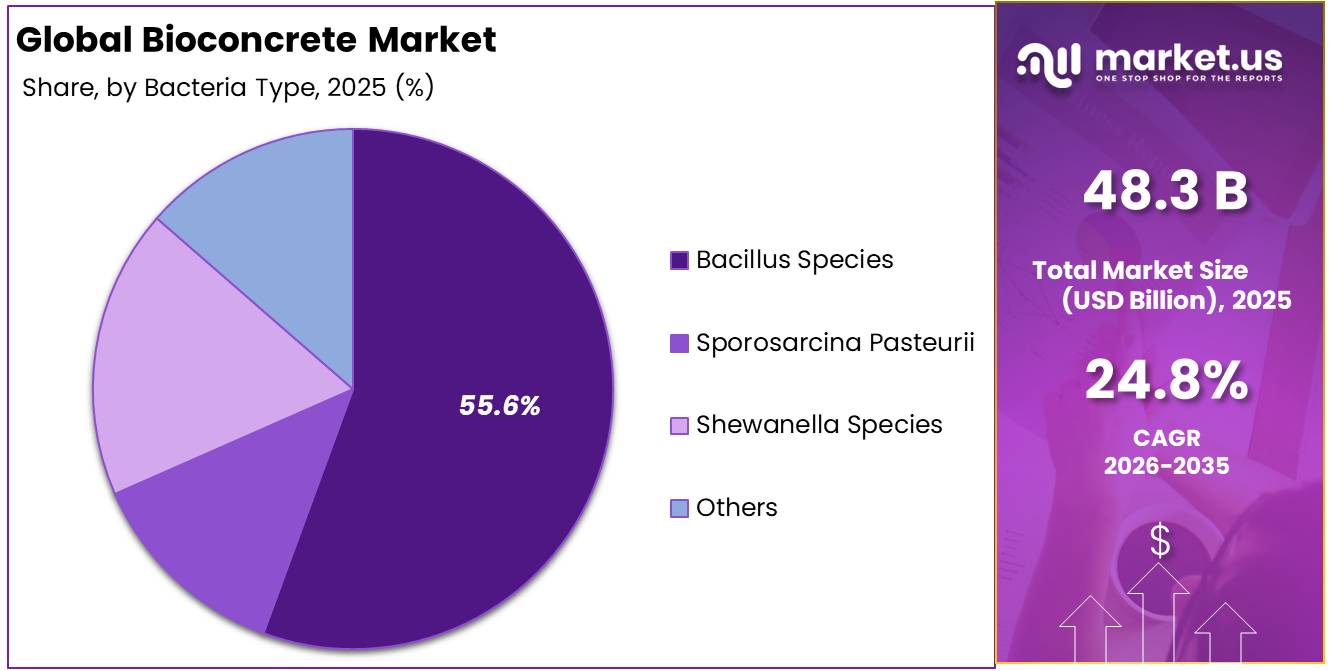
- Based on the bacteria type, Bacillus species led the market, comprising 55.6% of the total market.
- Among the applications, the commercial sector held a major share in the bioconcrete market, 38.7% of the market share.
- In 2025, Europe was the most dominant region in the bioconcrete market, accounting for 34.5% of the total global consumption.
Recent research is moving bioconcrete closer to field deployment. The European Commission-backed MAGIC project started in October 2025 with an EU contribution of approximately EUR 276,188 and will operate until September 2027. The project is developing bio-based self-healing concrete for foundations, tunnels, retaining structures, and other geotechnical applications. The European construction sector linked to this research supports around 18 million jobs and contributes approximately 9% of EU GDP, highlighting the large potential application base for durable self-repairing materials.
- The EU-supported SUSTAIN project, also launched in October 2025 with approximately EUR 276,188 in EU funding, combines microbial-induced calcite precipitation with accelerated carbonation and recycled construction materials. The project notes that Portland cement contributes around 8% of global greenhouse-gas emissions, while construction and demolition waste represents more than one-third of total EU waste.
Government investment in low-carbon cement technologies is also creating a supportive ecosystem for bioconcrete. The U.S. Department of Energy has awarded up to USD 61.7 million for a calcined-clay cement project targeting approximately 83% lower carbon intensity, while another commercial-scale project could receive up to USD 189 million and avoid more than 77,000 metric tons of CO₂ annually. These programs demonstrate rising public support for alternative cement chemistries and lower-carbon construction materials.
Concrete Type Analysis
Self-Healing Concrete is a Prominent Segment in the Market.
Self-healing concrete represents the largest segment within the bioconcrete market, accounting for 40.7% of the total share. Its prominence is driven by the material’s ability to autonomously repair microcracks, thereby significantly extending the service life of structures and reducing maintenance requirements. Incorporating bacterial spores or chemical healing agents, this concrete mitigates damage caused by environmental stresses, load fluctuations, and weathering.
Field trials in infrastructure projects across Europe and Asia have demonstrated that self-healing concrete can restore up to 90% of its original strength in cracked regions, validating its durability and operational efficiency. The material’s alignment with sustainability objectives—reducing repair frequency and associated emissions—further enhances its appeal. Its widespread adoption across residential, commercial, and industrial projects underscores its position as the preferred solution for long-lasting, low-maintenance construction.
Bacteria Type Analysis
Bacillus Species Held a Major Share of the Bioconcrete Market.
Bacillus species represent the dominant bacterial type in the bioconcrete market, accounting for 55.6% of usage. Their widespread adoption is attributed to their high survivability during concrete mixing and curing, as well as their efficiency in inducing calcium carbonate precipitation to seal microcracks. Research and field applications have demonstrated that Bacillus-based bioconcrete can restore up to 90% of compressive strength in damaged sections within weeks, significantly enhancing structural durability.
These bacteria are compatible with various concrete formulations, including self-healing and microbial mineralized variants, making them versatile across residential, commercial, and industrial projects. Furthermore, Bacillus species align with environmental sustainability objectives by reducing the frequency of repairs and associated emissions, reinforcing their position as the preferred microbial agent in long-lasting, low-maintenance construction solutions.
Application Analysis
Bioconcrete is Widely Utilized in the Commercial Sector.
Commercial construction represents the dominant application segment in the bioconcrete market, accounting for 38.7% of usage. The preference for bioconcrete in commercial projects is driven by the need for durable, low-maintenance structures that can withstand high traffic loads and environmental stress over extended periods. Incorporating self-healing and bacterial concrete solutions helps mitigate microcracks and structural degradation in office buildings, retail complexes, and institutional facilities, reducing repair frequency and operational disruptions.
Field implementations in Europe and North America have demonstrated that bioconcrete can restore up to 85–90% of original strength in cracked sections, ensuring long-term structural integrity. Additionally, its alignment with sustainability objectives and green building certifications makes it particularly attractive for developers aiming to meet regulatory and environmental standards in commercial construction projects.
Key Market Segments
By Concrete Type
- Self-Healing Concrete
- Bacterial Concrete
- Microbial Mineralized Concrete
- Others
By Bacteria Type
- Bacillus Species
- Sporosarcina Pasteurii
- Shewanella Species
- Others
By Application
- Residential
- Commercial
- Industrial
Driver Analysis
Embodied-Carbon Procurement Rules
Regulatory procurement is converting bioconcrete from a specialist material into a bid-qualification tool because public and institutional buyers increasingly evaluate concrete by verified global-warming potential rather than initial delivered cost alone. The revised EU Construction Products Regulation entered into force on 7 January 2025; from 8 January 2026, relevant manufacturers must begin declaring Global Warming Potential and other Annex II environmental characteristics, with broader environmental disclosure obligations extending in 2030 and full life-cycle coverage scheduled for 2032.
In the United States, the General Services Administration’s low-embodied-carbon requirements use product-specific Type III EPDs and set GWP thresholds by compressive strength; for example, a 4,000-psi concrete mix must meet thresholds of 284, 326 or 352 kg CO2e/m3 depending on the qualifying tier, while a 5,000-psi mix faces 305, 357 or 382 kg CO2e/m3 limits. The federal Buy Clean program also requires EPD documentation in 100% of qualifying IRA-funded cases, with no waiver route, creating an immediate commercial advantage for bioconcrete suppliers able to document durability-led material savings, lower repair frequency and verified environmental performance.
The driver adds an estimated 2.6 percentage points to achievable CAGR because suppliers can monetize compliance through premium specifications, EPD-backed tender access and performance-based pricing rather than competing solely on cubic-meter price; however, value capture will depend on demonstrating repeatable carbon data at plant and project level rather than relying on generic sustainability claims.
Drivers Impact Analysis
| Driver | (~) % Impact on CAGR Forecast | Geographic Relevance | Impact Timeline |
|---|---|---|---|
| Embodied-carbon procurement rules | +2.6% | EU core, North America, Australia | Medium term (2–4 years) |
| Infrastructure life-cycle savings | +2.3% | EU, North America, India, Gulf | Medium term (2–4 years) |
| Cement decarbonization pressure | +2.1% | Global, EU, China, India | Long term (≥4 years) |
| Water-tightness asset upgrades | +1.8% | Coastal APAC, Europe, Middle East | Short term (≤2 years) |
| Smart crack-monitoring integration | +1.4% | North America, EU, Japan, South Korea | Medium term (2–4 years) |
| Public infrastructure CapEx | +1.2% | India, China, Middle East, North America | Medium term (2–4 years) |
Restraint Analysis
High Bio-Agent Cost
Peer-reviewed analysis estimates bacterial concrete production at approximately USD 0.29/kg versus USD 0.16/kg for conventional concrete, implying an 81% material-cost differential under laboratory-oriented formulations, while commercial field formulations generally carry an incremental cost of roughly USD 46/m3 over base concrete selling around USD 68–91/m3; conventional concrete in the same comparison was around USD 44/m3.
Even where optimized commercial formulations reduce the differential, the healing package can add 20–50% to upfront project cost, and bacterial spores alone may account for approximately 55–65% of total bioconcrete operating expense, exposing suppliers to fermentation yield, sterile-processing, storage and supplier-concentration risk. This pricing structure limits use in commodity housing, low-bid municipal works and cost-sensitive emerging-market projects, where procurement decisions are still based on initial cost per cubic meter rather than 30–50-year maintenance economics; for a 10,000 m3 structural package, even a USD 25–45/m3 premium adds USD 0.25–0.45 million of immediate budget pressure.
Manufacturers must therefore reduce nutrient and encapsulation cost, substitute lower-cost microbial carriers, scale fermentation output, localize additive production and offer performance-linked warranties; until the premium declines toward a more financeable 5–15% range for mainstream applications, high bio-agent cost is expected to deduct approximately 2.7 percentage points from potential CAGR.
Restraint Impact Analysis
| Restraint | (~) % Impact on CAGR Forecast | Geographic Relevance | Impact Timeline |
|---|---|---|---|
| High bio-agent cost | -2.7% | Global, India, APAC emerging | Medium term (2–4 years) |
| Unstandardized performance codes | -2.2% | EU, North America, APAC | Medium term (2–4 years) |
| Limited long-term validation | -1.8% | Global infrastructure markets | Long term (≥4 years) |
| Contractor skill limitations | -1.4% | India, Southeast Asia, Middle East | Medium term (2–4 years) |
| Carbon-data compliance burden | -1.1% | EU core, North America | Short term (≤2 years) |
| Weak repair-cost ownership | -0.9% | Private construction, emerging markets | Long term (≥4 years) |
Opportunity Analysis
Performance-Warranty Contracts
The most material unmonetized opportunity is to convert bioconcrete from a premium material purchase into a durability-as-a-service contract in which the supplier shares financial responsibility for crack sealing, water-tightness retention, inspection and avoided repair events over a 10–25-year operating period; this is distinct from the current durability driver because conventional bioconcrete transactions still end once the cubic meters are delivered.
In Australia alone, corrosion-related maintenance in construction and infrastructure is estimated at about AUD 8 billion annually, illustrating the size of maintenance budgets that material suppliers do not presently capture. A supplier able to price a performance contract at 2–5% of installed concrete value, supported by moisture sensors, crack monitoring and an insured intervention guarantee, could create recurring service revenue equal to 15–30% of the original material margin over the asset’s early life while lowering customer resistance to an initial 20–50% self-healing mix premium.
The strategic pivot requires actuarial modeling, clear crack-width and exposure-class exclusions, third-party performance verification and long-duration balance-sheet capacity, but it changes procurement from lowest initial price to total-cost-of-ownership optimization and can add an estimated 2.5 percentage points above baseline CAGR in owner-operated infrastructure markets.
Opportunity Impact Analysis
| Opportunity | (~) % Potential CAGR Upside | Geographic Relevance | Execution Window |
|---|---|---|---|
| Performance-warranty contracts | +2.5% | EU, North America, Gulf, Australia | Medium term (2–4 years) |
| Water-infrastructure retrofits | +2.3% | India, Middle East, Southeast Asia, Africa | Medium term (2–4 years) |
| Bio-based admixture licensing | +1.9% | APAC, Europe, North America | Long term (≥4 years) |
| Digital concrete passports | +1.7% | EU core, UK, Japan, South Korea | Short term (≤2 years) |
| Modular precast integration | +1.5% | North America, EU, China, India | Medium term (2–4 years) |
| Distressed admixture M&A | +1.2% | Europe, North America, APAC | Short term (≤2 years) |
Challenges Analysis
Spore-Viability Uncertainty
Recent work on bio-based self-healing agents found that bacteria can survive early curing and healing conditions but that spore viability in some specimens fell below detectable levels after approximately 120–150 days, demonstrating why a crack-sealing claim over a 30–50-year design life cannot yet be treated as uniformly bankable across formulations and exposure classes.
The commercial risk is not an immediate sales barrier; rather, it drives conservative engineer specifications, short warranty periods, costly third-party trials and overdesign through higher bacterial or encapsulation dosages, each of which inflates unit cost and compresses supplier gross margin. A practical formulation must balance viable cell concentration, calcium availability, urea or alternate nutrient chemistry, pore structure, temperature range and crack-width performance, and even a 10–20% degradation in viable spore population can materially lower calcium-carbonate precipitation at the point of cracking.
Suppliers must mitigate the friction through encapsulation systems, alkaliphilic strains, low-nutrient-loss carriers, accelerated-aging protocols and long-term outdoor reference sites; until those data sets are standardized and replicated across markets, viability uncertainty is estimated to impose a -1.6 percentage-point drag on maximum potential CAGR.
Challenges Impact Analysis
| Challenge | (~) % CAGR Friction Drag | Geographic Relevance | Mitigation Horizon |
|---|---|---|---|
| Spore-viability uncertainty | -1.6% | Global, hot-climate APAC, Gulf | Long term (≥4 years) |
| Field-mix quality variance | -1.4% | India, Southeast Asia, Middle East | Medium term (2–4 years) |
| Construction talent shortage | -1.2% | EU, North America, APAC cities | Long term (≥4 years) |
| Evidence-to-specification gap | -1.1% | EU, North America, Japan | Medium term (2–4 years) |
| Carbon-data system integration | -0.9% | EU regulatory hubs, UK, Australia | Medium term (2–4 years) |
| Climate-exposure variability | -0.8% | Coastal APAC, Gulf, Nordics | Long term (≥4 years) |
Geopolitical Impact Analysis
Geopolitical Dynamics and Their Effects on Bioconcrete Deployment.
Current geopolitical tensions have had measurable effects on supply chains and material sourcing for innovative construction materials, including bioconcrete. The United States Department of Commerce reports that trade restrictions on chemical precursors and specialty minerals, including certain calcium and silica compounds, have increased lead times for concrete additives by up to 30% in 2022.
Similarly, the European Commission highlighted that disruptions in the transportation of bioengineered bacterial strains between member states and international partners slowed experimental infrastructure projects, with several pilot programs in Germany and the Netherlands experiencing delays of 3–6 months. In Asia, the Ministry of Commerce, India, noted that import curbs on polymeric encapsulation materials affected the production of self-healing concrete formulations used in urban highway projects, extending curing timelines by approximately 15%.
Additionally, UNESCO reports that cross-border collaborative research in sustainable construction technologies has been temporarily constrained in regions experiencing diplomatic or trade conflicts, limiting knowledge transfer in bioengineering techniques for concrete. These factors collectively illustrate that geopolitical instability can hinder raw material accessibility, delay field implementations, and slow the adoption of microbial concrete innovations, highlighting the need for resilient supply chain strategies in advanced construction sectors.
Regional Analysis
Europe Held the Largest Share of the Global Bioconcrete Market.
In 2025, Europe dominated the global bioconcrete market, holding about 34.5% of the total global consumption. Europe has emerged as a leading region in the adoption of bioconcrete, driven by stringent sustainability standards and infrastructure longevity requirements. The European Commission reports that approximately 38% of the region’s road network, totaling over 5.7 million kilometers, requires ongoing maintenance to address structural deterioration, highlighting the need for durable construction materials.
Pilot projects across the Netherlands and Germany, supported by Delft University of Technology, have demonstrated the practical application of Bacillus-based self-healing concrete in bridge overlays and water-retaining structures, achieving up to 90% restoration of mechanical strength in controlled trials. Regulatory frameworks, such as the EU Construction Products Regulation (CPR), emphasize environmental performance and lifecycle durability, encouraging the integration of microbial and self-healing solutions in public works.
Additionally, initiatives under the Horizon Europe program have funded research into bioengineered concrete for urban infrastructure, underscoring institutional support for material innovation. These factors collectively position Europe as a hub for bioconcrete development and deployment in sustainable construction projects.
Key Regions and Countries
- North America
- The US
- Canada
- Europe
- Germany
- France
- The UK
- Spain
- Italy
- Russia & CIS
- Rest of Europe
- APAC
- China
- Japan
- South Korea
- India
- ASEAN
- Rest of APAC
- Latin America
- Brazil
- Mexico
- Rest of Latin America
- Middle East & Africa
- GCC
- South Africa
- Rest of MEA
Key Players Analysis
Manufacturers of bioconcrete focus on advancing microbial formulations and optimizing integration techniques to enhance material performance and reliability. Research collaborations with academic institutions and government-funded laboratories enable the development of genetically optimized bacteria and encapsulation methods, improving crack-healing efficiency and long-term durability. Investment in pilot projects and field trials across residential, commercial, and industrial applications helps validate performance under real-world conditions, fostering adoption.
Companies also prioritize eco-friendly production processes, aligning with regulatory standards on sustainability and lifecycle emissions. Strategic partnerships with construction firms and urban infrastructure developers facilitate knowledge transfer and tailored solutions for specific project requirements. Additionally, manufacturers increasingly explore combining bioconcrete with smart monitoring technologies, allowing predictive maintenance and performance tracking, thereby positioning their offerings as technologically advanced, cost-effective, and environmentally responsible alternatives to conventional concrete.
The Major Players in The Industry
- Basilisk
- BioMason
- CEMEX
- LafargeHolcim (Holcim Group)
- Heidelberg Materials
- Sika AG
- Buzzi Unicem
- UltraTech Cement
- ACC Limited
- CarbonCure Technologies
- Tarmac
- Vicat Group
- CRH plc
- Taiheiyo Cement Corporation
- Breedon Group
- Other Key Players
Report Scope
| Report Features | Description |
|---|---|
| Market Value (2025) | US$48.3 Bn |
| Forecast Revenue (2035) | US$443.8 Bn |
| CAGR (2026-2035) | 24.8% |
| Base Year for Estimation | 2025 |
| Historic Period | 2020-2024 |
| Forecast Period | 2026-2035 |
| Report Coverage | Revenue Forecast, Market Dynamics, Competitive Landscape, Recent Developments |
| Segments Covered | By Concrete Type (Self-Healing Concrete, Bacterial Concrete, Microbial Mineralized Concrete, and Others), By Bacteria Type (Bacillus Species, Sporosarcina Pasteurii, Shewanella Species, and Others), By Application (Residential, Commercial, and Industrial) |
| Regional Analysis | North America – The US & Canada; Europe – Germany, France, The UK, Spain, Italy, Russia & CIS, Rest of Europe; APAC– China, Japan, South Korea, India, ASEAN & Rest of APAC; Latin America– Brazil, Mexico & Rest of Latin America; Middle East & Africa– GCC, South Africa, & Rest of MEA |
| Competitive Landscape | Basilisk, BioMason, CEMEX, LafargeHolcim (Holcim Group), Heidelberg Materials, Sika AG, Buzzi Unicem, UltraTech Cement, ACC Limited, CarbonCure Technologies, Tarmac, Vicat Group, CRH plc, Taiheiyo Cement Corporation, Breedon Group, and Other Players. |
| Customization Scope | Customization for segments, region/country-level will be provided. Moreover, additional customization can be done based on the requirements. |
| Purchase Options | We have three licenses to opt for: Single User License, Multi-User License (Up to 5 Users), Corporate Use License (Unlimited Users and Printable PDF) |





































