


Report Overview
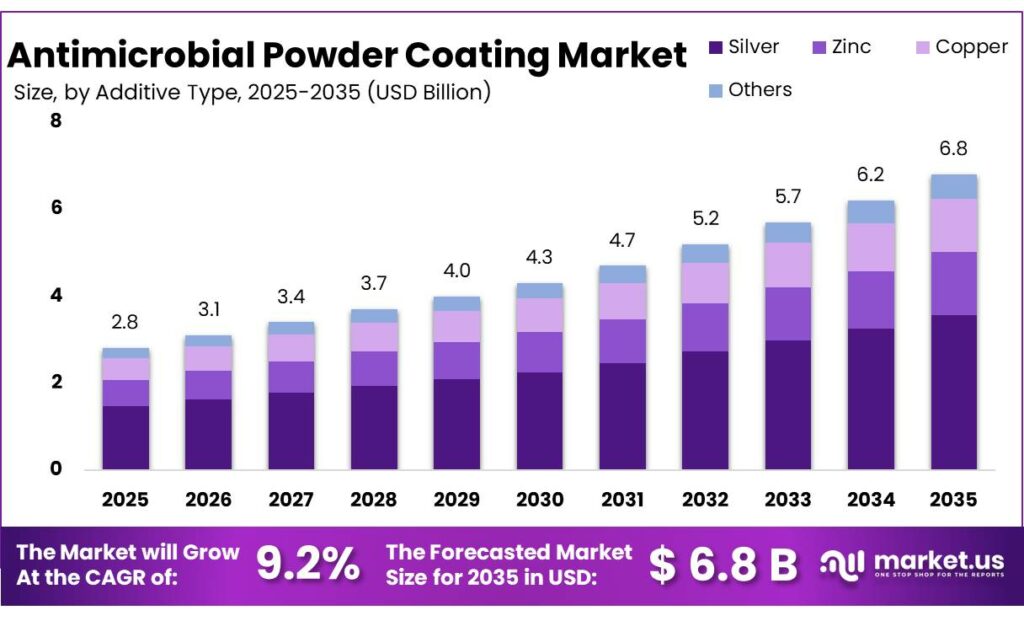
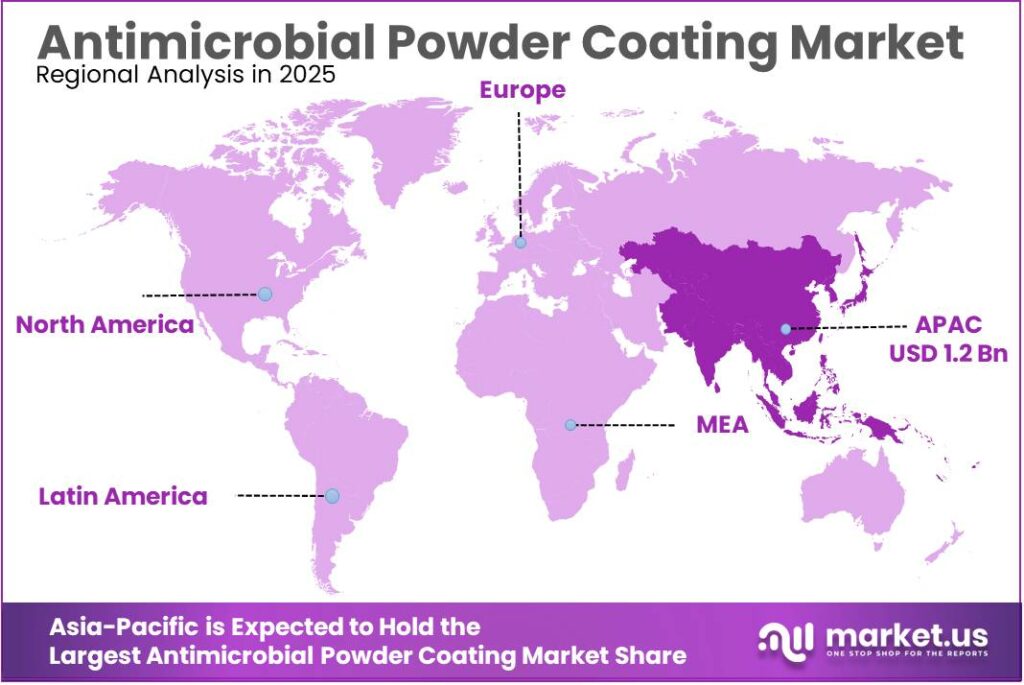
The Global Antimicrobial Powder Coating Market size is expected to be worth around USD 6.8 Billion by 2035, from USD 2.8 Billion in 2025, growing at a CAGR of 9.2% during the forecast period from 2026 to 2035. In 2025, Asia Pacific held a dominant market position, capturing more than a 43.8% share, holding USD 1.2 Billion revenue.
Antimicrobial powder coating is positioned as a functional finishing technology for metal and other durable substrates where hygiene, surface durability, odor control and reduced microbial degradation are important. It is increasingly specified in healthcare equipment, food-contact-adjacent infrastructure, public furniture, handrails, appliances, architectural hardware and high-touch industrial components.
The industrial scenario is being shaped by stricter hygiene expectations across food processing and institutional facilities. Globally, unsafe food causes about 600 million illnesses and 420,000 deaths each year, while children under five account for 40% of the foodborne disease burden and 125,000 deaths annually, according to WHO. In the U.S., FDA cites around 48 million foodborne illness cases, 128,000 hospitalizations, and 3,000 deaths annually, reinforcing the need for cleaner facility surfaces and equipment finishes.
Driving factors include food safety costs, antimicrobial-resistance awareness, sustainability and lower-VOC finishing. GAO reported in February 2025 that foodborne illness costs the U.S. about $75 billion annually in 2023 dollars, and that more than 9,000 outbreaks were reported across all 50 states during 2011–2022. Regulatory clarity also matters: the U.S. EPA allows treated-article claims only when protection is for the article itself, not public-health claims against human pathogens.
Regulation is also supporting adoption. EU food-hygiene rules under Regulation EC 852/2004 require food premises to be kept clean and in good repair, while USDA-FSIS protects meat, poultry, and egg safety through federal inspection programs. These rules increase interest in durable, cleanable, corrosion-resistant coated surfaces, although antimicrobial coatings remain an added hygiene layer and not a substitute for cleaning.
Akzo Nobel N.V. remains active through Interpon AM, developed with BioCote, where the coating technology is stated to reduce up to 99.99% of microbes that cause odors, staining and material degradation on protected surfaces. In 2025, AkzoNobel’s Interpon AM partnership visibility remained a relevant development for antimicrobial powder coating positioning, especially for architectural and hygiene-sensitive applications.
Key Takeaways
- Antimicrobial Powder Coating Market size is expected to be worth around USD 6.8 Billion by 2035, from USD 2.8 Billion in 2025, growing at a CAGR of 9.2%.
- Silver held a dominant market position, capturing more than a 52.4% share.
- Water-based held a dominant market position, capturing more than a 27.1% share.
- Asia-Pacific emerged as the leading region in the antimicrobial powder coating market, accounting for 43.8% share and reaching a valuation of around 1.2 Bn.
By Additive Type Analysis
Silver dominates with 52.4% driven by strong antimicrobial performance and long-lasting protection
In 2025, Silver held a dominant market position, capturing more than a 52.4% share in the antimicrobial powder coating market by additive type. This strong position is mainly due to silver’s well-known ability to kill a wide range of bacteria, fungi, and other microbes effectively even at low concentrations. Industries such as healthcare, food processing, and public infrastructure prefer silver-based coatings because they offer reliable and long-term antimicrobial protection without compromising the coating quality. Silver additives are also valued for their stability under high temperatures, which makes them suitable for powder coating processes.
By End-use Analysis
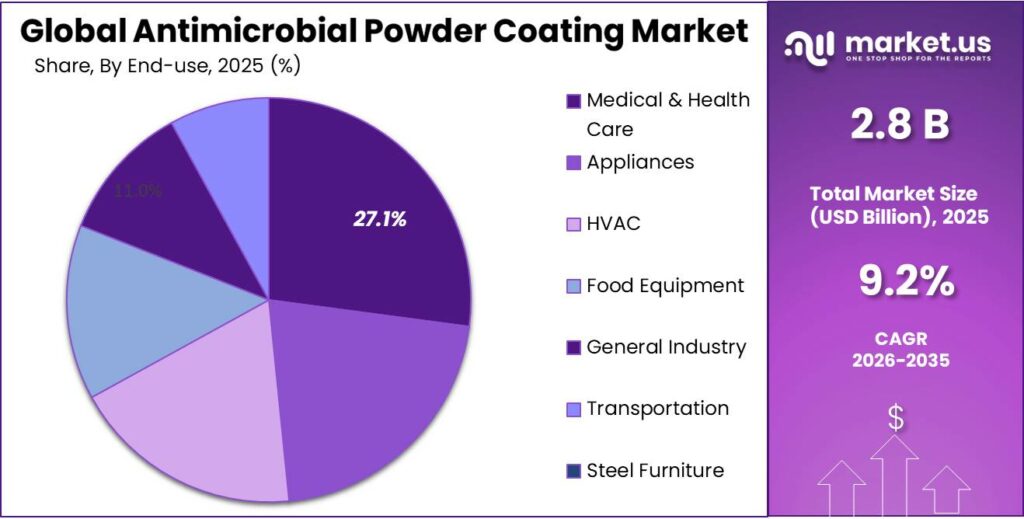
Medical & Health Care sees steady demand with 27.1% supported by strict hygiene needs
In 2025, Water-based held a dominant market position, capturing more than a 27.1% share in the antimicrobial powder coating market within the medical & health care segment. This growth is mainly driven by the increasing need for clean and safe environments in hospitals, clinics, and diagnostic centers. Antimicrobial powder coatings are widely used on medical equipment, hospital furniture, bed rails, and high-touch surfaces to reduce the spread of infections. The healthcare sector continues to rely on these coatings as they provide an extra layer of protection against harmful microbes without affecting durability.
Key Market Segments
By Additive Type
- Silver
- Zinc
- Copper
- Others
By End-use
- Medical & Health Care
- HVAC
- Appliances
- Food Equipment
- General Industry
- Transportation
- Fitness Equipment
- Steel Furniture
- Others
Emerging Trends
Shift toward continuous hygiene solutions in food environments
One clear trend in antimicrobial powder coatings is the growing shift from periodic cleaning to continuous hygiene protection. Food safety data shows why this shift is happening. According to the Centers for Disease Control and Prevention, 48 million people get sick from foodborne illnesses every year, leading to 128,000 hospitalizations in the U.S. alone.
Antimicrobial powder coatings are being applied on surfaces like processing lines, storage units, and handling equipment so that bacteria growth is reduced continuously. This is especially useful in high-touch areas where contamination risk is high. In 2025 and moving into 2026, companies are realizing that preventing contamination is more reliable than trying to eliminate it later.
Increased focus on food safety compliance and smart material use
Another noticeable trend is the stronger focus on compliance and smarter material choices across the food industry. The World Health Organization reports that 600 million people fall ill globally each year due to unsafe food, highlighting how serious the issue remains worldwide. Governments are responding with stricter guidelines and long-term strategies like the WHO Global Food Safety Strategy 2022–2030, encouraging industries to improve hygiene standards at every stage.
This is leading companies to rethink the materials used in their facilities. Instead of using basic coatings, many are now choosing antimicrobial powder coatings that can help meet regulatory expectations while also improving safety. These coatings are not just about protection; they also support durability and reduce maintenance needs.
Drivers
Rising food safety concerns pushing demand for antimicrobial coatings
One of the biggest drivers for antimicrobial powder coatings comes from the growing concern around food safety and contamination. Globally, the scale of the problem is quite serious. According to the World Health Organization, around 600 million people fall ill every year due to contaminated food, and about 420,000 deaths occur annually because of foodborne diseases. This shows how critical hygiene has become across food processing units, storage facilities, and packaging environments.
Because of this, industries are focusing more on preventive solutions rather than reacting after contamination happens. Antimicrobial powder coatings are increasingly used on food processing equipment, conveyor systems, storage racks, and surfaces that come in regular contact with food.
Strong regulatory pressure and outbreak data increasing adoption
Another key factor driving the market is the continuous monitoring and reporting of foodborne outbreaks by authorities. Data from the Centers for Disease Control and Prevention shows that 48 million people get sick from foodborne illnesses every year, with 128,000 hospitalizations and 3,000 deaths annually. Such numbers clearly highlight the scale of risk that food manufacturers and related industries face.
In addition, agencies like the U.S. Food and Drug Administration continue to investigate outbreaks regularly, with multiple multi-state incidents reported even in 2025, showing that contamination risks are still very active
Restraints
High cost burden and compliance challenges limiting adoption
One major factor slowing down the growth of antimicrobial powder coatings is the high cost burden associated with implementation and compliance. Food safety failures already carry a heavy financial impact. A study highlighted that the global cost of foodborne illness is estimated at around $75 billion annually, considering healthcare expenses, lost productivity, and long-term health impacts.
Antimicrobial powder coatings, especially those using advanced additives like silver, can be expensive to apply and maintain. Businesses often prioritize basic compliance measures over advanced coatings due to budget limits. Government regulations such as the Food Safety Modernization Act (FSMA) push companies to improve hygiene, but they don’t always provide financial support for adopting newer technologies.
Frequent recalls show gaps but also hesitation in technology adoption
Another restraining factor is the gap between rising food safety risks and the speed at which industries adopt preventive technologies. In 2025 alone, the FDA recorded 251 food and beverage recalls, which means roughly five recalls every week. Despite these high numbers, many companies still rely on traditional cleaning and monitoring systems instead of investing in antimicrobial coatings. This hesitation often comes from uncertainty about return on investment and lack of clear short-term financial gains.
Data from 2024 also shows that 296 total recalls were recorded, with increasing severity as hospitalizations rose from 230 to 487 and deaths increased from 8 to 19. These numbers clearly highlight the seriousness of contamination risks. Governments and agencies like the FDA continue to release advisories and strengthen food safety frameworks, but adoption of advanced materials still takes time.
Opportunity
Growing packaged food demand creating strong opportunity for antimicrobial coatings
One of the biggest growth opportunities for antimicrobial powder coatings comes from the rapid expansion of the global food industry, especially packaged and ready-to-eat products. As lifestyles become busier, people are relying more on processed and packaged food, which increases the need for better hygiene and longer shelf life. At the same time, food safety remains a serious concern. According to the World Health Organization, around 600 million people fall ill each year due to contaminated food, showing how widespread the issue still is
This gap between rising consumption and safety risks creates a clear opportunity. Antimicrobial powder coatings are increasingly used on food processing equipment, storage systems, and packaging surfaces to reduce contamination. These coatings help slow down bacterial growth and extend product life, which is especially important for packaged foods that travel long distances. In 2025 and moving into 2026, manufacturers are investing more in these coatings to protect food quality and reduce waste.
Government-backed food safety initiatives opening new adoption pathways
Another strong opportunity comes from global food safety programs and regulations encouraging better hygiene practices. Governments and organizations are not just focusing on reacting to outbreaks, but actively pushing prevention strategies. The World Health Organization introduced the Global Food Safety Strategy 2022–2030 to improve food systems and reduce contamination risks worldwide.
At the same time, research and public health efforts highlight that food contamination can happen at any stage—from production to consumption—making surface protection a key focus area. This is where antimicrobial coatings come into play as a practical solution. They act as an added safety layer on equipment and contact surfaces, reducing the chances of microbial spread.
Regional Insights
Asia-Pacific dominates with 43.8% share valued at 1.2 Bn driven by rapid industrial growth and hygiene demand
Asia-Pacific emerged as the leading region in the antimicrobial powder coating market, accounting for 43.8% share and reaching a valuation of around 1.2 Bn. The region’s dominance is largely supported by strong industrial expansion, rising population, and increasing awareness around hygiene and safety standards. Countries such as China, India, and Japan are witnessing continuous growth in sectors like healthcare, food processing, construction, and consumer goods, all of which actively use antimicrobial coatings.
The demand is further supported by the expanding manufacturing base, where coatings are applied on equipment and surfaces to reduce microbial contamination and improve durability. Additionally, Asia-Pacific’s powder coating market alone is projected to grow from about USD 3.85 billion in 2025 to USD 6.25 billion by 2033, showing steady industrial demand for advanced coating solutions
Key Regions and Countries Insights
- North America
- US
- Canada
- Europe
- Germany
- France
- The UK
- Spain
- Italy
- Rest of Europe
- Asia Pacific
- China
- Japan
- South Korea
- India
- Australia
- Rest of APAC
- Latin America
- Brazil
- Mexico
- Rest of Latin America
- Middle East & Africa
- GCC
- South Africa
- Rest of MEA
Key Players Analysis
The Sherwin-Williams Company stands as one of the largest players in the antimicrobial powder coating space, supported by its strong global presence and advanced coating technologies. In 2025, the company reported net sales of $23.57 billion, reflecting steady growth despite market fluctuations. It operates in over 120 countries with around 64,249 employees and more than 4,853 stores globally.
Akzo Nobel N.V. remains a key player in antimicrobial powder coatings, backed by its wide product portfolio and strong global footprint. The company reported revenue of €10.668 billion with net income of €488 million and operates in more than 150 countries. It employs around 35,200 people, supporting large-scale production and innovation in coatings, including antimicrobial solutions.
Axalta Coating Systems plays an important role in the antimicrobial powder coating market with its strong industrial and automotive coating solutions. In 2025, the company reported full-year net sales of $5,117 million along with net income of $379 million. Axalta operates in over 130 countries and serves more than 100,000 customers worldwide.
Top Key Players Outlook
- The Sherwin-Williams Company
- Akzo Nobel N.V.
- Axalta Coating Systems, LLC
- Berger Paints India
- Pulver Inc.
- IGP Pulvertechnik AG
- Protech Group
- Rapid Engineering Co. Pvt. Ltd.
- PPG Industries, Inc.
- Lonza
- BASF
Recent Industry Developments
In 2025, The Sherwin-Williams Company reported record net sales of $23.57 billion, with operating income of $3.81 billion and net income of $2.57 billion, showing stable financial strength to support innovation in advanced coatings.
In 2026, AkzoNobel continued to focus on performance coatings, reporting Q1 revenue of €2.39 billion and adjusted EBITDA of €345 million, supporting further investment in specialty coatings. With products used on hospital beds, ventilators, lighting, appliances, and food preparation surfaces, AkzoNobel remains a strong supplier in antimicrobial powder coatings.
Report Scope
| Report Features | Description |
|---|---|
| Market Value (2025) | USD 2.8 Bn |
| Forecast Revenue (2035) | USD 6.8 Bn |
| CAGR (2026-2035) | 9.2% |
| Base Year for Estimation | 2025 |
| Historic Period | 2020-2024 |
| Forecast Period | 2026-2035 |
| Report Coverage | Revenue Forecast, Market Dynamics, Competitive Landscape, Recent Developments |
| Segments Covered | By Additive Type (Silver, Zinc, Copper, Others), By End-use (Medical And Health Care, HVAC, Appliances, Food Equipment, General Industry, Transportation, Fitness Equipment, Steel Furniture, Others) |
| Regional Analysis | North America – US, Canada; Europe – Germany, France, The UK, Spain, Italy, Rest of Europe; Asia Pacific – China, Japan, South Korea, India, Australia, Singapore, Rest of APAC; Latin America – Brazil, Mexico, Rest of Latin America; Middle East & Africa – GCC, South Africa, Rest of MEA |
| Competitive Landscape | The Sherwin-Williams Company, Akzo Nobel N.V., Axalta Coating Systems, LLC, Berger Paints India, Pulver Inc., IGP Pulvertechnik AG, Protech Group, Rapid Engineering Co. Pvt. Ltd., PPG Industries, Inc., Lonza, BASF |
| Customization Scope | Customization for segments, region/country-level will be provided. Moreover, additional customization can be done based on the requirements. |
| Purchase Options | We have three licenses to opt for: Single User License, Multi-User License (Up to 5 Users), Corporate Use License (Unlimited User and Printable PDF) |





































