


Report Overview
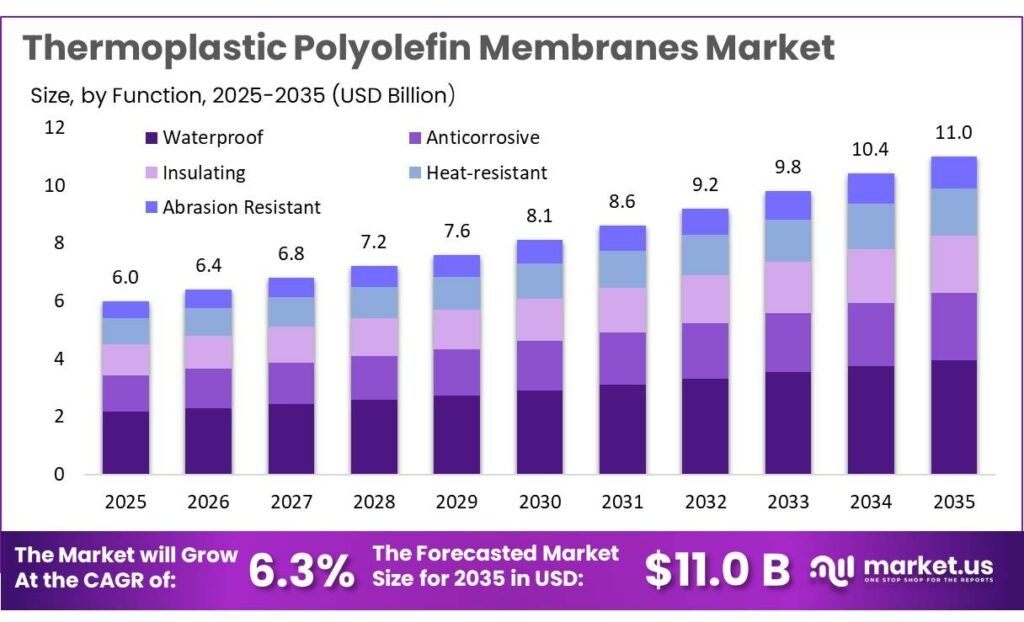
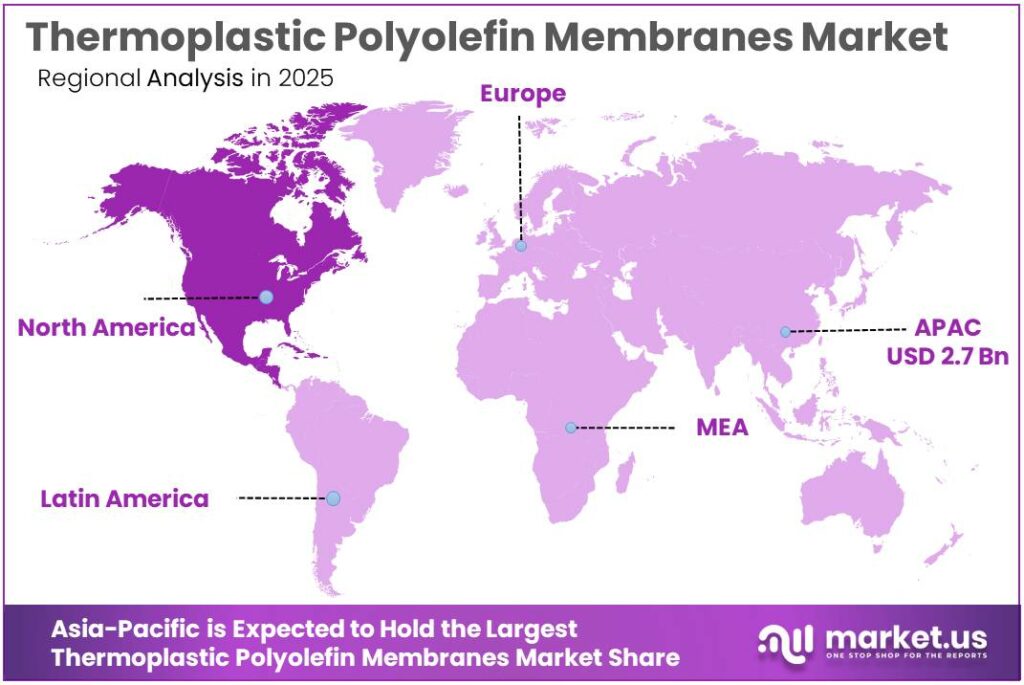
The Global Thermoplastic Polyolefin Membranes Market size is expected to be worth around USD 11.0 Billion by 2035, from USD 6.0 Billion in 2025, growing at a CAGR of 6.3% during the forecast period from 2026 to 2035. In 2025, Asia-Pacific held a dominant market position, capturing more than a 45.1% share, holding USD 2.7 Billion revenue.
Thermoplastic polyolefin membranes are positioned as single-ply roofing and waterproofing sheets used mainly in commercial, industrial and public buildings. The U.S. Department of Energy notes that conventional roofs can reach 150°F or more, while cool roofs reflect more sunlight and absorb less solar energy. The material is valued for heat-welded seams, UV resistance, flexibility, and reflective white surfaces; typical commercial thicknesses include 45, 60 and 80 mil membranes, while newer product sheets also show 0.080 inch / 2.03 mm reinforced TPO formats.
The industrial scenario remains favorable in North America and Europe, where energy-efficient building envelopes are being pushed by regulation and renovation spending. In the United States, nonresidential building starts rose 6.5% in the 12 months ending March 2026, indicating a larger project base for low-slope roofing systems. In Europe, buildings account for about 40% of energy use and 36% of energy-related emissions, making roof retrofits a policy-relevant application area.
- In North America, SPRI-reported single-ply industry shipments across EPDM, TPO, PVC, PVC-KEE, SBS and APP reached 4.30 billion sq. ft., with total installation value above US$8.6 billion, including US$4.85 billion material value and US$3.49 billion labor value.
Key driving factors include cooling-cost reduction, urban heat mitigation, solar-readiness and longer roof service expectations. The U.S. EPA states that cool roofs can reduce peak cooling demand by 11–27% in air-conditioned residential buildings, directly supporting reflective TPO adoption. ENERGY STAR also notes that reflective roof products can reduce energy bills by up to 50% and peak cooling demand by 10–15%.
Demand is driven by reflectivity, waterproofing performance, faster installation and lower cooling loads. The U.S. EPA states that cool roofs can reduce maximum indoor temperatures by 1.2–3.3°C, or 2.2–5.9°F, in non-air-conditioned residential buildings, supporting adoption of reflective TPO membranes in hot climates and dense urban zones. The U.S. Department of Energy notes that conventional roofs can reach 150°F or more, while cool roofs reflect more sunlight and absorb less solar energy.
Government and policy momentum is increasing adoption. The EU Energy Performance of Buildings Directive requires member states to improve building energy performance and supports renovation of inefficient building stock, creating opportunities for reflective and durable roof membranes in commercial retrofit programs. In the U.S., NRCA’s February 2025 reroofing index showed low-slope reroofing project contracts at 50.0 and blended low/steep-slope contracts at 61.1, indicating comparatively stronger reroofing momentum for low-slope systems where TPO is commonly specified.
In competitive positioning, Geocel Ltd. is relevant through roofing sealants and adhesives, with more than 30 years of technical expertise in the UK and Ireland, while Geocel/Uniflex appeared as a Sherwin-Williams exhibitor at Western Roofing Expo 2025.
Key Takeaways
- Thermoplastic Polyolefin Membranes Market size is expected to be worth around USD 11.0 Billion by 2035, from USD 6.0 Billion in 2025, growing at a CAGR of 6.3%.
- Water-based held a dominant market position, capturing more than a 47.3% share.
- Waterproof held a dominant market position, capturing more than a 36.1% share.
- Concrete held a dominant market position, capturing more than a 32.6% share.
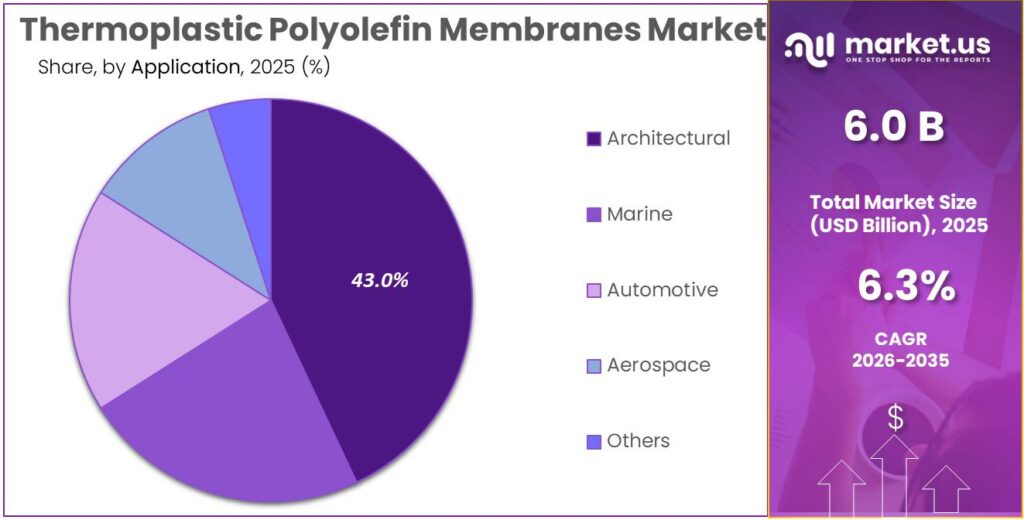
- Architectural held a dominant market position, capturing more than a 43.8% share.
- Asia-Pacific emerged as the dominating region in the Thermoplastic Polyolefin (TPO) membranes market, accounting for 45.1% share, valued at USD 2.7 billion.
By Type Analysis
Water-based dominates with 47.3% share due to growing preference for low-emission and eco-friendly roofing solutions
In 2025, Water-based held a dominant market position, capturing more than a 47.3% share. This strong performance was mainly driven by increasing demand for environmentally safer and low-VOC roofing materials across both residential and commercial construction. Water-based thermoplastic polyolefin (TPO) membranes gained wider acceptance as building regulations continued to emphasize sustainability and reduced chemical emissions. Contractors also preferred these systems because they are easier to apply, have lower odor during installation, and offer better compliance with green building standards.
By Function Analysis
Waterproof leads with 36.1% as protection against leaks remains a top priority in construction
In 2025, Waterproof held a dominant market position, capturing more than a 36.1% share. This was mainly because preventing water leakage continues to be one of the most important needs in roofing and building structures. TPO membranes are widely used for waterproofing due to their strong resistance to moisture, UV exposure, and harsh weather conditions. Builders and contractors prefer these membranes as they help extend the life of roofs while reducing maintenance issues over time. The demand was especially strong in commercial buildings, warehouses, and industrial spaces where long-term durability is critical.
By Substrate Analysis
Concrete leads with 32.6% as it remains the most widely used and reliable base for roofing systems
In 2025, Concrete held a dominant market position, capturing more than a 32.6% share. This was largely due to its strong presence in both commercial and industrial construction, where durable and stable substrates are essential. Concrete surfaces provide a solid base for thermoplastic polyolefin membranes, allowing better adhesion and long-term performance. Builders prefer concrete because it can handle heavy loads, resist environmental stress, and support large-scale roofing systems without frequent repairs. Its compatibility with different installation methods also makes it a practical choice across various project types.
By Application Analysis
Architectural leads with 43.8% as modern building designs increasingly rely on durable roofing solutions
In 2025, Architectural held a dominant market position, capturing more than a 43.8% share. This growth was mainly driven by the rising demand for reliable and long-lasting roofing systems in residential and commercial buildings. Thermoplastic polyolefin membranes are widely used in architectural applications because they offer strong weather resistance, flexibility, and energy efficiency. Builders and designers prefer these materials as they help improve building performance while also supporting modern construction standards. The segment saw strong demand from new construction projects, especially in urban areas where durable roofing is essential.
Key Market Segments
By Type
- Oil-based
- Water-based
- Solvent-based
By Function
- Waterproof
- Anticorrosive
- Insulating
- Heat-resistant
- Abrasion Resistant
By Substrate
- Metal
- Concrete
- Wood
- Plastic
- Glass
By Application
- Architectural
- Marine
- Automotive
- Aerospace
- Others
Emerging Trends
Cool and reflective roofing is becoming a major trend
A major latest trend in the thermoplastic polyolefin membranes market is the rising use of cool and reflective roofing systems. TPO membranes fit well in this trend because they can reflect sunlight and reduce heat absorption.
The U.S. Department of Energy says cool roofs reflect more sunlight than conventional roofs and absorb less solar energy, helping lower building temperature. This matters because buildings already account for 30% of global final energy consumption and 26% of global energy-related emissions, according to the International Energy Agency.
Heat reduction benefits are increasing demand in warm regions
Another strong trend is the use of TPO membranes in hot climates, where cooling costs are a major concern. The U.S. Environmental Protection Agency notes that cool roofs can reduce peak cooling demand by 11% to 27% in air-conditioned residential buildings.
This is making reflective TPO roofing more attractive for commercial buildings, warehouses, retail spaces, and urban projects exposed to strong sunlight. The trend is also supported by green building rules and energy-saving programs, where roofing is no longer seen only as protection from rain but also as a tool to manage heat and reduce electricity use.
Drivers
Rising demand for energy-efficient buildings is pushing TPO membrane adoption
One of the biggest drivers for thermoplastic polyolefin (TPO) membranes is the growing demand for energy-efficient buildings. Governments and industries are focusing more on reducing energy use and improving building performance, especially in roofing systems where heat loss and gain are major concerns. TPO membranes help reflect sunlight and reduce cooling costs, which makes them a preferred choice in both commercial and industrial buildings.
This shift is strongly supported by national energy trends. For example, India reached a major milestone in 2025, where 50% of its installed electricity capacity came from non-fossil sources, showing a clear move toward sustainable infrastructure. At the same time, renewable energy capacity has been expanding rapidly, with over 150 GW of solar capacity installed by March 2026. This kind of growth is increasing awareness around energy-saving construction materials, including reflective roofing systems like TPO.
Government focus on sustainable infrastructure is accelerating market growth
Another key factor is the strong push from government initiatives toward sustainable infrastructure and green construction practices. Many countries, including India, are investing heavily in clean energy and environmentally friendly development. These policies indirectly boost the demand for advanced roofing materials like TPO membranes, which align with sustainability goals.
For instance, India added a record 39,657 MW of renewable energy capacity during 2025–26, showing how fast the country is moving toward cleaner energy systems. In addition, total non-fossil fuel capacity reached 283.46 GW by March 2026, highlighting large-scale infrastructure transformation. As new buildings and industrial facilities are developed under these initiatives, there is a stronger preference for materials that support energy savings, durability, and environmental compliance.
Restraints
High installation cost and maintenance challenges are limiting wider adoption
One of the key restraints for thermoplastic polyolefin (TPO) membranes is the high initial installation cost and ongoing maintenance needs. While TPO is often seen as cost-effective in the long run, the upfront expense can still be a concern for many building owners, especially in small-scale or budget-sensitive projects. For example, residential TPO roofing installation can range between $6 to $18 per square foot, which can push total project costs to $9,000 to $27,000 for a standard roof size
Beyond cost, installation itself is not simple. It requires skilled labor, especially for heat-welding seams, and any mistake during this process can lead to early failures. Poorly installed seams are one of the most common reasons for leaks and performance issues. Over time, repairs can add to the total cost, making some users hesitant to choose TPO despite its benefits. For many developers, especially in emerging markets, these combined cost and skill requirements slow down adoption compared to simpler or more familiar roofing materials.
Performance concerns like seam failure and material damage create hesitation
Another major challenge is related to performance issues, especially around durability and long-term reliability. TPO membranes are known to face problems such as punctures, seam failures, and material degradation under extreme conditions. In fact, fixing water leaks accounts for nearly half of flat roof repairs, and most of these leaks occur at seams where TPO sheets are joined. This shows how critical and vulnerable seam areas can be in real-world use.
Additionally, TPO is a single-ply material, which makes it more prone to punctures from foot traffic or debris. Exposure to high heat can also cause shrinkage, cracking, or weakening of the membrane over time. These performance concerns create uncertainty among buyers, especially when long-term durability is a priority. Even though technology is improving, variations in product quality across manufacturers add another layer of risk.
Opportunity
Rapid growth in construction and building energy demand is opening new opportunities
One of the biggest growth opportunities for thermoplastic polyolefin (TPO) membranes is the fast expansion of the building and construction sector, especially in countries like India. The scale of construction itself is creating a huge need for better roofing materials. According to the Bureau of Energy Efficiency, India is adding nearly 3,00,000 square feet of commercial floor space every day, showing how quickly new buildings are coming up. At the same time, around 40% of the buildings that will exist in the next two decades are yet to be built, which clearly indicates long-term demand for modern construction materials.
This growth directly supports TPO membranes because every new building needs reliable roofing that can handle heat, rain, and long-term wear. Developers are also becoming more careful about material selection, as poor roofing can increase maintenance costs over time. TPO membranes, known for durability and weather resistance, are getting more attention in large commercial projects, warehouses, and malls.
Increasing focus on energy-saving buildings is boosting future demand
Another strong opportunity comes from the rising focus on reducing energy use in buildings. Today, buildings are one of the largest energy consumers. In India, the building sector alone accounts for over 30% of total electricity consumption, and this share continues to grow each year. In fact, overall building energy use is increasing at a steady rate of around 8% annually, showing how quickly demand is rising.
The Ministry of Power and related bodies are encouraging better building designs under energy conservation codes. This is where TPO membranes fit in well, as they help reduce heat absorption and improve energy efficiency in buildings. As more projects aim to lower electricity use and meet sustainability goals, the demand for advanced roofing materials is expected to increase. This shift is not just about saving energy but also about reducing long-term costs, which makes TPO membranes a practical choice for future construction projects.
Regional Insights
Asia-Pacific dominates with 45.1% share valued at USD 2.7 Bn driven by rapid construction and urban expansion
Asia-Pacific emerged as the dominating region in the Thermoplastic Polyolefin (TPO) membranes market, accounting for 45.1% share, valued at USD 2.7 billion. The region’s strong position is mainly supported by large-scale construction growth, increasing urban population, and continuous infrastructure investments across countries like China, India, Japan, and Southeast Asia.
The construction sector in Asia-Pacific alone reached around USD 3.88 trillion in 2025 and further grew to about USD 4.17 trillion in 2026, highlighting the massive scale of building activity across the region. This rapid expansion is directly increasing the demand for roofing solutions such as TPO membranes, especially in commercial buildings, warehouses, and industrial projects.
Key Regions and Countries Insights
- North America
- US
- Canada
- Europe
- Germany
- France
- The UK
- Spain
- Italy
- Rest of Europe
- Asia Pacific
- China
- Japan
- South Korea
- India
- Australia
- Rest of APAC
- Latin America
- Brazil
- Mexico
- Rest of Latin America
- Middle East & Africa
- GCC
- South Africa
- Rest of MEA
Key Players Analysis
Hebei Tuohua Metal Products operates as a mid-scale manufacturing company with a strong industrial base in China. Established in 2010, the company employs around 101–200 workers and generates an estimated US$50 million to US$100 million in annual revenue, showing stable production capacity and export strength. Its operations are supported by a factory size of 10,000–30,000 square meters, allowing large-scale output. With exports contributing nearly 90% of its sales, the company has built a wide global presence, particularly across Europe, the Middle East, and Africa.
Tianjin Haiyunda Metal Material is known for its expertise in producing bituminous and metal-based coating solutions, supporting roofing and industrial applications. It is recognized for its focus on product quality and innovation, particularly in coatings used for infrastructure and marine environments. Companies in this segment often maintain production capacities aligned with regional demand, typically ranging from 20,000–60,000 metric tons annually, reflecting steady output levels. Its role in the market is strengthened by increasing construction and industrial activity across Asia.
Juno Bitumix is recognized as a niche player in the coatings and waterproofing segment, focusing on bituminous and protective solutions. The company operates within the broader construction materials industry, where demand is driven by infrastructure growth and roofing needs. Industry estimates suggest firms in this category often serve regional markets with production capacities ranging between 10,000–50,000 metric tons annually. Its positioning reflects steady demand from infrastructure maintenance and industrial coating requirements, especially in developing regions where cost-effective solutions are prioritized.
Top Key Players Outlook
- Hebei Tuohua Metal Products
- Juno Bitumix, Geocel Ltd.
- Sealocrete PLA Ltd.
- Tianjin Haiyunda Metal Material
- Bird Brand
- Crown Paints Kenya PLC
Recent Industry Developments
Hebei Tuohua Metal Products has been gradually building its presence in construction-related materials, which indirectly supports applications linked to thermoplastic polyolefin (TPO) membrane systems. The company was established in 1996 and operates from Shijiazhuang, China, with a workforce ranging between 201–500 employees and a registered capital of around 5,000,000 RMB.
Juno Bitumix Private Limited and Geocel Ltd. both play supportive roles in the thermoplastic polyolefin (TPO) membranes ecosystem, mainly through waterproofing, sealants, and coating solutions used alongside membrane systems. Juno Bitumix, incorporated in 2009, operates from India with a workforce of around 33 employees (2024) and reported revenue of nearly ₹37.1 crore in 2025, showing steady activity in bitumen-based and petroleum product manufacturing.
Report Scope
| Report Features | Description |
|---|---|
| Market Value (2025) | USD 6.0 Bn |
| Forecast Revenue (2035) | USD 11.0 Bn |
| CAGR (2026-2035) | 6.3% |
| Base Year for Estimation | 2025 |
| Historic Period | 2020-2024 |
| Forecast Period | 2026-2035 |
| Report Coverage | Revenue Forecast, Market Dynamics, Competitive Landscape, Recent Developments |
| Segments Covered | By Type (Oil-based, Water-based, Solvent-based), By Function (Waterproof, Anticorrosive, Insulating, Heat-resistant, Abrasion Resistant), By Substrate (Metal, Concrete, Wood, Plastic, Glass), By Application (Architectural, Marine, Automotive, Aerospace, Others) |
| Regional Analysis | North America – US, Canada; Europe – Germany, France, The UK, Spain, Italy, Rest of Europe; Asia Pacific – China, Japan, South Korea, India, Australia, Singapore, Rest of APAC; Latin America – Brazil, Mexico, Rest of Latin America; Middle East & Africa – GCC, South Africa, Rest of MEA |
| Competitive Landscape | Hebei Tuohua Metal Products, Juno Bitumix, Geocel Ltd., Sealocrete PLA Ltd., Tianjin Haiyunda Metal Material, Bird Brand, Crown Paints Kenya PLC |
| Customization Scope | Customization for segments, region/country-level will be provided. Moreover, additional customization can be done based on the requirements. |
| Purchase Options | We have three licenses to opt for: Single User License, Multi-User License (Up to 5 Users), Corporate Use License (Unlimited User and Printable PDF) |





































