


Introduction
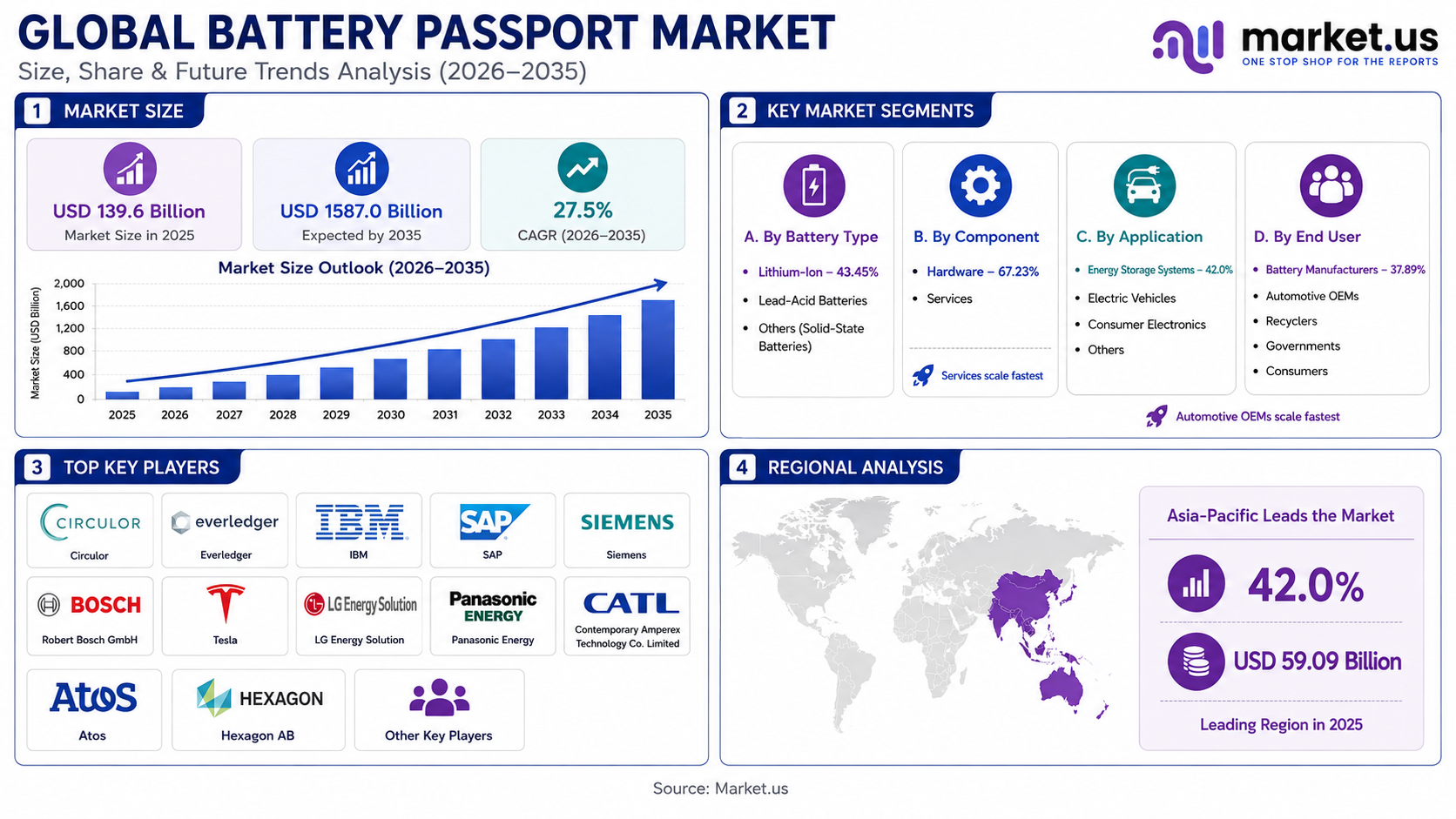
In 2025, the Global Battery Passport Market was valued at USD 139.6 billion and is projected to expand at a 27.5% CAGR from 2026 to 2035, reaching nearly USD 1,587.0 billion by 2035. Asia Pacific dominated the market with more than 42.0% share, generating approximately USD 59.09 billion in revenue. Battery passports are becoming an important digital tool for the battery industry by connecting product identity with technical, environmental, ownership, and supply-chain information throughout the battery lifecycle.
Global battery deployment is expanding rapidly, creating stronger demand for reliable tracking systems. The International Energy Agency reported that EV battery deployment reached around 1.2 TWh in 2025, increasing by almost 30% from the previous year. Electric vehicles accounted for more than 70% of total battery deployment, while light-duty vehicles represented over 85% of EV battery use. This growth is increasing the need for digital records that can track battery chemistry, manufacturing origin, performance, carbon data, ownership changes, and end-of-life treatment.
The wider electric-vehicle industry is also strengthening the battery data ecosystem. Global electric-car sales exceeded 20 million units in 2025 and represented about 25% of all new cars sold worldwide. At the same time, global lithium-ion battery manufacturing capacity surpassed 4 TWh, showing the growing scale and complexity of battery supply chains.
Government initiatives are further supporting battery-data transparency. The European Commission has promoted access to EV battery information such as state of charge, battery health, and location, while technical work continues on carbon-footprint calculation methods for rechargeable industrial batteries above 2 kWh. These measures can support smart charging, warranty management, residual-value assessment, repair, reuse, and recycling.
Looking ahead, global EV battery deployment is expected to approach 3 TWh by 2030 and reach around 4–5 TWh by 2035. Electric trucks could also account for about 10% of EV battery deployment. This expansion creates strong opportunities for battery-passport software providers, digital identity companies, certification firms, lifecycle-data platforms, and recycling technology specialists.
Key Takeaways
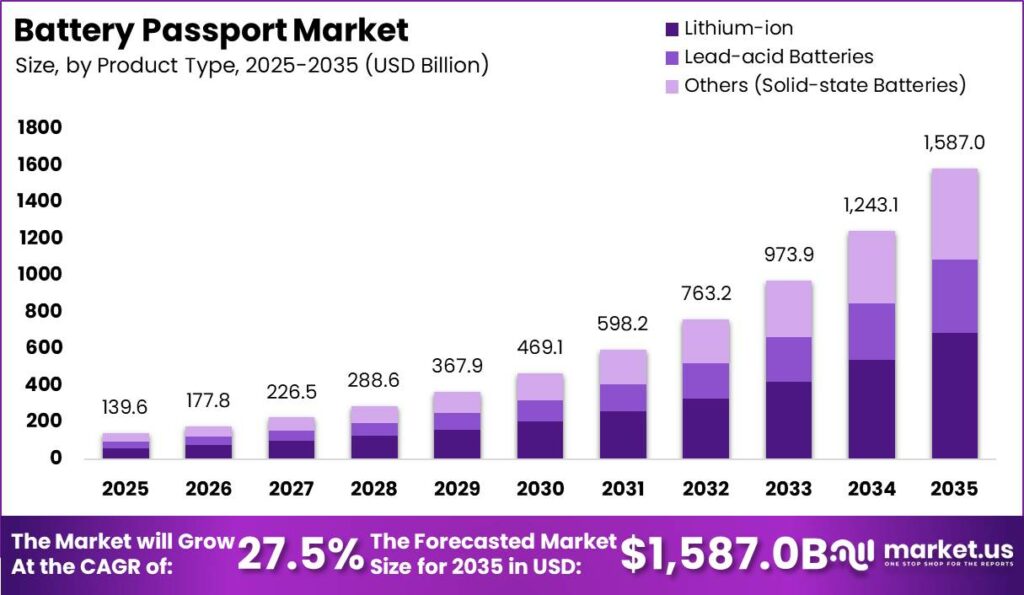
- The Battery Passport market reaches USD 139.6 Billion in 2025 and USD 1587.0 Billion by 2035 at a 27.5% CAGR.
- Hardware leads the component structure with a 67.23% share in 2025.
- Lithium-Ion leads battery type with a 43.45% share, while Services and Automotive OEMs scale fastest.
- Energy Storage Systems lead application with a 42.0% share; Battery Manufacturers lead end users at 37.89%.
- Battery Manufacturers held a dominant market position in the By End User segment of Battery Passport Market, with a 37.89% share.
- Asia-Pacific leads regionally with a 42.0% share, valued at USD 59.09 Billion.
Market Segmentation Overview
Battery Type Analysis
Lithium-Ion Dominates with 43.45% Market Share
In 2025, Lithium-Ion Batteries held the leading position in the Battery Passport Market by battery type, accounting for 43.45% of the total share. Their dominance is supported by the high concentration of lithium-ion packs in electric vehicles and energy storage systems. IEA data showed that EV battery demand exceeded 950 GWh in 2024, with electric cars representing most of the volume. This makes lithium-ion batteries the primary focus for passport platforms that track chemistry, origin, performance, and lifecycle data.
Component Analysis
Hardware Dominates with 67.23% Market Share
In 2025, Hardware held the dominant position in the Battery Passport Market by component, accounting for 67.23% of the market. EU Battery Regulation requirements create demand for durable physical identifiers, QR codes, secure tagging systems, and supporting access infrastructure. Battery passport information is designed for different user groups, including public users, regulators, and authorized stakeholders, making secure hardware an important part of compliance and plant-level deployment.
Application Analysis
Energy Storage Systems Dominate with 42.0% Share
In 2025, Energy Storage Systems held the largest application share at 42.0%. Growing grid-scale battery deployment is increasing the need for lifecycle, health, ownership, and residual-value records. Global battery storage deployment reached around 42 GW during a recent expansion period. Battery passports can help energy-storage operators document state of health, support second-life transactions, and verify battery history when assets are transferred between projects.
End User Analysis
Battery Manufacturers Dominate with 37.89% Market Share
In 2025, Battery Manufacturers held the leading position among end users, accounting for 37.89% of the Battery Passport Market. China represented around 85% of global battery manufacturing capacity in 2024, concentrating large volumes of battery data at cell and pack production facilities. Manufacturers therefore play a central role in capturing information on raw materials, production origin, carbon footprint, chemistry, and product identity.
Drivers
Mandatory Battery Regulations Accelerate Digital Passport Adoption Worldwide
Government regulation is becoming one of the strongest drivers for the Battery Passport industry. Under the European Union Batteries Regulation, from 18 February 2027, every electric-vehicle battery, light-means-of-transport battery, and industrial battery with capacity above 2 kWh placed on the EU market must have an electronic battery passport.
The scale of battery deployment makes this regulation increasingly important. According to the International Energy Agency, global EV battery deployment reached around 1.2 TWh in 2025, increasing by almost 30% in one year. Electric vehicles accounted for more than 70% of total battery deployment, while light-duty vehicles represented over 85% of EV battery use. Global electric-car sales also exceeded 20 million units in 2025 and represented around 25% of all new cars sold worldwide.
The European Commission is also building the digital infrastructure needed for implementation. Its Digital Product Passport Registry became operational on 20 July 2026, while mandatory battery passports are scheduled from 18 February 2027 for relevant categories. The IEA expects EV battery deployment to approach 3 TWh by 2030 and reach around 4–5 TWh by 2035.
Business Opportunities
Circular Battery Economy Creates New Passport Service Opportunities
The expansion of battery recycling and second-life applications creates a major business opportunity for Battery Passport providers. As electric vehicle batteries move through manufacturing, vehicle use, resale, repair, repurposing and recycling, companies need reliable information about battery chemistry, state of health, ownership history and material content. According to the International Energy Agency, global EV battery deployment reached around 1.2 TWh in 2025, increasing by almost 30% from 2024. Electric vehicles represented more than 70% of total battery deployment, while light-duty vehicles accounted for over 85% of EV battery use.
Recycling regulation strengthens this opportunity. Under the EU Batteries Regulation, recycling efficiency for lithium-based batteries must reach at least 65% by the end of 2025 and 70% by the end of 2030. Material recovery requirements are also becoming stricter. By the end of 2027, recycling processes must recover 90% of cobalt, copper, lead and nickel, together with 50% of lithium. These targets create demand for passport platforms that can verify battery composition, recycling history and recovered material flows.
The opportunity becomes larger as recycled-content rules take effect. From August 2031, relevant EU batteries must contain at least 16% recycled cobalt, 85% recycled lead, 6% recycled lithium and 6% recycled nickel. European Commission guidance also states that the Digital Product Passport Registry became operational on 20 July 2026, while battery passports become mandatory for relevant categories from 18 February 2027.
Emerging Trends
Live Battery Data Platforms Reshape Passport Technology Adoption
A major emerging trend in the Battery Passport industry is the shift from static digital records toward connected platforms that can exchange battery information throughout the product lifecycle. Battery passports are increasingly expected to carry data on identity, chemistry, performance, durability, repair, reuse and recycling rather than simply acting as digital labels. Under the EU Batteries Regulation, every EV battery, LMT battery and industrial battery above 2 kWh must have an electronic passport from 18 February 2027. This requirement encourages manufacturers to connect battery management systems, production databases and lifecycle platforms with standardized digital records.
Interoperability is also becoming central to passport development. The European Commission’s Digital Product Passport Registry became operational on 20 July 2026. By that point, 6 of 8 harmonised DPP standards had been published, covering areas such as unique identifiers, APIs, data exchange protocols and storage. This creates a more common technical foundation for battery manufacturers, automakers, recyclers and software providers to exchange trusted information.
The scale of battery deployment makes live data increasingly valuable. The IEA reported EV battery deployment of about 1.2 TWh in 2025, up almost 30%, with EVs representing more than 70% of total battery deployment. Deployment is expected to approach 3 TWh by 2030 and around 4–5 TWh by 2035. As battery volumes rise, connected passport platforms can create opportunities in predictive maintenance, residual-value assessment, second-life selection, recycling verification and carbon tracking.
Use Cases
1. Regulatory Compliance and Digital Battery Identification: Battery passports are primarily used to create a verified digital identity for batteries sold across regulated markets. Under the EU Batteries Regulation, from 18 February 2027, every electric-vehicle battery, light-means-of-transport battery and industrial battery above 2 kWh must have an electronic battery passport. The passport will be accessed through a QR code connected to a unique battery identifier. This allows manufacturers, regulators, buyers and service providers to retrieve standardized information without relying on separate paper records. The European Commission’s Digital Product Passport Registry became operational on 20 July 2026, creating supporting infrastructure for digital product records.
2. Electric Vehicle Battery Lifecycle Monitoring: Battery passports can track how an EV battery performs from manufacturing through vehicle use and eventual retirement. The passport can include state of health, charging and discharging cycles, state of charge, operating temperature and significant events such as accidents. This application is becoming more important as the IEA reported that global EV battery deployment reached around 1.2 TWh in 2025, increasing almost 30% in one year. Light-duty vehicles accounted for more than 85% of EV battery deployment, while EVs represented over 70% of total battery deployment.
3. Battery Health and Residual Value Assessment: Battery passports can support used-EV sales, leasing, warranty decisions and battery valuation by providing verified information about condition and previous use. The European Commission issued guidance in 2025 supporting real-time, cost-free sharing of EV information such as battery state of charge, health and location with users and authorized third parties. Such data can help buyers distinguish a healthy battery from one that has experienced heavy cycling or unfavorable operating conditions. This use case becomes increasingly important as global lithium-ion manufacturing capacity exceeded 4 TWh by the end of 2025, up roughly 30% from 2024.
4. Second-Life and Battery Repurposing Decisions: A battery that is no longer suitable for an electric vehicle may still retain enough usable capacity for stationary storage. Battery passports can help second-life operators review battery chemistry, state of health, usage history and safety information before deciding whether a pack should be reused, repurposed or recycled. The EU regulation specifically provides legitimate access to passport information for repairers, remanufacturers, second-life operators and recyclers. With EV battery deployment expected to approach 3 TWh by 2030 and reach around 4–5 TWh by 2035, a much larger volume of batteries will eventually require reuse or end-of-life decisions.
Regional Analysis
Asia-Pacific dominates the Battery Passport Market with a 42.0% share, valued at around USD 59.09 billion. The region benefits from a large battery-cell manufacturing base that supports both domestic and export EV production. Strong exposure to European compliance requirements is also encouraging Asian battery producers to adopt passport systems early, creating demand for plant-level data integration and digital identification tools.
Europe is the fastest-growing regional market as EU regulations define battery passport content, access, and compliance requirements. Volvo Cars introduced the world’s first production EV battery passport ahead of the EU mandate, with battery information accessible through a QR code inside the vehicle. This shows that European automakers are moving toward compliance before the rules become fully mandatory.
Recent Developments
- In April 2025, Powin partnered with Circulor to introduce battery passport solutions for utility-scale battery energy storage systems. The collaboration supports end-to-end tracking of graphite, lithium, aluminum, steel, copper, and embedded carbon emissions to help meet EU Battery Regulation requirements.
- In February 2026, Circulor partnered with Tees Valley Lithium to build traceable recycled-lithium supply chains. The initiative supports responsible sourcing and helps battery producers prepare for EU Battery Passport compliance.
- In February 2026, Minespider launched Recircle.market, a digital marketplace designed to connect companies involved in EV battery reuse, repair, refurbishment, and recycling. The platform supports circular-economy activities linked with battery passport data.
- In March 2026, MineHub partnered with Minespider to provide Digital Product Passports and Battery Passports for critical-mineral supply chains. The partnership aims to improve material traceability, transparency, and ESG compliance.
- In June 2026, Bureau Veritas partnered with Circulor to strengthen battery passport verification and supply-chain traceability. The collaboration adds independent assurance and compliance support for companies deploying battery passport systems.
Conclusion
The Battery Passport is becoming an important part of the global battery ecosystem as electric vehicle adoption, battery manufacturing, recycling requirements, and digital compliance continue to expand. According to the International Energy Agency, global EV battery deployment reached around 1.2 TWh in 2025, rising almost 30% from the previous year, while lithium-ion manufacturing capacity exceeded 4 TWh. The regulatory environment is also strengthening demand.
The European Commission’s Digital Product Passport Registry also became operational on 20 July 2026, supporting standardized digital product records. Looking ahead, the IEA expects EV battery deployment to approach 3 TWh by 2030 and reach around 4–5 TWh by 2035. This expansion should create strong opportunities for battery manufacturers, automotive companies, recyclers, software providers, certification firms, and lifecycle-data platforms.
Looking for data tailored to your specific market, region, or business need? Request a custom report or consultation — write to us at [email protected]




















