


Report Overview
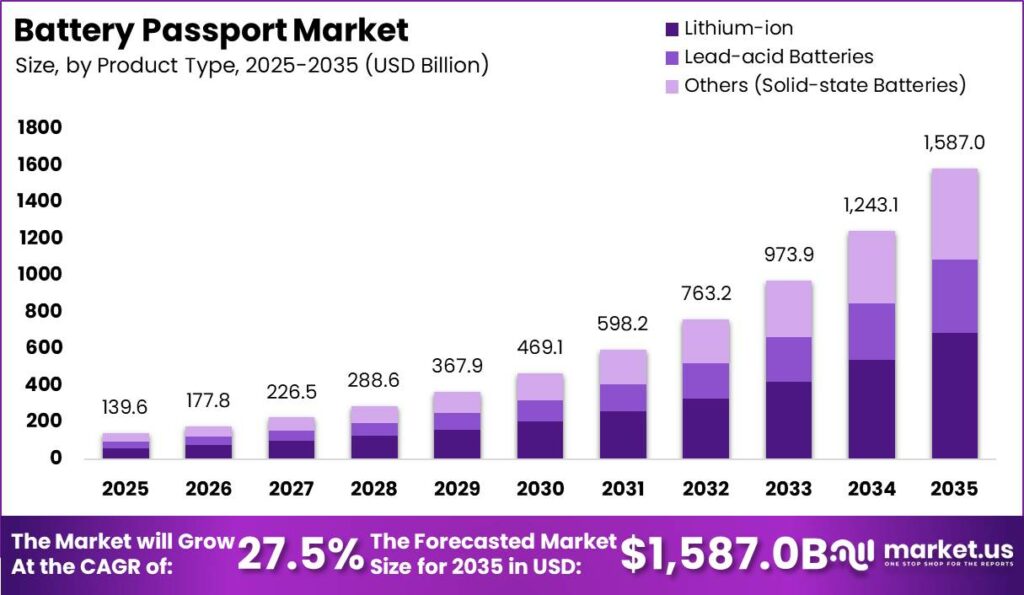
In 2025, the Global Battery Passport Market was valued at USD 139.6 billion, and between 2026 and 2035, this market is estimated to register a CAGR of 27.5%, reaching about USD 1587.0 billion by 2035. Asia Pacific held a dominant market position, capturing more than a 42.0% share, holding USD 59.09 billion in revenue.
Battery passports are becoming a core digital layer for the modern battery industry, linking product identity with technical, environmental and supply-chain information across the battery life cycle.
- According to the International Energy Agency, global EV battery deployment reached approximately 1.2 TWh in 2025, increasing by almost 30% from the previous year. Electric vehicles accounted for more than 70% of overall battery deployment, while light-duty vehicles represented over 85% of EV battery deployment. This rising volume means manufacturers, automakers, recyclers and fleet operators need more reliable systems for tracking battery origin, condition, chemistry and lifecycle information.
Key Takeaways
- The Battery Passport market reaches USD 139.6 Billion in 2025 and USD 1587.0 Billion by 2035 at a 27.5% CAGR.
- Hardware leads the component structure with a 67.23% share in 2025.
- Lithium-Ion leads battery type with a 43.45% share, while Services and Automotive OEMs scale fastest.
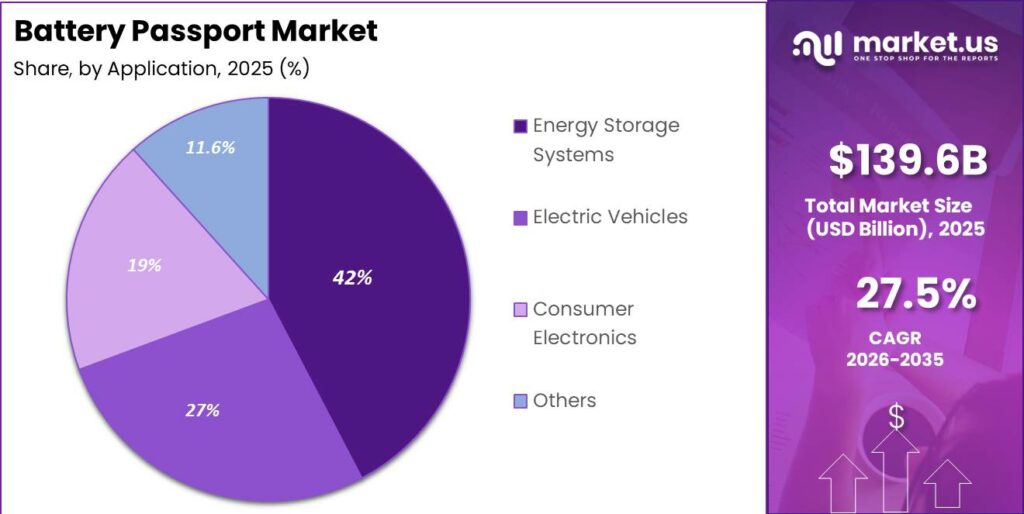
- Energy Storage Systems lead application with a 42.0% share; Battery Manufacturers lead end users at 37.89%.
- Battery Manufacturers held a dominant market position in the By End User segment of Battery Passport Market, with a 37.89% share.
- Asia-Pacific leads regionally with a 42.0% share, valued at USD 59.09 Billion.
The International Energy Agency reported that global EV battery deployment reached 1.2 TWh in 2025, increasing by almost 30% from the previous year. EVs represented more than 70% of total battery deployment, showing how strongly the battery data ecosystem is tied to vehicle electrification. As production scales across complex international supply chains, battery passports can provide a common digital record for chemistry, manufacturing origin, performance, carbon data, ownership changes and end-of-life handling.
- The IEA Global EV Outlook 2026 reported that global electric-car sales exceeded 20 million units in 2025 and represented 25% of all new cars sold worldwide. Global lithium-ion battery manufacturing capacity also surpassed 4 TWh by the end of 2025.
Government action is strengthening the business case for standardized battery data. In July 2025, the European Commission issued guidance supporting real-time, cost-free sharing of EV battery information such as state of charge, battery health and location with users and authorized third parties. The Commission also continues technical work on carbon-footprint calculation methods for rechargeable industrial batteries above 2 kWh through its Joint Research Centre. These measures move the industry toward interoperable data systems that can support smart charging, warranty decisions, residual-value assessment, repair, repurposing and recycling while improving transparency across the value chain.
- The IEA expects global EV battery deployment to approach 3 TWh by 2030 and rise to around 4–5 TWh by 2035, while electric trucks could represent about 10% of EV battery deployment. This growth creates opportunities for battery-passport software providers, digital identity specialists, certification firms, lifecycle-data platforms and recycling technology companies.
Battery Type Analysis
Lithium-Ion dominates with 43.45% due to EV pack volume concentration.
In 2025, Lithium-Ion held a dominant market position in the By Battery Type segment of Battery Passport Market, with a 43.45% share. Data from the IEA shows EV battery demand surpassed 950 GWh in 2024 as electric cars drove most pack volume. This concentration means passport vendors win faster by prioritizing lithium chemistries first. Suppliers that master lithium data schemas capture the largest attach-rate pool before other chemistries scale.
Lead-Acid Batteries still support starter, industrial backup, and motive-power fleets that need simpler identity and recycling records. National statistical offices continue to track large installed bases in automotive aftermarket and stationary backup channels. This creates a lower-complexity passport tier for cost-sensitive fleets. Vendors that offer lightweight lead-acid modules expand beyond premium EV accounts without heavy BMS integration.
Others, including Solid-State Batteries, form the fastest-growing battery type as next-generation cells enter pilot lines. Figures from the IEA show global battery cell manufacturing capacity reached about 3.3 TWh in 2024, more than triple contemporaneous demand. This overbuild leaves room for new chemistries that still need passport fields. Early schema support for solid-state attributes positions platforms for premium design-win cycles.
Component Analysis
Hardware dominates with 67.23% due to mandatory physical battery tagging.
In 2025, Hardware held a dominant market position in the By Component segment of Battery Passport Market, with a 67.23% share. Based on Regulation (EU) 2023/1542, each passport must support three access levels for public users, authorities, and restricted stakeholders. This rule forces durable on-pack identifiers and secure readers across plants. Hardware vendors that pair tags with access control gain stickier plant-level deployments.
Services is the fastest-growing component as makers buy integration, verification, and data-custody support rather than tools alone. In May 2025, Acculon Energy partnered with Circulor and Rockwell Automation to strengthen supply-chain transparency for energy storage passport deployment. This creates pull for systems integrators that map ERP, MES, and BMS data. Service-led bundles raise switching costs once supplier networks are connected.
Application Analysis
Energy Storage Systems dominate with 42.0% due to grid battery compliance scope.
In 2025, Energy Storage Systems held a dominant market position in the By Application segment of Battery Passport Market, with a 42.0% share. According to the IEA, global battery storage deployment reached 42 GW in a recent surge year as grids absorbed more variable renewables. Passport records help certify residual value when packs move between grid projects. Platforms that score storage health data win second-life transaction fees.
Electric Vehicles is the fastest-growing application as fleet electrification multiplies covered packs. The IEA found that worldwide electric car sales reached 17 million units in 2024 and pushed annual battery demand past 1 TWh. This volume turns per-passport fees into large annuity streams for compliant OEMs. Software vendors aligned to vehicle launch calendars secure multi-model contracts first.
Consumer Electronics faces a structural boundary because batteries below 2 kWh capacity sit outside the EU digital passport obligation. As per our research, other battery rules still apply to smaller packs even without full passport coverage. This means electronics brands prioritize lighter labeling rather than full lifecycle portals today. Specialists that productize modular mini-records stay ready if thresholds fall later. Others across specialty mobility hold the remaining application share collectively.
End User Analysis
Battery Manufacturers dominate with 37.89% due to first-placer data custody duties.
In 2025, Battery Manufacturers held a dominant market position in the By End User segment of Battery Passport Market, with a 37.89% share. IEA data indicates China held about 85% of global battery manufacturing capacity in 2024, concentrating passport issuance duties at cell plants. This means plant-floor data capture decides compliance speed for export shipments. Vendors embedded in gigafactory IT stacks control the primary record of truth.
Automotive OEMs are the fastest-growing end users because vehicle brands must present passport access at sale and service. Electric cars already account for over 85% of EV battery demand according to the IEA, tying OEM programs to almost all traction pack flows. This reflects buyer power shifting toward carmakers that specify supplier data formats. Passport providers that certify OEM-ready APIs shorten multi-tier onboarding.
Recyclers need immutable material histories to prove recovered cobalt, lithium, nickel, and lead content against carbon rules. The IEA reports recycling rates versus available feedstock reached over 40% for cobalt and about 20% for lithium in 2023. This creates paid verification demand at end-of-life gates. Governments and consumers hold the remaining end-user share collectively as disclosure audiences expand.
Key Market Segments
By Battery Type
- Lithium-Ion
- Lead-Acid Batteries
- Others (Solid-State Batteries)
By Component
- Hardware
- Services
By Application
- Electric Vehicles
- Energy Storage Systems
- Consumer Electronics
- Others
By End User
- Battery Manufacturers
- Automotive OEMs
- Recyclers
- Governments
- Consumers
Regional Analysis
Asia-Pacific Dominates the Battery Passport Market with a Market Share of 42.0%, Valued at USD 59.09 Billion
Asia-Pacific leads because the region hosts the densest cell manufacturing base serving domestic and export EV programs. Passport spending follows factory output where unique identifiers must be issued before shipment. This means regional IT vendors and global platforms fight first for plant integration seats. Export exposure to European rules keeps Asian producers on an early compliance calendar.
Europe is the fastest-growing regulatory pull zone as local rules define passport content and access. Volvo Cars introduced the world first production electric vehicle battery passport ahead of the EU mandate, with access through a QR code inside the vehicle. This reflects OEM willingness to operationalize compliance before the legal cliff. Suppliers that match European audit expectations win continental framework deals.
As a result, North America, Latin America, and Middle East and Africa build passport capacity through storage projects and mineral export chains. In June 2026, Circulor completed the industry first Battery Energy Storage System Battery Passport pilot beyond vehicle use cases. This creates a reference path for stationary storage owners outside Europe core auto hubs. Cross-region vendors that reuse pilot playbooks scale with lower custom cost. 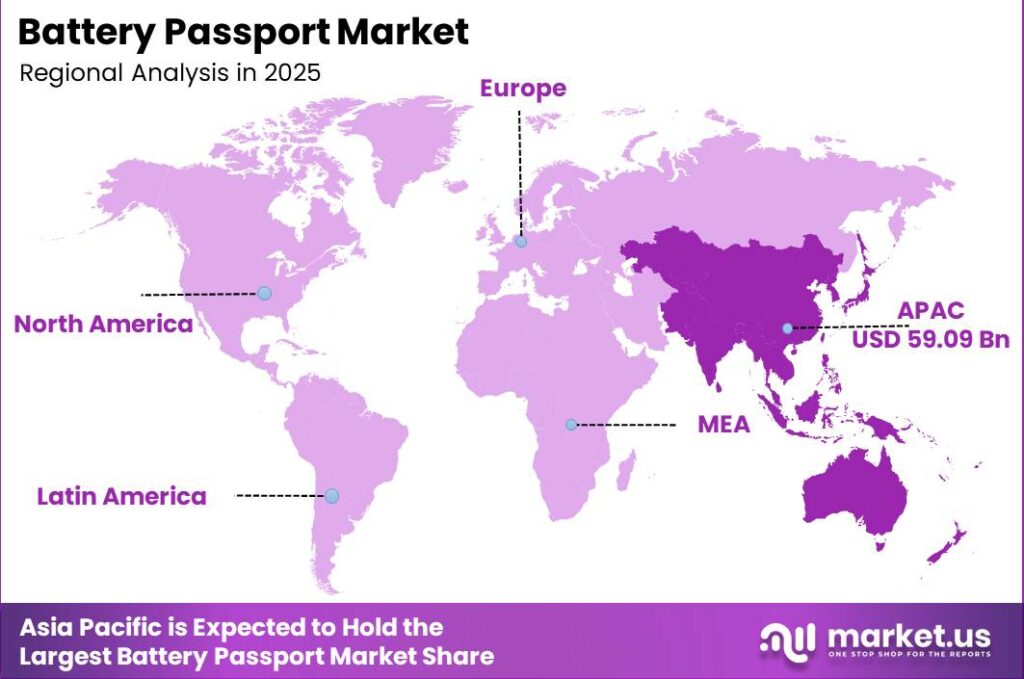
Key Regions and Countries
North America
- US
- Canada
Europe
- Germany
- France
- The UK
- Spain
- Italy
- Rest of Europe
Asia Pacific
- China
- Japan
- South Korea
- India
- Australia
- Rest of APAC
Latin America
- Brazil
- Mexico
- Rest of Latin America
Middle East and Africa
- GCC
- South Africa
- Rest of MEA
Drivers
EU law now forces a QR-accessible digital record for every EV, light transport, and industrial battery above 2 kWh placed on the EU market from 18 February 2027. The rule entered into force on 17 August 2023 after the 18 February 2025 carbon-footprint milestone. Procurement teams already convert that deadline into software budgets. This shifts vendor revenue from one-time identifiers toward recurring SaaS custody fees.
This means near-universal attach rates on covered packs can support cloud-like gross margins near the 70% range as volumes compound. Non-EU OEMs in Asia and North America still pay when they sell into Europe. Early platform wins therefore travel with export models. Investors gain a compliance-driven base that expands as delegated acts add more data fields.
| Driver | (~) % Impact on CAGR Forecast | Geographic Relevance | Impact Timeline |
|---|---|---|---|
| EU Battery Regulation Article 77 mandate | +6.5% | EU, EU-exporting OEMs (Asia, North America) | Short term (2 years or less) |
| EV and LMT fleet electrification volumes | +4.2% | Global, led by China and EU | Medium term (2 to 4 years) |
| Mandatory carbon footprint declaration compliance | +3.0% | EU, EEA | Short term (2 years or less) |
| Grid-scale stationary storage above 2 kWh | +2.4% | North America, EU, Australia | Medium term (2 to 4 years) |
| Supply chain due diligence obligations | +1.8% | Global upstream (Africa, Latin America mining) | Medium term (2 to 4 years) |
Restraints
High capital costs freeze discretionary digital spend before passport projects show revenue. IMF and World Bank rate series kept benchmarks above pre-2022 levels through the baseline period and raised hurdle rates on compliance IT. Passport onboarding needs upfront data mapping and cloud provisioning. Mid-tier cell makers delay until the final compliant quarters before February 2027.
As a result, bookings slip and sales cycles stretch while recognized revenue stays thin near term. OECD investment tracking shows manufacturers trim discretionary software CapEx in tightening cycles. Cell margins already sit in the low teens in major annual reports. Passport stacks compete with gigafactory budgets and push demand into a compressed pre-deadline wave.
| Restraint | (~) % Impact on CAGR Forecast | Geographic Relevance | Impact Timeline |
|---|---|---|---|
| High interest rate CapEx deferral | -2.8% | North America, EU, emerging markets | Short term (2 years or less) |
| Absence of finalized delegated act specifications | -2.5% | EU, global exporters | Short term (2 years or less) |
| Confidential business data disclosure resistance | -1.9% | Asia manufacturing, EU OEMs | Medium term (2 to 4 years) |
| Scope exclusion of sub-2 kWh batteries | -1.4% | Global consumer electronics | Long term (4 years or more) |
| Legacy ERP and MES incompatibility | -1.2% | Global manufacturing base | Medium term (2 to 4 years) |
Challenges
Missing primary data at mining and refining tiers remains the hardest friction in passport buildouts. Origin, recycled content, and site emissions must be captured far upstream where digitization is weakest. UNEP and OECD due-diligence work flags large artisanal cobalt routes without clean digital custody. IEA minerals tracking also shows refining clusters with thin standardized reporting.
This creates long onboarding cycles and multiplies data-acquisition cost versus simple hosting fees. Platforms that sell supplier verification, attestation, and credential exchange open a paid data-plumbing layer. EU EBSI and Catena-X style rails point to where that spend lands. Vendors that absorb upstream integration early convert a margin drag into a multi-year services franchise.
| Challenge | (~) % CAGR Friction Drag | Geographic Relevance | Mitigation Horizon |
|---|---|---|---|
| Upstream supply chain data gaps | -3.1% | Africa, Latin America, Southeast Asia mining | Long term (4 years or more) |
| Cross-platform interoperability fragmentation | -2.3% | EU, global consortium participants | Medium term (2 to 4 years) |
| Digital traceability talent shortage | -1.7% | Global, acute in EU and India | Medium term (2 to 4 years) |
| Data verification and audit integrity | -1.5% | Global, EU-enforced | Medium term (2 to 4 years) |
| Lifecycle data persistence over battery life | -1.1% | Global secondary and recycling markets | Long term (4 years or more) |
Opportunities
Second-life and recycling data remains the largest untapped monetization layer beyond basic compliance fields. Initial rules emphasize identity and core technical data, leaving residual-value analytics commercially open. Static hosting fees stay low while health scoring and pack matching can price at a premium. This lifts revenue per passport with little extra cloud cost.
By contrast, contribution margins can expand an estimated 10 to 15 percentage points above base traceability tiers when circular services attach. IEA storage tracking and IRENA circular analysis point to large retiring pack flows this decade. Recyclers still need verified chemistry to hit regulated recycled-content targets. Early movers that own residual-value data convert a compliance touch into a marketplace annuity.
| Opportunity | (~) % Potential CAGR Upside | Geographic Relevance | Execution Window |
|---|---|---|---|
| Second-life and recycling data monetization | +3.4% | Global, EU and North America first | Medium term (2 to 4 years) |
| Cross-product digital passport expansion | +2.6% | EU, then global under ESPR | Long term (4 years or more) |
| Non-EU regulatory replication licensing | +2.2% | US, China, India, Japan | Long term (4 years or more) |
| Insurance and financing analytics services | +1.6% | Global, developed-market lenders | Medium term (2 to 4 years) |
| SME compliance-as-a-service tier | +1.3% | EU, emerging-market exporters | Medium term (2 to 4 years) |
Geopolitical Impact Analysis
Data from the WTO shows applied MFN tariffs on critical minerals averaged about 4% in 2022 while bound ceilings averaged near 26%. That gap lets governments raise mineral duties quickly during strategic disputes. Battery passport programs then face costlier cobalt, lithium, and nickel inputs and heavier origin proof needs. Exporters invest faster in digital custody to keep EU market access when tariff risk rises.
UNCTAD indicates seaborne trade growth slowed toward about 0.5% in 2025 after ton-miles jumped nearly 6% in 2024 from conflict-driven rerouting. Longer mineral and cell routes raise freight volatility for battery supply chains. Consequently, delayed precursor shipments disrupt passport data completeness at packing plants. Vendors that support offline capture and late field updates protect compliance when ships divert.
Key Company Insights
Circulor positions as a traceability specialist tying battery materials to compliance-grade digital records for industrial buyers. In June 2025, Circulor and TÜV Rheinland agreed to jointly deliver sustainability compliance services including passport verification. This pairing adds independent assurance that reduces buyer audit risk. The model favors recurring verification revenue over pure software seats alone.
Everledger sits among dedicated passport and provenance platforms listed against larger enterprise software groups in this market. Specialist focus helps win early design reviews where battery identity is the core product rather than a module. However, scale buyers may still bundle passports inside broader ERP suites. Everledger must prove niche depth against full-stack incumbents to hold share.
Key Players
- Circulor
- Everledger
- IBM
- SAP
- Siemens
- Robert Bosch GmbH
- Tesla
- LG Energy Solution
- Panasonic Energy
- Contemporary Amperex Technology Co. Limited
- Atos
- Hexagon AB
- Other Key Players
Recent Developments
- April 2025: Powin partnered with Circulor to launch battery passport solutions for utility-scale battery energy storage systems, enabling end-to-end traceability of graphite, lithium, aluminum, steel, copper, and embedded carbon emissions for EU Battery Regulation compliance.
- February 2026: Circulor partnered with Tees Valley Lithium to deploy traceable recycled lithium supply chains supporting EU Battery Passport compliance and responsible sourcing requirements.
- February 2026: Minespider launched Recircle.market, a digital marketplace connecting companies involved in EV battery reuse, refurbishment, repair, and recycling while supporting battery passport-enabled circular economy workflows.
- March 2026: MineHub partnered with Minespider to deliver Digital Product Passports and Battery Passports for critical mineral supply chains, improving traceability and ESG compliance.
- June 2026: Bureau Veritas partnered with Circulor to support battery passport verification and supply-chain traceability compliance, strengthening independent assurance for battery passport deployments.
Report Scope
| Report Features | Description |
|---|---|
| Market Value (2025) | USD 139.6 Billion |
| Forecast Revenue (2035) | USD 1587.0 Billion |
| CAGR (2026-2035) | 27.5% |
| Base Year for Estimation | 2025 |
| Historic Period | 2020-2024 |
| Forecast Period | 2026-2035 |
| Report Coverage | Revenue Forecast, Market Dynamics, Market Opportunity Analysis, Technology and Innovation Landscape, Competitive Landscape, Recent Developments |
| Segments Covered | By Battery Type (Lithium-Ion, Lead-Acid Batteries, Others (Solid-State Batteries)), By Component (Hardware, Services), By Application (Electric Vehicles, Energy Storage Systems, Consumer Electronics, Others), By End User (Battery Manufacturers, Automotive OEMs, Recyclers, Governments, Consumers) |
| Regional Analysis | North America (US and Canada), Europe (Germany, France, The UK, Spain, Italy, and Rest of Europe), Asia Pacific (China, Japan, South Korea, India, Australia, and Rest of APAC), Latin America (Brazil, Mexico, and Rest of Latin America), Middle East and Africa (GCC, South Africa, and Rest of MEA) |
| Competitive Landscape | Circulor, Everledger, IBM, SAP, Siemens, Robert Bosch GmbH, Tesla, LG Energy Solution, Panasonic Energy, Contemporary Amperex Technology Co. Limited, Atos, Hexagon AB, Other Key Players |
| Customization Scope | Customization for segments, region / country-level will be provided. Additional customization can be done based on requirements. |
| Purchase Options | We have three licenses to opt for: Single User License | Multi-User License (Up to 5 Users) | Corporate Use License (Unlimited User and Printable PDF) |





































