


Global Battery Packaging Market
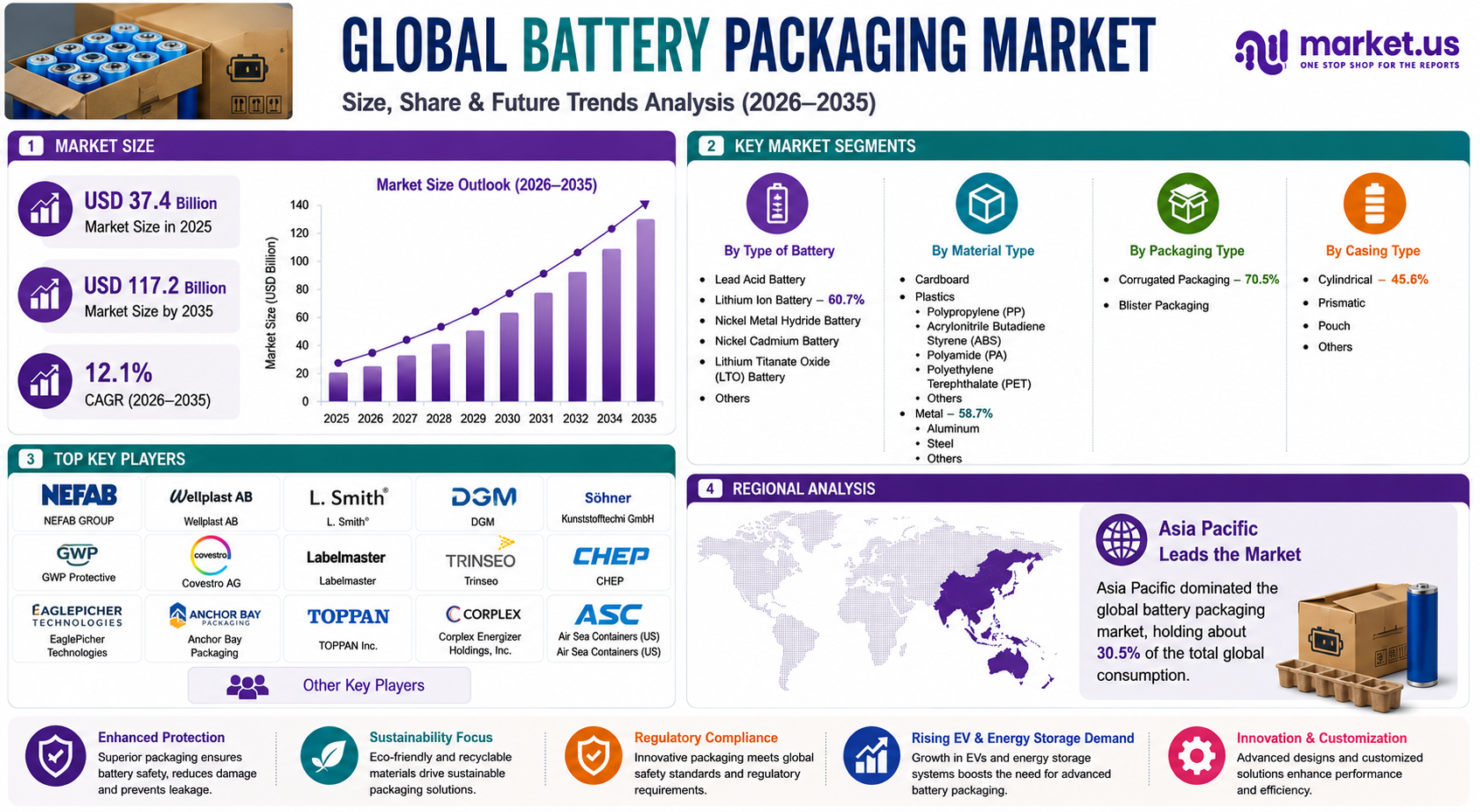
The Global Battery Packaging Market was valued at USD 37.4 billion in 2025 and is projected to expand at a CAGR of 12.1% from 2026 to 2035, reaching approximately USD 117.2 billion by 2035. In 2025, Asia Pacific remained the leading region with more than a 30.5% share, generating around USD 0.4 billion in revenue.
Market growth is closely linked with rising electric vehicle production and increasing use of portable electronic devices. Asia Pacific continues to play an important role, supported by China, Japan, and South Korea, which together account for more than 70% of global lithium-ion cell production.
The International Energy Agency reported that EV battery deployment reached 1.2 TWh in 2025, increasing by nearly 30% from the previous year. Electric vehicles represented more than 70% of total battery deployment, while global lithium-ion nameplate manufacturing capacity exceeded 4 TWh by the end of 2025.
Material innovation is also influencing battery packaging design. Aluminum remains widely used because of its low weight, corrosion resistance, structural strength, and recyclability. Novelis reported that aluminum battery enclosures can be up to 50% lighter than comparable steel designs and can provide more than 20% mass reduction compared with baseline aluminum-extrusion structures.
Engineering plastics are gaining wider use in battery covers, cell holders, module boxes, busbars, and insulation components. SABIC offers flame-retardant polypropylene grades containing 15%, 25%, and 30% glass-fiber reinforcement for battery applications. Its multi-material EV battery enclosure concept has also demonstrated around 20% lower weight than an all-aluminum design, supporting demand for thermoplastics, composites, adhesives, foams, coatings, and fire-resistant materials.
Government programs are further supporting battery manufacturing and packaging innovation. The U.S. Department of Energy provides USD 3 billion through its Battery Manufacturing and Recycling Grants program, alongside another USD 3 billion for battery-material processing. In Europe, digital battery passports will become mandatory from 18 February 2027 for EV batteries, light-means-of-transport batteries, and industrial batteries above 2 kWh.
Key Takeaways
- The global battery packaging market was valued at USD 37.4 billion in 2025.
- The global market is projected to grow at a CAGR of 12.1% and is estimated to reach USD 117.2 billion by 2035.
- On the basis of type of battery, lithium-ion battery dominated the market, constituting 60.7% of the total market share.
- Based on the material type, most battery packaging is made from metals, with a market share of 58.7%.
- Among the packaging types, corrugated packaging held a major share in the battery packaging market, 70.5% of the market share.
- On the basis of casing type, cylindrical casing battery packaging dominated the market, with 45.6% market share.
- In 2025, the Asia Pacific was the most dominant region in the battery packaging market, accounting for 30.5% of the total global consumption.
Type of Battery Analysis
Lithium-Ion Battery Leads the Battery Packaging Market with a 60.7% Share
Lithium-ion batteries held the leading position in the battery packaging market, accounting for 60.7% of the total share. Their strong use across electric vehicles, consumer electronics, and energy storage systems creates steady demand for protective and high-performance packaging. These batteries require packaging that can manage heat, mechanical stress, and safety risks while maintaining structural strength.
Cylindrical, prismatic, and pouch formats are widely used, supported by aluminum and advanced polymer materials. Growing attention to recyclable materials and smart monitoring solutions is also improving lithium-ion battery packaging safety, reliability, and sustainability.
Material Type Analysis
Metals Dominated the Battery Packaging Market with a 58.7% Share
The metal segment accounted for 58.7% of the battery packaging market, supported by the wide use of aluminum and steel in battery casings and protective structures. Metals offer strong mechanical protection, good thermal conductivity, and high resistance to impact and deformation.
Aluminum is commonly preferred where lower weight and corrosion resistance are important, while steel is suited to heavier industrial battery applications. Metal packaging also supports compliance with battery transport and safety standards. Growing use of recyclable metals is further strengthening the segment as manufacturers focus on durable, reusable, and environmentally responsible packaging solutions.
Packaging Type Analysis
Corrugated Packaging Leads the Battery Packaging Market with a 70.5% Share
Corrugated packaging dominated the battery packaging market with a 70.5% share, mainly because it offers a practical combination of low weight, durability, cushioning, and cost efficiency. It is widely used for transporting and storing lithium-ion and other battery types where protection from impact, movement, short circuits, and deformation is required.
Corrugated designs can also be customized for cylindrical, pouch, and prismatic battery formats. Strong recyclability and compatibility with protective inserts and coatings further improve its appeal across automotive, industrial, energy storage, and consumer electronics applications.
Casing Type Analysis
Cylindrical Battery Packaging Held a 45.6% Market Share
Cylindrical battery casings accounted for 45.6% of the battery packaging market, supported by their strong mechanical stability and standardized design. These casings are widely used in consumer electronics, industrial equipment, and lithium-ion battery packs because they provide reliable electrolyte containment and uniform structural protection. Common formats such as 18650 and 21700 also support automated manufacturing and modular battery-pack assembly. Cylindrical designs offer effective heat dissipation and good resistance to deformation, making them suitable for applications where safety, production consistency, durability, and compatibility with metal or polymer protective materials are important.
Key Market Segments
By Type of Battery
- Lead Acid Battery
- Lithium Ion Battery
- Nickel Metal Hydride Battery
- Nickel Cadmium Battery
- Lithium Titanate Oxide (LTO) Battery
- Others
By Material Type
- Cardboard
- Plastics
- Polypropylene (PP)
- Acrylonitrile Butadiene Styrene (ABS)
- Polyamide (PA)
- Polyethylene Terephthalate (PET)
- Others
- Metal
- Aluminum
- Steel
- Others
By Packaging Type
- Corrugated Packaging
- Blister Packaging
By Casing Type
- Cylindrical
- Prismatic
- Pouch
- Others
Regional Analysis
Asia Pacific Dominates the Global Battery Packaging Market with a 30.5% Share
In 2025, Asia Pacific held the leading position in the global battery packaging market, accounting for around 30.5% of total consumption. The region benefits from a strong battery manufacturing base and high demand from electric vehicles, consumer electronics, and energy storage systems.
China remains a major contributor to regional demand. According to the International Energy Agency, China represented more than 60% of the global electric vehicle stock in 2022, creating significant requirements for lithium-ion batteries and related protective packaging.
Japan and South Korea also play an important role in producing high-performance battery cells. East Asia collectively accounts for more than 70% of global lithium-ion cell production, supporting demand for prismatic, pouch, and cylindrical casings, along with protective shipment materials.
Recent Developments
In January 2025, Energizer Holdings, Inc., a leading global manufacturer and distributor of primary batteries, introduced 100% recyclable, plastic-free packaging across its Energizer battery portfolio, emphasizing sustainability and environmentally friendly product design.
In April 2026, Nefab Group acquired Slovakian packaging company Vallos, s.r.o., enhancing its global and local market presence while reinforcing its focus on resource-efficient supply chain solutions and comprehensive corrugated packaging offerings.
The Following Are Some of the Major Players in the Industry
- NEFAB GROUP
- Wellplast AB
- L. Smith
- DGM
- Söhner Kunststofftechni GmbH
- GWP Protective
- Covestro AG
- Labelmaster
- Trinseo
- CHEP
- EaglePicher Technologies
- Anchor Bay Packaging
- TOPPAN Inc.
- Corplex Energizer Holdings, Inc.
- Air Sea Containers (US)
- Other Key Players




















