


Report Overview
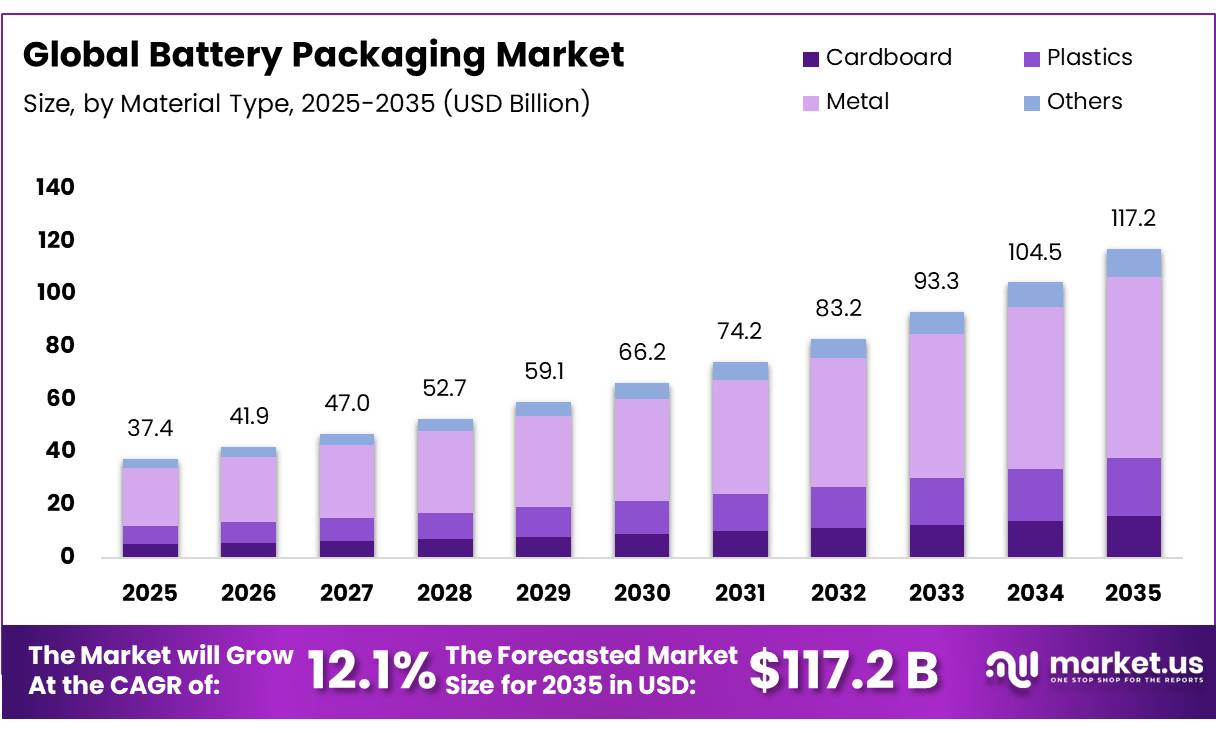
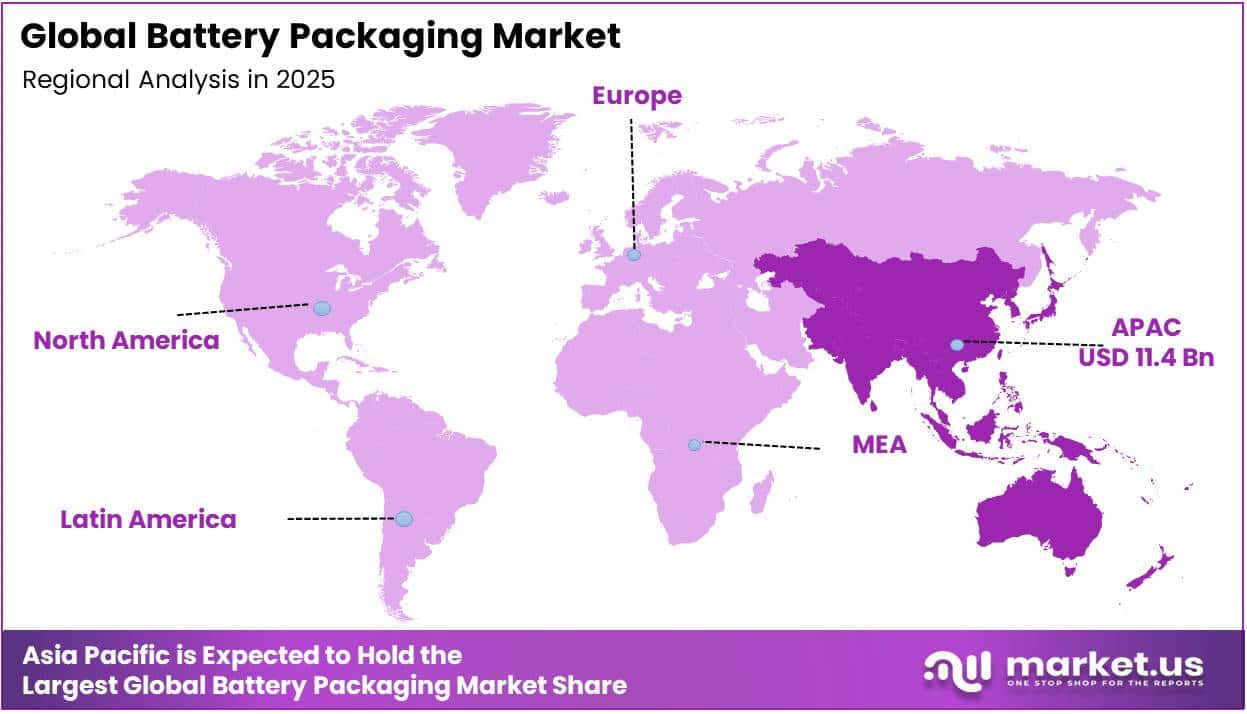
In 2025, the Global Battery Packaging Market was valued at USD 37.4 billion, and between 2026 and 2035, this market is estimated to register a CAGR of 12.1%, reaching about USD 117.2 billion by 2035. In 2025, Asia Pacific held a dominant market position, capturing more than a 30.5% share, holding USD 0.4 Billion revenue.
The global battery packaging market is shaped by the growing adoption of electric vehicles and portable electronics, which drives demand for safe, durable, and efficient packaging solutions. Asia Pacific dominates the market, supported by China, Japan, and South Korea, which collectively produce over 70% of lithium-ion cells globally, requiring high-quality casings and shipment packaging.
- The International Energy Agency reported that EV battery deployment reached 1.2 TWh in 2025, increasing by almost 30% from the previous year, while electric vehicles accounted for more than 70% of total battery deployment. Global lithium-ion nameplate manufacturing capacity also exceeded 4 TWh by the end of 2025. Rising cell production directly increases requirements for battery trays, module cases, cooling structures, insulation, fire barriers, and shipment packaging.
Key Takeaways
- The global battery packaging market was valued at USD 37.4 billion in 2025.
- The global market is projected to grow at a CAGR of 12.1% and is estimated to reach USD 117.2 billion by 2035.
- On the basis of type of battery, lithium-ion battery dominated the market, constituting 60.7% of the total market share.
- Based on the material type, most battery packaging is made from metals, with a market share of 58.7%.
- Among the packaging types, corrugated packaging held a major share in the battery packaging market, 70.5% of the market share.
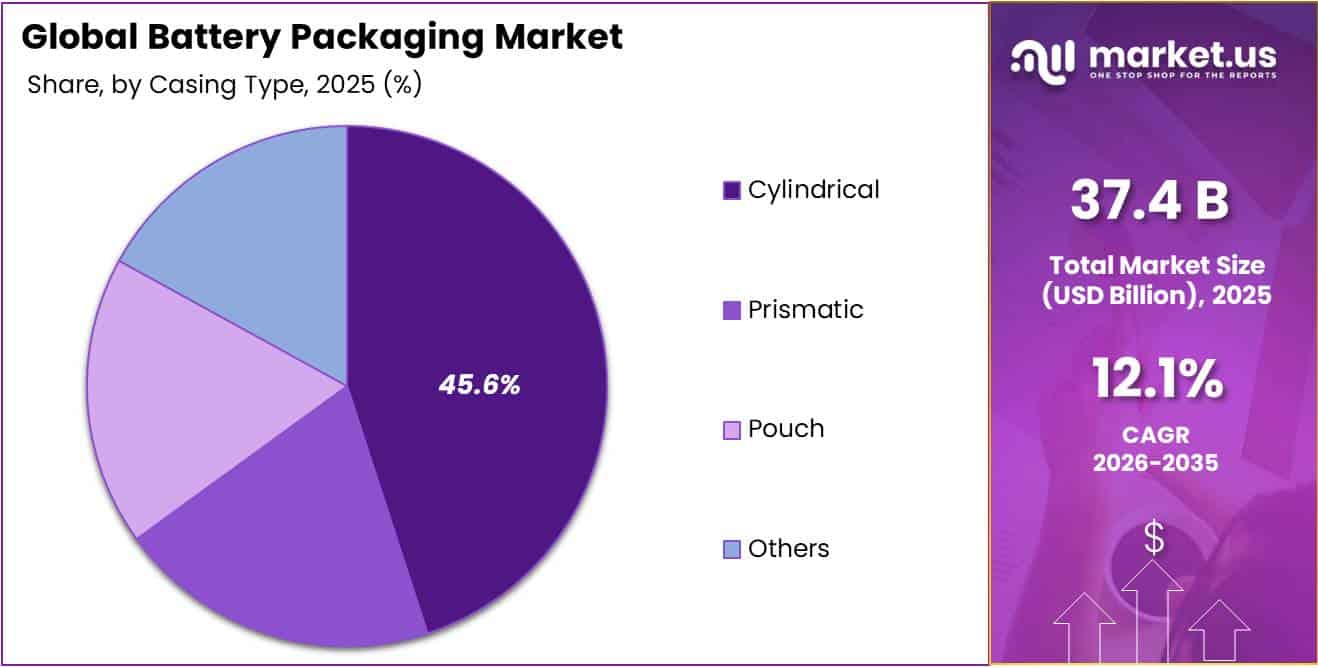
- On the basis of casing type, cylindrical casing battery packaging dominated the market, with 45.6% market share.
- In 2025, the Asia Pacific was the most dominant region in the battery packaging market, accounting for 30.5% of the total global consumption.
Material innovation remains a major driving factor. Aluminum is widely used because it combines structural strength, corrosion resistance, recyclability, and lower weight. Novelis states that aluminum battery enclosures can be up to 50% lighter than equivalent steel enclosures and can achieve more than 20% mass reduction compared with baseline aluminum-extrusion designs. In March 2025, Novelis, Shape Corp., and Metalsa also started collaborating on advanced roll-formed aluminum EV battery trays, supporting lighter and more manufacturing-efficient enclosure systems.
Engineering plastics are also gaining importance in covers, module boxes, busbars, cell holders, and electrical insulation. SABIC offers flame-retardant polypropylene grades containing 15%, 25%, and 30% glass-fiber reinforcement for battery applications. Its multi-material EV battery enclosure concept has demonstrated approximately 20% lower weight than an all-aluminum design. These developments are expanding opportunities for high-performance thermoplastics, composite sheets, adhesives, foams, coatings, and fire-resistant materials that can reduce weight while improving thermal and electrical protection.
Government support is strengthening the future manufacturing base. The U.S. Department of Energy provides USD 3 billion through its Battery Manufacturing and Recycling Grants program and another USD 3 billion for battery-material processing. U.S. DOE – Battery Manufacturing and Recycling Grants In Europe, a digital battery passport will become mandatory from 18 February 2027 for EV batteries, light-means-of-transport batteries, and industrial batteries above 2 kWh. European Commission Battery Digital Product Passport Future opportunities are therefore expected in lightweight enclosures, recyclable packaging, flame-retardant polymers, thermal-runaway barriers, reusable transport systems, smart labels, and digitally traceable battery-pack designs.
Type of Battery Analysis
Lithium-Ion Battery Dominated the Battery Packaging Market.
Lithium-ion batteries represent the dominant segment, accounting for 60.7% of the battery packaging market. Their widespread adoption across electric vehicles, consumer electronics, and energy storage systems drives substantial demand for specialized packaging solutions. The high energy density, compact form factor, and sensitivity to temperature and mechanical stress necessitate packaging that ensures safety, structural integrity, and regulatory compliance.
Packaging formats such as prismatic, pouch, and cylindrical cells are commonly used, often incorporating high-performance polymers and aluminum casings to enhance thermal stability and mechanical protection. Additionally, the growing focus on sustainable and recyclable materials aligns with environmental regulations and industry initiatives, while the integration of smart packaging solutions enables real-time monitoring, further improving the safety and reliability of lithium-ion battery transport and storage.
Material Type Analysis
Metals Held Major Share of the Battery Packaging Market.
The metal segment holds a dominant position in the battery packaging market, accounting for 58.7% of the material share. Aluminum and steel are extensively used due to their strength, thermal conductivity, and resistance to mechanical stress, which are critical for ensuring the safety and durability of battery cells during transportation and storage. Metal casings are particularly important for lithium-ion batteries, where high energy density increases the risk of thermal runaway and mechanical damage.
Aluminum is favored for lightweight and corrosion-resistant packaging, while steel provides robust protection for larger industrial batteries. The use of metal materials also facilitates compliance with international standards, including UN 38.3 and IATA regulations. Increasing adoption of recyclable and reusable metals aligns with environmental mandates, while innovations in design continue to enhance thermal management, structural integrity, and operational safety.
Packaging Type Analysis
Corrugated Battery Packaging Led the Market.
Corrugated packaging dominates the battery packaging market, accounting for 70.5% of the segment. Its widespread adoption is driven by the need for cost-effective, durable, and lightweight solutions capable of protecting batteries during transportation and storage. Corrugated structures provide high mechanical strength and cushioning, mitigating the risk of physical damage, short circuits, or deformation, particularly for lithium-ion and other high-energy-density batteries.
The material’s versatility allows for custom designs that accommodate cylindrical, prismatic, and pouch cell formats while ensuring compliance with international transport standards such as UN 38.3. Additionally, corrugated packaging is increasingly aligned with sustainability objectives, as it is easily recyclable and can incorporate eco-friendly coatings or inserts. Its combination of structural protection, adaptability, and environmental compliance reinforces its position as the preferred packaging solution across industrial, automotive, and consumer electronics applications.
Casing Type Analysis
Cylindrical Battery Packaging Held Most Share of the Market.
Cylindrical battery casings lead the market with a 45.6% share, reflecting their widespread use across consumer electronics, industrial applications, and legacy battery systems. Their robust design provides high mechanical stability, uniform thermal distribution, and reliable containment of electrolytes, making them suitable for high-energy-density lithium-ion cells. Standardized sizes such as 18650 and 21700 enhance compatibility with automated assembly lines and modular battery packs.
Cylindrical casings facilitate effective heat dissipation and minimize the risk of deformation or short-circuiting during transport and operation, ensuring compliance with UN 38.3 and IATA safety standards. Additionally, their compatibility with metal and high-performance polymer packaging materials supports durability and regulatory adherence. The combination of structural reliability, production standardization, and safety performance reinforces cylindrical casings as the preferred choice in both industrial and consumer battery applications.
Key Market Segments
By Type of Battery
- Lead Acid Battery
- Lithium Ion Battery
- Nickel Metal Hydride Battery
- Nickel Cadmium Battery
- Lithium Titanate Oxide (LTO) Battery
- Others
By Material Type
- Cardboard
- Plastics
- Polypropylene (PP)
- Acrylonitrile Butadiene Styrene (ABS)
- Polyamide (PA)
- Polyethylene Terephthalate (PET)
- Others
- Metal
- Aluminum
- Steel
- Others
By Packaging Type
- Corrugated Packaging
- Blister Packaging
By Casing Type
- Cylindrical
- Prismatic
- Pouch
- Others
Driver Analysis
EV Production Scale-Up and Gigafactory Ramp-Up
Global electric car sales crossed roughly 20.7 million units in 2025 and are tracked toward approximately 23-23.3 million units in 2026, an increase of roughly 11% year-on-year, with Europe alone growing sales by over 30% following tighter CO2 compliance rules.
This unit growth is compounding against an aggressive global cell-manufacturing buildout: India alone has more than 30 announced gigafactory projects targeting a combined 290 GWh by 2030, including Reliance’s 25-30 GWh Jamnagar facility and Tata’s Agratas 20 GWh Gujarat plant, both targeted for commissioning around late 2026.
Every incremental GWh of cell capacity requires a proportional expansion in cell pouches, module trays, thermal barriers, and pack-level enclosures, meaning packaging demand scales almost linearly with announced capacity rather than with realized production, creating a forward-loaded order book for tier-2 and tier-3 packaging suppliers well ahead of actual battery shipments.
The unit economics implication is a compression of per-pack packaging cost as a share of total pack cost as scale increases, but a simultaneous premium being paid for thermal-safety-certified materials that command 15-25% higher unit pricing versus legacy corrugated or plastic trays.
Drivers Impact Analysis
| Driver | (~) % Impact on CAGR Forecast | Geographic Relevance | Impact Timeline |
|---|---|---|---|
| EV production scale-up and gigafactory ramp-up | +3.2% | China core, EU, North America, India corridors | Medium term (2-4 years) |
| EU Packaging & Packaging Waste Regulation (PPWR) and EU Battery Regulation compliance | +2.4% | EU core, UK spill-over | Short term (≤2 years) |
| Stationary battery energy storage (BESS) deployment surge | +2.1% | North America, China, India, Middle East | Medium term (2-4 years) |
| UN/IATA/IMDG dangerous-goods transport recertification (2026 label & documentation cycle) | +1.6% | Global air/sea freight corridors, APAC export hubs | Short term (≤2 years) |
| Sodium-ion and next-gen chemistry commercialization | +1.3% | China core, APAC, early EU adoption | Long term (≥4 years) |
| Critical-material recovery mandates and closed-loop recycling infrastructure | +1.1% | EU core, South Korea, India spill-over | Long term (≥4 years) |
Restraint Analysis
Aluminum and Lithium Input-Cost Inflation
Battery packaging is materially exposed to two commodity curves that both re-priced sharply through 2025-2026: aluminum, used in foil laminates, module trays, and thermal-barrier housings, opened 2026 at roughly USD 3,000 per tonne on the LME before the US Midwest Premium alone surpassed USD 1.00 per pound for the first time on record, meaning delivered US aluminum cost is now driven more by regional surcharge than by global benchmark pricing; simultaneously, battery-grade lithium carbonate roughly doubled from around ¥59,000/ton in June 2025 to over ¥130,000/ton by year-end, and separately climbed from about USD 8/kg in May 2025 to over USD 25/kg by mid-2026.
Because aluminum-plastic laminate film and foil-based pouches typically represent 8-12% of total pack bill-of-materials cost, a sustained 40-60% input inflation on aluminum compresses converter gross margins by an estimated 300-500 basis points unless fully pass-through priced, which most tier-2 suppliers cannot achieve mid-contract; this directly delays new capacity CapEx decisions among packaging converters who now face 12-18 month payback recalculations on laminate-line investments originally underwritten at 2024 input costs.
Restraint Impact Analysis
| Restraint | (~) % Impact on CAGR Forecast | Geographic Relevance | Impact Timeline |
|---|---|---|---|
| Aluminum and lithium input-cost inflation | -2.6% | Global, US core, China export corridors | Short term (≤2 years) |
| US Section 301 tariffs on Chinese battery parts and materials | -2.1% | North America core, China spill-over | Medium term (2-4 years) |
| China export VAT rebate withdrawal | -1.7% | China core, global import corridors | Short term (≤2 years) |
| Fragmented EU/UN compliance and testing lead times | -1.4% | EU core, APAC export hubs | Medium term (2-4 years) |
| EV demand deceleration and subsidy rollback | -1.2% | North America, EU | Short term (≤2 years) |
| Recycled-material supply and sodium-ion substitution risk | -0.8% | China, EU, APAC | Long term (≥4 years) |
Opportunity Analysis
Digital Battery Passport Data-Layer Monetization
The EU’s Digital Battery Passport becomes mandatory on February 18, 2027, requiring roughly 80 mandatory data attributes per EV battery spanning carbon footprint, recycled content, and durability, with the DPP Registry going operational from July 20, 2026 and expanded labeling already required from August 18, 2026, creating a live 12-18 month build window right now rather than a distant future mandate; this is not a current driver because today’s packaging revenue is still overwhelmingly transactional per-unit sales, whereas the opportunity lies in packaging converters embedding QR/RFID carriers and lifecycle-tracking sensors directly into pack enclosures and then selling recurring data-integration and compliance-as-a-service subscriptions to OEMs who lack in-house ERP-to-passport integration capability.
A converter that captures even 5-8% of the roughly 80-attribute compliance workflow as a recurring SaaS-style fee per battery unit, layered on top of the physical packaging sale, could realistically add 150-250 basis points of incremental margin per unit versus pure hardware sale, effectively converting a one-time packaging transaction into a multi-year data-annuity relationship; first movers building certified DPP platforms ahead of the 2027 deadline can lock in exclusive integration contracts with Tier-1 OEMs before slower competitors catch up, making the next 18 months the decisive execution window.
Opportunity Impact Analysis
| Opportunity | (~) % Potential CAGR Upside | Geographic Relevance | Execution Window |
|---|---|---|---|
| Digital Battery Passport data-layer monetization (packaging-embedded QR/RFID services) | +2.8% | EU core, UK, South Korea spill-over | Short term (≤2 years) |
| Second-life and repurposed-battery enclosure retrofitting | +2.3% | North America, EU, China, India emerging | Medium term (2-4 years) |
| Distressed-asset M&A roll-up of packaging converters | +1.9% | North America, EU core | Short term (≤2 years) |
| Non-automotive adjacent verticals (marine, aviation eVTOL, off-grid telecom BESS) | +1.7% | APAC, Middle East, North America niche | Medium term (2-4 years) |
| Packaging-as-a-Service and reusable returnable-container models | +1.4% | EU core, North America pilot markets | Medium term (2-4 years) |
| Sodium-ion and multi-chemistry tooling licensing/IP monetization | +1.1% | China core, India, Southeast Asia | Long term (≥4 years) |
Challenges Analysis
Cell-Format Volatility
The battery-packaging value chain must continuously adapt to unstable cell-format and chemistry roadmaps rather than confront a current sales-stopping restraint: cylindrical 4680 cells, large prismatic LFP cells, blade-style formats, pouch cells, semi-solid cells and sodium-ion architectures require different tray dimensions, aluminum-plastic film gauge, compression-force profiles, vent routing, insulation placement and thermal-runaway propagation barriers, while even a large 38 GWh/year gigafactory can produce approximately 6 million cylindrical cells per day, or nearly 70 cells per second, making small specification revisions operationally material at scale.
A packaging supplier designed around one cell geometry can face 6–12 months of retooling, customer validation and line requalification when an OEM migrates cell suppliers or changes pack architecture; a 2–3 mm module tolerance change can alter spacer, busbar, tray and gasket design, creating obsolescence risk in finished-goods inventory and tooling. The issue is magnified by accelerated sodium-ion commercialization and emerging semi-solid-state programs, which can require separate dielectric, thermal and corrosion validation rather than a straightforward lithium-ion material substitution.
The strategic adjustment is to invest in configurable tooling, digital twins and modular pack-platform designs that hold common structural interfaces across chemistries; doing so raises initial engineering cost by an estimated 10–15%, but can reduce future conversion expense by 25–35% and prevent a 1.5 percentage-point drag on attainable market CAGR caused by format-specific capacity stranded during technology transitions.
Challenges Impact Analysis
| Challenge | (~) % CAGR Friction Drag | Geographic Relevance | Mitigation Horizon |
|---|---|---|---|
| Cell-format volatility | -1.5% | China core, EU, North America | Medium term (2-4 years) |
| Safety-validation bottlenecks | -1.4% | Global freight lanes, APAC hubs, EU | Medium term (2-4 years) |
| Skilled-process talent gap | -1.3% | North America core, EU, India | Long term (≥ 4 years) |
| Yield-data integration gaps | -1.2% | New gigafactory clusters globally | Medium term (2-4 years) |
| Red Sea logistics instability | -0.9% | Asia–EU corridors, Middle East | Short term (≤ 2 years) |
| Circular reverse-logistics complexity | -0.8% | EU, North America, India | Long term (≥ 4 years). |
Geopolitical Impact Analysis
Geopolitical Dynamics and Their Influence on Battery Packaging Supply Chains.
Current geopolitical tensions have introduced significant complexities in the battery packaging supply chain, particularly in sourcing raw materials and managing cross-border logistics. Lithium, cobalt, nickel, and aluminum, essential for both batteries and their protective casings, are concentrated in specific regions.
- The U.S. Geological Survey (USGS) Mineral Commodity Summaries 2023 reports that the Democratic Republic of Congo supplies over 70% of global cobalt, while China produces more than 60% of global lithium-ion battery cells.
Trade restrictions and export controls on these critical materials, combined with sanctions affecting key shipping routes, can disrupt the consistent supply of metals and advanced polymers required for packaging. Consequently, the U.S. Department of Commerce has emphasized the need for resilient supply chains for strategic materials, including securing domestic and allied sources of aluminum and high-performance plastics.
Regional Analysis
Asia Pacific Held the Largest Share of the Global Battery Packaging Market.
In 2025, the Asia Pacific dominated the global battery packaging market, holding about 30.5% of the total global consumption, driven by the region’s dominance in both battery production and consumption. According to the International Energy Agency (IEA) Global EV Outlook 2023, China accounted for over 60% of global electric vehicle stock in 2022, creating substantial demand for lithium-ion batteries and their associated packaging.
- Japan and South Korea are significant producers of high-performance battery cells, necessitating advanced packaging solutions such as prismatic, pouch, and cylindrical casings. The U.S. Department of Energy (DOE) highlights that East Asia collectively produces over 70% of lithium-ion cells globally, underscoring the region’s influence on supply chain dynamics for protective casings and shipment materials.
Government initiatives, such as China’s New Energy Vehicle Industry Development Plan and South Korea’s battery innovation policies, further reinforce the need for high-quality, standardized packaging to ensure safe transport and storage. Consequently, both industrial and regulatory factors consolidate Asia Pacific’s position as the primary hub for battery packaging solutions.
Key Regions and Countries
- North America
- The US
- Canada
- Europe
- Germany
- France
- The UK
- Spain
- Italy
- Russia & CIS
- Rest of Europe
- APAC
- China
- Japan
- South Korea
- India
- ASEAN
- Rest of APAC
- Latin America
- Brazil
- Mexico
- Rest of Latin America
- Middle East & Africa
- GCC
- South Africa
- Rest of MEA
Key Players Analysis
Manufacturers of battery packaging focus on several strategic activities to strengthen their competitive position and expand market share. Product innovation is central, with companies developing lightweight, durable, and thermally stable materials that comply with international transport and safety standards. Investments in automation and advanced manufacturing processes improve precision, consistency, and production efficiency, particularly for complex prismatic and pouch cell casings.
Adoption of sustainable and recyclable materials aligns with environmental regulations and customer demand for eco-friendly solutions. Collaborations with battery producers and logistics providers enable integrated packaging designs that optimize safety, handling, and supply chain efficiency. Additionally, regional diversification of production facilities helps mitigate geopolitical and raw material supply risks, ensuring timely delivery and regulatory compliance. Continuous research in smart packaging technologies, such as IoT-enabled monitoring, further enhances product differentiation and operational reliability, reinforcing market competitiveness.
The Major players in the industry
- NEFAB GROUP
- Wellplast AB
- L. Smith
- DGM
- Söhner Kunststofftechni GmbH
- GWP Protective
- Covestro AG
- Labelmaster
- Trinseo
- CHEP
- EaglePicher Technologies
- Anchor Bay Packaging
- TOPPAN Inc.
- Corplex Energizer Holdings, Inc.
- Air Sea Containers (US)
- Other Key Players
Key Development
- In January 2025, Energizer Holdings, Inc., a leading global manufacturer and distributor of primary batteries, introduced 100% recyclable, plastic-free packaging across its Energizer battery portfolio, emphasizing sustainability and environmentally friendly product design.
- In April 2026, Nefab Group acquired Slovakian packaging company Vallos, s.r.o., enhancing its global and local market presence while reinforcing its focus on resource-efficient supply chain solutions and comprehensive corrugated packaging offerings.
Report Scope
| Report Features | Description |
|---|---|
| Market Value (2025) | USD 37.4 Bn |
| Forecast Revenue (2035) | USD 117.2 Bn |
| CAGR (2026-2035) | 12.1% |
| Base Year for Estimation | 2025 |
| Historic Period | 2020-2024 |
| Forecast Period | 2026-2035 |
| Report Coverage | Revenue Forecast, Market Dynamics, Competitive Landscape, Recent Developments |
| Segments Covered | By Product (Aluminum, Zinc, Copper, Stainless Steel, and Others), By Application (Paints & Coatings, Plastics, Printing Inks, Cosmetics, and Others) |
| Regional Analysis | North America – The US & Canada; Europe – Germany, France, The UK, Spain, Italy, Russia & CIS, Rest of Europe; APAC– China, Japan, South Korea, India, ASEAN & Rest of APAC; Latin America– Brazil, Mexico & Rest of Latin America; Middle East & Africa– GCC, South Africa, & Rest of MEA |
| Competitive Landscape | NEFAB GROUP, Wellplast AB, C.L. Smith, DGM, Söhner Kunststofftechni GmbH, GWP Protective, Covestro AG, Labelmaster, Trinseo, CHEP, EaglePicher Technologies, Anchor Bay Packaging, TOPPAN Inc., Corplex, Air Sea Containers (US), Energizer Holdings, Inc., and Other Players. |
| Customization Scope | Customization for segments, region/country-level will be provided. Moreover, additional customization can be done based on the requirements. |
| Purchase Options | We have three licenses to opt for: Single User License, Multi-User License (Up to 5 Users), Corporate Use License (Unlimited Users and Printable PDF) |





































