


Report Overview
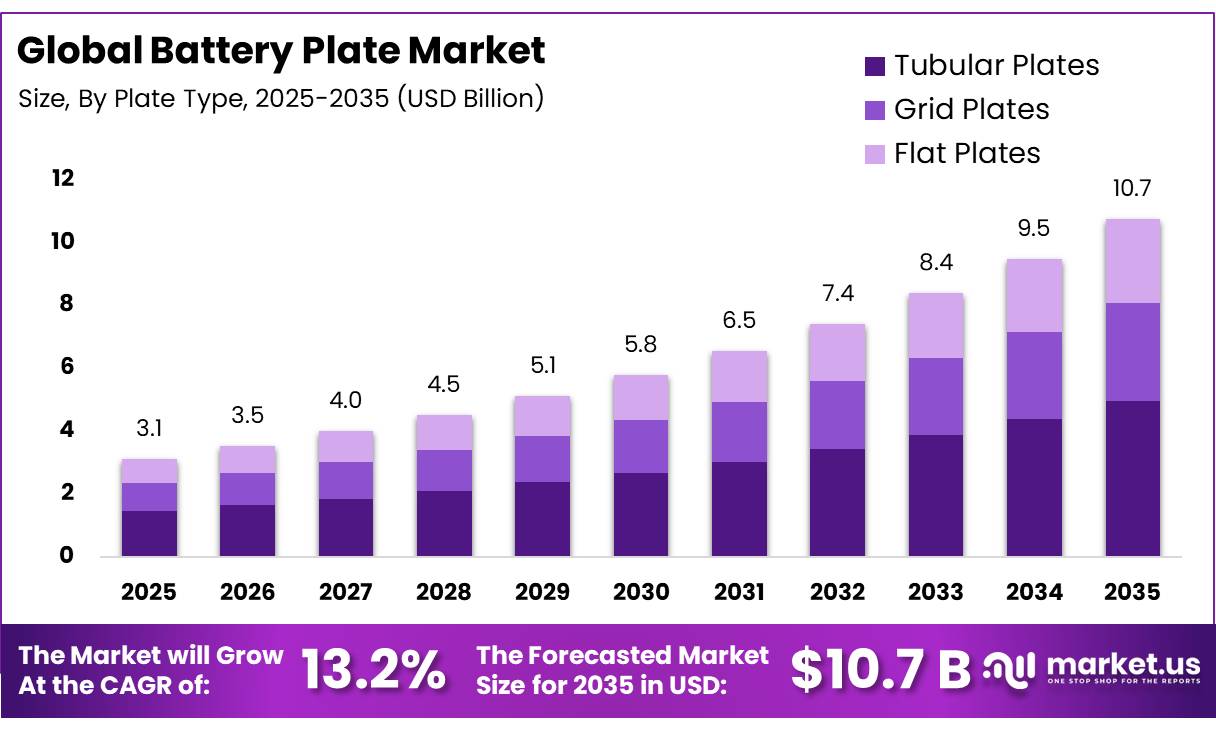
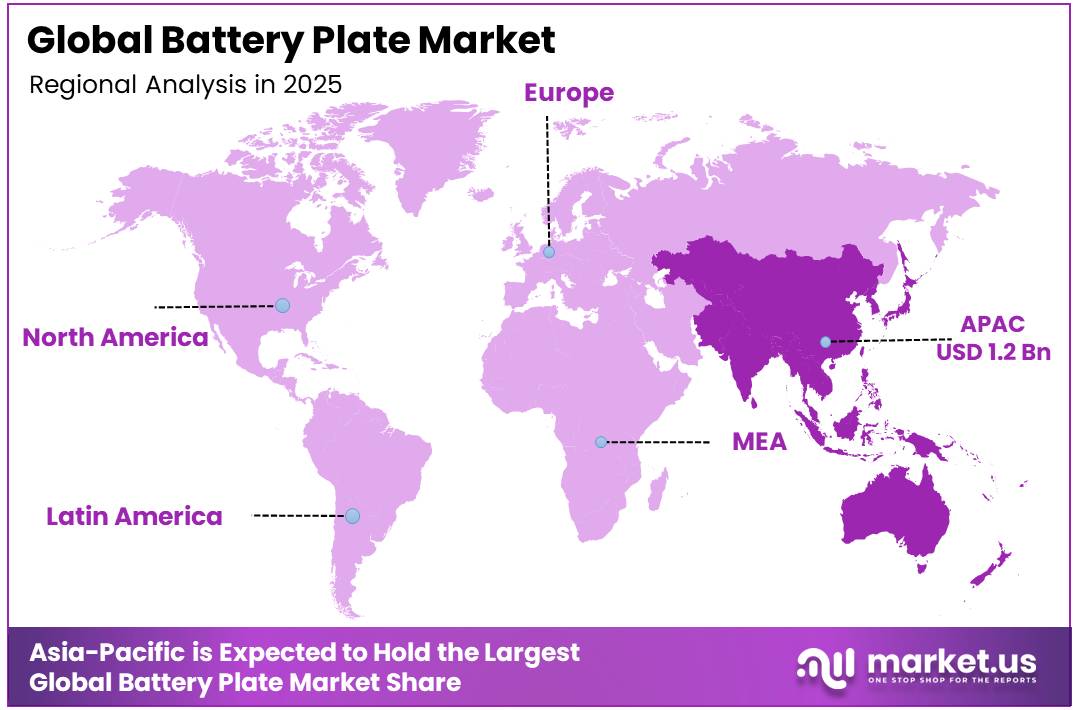
In 2025, the Global Battery Plate Market was valued at USD 3.1 billion, and between 2026 and 2035, this market is estimated to register a CAGR of 13.2%, reaching about USD 10.7 billion by 2035. In 2025, Asia-Pacific led the market, achieving over 38.8% share with a revenue of USD 1.2 billion.
Battery plates form the electrochemical core of lead-acid batteries used in automotive starting, lighting and ignition systems, industrial motive power, backup power and stationary storage. A plate consists of a conductive lead-alloy grid carrying active material. Lead dioxide is used on the positive plate, while metallic sponge lead is used on the negative plate. Plate design influences current flow, charge acceptance, corrosion resistance, cycle life and battery reliability.
- The International Organization of Motor Vehicle Manufacturers reported that global vehicle production reached 96.4 million units in 2025, while sales reached 99.8 million units, rising 3.9% and 4.7%, respectively. This scale supports original-equipment plate demand, while the installed vehicle population creates aftermarket requirements across passenger and commercial fleets.
Key Takeaways
- The Global Battery Plate Market was valued at USD 3.1 billion in 2025.
- The market is projected to grow at a CAGR of 13.2% and is estimated to reach USD 10.7 billion by 2035.
- On the basis of plate type, Tubular Plates dominated the market, constituting 46.2% of the total market share.
- Based on the battery type, Lead-Acid Battery dominated the market, with a substantial market share of around 62.3%.
- Based on the application, Automotive led the market, comprising 34.7% of the total market.
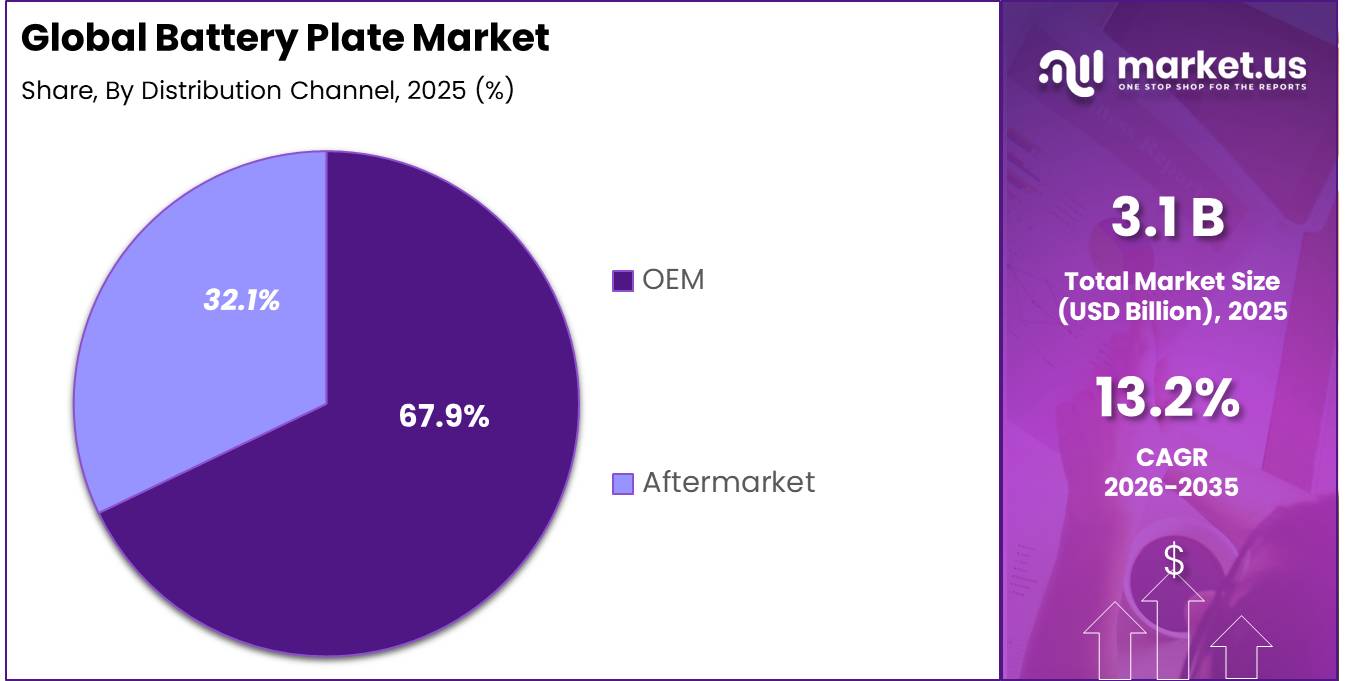
- On the basis of distribution channel, OEM dominated the market, constituting 67.9% of the total market share.
- In 2025, Asia-Pacific was the most dominant region in the market, accounting for 38.8% of the total global consumption.
Europe had 256 million passenger cars, 31.1 million vans, 6.2 million trucks and 700,000 buses on its roads in 2024, according to ACEA’s 2026 fleet report. The size and age of this fleet support stable plate consumption because batteries require periodic replacement even when sales fluctuate. Logistics facilities sustain demand for deep-cycle forklift and standby plates.
- The International Energy Agency estimated global data-centre electricity consumption at 485 TWh in 2025 and expects it to approach 950 TWh by 2030. Expanding server capacity increases the need for backup-power architecture. Lead-acid systems remain relevant where operators value surge capability, established maintenance and recyclability, although lithium-ion and alternative chemistries are increasing competitive pressure.
IEA data show that electric-vehicle battery deployment reached 1.2 TWh in 2025, almost 30% above 2024, with light-duty vehicles representing more than 85% of deployment. Although this growth is mainly lithium-based, it creates opportunities for advanced auxiliary batteries and pushes plate manufacturers toward enhanced flooded batteries, absorbent glass mat designs, thinner grids, improved paste formulations and higher charge acceptance.
- In the United States, the Department of Energy’s Battery Manufacturing and Recycling Grants program provides USD 3 billion for component manufacturing, advanced batteries and recycling capacity. European Union rules require at least 75% recycling efficiency by average weight for lead-acid batteries by the end of 2025, increasing to 80% by 2030. The regulation also targets 90% lead recovery by 2027 and 95% by 2031. These requirements favour producers with closed-loop sourcing, efficient recycling partnerships, traceable materials and lower-emission plate production.
Future growth will depend on automated grid casting, precision pasting, quality inspection and corrosion-resistant alloys. Opportunities are strongest in replacement automotive batteries, data-centre backup, telecommunications, renewable-power support and industrial motive applications. Manufacturers that reduce plate weight while improving cycle life, recyclability and high-temperature performance should strengthen their position as customers demand dependable, cost-controlled and environmentally compliant energy-storage components.
Plate Type Analysis
Tubular Plates dominate the Battery Plate Market with a 46.2% share, supported by durable deep-cycle operation
In 2025, Tubular Plates held a dominant market position, capturing more than a 46.2% share. Their strong position was supported by reliable operation in solar storage, industrial backup, telecommunications, and other applications involving frequent charging and deep discharge.
- Government data updated in December 2025 shows that a solar home-lighting system can use a 12-volt, 40-ampere-hour tubular plate battery. The same government source states that tubular plate batteries have an expected operating life of around 5 years and can support solar lighting systems designed for approximately 4 to 5 hours of daily operation. These performance characteristics strengthen their use in applications where durability, low maintenance, and stable power delivery are important.
Grid Plates are the fastest-growing segment of the Battery Plate Market. In 2026, their adoption is expected to strengthen because they offer a practical structure for holding active material while supporting efficient current flow within lead-acid batteries. Their comparatively straightforward production process makes them suitable for high-volume manufacturing and replacement battery applications. Demand is particularly supported by starting, lighting, and ignition batteries, alongside standby and motive-power systems used in transportation, telecommunications, industrial equipment, and emergency power installations.
Battery Type Analysis
Lead-Acid Battery dominates with a 62.3% share, supported by established applications and strong recycling
In 2025, Lead-Acid Battery held a dominant market position, capturing more than a 62.3% share. The lead-acid battery segment remained ahead because its plates are widely used in vehicle starting batteries, industrial forklifts, telecommunications systems, hospitals, and standby power equipment.
- In 2025, the U.S. Environmental Protection Agency reported that 99% of lead-acid batteries are recycled annually and that new U.S.-made lead-acid batteries contain more than 80% recycled material. This established collection system provides manufacturers with a steady supply of recovered lead and plastic, supports replacement demand, and keeps large-scale plate production commercially practical.
Lithium-Ion Battery is the fastest-growing segment in the Battery Plate Market. In 2025, the segment gained momentum from rising use in electric vehicles, portable electronics, and stationary energy storage systems. These applications require lightweight battery structures, rechargeable operation, stronger energy performance, and longer operating life. Its expansion is increasing demand for coated electrodes, current collectors, separators, and tightly controlled cell-manufacturing processes.
Application Analysis
Automotive leads the Battery Plate Market with a 34.7% share, supported by steady vehicle production and replacement demand
In 2025, Automotive held a dominant market position, capturing more than a 34.7% share. Automotive remained the leading application because battery plates are required in batteries used for vehicle starting, lighting, ignition, auxiliary power, and electric propulsion systems.
- U.S. Bureau of Economic Analysis data showed that total vehicle sales reached 8.329 million units during the first half of 2025 and 8.346 million units during the second half of 2025. This large volume supported demand from vehicle manufacturers as well as the replacement battery industry. The wider use of start-stop systems, onboard electronics, hybrid powertrains, and electric vehicles also encouraged manufacturers to develop battery plates with stronger cycling performance and longer operating life.
Renewable Energy Storage is the fastest growing segment in the Battery Plate Market. Growth is being supported by the expansion of solar and wind installations, where batteries help store surplus electricity and supply it when generation falls. Battery plates designed for deeper discharge cycles, corrosion resistance, and longer service life are becoming more important in residential, commercial, and utility storage systems. Grid operators are also increasing their focus on storage for frequency control, peak-load management, and emergency backup.
Distribution Channel Analysis
OEM dominates with a 67.9% share as new vehicles require factory-fitted battery systems
In 2025, OEM held a dominant market position, capturing more than a 67.9% share of the Battery Plate Market by distribution channel. Battery manufacturers supply plates directly to vehicle and equipment producers because OEM assembly requires consistent dimensions, reliable performance, large-volume availability, and strict quality checks.
- According to the UK Department for Transport, 2,617,000 vehicles were registered for the first time in 2025. This large flow of new vehicles supports demand for battery plates installed through original manufacturing and assembly contracts. OEM supply also reduces compatibility problems and allows battery designs to be matched with the electrical requirements of each vehicle model.
Aftermarket is the fastest-growing segment in the Battery Plate Market by distribution channel. In 2025, demand was supported by the replacement of damaged, corroded, or low-performing plates in automotive batteries, industrial backup systems, material-handling equipment, and stationary power applications. Independent battery dealers and repair centres make replacement components easier to access, particularly for older equipment that is no longer covered by manufacturer service programmes.
Key Market Segments
By Plate Type
- Tubular Plates
- Grid Plates
- Flat Plates
By Battery Type
- Lead-Acid Battery
- Lithium Ion Battery
- Nickel–Cadmium Battery
- Others
By Application
- Automotive
- Renewable Energy Storage
- Industrial
- Backup Power Systems
By Distribution Channel
- OEM
- Aftermarket
Driver Analysis
EU Battery Regulation 2023/1542 Recycled-Content Mandates
Regulation (EU) 2023/1542, in force since 17 August 2023, imposes binding minimum recycled-content thresholds directly on plate-grid alloy sourcing: Phase 1 from August 2031 requires 85% recycled lead content, with material-recovery efficiency targets of 90% for lead by end-2027 rising to 95% by end-2031. Separately, recycling-efficiency floors of 75% for lead-acid batteries by end-2025 and 80% by end-2030 are now statutory under the regulation’s Annex provisions.
From a unit-economics standpoint, this forces plate manufacturers to re-architect grid-casting lines around secondary lead feedstock years ahead of the 2031 hard deadline, since qualifying a smelter-to-grid supply chain for battery passport traceability requires multi-year certification lead times. The strategic shift is from spot-market primary lead procurement toward long-term secondary-lead offtake contracts and closed-loop recycler partnerships, which changes plate producers’ capital allocation from casting-line capacity expansion to backward-integrated recycling infrastructure.
Driver Impact Analysis
| Driver | (~) % Impact on CAGR Forecast | Geographic Relevance | Impact Timeline |
|---|---|---|---|
| Replacement-cycle automotive SLI demand sustaining lead-plate volumes | +1.6% | North America core, EU, APAC corridors (India, China) | Short term (≤2 years) |
| EU Battery Regulation 2023/1542 recycled-lead content mandates reshaping plate alloy sourcing | +1.2% | EU core, spill-over to UK/EFTA suppliers | Medium term (2-4 years) |
| Data-centre and telecom backup power (UPS/VRLA) capacity expansion | +2.1% | North America core, APAC (China, India, Southeast Asia) | Short to medium term |
| India PLI-ACC and FAME/PM E-DRIVE-driven domestic battery manufacturing buildout | +1.4% | APAC corridors (India), South Asia spill-over | Medium term (2-4 years) |
| US RCRA/EPA hazardous-waste and universal-waste compliance costs reshaping plate recycling economics | +0.7% | North America core | Short term (≤2 years) |
| Domestic lead mine output constraints tightening primary-plate feedstock economics | -0.5% (drag), offset structurally | North America core (US Missouri/Alaska/Idaho), global spill-over | Long term (≥4 years) |
Restraint Analysis
India Battery Waste Management Rules EPR Tightening
India’s Battery Waste Management Rules, first notified in August 2022 and significantly amended in 2025 under the Ministry of Environment, Forest and Climate Change, impose escalating recovery targets monitored by the Central Pollution Control Board 70% material recovery in FY 2024-25, rising to 80% in FY 2025-26, and 90% from FY 2026-27 onward alongside mandatory minimum recycled-content requirements for new batteries from FY 2027-28 and barcode/QR-code lifecycle traceability on every battery pack.
The quantitative bottleneck is compliance-driven: producers unable to meet collection and recycling targets through direct reverse logistics must purchase EPR certificates from CPCB-authorized recyclers, and non-compliance triggers legally mandated Environmental Compensation charges calculated on the shortfall, with repeated defaults risking business restriction and public disclosure. For plate manufacturers integrated into Indian lead-acid supply chains, this raises per-unit compliance cost through certificate purchases and digital-traceability system investment ahead of the FY 2027-28 recycled-content mandate, delaying export-oriented capacity expansion into APAC corridors and supporting a 1.3-percentage-point CAGR deduction over the 2- to 4-year window as recyclers scale to meet the 90% recovery threshold.
Restraint Impact Analysis
| Restraint | (~) % Impact on CAGR Forecast | Geographic Relevance | Impact Timeline |
|---|---|---|---|
| Antimony & lead feedstock supply concentration (China export curbs) | -2.2% | North America core, EU, APAC ex-China | Short term (≤2 years) |
| Section 301 tariff escalation on lead-acid battery parts | -1.6% | United States (import-dependent grid/plate assembly) | Short to Medium term |
| OSHA lead exposure compliance burden (29 CFR 1910.1025) | -1.1% | United States manufacturing corridors | Medium term (2-4 years) |
| EU Batteries Regulation recycling/recovery mandates | -1.8% | EU-27 core markets | Medium to Long term |
| India Battery Waste Management Rules (BWMR) EPR tightening | -1.3% | India domestic and APAC export corridors | Medium term (2-4 years) |
| Secondary lead/antimony recycling feedstock bottleneck | -0.9% | Global, acute in North America and EU | Long term (≥4 years) |
Opportunity Analysis
Recycled-Content Compliance-as-a-Service (EU Mandate Arbitrage)
The EU Battery Regulation mandates that industrial and SLI batteries source a minimum 85% recycled lead content by August 2031, rising in parallel with a 90% material-recovery target for lead by end-2027 and 95% by end-2031; this is not a baseline driver because compliance thresholds do not bind until 2027–2031, meaning no current-year revenue is captured from this requirement it is a forward liability that plate producers can convert into a fee-based verification and supply-assurance service today.
A first-mover plate fabricator that builds closed-loop smelter partnerships now could offer “pre-certified recycled-content plates” to OEMs facing the 2028 documentation requirement and 2027 QR-code/digital labeling deadline, capturing an estimated 300–450 basis points of gross margin premium over standard plates due to scarcity pricing on verified secondary lead feedstock, on top of a projected uncaptured TAM of roughly USD 180–240 million by 2031 across EU industrial and SLI segments assuming a 12–15% price premium on a EUR 1.5–1.8 billion regional plate base; the execution window is medium-term because supply-chain certification infrastructure typically takes 24–40 months to scale to bankable volumes.
Opportunity Impact Analysis
| Opportunity | (~) % Potential CAGR Upside | Geographic Relevance | Execution Window |
|---|---|---|---|
| Recycled-Content Compliance-as-a-Service (EU mandate arbitrage) | +2.8% | EU core (Germany, France, Italy, Poland) | Medium term (2–4 years) |
| Bipolar / Thin-Plate Grid Licensing for Stationary Storage | +2.2% | North America, APAC emerging (India, Southeast Asia) | Medium term (2–4 years) |
| Critical-Minerals Grant-Backed Domestic Plate Fabrication (US) | +1.9% | US Midwest/Southeast “battery belt” | Short term (≤2 years) |
| India ACC/PLI-Linked Grid & Plate Component Localization | +2.5% | India (national), APAC ancillary supply chains | Short term to medium term (≤3 years) |
| M&A Roll-Up of Fragmented Regional Plate Fabricators | +1.6% | APAC emerging, Latin America, Middle East | Long term (≥4 years) |
| Digital Battery Passport Data-Monetization Layer | +1.2% | EU core, expanding to UK/EFTA | Medium term (2–4 years) |
Challenges Analysis
Skilled Labor and Technician Deficit
The structural vulnerability originates in an aging workforce combined with insufficient technical-vocational pipeline capacity for grid-casting, paste-mixing, and curing-oven operations, compounded by battery manufacturing’s classification within the broader “other electrical equipment and component manufacturing” category that BLS projects as the fastest-growing manufacturing subsector through 2034, intensifying competition for the same limited technician pool.
National manufacturing employment stood at approximately 12,605,000 workers in May 2026 with job openings of 477,000 recorded in April 2026 alone, indicating persistent unfilled demand across the sector that plate and battery-component lines compete within, while independent supply-chain workforce modeling projects lithium-battery-adjacent employment needs reaching roughly 310,000 workers nationally by 2030 against a considerably smaller current base, implying an annualized talent absorption rate that plate-specific facilities are ill-equipped to match given 12-18 month technician certification cycles.
This deficit imposes an estimated 1.1 percentage point drag on achievable CAGR through elevated overtime costs, production-line downtime averaging 3-5% of scheduled capacity during staffing shortfalls, and quality-control lapses tied to inexperienced grid-casting crews; the long-term mitigation path, spanning 4 or more years, requires employer-sponsored apprenticeship pipelines, automation of paste-application and curing stages to reduce headcount dependency by an estimated 15-25%, and regional workforce-development partnerships anchored in manufacturing corridors.
Challenges Impact Analysis
| Challenge | (~) % CAGR Friction Drag | Geographic Relevance | Mitigation Horizon |
|---|---|---|---|
| Lead price and supply volatility | -0.9% | North America core, APAC smelting hubs | Medium term (2-4 years) |
| Skilled labor and technician deficit | -1.1% | North America core, EU manufacturing belts | Long term (≥ 4 years) |
| Cross-border SLAB recycling logistics friction | -0.7% | North America (US-Mexico corridor), APAC logistics corridors | Medium term (2-4 years) |
| Grid alloy manufacturing yield variability | -0.6% | Global plate-casting facilities, APAC production clusters | Short term (≤ 2 years) |
| Import dependency on critical minerals | -1.3% | North America core, EU regulatory hubs | Long term (≥ 4 years) |
| Environmental compliance and hazardous-material handling burden | -0.8% | EU regulatory hubs, North America core | Medium term (2-4 years) |
Geopolitical Impact Analysis
War-Driven Supply and Cost Pressures Reshape the Battery Plate Market
Ongoing conflicts in the Middle East and the Russia-Ukraine war are increasing uncertainty across the battery plate supply chain. Lead-alloy plates require mined and recycled lead, antimony, electricity, fuel, and reliable transport.
- The World Bank reported in April 2026 that disruptions around the Strait of Hormuz, which carries about 35% of global seaborne crude oil trade, removed roughly 10 million barrels per day from supply. It forecast Brent crude at USD 86 per barrel in 2026, compared with USD 69 in 2025. Higher fuel and power costs raise expenses for lead smelting, grid casting, curing, and international freight.
Raw-material security is another concern. A 2026 U.S. Geological Survey assessment showed that China represented 35% of global antimony exports by value, while U.S. net import reliance reached 84%. Antimony is used in lead alloys to improve plate strength and cycling performance. Export controls, sanctions, and disrupted routes can therefore lengthen delivery times and increase alloy premiums. At the same time, wars support demand for backup batteries used in telecom networks, emergency power, military vehicles, hospitals, and data centers.
Regional Analysis
Asia-Pacific Leads the Battery Plate Market with a 38.8% Share and USD 1.2 Billion, While Europe Grows Fastest
In 2025, Asia-Pacific held the dominant market position, capturing 38.8% of global revenue and generating about USD 1.2 billion. The region benefits from its large automotive base, concentrated battery supply chain, lower production costs, and strong demand from electric vehicles, two-wheelers, telecom systems, and industrial equipment. China alone represented 60% of global EV battery deployment in 2025, while nearly 75% of the world’s electric cars were produced in the country. Battery prices in China were also 30% below North American levels and 35% below European levels, strengthening regional competitiveness.
Europe is expected to be the fastest-growing regional market as battery production and electrified transport expand. EV battery deployment represented almost 15% of the global total in 2025, supported by stronger vehicle demand and regional industrial policies. During the first half of 2026, the European Union registered 1,220,890 battery-electric cars, giving them a 20.7% share of new-car registrations, compared with 15.6% one year earlier. The European Commission also announced EUR 1.8 billion to strengthen secure battery raw-material supply chains.
Key Regions and Countries Covered
- North America
- The US
- Canada
- Europe
- Germany
- France
- The UK
- Spain
- Italy
- Russia & CIS
- Rest of Europe
- APAC
- China
- Japan
- South Korea
- India
- ASEAN
- Rest of APAC
- Latin America
- Brazil
- Mexico
- Rest of Latin America
- Middle East & Africa
- GCC
- South Africa
- Rest of MEA
Key Players Analysis
Microvast Holding Inc. strengthens its position through vertically integrated battery technologies covering cells, cathodes, electrolytes, separators, modules, and packs. In 2025, the company generated USD 427.5 million in revenue, reflecting 12.6% annual growth. Its manufacturing platform included about 3.5 GWh of annual cell, module, and pack capacity, alongside 5 million square metres of separator pilot-line capacity.
Crown Battery maintains a strong position in lead-acid battery plates through integrated manufacturing, established distribution, and circular material use. The company operates 14 sales and distribution offices across North America and employs about 615 people. Its batteries are described as 99% recyclable, while production uses approximately 80% previously recycled materials.
CSB Energy Technology Co. Ltd. competes through broad valve-regulated lead-acid battery production and specialised plate engineering. Founded in 1987, the company operates 6 business locations and 3 production sites, supported by nearly 2,300 employees worldwide. Its battery ranges use 99.99% pure lead for oxide, grids, and other lead components. Selected products provide capacities from 7.2 Ah to 110 Ah and standby design life of up to 12 years, supporting telecommunications, UPS, mobility, and industrial backup requirements across diverse international markets.
FIAMM Energy Storage Solutions SpA remains influential in automotive and industrial lead-battery applications, supported by a long operating history and international distribution network. Established in 1942, the business employs more than 1,000 people and maintains commercial or technical locations across Europe, Asia, the Middle East, and the United States. In 2017, Hitachi Chemical completed the acquisition of a 51% stake, the parent business later became Resonac in 2023, and Aurelius Group completed its acquisition of the company from Resonac in December 2025.
The Major Players in The Industry
- Enersys
- Exide Technologies
- Toshiba Corporation
- S. Yuasa
- Amara Raja Batteries Limited
- Kijo Battery Group
- Microvast Holding Inc.
- Crown Battery
- CSB Energy Technology Co. Ltd.
- Fiamm Energy Storage Solutions SpA
- Other Key Players
Key Development
- In August 2025, Exide Technologies signed an agreement to supply an Italian foundry with a 1.7 MW/3.44 MWh battery-storage system, extending its industrial presence across Southern Europe.
- In January 2025, EnerSys finalized a USD 199 million funding agreement with the U.S. Department of Energy for a planned 500,000-square-foot lithium-ion facility in Greenville, South Carolina, with commercial production targeted for 2028.
Report Scope
| Report Features | Description |
|---|---|
| Market Value (2025) | USD 3.1 Bn |
| Forecast Revenue (2035) | USD 10.7 Bn |
| CAGR (2026-2035) | 13.2% |
| Base Year for Estimation | 2025 |
| Historic Period | 2020-2024 |
| Forecast Period | 2026-2035 |
| Report Coverage | Revenue Forecast, Market Dynamics, Competitive Landscape, Recent Developments |
| Segments Covered | By Plate Type (Tubular Plates, Grid Plates, Flat Plates), By Battery Type (Lead-Acid Battery, Lithium Ion Battery, Nickel–Cadmium Battery, Others), By Application (Automotive, Renewable Energy Storage, Industrial, Backup Power Systems), By Distribution Channel (OEM, Aftermarket) |
| Regional Analysis | North America – The US & Canada; Europe – Germany, France, The UK, Spain, Italy, Russia & CIS, Rest of Europe; APAC– China, Japan, South Korea, India, ASEAN & Rest of APAC; Latin America– Brazil, Mexico & Rest of Latin America; Middle East & Africa– GCC, South Africa, & Rest of MEA |
| Competitive Landscape | Enersys, Exide Technologies, Toshiba Corporation, G.S. Yuasa, Amara Raja Batteries Limited, Kijo Battery Group, Microvast Holding Inc., Crown Battery, CSB Energy Technology Co. Ltd., Fiamm Energy Storage Solutions SpA, Other Key Players |
| Customization Scope | Customization for segments, region/country-level will be provided. Moreover, additional customization can be done based on the requirements. |
| Purchase Options | We have three licenses to opt for: Single User License, Multi-User License (Up to 5 Users), Corporate Use License (Unlimited Users and Printable PDF) |





































