


Report Overview
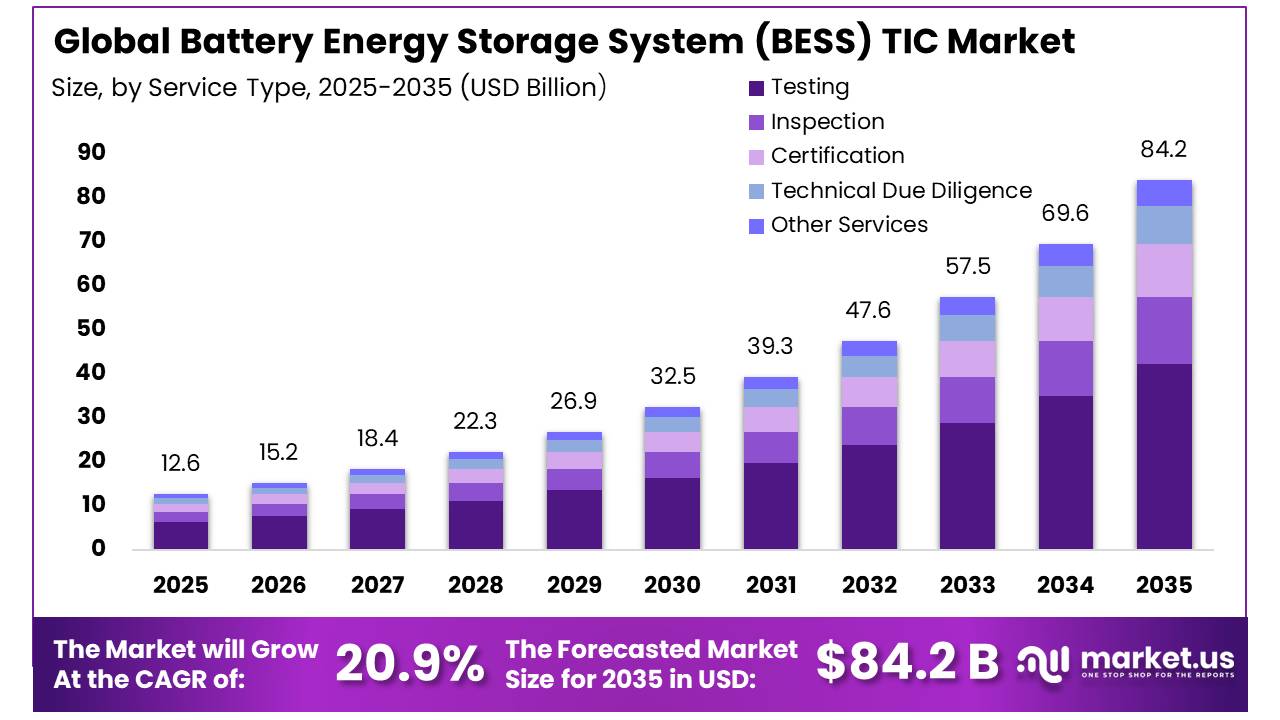
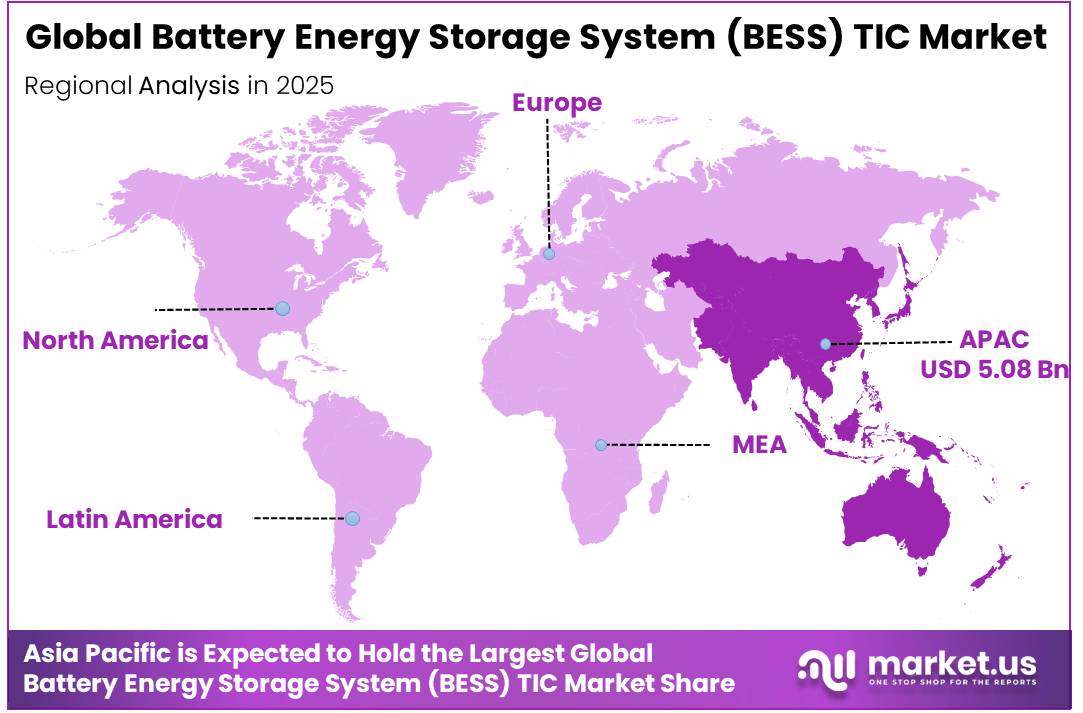
In 2025, the Global Battery Energy Storage System (BESS) TIC Market was valued at USD 12.6 billion, and between 2026 and 2035, this market is estimated to register a CAGR of 20.9%, reaching about USD 84.2 billion by 2035. In 2025, Asia Pacific led the market, achieving over 40.3% share with a revenue of USD 5.08 Billion.
The Battery Energy Storage System testing, inspection and certification industry supports the safe, reliable and regulation-compliant deployment of battery storage across utility networks, commercial facilities, renewable power plants and residential applications. TIC providers evaluate battery cells, modules, racks, inverters, control software, fire-protection systems and complete storage installations.
Their services commonly cover electrical safety, thermal propagation, electromagnetic compatibility, cybersecurity, transportation, grid interconnection, commissioning and operational performance. As battery installations become larger and more technically complex, independent verification is increasingly important for manufacturers, project developers, utilities, insurers and regulatory authorities.
- According to the pv magazine Global, approximately 63 GW of utility-scale battery storage capacity was installed globally in 2024, lifting total utility-scale capacity to about 124 GW. According to International Energy Agency, Battery storage project costs also declined by nearly 40% during 2024 to approximately USD 150 per kWh.
Key Takeaways
- The Global Battery Energy Storage System (BESS) TIC Market was valued at USD 12.6 billion in 2025.
- The market is projected to grow at a CAGR of 20.9% and is estimated to reach USD 84.2 billion by 2035.
- On the basis of service type, Testing dominated the market, constituting 50.3% of the total market share.
- Based on the sourcing type, Outsourced dominated the market, with a substantial market share of around 65.1%.
- Based on the battery type, Lithium-Ion Batteries led the market, comprising 82.3% of the total market.
- On the basis of delivery mode, On-Site Services dominated the market, constituting 61.4% of the total market share.
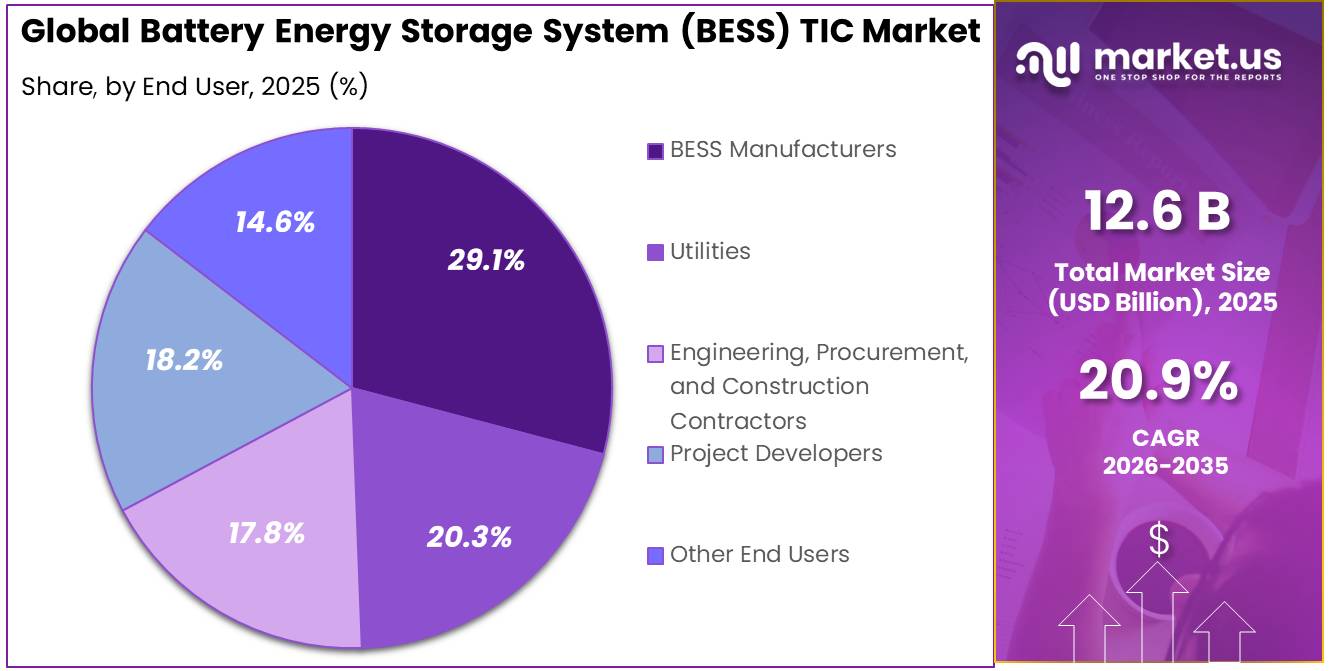
- Based on the end user, BESS Manufacturers dominated the market, with a substantial market share of around 29.1%.
- In 2025, Asia Pacific was the most dominant region in the market, accounting for 40.3% of the total global consumption.
These developments are encouraging larger projects, but they are also increasing the need for detailed testing of system durability, thermal management, power conversion equipment and emergency-response controls. The IEA further reported that lithium-ion battery pack prices fell by around 20% in 2024 and another 8% in 2025, supporting continued project development.
- IRENA reported that global renewable power capacity reached 4,448 GW in 2024, following a 15.1% annual increase. As solar and wind output varies by weather and time of day, storage systems are increasingly required for energy shifting, frequency control, reserve capacity and congestion management. The IEA estimates that global energy-storage capacity with batteries supplying about 90% of the required increase and reaching approximately 1,200 GW.
Safety regulation is strengthening the role of TIC companies. The 2026 edition of NFPA 855 covers commissioning, operation, maintenance, decommissioning, electrochemical storage, fire hazards and emergency-response considerations for stationary energy-storage installations.
- In Europe, Regulation EU 2023/1542 applies lifecycle requirements to industrial batteries, while carbon-footprint rules cover rechargeable industrial batteries with capacities above 2 kWh. The EU has also allocated EUR 925 million to the BATT4EU research partnership for 2021–2027.
Future opportunities will emerge from long-duration storage, second-life batteries, recycling verification, digital battery passports, cybersecurity assessments and continuous operational monitoring. The U.S. Department of Energy aims to reduce the cost of grid-scale storage systems providing more than 10 hours of operation by 90% within a decade. Its Rapid Operational Validation Initiative is also developing standardized performance data and accelerated validation tools. These initiatives are expected to expand demand for lifecycle testing, field inspection, performance certification and environmental verification throughout the BESS value chain.
Service Type Analysis
Testing Dominates the BESS TIC Market with a 50.3% Share Due to Strong Safety and Performance Validation Needs
In 2025, Testing held a dominant market position, capturing more than a 50.3% share of the Battery Energy Storage System TIC market. Testing remains essential because battery cells, modules, inverters and complete storage systems must be assessed for electrical performance, thermal stability, fire resistance and grid response before deployment.
- Government guidance from the UK Department for Energy Security and Net Zero defines grid-scale battery systems as installations of 1 MW or above and recommends testing during commissioning, operation and maintenance. The guidance also highlights periodic third-party verification to confirm system safety and operating reliability.
Inspection is the fastest-growing service type in the Battery Energy Storage System TIC market. Growth is supported by the rising number of operational battery installations that require regular checks of wiring, ventilation, fire-protection systems, battery enclosures and control equipment. In 2026, the UK Department for Energy Security and Net Zero updated its official domestic battery installation statistics to include data through March 2026, showing that battery deployment is being monitored through certified installation records.
Sourcing Type Analysis
Outsourced sourcing dominates the BESS TIC market with a 65.1% share, supported by rising project volumes and independent compliance needs.
In 2025, Outsourced held a dominant market position, capturing more than a 65.1% share of the Battery Energy Storage System (BESS) TIC market. Battery manufacturers, utilities and project developers frequently outsourced testing, inspection and certification activities to access specialised laboratories, qualified engineers and independent compliance expertise. External TIC providers help assess electrical safety, fire risks, battery performance, grid connectivity and system reliability without requiring companies to build costly internal testing facilities.
- According to the U.S. Energy Information Administration, in an update published on February 20, 2026, developers added a record 15 GW of utility-scale battery storage capacity to the U.S. grid during 2025. The agency also reported that more than 40 GW had been added over the previous five years. This rapid deployment expanded the number of battery projects requiring commissioning, safety validation and periodic inspection, strengthening demand for outsourced BESS TIC services.
In-House is the fastest-growing segment in the Battery Energy Storage System (BESS) TIC market. Large utilities, battery manufacturers and integrated energy companies are expanding internal testing teams to gain greater control over product development, fault investigation and quality assurance. In-house capabilities can reduce testing delays, protect technical information and support repeated checks throughout battery design and operation. In February 2026, the U.S. Energy Information Administration reported that developers planned to add 24 GW of utility-scale battery storage during 2026, compared with a record 15 GW added in 2025. This continuing expansion is encouraging large organisations with sufficient financial and technical resources to establish dedicated laboratories and internal inspection procedures.
Battery Type Analysis
Lithium-Ion Batteries dominate with an 82.3% share as grid-scale installations continue to expand
In 2025, Lithium-Ion Batteries held a dominant market position, capturing more than an 82.3% share of the Battery Energy Storage System TIC market. According to the UK Department for Energy Security and Net Zero’s July 2026 Clean Flexibility Roadmap, lithium-ion technology accounted for almost all grid-scale battery storage operating in the country. UK grid-scale battery power capacity reached 7.5 GW by the end of 2025, after a record 2.3 GW was energized during the year.
- The U.S. Energy Information Administration reported that developers added a record 15 GW of battery storage capacity in 2025 and planned another 24 GW for 2026. More than 40 GW was added to the U.S. grid over the five years ending in 2025. The rapid expansion of lithium-ion installations increases the need for thermal-runaway assessment, electrical performance testing, fire-safety inspection and grid-compliance certification, supporting the segment’s dominant position in the BESS testing, inspection and certification market.
Lead-Acid Batteries are the fastest-growing segment in the Battery Energy Storage System TIC market. Their established manufacturing base, recyclable design, operational simplicity, and comparatively low initial cost support their use in backup power, telecommunications, industrial facilities, substations, and smaller stationary storage installations. Although lithium-ion batteries remain the leading technology in large grid projects, lead-acid systems continue to provide a practical choice where weight and installation space are less important than cost, familiarity, and dependable short-duration backup performance.
Delivery Mode Analysis
On-Site Services dominate the BESS TIC market due to direct field inspection and safety verification.
In 2025, On-Site Services held a dominant market position, capturing more than a 61.4% share of the Battery Energy Storage System TIC market. These services are widely preferred because BESS installations require direct inspection, testing, and verification at the project location. Technical teams assess electrical connections, battery placement, thermal management, fire protection, control systems, and operating conditions before commercial use.
Off-Site Services is the fastest-growing segment in the Battery Energy Storage System TIC market. Growth is supported by increasing demand for controlled laboratory testing before battery systems are installed at project sites. Manufacturers use off-site facilities to examine battery cells, modules, software, power electronics, and thermal-management components under consistent testing conditions. validation with final field inspection, supporting steady demand for off-site TIC services.
By End User Analysis
BESS Manufacturers lead the market with a 29.1% share as stricter testing needs grow.
In 2025, BESS Manufacturers held a dominant market position, capturing more than a 29.1% share. Their leading position was supported by the growing need to verify battery safety, operating performance, durability and grid compatibility before systems were supplied to project developers. Manufacturers increasingly relied on testing, inspection and certification services to meet technical standards and reduce the risk of thermal incidents, equipment failure and project delays.
- The U.S. Energy Information Administration reported in February 2026 that developers added 15 GW of utility-scale battery storage during 2025.
Utilities are the fastest-growing segment in the Battery Energy Storage System TIC market. Power providers are adding larger storage facilities to manage renewable electricity, reduce peak pressure and maintain grid frequency. Every new utility project requires independent inspection, commissioning tests, performance verification and periodic safety assessment. In February 2026, the U.S. Energy Information Administration stated that developers planned to install 24 GW of utility-scale battery storage during 2026, compared with the capacity added in the previous year.
Key Market Segments
By Service Type
- Testing
- Inspection
- Certification
- Technical Due Diligence
- Other Services
By Sourcing Type
- In-House
- Outsourced
By Battery Type
- Lithium-Ion Batteries
- Lead-Acid Batteries
- Flow Batteries
- Sodium-Ion Batteries
- Other Battery Types
By Delivery Mode
- On-Site Services
- Off-Site Services
By End User
- BESS Manufacturers
- Utilities
- Engineering, Procurement, and Construction Contractors
- Project Developers
- Other End Users
Driver Analysis
Fire-safety validation tightening across UL 9540A, NFPA 855, IEC 62933 workflows
Fire-risk scrutiny is the clearest near-term revenue accelerator for BESS TIC because regulatory acceptance is moving from document-based conformity toward demonstrated thermal-runaway behavior at system level. UL states that UL 9540A is the U.S. and Canadian national test method for assessing fire propagation related to thermal runaway, while NFPA-linked market guidance increasingly ties installation approval to NFPA 855-aligned evidence, forcing vendors to produce test packages that go beyond cell certificates and include enclosure, spacing, propagation, and emergency-response assumptions.
In practice, that expands the TIC bill from a one-time product test toward a staged program covering factory acceptance, witness testing, installation inspection, commissioning review, and periodic compliance updates as designs change.
Drivers Impact Analysis
| Driver | (~) % Impact on CAGR | Geographic Relevance | Impact Timeline |
|---|---|---|---|
| Fire-safety validation tightening across UL 9540A, NFPA 855, IEC 62933 workflows | +2.4% | North America core, EU, Australia, selective APAC utility markets | Short term |
| Utility-scale BESS buildout increasing project-level TIC volume | +2.1% | China scale base, U.S. core, EU, India, MENA spill-over | Short term |
| EU Battery Regulation and 2027 battery-passport readiness expanding traceability certification | +1.5% | EU core, UK alignment spill-over, export-oriented Asia suppliers | Medium term |
| Interconnection and grid-code scrutiny raising commissioning and performance testing scope | +1.3% | U.S. ISO/RTO markets, EU grids, Australia, India corridors | Medium term |
| Bankability, insurer diligence, and third-party QA shifting procurement toward independent TIC | +1.1% | North America, EU, GCC, LATAM utility procurement | Short term |
| System architecture complexity from higher energy density, hybrid plants, and software controls | +1.7% | U.S., China, EU, South Korea, Japan, Australia | Medium term |
Restraint Analysis
Fragmented standards and regulatory misalignment
Regulatory fragmentation across regions is a persistent restraint because BESS suppliers and TIC firms must navigate overlapping and sometimes inconsistent requirements between North American UL/NFPA regimes, European CE and Battery Regulation frameworks, and varied Asian national standards. In the United States, UL 9540 and UL 9540A combine with NFPA 855, NEC Article 706, and local building codes, while international projects must align with the IEC 62933 series and site-specific fire and electrical rules; Europe then adds newly implemented Regulation (EU) 2023/1542 and upcoming battery passport obligations for industrial batteries above 2 kWh from February 2027, creating additional compliance layers beyond safety alone.
This mosaic increases the number of distinct test plans, documentation bundles, and certification files needed for multi-region product platforms, often requiring duplicate or overlapping assessments: a system certified under UL 9540 may still need separate IEC testing and CE procedures when exported to Europe, adding cost and complexity without proportionate revenue uplift for TIC firms. As a result, some manufacturers restrict market coverage or stagger regional launches to manage compliance burden, and TIC providers face higher overhead per contract to maintain multi-standard competence, jointly depressing market CAGR by an estimated 1.7 percentage points in the medium term as regulatory alignment evolves slowly and remains a friction factor through at least 2028.
Restraint Impact Analysis
| Restraint | (~) % Impact on CAGR | Geographic Relevance | Impact Timeline |
|---|---|---|---|
| High and rising certification and compliance costs | -2.3% | North America core, EU, selective APAC | Short term |
| Limited large-scale fire-test and specialized lab capacity | -2.0% | North America, EU, India, Australia | Short term |
| Fragmented standards and regulatory misalignment | -1.7% | North America vs EU vs Asia | Medium term |
| Developer cash-flow strain from delays and re-testing | -1.5% | Global utility-scale, C&I, IPPs | Short term |
| Shortage of qualified TIC and BESS safety talent | -1.3% | Global, strongest in emerging APAC, LATAM, MENA | Medium term |
| Volatile project pipelines and price pressure on TIC fees | -1.4% | North America, EU, China, India | Medium term |
Opportunity Analysis
End-of-life, reuse and recycling TIC services
This is an opportunity rather than a current driver because most BESS TIC revenue in 2026 is concentrated in pre-deployment and commissioning work, while end-of-life, reuse, and recycling compliance is only beginning to be discussed and is not yet a large, recurring income stream. Guidance from UL and others explicitly flags end-of-life considerations, recyclability, and waste management as future growth areas, noting that BESS deployed over roughly the past decade will reach end of life in coming decades, creating new complexity and risk that will require new testing, certification, and standards.
Given global BESS markets projected into the tens of billions of dollars of installed assets by the early 2030s, a conservative modeling assumption would be that 10–15% of cumulative installed capacity per year enters some form of refurbishment, repowering, or decommissioning cycle after 2030, yielding an untapped technical assurance TAM in verifying residual capacity, fire risk, transportation safety of used units, and responsible materials recovery.
If TIC players build dedicated end-of-life service lines—with standardized protocols for reuse grading, second-life qualification, recycling process verification, and ESG reporting—average revenue per MWh across the lifecycle could increase by 15–25%, translating into roughly +2.2 percentage points of CAGR upside over a 2026–2035 horizon as fleets age and policy frameworks begin requiring more structured end-of-life compliance.
Opportunity Impact Analysis
| Opportunity | (~) % Potential CAGR Upside | Geographic Relevance | Execution Window |
|---|---|---|---|
| End-of-life, reuse and recycling TIC services | +2.2% | EU core, North America, APAC large-scale fleets | Long term |
| Digital compliance platforms and battery passports-as-a-service | +2.0% | EU, UK, export-oriented Asia, global OEMs | Medium term |
| Outcome-based, subscription and bundled TIC monetization | +1.8% | North America, EU, India, GCC utilities | Medium term |
| Expansion into non-battery storage and hybrid assets | +1.6% | Global grid-scale, microgrids, industrial sites | Medium term |
| M&A roll-ups and platform consolidation in BESS TIC | +1.7% | North America, EU, APAC consolidators | Medium term |
| Emerging-market localization and capacity build-out | +1.9% | India, Southeast Asia, Africa, LATAM | Long term |
Challenges Analysis
Multi-layer regulatory complexity
Regulatory complexity is an ongoing challenge rather than a restraint because it does not ban BESS TIC activity, but it forces companies to navigate overlapping UL, IEC, NFPA, CE, and national codes that add time, cost, and uncertainty to project execution and portfolio design. TIC industry commentary identifies regulatory fragmentation as a primary challenge, highlighting how companies must comply with a “web” of local, national, and international standards; for BESS, this includes UL 9540/9540A and NFPA 855 in North America, IEC 62933-series and CE procedures in Europe, and multiple country-specific fire and electrical codes across Asia.
Strategically, mid-tier TIC firms and BESS OEMs must invest continuously in regulatory monitoring, internal expertise, and test-plan harmonization, often dedicating 5–10% of engineering and compliance budgets to tracking evolving codes rather than delivering revenue-generating projects, resulting in an estimated -1.2 percentage point drag on achievable CAGR until regulatory convergence improves in the 2028–2030 window.
Challenges Impact Analysis
| Challenge | (~) % CAGR Friction | Geographic Relevance | Mitigation Horizon |
|---|---|---|---|
| Multi-layer regulatory complexity | -1.2% | North America, EU hubs, Asia export corridors | Medium term |
| Volatile supply chain and logistics | -1.0% | Global, esp. APAC–EU/US trade lanes | Medium term |
| Digitalization and cybersecurity exposure | -0.9% | Global TIC leaders and data-heavy operators | Medium term |
| BESS data quality and root-cause analytics | -0.8% | Global utility-scale and C&I fleets | Long term |
| Structural TIC talent shortages | -1.1% | Global, acute in advanced test domains | Long term |
| Grid-integration complexity and coordination | -0.7% | North America ISO/RTO, EU TSOs, UK, Australia | Medium term |
Geopolitical Impact Analysis
War-Driven Supply Risks Reshape the BESS TIC Market
Ongoing conflicts in the Middle East and the Russia-Ukraine war are increasing the strategic importance of testing, inspection and certification services across the battery energy storage system industry. Disruptions near the Strait of Hormuz and Red Sea shipping routes have raised transport uncertainty for battery cells, power electronics, aluminium and mineral-processing inputs. The Middle East supplies around 8% of global aluminium and one-quarter of global sulphur, making regional disruption relevant to battery enclosures and critical-mineral processing.
At the same time, repeated attacks on Ukraine’s electricity infrastructure are strengthening demand for decentralized storage, backup power and grid-resilience projects. This creates additional requirements for safety validation, performance testing, fire-risk assessment and grid-code certification before systems are deployed in vulnerable locations. However, war-related freight delays, insurance costs and restricted access to testing equipment can extend project schedules and increase compliance expenses.
The market is also facing greater scrutiny of battery origin, mineral traceability and supplier reliability. TIC providers are therefore expanding supply-chain audits, cybersecurity checks and certification for alternative battery chemistries. Overall, geopolitical tension is supporting long-term BESS testing demand, although short-term installations may face higher costs, delayed certification and more complex cross-border approval processes.
Regional Analysis
Asia-Pacific Dominates the Battery Energy Storage System (BESS) TIC Market
In 2025, Asia-Pacific held the dominant position in the Battery Energy Storage System testing, inspection, and certification market, accounting for 40.3% of global revenue, equivalent to USD 5.08 billion. Regional leadership is supported by rapid utility-scale storage construction, strong battery manufacturing, and tighter requirements for fire safety, grid connection, transportation, and product performance.
- China added more than 63 GW of battery storage capacity in 2025, representing around 60% of global additions, while its cumulative new-type energy storage capacity reached approximately 145 GW by year-end.
Australia also installed nearly 8 GW, around nine times its 2024 level. These deployments increase demand for cell testing, system validation, thermal-runaway assessment, cybersecurity checks, commissioning inspections, and certification. As projects become larger and operate for longer durations, independent TIC providers are becoming essential for controlling technical risks, supporting insurance approvals, and confirming grid reliability.
North America is positioned as the fastest-growing regional segment, mainly because of record battery deployment in the United States, expanding renewable integration, and stricter safety and interconnection reviews. Larger installations are strengthening demand for electrical-safety, fire-resistance, grid-code, environmental, and performance testing across the project lifecycle.
Key Regions and Countries Covered
- North America
- The US
- Canada
- Europe
- Germany
- France
- The UK
- Spain
- Italy
- Russia and CIS
- Rest of Europe
- APAC
- China
- Japan
- South Korea
- India
- ASEAN
- Rest of APAC
- Latin America
- Brazil
- Mexico
- Rest of Latin America
- Middle East and Africa
- GCC
- South Africa
- Rest of MEA
Key Players Analysis
Applus+ Laboratories supports the BESS TIC market through battery safety, performance, environmental, vibration and regulatory compliance testing. The wider Applus+ network employs approximately 26,000 professionals across around 65 countries and operates more than 350 testing and inspection sites. Its battery laboratory includes an 11-cubic-metre climatic chamber operating from -70°C to 180°C, alongside equipment providing 200 kN vibration and 400 kN shock capacity. These capabilities strengthen its position in large battery-system validation and certification.
TÜV NORD Group provides independent testing, grid-connection assessment and certification for battery storage systems under standards such as IEC 62619 and IEC 61010-1. In 2025, the group generated €1.795 billion in revenue, representing 6.0% annual growth, while operating profit reached €94.8 million. Its workforce increased to 15,781 employees, and international operations contributed €536.0 million, or 29.9% of total revenue. This technical scale supports BESS manufacturers, developers and operators across laboratory and on-site projects.
Kiwa Group serves the BESS TIC market through accredited cell, module, battery-pack and complete energy-storage-system testing. The company employs more than 12,000 professionals and operates in over 35 countries. Its battery-testing capabilities cover electrical performance, safety and environmental reliability, with evaluations conducted against IEC 62619, UL 1973 and GB/T 36276. Kiwa also applies IEC 63056 specifically to secondary lithium batteries used in electrical energy-storage systems.
RINA S.p.A. strengthens the BESS TIC landscape through engineering assessment, technology qualification, inspection, testing and certification services. In 2025, the company generated more than €1 billion in revenue and employed over 7,000 people across more than 200 offices in 70 countries. Its energy-storage capabilities include component reviews, laboratory quality testing, grid-compliance assessment, risk analysis and lifecycle-cost evaluation.
The Major Players in The Industry
- UL Solutions Inc.
- Intertek Group plc
- TÜV Rheinland Group
- TÜV SÜD AG
- DNV Group AS
- CSA Group
- Bureau Veritas SA
- SGS SA
- DEKRA SE
- Element Materials Technology Group
- Eurofins Scientific SE
- Applus+ Laboratories
- TÜV NORD Group
- Kiwa Group
- RINA S.p.A.
- Other Key Players
Key Development
- In July 2026, Intertek Group plc awarded its first EU Battery Regulation certificates to RelyEZ Energy and StarCharge, covering 3 GridUltra systems rated at 5,016 kWh, 4,180 kWh and 3,344 kWh. The company was also identified as the only notified body able to assess stationary BESS under Article 12 at that time, giving it a strong regulatory advantage in the European energy-storage TIC market.
- In April 2026, UL Solutions Inc. signed a agreement to acquire Eurofins Scientific’s electrical and electronics testing business, including MET Laboratories, for approximately €575 million, or $670 million. The deal, expected to close in the fourth quarter of 2026, is designed to expand UL Solutions’ laboratory footprint and strengthen its electrical-safety and connected-product TIC capabilities, which can also support testing of BESS controls, converters and related electrical equipment.
Report Scope
| Report Features | Description |
|---|---|
| Market Value (2025) | USD 12.6 Bn |
| Forecast Revenue (2035) | USD 84.2 Bn |
| CAGR (2026-2035) | 20.9% |
| Base Year for Estimation | 2025 |
| Historic Period | 2020-2024 |
| Forecast Period | 2026-2035 |
| Report Coverage | Revenue Forecast, Market Dynamics, Competitive Landscape, Recent Developments |
| Segments Covered | By Service Type (Testing, Inspection, Certification, Technical Due Diligence, and Other Services), By Sourcing Type (In-House and Outsourced), By Battery Type (Lithium-Ion Batteries, Lead-Acid Batteries, Flow Batteries, Sodium-Ion Batteries, and Other Battery Types), By Delivery Mode (On-Site Services and Off-Site Services), By End User (BESS Manufacturers, Utilities, Engineering, Procurement, and Construction Contractors, Project Developers, and Other End Users) |
| Regional Analysis | North America – The US and Canada; Europe – Germany, France, The UK, Spain, Italy, Russia and CIS, Rest of Europe; APAC– China, Japan, South Korea, India, ASEAN and Rest of APAC; Latin America– Brazil, Mexico and Rest of Latin America; Middle East and Africa– GCC, South Africa, and Rest of MEA |
| Competitive Landscape | UL Solutions Inc., Intertek Group plc, TÜV Rheinland Group, TÜV SÜD AG, DNV Group AS, CSA Group, Bureau Veritas SA, SGS SA, DEKRA SE, Element Materials Technology Group, Eurofins Scientific SE, Applus+ Laboratories, TÜV NORD Group, Kiwa Group, RINA S.p.A., Other Key Players |
| Customization Scope | Customization for segments, region/country-level will be provided. Moreover, additional customization can be done based on the requirements. |
| Purchase Options | We have three licenses to opt for: Single User License, Multi-User License (Up to 5 Users), Corporate Use License (Unlimited Users and Printable PDF) |





































