One Stop Shop For Reports One Stop Shop For Reports
  • All Reports
  • All Sectors
    • Chemicals & Materials
      • Advanced Materials
      • Bulk Chemicals
      • Coatings | Paints and Additives
      • Composites
      • Renewable | Speciality chemicals
    • Consumer Goods
      • Baby Products
      • Consumer Electronics
      • Consumer Packaging
      • Cosmetics & Personal Care
      • Homecare & Decor
      • Luxury & premium products
    • Energy and Power
      • Energy Efficiency and Conservation
      • Green | Renewable Energy
      • Non Renewable | Conventional Energy
      • Power Equipment and Devices
    • Life Science
      • Biotechnology
      • Diagnostics
      • Healthcare
      • Healthcare IT
      • Medical Devices & Supplies
      • Pharmaceuticals
    • Food and Beverage
      • Agriculture & Agri Products
      • Beverages
      • Food Ingredients
      • Food Services and Hospitality
      • Nutraceutical | Wellness Food
      • Processed & Frozen Foods
    • Automotive and Transportation
      • Automotive components
      • Automotive Logistics
      • Automotive systems and accessories
    • Information and Communications Technology
      • E Commerce and Outsourcing
      • Entertainment & Media
      • High Tech | Enterprise & Consumer IT
      • Information & Network Security
      • Mobility | Telecom & Wireless
      • Software and Services
    • Semiconductor and Electronics
      • Semiconductor Materials and Components
      • Display Technology
      • Electronics System and Components
      • Emerging technologies
      • Security and Surveillance
      • Sensors and Controls
    • Building and Construction
      • Construction Materials
      • HVAC
      • Residential Construction and Improvement
      • Roads & Highways
    • Manufacturing
      • Manufacturing Services
      • Heavy Manufacturing
      • Packaging
      • Engineering | Equipment and Machinery
  • Who Trust Us
  • inquiry@market.us
  • +1 718 874 1545 (International)
  • +91 78878 22626 (Asia)

More Results

One Stop Shop For Reports One Stop Shop For Reports
  • All Reports
  • All Sectors
    • Chemicals & Materials
      • Advanced Materials
      • Bulk Chemicals
      • Coatings | Paints and Additives
      • Composites
      • Renewable | Speciality chemicals
    • Consumer Goods
      • Baby Products
      • Consumer Electronics
      • Consumer Packaging
      • Cosmetics & Personal Care
      • Homecare & Decor
      • Luxury & premium products
    • Energy and Power
      • Energy Efficiency and Conservation
      • Green | Renewable Energy
      • Non Renewable | Conventional Energy
      • Power Equipment and Devices
    • Life Science
      • Biotechnology
      • Diagnostics
      • Healthcare
      • Healthcare IT
      • Medical Devices & Supplies
      • Pharmaceuticals
    • Food and Beverage
      • Agriculture & Agri Products
      • Beverages
      • Food Ingredients
      • Food Services and Hospitality
      • Nutraceutical | Wellness Food
      • Processed & Frozen Foods
    • Automotive and Transportation
      • Automotive components
      • Automotive Logistics
      • Automotive systems and accessories
    • Information and Communications Technology
      • E Commerce and Outsourcing
      • Entertainment & Media
      • High Tech | Enterprise & Consumer IT
      • Information & Network Security
      • Mobility | Telecom & Wireless
      • Software and Services
    • Semiconductor and Electronics
      • Semiconductor Materials and Components
      • Display Technology
      • Electronics System and Components
      • Emerging technologies
      • Security and Surveillance
      • Sensors and Controls
    • Building and Construction
      • Construction Materials
      • HVAC
      • Residential Construction and Improvement
      • Roads & Highways
    • Manufacturing
      • Manufacturing Services
      • Heavy Manufacturing
      • Packaging
      • Engineering | Equipment and Machinery
  • Who Trust Us
Home ➤ Chemicals & Materials ➤ Carbon Dioxide Monitors Market
Carbon Dioxide Monitors Market
Published date: August 2026 • Formats:
sales@market.us +1 718 874 1545
Request Sample Schedule a Call
Table of Contents
  • Report Overview
  • Key Takeaways
  • By Component
  • By Type
  • By Application
  • By End-user
  • Key Market Segments
  • Driver Analysis
  • Restraint Analysis
  • Opportunity Analysis
  • Challenges Analysis
  • Geopolitical Impact Analysis
  • Regional Analysis
  • Key Players Analysis
  • Key Development
  • Report Scope
  • Home ➤ Chemicals & Materials ➤ Carbon Dioxide Monitors Market

Carbon Dioxide Monitors Market Size, Share And Report AnalysisBy Component (Wall-mounted CO₂ monitors, Portable / handheld CO₂ monitors, Pipeline CO₂ monitors, Fixed / desktop & wearable CO₂ monitors), By Type (End-tidal CO₂ (EtCO₂) monitors, Transcutaneous CO₂ (tcpCO₂) monitors), By Application (Hospital use, Scientific research, Office buildings & indoor air-quality, Breweries & greenhouses, Others), By End-user (Healthcare, Industrial & manufacturing, Building & HVAC / building automation, Residential / small commercial), By Region and Companies  Industry Segment Outlook, Market Assessment, Competition Scenario, Trends and Forecast 2026 2035

  • Published date: August 2026
  • Report ID: 192563
  • Number of Pages: 222
  • Format:
Fact Checked
Carbon Dioxide Monitors Market https://market.us/report/carbon-dioxide-monitors-market/
Cite this Research
  • Overview
  • Table of Contents
  • Segmentation
  • currency-icon
    Revenue, 2025 (US$B)
    600.1 Mn
    growth-icon
    Forecast, 2035 (US$B)
    1390.7 Mn
    chart-icon
    CAGR, 2025 - 2035
    8.8%
    globe-icon
    Leading Region
    Asia-Pacific

    Quick Navigation

    • Report Overview
    • Key Takeaways
    • By Component
    • By Type
    • By Application
    • By End-user
    • Key Market Segments
    • Driver Analysis
    • Restraint Analysis
    • Opportunity Analysis
    • Challenges Analysis
    • Geopolitical Impact Analysis
    • Regional Analysis
    • Key Players Analysis
    • Key Development
    • Report Scope

    Report Overview

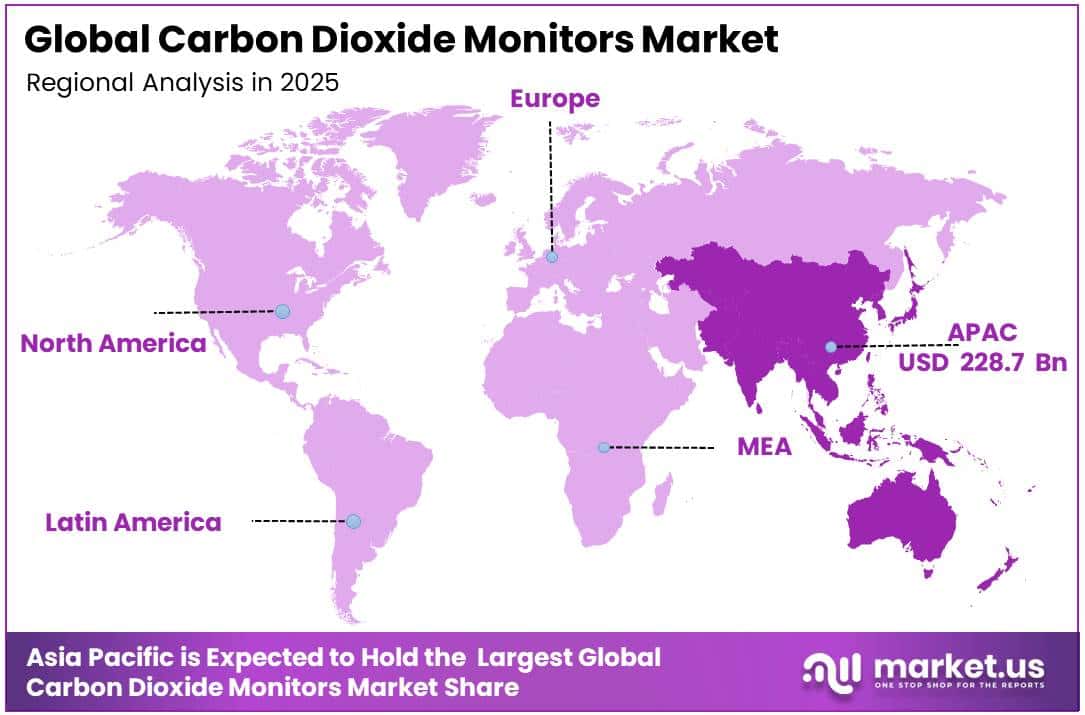
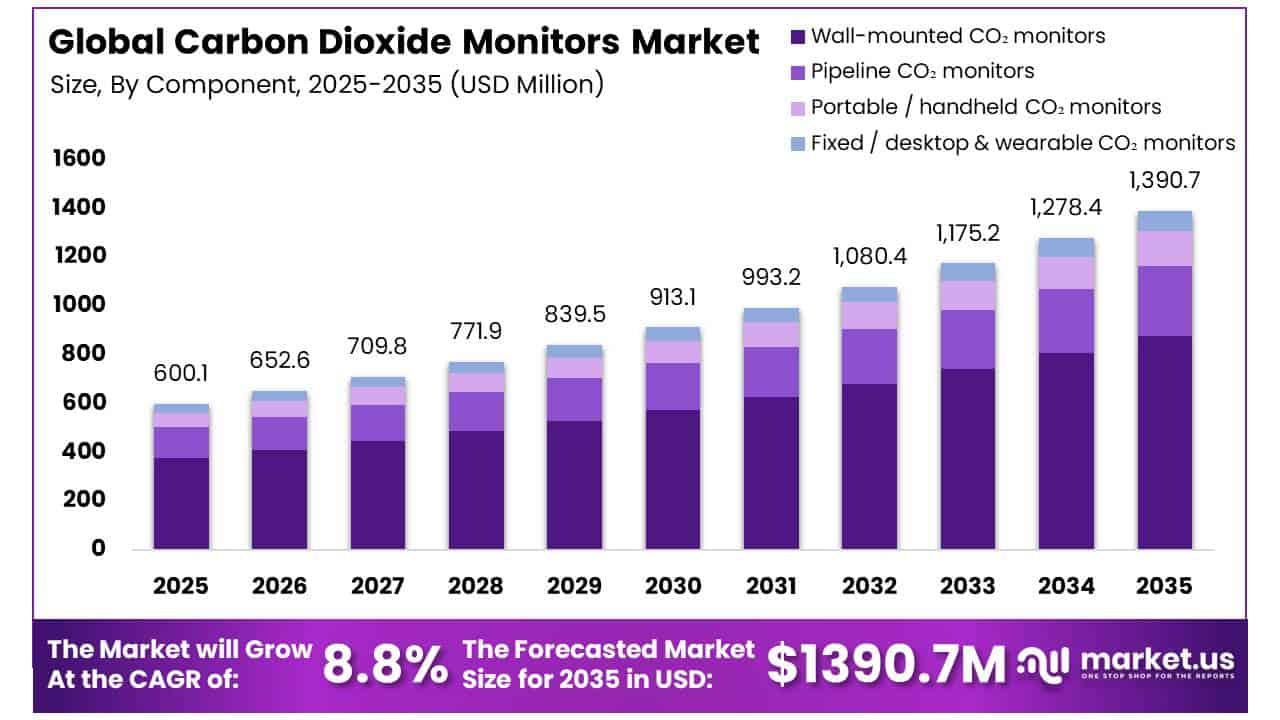
    In 2025, the Carbon Dioxide Monitors Market was valued at USD 600.1 Million, and between 2026 and 2035, this market is estimated to register a CAGR of 8.8%, reaching about USD 1390.7 Million by 2035. Asia Pacific held a dominant market position, capturing more than a 38.1% share, holding USD 228.7 Million in revenue.

    The carbon dioxide monitors market comprises instrumentation designed to detect and quantify carbon dioxide (CO2) concentration across industrial, manufacturing, agricultural, and building environments. These devices are deployed to safeguard worker health in confined and process spaces, regulate demand controlled ventilation (DCV) in commercial and industrial facilities, and support emissions accounting at large stationary sources.

    • On the industrial scenario, atmospheric background CO2 continues to climb, with the National Oceanic and Atmospheric Administration (NOAA) Global Monitoring Laboratory recording a Mauna Loa Observatory monthly average of 429.12 parts per million (ppm) in July 2026, up from 427.87 ppm in July 2025.
    • At the facility level, the United States Environmental Protection Agency (EPA) Greenhouse Gas Reporting Program (GHGRP) recorded 7,544 direct emitting facilities reporting 2.578 billion metric tons of carbon dioxide equivalent (CO2e) for reporting year 2023, sustaining demand for continuous stack and ambient CO2 monitoring across manufacturing plants.
    Carbon Dioxide Monitors Market

    Key Takeaways

    • The Global Carbon Dioxide Monitors Market was valued at US$600.1 million in 2025.
    • The global market is projected to grow at a CAGR of 8.8% and is estimated to reach US$1,390.7 million by 2035.
    • On the basis of component, Wall-mounted CO₂ monitors dominated the market, constituting 63.1% of the total market share.
    • Based on type, End-tidal CO₂ (EtCO₂) monitors dominated the market, accounting for 55.6% of the total market share.
    • Based on application, Hospital use dominated the market, accounting for 36.5% of the total market share.
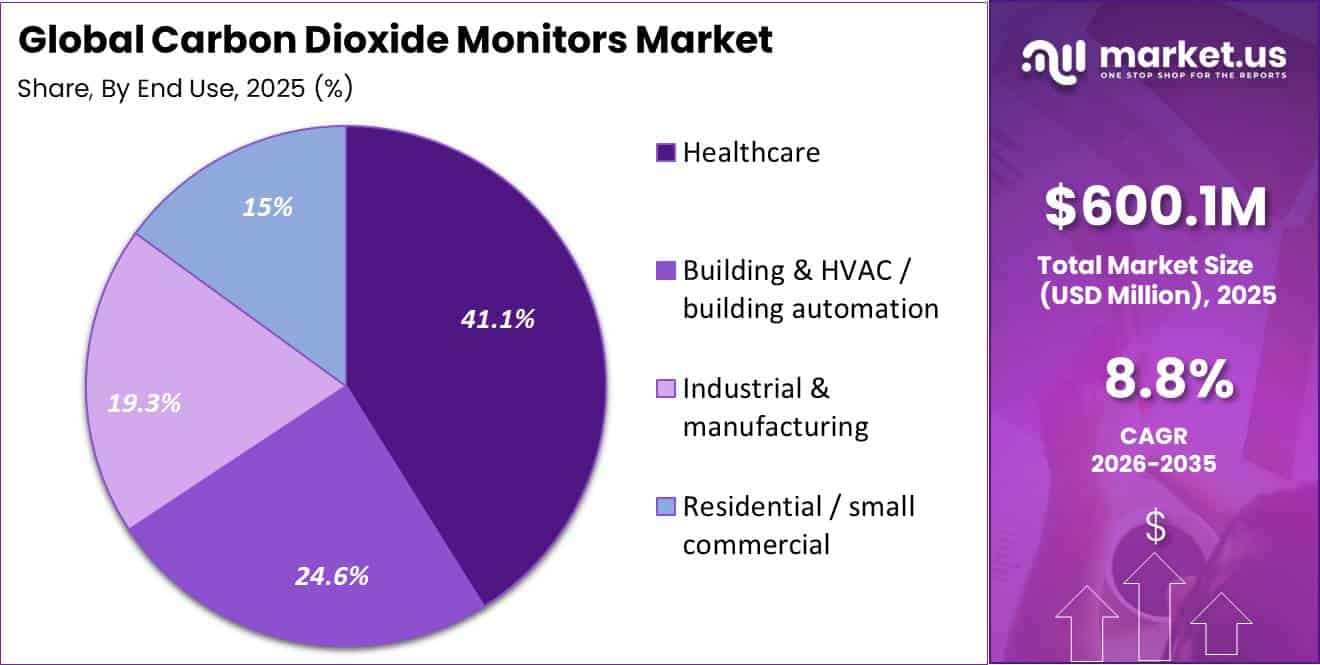
    • Based on end-user, Healthcare dominated the market, accounting for 41.1% of the total market share.
    • In 2025, Asia-Pacific was the most dominant region in the carbon dioxide monitors market, accounting for 38.1% of the global market.

    Regarding driving factors, the Occupational Safety and Health Administration (OSHA) enforces a Permissible Exposure Limit (PEL) of 5,000 ppm for CO2 as an 8 hour time weighted average under 29 Code of Federal Regulations (CFR) 1910.1000, compelling monitoring in enclosed industrial workspaces. The American Society of Heating, Refrigerating and Air-Conditioning Engineers (ASHRAE) Standard 62.1-2022 further requires CO2 sensors used for demand controlled ventilation to be manufacturer certified accurate within plus or minus B at 600 and 1,000 ppm concentrations, driving sensor precision upgrades.

    Government initiatives present notable growth opportunities. The European Union’s 2024 recast of the Energy Performance of Buildings Directive (EPBD), under Article 13, mandates installation of indoor air quality monitoring and control devices, including CO2 sensors, in new non-residential zero emission buildings and during major renovations, with member states transposing the directive by 29 May 2026, expanding institutional demand for CO2 monitoring equipment across the European building stock.

    By Component

    Wall-mounted CO₂ monitors dominate with 63.1% due to their broad use across monitoring applications.

    In 2025, Wall-mounted CO₂ monitors held a dominant market position, capturing more than a 63.1% share of the Carbon Dioxide Monitors Market by component. Their leading position reflects their established use in fixed monitoring applications where continuous carbon dioxide measurement is required.

    Pipeline CO₂ monitors represented the fastest-growing segment in 2025 within the Carbon Dioxide Monitors Market by component. Their growth is associated with increasing use in applications where carbon dioxide levels need to be monitored within pipeline systems.

    By Type

    End-tidal CO₂ monitors dominate with 55.6% due to their established use.

    In 2025, End-tidal CO₂ (EtCO₂) monitors held a dominant market position, capturing more than a 55.6% share of the Carbon Dioxide Monitors Market by type. Their leading position reflects their established role in monitoring carbon dioxide levels through end-tidal measurements. The segment continues to hold a strong position because EtCO₂ monitoring is widely used where continuous observation of exhaled carbon dioxide is required.

    Transcutaneous CO₂ (tcpCO₂) monitors represented the fastest-growing segment in 2025 by type. Their growth is supported by increasing adoption of non-invasive approaches for monitoring carbon dioxide levels. The segment is gaining attention as monitoring requirements expand across applications where continuous CO₂ measurement is needed without relying on end-tidal measurement.

    By Application

    Hospital use dominates with 36.5% due to its strong need for CO₂ monitoring.

    In 2025, Hospital use held a dominant market position, capturing more than a 36.5% share of the Carbon Dioxide Monitors Market by application. Its leading position reflects the importance of CO₂ monitoring in hospital settings, where reliable measurement supports routine monitoring requirements. The segment continues to account for the largest share as hospitals use carbon dioxide monitors across different areas where consistent monitoring is required.

    Office buildings & indoor air-quality represented the fastest-growing segment in 2025 by application. Its growth is linked to the increasing focus on maintaining suitable indoor air conditions and monitoring CO₂ levels in occupied spaces. The segment is gaining importance as office environments place greater attention on indoor air-quality monitoring and regular measurement of carbon dioxide levels.

    By End-user

    Healthcare dominates with 41.1% due to its strong monitoring requirements.

    In 2025, Healthcare held a dominant market position, capturing more than a 41.1% share of the Carbon Dioxide Monitors Market by end-user. Its leading position reflects the continued need for CO₂ monitoring across healthcare settings. Healthcare facilities rely on carbon dioxide monitors for applications where regular and dependable measurement is required, supporting the segment’s strong position in the market.

    Building & HVAC / building automation represented the fastest-growing segment in 2025 by end-user. Its growth is supported by the increasing use of CO₂ monitoring within building systems and HVAC environments. The segment is gaining importance as building operators place greater focus on monitoring indoor conditions and integrating CO₂ measurement into building automation systems.
    Carbon Dioxide Monitors Market Share

    Key Market Segments

    By Component

    • Wall‑mounted CO₂ monitors
    • Portable / handheld CO₂ monitors
    • Pipeline CO₂ monitors
    • Fixed / desktop & wearable CO₂ monitors

    By Type

    • End‑tidal CO₂ (EtCO₂) monitors
    • Transcutaneous CO₂ (tcpCO₂) monitors

    By Application

    • Hospital use
    • Scientific research
    • Office buildings & indoor air‑quality
    • Breweries & greenhouses
    • Others

    By End-user

    • Healthcare
    • Industrial & manufacturing
    • Building & HVAC / building automation
    • Residential / small commercial

    Driver Analysis

    Ventilation compliance and DCV mandates

    California’s 2025 Energy Code requires demand-ventilation controls in densely occupied spaces—at least 25 people per 1,000 sq. ft., or 40 sq. ft. or less per person—when the serving system has an economizer, modulating outdoor-air control, or outdoor-airflow capacity above 3,000 cfm; these installations require at least one CO₂ sensor per 10,000 sq. ft. and a room control limit no higher than outdoor CO₂ plus 600 ppm.

    The same acceptance regime specifies sensor accuracy within ±75 ppm at 600 ppm and 1,000 ppm, and manufacturer-certified calibration intervals of no more than five years, raising the competitive value of stable, low-drift NDIR platforms over low-cost devices that cannot support documented compliance.

    With 2025 atmospheric CO₂ averaging approximately 425.6 ppm, a 600-ppm differential implies a practical control point near 1,026 ppm where outdoor concentration is not directly measured, tightening the engineering relevance of accurate outdoor-reference sensing.

    Drivers Impact Analysis

    Driver (~) % Impact on CAGR Forecast Geographic Relevance Impact Timeline
    Ventilation compliance and DCV mandates +2.2 pp North America core, EU, developed APAC Short term (≤ 2 years)
    Smart-building HVAC automation integration +1.8 pp North America, EU, China, Japan, GCC Medium term (2-4 years)
    School and public-building IAQ upgrades +1.5 pp U.S., Canada, EU, UK, Australia Short term (≤ 2 years)
    Low-cost NDIR sensor and wireless adoption +1.3 pp Global, especially APAC and India Medium term (2-4 years)
    Energy-cost optimization through DCV +1.1 pp EU, North America, China, GCC Medium term (2-4 years)
    Indoor-health risk and productivity focus +0.9 pp Global urban markets Long term (≥ 4 years)

    Restraint Analysis

    Low-cost sensor commoditization

    A typical low-cost NDIR monitor claims accuracy near ±30–50 ppm plus 3%–5% of reading; at 1,000 ppm, this can translate into a practical uncertainty band of roughly ±60–100 ppm before placement, temperature, humidity, optical contamination, and long-term drift effects are considered.

    Premium commercial products therefore face a difficult value-capture equation: achieving California-style demand-controlled ventilation requirements of ±75 ppm at both 600 ppm and 1,000 ppm, factory calibration, and recalibration intervals of no more than five years adds engineering, quality-control, certification, and field-support costs that cannot always be passed through in residential and small-business channels.

    The result is margin compression rather than demand destruction: mid-tier suppliers are pressured to reduce bill-of-material cost, consolidate SKUs, source lower-cost optical components, and absorb higher warranty risk, while low-price competitors can win one-time unit sales without funding commissioning software, calibration infrastructure, or building-management-system interoperability.

    Restraint Impact Analysis

    Restraint (~) % Impact on CAGR Geographic Relevance Impact Timeline
    Low-cost sensor commoditization -1.9 pp APAC, India, LATAM, online channels Short term (≤ 2 years)
    Calibration and drift burden -1.6 pp Global, especially HVAC retrofits Medium term (2-4 years)
    Fragmented IAQ regulations -1.4 pp U.S. states, EU, UK, APAC Medium term (2-4 years)
    Semiconductor and tariff exposure -1.2 pp North America, China-linked supply chains Short term (≤ 2 years)
    Weak retrofit ROI visibility -1.1 pp Mature commercial markets Medium term (2-4 years)
    IoT cybersecurity compliance cost -0.8 pp EU, UK, North America Long term (≥ 4 years)

    Opportunity Analysis

    CO₂-as-a-service platforms

    A provider could package a $60–150 installed wireless room monitor, gateway access, remote health checks, automated threshold alerts, calibration-status records, and portfolio dashboards into a $3–8 per-device monthly subscription; across a 2,000-device commercial or education portfolio, this produces $72,000–192,000 of annual recurring revenue before professional services, compared with a one-time hardware transaction.

    The strategic objective is to raise gross-margin mix: sensor hardware may produce approximately 25%–45% gross margin after channel discounting and warranty provision, while mature cloud analytics can approach 65%–80% gross margin after hosting and customer-success costs if device connectivity and churn are controlled.

    Opportunity Impact Analysis

    Opportunity (~) % Potential CAGR Geographic Relevance Execution Window
    CO₂-as-a-service platforms +2.1 pp North America, EU, Japan, GCC Short term (≤ 2 years)
    EU BACS retrofit bundles +1.9 pp EU core, UK, Nordics Medium term (2-4 years)
    School fleet analytics +1.6 pp U.S., Canada, UK, Australia Short term (≤ 2 years)
    Emerging-market HVAC retrofit kits +1.5 pp India, ASEAN, GCC, LATAM Medium term (2-4 years)
    Verified energy-savings contracts +1.3 pp EU, North America, China Medium term (2-4 years)
    Consolidation and channel roll-ups +1.0 pp Global fragmented markets Long term (≥ 4 years)

    Challenges Analysis

    Electronics supply-chain volatility

    In late 2025, average microcontroller lead times increased to about 13–14 weeks, and by early 2026 certain microcontroller lines exceeded 20 weeks; more acute reports recorded upper-end component lead times approaching 40 weeks versus 20–25 weeks through much of 2025.

    Physical logistics remain an additional planning risk: the continued Red Sea diversion adds about 10–14 days to major Asia–Europe lanes, extending Shanghai–Rotterdam journeys from roughly 28–32 days to 38–46 days and increasing freight cost by an estimated $200–400 per twenty-foot-equivalent container.

    For a supplier holding 8–10 weeks of inventory, a 10-week component delay plus two extra shipping weeks can force expedited freight, split builds, component brokerage, or postponed BMS project commissioning; this can add an estimated 3%–8% to delivered device cost and erode installer confidence.

    Challenges Impact Analysis

    Challenge (~) % CAGR Friction Drag Geographic Relevance Mitigation Horizon
    Sensor-data reliability management -1.5 pp Global, HVAC retrofits Medium term (2-4 years)
    Electronics supply-chain volatility -1.3 pp APAC logistics, EU, North America Medium term (2-4 years)
    BMS interoperability fragmentation -1.2 pp North America, EU, GCC, APAC Long term (≥ 4 years)
    Field commissioning skills gap -1.0 pp Global, emerging APAC, LATAM Medium term (2-4 years)
    Cybersecurity lifecycle operations -0.9 pp EU regulatory hubs, North America Long term (≥ 4 years)
    Cross-border compliance localization -0.8 pp EU, U.S. states, UK, APAC Long term (≥ 4 years)

    Geopolitical Impact Analysis

    Geopolitical tensions raise supply-chain and logistics risks for the Carbon Dioxide Monitors Market.

    The 2026 Middle East conflict and disruption around the Strait of Hormuz are creating indirect pressure on the Carbon Dioxide Monitors Market through higher logistics, energy, and manufacturing costs.

    • UNCTAD reported that the Strait carries around one quarter of global seaborne oil trade, while disruption in March caused ship transits to fall by about 95%. These conditions increase freight, insurance, and energy-related costs across international supply chains, which can affect manufacturers and distributors of monitoring equipment.

    The impact is also being felt through broader manufacturing uncertainty. The European Commission reported in May 2026 that manufacturers are rethinking energy sourcing, logistics, and operational dependencies because of geopolitical tensions and the continuing effects of the war in Ukraine.

    For CO₂ monitor manufacturers, prolonged supply-chain uncertainty can make procurement and delivery planning more difficult. At the same time, the disruption may encourage manufacturers to diversify suppliers and strengthen regional sourcing. UNCTAD noted in July 2026 that shipping and value chains require time to adjust even after major disruptions ease.

    Regional Analysis

    Asia Pacific dominates with 38.1% share, valued at USD 228.65 Million.

    In 2025, Asia Pacific held a dominant market position, capturing more than a 38.1% share of the Carbon Dioxide Monitors Market, with a market value of USD 228.65 million, based on the provided market data. The region’s position is supported by the growing importance of indoor air-quality management, healthcare monitoring, and building ventilation practices.

    • Japan provides a clear regulatory example. Its Ministry of Health, Labour and Welfare requires indoor carbon dioxide concentration in regulated buildings to remain at 1,000 ppm or below and specifies the use of carbon dioxide measuring instruments for monitoring.

    China also continues to maintain a large building and urban environment base. Its official 2025 statistical communiqué reported 60,348 ten-thousand square meters of completed building floor space, while 27,000 old urban residential compounds were newly started for renovation. These developments provide a broad setting where ventilation and indoor environmental monitoring can remain relevant.

    Carbon Dioxide Monitors Market Regional Analysis

    Key Regions and Countries

    • North America
      • The US
      • Canada
    • Europe
      • Germany
      • France
      • The UK
      • Spain
      • Italy
      • Russia & CIS
      • Rest of Europe
    • APAC
      • China
      • Japan
      • South Korea
      • India
      • ASEAN
      • Rest of APAC
    • Latin America
      • Brazil
      • Mexico
      • Rest of Latin America
    • Middle East & Africa
      • GCC
      • South Africa
      • Rest of MEA

    Key Players Analysis

    Carbon dioxide monitor manufacturers focus on improving sensor accuracy, response time, reliability, and ease of use to strengthen their position across healthcare, industrial, and building applications. Companies such as Honeywell International Inc., Siemens AG, GE Healthcare, Drägerwerk AG & Co. KGaA, Masimo Corporation, Medtronic plc, Mindray Medical, Nihon Kohden Corporation, Nonin Medical, Inc., and Radiometer Medical ApS emphasize product development for dependable CO₂ measurement.

    Healthcare-focused manufacturers place particular attention on compact monitoring systems, continuous measurement, and integration with patient-monitoring equipment. Building and industrial monitoring suppliers focus more on stable sensing, simple installation, connectivity, and compatibility with ventilation or building automation systems.

    Competitive strategies also include product portfolio expansion, technology partnerships, distribution development, and stronger customer support. Smiths Medical, Philips Healthcare, Axetris AG, RKI Instruments, Inc., and Analox Group, along with other manufacturers, compete by addressing specific application requirements rather than relying on a single product category.

    The Major Players in The Industry

    • Honeywell International Inc.
    • Siemens AG
    • GE Healthcare
    • Drägerwerk AG & Co. KGaA
    • Masimo Corporation
    • Medtronic plc
    • Mindray Medical
    • Nihon Kohden Corporation
    • Nonin Medical, Inc.
    • Radiometer Medical ApS
    • Smiths Medical
    • Philips Healthcare
    • Axetris AG
    • RKI Instruments, Inc.
    • Analox Group
    • Others

    Key Development

    • In April 2026, Nihon Kohden launched the BSM-5700 series, also known as Life Scope E7, a new bedside patient monitor. The system includes CO₂ monitoring along with other clinical parameters and is designed for applications including anesthesia care and patient monitoring. The product also supports integration with anesthesia machines and hospital information systems.
    • In July 2025, Medtronic announced a strategic partnership with Philips to expand access to patient-monitoring technology. The multi-year agreement includes the integration of Medtronic technologies into Philips monitoring solutions, including Microstream capnography, which supports continuous CO₂ monitoring.

    Report Scope

    Report Features Description
    Market Value (2025) USD 600.1 Mn
    Forecast Revenue (2035) USD 1390.7 Mn
    CAGR (2026 2035) 3.9%
    Base Year for Estimation 2025
    Historic Period 2020-2024
    Forecast Period 2026-2035
    Report Coverage Revenue Forecast, Market Dynamics, Competitive Landscape, Recent Developments
    Segments Covered By Component (Wall-mounted CO₂ monitors, Portable / handheld CO₂ monitors, Pipeline CO₂ monitors, Fixed / desktop & wearable CO₂ monitors), By Type (End-tidal CO₂ (EtCO₂) monitors, Transcutaneous CO₂ (tcpCO₂) monitors), By Application (Hospital use, Scientific research, Office buildings & indoor air-quality, Breweries & greenhouses, Others), By End-user (Healthcare, Industrial & manufacturing, Building & HVAC / building automation, Residential / small commercial)
    Regional Analysis North America    The US & Canada; Europe    Germany, France, The UK, Spain, Italy, Russia & CIS, Rest of Europe; APAC  China, Japan, South Korea, India, ASEAN & Rest of APAC; Latin America  Brazil, Mexico & Rest of Latin America; Middle East & Africa  GCC, South Africa, & Rest of MEA
    Competitive Landscape Honeywell International Inc., Siemens AG, GE Healthcare, Drägerwerk AG & Co. KGaA, Masimo Corporation, Medtronic plc, Mindray Medical, Nihon Kohden Corporation, Nonin Medical, Inc., Radiometer Medical ApS, Smiths Medical, Philips Healthcare, Axetris AG, RKI Instruments, Inc., Analox Group, and Other Key Players.
    Customization Scope Customization for segments, region/country level will be provided. Moreover, additional customization can be done based on the requirements.
    Purchase Options We have three licenses to opt for: Single User License, Multi User License (Up to 5 Users), Corporate Use License (Unlimited Users and Printable PDF)
    keyboard_arrow_up
  • Segments Sub-segments
    By Component
    • Wall‑mounted CO₂ monitors
    • Portable / handheld CO₂ monitors
    • Pipeline CO₂ monitors
    • Fixed / desktop & wearable CO₂ monitors
    By Type
    • End‑tidal CO₂ (EtCO₂) monitors
    • Transcutaneous CO₂ (tcpCO₂) monitors
    By Application
    • Hospital use
    • Scientific research
    • Office buildings & indoor air‑quality
    • Breweries & greenhouses
    • Others
    By End-user
    • Healthcare
    • Industrial & manufacturing
    • Building & HVAC / building automation
    • Residential / small commercial

     
    North America Europe Asia Pacific Latin America Middle East & Africa
    • US
    • Canada
    • Germany
    • France
    • The UK
    • Spain
    • Italy
    • Rest of Europe
    • China
    • Japan
    • South Korea
    • India
    • Australia
    • Rest of APAC
    • Brazil
    • Mexico
    • Rest of Latin America
    • GCC
    • South Africa
    • Rest of MEA
Carbon Dioxide Monitors Market
Published date: August 2026
add_shopping_cartBuy Now get_appDownload Sample

Related Reports

  • Renewable Aviation Fuel Market
  • Offshore Mooring System Market
  • Direct Methanol Fuel Cell Market
  • Synchronous Generator Market
  • Zonal Isolation Market

  • Solar Simulator Market
  • Oil and Gas Infrastructure Market
  • Tidal Energy Market
  • Silent Generator Market
  • Vessel Energy Storage System Market
Carbon Dioxide Monitors Market
  • 192563
  • August 2026
    • ★★★★★
      ★★★★★
Buy Now
Trusted by more than 17382 organizations globally
  • Client Logo
  • Client Logo
  • Client Logo
  • Client Logo
  • Client Logo
  • Client Logo
  • Client Logo
  • Client Logo
  • Client Logo
  • Client Logo
  • Client Logo
  • Client Logo
  • Client Logo
  • Client Logo
  • Client Logo
  • Client Logo

Our Clients

philips
pentair
suez
ecowater
ergobaby
fabricato
genomatica
lenzing
lilly
siemens
honeywell
valspar
pactiv
petsure
schweitzer-online
sappi
pfizer
unilabs
lonza
BD
mckinsey
hilti
✖
Request a Sample Report
We'll get back to you as quickly as possible

✖
Request a Sample Report
We'll get back to you as quickly as possible

  • location_on420 Lexington Avenue, Suite 300 New York City, NY 10170,
    United States
  • phone+1 718 874 1545 (International)
  • phone+91 78878 22626 (Asia)
  • emailinquiry@market.us
  • Facebook Logo
  • Twitter Logo
  • LinkedIn Logo
Find Help
  • Contact Us
  • How to Order
Legal
  • Privacy Policy
  • Refund Policy
  • Frequently Asked Questions
  • Terms and Conditions
Explore
  • About Us
  • Our Clients
  • Media Mentions
  • Infographics
  • Statistics and Facts
  • Research Methodology
  • Why Choose Us?
Secured Payment Options

© 2026 Market.Us. All Rights Reserved.