


Report Overview
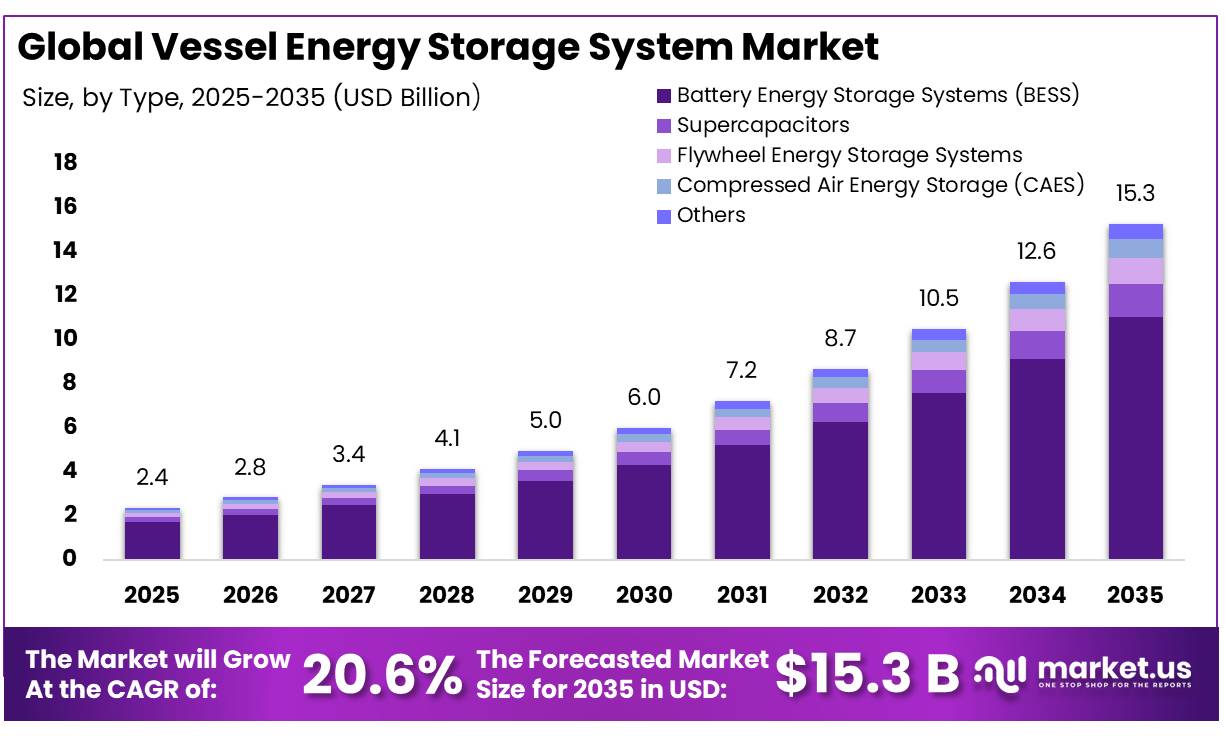
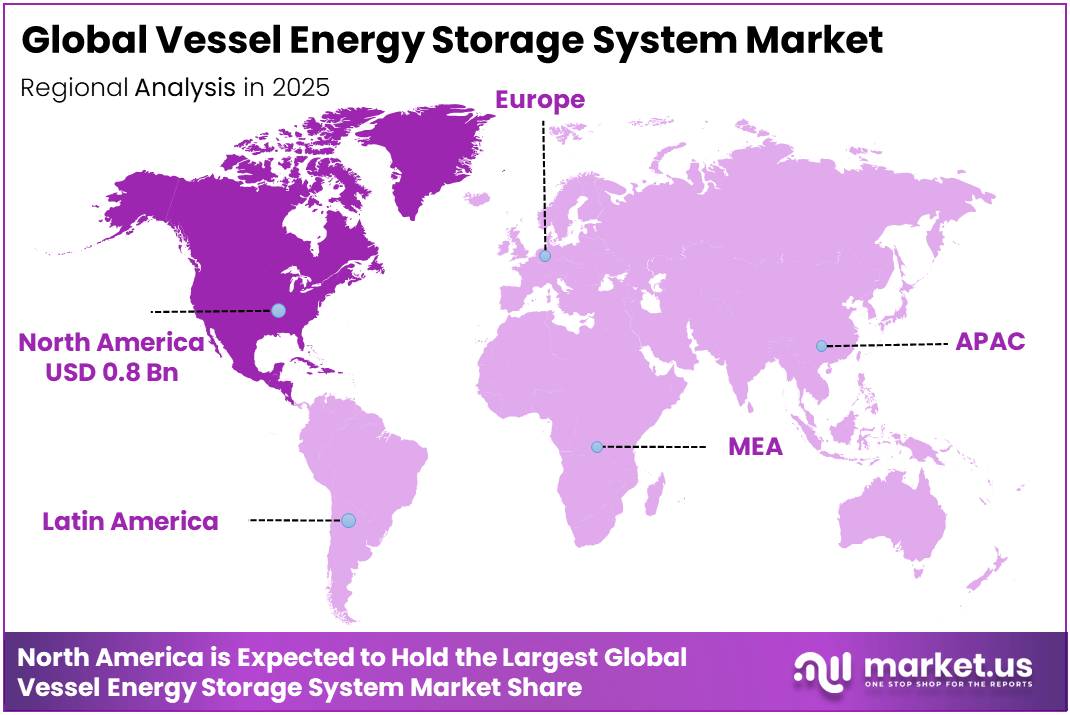
In 2025, the Global Vessel Energy Storage System Market was valued at USD 2.4 billion, and between 2026 and 2035, this market is estimated to register a CAGR of 20.6%, reaching about USD 15.3 billion by 2035. In 2025, North America led the market, achieving over 34.2% share with a revenue of USD 0.8 Billion.
The vessel energy storage system industry is becoming an important part of maritime electrification and emission reduction. These systems combine batteries, power-conversion equipment, battery-management software, cooling systems and safety controls to store and distribute electricity onboard ships. The stored power can support propulsion, hotel loads, peak demand and emergency operations. It can also work with diesel engines, LNG systems, fuel cells or renewable power in hybrid vessels.
- In September 2025, UN Trade and Development reported that maritime transport carries over 80% of international trade in goods by volume, showing the commercial importance of improving vessel efficiency.
Key Takeaways
- The Global Vessel Energy Storage System Market was valued at USD 2.4 billion in 2025.
- The market is projected to grow at a CAGR of 20.6% and is estimated to reach USD 15.3 billion by 2035.
- On the basis of type, Battery Energy Storage Systems (BESS) dominated the market, constituting 72.3% of the total market share.
- Based on the energy source, Hybrid Systems dominated the market, with a substantial market share of around 54.6%.
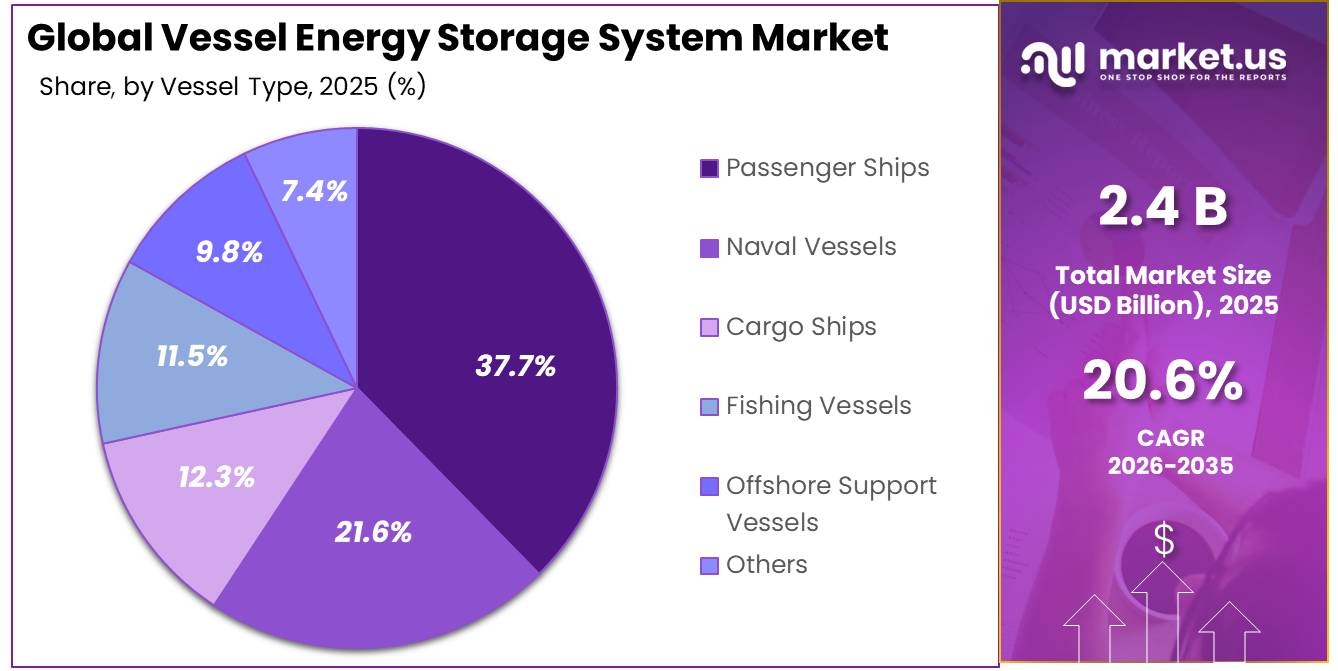
- Based on the vessel type, Passenger Ships led the market, comprising 37.7% of the total market.
- In 2025, North America was the most dominant region in the market, accounting for 34.2% of the total global consumption.
The industrial environment is gradually moving from conventional fuel-based vessels toward hybrid and fully electric ships. Ferries, passenger ships, tugboats, inland vessels, offshore support vessels and short-sea ships are among the main adopters because they usually operate on predictable routes and can access regular charging points.
- According to UNCTAD’s published on September 24, 2025, the global commercial fleet reached approximately 112,500 vessels and 2.44 billion deadweight tons in January 2025. This large operating fleet presents opportunities for new battery-powered ships and the retrofitting of existing vessels.
Changes in maritime trade are also influencing energy requirements. In September 2025, UNCTAD reported that global seaborne trade volume grew by 2.2% in 2024 but was projected to increase by only 0.5% in 2025. The organization also stated that geopolitical disruption and vessel rerouting produced nearly 6% growth in maritime ton-miles during 2024. Longer routes keep ships operating for extended periods, raising the importance of efficient propulsion, energy optimization and hybrid power systems.
- The European Commission stated that the FuelEU Maritime Regulation became applicable on January 1, 2025. It requires ships above 5,000 gross tonnage calling at European ports to reduce the annual greenhouse-gas intensity of onboard energy by 2% in 2025 compared with the 2020 reference level. The required reduction increases to 6% in 2030 and 80% in 2050.
International climate targets are strengthening long-term demand. Under its 2023 greenhouse-gas strategy, the International Maritime Organization aims to reduce annual shipping emissions by at least 20%, while striving for 30%, by 2030 compared with 2008. The reduction checkpoint reaches at least 70%, while striving for 80%, by 2040, with net-zero emissions targeted by or around 2050. The IMO also expects zero or near-zero-emission technologies, fuels and energy sources to supply at least 5%, while striving for 10%, of international shipping energy by 2030.
Future opportunities will emerge from electric ferries, harbour vessels, offshore ships, charging networks, battery replacement services and integrated energy-management platforms. The IEA reported that average battery prices fell by 8% in 2025 and that global battery energy storage system prices declined to approximately one-third of their 2020 level. These cost improvements can support marine battery adoption, although system weight, charging access, thermal runaway and fire protection remain key concerns.
Safety standards will remain essential as vessel electrification expands. The European Maritime Safety Agency updated its battery energy storage system guidance in November 2025 to promote consistent safety requirements for onboard battery installations. EMSA stated that the guidance addresses equipment design, battery technology, planning, operation and safety. Clearer technical practices are expected to improve owner confidence and support safer deployment across both new vessels and retrofit projects.
Type Analysis
Battery Energy Storage Systems dominate with a 72.3% share due to their high efficiency and proven use in electric and hybrid vessels.
In 2025, Battery Energy Storage Systems (BESS) held a dominant market position, capturing more than a 72.3% share. The segment’s leadership is supported by the rapid expansion of battery storage across the wider energy sector. According to the International Energy Agency, 108 GW of new battery storage capacity was deployed worldwide in 2025, representing a 40% increase from 2024. Utility-scale systems accounted for around 87 GW, or nearly four-fifths of the total additions. The IEA also reported that lithium-iron phosphate batteries represented around 90% of battery storage deployments in 2025. These figures show the strong commercial acceptance, scalability and operating reliability of battery-based systems, supporting their increasing use in electric and hybrid vessels.
Supercapacitors are the fastest-growing segment in the Vessel Energy Storage System Market. Their adoption is increasing because they can charge and discharge rapidly, deliver strong power during acceleration and handle repeated operating cycles with limited performance loss. Vessel operators are exploring these systems for peak-power support, regenerative energy recovery and load balancing in hybrid propulsion arrangements. Supercapacitors can also work alongside batteries, reducing sudden stress on the main battery pack and improving overall energy-management efficiency.
Energy Sources Analysis
Hybrid Systems dominate the market with a 54.6% share due to their operational flexibility and reliable power supply.
In 2025, Hybrid Systems held a dominant market position, capturing more than a 54.6% share. The segment remained widely preferred because it combines battery energy storage with conventional engines or other onboard power sources. Hybrid systems also support peak shaving, allowing batteries to supply additional power when vessel energy requirements increase. The technology is well suited for ferries, passenger vessels, tugboats and offshore support ships that operate under frequently changing load conditions.
Fuel Cells is the fastest growing segment in the Vessel Energy Storage System Market. The segment is gaining attention because fuel cells can produce electricity with lower onboard emissions and can operate alongside batteries in an integrated vessel power system. These systems are particularly suitable for passenger ships, ferries, and vessels requiring continuous hotel and auxiliary power. In 2025, the European Commission reported that its NAUTILUS project developed an onboard fuel-cell and battery system for ships.
Vessel Type Analysis
Passenger Ships dominate the vessel energy storage system market with a 37.7% share, supported by frequent operations and rising demand for cleaner passenger transport.
In 2025, Passenger Ships held a dominant market position, capturing more than a 37.7% share of the Vessel Energy Storage System Market. Passenger ferries and cruise ships operate on fixed schedules and spend considerable time near populated ports, creating strong demand for battery systems that reduce fuel consumption, engine noise, and local emissions. Energy storage also supports peak shaving, hotel loads, emergency power, and low-emission movement during port entry and departure.
- In July 2025, the UK Department for Transport reported 18.4 million international sea-passenger movements, including 15.3 million short-sea ferry passengers and 3.1 million cruise passengers. These government figures demonstrate the high operating volume of passenger vessels and support continued investment in reliable onboard energy storage systems.
Naval Vessels are the fastest-growing segment in the Vessel Energy Storage System Market. Modern naval platforms increasingly depend on batteries, capacitors, flywheels, and integrated power controls to handle sudden changes in electrical demand and maintain stable shipboard power. In May 2026, the U.S. Office of Naval Research also opened the Transient Reducing Active Power System program to develop shipboard architectures combining controls, power conversion, and energy storage. These programmes indicate that naval vessels are becoming an important growth area for high-performance and mission-ready energy storage systems.
Key Market Segments
By Type
- Battery Energy Storage Systems (BESS)
- Supercapacitors
- Flywheel Energy Storage Systems
- Compressed Air Energy Storage (CAES)
- Others
By Energy Source
- Renewable Energy Sources
- Conventional Energy Sources
- Hybrid Systems
- Fuel Cells
- Others
By Vessel Type
- Passenger Ships
- Naval Vessels
- Cargo Ships
- Fishing Vessels
- Offshore Support Vessels
- Others
Driver Analysis
IMO decarbonization compliance pulling battery-hybrid retrofits
The strongest structural demand driver is the IMO’s tightening emissions architecture, because it changes vessel investment logic from optional fuel-saving upgrades to compliance-oriented energy optimization. In April 2025, IMO member states approved draft net-zero regulations that combine a global marine fuel standard with an emissions pricing mechanism, targeting large ocean-going ships above 5,000 gross tonnage, a segment responsible for about 85% of international shipping CO2 emissions; the framework is intended to support formal adoption and later entry into force, while the 2023 IMO strategy also targets at least 5%, striving for 10%, of shipping energy from zero- or near-zero-GHG technologies by 2030.
For vessel ESS suppliers, this matters because battery packs, power conversion systems, and energy management software become compliance enablers for peak shaving, spinning reserve reduction, port-entry zero-emission operation, and hybridization of auxiliary loads, especially where full fuel switching is still uneconomic. The business-model shift is material: owners can justify ESS not only on fuel savings but on avoided compliance payments, improved carbon-intensity performance, and surplus-credit optionality under emerging fuel-intensity regimes, which raises retrofit conversion rates first in short-sea and high-utilization fleets, then in selected ocean-going vessels with hotel loads, dynamic positioning, or repeated port calls.
Drivers Impact Analysis
| Driver | (~) % Impact on CAGR | Geographic Relevance | Impact Timeline |
|---|---|---|---|
| IMO decarbonization compliance pulling battery-hybrid retrofits | +2.4% | Global deep-sea, EU, North America, advanced Asian shipbuilding hubs | Medium term (2-4 years) |
| EU FuelEU Maritime and at-berth zero-emission rules accelerating onboard ESS | +1.9% | EU core, EEA ports, Baltic-Med corridors, spill-over to UK/Turkiye yards | Short term (≤ 2 years) |
| U.S. Clean Ports grants funding electric vessels, shore power, and storage ecosystems | +1.6% | North America core, U.S. coastal and inland port clusters | Short term (≤ 2 years) |
| Lithium-ion cost normalization and pack-energy density gains improving vessel economics | +1.4% | Global, strongest in APAC supply chain and OECD retrofit markets | Medium term (2-4 years) |
| Ferry, harbor craft, and workboat electrification mandates de-risking first-use cases | +1.3% | Nordics core, EU coastal markets, North America ferries, APAC island routes | Short term (≤ 2 years) |
| Port electrification and grid-linked charging architecture expanding ESS-compatible vessel operations | +1.1% | EU TEN-T ports, U.S. ports, Northeast Asia smart-port corridors | Long term (≥ 4 years) |
Restraint Analysis
IMO rule delay
The 2026 market is still carrying a policy-conversion discount because the IMO’s 2023 GHG strategy targets at least 5%, striving for 10%, zero- or near-zero energy use by 2030 and a 40% carbon-intensity reduction by 2030, yet the draft fuel-intensity and pricing package approved at MEPC 83 was not adopted in October 2025 and was pushed forward for further consideration, extending the window in which shipowners can defer battery-hybrid orders without immediate international compliance penalties.
Since the framework would apply to ships above 5,000 GT, which account for about 85% of CO2 emissions from international shipping, delayed adoption weakens near-term boardroom urgency for battery investments on deep-sea and larger auxiliary-power applications, especially where hybridization competes with scrubbers, efficiency retrofits, or fuel-flexibility capex.
Strategically, that postponement translates into slower order intake, longer sales cycles, and lower 2026-2028 conversion rates, because owners are more likely to preserve liquidity until the final compliance architecture, compensation-unit economics, and implementation guidelines are clearer; in practical forecasting terms, this justifies roughly a 1.9 percentage-point drag on baseline CAGR through delayed fleetwide procurement, lower pilot-to-series conversion, and postponed capital allocation in globally traded vessel classes.
Restraint Impact Analysis
| Restraint | (~) % Impact on CAGR | Geographic Relevance | Impact Timeline |
|---|---|---|---|
| IMO rule delay | -1.9% | Global blue-water, EU, APAC | Short term (≤ 2 years) |
| EU battery compliance burden | -1.4% | EU core, EEA, export-to-EU Asia | Medium term (2-4 years) |
| Lithium battery shipping controls | -1.2% | North America core, EU, APAC corridors | Short term (≤ 2 years) |
| Mineral price volatility | -1.6% | Global supply chain, China-linked APAC, EU, US | Medium term (2-4 years) |
| Port charging gap | -1.7% | EU ports, North America, Asian coastal hubs | Medium term (2-4 years) |
| Vessel retrofit capex intensity | -2.1% | Global retrofit fleet, Nordics, EU short-sea, North America ferries | Long term (≥ 4 years) |
Opportunity Analysis
OPS-linked battery packages for EU berth compliance
FuelEU applies from 1 January 2025, covers ships above 5,000 GT calling at European ports, and requires passenger and container ships at berth to use OPS or alternative zero-emission technologies from 2030 in AFIR-covered ports and from 2035 in all EU ports with OPS capacity, which creates a monetizable compliance layer for batteries optimized for hotel loads, peak shaving, blackout prevention, and fast charge-discharge cycles rather than full-route propulsion.
The white space is that many owners will not need full electrification but will need 2 MWh to 20 MWh class systems to avoid berth emissions, reduce auxiliary engine runtime, and arbitrage port power constraints; that can produce 20% to 35% lower installed system cost versus propulsion-sized architectures, lift gross margins by 300 to 600 basis points through software and controls, and reduce customer acquisition cost because sales can be targeted by port-call pattern and vessel class under a rule-based screening model.
This is not a present driver because most current deployments are still route-specific or demonstration-led, while the real upside begins when vendors standardize EU berth-compliance kits, secure preferred status with ports and verifiers, and bundle monitoring software for annual FuelEU reporting, potentially adding about 2.4 percentage points of CAGR across Europe between 2027 and 2032.
Opportunity Impact Analysis
| Opportunity | (~) % Potential CAGR | Geographic Relevance | Execution Window |
|---|---|---|---|
| Retrofit leasing for sub-10k GT passenger fleets | +2.8% | Nordics core, EU coastal | Short term (≤ 2 years) |
| OPS-linked battery packages for EU berth compliance | +2.4% | EU core, UK/EFTA adjacencies | Medium term (2-4 years) |
| Harbor craft and inland workboat electrification | +2.1% | North America core, EU, APAC ports | Short term (≤ 2 years) |
| Battery-as-a-service and lifecycle contracts | +1.9% | Global, led by EU and North America | Short term (≤ 2 years) |
| Hybrid retrofit roll-up via shipyard M&A | +1.7% | Europe, Japan, South Korea | Medium term (2-4 years) |
| Emerging-market green corridor localization | +1.5% | SIDS, ASEAN, Latin America, Africa | Long term (≥ 4 years) |
Challenges Analysis
Regulatory compliance cost overhang
Mandatory GHG intensity and carbon pricing mechanisms in Europe specifically FuelEU Maritime, which sets ship‑level GHG intensity caps referenced to a baseline of 91.16 gCO2e/MJ with stepwise reductions from 2025 onward, and the phased inclusion of maritime emissions into the EU Emissions Trading System (EU ETS) starting 2025–2027 introduce recurring compliance costs and balance‑sheet uncertainty that alter the economics of ESS deployment.
FuelEU Maritime requires ships above 5,000 GT calling at EU ports to reduce their well‑to‑wake GHG intensity by 2% by 2025 and progressively up to 80% by 2050, with non‑compliance triggering penalties or forcing the purchase of compliance units, while EU ETS coverage of maritime CO₂ emissions from 5,000 GT vessels obliges companies to surrender allowances at specified deadlines, effectively adding a variable per‑tonne emissions cost layer on operational budgets.
The friction arises because ESS payback is now contingent not only on fuel savings but also on uncertain future carbon price trajectories and evolving intensity benchmarks; conservative financial modeling in such a regime typically applies higher discount rates or requires shorter than 8–10 year payback windows, removing some higher‑capex ESS projects from the near‑term pipeline and introducing an estimated 1.0 percentage point drag on CAGR.
Challenges Impact Analysis
| Challenge | (~) % CAGR Friction | Geographic Relevance | Mitigation Horizon |
|---|---|---|---|
| Fragmented decarbonisation rules | -1.2% | EU corridors, global deep sea | Medium term (2-4 years) |
| Regulatory compliance cost overhang | -1.0% | EU ports, EEA, adjacent trade | Medium term (2-4 years) |
| Maritime battery safety complexity | -0.9% | Nordic ferries, EU shortsea, Asia pilot routes | Long term (≥ 4 years) |
| Port grid & OPS readiness gaps | -1.1% | EU secondary ports, APAC hubs, US coastal | Long term (≥ 4 years) |
| Capital intensity & project risk | -0.8% | Global fleet retrofits, newbuilds | Medium term (2-4 years) |
| Specialized skills and design deficit | -0.7% | Europe yards, North America, East Asia | Long term (≥ 4 years) |
Geopolitical Impact Analysis
Red Sea Conflict and Naval Escalation is Reshaping Vessel Energy Storage Demand
The Houthi campaign against commercial shipping in the Red Sea and Bab el-Mandeb strait has pushed vessel operators to rethink onboard power systems since late 2023, and the effects are still being felt in 2026. Ships rerouted around the Cape of Good Hope add 10 to 14 days and roughly 3,000 to 3,500 nautical miles to Asia-Europe and Asia-US voyages, forcing owners to prioritize fuel efficiency and endurance, both of which favor hybrid and battery-supported propulsion.
At the same time, naval forces patrolling the corridor have leaned harder on anti-ship missile defense, drone interception, and other advanced systems, driving fresh demand for onboard energy storage that can support high-draw defense electronics without straining a vessel’s main power plant. Even as attack frequency eased through early 2026, insurers and shipping lines are not treating the threat as resolved, and that lingering caution is keeping investment in resilient, storage-backed vessel power on the table.
Regional Analysis
North America Dominates the Vessel Energy Storage System Market.
North America was identified as the dominant regional market for vessel energy storage systems in 2025, with a 34.2% share and revenue of approximately US$0.8 billion. The region’s leadership was attributed to an early and accelerating shift toward hybrid and electric marine propulsion, supported by sustained naval modernization programs, port-side electrification initiatives, and a mature offshore support vessel fleet transitioning toward battery-hybrid operation.
Naval Vessels were identified as the fastest-growing vessel-type segment in the region, driven by sustained defense modernization spending and continued investment in hybrid-electric propulsion for surface combatants and support vessels. Energy storage integration in naval platforms is being pursued to improve stealth operation, reduce fuel consumption, and support sensor and payload systems with higher onboard power demand.
Key Regions and Countries Covered
- North America
- The US
- Canada
- Europe
- Germany
- France
- The UK
- Spain
- Italy
- Russia & CIS
- Rest of Europe
- APAC
- China
- Japan
- South Korea
- India
- ASEAN
- Rest of APAC
- Latin America
- Brazil
- Mexico
- Rest of Latin America
- Middle East & Africa
- GCC
- South Africa
- Rest of MEA
Key Players Analysis
Rolls-Royce Power Systems strengthens the vessel energy storage market through mtu hybrid propulsion, marine engines, battery controls, and integrated power solutions. In 2025, Rolls-Royce Power Systems generated £4.89 billion in revenue, reflecting 19% organic growth year-on-year. Its maritime collaboration with EST-Floattech supports 9 hybrid ferries using battery modules totaling 3,118.5 kWh. The company also employs more than 10,350 people in Power Systems, supporting marine electrification, system integration, servicing, and low-emission vessel operations worldwide across commercial and specialized marine fleets.
Samsung SDI supports the vessel energy storage market through lithium-ion cells, battery management systems, and ESS technologies adaptable to marine power applications. In 2025, the company generated KRW 13.27 trillion in revenue, while fourth-quarter revenue reached KRW 3.86 trillion. Its ESS battery sales achieved a quarterly record, showing stronger demand for high-safety storage products. Samsung SDI also expanded its prismatic and LFP portfolio, including the 20-foot Samsung Battery Box 2.0, strengthening its position in advanced energy storage solutions across markets worldwide.
EST-Floattech is a specialized maritime battery supplier serving ferries, workboats, inland vessels, tugs, and fully electric ships. In 2025, it supplied a 1.68 MWh containerized Octopus Lite system for the ROS E-Pusher M and nearly 2 MWh for Damen’s first fully electric Multi Cat 1908 E. Its partnership with Rolls-Royce also covers 9 hybrid ferries with 3,118.5 kWh of battery capacity, highlighting its strong role in certified, modular, and zero-emission vessel energy storage systems across demanding European commercial marine operations.
CATL holds a strong position in vessel energy storage through marine battery systems, charging, swapping, and digital ship-management solutions. In 2025, its Yujian 77 passenger ship used a 3,918 kWh battery system, delivered more than 140 Wh/kg pack energy density, and achieved a 100 km electric range. By year-end, CATL batteries had been deployed in nearly 1,000 electric vessels. Companywide revenue reached RMB 423.7 billion, while lithium-ion battery sales rose 39% to 661 GWh during the same reporting period globally.
The Major Players in The Industry
- Corvus Energy
- Wartsila Corporation
- ABB Ltd.
- Siemens Energy
- Leclanche SA
- Rolls-Royce Power Systems
- Samsung SDI
- Saft (TotalEnergies)
- EST-Floattech
- Shift Clean Energy
- CATL
- Other Key Players
Key Development
- In December 2025, Corvus launched the Blue Whale NxtGen LFP energy storage system with a service life of up to 15 years, a 1C charge-discharge rate and a fourth-generation battery management system, with the first deliveries planned for the fourth quarter of 2026.
- In August 2025, Wartsila Corporation expanded its partnership with Wasaline to upgrade the Aurora Botnia ferry by 10.4 MWh, raising its total battery capacity from 2.2 MWh to 12.6 MWh and creating the world’s largest operating marine battery-hybrid system.
Report Scope
| Report Features | Description |
|---|---|
| Market Value (2025) | USD 2.4 Bn |
| Forecast Revenue (2035) | USD 15.3 Bn |
| CAGR (2026-2035) | 20.6% |
| Base Year for Estimation | 2025 |
| Historic Period | 2020-2024 |
| Forecast Period | 2026-2035 |
| Report Coverage | Revenue Forecast, Market Dynamics, Competitive Landscape, Recent Developments |
| Segments Covered | By Type (Battery Energy Storage Systems (BESS), Supercapacitors, Flywheel Energy Storage Systems, Compressed Air Energy Storage (CAES), and Others), By Energy Source (Renewable Energy Sources, Conventional Energy Sources, Hybrid Systems, Fuel Cells, and Others), By Vessel Type (Passenger Ships, Naval Vessels, Cargo Ships, Fishing Vessels, Offshore Support Vessels, and Others) |
| Regional Analysis | North America – The US & Canada; Europe – Germany, France, The UK, Spain, Italy, Russia & CIS, Rest of Europe; APAC– China, Japan, South Korea, India, ASEAN & Rest of APAC; Latin America– Brazil, Mexico & Rest of Latin America; Middle East & Africa– GCC, South Africa, & Rest of MEA |
| Competitive Landscape | Corvus Energy, Wartsila Corporation, ABB Ltd., Siemens Energy, Leclanche SA, Rolls-Royce Power Systems, Samsung SDI, Saft (TotalEnergies), EST-Floattech, Shift Clean Energy, CATL, Other Key Players. |
| Customization Scope | Customization for segments, region/country-level will be provided. Moreover, additional customization can be done based on the requirements. |
| Purchase Options | We have three licenses to opt for: Single User License, Multi-User License (Up to 5 Users), Corporate Use License (Unlimited Users and Printable PDF) |





































