


Report Overview
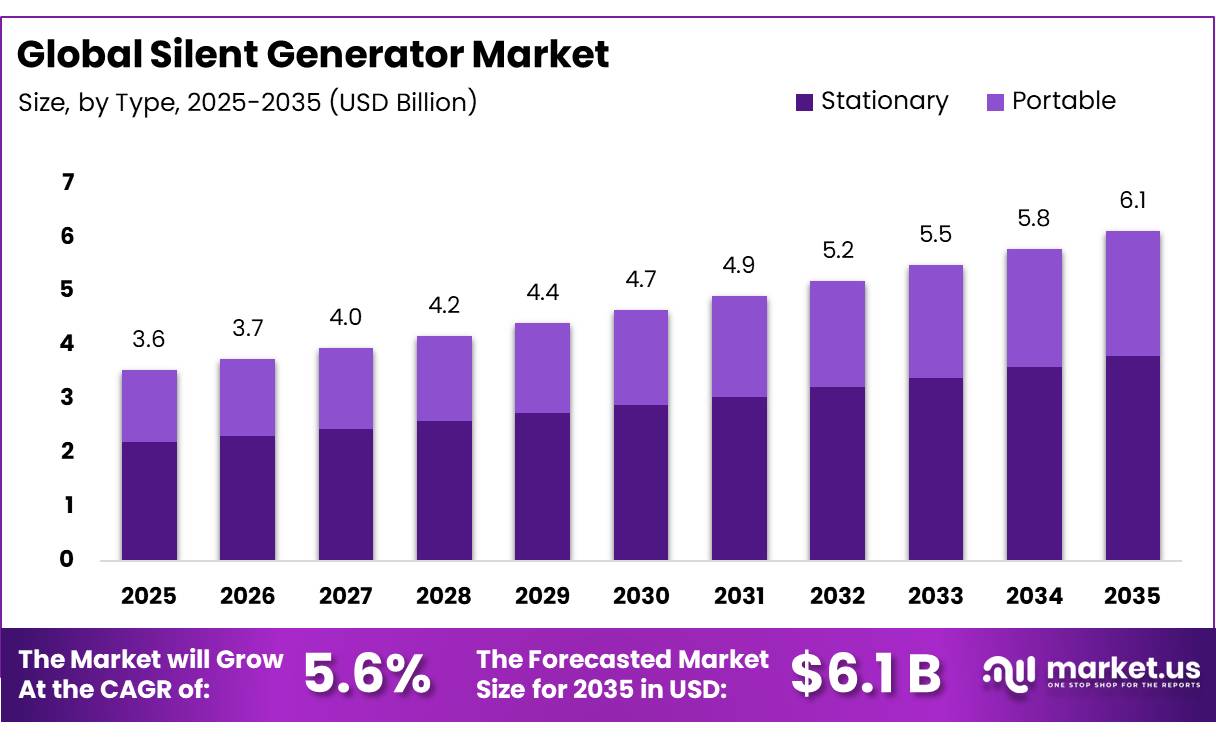
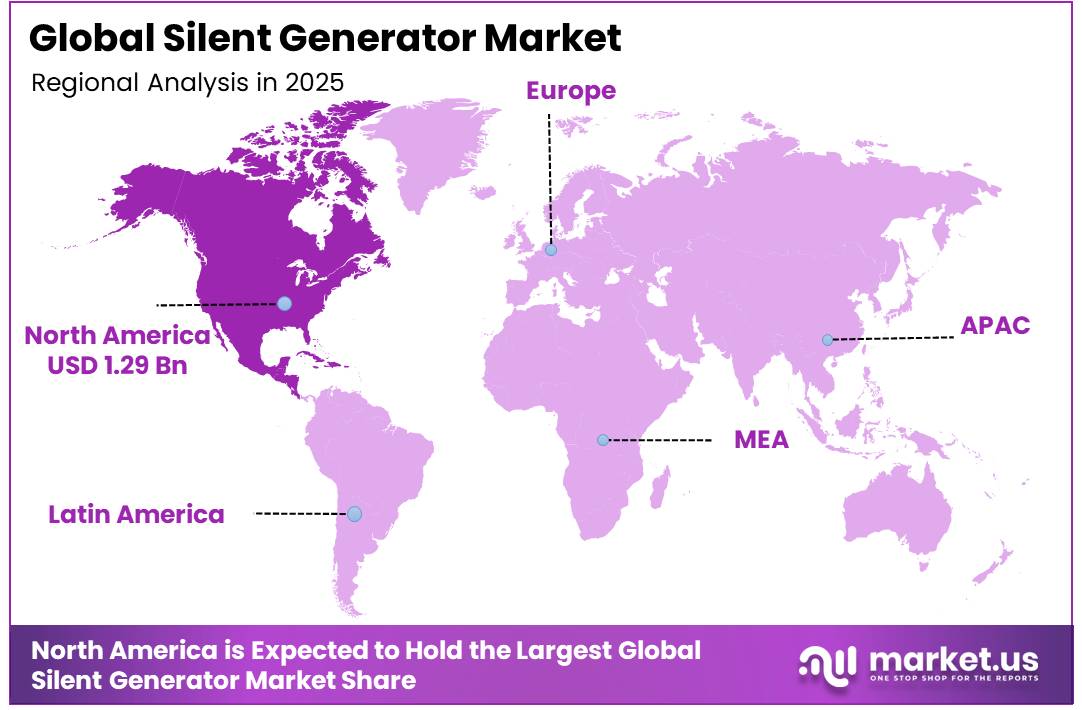
In 2025, the Global Silent Generator Market was valued at USD 3.6 billion, and between 2026 and 2035, this market is estimated to register a CAGR of 5.6%, reaching about USD 6.1 billion by 2035. North America held a dominant market position, capturing more than a 36.2% share, holding USD 1.29 billion in revenue.
Silent generators are backup power systems designed to provide reliable electricity with reduced operational noise through acoustic enclosures, vibration control, and improved engine technologies. These systems include portable and stationary units powered by diesel, natural gas, and other fuels for residential, commercial, industrial, healthcare, construction, and infrastructure applications. Growing dependence on uninterrupted electricity supply is increasing demand for compact, efficient, and low-noise generator solutions, especially in locations where grid reliability and noise regulations are critical.
- The International Energy Agency reported that global electricity consumption increased by an estimated 4.3% year-on-year in 2024, with demand growth expected to continue at an annual average rate of 3.9% during 2025 to 2027. This environment supports demand for backup generation equipment across data centers, industrial facilities, and essential services requiring continuous power availability.
Key Takeaways
- The global silent generator market was valued at USD 3.6 billion in 2025.
- The global silent generator market is projected to grow at a CAGR of 5.6% and is estimated to reach USD 6.1 billion by 2035.
- On the basis of type, the stationary segment dominated the silent generator market, constituting 62.00% of the total market share.
- Based on power rating, the up to 25 kVA segment dominated the silent generator market, with a substantial market share of around 34.00%.
- Among the end-users, the commercial sector held a major share in the silent generator market, accounting for 56.00% of the total market share.
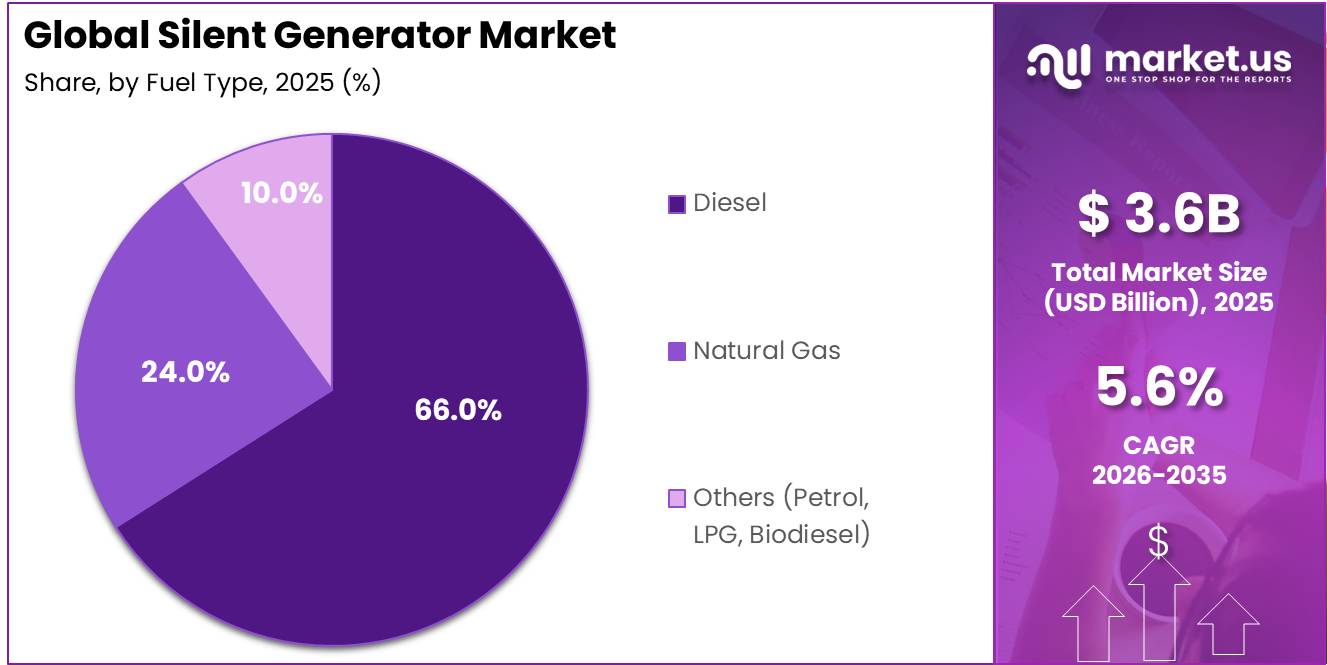
- Based on fuel type, diesel led the silent generator market, comprising 66.00% of the total market.
- Based on sound level, the silent segment dominated the market, accounting for 62.00% of the total market share.
- Among the phases, the three-phase segment held a major share in the silent generator market, accounting for 67.20% of the total market share.
- In 2025, North America was the most dominant region in the silent generator market, accounting for 36.20% of the total global market share.
Growth is driven by infrastructure expansion, extreme weather-related outages, construction activity, and the need for dependable emergency power. Silent generators are gaining adoption because they reduce sound impact while maintaining operational flexibility. Government resilience programs are also supporting distributed power systems.
- In June 2025, the United States Department of Energy announced more than USD 8 million through the Community Microgrid Assistance Partnership program to support microgrid innovation across 35 towns and villages, strengthening interest in localized and resilient power solutions.
Future opportunities are emerging through hybrid systems, cleaner fuels, remote monitoring, and integration with distributed energy resources. In the United States, the Department of Energy’s grid resilience initiatives include USD 5 billion in funding programs supporting technologies that improve electricity system reliability, including distributed energy resources and microgrid solutions. These initiatives create opportunities for advanced silent generators with improved fuel efficiency, lower emissions, digital controls, and flexible operation for residential, commercial, and industrial users.
Type Analysis
Stationary Generators Lead with 62.00% Due to Reliable Backup Power Demand
In 2025, Stationary held a dominant market position, capturing more than a 62.00% share of the silent generator market. Its leadership was supported by increasing demand from commercial buildings, industrial facilities, healthcare centers, data centers, and infrastructure projects requiring dependable backup electricity. Stationary generators provide higher operational stability, longer runtime, and continuous power support, making them suitable for locations where uninterrupted electricity availability is essential.
- For instance, in March 2025, according to the U.S. Department of Energy, the agency continued promoting resilient energy systems and distributed power solutions to strengthen electricity reliability across critical facilities.
Portable is the growing segment as users seek flexible and easily deployable power solutions for residential applications, construction activities, outdoor operations, and temporary facilities. Portable silent generators offer easier transportation, compact design, reduced noise, and convenient operation, supporting their adoption where mobility and quick power access are important.
Power Rating Analysis
Up to 25 kVA Generators Lead with 34.00% Through Small-Scale Backup Demand
In 2025, Up to 25 kVA held a dominant market position, capturing more than a 34.00% share of the silent generator market. Its leadership was supported by demand from residential buildings, small commercial facilities, retail outlets, offices, and temporary power requirements. These generators offer compact design, lower fuel consumption, easier installation, and suitable backup capacity for users requiring reliable electricity without large infrastructure investment.
- For instance, in May 2025, according to the U.S. Department of Energy, the agency highlighted continued efforts to improve power resilience through distributed energy solutions and backup power technologies for critical facilities.
25–49 kVA is the growing segment as demand increases from small and medium commercial establishments, construction sites, healthcare facilities, and business operations requiring higher backup capacity. These generators provide a balance between portability, operating efficiency, and extended power support, making them suitable for users needing more capacity while maintaining lower installation complexity.
End-User Analysis
Commercial Sector Leads with 56.00% Due to Continuous Power Requirements
In 2025, Commercial held a dominant market position, capturing more than a 56.00% share of the silent generator market. Its leadership was supported by growing demand from offices, retail spaces, hotels, healthcare facilities, educational institutions, and commercial infrastructure requiring reliable backup electricity. Silent generators are preferred in commercial environments because they provide dependable power with reduced noise levels, supporting operations where customer comfort, workplace conditions, and regulatory requirements are important.
- For instance, in June 2025, according to the U.S. Department of Energy, the agency continued supporting energy resilience programs focused on strengthening reliable electricity access and improving backup power capabilities for critical facilities.
Residential is the growing segment as households increasingly require uninterrupted electricity for appliances, security systems, home offices, and essential services. Rising awareness of power reliability, compact generator designs, lower noise operation, and easier installation are encouraging adoption among residential users seeking convenient backup power solutions.
Fuel Type Analysis
Diesel Generators Lead with 66.00% Due to High Reliability and Wide Industrial Use
In 2025, Diesel held a dominant market position, capturing more than a 66.00% share of the silent generator market. Its leadership was supported by strong demand from commercial buildings, industrial facilities, construction sites, healthcare centers, and emergency backup applications. Diesel generators are preferred because they provide high power output, dependable operation, longer running capability, and availability in areas where grid electricity is unstable. Their established fuel infrastructure and suitability for heavy-duty applications continue to support procurement across multiple sectors.
- For instance, in April 2025, according to the International Energy Agency, global electricity security remained a key focus as power systems faced rising demand, reinforcing the importance of reliable backup generation solutions for critical operations.
Natural Gas is the growing segment as users increasingly seek cleaner fuel alternatives with lower emissions and quieter operation. Natural gas generators support commercial facilities, residential applications, and distributed power systems where fuel availability is reliable. Growing focus on emission reduction, improved efficiency, and cleaner energy solutions is encouraging adoption of natural gas-based silent generators.
Sound Level Analysis
Silent Generators Lead with 62.00% Due to Reduced Noise and Wider Adoption
In 2025, Silent held a dominant market position, capturing more than a 62.00% share of the silent generator market. Its leadership was supported by increasing demand from residential, commercial, healthcare, hospitality, and office environments where noise control is important. Silent generators use acoustic enclosures, vibration reduction systems, and improved engine designs to provide reliable backup power while maintaining comfortable operating conditions. Their suitability for noise-sensitive locations continues to support adoption across urban and commercial applications.
- For instance, in March 2025, according to the U.S. Department of Energy, the agency continued promoting resilient electricity systems through distributed energy initiatives aimed at improving reliability for critical facilities.
Super Silent is the growing segment as users increasingly require lower operational noise in hospitals, residential complexes, data centers, and specialized commercial locations. These generators provide enhanced sound reduction through advanced enclosure technology and improved mechanical designs. Growing focus on urban regulations, workplace comfort, and environmentally considerate operations is encouraging demand for super silent generator solutions.
Phase Analysis
Three-Phase Generators Lead with 67.20% Due to Higher Power Demand
In 2025, Three-Phase held a dominant market position, capturing more than a 67.20% share of the silent generator market. Its leadership was supported by strong demand from industrial facilities, commercial buildings, data centers, construction sites, and large infrastructure projects requiring stable and efficient power distribution. Three-phase generators provide better load handling, improved operational efficiency, and suitability for high-power applications, making them preferred for continuous and heavy-duty backup requirements.
- For instance, in May 2025, according to the U.S. Department of Energy, continued investments in grid reliability and distributed energy resources highlighted the growing importance of dependable backup power solutions for critical electricity users.
Single-Phase is the growing segment as residential users, small offices, retail facilities, and compact businesses increasingly adopt backup power systems. These generators offer simpler installation, lower operating requirements, and suitable power capacity for household and light commercial applications. Growing demand for reliable electricity access and compact backup solutions is supporting wider adoption of single-phase silent generators.
Key Market Segments
By Type
- Stationary
- Portable
By Power Rating
- Up to 25 kVA
- 25–49 kVA
- 50–99 kVA
- 100–499 kVA
- 500 kVA and above
By End-User
- Residential
- Commercial
- Industrial
By Fuel Type
- Diesel
- Natural Gas
- Others (Petrol, LPG, Biodiesel)
By Sound Level
- Silent
- Super Silent
By Phase
- Single-Phase
- Three-Phase
Driver Analysis
AI-Driven Data Center Backup Power Buildout
Diesel generator capacity dedicated to data centers nearly tripled from 20 gigawatts in 2018 to 55 gigawatts in 2024, and by the end of 2025 more than 10,500 generator units had been permitted for data centers in Virginia alone, representing 27 gigawatts of capacity, equivalent to the electricity usage of roughly 20 million US households in a state with fewer than 4 million homes.
Goldman Sachs Research projects global data center power demand will climb from approximately 55 gigawatts currently to 84 gigawatts by 2027, with AI’s share of total data center workload rising from 14% to 27% over that window, directly correlating to accelerated backup generator procurement cycles as facility occupancy is expected to peak above 95% in late 2026.
This structural shift is moving generator OEM business models from selling standard industrial units toward selling fully engineered, site-specific acoustic packages bundled with extended service contracts, and it is the primary reason this driver carries the highest incremental CAGR weight in the 2026 baseline.
Drivers Impact Analysis
| Driver | (~) % Impact on CAGR | Geographic Relevance | Impact Timeline |
|---|---|---|---|
| AI-driven data center backup power buildout demanding acoustic-compliant gensets | +3.3% | North America core (Virginia, Oregon), EU, APAC hyperscale corridors | Short term (≤2 years) |
| Urban noise and Stage V emissions regulation forcing enclosure and engine upgrades | +2.2% | EU core, India metro zones, North America municipal codes | Medium term (2-4 years) |
| Power rental market expansion for construction, events, and grid-instability backup | +1.9% | India, APAC emerging, Africa/Middle East infrastructure corridors | Short term (≤2 years) |
| Hybrid battery-genset integration reshaping runtime and fuel-efficiency economics | +1.6% | Global core, early adoption North America and EU microgrids | Medium term (2-4 years) |
| Grid instability and peak-demand strain from electrification and EV charging load | +1.4% | North America, EU, India (peak demand approaching 300 GW) | Medium term (2-4 years) |
| Healthcare and critical-infrastructure resilience mandates for silent backup power | +1.1% | EU, North America, APAC hospital/data infrastructure hubs | Long term (≥4 years) |
Restraint Analysis
Community Opposition and Diesel-Permitting Backlash
Organized community opposition to diesel-generator-heavy data center backup infrastructure has escalated dramatically, with the number of local opposition groups tracked across the US rising from roughly 76 at the end of 2025 to 268 by April 2026 and further to 430 across more than 40 states by mid-2026, representing an estimated 525,000-plus members, nearly seven times the level tracked just six months earlier.
This opposition has produced concrete commercial consequences: Data Center Watch reported that opponents blocked or delayed at least 75 data center projects representing approximately USD 130 billion during the first quarter of 2026 alone, the highest quarterly total since tracking began in 2023, while a separate analysis estimated community opposition has blocked USD 18 billion and delayed a further USD 46 billion in cumulative project value.
Bloomberg reporting cited in industry coverage estimates more than half of all US data center projects planned for 2026 face delays attributable to permitting, zoning, power procurement, or equipment shortages, with diesel-generator noise and emissions cited as a top-three community grievance alongside water usage and local electricity price impacts.
Restraint Impact Analysis
| Restraint | (~) % Impact on CAGR Forecast | Geographic Relevance | Impact Timeline |
|---|---|---|---|
| Power electronics and control-module lead-time bottleneck | -2.7% | Global, most acute North America and EU OEM base | Short term (≤2 years) |
| Community opposition and diesel-permitting backlash near data centers | -2.2% | US core (Virginia, Texas), EU municipal zones | Short term (≤2 years) |
| Air-quality and Clean Air Act emissions compliance exposure | -1.9% | US core, EU regulated metros, India CPCB zones | Medium term (2-4 years) |
| Copper and alternator input-cost inflation compressing OEM margins | -1.5% | Global, acute in India/APAC manufacturing base | Medium term (2-4 years) |
| Statutory runtime-hour caps limiting non-emergency revenue use cases | -1.2% | US core (TCEQ, EPA), EU comparable frameworks | Long term (≥4 years) |
| Acoustic-enclosure engineering cost inflation from tightening noise codes | -1.0% | India metro zones, EU core, North America municipal | Medium term (2-4 years) |
Opportunity Analysis
Fuel-Cell and Hydrogen-Hybrid Genset Pivot
Unlike the current baseline driver of acoustic-compliant diesel procurement for data centers, a distinct future opportunity lies in pivoting toward fuel-cell and hydrogen-hybrid backup systems that eliminate the noise and emissions constraints driving today’s community-opposition and permitting friction altogether, a white space validated by concrete 2025-2026 commercial milestones including Bloom Energy’s April 2026 expansion with Oracle to support up to 2.8 gigawatts of solid-oxide fuel cell capacity and Microsoft’s 3 megawatt hydrogen fuel cell pilot with Plug Power in Latham, New York, which sustained a data center for 48 hours to prove diesel-replacement viability.
This is not a current driver because fuel cells remain a nascent, sub-1% share of the installed backup-power base, with the global fuel cell for data center market estimated at only around USD 361 million in 2026, meaning first movers who commit now can capture disproportionate share of a segment that is structurally forced to scale as diesel permitting friction intensifies.
The strategic monetization shift is significant: PEM fuel cells carry roughly USD 1,800 per kilowatt CapEx for backup applications versus far lower diesel benchmarks, but are increasingly justified where blocked or delayed permits make a zero-emission alternative the only path to project approval, effectively converting regulatory friction into demand for a premium-priced product category.
Because hydrogen supply infrastructure and cost curves remain early-stage, with hydrogen-blended dual-gas engines currently capped near 10 megawatts, full-scale commercial deployment is realistically a 2-4 year execution window for OEMs willing to invest now in fuel-cell integration partnerships.
Opportunity Impact Analysis
| Opportunity | (~) % Potential CAGR Upside | Geographic Relevance | Execution Window |
|---|---|---|---|
| Fuel-cell and hydrogen-hybrid genset pivot for zero-emission backup contracts | +2.8% | North America core, EU/Japan Tier IV green data centers | Medium term (2-4 years) |
| Generator fleet enrollment into virtual power plant grid-services markets | +2.3% | North America, EU high-renewable-penetration grids | Short term (≤2 years) |
| Predictive-maintenance-as-a-service subscription monetization | +2.0% | Global core, first-mover North America and EU fleets | Short term (≤2 years) |
| Bi-fuel/dual-gas retrofit-as-a-service for existing diesel fleets | +1.6% | North America, EU, APAC industrial retrofit corridors | Medium term (2-4 years) |
| Microgrid-as-a-service roll-up for underserved commercial and rural verticals | +1.4% | APAC emerging, Africa/Middle East, Latin America corridors | Long term (≥4 years) |
| M&A consolidation of regional silent-genset OEMs into acoustic-engineering platforms | +1.2% | India/APAC core, EU, North America | Medium term (2-4 years) |
Challenges Analysis
Diesel Technician and Field-Service Talent Shortage
The root structural vulnerability is a widening gap between the technical skillset required to install, calibrate, and repair increasingly complex silent-genset control systems and the shrinking pipeline of qualified diesel and generator-control technicians entering the trades, with US median annual technician compensation benchmarked near USD 60,640 as of 2024, a wage level increasingly insufficient to attract new entrants against competing skilled-trade sectors.
Industry operators are already responding with material capital commitments, one major fleet operator publicly committing USD 25 million specifically to recruit and train diesel technicians, an explicit signal that the labor shortfall is severe enough to warrant direct capital investment rather than incremental wage adjustment alone.
This shortage manifests operationally as extended service-response windows, with field-service postings for generator control specialists spanning entire multi-country regions such as APAC rather than localized single-market coverage, indicating service organizations are stretching thin technician rosters across wider geographic footprints, directly risking longer mean-time-to-repair intervals and eroding the reliability guarantees premium silent-generator brands depend on for data center and hospital-grade service contracts.
Challenges Impact Analysis
| Challenge | (~) % CAGR Friction | Geographic Relevance | Mitigation Horizon |
|---|---|---|---|
| Diesel technician and field-service talent shortage | -1.9% | North America, India/APAC, Middle East service corridors | Long term (≥4 years) |
| Acoustic engineering and noise-testing expertise scarcity | -1.4% | EU core, India metro zones, North America | Medium term (2-4 years) |
| Fragmented, low-tech field-service logistics for remote sites | -1.3% | APAC, Middle East, Africa remote/off-grid corridors | Medium term (2-4 years) |
| Multi-standard acoustic and emissions test compliance burden | -1.1% | Global, acute EU-India-North America cross-certification | Medium term (2-4 years) |
| Aftermarket parts counterfeiting and grey-market component risk | -0.9% | India/APAC core, Middle East, Africa distribution | Long term (≥4 years) |
| Rising fleet-data cybersecurity exposure from IoT-enabled monitoring | -0.8% | North America, EU, APAC connected-fleet deployments | Medium term (2-4 years) |
Geopolitical Impact Analysis
Fuel Supply Disruption and Trade Fragmentation Reshape Silent Generator Manufacturing
Current geopolitical tensions are reshaping the silent generator market through diesel-price volatility, disrupted maritime routes, trade barriers, and stronger demand for localized emergency power. Generator manufacturers depend on engines, alternators, acoustic enclosures, electronic controls, steel components, and internationally traded fuels. Conflict or trade restrictions affecting these inputs can increase equipment costs, extend delivery schedules, and influence procurement decisions across commercial and industrial users.
In March 2026, the International Energy Agency reported that conflict in the Middle East had reduced crude oil and petroleum-product flows through the Strait of Hormuz from around 20 million barrels per day to near standstill. Crude prices moved above USD 100 per barrel, while diesel and liquefied petroleum gas prices increased sharply. This creates higher operating-cost exposure for diesel and mixed-fuel silent generators.
Shipping instability creates additional pressure. United Nations Trade and Development reported that Suez Canal tonnage remained 70% below 2023 levels in May 2025, while vessel rerouting increased tonne-miles by 5.9% during 2024. Longer routes can delay imported engines, alternators, control panels, and soundproofing materials.
Trade fragmentation is also encouraging localization. The World Trade Organization reported that new tariffs and import measures affected USD 2,640 billion of global goods imports between October 2024 and October 2025. Manufacturers are responding through regional assembly, multiple component suppliers, larger spare-parts inventories, and greater interest in natural-gas and hybrid generator systems.
Regional Analysis
North America Leads with 36.20% Share and USD 1.29 Billion Revenue
In 2025, North America held a dominant position in the silent generator market, capturing 36.20% of global revenue and generating USD 1.29 billion. Regional leadership was supported by weather-related outages, commercial infrastructure, data-centre expansion, and demand for backup power. The United States Energy Information Administration reported that customers experienced an average of 11 hours of electricity interruptions in 2024, nearly double the preceding decade’s annual average. These conditions support stationary, diesel, and three-phase silent generator installations across healthcare, retail, offices, construction, and industrial facilities.
Europe is the fastest-growing region, supported by tighter noise controls, energy-security planning, expanding data centres, and demand for lower-emission backup systems. The International Energy Agency reported that European Union electricity demand rose by 1% in 2025 and is forecast to increase by about 300 terawatt-hours through 2030. This outlook supports natural-gas, hybrid, digitally monitored, and super-silent generators across commercial buildings, utilities, healthcare facilities, and critical infrastructure.
Key Regions and Countries Covered
- North America
- The US
- Canada
- Europe
- Germany
- France
- The UK
- Spain
- Italy
- Russia & CIS
- Rest of Europe
- APAC
- China
- Japan
- South Korea
- India
- ASEAN
- Rest of APAC
- Latin America
- Brazil
- Mexico
- Rest of Latin America
- Middle East & Africa
- GCC
- South Africa
- Rest of MEA
Key Players Analysis
Silent generator manufacturers focus on improving fuel efficiency, noise reduction technology, power reliability, and digital monitoring capabilities to strengthen their competitive position. Key participants include Cummins Inc., Caterpillar Inc., Rolls-Royce Holdings plc (mtu), Generac Power Systems, Inc., Atlas Copco AB, Honda Motor Co., Ltd., Rehlko (formerly Kohler Energy), Yamaha Motor Co., Ltd., HIMOINSA S.L., Yanmar Holdings Co., Ltd., and Wärtsilä Corporation. Companies compete through portable and stationary generator solutions, advanced engine technologies, emission-compliant systems, and customized backup power solutions for residential, commercial, industrial, healthcare, and data center applications.
In 2026, competition increasingly focused on high-capacity power systems, cleaner fuel options, digital controls, and solutions for mission-critical facilities. In March 2026, Generac Power Systems introduced its SD1250 and SD1500 diesel generators, designed for mission-critical applications with improved fuel efficiency and reduced emissions. In January 2026, Caterpillar announced collaborations focused on integrated power solutions combining natural gas generation, energy storage, and carbon management for large-scale infrastructure applications. These developments show how major manufacturers are strengthening their market position through advanced generator technologies, reliability improvements, and expanded solutions for critical power requirements.
Market Key Players
- Cummins Inc.
- Caterpillar Inc.
- Rolls-Royce Holdings plc – mtu
- Generac Power Systems, Inc.
- Atlas Copco AB
- Honda Motor Co., Ltd.
- Rehlko – formerly Kohler Energy
- Yamaha Motor Co., Ltd.
- HIMOINSA S.L.
- Yanmar Holdings Co., Ltd.
- Wärtsilä Corporation
- Briggs & Stratton Corporation
- Greaves Cotton Limited
- Jakson Group
- Kingway Group
Key Development
- In March 2026, Generac Power Systems, Inc. introduced the SD1250 and SD1500 diesel generator models designed for mission-critical power applications. The new generators feature Perkins 5012 engines focused on improved fuel efficiency, reduced emissions, and reliable operation for industrial and high-demand power environments.
- In May 2026, Wärtsilä Corporation announced an investment of approximately EUR 90 million to expand its technical production capacity by 30% at its Sustainable Technology Hub in Finland and across its global supply chain. The expansion supports higher engine production volumes and growing demand from energy and marine sectors.
- In June 2026, Generac Power Systems, Inc. acquired a facility in Belvidere, Illinois, to expand large-megawatt generator packaging capacity. The expansion supports the company’s growing focus on commercial and industrial power applications requiring reliable backup generation solutions.
Report Scope
| Report Features | Description |
|---|---|
| Market Value (2025) | USD 3.6 Bn |
| Forecast Revenue (2035) | USD 6.1 Bn |
| CAGR (2026-2035) | 5.6% |
| Base Year for Estimation | 2025 |
| Historic Period | 2020-2024 |
| Forecast Period | 2026-2035 |
| Report Coverage | Revenue Forecast, Market Dynamics, Competitive Landscape, Recent Developments |
| Segments Covered | By Type (Portable and Stationary), By Power Rating (Up to 25 kVA, 25–49 kVA, 50–99 kVA, 100–499 kVA, and 500 kVA and above), By End-User (Residential, Commercial, and Industrial), By Fuel Type (Diesel, Natural Gas, and Others (Petrol, LPG, Biodiesel)), By Sound Level (Silent and Super Silent), By Phase (Single-Phase and Three-Phase) |
| Regional Analysis | North America – The US & Canada; Europe – Germany, France, The UK, Spain, Italy, Russia & CIS, Rest of Europe; APAC– China, Japan, South Korea, India, ASEAN & Rest of APAC; Latin America– Brazil, Mexico & Rest of Latin America; Middle East & Africa– GCC, South Africa, & Rest of MEA |
| Competitive Landscape | Cummins Inc., Caterpillar Inc., Rolls-Royce Holdings plc – mtu, Generac Power Systems, Inc., Atlas Copco AB, Honda Motor Co., Ltd., Rehlko – formerly Kohler Energy, Yamaha Motor Co., Ltd., HIMOINSA S.L., Yanmar Holdings Co., Ltd., Wärtsilä Corporation, Briggs & Stratton Corporation, Greaves Cotton Limited, Jakson Group, Kingway Group. |
| Customization Scope | Customization for segments, region/country-level will be provided. Moreover, additional customization can be done based on the requirements. |
| Purchase Options | We have three licenses to opt for: Single User License, Multi-User License (Up to 5 Users), Corporate Use License (Unlimited Users and Printable PDF) |





































