


Market Overview
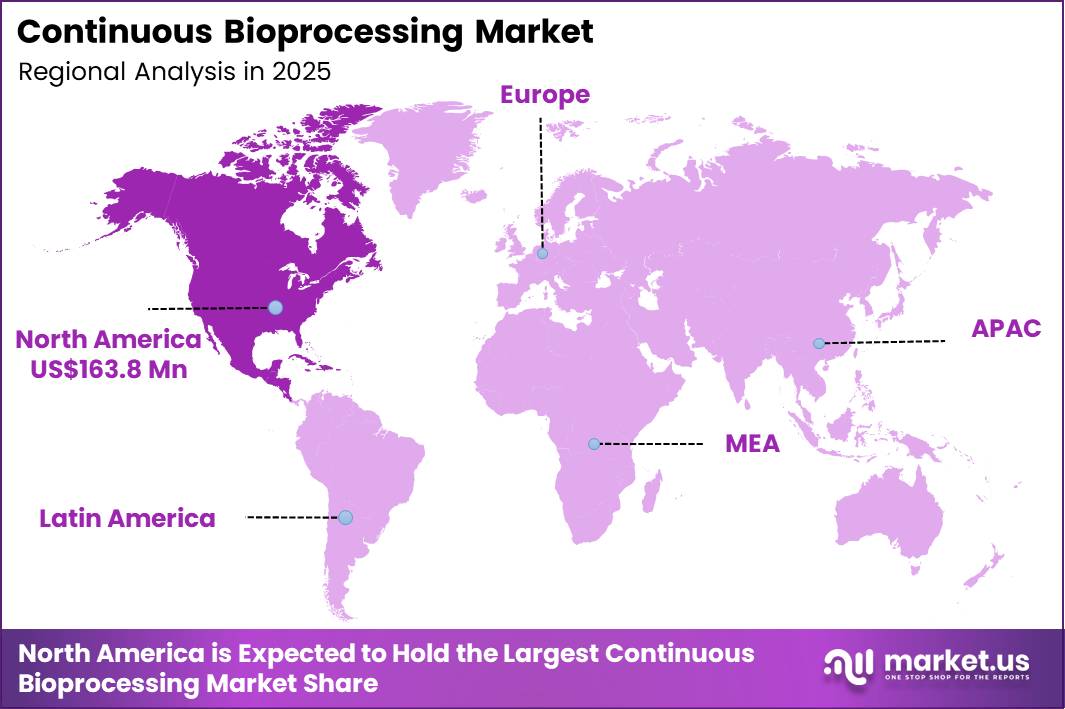
Global Continuous Bioprocessing Market size is expected to be worth around US$ 1,758.3 Million by 2035 from US$ 396.7 Million in 2025, growing at a CAGR of 16.2% during the forecast period from 2026 to 2035. In 2025, North America led the market, achieving over 41.3% share with a revenue of US$ 163.82 Million.
The global Continuous Bioprocessing Market is gaining momentum as biopharmaceutical manufacturers increasingly adopt advanced manufacturing technologies to improve production efficiency, product quality, and process flexibility.
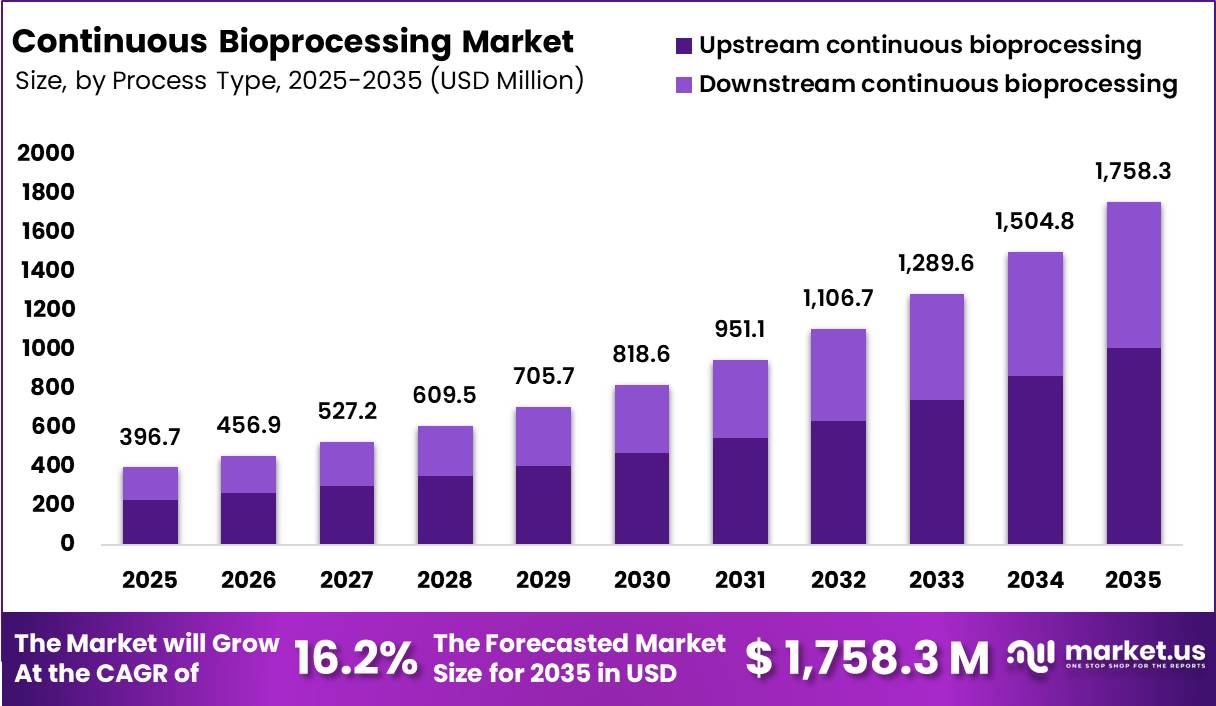
Continuous bioprocessing integrates upstream cell culture, downstream purification, and real-time process monitoring into a seamless manufacturing workflow, reducing production time, minimizing waste, and supporting consistent product quality. The technology is particularly valuable for the production of monoclonal antibodies, vaccines, recombinant proteins, cell and gene therapies, and biosimilars.
Growing demand for biologic medicines is a key factor supporting market expansion. According to the U.S. Food and Drug Administration (FDA), biologics require highly controlled manufacturing environments, and continuous manufacturing is recognized as an advanced approach that enhances quality assurance through real-time monitoring while improving manufacturing efficiency. The FDA’s ICH Q13 guidance, finalized in 2023, provides a harmonized regulatory framework for continuous manufacturing, encouraging broader industry adoption.
Numerical indicators further highlight the market opportunity. The FDA has approved more than 60 biosimilar products in the United States, increasing the need for efficient and cost-effective biologics manufacturing platforms.
Additionally, the National Center for Biotechnology Information (NCBI) reports that at least 19 commercial biologic products had incorporated continuous operations such as perfusion cell culture, demonstrating the technology’s growing commercial relevance. Continuous bioprocessing also supports smaller facility footprints, lower capital investment, and improved manufacturing sustainability.
As pharmaceutical companies invest in digital process control, automation, and Process Analytical Technology (PAT), continuous bioprocessing is expected to become a critical manufacturing strategy for next-generation biologics, strengthening supply chain resilience and accelerating access to innovative therapies worldwide.
Key Takeaways
- Market Size: Global Continuous Bioprocessing Market size is expected to be worth around US$ 1,758.3 Million by 2035 from US$ 396.7 Million in 2025.
- Market Share: The market is growing at a CAGR of 16.2% during the forecast period from 2026 to 2035.
- Process Type: The upstream continuous bioprocessing segment dominates the Continuous Bioprocessing Market, accounting for 57.6% of the market share in 2025.
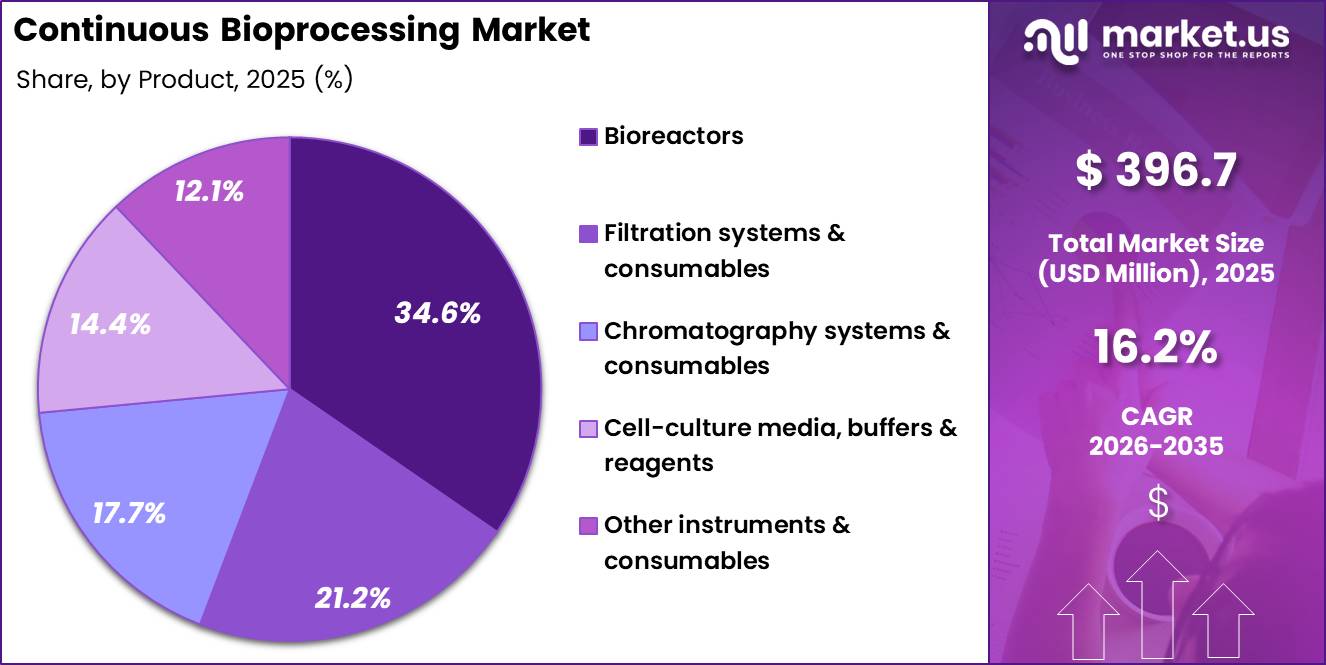
- Product: The bioreactors segment leads the Continuous Bioprocessing Market with 34.6% market share in 2025.
- End-user: The pharmaceutical & biotechnology companies segment dominates the Continuous Bioprocessing Market with 44.5% market share in 2025.
- Application: The monoclonal antibodies (mAbs) segment holds the largest share of the Continuous Bioprocessing Market, accounting for 40.1% in 2025.
- Regional Analysis: In 2025, North America accounted for the largest share of the continuous bioprocessing market, contributing over 41.3% of global revenue and reaching approximately US$ 163.82 million.
Process Type Analysis
Upstream Continuous Bioprocessing Leads the Process Type Segment.
The upstream continuous bioprocessing segment dominates the Continuous Bioprocessing Market, accounting for 57.6% of the market share in 2025. The leadership of this segment is driven by increasing adoption of continuous cell culture technologies that improve production efficiency, reduce manufacturing costs, and deliver consistent product quality.
Biopharmaceutical manufacturers are investing in perfusion-based processes and advanced bioreactor systems to increase productivity while minimizing downtime associated with batch processing. Continuous upstream operations enable higher cell densities, efficient nutrient utilization, and stable product output, making them particularly suitable for large-scale manufacturing of biologics and biosimilars.
Growing regulatory support for advanced manufacturing approaches and the integration of process analytical technologies (PAT) further strengthen the adoption of continuous upstream production. In addition, increasing demand for flexible manufacturing facilities capable of producing multiple biologic products encourages pharmaceutical companies to modernize upstream operations.
The downstream continuous bioprocessing segment holds 42.4% of the market in 2025 and continues to gain momentum as manufacturers seek end-to-end continuous manufacturing solutions. Advances in continuous chromatography, filtration, viral inactivation, and purification technologies are improving product recovery while reducing processing time and operational costs.
As downstream technologies become more integrated with upstream systems, this segment is expected to witness steady expansion across commercial biopharmaceutical manufacturing.
Product Analysis
Bioreactors Lead the Product Segment.
The bioreactors segment leads the Continuous Bioprocessing Market with 34.6% market share in 2025, supported by rising deployment of single-use and perfusion bioreactor technologies in commercial biologics manufacturing. Continuous bioprocessing depends heavily on advanced bioreactor systems that maintain stable operating conditions, optimize cell growth, and improve product consistency.
Manufacturers are increasingly investing in automated and digitally connected bioreactors equipped with real-time monitoring capabilities to enhance process control and reduce production variability. The growing pipeline of monoclonal antibodies, recombinant proteins, and cell-based therapies further accelerates demand for high-performance bioreactor platforms capable of supporting scalable continuous production.
The filtration systems & consumables segment accounts for 21.2%, benefiting from increased demand for continuous clarification and sterile filtration technologies. Chromatography systems & consumables represent 17.7%, driven by continuous purification requirements that improve yield and operational efficiency.
Cell-culture media, buffers & reagents contribute 14.4%, reflecting the importance of maintaining uninterrupted cell culture performance throughout continuous manufacturing. Meanwhile, other instruments & consumables, holding 12.1%, include sensors, sampling systems, tubing, connectors, and automation components that support integrated process monitoring, control, and workflow optimization across modern continuous bioprocessing facilities.
End-user Analysis
Pharmaceutical & Biotechnology Companies Lead the End-user Segment.
The pharmaceutical & biotechnology companies segment dominates the Continuous Bioprocessing Market with 44.5% market share in 2025. The leadership of this segment is attributed to increasing investments in advanced biologics manufacturing, expanding pipelines of monoclonal antibodies, vaccines, gene therapies, and recombinant proteins, and the need to improve manufacturing efficiency.
Large pharmaceutical and biotechnology organizations are adopting continuous bioprocessing to enhance productivity, reduce operational costs, improve product consistency, and accelerate commercial-scale production.
Integration of automation, digital monitoring, and real-time process control enables these companies to achieve higher manufacturing flexibility while meeting stringent regulatory quality requirements. Continuous production also supports faster scale-up from clinical to commercial manufacturing, making it an attractive strategy for biologic developers.
The CDMOs / CROs segment continues to experience strong growth as outsourcing of biologics manufacturing expands globally. Contract organizations are investing in continuous manufacturing platforms to provide flexible, cost-effective, and scalable production services for multiple clients while shortening development timelines.
The academic & research institutes segment also contributes significantly by advancing process development, pilot-scale manufacturing, and technology innovation. Universities and research organizations increasingly collaborate with industry partners to optimize continuous manufacturing technologies, validate novel production methods, and support workforce development for next-generation bioprocessing.
Application Analysis
Monoclonal Antibodies (mAbs) Lead the Application Segment.
The monoclonal antibodies (mAbs) segment holds the largest share of the Continuous Bioprocessing Market, accounting for 40.1% in 2025. The dominance of this segment is supported by the growing global demand for antibody-based therapies used in oncology, autoimmune disorders, inflammatory diseases, and rare conditions.
Continuous bioprocessing enables manufacturers to achieve higher production yields, maintain consistent product quality, and reduce manufacturing costs, making it particularly well suited for large-scale mAb production.
Increasing approvals of biologics and biosimilars, combined with investments in high-productivity perfusion technologies and integrated continuous purification systems, continue to strengthen this segment. Pharmaceutical companies are increasingly adopting continuous manufacturing to accelerate production timelines while maintaining regulatory compliance and supply reliability.
The vaccines and viral vectors segment is expanding steadily as manufacturers seek flexible and scalable production platforms capable of supporting rapid vaccine deployment and advanced gene therapy manufacturing. Continuous technologies improve process efficiency, reduce facility footprints, and enhance manufacturing responsiveness.
The other biologics segment, which includes recombinant proteins, enzymes, cytokines, and emerging biologic therapies, also contributes substantially to market growth. Increasing research activity, expanding clinical pipelines, and continuous improvements in integrated manufacturing technologies are expected to support sustained adoption across diverse biologic applications.
Key Market Segments
By Process Type
- Upstream continuous bioprocessing
- Downstream continuous bioprocessing
By Product
- Bioreactors
- Filtration systems & consumables
- Chromatography systems & consumables
- Cell‑culture media, buffers & reagents
- Other instruments & consumables
By End-user
- Pharmaceutical & biotechnology companies
- CDMOs / CROs
- Academic & research institutes
By Application
- Monoclonal antibodies (mAbs)
- Vaccines and viral vectors
- Other biologics
Drivers
Regulatory normalization under ICH Q13 and FDA advanced manufacturing pathways.
The strongest near-term demand catalyst is not purely technical; it is regulatory de-risking. The FDA’s final implementation of ICH Q13 established a formal framework for continuous manufacturing of therapeutic proteins, including expectations around process dynamics, material characterization, integrated equipment design, disturbance management, and real-time monitoring, which materially lowers the uncertainty premium that previously delayed investment committees and CMC teams from approving continuous-platform capex.
This is reinforced by the FDA’s Emerging Technology Program, updated in February 2026, which gives sponsors a defined route to engage regulators before filing, helping compress development-to-submission cycles for novel continuous set-ups and reducing the probability of late-stage comparability or validation redesign.
In practical market terms, this changes business models from “technology evaluation” to “platform deployment”: vendors can sell not only hardware but validation packages, digital control stacks, and compliance support, while biomanufacturers can justify multi-product continuous assets with better approval visibility and lower regulatory execution risk.
| Driver | (~) % Impact on CAGR Forecast | Geographic Relevance | Impact Timeline |
|---|---|---|---|
| Regulatory normalization under ICH Q13 and FDA advanced manufacturing pathways | +2.3% | North America core, EU, Japan, APAC regulated export hubs | Short term (≤ 2 years) |
| Biosimilar economics forcing lower biologics CoGS | +2.0% | EU, India, South Korea, U.S. biosimilar corridors | Medium term (2-4 years) |
| Single-use perfusion and intensified upstream productivity | +1.8% | North America core, Western Europe, Singapore, South Korea | Medium term (2-4 years) |
| CDMO adoption of flexible multi-client continuous lines | +1.5% | U.S., EU, India, China spill-over | Short term (≤ 2 years) |
| PAT, automation, and real-time control improving batch-release economics | +1.4% | North America, EU, Japan, advanced APAC sites | Medium term (2-4 years) |
| Supply-chain resilience and regional biologics manufacturing build-out | +1.2% | U.S., EU, India, Middle East emerging hubs | Long term (≥ 4 years) |
Challenges
PAT integration complexity.
Continuous bioprocessing depends on tightly coupled sensing, control, and release logic, but the practical bottleneck is not sensor availability alone; it is the difficulty of converting multivariate process data into stable, validated decisions across 24/7 production windows.
In 2026, many plants still face 8–15% effective engineering overhead from alarm tuning, model recalibration, and exception handling, which lowers the realized output gain from continuous operation and can trim roughly 1.4 percentage points from potential CAGR expansion.
The friction is most visible in North America and EU regulatory hubs, where firms are pushing toward real-time release but must still bridge gaps between PAT architecture, process models, and QA sign-off discipline.
The strategic response is a longer validation cycle for control strategies, heavier investment in sensor redundancy and digital twins, and a shift toward standardized control libraries that reduce site-by-site customization while preserving batch-to-continuous comparability.
| Challenge | (~) % CAGR Friction Drag | Geographic Relevance | Mitigation Horizon |
|---|---|---|---|
| PAT integration complexity | -1.4% | North America core, EU regulatory hubs, APAC biologics clusters | Medium term (2-4 years) |
| Skilled workforce gap | -1.2% | North America, EU, India, China, SEA | Long term (≥ 4 years) |
| Single-use supply volatility | -1.1% | North America, EU import lanes, APAC logistics corridors | Medium term (2-4 years) |
| Validation lifecycle burden | -0.9% | North America core, EU GMP hubs, Japan, South Korea | Long term (≥ 4 years) |
| Line-balancing and uptime risk | -1.0% | North America, Western Europe, APAC scale-up sites | Medium term (2-4 years) |
| Digital quality-data fragmentation | -0.8% | Global, strongest in multi-site CDMOs and multinational pharma | Medium term (2-4 years) |
Restraints
High upfront CapEx and retrofit complexity.
For most large molecule manufacturers, the shift from stainless, batch-centric plants to continuous bioprocessing implies discrete CapEx outlays of USD 60–150 million per site for new hybrid lines or extensive retrofits.
With line-level investments of USD 8–20 million for intensified perfusion bioreactors, continuous chromatography skids, PAT sensors, and automation layers, and this is occurring against a backdrop where global bioprocessing CapEx has already risen by roughly 25–35% between 2020 and 2024 due to inflation in specialty alloys, automation components, and cleanroom construction.
At a project level, retrofit programs now routinely face 9–15 month engineering and validation windows versus 6–9 months pre-pandemic, with contractor day-rates and electrical/instrumentation packages often 20–30% higher than 2019 baselines, stretching internal hurdle rates that are commonly set at 12–15% IRR for biologics manufacturing projects.
The result is that several Tier-2 and regional CDMOs defer fully continuous retrofits in favor of incremental intensification (e.g., 2–3x titer improvement in fed-batch with modest capex of USD 2–5 million per line), which pushes out volume and cost benefits from end-to-end continuous architectures by 3–5 years and clips the achievable market CAGR by an estimated 2.2% points versus a scenario with more frictionless financing and construction.
From a P&L standpoint, the heavier CapEx and longer payback (often 7–10 years versus 4–6 years expected for incremental debottlenecking) drive tighter CapEx committees, project reprioritizations toward near-term revenue molecules, and smaller order sizes for continuous platforms, compressing vendor order books and slowing installed-base growth in core markets through at least the early 2030s.
| Restraint | (~) % Impact on CAGR Forecast | Geographic Relevance | Impact Timeline |
|---|---|---|---|
| High upfront CapEx and retrofit complexity | -2.2% | North America core, EU, Japan, select China | Medium term (2–4 years) |
| Single-use hardware and resin supply constraints | -1.9% | North America, EU, APAC biologics hubs | Short to medium term (≤ 3 years) |
| Regulatory validation burden for fully continuous biologics | -1.7% | US, EU, UK, Japan | Medium to long term (3–6 years) |
| Skilled workforce and digital M&P capability gap | -1.4% | Emerging APAC, LatAm, CEE, Middle East | Medium term (2–4 years) |
| Legacy batch asset lock-in and conservative tech governance | -1.6% | Big Pharma in US, EU, Japan | Long term (≥ 4 years) |
| Biologics demand and pricing volatility impacting ROI | -1.3% | Global, with higher exposure in US and EU | Short to medium term (1–4 years) |
Opportunity
CDMO perfusion roll-up.
This is an opportunity rather than a baseline driver because current market growth already reflects gradual technology adoption by innovators, whereas the upside comes from a deliberate buy-and-build strategy in which equipment vendors, process integrators, or private-capital-backed platforms acquire underutilized biologics facilities and convert them into standardized continuous-capable CDMO nodes with shared control architecture, disposable flow paths, and multicolumn downstream trains.
BioPlan-linked industry reporting indicates 37.1% of facilities were evaluating upstream continuous bioprocessing in 2025 and 50.0% of CMOs planned to evaluate continuous upstream or perfusion technologies, suggesting a large conversion funnel that is not yet monetized at scale.
Because broader CDMO outsourcing has risen to about 40% of pharmaceutical manufacturing and biologics remains the fastest-growing outsourcing segment, a consolidator that converts even 8 to 12 midsized suites into high-intensity perfusion assets could lift asset utilization from roughly 35-45% to 60-75%.
Compress client tech-transfer timelines by 20-30%, and expand EBITDA margins by 400-700 basis points through labor dilution and smaller cleanroom footprints; at market level, that creates incremental supply elasticity above baseline demand and can reasonably add about 2.4% points to sector CAGR where sponsor pipelines are constrained more by flexible capacity than by molecule demand.
| Opportunity | (~) % Potential CAGR Upside | Geographic Relevance | Execution Window |
|---|---|---|---|
| CDMO perfusion roll-up | +2.4% | North America core, EU, Singapore, India | Short term (≤ 2 years) |
| Biosimilar cost-out platforms | +1.9% | EU, India, South Korea, LATAM | Short term (≤ 2 years) |
| ATMP hybrid continuous tools | +1.6% | UK, EU, US, Japan | Medium term (2-4 years) |
| mRNA and plasmid flow trains | +2.1% | US, EU, South Korea, China | Medium term (2-4 years) |
| Data/PAT recurring revenue | +1.4% | North America core, EU, APAC developed | Short term (≤ 2 years) |
| Emerging-market modular microplants | +1.8% | India, ASEAN, MENA, Africa | Long term (≥ 4 years) |
Regional Analysis
North America Led the Continuous Bioprocessing Market.
In 2025, North America accounted for the largest share of the continuous bioprocessing market, contributing over 41.3% of global revenue and reaching approximately US$ 163.82 million. The region’s leadership is supported by its advanced biopharmaceutical manufacturing infrastructure, strong adoption of continuous manufacturing technologies, and substantial investments in biologics production.
The United States remains the primary growth engine due to the presence of leading biopharmaceutical companies, contract development and manufacturing organizations (CDMOs), and research institutions focused on process innovation. Regulatory support for advanced manufacturing approaches and ongoing investments in process intensification further strengthen regional demand for continuous bioprocessing systems.
Europe represents the second-largest regional market, driven by robust pharmaceutical research, increasing production of biosimilars, and favorable government initiatives promoting innovative biomanufacturing. Countries such as Germany, Switzerland, the United Kingdom, and France continue to expand manufacturing capacity while encouraging sustainable and efficient production technologies.
The Asia-Pacific region is expected to record the fastest growth during the forecast period. Expanding biotechnology industries, rising healthcare expenditures, increasing biologics manufacturing capacity, and government support for domestic biopharmaceutical production in China, India, South Korea, and Singapore are accelerating market expansion. Growing investments in modern manufacturing facilities and contract manufacturing services are also contributing to regional growth.
Latin America and the Middle East & Africa currently account for smaller market shares but present emerging opportunities. Improvements in healthcare infrastructure, increasing vaccine and biologics production capabilities, and gradual investments in biotechnology manufacturing are expected to support steady market development across these regions over the coming years.
Key Regions and Countries
North America
- The US
- Canada
Europe
- Germany
- France
- The U.K.
- Italy
- Spain
- Russia & CIS
- Rest of Europe
Asia Pacific
- China
- India
- Japan
- South Korea
- ASEAN
- Australia & New Zealand
- Rest of Asia Pacific
Middle East & Africa
- GCC
- South Africa
- Rest of Middle East & Africa
Latin America
- Brazil
- Mexico
- Rest of Latin America
Key Player Analysis
The continuous bioprocessing market is moderately consolidated, with a mix of global life sciences technology providers, bioprocess equipment manufacturers, contract development and manufacturing organizations (CDMOs), and biopharmaceutical companies competing through innovation and integrated manufacturing solutions.
Competition is centered on improving productivity, reducing manufacturing costs, enabling end-to-end continuous processing, and supporting large-scale biologics production. Companies are prioritizing automation, digital process monitoring, single-use technologies, and advanced bioreactor systems to strengthen their market positions.
Leading participants such as Danaher Corporation (incl. Cytiva, Pall), Sartorius AG, Thermo Fisher Scientific Inc., Merck KGaA (MilliporeSigma), and Repligen Corporation continue to invest heavily in research and development to expand continuous upstream and downstream processing platforms. These companies emphasize workflow integration, smart process analytics, and strategic collaborations with biopharmaceutical manufacturers to improve manufacturing efficiency.
3M Company, Eppendorf SE, Bio-Rad Laboratories, Inc., GE Healthcare / Cytiva, and Asahi Kasei Bioprocess America, Inc. focus on product innovation, filtration technologies, cell culture solutions, and process optimization tools that enhance continuous manufacturing performance and regulatory compliance.
Meanwhile, Lonza Group, FUJIFILM Diosynth Biotechnologies, WuXi Biologics, AGC Biologics, and Biogen leverage their manufacturing expertise by expanding continuous bioprocessing capabilities through facility modernization, technology partnerships, and integrated development-to-commercialization services.
These organizations increasingly compete through ecosystem-based strategies that combine equipment, analytics, software, and manufacturing services into comprehensive bioprocessing solutions. Others contribute by introducing specialized technologies, niche process innovations, and customized solutions that broaden market competitiveness and support the industry’s transition toward continuous biologics manufacturing.
Top Key Players
-
- Danaher Corporation (incl. Cytiva, Pall)
- Sartorius AG
- Thermo Fisher Scientific Inc.
- Merck KGaA (MilliporeSigma)
- Repligen Corporation
- 3M Company
- Eppendorf SE
- Bio‑Rad Laboratories, Inc.
- GE Healthcare / Cytiva
- Asahi Kasei Bioprocess America, Inc.
- Lonza Group
- FUJIFILM Diosynth Biotechnologies
- WuXi Biologics
- AGC Biologics
- Biogen
- Others
Recent Developments
- In September 2025, Thermo Fisher Scientific completed the acquisition of Solventum’s Purification & Filtration business for approximately $4.0 billion, strengthening its upstream and downstream bioprocessing filtration capabilities and expanding its continuous biologics manufacturing portfolio.
- In April 2025, Sartorius entered into an agreement to acquire MatTek Corp for $80 million, expanding its cell culture and 3D microtissue portfolio used in advanced bioprocess development and continuous biomanufacturing research.
- In April 2026, Cytiva and Rockwell Automation launched the Figurate SCADA platform designed to enable 100% digital connectivity across multi-vendor bioprocessing systems, supporting real-time control and integration in continuous biopharmaceutical manufacturing.
Report Scope
| Report Features | Description |
|---|---|
| Market Value (2025) | US$ 396.7 Million |
| Forecast Revenue (2035) | US$ 1,758.3 Million |
| CAGR (2026-2035) | 16.2% |
| Base Year for Estimation | 2025 |
| Historic Period | 2020-2024 |
| Forecast Period | 2026-2035 |
| Report Coverage | Revenue Forecast, Market Dynamics, Competitive Landscape, Recent Developments |
| Segments Covered | By Process Type (Upstream continuous bioprocessing, Downstream continuous bioprocessing), By Product (Bioreactors, Filtration systems & consumables, Chromatography systems & consumables, Cell-culture media, buffers & reagents, Other instruments & consumables), By End-user (Pharmaceutical & biotechnology companies, CDMOs / CROs, Academic & research institutes), By Application (Monoclonal antibodies (mAbs), Vaccines and viral vectors, Other biologics) |
| Regional Analysis | North America – The US, Canada; Europe – Germany, France, U.K., Italy, Spain, Russia & CIS, Rest of Europe; Asia Pacific – China, India, Japan, South Korea, ASEAN, Australia & New Zealand, Rest of Asia Pacific; Middle East & Africa – GCC, South Africa, Rest of Middle East & Africa; Latin America – Brazil, Mexico, Rest of Latin America |
| Competitive Landscape | By Process Type (Upstream continuous bioprocessing, Downstream continuous bioprocessing), By Product (Bioreactors, Filtration systems & consumables, Chromatography systems & consumables, Cell-culture media, buffers & reagents, Other instruments & consumables), By End-user (Pharmaceutical & biotechnology companies, CDMOs / CROs, Academic & research institutes), By Application (Monoclonal antibodies (mAbs), Vaccines and viral vectors, Other biologics) |
| Customization Scope | Customization for segments, region/country-level will be provided. Moreover, additional customization can be done based on the requirements. |
| Purchase Options | We have three licenses to opt for: Single User License, Multi-User License (Up to 5 Users), Corporate Use License (Unlimited User and Printable PDF) |





































