


Report Overview
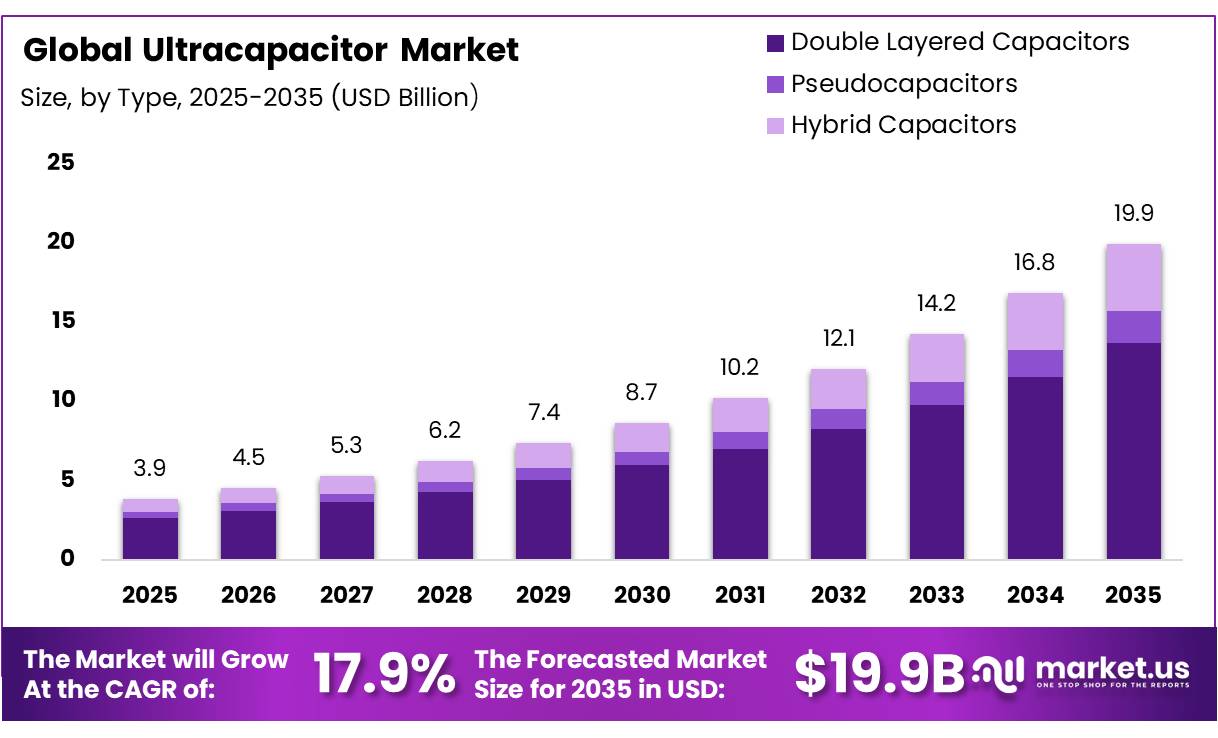
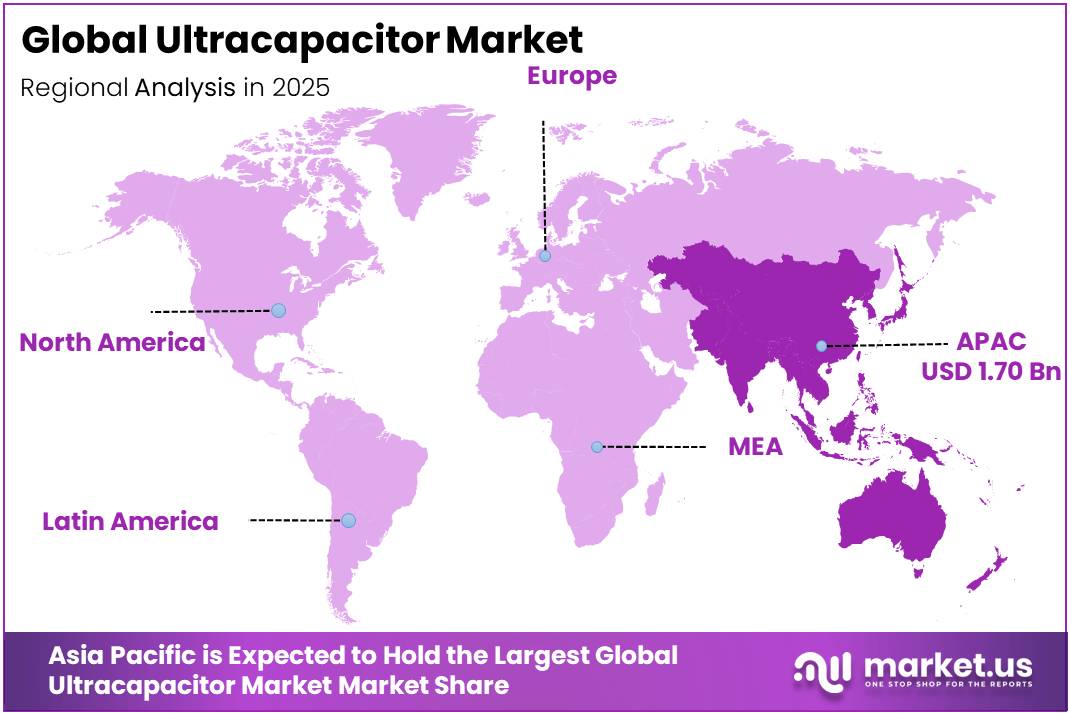
In 2025, the Global Ultracapacitor Market was valued at USD 3.9 billion, and between 2026 and 2035, this market is estimated to register a CAGR of 17.9%, reaching about USD 19.9 billion by 2035. Asia Pacific held a dominant market position, capturing more than a 44.2% share, holding USD 1.72 billion in revenue.
Ultracapacitors are electrochemical energy-storage devices designed for rapid charging, high-power discharge, and repeated cycling. They bridge the performance gap between conventional capacitors and batteries, supporting regenerative braking, voltage stabilization, backup power, industrial automation, renewable-energy smoothing, and electronic devices.
- Eaton states that its supercapacitors can provide service lives of up to 20 years and exceed 1 million charge-discharge cycles, strengthening their appeal in applications where reliability and frequent power pulses matter across global industrial markets.
Key Takeaways
- The global ultracapacitor market was valued at USD 3.9 billion in 2025.
- The global market is projected to grow at a CAGR of 17.9% and is estimated to reach USD 19.9 billion by 2035.
- On the basis of type, the double layered capacitors segment dominated the market, constituting 68.7% of the total market share.
- Based on the power rating, the 10 Volts to 25 Volts segment dominated the ultracapacitor market, with a substantial market share of around 31.2%.
- Based on the module type, multi-cell modules led the market, comprising 63.4% of the total market.
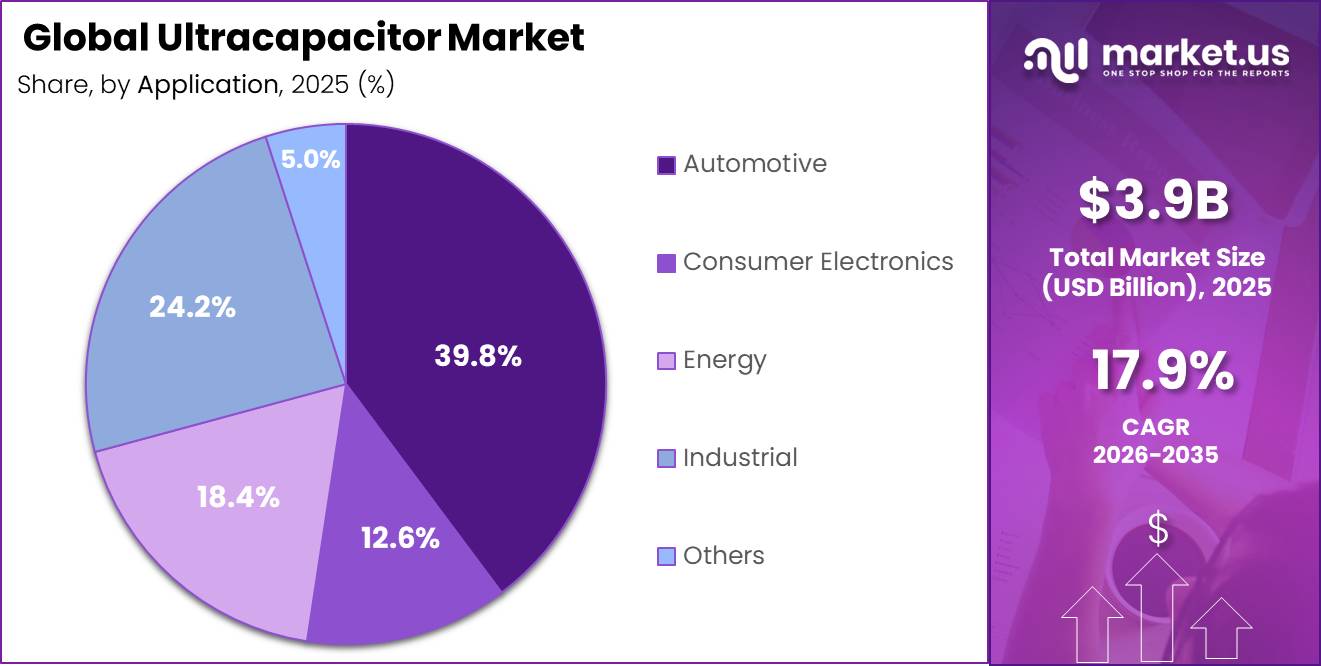
- Among the applications, the automotive segment held a major share in the ultracapacitor market, accounting for 39.8% of the market share.
- In 2025, Asia Pacific was the most dominant region in the ultracapacitor market, accounting for 44.2% of the total global market revenue.
The industrial landscape is moving toward larger modules, hybrid cells, lower equivalent series resistance, and systems integrated with batteries. Eaton’s XLR-16 industrial module, documented in July 2025, delivers 500 farads of capacitance, 38.6 kilowatts of power, and 18.2 watt-hours of stored energy. Such performance supports cranes, rail systems, automated equipment, marine starting, grid controls, and heavy vehicles that require fast energy capture and immediate release without accelerating battery degradation. These systems are increasingly paired with batteries to absorb power peaks, reduce heat, and improve asset utilization.
Growth is driven by transport electrification, renewable-power variability, data-center resilience, and demand for maintenance-light storage. The International Energy Agency reported in 2026 that electric-car sales reached 21 million units in 2025, with one in four new cars sold being electric. This expanding vehicle base creates opportunities for ultracapacitors in regenerative braking, peak-power assistance, start-stop systems, and battery-life extension. Further opportunities are emerging in smart meters, telecommunications, robotics, and short-duration grid services.
Government-backed research is also improving materials, manufacturability, and commercialization. In January 2025, the United States Department of Energy announced up to $8 million for pre-production design innovations in energy-storage technologies. Separately, its coal-based supercapacitor-materials project received $1 million in federal funding and $250,000 in non-federal support. The European Commission’s IONOLOGIC ultracapacitor project carries €2,351,250 in funding and runs through February 2028, supporting advanced ion-based devices and future power-management applications.
Type Analysis
Double Layered Capacitors Dominated the Ultracapacitor Market
Double layer capacitors were the predominant type of ultracapacitors used in the year 2025. The key factors behind the dominance of this particular category are their higher power density, quick charge/discharge properties, and long life cycles as compared to other energy storing devices. This kind of capacitor is frequently used in cases where short bursts of energy are needed along with high reliability, such as in regenerative braking systems, power backups, and industrial machinery.
- According to the International Energy Agency (IEA), published in April 2025, global electric car sales surpassed 17 million units in 2024, reinforcing the growing demand for advanced energy storage technologies that can support electrification trends.
The growth in the market share of double layer capacitors is likely to gain momentum through investments in electric vehicles, use of renewable sources of energy, and industrial automation. Further innovations focused on increasing energy densities, minimizing internal resistance, and overall efficiency are likely to expand their scope of application within various industry verticals. Furthermore, the development of advanced technologies incorporating batteries and ultracapacitors as hybrid systems is also expected to fuel the growth of the double-layered capacitor segment.
Power Rating Analysis
10 Volts to 25 Volts Led the Ultracapacitor Market
The 10 volts to 25 volts range held the leading position in the ultracapacitor market, contributing 31.2% to the overall market share in 2025. The predominance of the 10 volts to 25 volts range is owed to its balanced combination of efficient voltage capacity, energy efficiency, and space-efficient nature that makes them applicable to diverse uses. Due to their capability of delivering energy quickly and efficiently, ultracapacitors in this range find wide application in automotive start-stop systems, regenerative braking systems, backup power in industrial settings, and handling devices. Their easy integration into electronic architecture contributes to the rising demand for such ultracapacitors.
The growth in the 10 Volts to 25 Volts segment is projected to be driven by growing electrification, rise in automation in industries, and increasing adoption of energy efficient technologies. Continuous innovation in terms of improvements related to energy density, heat resistance, and module efficiency is likely to increase the usability of ultracapacitors in the voltage range. Moreover, rising use of hybrid energy storage solutions in transport and industries is likely to drive the market for 10 Volts to 25 Volts ultracapacitors over the forecast period.
Module Type Analysis
Multi-Cell Modules Dominated the Ultracapacitor Market
The multi-cell module segment constituted the largest portion of the ultracapacitors market, comprising 63.4% of the entire market share in 2025. The reason behind the high share is that multi-cell modules are capable of providing higher voltage output and energy density than single cells. Multi-cell modules find application in a variety of sectors where efficient short-term power generation is required, and include the automobile industry, industrial sector, and energy industries among others. The usage of multi-cell modules in regenerative braking systems, uninterruptible power supply systems, grid applications, and heavy industrial machinery has boosted their popularity in the market.
The future growth of the multi-cell modules market is expected to be fueled by the rising adoption of electrified transport, increased investment in renewable energy systems, and the need for improved energy storage options in industries. The development of new technologies and techniques that will improve the functionality of the modules, including thermal management and energy density, is expected to widen their applications in different areas. In addition, the increasing use of hybrid energy storage systems incorporating ultracapacitors and batteries is expected to ensure a steady demand for the modules.
Application Analysis
The automotive sector is the leading segment in the market.
The automotive segment takes up the maximum market share with a value of 39.8% in 2025, due to its inherent dependence on the distinctive technological attributes associated with ultracapacitors that make them an irreplaceable source of power in modern-day vehicles – attributes that cannot be replicated even remotely by any alternative source of energy storage, in terms of efficiency and reliability.
The ability of ultracapacitors to deliver instantaneous power boosts during vehicular acceleration, regenerative braking energy harvest, engine start-stop operation, and peak load balancing are among the crucial functions that cannot be adequately served by batteries because of their inherently slower recharge times and reduced longevity under frequent power cycling.
According to the Global EV Outlook 2025 report from the International Energy Agency (IEA), more than 17 million electric vehicles were sold across the world in 2024, up 25% year-over-year with more than 20 million electric vehicles being projected to be sold in 2025, accounting for more than a quarter of all automobile sales around the globe. Such an increasingly electrified market is poised to bolster the growth potential of automotive ultracapacitors as each electric and hybrid automobile platform needs power buffering via ultracapacitors.
Key Market Segments
Type
- Double Layered Capacitors
- Pseudocapacitors
- Hybrid Capacitors
Power Rating
- Less than 10 Volts
- 10 Volts to 25 Volts
- 25 Volts to 50 Volts
- 50 Volts to 100 Volts
- Above 100 Volts
Module Type
- Single Cell Ultracapacitors
- Multi-Cell Modules
Application
- Automotive
- Consumer Electronics
- Energy
- Industrial
- Others
Driver Analysis
Renewable energy & grid stability deployments
Rapid renewable penetration in key markets is creating acute needs for fast-response energy storage and grid‑support assets, thereby elevating ultracapacitors and hybrid supercapacitors as preferred technologies for frequency regulation, ramp-rate control, and power smoothing at sub‑second to multi-second timescales. Between 2024 and 2025, global renewable additions (wind, solar) have exceeded 400 GW annually, with solar alone approaching 300 GW/year in 2025, driving more volatile net-load profiles.
Technology roadmaps from agencies such as the U.S. Department of Energy indicate that next‑generation supercapacitor portfolios can lower levelized cost of storage (LCOS) by 12–26% versus 2025 baselines, with the top‑performing portfolios reaching LCOS ranges around 0.33–0.34 USD per kWh‑cycle versus ~0.44–0.45 USD per kWh‑cycle baseline, primarily through packaging optimization, hybridization with batteries, and improved round‑trip efficiency.
From a business‑model perspective, this driver is shifting utility and IPP investments from purely battery-centric projects to multi‑technology stacks, enabling higher monetization of ancillary services and capacity payments; it also moves the market toward service‑oriented contracts where EPCs and integrators charge for grid‑stability performance metrics over multi‑year contracts rather than only equipment sales, supporting structurally higher ultracapacitor attach rates in EU, China, North America and selected APAC corridors through at least the medium term.
Drivers Impact Analysis
| Driver | (~) % Impact on CAGR | Geographic Relevance | Impact Timeline |
|---|---|---|---|
| EV & automotive electrification demand for ultracapacitors | +2.0% | North America core, EU, China, Japan, South Korea | Medium term (2–4 years) |
| Renewable energy & grid stability deployments | +1.5% | EU, China, North America, APAC corridors | Medium term (2–4 years) |
| Industrial automation, backup power & peak power management | +1.1% | North America, EU, China, Southeast Asia | Medium term (2–4 years) |
| Advanced materials (graphene, carbon aerogels, hybrid ultracaps) | +1.3% | USA, China, Japan, South Korea, Germany | Long term (≥ 4 years) |
| Regulatory push for decarbonization & safety standards | +0.9% | EU, North America, China, selected APAC | Medium to long term (3–5 years) |
| Localization of ultracapacitor manufacturing & supply chains | +0.7% | North America, EU, India, ASEAN | Short to medium term (≤ 3 years) |
Restraint Analysis
High upfront cost vs batteries
High upfront cost per unit of stored energy remains the single most direct commercial restraint on ultracapacitor adoption, especially when benchmarked against increasingly cost‑efficient lithium‑ion and other battery technologies; this is a hard economic barrier rather than a mere operational challenge because it directly eliminates price‑sensitive segments from the current addressable market. Industry analyses and procurement discussions consistently flag that ultracaps, particularly those using advanced materials like graphene or high‑surface‑area carbons, carry significantly higher $/Wh and $/kWh metrics than mature battery chemistries, sometimes on the order of 1.5–3× at system level when factoring in packaging and electronics.
While data shows that ultracapacitors offer superior cycle life (often >1,000,000 cycles) and power density, many OEMs and EPCs still focus on upfront capex rather than lifecycle economics, especially in emerging markets and large‑scale projects where capital budgets are rigid; this leads to outright exclusion of ultracaps from tenders when per‑kWh cost thresholds are exceeded.
Mitigating this restraint requires material cost reduction, manufacturing scale‑up to improve fixed‑cost absorption, and more sophisticated TCO narratives for customers; until those breakthroughs materially narrow the upfront cost gap, high capital intensity per unit of energy will continue to subtract roughly 2 percentage points from otherwise achievable CAGR, acting as a direct quantitative cap on market expansion.
Restraint Impact Analysis
| Restraint | (~) % Impact on CAGR Forecast | Geographic Relevance | Impact Timeline |
|---|---|---|---|
| High upfront cost vs batteries | -2.0% | Global; strongest in emerging markets | Medium term (2–4 years) |
| Low energy density limiting core use cases | -1.7% | Global, especially EV & grid | Long term (≥ 4 years) |
| Tariffs and cross-border trade frictions | -1.2% | North America, EU, China, APAC corridors | Medium term (2–4 years) |
| Low technology awareness & customer confusion | -0.9% | Global; more acute in consumer and SME segments | Short–medium term (≤ 3 years) |
| Semiconductor & power-electronics supply bottlenecks | -1.0% | North America core, EU, East Asia | Medium term (2–4 years) |
Opportunity Analysis
Multi‑service energy storage revenue stacking with ultracaps
This opportunity is distinct from current ultracapacitor drivers because it focuses on monetizing underutilized flexibility through revenue stacking across multiple grid and market services rather than simply selling hardware into a single use case. Today, most deployed energy storage systems earn revenue via one or two streams, leaving significant idle time where assets sit unused even though volatile prices and ancillary needs exist; modelling of battery assets shows that restricting a system to a single market can materially underutilize capacity and depress returns, and the same logic applies to high‑power ultracapacitor fleets.
If a 10 MW ultracapacitor installation that currently earns, for example, the equivalent of 60–80 thousand USD per MW‑year from a single grid‑support contract adds two incremental services each contributing even 20–30 thousand USD per MW‑year, total top‑line per site could rise 50–70%, pushing project IRRs from high single digits toward low‑teens and enabling more deployments.
At scale, if 15–20% of new ultracapacitor capacity installed in EU, the UK, North America and Turkey over 2026–2030 adopts revenue‑stacking models, this could realistically expand the monetized addressable market by low‑double‑digit percentages versus baseline hardware‑only sales and add around 1.5–2.0 percentage points of CAGR upside as capital flows into higher‑return ultracap projects that are bankable under multi‑service contracts rather than single‑service PPAs.
Opportunity Impact Analysis
| Opportunity | (~) % Potential CAGR Upside | Geographic Relevance | Execution Window |
|---|---|---|---|
| Multi-service energy storage revenue stacking with ultracaps | +1.8% | EU, North America core, UK, Turkey | Short–medium term (≤ 3 years) |
| Embedded ultracapacitors in IoT, wearables and consumer devices | +1.5% | APAC emerging, China, EU, North America | Medium term (2–4 years) |
| Ultracap-centric microgrids and critical infrastructure packages | +1.3% | India, Southeast Asia, Africa corridors, LatAm | Medium–long term (3–6 years) |
| Performance-based service and capacity payment models | +1.2% | EU, North America, India | Short–medium term (≤ 4 years) |
| Hybrid ultracap-battery platforms for niche mobility segments | +1.5% | China, EU, Japan, Southeast Asia | Medium term (2–4 years) |
| Strategic M&A / roll-ups across fragmented ultracap ecosystem | +0.9% | Global, with focus on North America, EU, APAC | Long term (≥ 4 years) |
Challenges Analysis
Persistent energy density gap vs batteries
Lower energy density, typically in the 5–20 Wh/kg range for commercial supercapacitors and ultracapacitors compared with roughly 100–250 Wh/kg for mainstream lithium‑ion chemistries, remains a structural performance gap that does not halt current ultracap sales but continuously limits their penetration into long‑duration and energy‑heavy applications, translating into an estimated 1.5–2 percentage point drag on otherwise attainable CAGR.
This ratio roughly 1:5 to 1:10 compared to Li‑ion means that to deliver the same energy, ultracapacitor systems must use significantly more material, larger footprints and more complex packaging, raising system‑level $/Wh and $/kWh metrics even in use cases where their million‑cycle lifetimes and high power are attractive; as a result, many grid‑scale projects, stationary storage deployments and long‑range mobility platforms either exclude ultracaps entirely or relegate them to ancillary roles representing a small fraction of the total energy storage bill of materials.
Challenges Impact Analysis
| Challenge | (~) % CAGR Friction Drag | Geographic Relevance | Mitigation Horizon |
|---|---|---|---|
| Persistent energy density gap vs batteries | -1.6% | Global, all segments | Long term (≥ 4 years) |
| Complex, low-throughput manufacturing processes | -1.3% | Asia manufacturing hubs, EU, North America | Medium term (2–4 years) |
| Raw material cost volatility & sourcing risk | -1.1% | APAC logistics corridors, EU, North America | Medium term (2–4 years) |
| Integration and standards fragmentation | -0.9% | EU regulatory hubs, North America core, China | Medium term (2–4 years) |
| Macroeconomic capital cost & project financing friction | -0.8% | Global, especially emerging markets | Short–medium term (≤ 3 years) |
| Specialized talent and R&D scalability constraints | -0.7% | North America, EU, Japan, South Korea | Long term (≥ 4 years) |
Geopolitical Impact Analysis
China’s export restrictions on critical minerals and risks related to concentrated supply chains are transforming the global ultracapacitor market.
The global ultracapacitor market is increasingly vulnerable due to China’s dominance in critical mineral supply chains essential for manufacturing. Key inputs like activated carbon, graphite, and rare earth elements are concentrated under Chinese control, posing risks of supply disruption and price volatility from geopolitical export restrictions. Limited sourcing alternatives further exacerbate the structural weaknesses in the ultracapacitor value chain.
- As stated in the IEA (International Energy Agency) Global Critical Minerals Outlook 2025, only one country, China, accounts for almost 70% market share of 19 out of 20 strategic energy minerals, and in particular, China alone supplies about 80% of the global battery-grade graphite and rare earth elements’ refining, directly indicating the level of supply concentration in those strategic energy minerals that make up the manufacturing of ultracapacitors.
China’s heightened export controls have significantly impacted the global energy storage sector. In April 2025, controls on seven heavy rare earth elements disrupted supply chains, prompting some manufacturers outside China to cut back or halt production. By October 2025, an expanded set of export controls encompassed synthetic graphite anodes, and lithium-ion battery technologies, risking up to USD 6.5 trillion in economic activity across multiple industries, as reported by the IEA. Although these controls were suspended for a year in November 2025, China tightened restrictions on dual-use goods for Japan in January 2026, revealing ongoing geopolitical risks.
- The IEA’s April 2026 report indicates that China’s 2025 export controls on rare earth elements caused short-term disruptions, impacting manufacturers outside China and leading to production reductions. Full implementation could risk up to USD 6.5 trillion in economic activity annually, particularly affecting automotive, electronics, and energy storage sectors.
Strategic supply chain diversification is accelerating in North America, Europe, and Japan, driven by investments in domestic mineral processing, alternative sourcing, and electrode innovation to reduce reliance on Chinese materials. This geopolitical environment pressures ultracapacitor supply costs while fostering long-term resilience and strengthening the global market’s foundations.
Regional Analysis
Asia Pacific Held the Largest Share of the Global Ultracapacitor Market.
Asia Pacific held the top share in the global ultracapacitor market in 2025, contributing to 44.2% of global consumption owing to its status as the biggest manufacturer of electric vehicles, renewable energy installations, and consumer electronics, which happen to be the main application areas responsible for high consumption of ultracapacitors worldwide.
China occupies a central place in this regard due to its position as the biggest manufacturer and consumer of ultracapacitors thanks to its huge production of electric vehicles, renewable energy installations, and electronics products. Japan and South Korea have also been responsible for meeting high levels of demand on account of their significant presence in the automotive, industrial automation, and electronics industry segments, with major manufacturers large volumes of ultracapacitors.
According to the IEA’s Global EV Outlook 2025, China is responsible for more than 70% of global electric vehicle production, with over 11 million electric cars sold in China in 2024 alone, more than the entire global EV market just two years earlier directly reflecting the scale of automotive electrification activity in Asia Pacific that structurally underpins the region’s dominant position in global ultracapacitor consumption.
Key Regions and Countries Covered
- North America
- The US
- Canada
- Europe
- Germany
- France
- The UK
- Spain
- Italy
- Russia & CIS
- Rest of Europe
- APAC
- China
- Japan
- South Korea
- India
- ASEAN
- Rest of APAC
- Latin America
- Brazil
- Mexico
- Rest of Latin America
- Middle East & Africa
- GCC
- South Africa
- Rest of MEA
Key Players Analysis
The global ultracapacitor market features a moderately consolidated competitive landscape dominated by a few established international players alongside specialized manufacturers focused on technological differentiation and regional presence. Significant technological barriers, especially in advanced electrode material development and manufacturing precision, favor incumbents with strong intellectual property and production capabilities.
Key strategies include investing in next-generation materials like curved graphene, expanding production capacity for automotive and grid storage demands, and forming strategic partnerships with automotive OEMs and renewable energy developers to ensure long-term integration.
In the case of western companies like Skeleton Technologies and Eaton Corporation plc, they thrive based on their superior performance standards, manufacturing capabilities in Europe, and experience in their applications in automotive, grid, and industrial sectors, whereas for Asian companies, including firms from China, Japan, and South Korea, their cost-effectiveness in manufacturing and close proximity to the biggest base of manufacturing electric vehicles enable them to enjoy a significant market volume share in both domestic and regional markets.
Market Key Players
- CAP-XX
- Eaton Corporation
- KEMET Corporation (YAGEO Group)
- LS Mtron Co., Ltd.
- Maxwell Technologies
- NEC Corporation
- Nippon Chemi-Con Corporation
- Ness Electronics, Inc.
- Panasonic Corporation
- Skeleton Technologies
- KYOCERA AVX Corporation
- ELNA CO., LTD.
- Other Key Players
Key Development
- In April 2025, Eaton Corporation plc acquired Fibrebond Corporation for USD 1.45 billion, a U.S.-based designer and builder of modular power enclosures for data center, industrial, utility, and communications customers, strengthening its position across high-growth power management markets.
- In January 2026, Eaton Corporation plc completed the acquisition of Ultra PCS Limited for USD 1.55 billion, strengthening its advanced power electronics, sensing, and control capabilities for aerospace and defense applications. The acquisition expands Eaton’s intelligent power management portfolio and supports broader energy management solutions relevant to high-performance industrial and energy storage applications.
Report Scope
| Report Features | Description |
|---|---|
| Market Value (2025) | USD 3.9 Bn |
| Forecast Revenue (2035) | USD 19.9 Bn |
| CAGR (2026-2035) | 17.9% |
| Base Year for Estimation | 2025 |
| Historic Period | 2020-2024 |
| Forecast Period | 2026-2035 |
| Report Coverage | Revenue Forecast, Market Dynamics, Competitive Landscape, Recent Developments |
| Segments Covered | By Type (Double Layered Capacitors, Pseudocapacitors, and Hybrid Capacitors), By Power Rating (Less than 10 Volts, 10 Volts to 25 Volts, 25 Volts to 50 Volts, 50 Volts to 100 Volts, and Above 100 Volts), By Module Type (Single Cell Ultracapacitors and Multi-Cell Modules), By Application (Automotive, Consumer Electronics, Energy, Industrial, and Others) |
| Regional Analysis | North America – The US & Canada; Europe – Germany, France, The UK, Spain, Italy, Russia & CIS, Rest of Europe; APAC– China, Japan, South Korea, India, ASEAN & Rest of APAC; Latin America– Brazil, Mexico & Rest of Latin America; Middle East & Africa– GCC, South Africa, & Rest of MEA |
| Competitive Landscape | Eaton Corporation plc, Skeleton Technologies, Panasonic Corporation, NEC Corporation, Nippon Chemi-Con Corporation, Maxwell Technologies, KEMET Corporation (YAGEO Group), LS Mtron Co., Ltd., KYOCERA AVX Corporation, CAP-XX Limited, Ness Electronics, Inc., ELNA CO., LTD., and Other Key Players. |
| Customization Scope | Customization for segments, region/country-level will be provided. Moreover, additional customization can be done based on the requirements. |
| Purchase Options | We have three licenses to opt for: Single User License, Multi-User License (Up to 5 Users), Corporate Use License (Unlimited Users and Printable PDF) |





































