


Report Overview
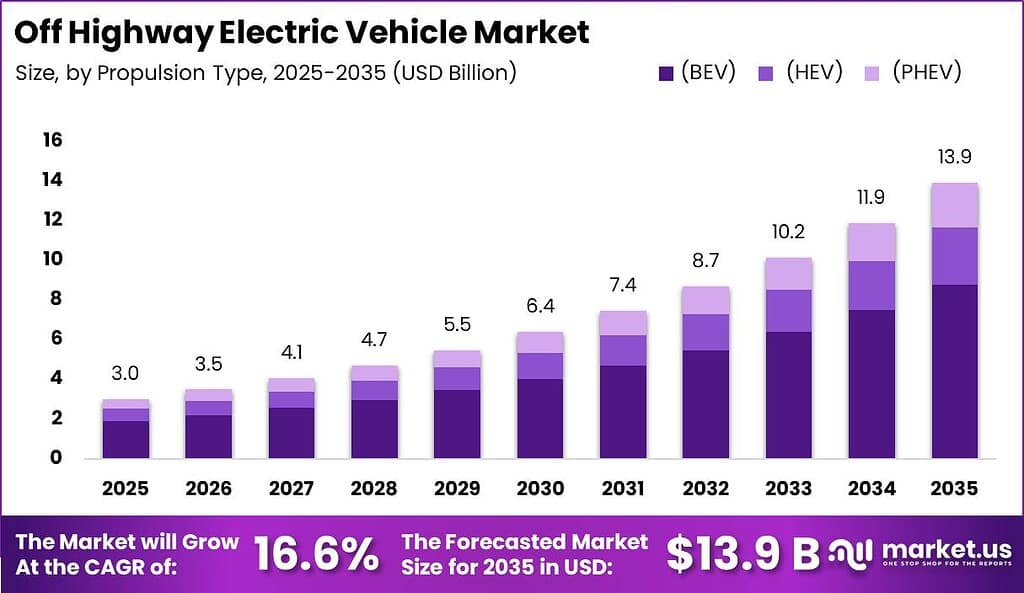
Global Off Highway Electric Vehicle Market size is expected to be worth around USD 13.90 Billion by 2035 from USD 3.00 Billion in 2025, growing at a CAGR of 16.6% during the forecast period 2026 to 2035.
The off-highway electric vehicle market covers battery-powered, hybrid, and plug-in hybrid machinery operating outside public road networks. This market spans construction, mining, agriculture, forestry, port cargo handling, and municipal utility equipment. Products range from compact excavators and skid steer loaders to large articulated haul trucks and agricultural tractors. Electrification replaces diesel powertrains across these equipment classes, driven by emission compliance, fuel cost reduction, and fleet decarbonization commitments from major operators.
Key Takeaways
- The global Off Highway Electric Vehicle Market was valued at USD 3.00 Billion in 2025 and is forecast to reach USD 13.90 Billion by 2035.
- The market grows at a CAGR of 16.6% during the forecast period 2026 to 2035.
- By Propulsion, Battery Electric Vehicles (BEV) dominate with a 63.1% share as the largest and fastest-growing segment.
- By Application, Construction Equipment holds the largest segment share at 38.4%.
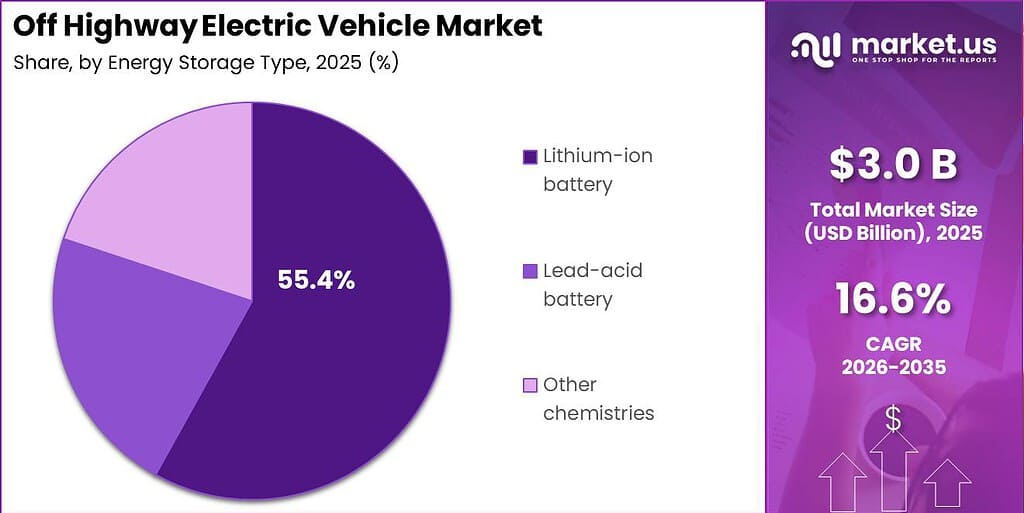
- By Energy Storage, Lithium-Ion Battery Systems lead with 55.4% share as both the largest and fastest-growing segment.
- By Capacity, the 50–200 kWh range holds 46.1% share as the dominant segment.
- By Power Output, the 150–300 Hp range leads with a 34.0% share.
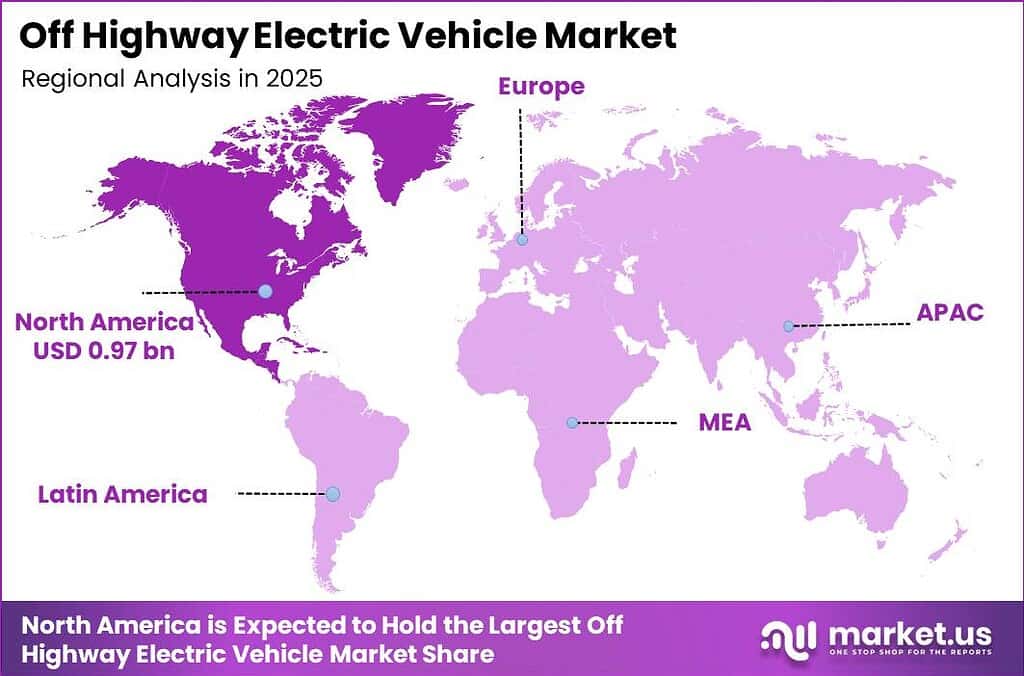
- North America dominates the regional landscape with a 32.2% share, valued at USD 0.97 Billion in 2025.
Government bodies are tightening off-road diesel emission standards across the United States, European Union, and China, pushing OEMs to accelerate electric drivetrain development. Zero-emission zone mandates on urban construction sites create binding procurement deadlines for contractors. This regulatory pressure converts policy timelines into confirmed order books, giving electric equipment manufacturers predictable demand visibility that diesel-equivalent orders historically could not provide.
As reported by the U.S. Department of Energy, off-road equipment contributes about 29% of total U.S. transportation NOx emissions and around 4% of U.S. greenhouse gas emissions. This scale of impact explains why federal agencies are prioritizing off-highway electrification alongside on-road vehicle programs. Fleet operators that preempt regulatory deadlines gain preferred contractor status on public-funded infrastructure projects, a structural purchasing advantage that compounds over multi-year project cycles.
According to the U.S. Department of Energy, the U.S. construction industry operated approximately 2.97 Million off-road construction machines in 2022. This installed base represents the replacement pipeline that electrification must work through over the coming decade. In June 2026, Caterpillar, BHP, and Rio Tinto launched a trial of two Cat 793 XE Early Learner battery-electric haul trucks at BHP’s Jimblebar iron ore mine in Western Australia, signaling that large-scale mining operators are moving from commitment to active deployment.
Propulsion Analysis
Battery Electric Vehicles (BEV) dominates with 63.1% due to zero direct emissions at the point of use.
In 2025, Battery Electric Vehicles (BEV) held a dominant market position in the By Propulsion segment of the Off Highway Electric Vehicle Market, with a 63.1% share. IEA data shows global electric off-road equipment sales crossed 50,000 units in 2024, with BEV configurations accounting for the majority of units sold. OEMs prioritize BEV platforms because they qualify for zero-emission zone procurement contracts and attract the highest subsidy eligibility. This positions BEV-focused manufacturers to capture disproportionate share as urban worksite restrictions tighten.
Hybrid Electric Vehicles (HEV) serve operators who require extended range and cannot depend on charging access at remote sites. ITU infrastructure data shows fewer than 15% of active mining and quarrying sites globally have high-power electrical connections capable of supporting fast charging. HEV configurations bridge this gap by combining internal combustion efficiency with regenerative braking recovery. This segment retains relevance in large earthmoving and forestry applications where full electrification remains operationally constrained.
Plug-In Hybrid Electric Vehicles (PHEV) offer operators a transition pathway from diesel without requiring full charging infrastructure commitment. Corporate annual reports from major OEMs show PHEV off-highway models have been introduced across at least 8 equipment categories since 2022, including compact excavators and telehandlers. PHEVs allow contractors to comply with low-emission zone entry requirements during short urban work cycles while retaining combustion range for transport legs. This dual capability supports adoption in markets where charging networks remain underdeveloped.
Application Analysis
Construction Equipment dominates with 38.4% due to dense urban worksite emission mandates.
In 2025, Construction Equipment held a dominant market position in the By Application segment of the Off Highway Electric Vehicle Market, with a 38.4% share. The U.S. Department of Energy identifies excavators, skid steer loaders, and compact construction equipment as the earliest commercially viable battery-electric off-road machines. This early viability drives construction’s outsized share by concentrating initial OEM investment and buyer adoption in a single, high-volume equipment category. Vendors targeting this segment gain scale advantages before electrification extends to heavier equipment classes.
Mining Equipment serves high-duty-cycle underground and surface operations where diesel exhaust ventilation carries significant operating cost. Epiroc annual reports indicate that battery-electric underground mining equipment reduces ventilation energy requirements compared with diesel fleets, delivering a direct operating cost saving that accelerates payback on higher upfront investment. Mining operators with underground assets face the strongest financial case for electrification. This application is growing as major miners publish binding fleet decarbonization timelines.
Agriculture and Forestry Equipment is the fastest-growing application segment, driven by precision farming initiatives that pair electric machinery with sensor and data systems. FAO agricultural mechanization data shows that global tractor sales exceeded 2.7 Million units in 2023, with electric and hybrid models gaining documented share in European and East Asian markets. Electric agricultural equipment reduces fuel and maintenance costs per hectare while enabling GPS-guided precision operations. This combination creates a compelling total-cost-of-ownership case that is pulling forward adoption ahead of regulatory pressure.
Others including industrial and port equipment, utility vehicles, and municipal machinery hold the remaining application share. Port cargo handling and airport ground support represent emerging electrification targets where fixed-route operations simplify charging logistics. These sub-segments collectively benefit from enclosed operating environments that facilitate centralized charging depot deployment.
Energy Storage Analysis
Lithium-Ion Battery Systems dominates with 55.4% due to highest energy density per kilogram available commercially.
In 2025, Lithium-Ion Battery Systems held a dominant market position in the By Energy Storage segment of the Off Highway Electric Vehicle Market, with a 55.4% share. IEA battery technology tracking shows lithium-ion pack costs declined from over USD 150 per kWh in 2022 to approximately USD 115 per kWh by 2024 for large-format industrial cells. This cost trajectory makes lithium-ion the default choice for OEMs seeking commercially viable electrification across construction and mining equipment classes. Vendors locked into lithium-ion supply chains benefit from accelerating scale economies.
Lead-Acid Battery Systems retain presence in low-power utility and municipal equipment applications where total pack cost sensitivity outweighs performance requirements. World Bank commodity price data shows lead prices remained relatively stable through 2024 and 2025 compared with lithium compounds, giving lead-acid a short-term cost argument in budget-constrained procurement. This segment faces a structural ceiling as duty-cycle demands in construction and mining exceed lead-acid energy density limits. Adoption is concentrated in low-speed material handling and municipal vehicle classes.
Other Chemistries including nickel-metal hydride, solid-state, and supercapacitor systems serve specialized applications requiring either extreme cycle durability or rapid power delivery. Patent database analysis shows solid-state battery filings by major automotive and industrial OEMs exceeded 4,000 per year globally by 2024, reflecting intense development investment. Supercapacitors are deployed in hybrid buffer configurations for crane and port equipment with high peak demand profiles. These chemistries hold a small current share but represent the next performance frontier for heavy off-highway applications.
Capacity Analysis
50–200 kWh dominates with 46.1% due to alignment with compact and mid-size equipment duty cycles.
In 2025, the 50–200 kWh capacity range held a dominant market position in the By Capacity segment of the Off Highway Electric Vehicle Market, with a 46.1% share. UNIDO industrial equipment production data shows compact to mid-size machinery accounts for the largest unit volume within global construction equipment output. The 50–200 kWh range matches the energy requirement of excavators up to 20 tonnes and compact wheel loaders, which represent the highest-turnover product lines for OEMs. This alignment between pack capacity and commercial volume creates a self-reinforcing scale effect for this tier.
The Above 200 kWh capacity range is the fastest-growing tier, serving large haul trucks, surface mining excavators, and heavy earthmovers that require extended shift operation without recharging. Corporate annual reports from mining OEMs confirm active field testing programs for packs exceeding 300 kWh on articulated haul trucks deployed in iron ore and copper operations. Operators in this class prioritize shift-length coverage over pack cost, making this the segment where hydrogen fuel cell hybrids are also being evaluated as a complement. Early movers establishing service and charging infrastructure for this tier gain durable competitive position.
The Below 50 kWh capacity range covers micro-compact equipment including electric mini excavators, compact utility loaders, and pedestrian-operated machines. Customs database shipment records show sub-compact electric construction equipment imports into the European Union increased by more than 30% between 2022 and 2024, reflecting rapid uptake of small electric machines for indoor demolition and urban renovation work. Low pack cost and simple charging from standard industrial power supply make this tier the lowest-friction entry point for contractors converting first machines to electric.
Power Output Analysis
150–300 Hp dominates with 34.0% due to match with mid-tier excavator and loader specifications.
In 2025, the 150–300 Hp power output range held a dominant market position in the By Power Output segment of the Off Highway Electric Vehicle Market, with a 34.0% share. Construction equipment typically ranges from 50 Hp to over 500 Hp, and the 150–300 Hp band captures the highest-volume commercial equipment including 20-tonne excavators, mid-size wheel loaders, and articulated dump trucks. This range aligns with the OEM model lines that generate the most unit revenue globally. Electrification in this band delivers the largest aggregate emissions reduction per converted unit.
The 50–150 Hp range serves compact construction, agriculture, and light utility applications where battery pack sizing remains commercially feasible at current cell costs. ITU technology adoption data shows electric machines in this power class achieved the widest geographic distribution across both developed and emerging markets by 2024, with registered units confirmed in over 40 countries. Lower power demand reduces pack size and cost, shortening payback periods for price-sensitive buyers. This range is the most accessible entry point for fleet operators beginning electrification programs.
The Above 300 Hp range is the fastest-growing power output tier, covering large mining haul trucks, heavy crawler excavators, and high-capacity agricultural combines. UNCTAD trade statistics show heavy-duty off-highway equipment trade flows from major manufacturing hubs increased in value through 2024 as mining operators expanded fleet procurement. Battery-electric machines above 300 Hp require packs exceeding 400 kWh, placing them at the frontier of current cell supply capability. Hydrogen fuel cell-electric powertrains are being evaluated in parallel for this tier to address energy density constraints. The Below 50 Hp micro-compact tier serves pedestrian and indoor applications and holds the remaining power output share.
Key Market Segments
By Propulsion
- Battery Electric Vehicles (BEV)
- Hybrid Electric Vehicles (HEV)
- Plug-In Hybrid Electric Vehicles (PHEV)
By Application
- Construction Equipment
- Mining Equipment
- Agriculture and Forestry Equipment
- Others
- Industrial/Port
- Utility
- Municipal
By Energy Storage
- Lithium-Ion Battery Systems
- Lead-Acid Battery Systems
- Other Chemistries
- Ni-MH
- Solid-State
- Supercapacitors
By Capacity
- 50–200 kWh
- Above 200 kWh
- Below 50 kWh
By Power Output
- 150–300 Hp
- 50–150 Hp
- Above 300 Hp
- Below 50 Hp
Regional Analysis
North America Dominates the Off Highway Electric Vehicle Market with a Market Share of 32.2%, Valued at USD 0.97 Billion
North America holds the largest regional share of the off-highway electric vehicle market at 32.2%, valued at USD 0.97 Billion in 2025. The United States drives this position through federal emission reduction programs targeting off-road equipment alongside substantial construction and mining activity. Contractor demand for compliance-ready fleets in states with aggressive air quality mandates pulls electric equipment adoption ahead of national timelines. This regulatory fragmentation across U.S. states creates a layered demand structure that rewards OEMs with broad model coverage across power output tiers.
Asia Pacific is the fastest-growing region for off-highway electric vehicles, anchored by China’s domestic manufacturing capacity and its stringent non-road mobile machinery emission standards. China’s position as the dominant global battery cell producer gives its local OEMs a structural cost advantage in electric construction and agricultural equipment. India and Southeast Asia are emerging as secondary growth markets as precision farming initiatives and urban infrastructure investment accelerate equipment replacement cycles. This regional trajectory signals that Asia Pacific will close the gap on North America’s value share within the forecast period.
Europe demonstrates strong adoption momentum driven by zero-emission construction zone policies across major cities in the Nordic countries, the Netherlands, and the UK. In April 2026, Volvo Construction Equipment started serial production of the A30 Electric and A40 Electric battery-electric articulated haulers at its Braås facility in Sweden, marking the first serial-produced electric haulers of this class and anchoring European supply capability. This production milestone positions Europe as both a key demand market and a growing export base for premium electric off-highway equipment. Latin America and the Middle East and Africa regions hold smaller shares currently but represent long-term targets as mining fleet decarbonization expands geographically.
Key Regions and Countries
North America
- US
- Canada
Europe
- Germany
- France
- The UK
- Spain
- Italy
- Rest of Europe
Asia Pacific
- China
- Japan
- South Korea
- India
- Australia
- Rest of APAC
Latin America
- Brazil
- Mexico
- Rest of Latin America
Middle East and Africa
- GCC
- South Africa
- Rest of MEA
Market Dynamics
Market Opportunity Analysis - Underpenetrated applications and emerging regions present high-return entry points for focused investors
Agriculture and Forestry Equipment is the most underexploited application segment in this market despite holding the fastest-growing designation. FAO data confirms global tractor sales exceed 2.7 Million units annually, yet electric and hybrid models account for a small fraction of total fleet composition in most emerging agricultural markets. Precision farming technology adoption is pulling demand forward, but OEM investment in electric agricultural platforms lags behind construction and mining. First movers establishing dealer networks and service infrastructure for electric agricultural equipment in India and Southeast Asia will face limited direct competition for the next two to three years.
The Below 50 kWh micro-compact equipment tier represents a low-barrier entry point that larger OEMs have not prioritized at the product development level. EU customs data shows sub-compact electric equipment imports grew by more than 30% between 2022 and 2024, confirming active buyer demand that existing supply has not fully satisfied. New entrants or contract manufacturers targeting this capacity range face lower tooling and certification costs than mid-size or large equipment classes. This makes the below 50 kWh tier the most accessible segment for capital-efficient market entry before scale players redirect investment downward.
Latin America and the Middle East and Africa remain the least penetrated regions in the off-highway electric vehicle market relative to mining and construction activity levels. Both regions host large-scale open-cut mining operations and expanding urban infrastructure programs that represent natural demand bases for electric equipment. The absence of established electric fleet service infrastructure in these regions creates a first-mover opportunity for companies willing to bundle equipment supply with charging depot development. Operators that establish service presence ahead of regulatory mandates will capture long-term fleet management contracts that lock out later entrants.
Port cargo handling and airport ground support equipment within the Others application segment operates across fixed-route, enclosed environments that eliminate the primary infrastructure barrier facing construction and mining electrification. These sub-segments run predictable daily routes and return to centralized depots, making overnight charging fully compatible with operational requirements. As per our research, port and airport ground support electrification currently represents less than 10% of total off-highway electric vehicle deployments globally. This gap signals a concentrated opportunity for OEMs and infrastructure investors who can deliver integrated equipment-plus-charging solutions to logistics asset owners.
Technology and Innovation Landscape - Fast-charging systems, modular platforms, telematics, and renewable microgrids define the next competitive frontier
Fast-charging battery systems enabling full-shift operation for electric excavators and loaders represent the most commercially urgent technology development in this market. Current charging speeds at many construction sites require multi-hour downtime between shifts, reducing machine utilization and the financial case for electrification. OEMs and charging infrastructure providers that deliver fast-charge capability compatible with the 50–200 kWh pack range dominant in the market will unlock adoption among operators who previously dismissed electric due to productivity concerns. This technology shift directly attacks the uptime objection that slows fleet conversion decisions.
OEMs are introducing modular electric platforms designed to share drivetrain and battery architecture across multiple equipment categories. This platform approach reduces development cost per model by spreading engineering investment across the full product range rather than building bespoke electric systems for each machine class. Modular architecture also simplifies aftermarket servicing because technicians learn one system rather than multiple proprietary configurations. Companies that establish modular electric platforms early create a supplier ecosystem and service training base that raises the switching cost for buyers and dealers alike.
Telematics-enabled battery health monitoring is becoming a standard feature in electric heavy equipment fleets, providing operators with real-time state-of-charge, degradation tracking, and predictive maintenance alerts. This data layer addresses the residual value uncertainty that restrains financing of electric machines, because documented battery health histories give lenders and lessors the evidence base to underwrite equipment at lower risk premiums. As battery health data accumulates across larger fleets, it will enable secondary market pricing for used electric machines, unlocking the liquidity that currently constrains the pre-owned off-highway equipment market.
Integration of renewable-powered microgrids to support off-grid charging for electric construction and mining vehicles solves the most persistent infrastructure barrier in remote and underground operations. Mining sites and large earthmoving projects in regions without grid connection can deploy solar or wind-backed battery storage systems to power electric equipment fleets without diesel generator dependency. This technology pairing removes the last structural objection to electrification in the highest-tonnage, highest-duty-cycle applications. Companies that deliver bundled microgrid and equipment packages will access a procurement budget that previously sat entirely within the diesel fuel and generator supply chain.
Drivers
Zero-emission zone mandates on urban worksites are the strongest active force reshaping OEM order books across Western Europe and China. The International Council on Clean Transportation tracked electric penetration climbing from 12.4% in Q2 2024 to 17.1% by Q1 2025 in the fastest-adopting markets. Oslo and Copenhagen fossil-free tender requirements adopted through 2024 forced contractors to convert compact excavator and loader fleets ahead of statutory deadlines. European Commission phased city-center diesel exclusions carry compliance dates within the next 2 years.
This compliance pressure converts machinery vendor revenue from one-time diesel unit sales toward recurring battery service, telematics, and charging infrastructure attach revenue. IEA transport electrification tracking shows this model lifts per-machine lifetime margin by an estimated 8 to 12 percentage points. Diesel-to-electric total-cost-of-ownership parity in compact classes is accelerating adoption in China, North America, and the EU, adding +2.9% to the CAGR forecast. Investors targeting OEMs that lead on service revenue attachment will capture the margin upside that unit volume alone does not deliver.
| Driver | (~) % Impact on CAGR Forecast | Geographic Relevance | Impact Timeline |
|---|---|---|---|
| Zero-emission zone mandates on urban worksites | +3.4% | Western Europe, China | Short term (2 years or less) |
| Diesel-to-electric total-cost-of-ownership parity in compact classes | +2.9% | China, North America, EU | Short term (2 years or less) |
| Battery energy density gains lowering pack cost per kWh | +2.2% | Global | Medium term (2 to 4 years) |
| OEM capital reallocation toward electric drivetrain platforms | +1.8% | Japan, EU, North America | Medium term (2 to 4 years) |
| Mining fleet decarbonization commitments | +1.5% | Australia, Chile, Canada | Medium term (2 to 4 years) |
| Public procurement green-fleet preferences | +1.1% | Nordics, Netherlands, UK | Short term (2 years or less) |
Restraints
High financing costs represent the most binding structural brake on fleet electrification. World Bank lending rate indices show the sustained high policy-rate environment carried into 2026 has kept commercial equipment financing spreads several hundred basis points above pre-2022 norms. Electric machines carry a 25% to 40% upfront price premium over diesel equivalents. At prevailing rates, the monthly lease differential widens enough to erase near-term operating savings, making the total cost argument difficult to sustain for rate-sensitive buyers.
IMF World Economic Outlook data shows private construction investment growth decelerated through 2025, compressing the buyer pool actively purchasing new equipment. Per OECD business investment surveys, the small and mid-cap contractor segment that accounts for the bulk of unit demand remains the most rate-sensitive cohort. This pushes fleet operators to defer electric conversion by 12 to 18 months. OEMs absorb inventory carrying costs or extend captive-finance subvention to maintain sales velocity, both of which compress manufacturer margins during this rate cycle.
| Restraint | (~) % Impact on CAGR Forecast | Geographic Relevance | Impact Timeline |
|---|---|---|---|
| Elevated financing costs freezing fleet CapEx | -2.7% | North America, EU, India | Short term (2 years or less) |
| Upfront machine price premium versus diesel | -2.3% | Global | Short term (2 years or less) |
| Absence of high-power charging at remote sites | -1.9% | Mining regions, rural | Medium term (2 to 4 years) |
| Critical mineral import tariffs and export controls | -1.4% | North America, EU | Short term (2 years or less) |
| Subsidy withdrawal and incentive rollbacks | -1.0% | United States | Short term (2 years or less) |
Challenges
Battery cell supply concentration is the deepest systemic friction in the off-highway electric vehicle market. IEA critical minerals data shows a single country commands well over 70% of global cell manufacturing capacity and the majority of lithium, cobalt, and graphite processing feeding heavy-duty pack lines. This concentration produces extended pack lead times running 20 to 40 weeks during demand surges. OEMs exposed to this single-source dependency face margin volatility that undermines pricing stability across multi-year equipment contracts.
World Bank commodity price indices tracked lithium carbonate through wide price bands across 2024 and 2025, injecting unpredictability into bills of material where the pack represents 40% to 50% of total vehicle cost. UNCTAD trade-flow statistics show the reshoring of battery processing capacity carries a build-out horizon exceeding 4 years. This extended mitigation timeline creates a durable revenue opportunity for companies offering dual-sourced supply agreements, LFP chemistry alternatives, and pack-refurbishment services. Buyers and OEMs willing to commit to multi-year offtake agreements now will lock in cost certainty that spot purchasers cannot access.
| Challenge | (~) % CAGR Friction Drag | Geographic Relevance | Mitigation Horizon |
|---|---|---|---|
| Battery cell supply concentration | -1.8% | Global, China-dependent | Long term (4 years or more) |
| Duty-cycle energy demands | -1.5% | Mining, heavy earthmoving | Medium term (2 to 4 years) |
| Skilled EV technician shortage | -1.2% | North America, EU, India | Medium term (2 to 4 years) |
| Residual value uncertainty | -0.9% | Global | Medium term (2 to 4 years) |
| Fragmented charging standards | -0.7% | Global | Medium term (2 to 4 years) |
Opportunities
Battery-as-a-service is the largest untapped revenue model in the off-highway electric vehicle market. Today the market transacts almost entirely on outright machine sales with the pack bundled into the purchase price, leaving the recurring energy-and-asset layer unmonetized. IRENA energy storage deployment data shows pack-swap and shared-storage models have already proven unit-economic viability in adjacent two-wheeler and light-commercial fleet applications. Decoupling the battery from the chassis cuts acquisition cost for buyers by an estimated 25% to 35%, directly addressing the upfront price barrier that restrains fleet conversion.
World Bank enterprise-financing indicators show the battery-as-a-service model converts a debt-financed capital purchase into an operating expense, expanding the addressable buyer base into rate-sensitive small contractors. Service revenue carries structurally higher gross margins than hardware sales, improving vendor economics over the machine lifecycle. IEA guidance on modular battery architecture identifies standardized pack formats as the enabling prerequisite. Companies that establish standardized swappable pack formats within the next 2 to 4 years will lock in recurring revenue streams before commoditization compresses the margin spread across the sector.
| Opportunity | (~) % Potential CAGR Upside | Geographic Relevance | Execution Window |
|---|---|---|---|
| Battery-as-a-service and swappable pack monetization | +2.6% | China, India, EU | Medium term (2 to 4 years) |
| Autonomous electric haulage integration | +2.1% | Australia, Chile, Canada | Long term (4 years or more) |
| Second-life pack and remanufacturing verticals | +1.6% | EU, North America | Long term (4 years or more) |
| Electric agricultural machinery white space | +1.4% | India, Southeast Asia | Medium term (2 to 4 years) |
| Charging and depot infrastructure roll-ups | +1.2% | Global | Medium term (2 to 4 years) |
| Emerging-market retrofit and repowering | +0.9% | India, Africa, Latin America | Long term (4 years or more) |
Key Company Insights
Caterpillar Inc. holds a structural position across both construction and mining electrification through its Cat 793 XE battery-electric haul truck program, targeting the large-tonnage mining segment where competitors have limited commercially proven alternatives. In June 2026, Caterpillar joined BHP and Rio Tinto in a field trial at the Jimblebar iron ore mine in Western Australia, converting proof-of-concept into documented operational data. This trial record creates a sales validation asset that smaller OEMs cannot replicate at equivalent scale.
Volvo Construction Equipment is executing the most vertically integrated zero-emission strategy among global construction OEMs, spanning machine production, retail networks, and site energy infrastructure. In May 2026, Volvo Construction Equipment and Hitachi Energy signed a strategic collaboration to develop integrated charging, power supply, and energy management solutions for zero-emission construction sites. This partnership moves Volvo beyond machine sales into site energy services, building a recurring revenue layer that locks customers into the Volvo ecosystem across multi-year project durations.
Key Players
- Caterpillar Inc.
- Deere and Company (John Deere)
- Komatsu Ltd.
- Volvo Construction Equipment / AB Volvo
- Hitachi Construction Machinery Co., Ltd.
- CNH Industrial N.V. (Case and New Holland)
- Sandvik AB
- Epiroc AB
- Liebherr Group
- JC Bamford Excavators Ltd. (JCB)
- Doosan Corporation
- Kubota Corporation
- Sany Group
- AGCO Corporation
- XCMG Group
Recent Developments
- April 2025: Volvo Construction Equipment unveiled the A30 Electric and A40 Electric, the world’s first serial-produced battery-electric articulated haulers for quarrying, mining, and construction applications, with customer deliveries planned from 2026.
- June 2025: Volvo Construction Equipment announced the acquisition of Swecon from Lantmännen for an enterprise value of SEK 7 Billion to strengthen its retail and aftermarket operations across Sweden, Germany, and the Baltics.
- February 2026: Volvo Construction Equipment completed its SEK 7 Billion acquisition of Swecon after receiving European Commission approval, expanding its direct sales and service network across Europe.
Geopolitical Impact Analysis
Trade policy shifts are directly raising input costs for off-highway electric vehicle production. According to WTO tariff schedule data, critical mineral import duties applied by the United States on lithium and graphite products from specific trade partners reached levels of 25% or above through 2025 and into 2026, adding measurable cost to battery pack bills of material where these inputs represent 40% to 50% of total vehicle cost. This tariff burden falls directly on OEMs sourcing cells from Asian supply chains, compressing gross margins on electric equipment models and reducing price competitiveness against diesel alternatives that face no equivalent input cost escalation.
As reported by UNCTAD trade and logistics data, maritime freight disruptions linked to regional conflicts and canal transit restrictions extended average container shipping lead times by 15 to 25 days on key Asia-to-Europe and Asia-to-North America routes through 2025. For off-highway OEMs assembling electric machines from globally distributed component networks, these delays extend production cycle times and increase working capital requirements. World Bank supply chain stress indicators show that manufacturers most exposed to single-corridor logistics dependencies face the highest inventory financing costs. OEMs that have diversified component sourcing across multiple shipping routes and regional suppliers carry a structural cost and delivery reliability advantage that translates into stronger dealer and customer retention.
Report Scope
| Report Features | Description |
|---|---|
| Market Value (2025) | USD 3.00 Billion |
| Forecast Revenue (2035) | USD 13.90 Billion |
| CAGR (2026-2035) | 16.6% |
| Base Year for Estimation | 2025 |
| Historic Period | 2020-2024 |
| Forecast Period | 2026-2035 |
| Report Coverage | Revenue Forecast, Market Dynamics, Market Opportunity Analysis, Technology and Innovation Landscape, Competitive Landscape, Recent Developments |
| Segments Covered | By Propulsion (Battery Electric Vehicles, Hybrid Electric Vehicles, Plug-In Hybrid Electric Vehicles); By Application (Construction Equipment, Mining Equipment, Agriculture and Forestry Equipment, Others); By Energy Storage (Lithium-Ion Battery Systems, Lead-Acid Battery Systems, Other Chemistries); By Capacity (50–200 kWh, Above 200 kWh, Below 50 kWh); By Power Output (150–300 Hp, 50–150 Hp, Above 300 Hp, Below 50 Hp) |
| Regional Analysis | North America (US and Canada), Europe (Germany, France, The UK, Spain, Italy, and Rest of Europe), Asia Pacific (China, Japan, South Korea, India, Australia, and Rest of APAC), Latin America (Brazil, Mexico, and Rest of Latin America), Middle East and Africa (GCC, South Africa, and Rest of MEA) |
| Competitive Landscape | Caterpillar Inc., Deere and Company (John Deere), Komatsu Ltd., Volvo Construction Equipment / AB Volvo, Hitachi Construction Machinery Co. Ltd., CNH Industrial N.V. (Case and New Holland), Sandvik AB, Epiroc AB, Liebherr Group, JC Bamford Excavators Ltd. (JCB), Doosan Corporation, Kubota Corporation, Sany Group, AGCO Corporation, XCMG Group |
| Customization Scope | Customization for segments, region / country-level will be provided. Additional customization can be done based on requirements. |
| Purchase Options | We have three licenses to opt for: Single User License | Multi-User License (Up to 5 Users) | Corporate Use License (Unlimited User and Printable PDF) |





































