One Stop Shop For Reports One Stop Shop For Reports
  • All Reports
  • All Sectors
    • Chemicals & Materials
      • Advanced Materials
      • Bulk Chemicals
      • Coatings | Paints and Additives
      • Composites
      • Renewable | Speciality chemicals
    • Consumer Goods
      • Baby Products
      • Consumer Electronics
      • Consumer Packaging
      • Cosmetics & Personal Care
      • Homecare & Decor
      • Luxury & premium products
    • Energy and Power
      • Energy Efficiency and Conservation
      • Green | Renewable Energy
      • Non Renewable | Conventional Energy
      • Power Equipment and Devices
    • Life Science
      • Biotechnology
      • Diagnostics
      • Healthcare
      • Healthcare IT
      • Medical Devices & Supplies
      • Pharmaceuticals
    • Food and Beverage
      • Agriculture & Agri Products
      • Beverages
      • Food Ingredients
      • Food Services and Hospitality
      • Nutraceutical | Wellness Food
      • Processed & Frozen Foods
    • Automotive and Transportation
      • Automotive components
      • Automotive Logistics
      • Automotive systems and accessories
    • Information and Communications Technology
      • E Commerce and Outsourcing
      • Entertainment & Media
      • High Tech | Enterprise & Consumer IT
      • Information & Network Security
      • Mobility | Telecom & Wireless
      • Software and Services
    • Semiconductor and Electronics
      • Semiconductor Materials and Components
      • Display Technology
      • Electronics System and Components
      • Emerging technologies
      • Security and Surveillance
      • Sensors and Controls
    • Building and Construction
      • Construction Materials
      • HVAC
      • Residential Construction and Improvement
      • Roads & Highways
    • Manufacturing
      • Manufacturing Services
      • Heavy Manufacturing
      • Packaging
      • Engineering | Equipment and Machinery
  • Who Trust Us
  • [email protected]
  • +1 718 874 1545 (International)
  • +91 78878 22626 (Asia)

More Results

One Stop Shop For Reports One Stop Shop For Reports
  • All Reports
  • All Sectors
    • Chemicals & Materials
      • Advanced Materials
      • Bulk Chemicals
      • Coatings | Paints and Additives
      • Composites
      • Renewable | Speciality chemicals
    • Consumer Goods
      • Baby Products
      • Consumer Electronics
      • Consumer Packaging
      • Cosmetics & Personal Care
      • Homecare & Decor
      • Luxury & premium products
    • Energy and Power
      • Energy Efficiency and Conservation
      • Green | Renewable Energy
      • Non Renewable | Conventional Energy
      • Power Equipment and Devices
    • Life Science
      • Biotechnology
      • Diagnostics
      • Healthcare
      • Healthcare IT
      • Medical Devices & Supplies
      • Pharmaceuticals
    • Food and Beverage
      • Agriculture & Agri Products
      • Beverages
      • Food Ingredients
      • Food Services and Hospitality
      • Nutraceutical | Wellness Food
      • Processed & Frozen Foods
    • Automotive and Transportation
      • Automotive components
      • Automotive Logistics
      • Automotive systems and accessories
    • Information and Communications Technology
      • E Commerce and Outsourcing
      • Entertainment & Media
      • High Tech | Enterprise & Consumer IT
      • Information & Network Security
      • Mobility | Telecom & Wireless
      • Software and Services
    • Semiconductor and Electronics
      • Semiconductor Materials and Components
      • Display Technology
      • Electronics System and Components
      • Emerging technologies
      • Security and Surveillance
      • Sensors and Controls
    • Building and Construction
      • Construction Materials
      • HVAC
      • Residential Construction and Improvement
      • Roads & Highways
    • Manufacturing
      • Manufacturing Services
      • Heavy Manufacturing
      • Packaging
      • Engineering | Equipment and Machinery
  • Who Trust Us
Home ➤ Energy and Power ➤ Solar Backsheet Market
Solar Backsheet Market
Published date: August 2026 • Formats:
[email protected] +1 718 874 1545
Request Sample Schedule a Call
Table of Contents
  • Report Overview
  • Key Takeaways
  • By Type
  • By Thickness
  • By Installation
  • By Application / End-Use
  • Key Market Segments
  • Driver Analysis
  • Restraint Analysis
  • Opportunity Analysis
  • Challenges Analysis
  • Geopolitical Impact Analysis
  • Regional Analysis
  • Key Players Analysis
  • Key Development
  • Report Scope
  • Home ➤ Energy and Power ➤ Solar Backsheet Market

Solar Backsheet Market Size, Share And Report Analysis By Type (Fluoropolymer (TPT (Tedlar-PET-Tedlar), PVDF, PVF), Non-Fluoropolymer (PET-based, Polyamide, Polyolefin)), By Thickness (Less than 100 Micrometer, 100 to 500 Micrometer, More than 500 Micrometer), By Installation (Ground-Mounted, Roof-Mounted, Floating Power Plant), By Application / End-Use (Utility, Commercial, Industrial, Residential, Military), By Region and Companies  Industry Segment Outlook, Market Assessment, Competition Scenario, Trends and Forecast 2026 2035

  • Published date: August 2026
  • Report ID: 192570
  • Number of Pages: 325
  • Format:
Fact Checked
Solar Backsheet Market https://market.us/report/solar-backsheet-market/
Cite this Research
  • Overview
  • Table of Contents
  • Segmentation
  • currency-icon
    Revenue, 2025 (US$B)
    6.9 Bn
    growth-icon
    Forecast, 2035 (US$B)
    14.5 Bn
    chart-icon
    CAGR, 2025 - 2035
    7.7%
    globe-icon
    Leading Region
    Asia-Pacific

    Quick Navigation

    • Report Overview
    • Key Takeaways
    • By Type
    • By Thickness
    • By Installation
    • By Application / End-Use
    • Key Market Segments
    • Driver Analysis
    • Restraint Analysis
    • Opportunity Analysis
    • Challenges Analysis
    • Geopolitical Impact Analysis
    • Regional Analysis
    • Key Players Analysis
    • Key Development
    • Report Scope

    Report Overview

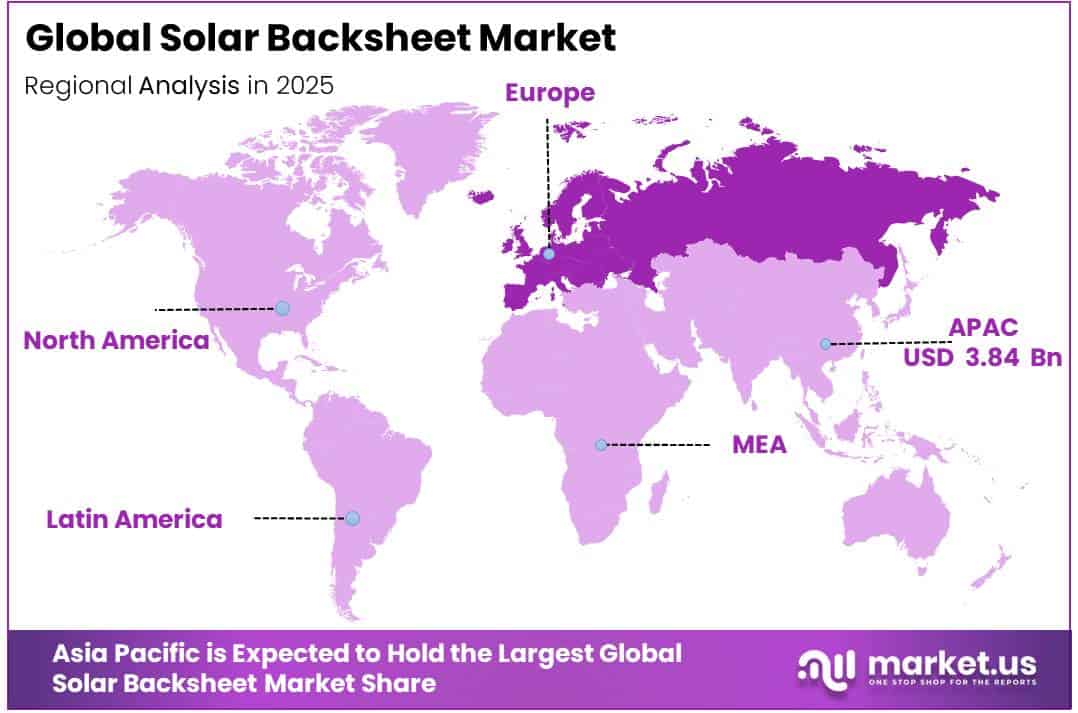
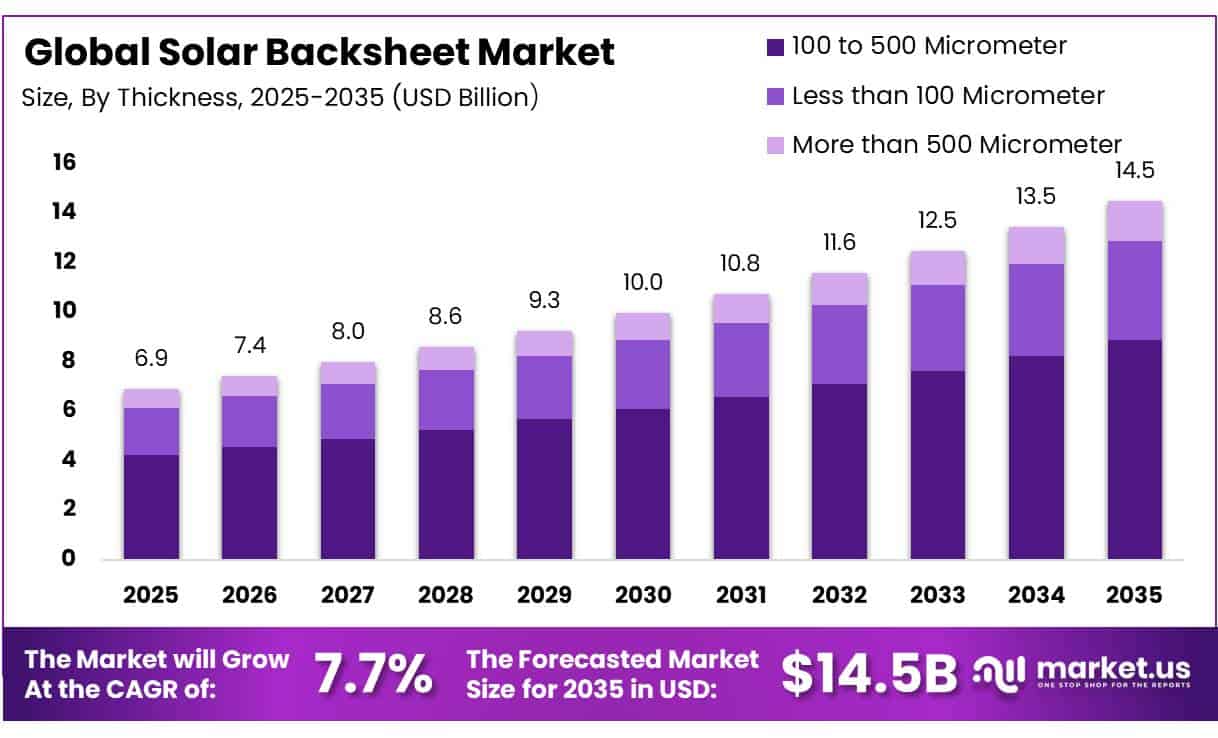
    In 2025, the Solar Backsheet Market was valued at USD 6.9 Billion, and between 2026 and 2035, this market is estimated to register a CAGR of 7.7%, reaching about USD 14.5 Billion by 2035. Asia Pacific held a dominant market position, capturing more than a 55.80% share, holding USD 3.84 Billion in revenue.

    The solar backsheet market is part of photovoltaic (PV) manufacturing and supplies protective polymer layers used in PV modules. The U.S. Department of Energy (DOE) identifies backsheets as a module subcomponent alongside cells, encapsulants, glass, junction boxes, connectors, and frames. Backsheets provide insulation and protection from moisture, ultraviolet exposure, and weathering, making durability important. DOE also identifies resins used for backsheet production as supply-chain inputs.

    • The International Energy Agency (IEA) reported that solar PV capacity additions increased by around 12% in 2025, exceeding 600 GW, while cumulative solar PV capacity reached around 2,800 GW. This expansion supports demand for backsheets. Manufacturers face pricing pressure. IEA reported that solar manufacturing capacity was expected to exceed 1,100 GW by the end of 2024, more than twice projected PV demand.
    Solar Backsheet Market

    Key Takeaways

    • The Global Solar Backsheet Market was valued at USD 6.9 billion in 2025.
    • The global market is projected to grow at a CAGR of 7% and is estimated to reach USD 14.5 billion by 2035.
    • On the basis of type, Fluoropolymer dominated the market, constituting 58.9% of the total market share.
    • Based on thickness, 100 to 500 Micrometer dominated the market, accounting for 61.20% of the total market share.
    • Based on installation, Ground-Mounted dominated the market, accounting for 64.00% of the total market share.
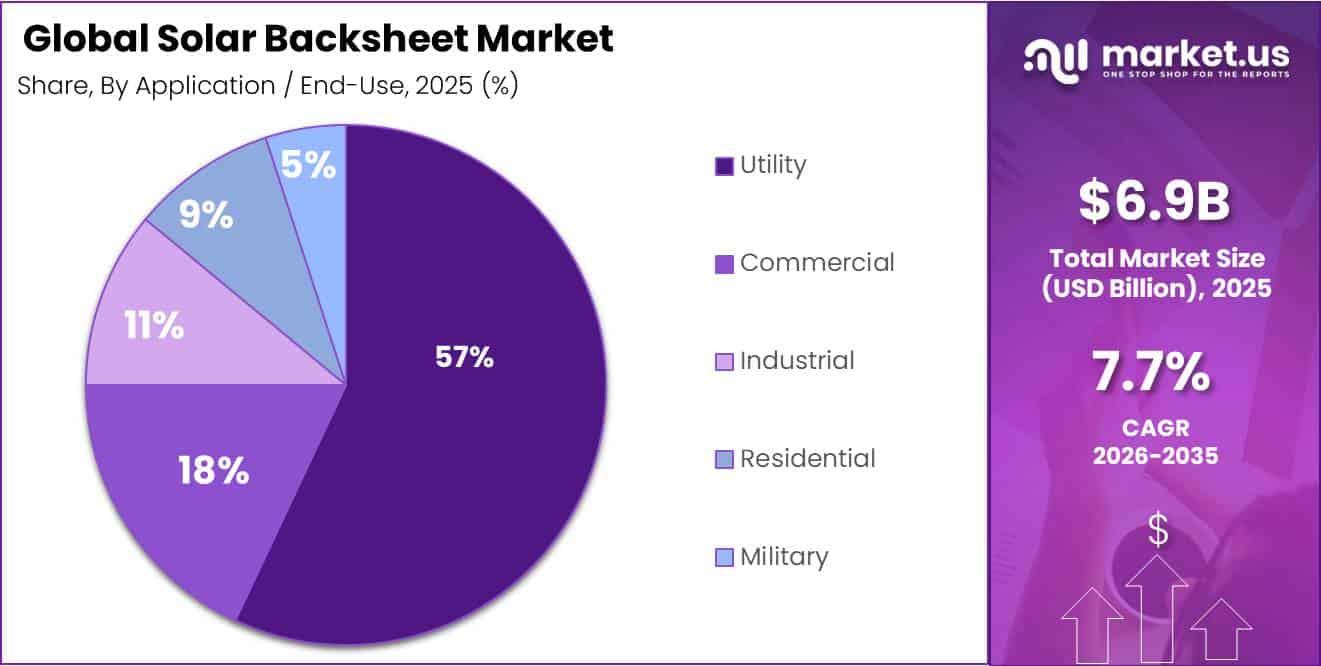
    • Based on application/end-use, Utility dominated the market, accounting for 57% of the total market share.
    • In 2025, Asia-Pacific was the most dominant region in the solar backsheet market, accounting for 55.80% of the global market. Europe was identified as the fastest-growing region

    Key drivers include solar deployment and demand for durable modules that resist moisture, ultraviolet radiation, heat, and environmental exposure. A DOE-supported U.S. project received $443,120 to develop a resistant backsheet through continuous co-extrusion, targeting service lifetimes of more than 30 years. Opportunities therefore exist for fluoropolymer, non-fluoropolymer, multilayer, recyclable, and lower-cost products.

    Government initiatives are strengthening solar manufacturing. In Europe, the European Solar Charter, signed on 15 April 2024, supports photovoltaic manufacturing resilience and competitiveness. The European Commission states that the Net-Zero Industry Act targets manufacturing capacity sufficient to meet at least 40% of European Union deployment needs by 2030 and covers solar photovoltaic technologies. The Commission also reported that its Innovation Fund had funded €445 million in solar PV manufacturing by 2026, while a December 2025 call dedicated €1 billion to clean-technology manufacturing. These measures support industrial investment and resilience.

    By Type

    Fluoropolymer dominates with 58.9% due to its strong protective performance.

    In 2025, Fluoropolymer held a dominant market position, capturing more than a 58.9% share of the Solar Backsheet Market by type. Its leading position is supported by its use in backsheet structures where protection and long-term material performance are important. Fluoropolymer backsheets are widely used to provide resistance against environmental exposure, helping protect photovoltaic modules during operation. Their established use in solar module manufacturing also supports continued demand from manufacturers seeking durable backsheet solutions.

    In 2025, Non-Fluoropolymer backsheets represented the growing segment within the Solar Backsheet Market by type. The segment is gaining attention as manufacturers consider alternatives to fluoropolymer-based materials. PET-based, polyamide, and polyolefin structures provide manufacturers with additional material choices for different module designs and production requirements. This growing interest is supported by ongoing development of backsheet materials and the need for cost-effective and application-specific solutions in photovoltaic module manufacturing.

    By Thickness

    100 to 500 Micrometer leads with 61.2% due to its balanced thickness.

    In 2025, 100 to 500 Micrometer held a dominant market position, capturing more than a 61.2% share of the Solar Backsheet Market by thickness. This thickness range is widely preferred for backsheet applications because it provides a practical balance between material structure and protection. Its established use in solar module manufacturing supports its leading position, particularly where manufacturers require dependable backsheet performance.

    Less than 100 Micrometer is the growing segment in the Solar Backsheet Market by thickness. Its growth is supported by increasing interest in thinner backsheet structures that can help reduce material use while meeting module design requirements. Manufacturers are showing greater interest in lightweight backsheet solutions, supporting the gradual adoption of thinner materials in photovoltaic module production.

    By Installation

    Ground-Mounted dominates with 64.00% due to its widespread deployment.

    In 2025, Ground-Mounted held a dominant market position, capturing more than a 64.00% share of the Solar Backsheet Market by installation. Its leading position is supported by its broad use in large-scale solar installations, where backsheet materials are required to provide protection and durability for photovoltaic modules. The strong presence of ground-mounted systems makes this installation type an important demand area for solar backsheet manufacturers.

    Roof-Mounted is the growing segment in the Solar Backsheet Market by installation. Its growth is linked to the increasing use of rooftop solar systems across different building applications. As more photovoltaic modules are installed on rooftops, demand for suitable backsheet solutions is also increasing. This creates further opportunities for manufacturers offering backsheet materials designed for roof-mounted solar applications.

    By Application / End-Use

    Utility dominates with 57% due to strong demand from large-scale solar projects.

    In 2025, Utility held a dominant market position, capturing more than a 57% share of the Solar Backsheet Market by application/end-use. Its leading position is supported by the widespread use of photovoltaic modules in utility-scale solar projects. These projects require reliable backsheet materials to protect modules and support consistent operation. The strong role of utility applications therefore continues to make this segment an important demand area for solar backsheet manufacturers.

    Commercial is the growing segment in the Solar Backsheet Market by application/end-use. Its growth is supported by the increasing use of solar photovoltaic systems across commercial facilities. As businesses adopt solar installations for their energy requirements, demand for photovoltaic modules also increases, creating additional opportunities for backsheet manufacturers.
    Solar Backsheet Market Share

    Key Market Segments

    By Type

    • Fluoropolymer
      • TPT (Tedlar-PET-Tedlar)
      • PVDF
      • PVF
    • Non-Fluoropolymer
      • PET-based
      • Polyamide
      • Polyolefin

    By Thickness

    • Less than 100 Micrometer
    • 100 to 500 Micrometer
    • More than 500 Micrometer

    By Installation

    • Ground-Mounted
    • Roof-Mounted
    • Floating Power Plant

    By Application / End-Use

    • Utility
    • Commercial
    • Industrial
    • Residential
    • Military

    Driver Analysis

    Global PV build-out

    The IEA expects global renewable capacity to add almost 4,600 GW between 2025 and 2030—roughly double the 2019–2024 build-out—with annual renewable additions increasing from 666 GW in 2024 to nearly 935 GW in 2030; solar PV is expected to account for about 80% of incremental renewable capacity during this period.

    Global solar additions exceeded 600 GW in 2025, lifting cumulative installed capacity to about 2.8 TW, while China alone commissioned nearly 370 GW, establishing a large and immediate module-material demand base.

    Converting 600 GW of annual PV installations into module area using 21%–23% module efficiency implies approximately 2.6–2.9 billion m² of module surface requirement before accounting for replacement, breakage, and production scrap; even with glass-glass modules cannibalizing part of the conventional backsheet opportunity, sustained utility, commercial, and rooftop deployment supports multi-year demand for PET, PVDF, PVF, and multilayer backsheet structures.

    Drivers Impact Analysis

    Driver (~) % Impact on CAGR Forecast Geographic Relevance Impact Timeline
    Global PV build-out +2.4 pp China, North America, EU, India, MENA Short term (≤ 2 years)
    Domestic manufacturing incentives +1.8 pp U.S. core, India, EU Medium term (2-4 years)
    Reliability and warranty upgrades +1.5 pp Global utility-scale, MENA, APAC Medium term (2-4 years)
    Bifacial backsheet innovation +1.3 pp China, India, MENA, Australia Medium term (2-4 years)
    Circularity and traceability rules +1.0 pp EU, UK, North America Long term (≥ 4 years)
    Distributed solar expansion +0.8 pp India, ASEAN, LATAM, Africa Long term (≥ 4 years)

    Restraint Analysis

    Glass-glass substitution

    Glass-glass module adoption is the largest structural restraint on backsheet volumes because every dual-glass module replaces the polymer rear protective layer with a second sheet of tempered glass, eliminating approximately 1.8–2.4 m² of backsheet demand per 400–600 W module.

    At an illustrative 600 GW annual PV installation run rate, if glass-glass penetration rises from 45% to 60%, the additional 15 percentage points could displace roughly 160–210 million m² of polymer backsheet demand, assuming average module power of 550–600 W and area of around 2.3–2.6 m².

    The resulting value destruction is concentrated in standard opaque PET-laminate products, where volume loss cannot be offset by modest price increases; suppliers must either develop transparent backsheets for lightweight bifacial, rooftop, and constrained-load applications, focus on premium high-voltage or harsh-climate films, or accept lower utilization of coating and lamination assets.

    Restraint Impact Analysis

    Restraint (~) % Impact on CAGR Forecast Geographic Relevance Impact Timeline
    Glass-glass substitution -2.3 pp China, EU, North America, MENA Medium term (2-4 years)
    Module price deflation -1.8 pp China-led global supply chain Short term (≤ 2 years)
    PFAS regulatory uncertainty -1.4 pp EU, North America, export APAC Medium term (2-4 years)
    Tariff-driven supply disruption -1.2 pp U.S., Southeast Asia, China Short term (≤ 2 years)
    Fluoropolymer cost exposure -1.0 pp Global, especially EU and India Medium term (2-4 years)
    Reliability qualification burden -0.8 pp Utility-scale MENA, APAC, Americas Long term (≥ 4 years)

    Opportunity Analysis

    Lightweight rooftop modules

    A conventional 550–600 W module commonly weighs 27–35 kg, whereas lightweight bifacial designs can approach 16–18 kg and polymer-based roof systems can reduce total roof-system weight by up to 40% relative to glass-heavy configurations; at a 1 MW commercial rooftop site using approximately 1,700–1,900 modules, reducing installed module weight by 10–15 kg per unit removes roughly 17–29 tonnes of roof load.

    This permits solar deployment without structural reinforcement that can otherwise cost an estimated $20–60 per m² of roof area, creating an economically addressable segment unavailable to dual-glass modules.

    Backsheet producers can capture this upside by co-designing high-dielectric, UV-stable, moisture-barrier, flame-retardant, and puncture-resistant films with module makers, charging a 20%–50% premium per m² over commodity opaque PET laminates while increasing the likelihood of design wins in commercial rooftops; it is an opportunity because winning requires specialized lightweight certification, structural-load selling tools, and installer partnerships that are not yet standard offerings in the mainstream backsheet supply base.

    Opportunity Impact Analysis

    Opportunity (~) % Potential CAGR Geographic Relevance Execution Window
    Lightweight rooftop modules +2.0 pp EU, Japan, U.S., India, ASEAN Medium term (2-4 years)
    PFAS-free premium films +1.7 pp EU, North America, export APAC Short term (≤ 2 years)
    Digital material passports +1.3 pp EU core, UK, North America Medium term (2-4 years)
    U.S. localized film conversion +1.5 pp North America core Short term (≤ 2 years)
    BIPV and mobility laminates +1.2 pp EU, Japan, South Korea, GCC Long term (≥ 4 years)
    Recycling and delamination services +1.0 pp EU, Japan, North America Long term (≥ 4 years)

    Challenges Analysis

    Multi-climate reliability validation

    Solar backsheet suppliers must continuously prove that materials can retain dielectric strength, adhesion, UV stability, moisture barrier performance, and resistance to cracking over 25–30-year warranty periods while facing sharply different exposure profiles: desert modules can see rear-surface temperatures above 80°C, high-UV conditions, sand abrasion, and daily thermal swings above 40°C, whereas tropical installations combine 85%–100% relative humidity, intense UV, salt-laden air, and persistent wet-dry cycles.

    IEC 61215 baseline qualification includes 200 thermal cycles from -40°C to +85°C, 1,000 hours at 85°C/85% relative humidity, 10 humidity-freeze cycles, 60 kWh/m² UV exposure, 2,400 Pa mechanical loading, and 5,400 Pa heavy-snow testing, but this remains a type-qualification floor rather than a guarantee against every site-specific degradation pathway.

    A material change as small as a new PET supplier, primer grade, adhesive cure profile, pigment concentration, or 10–20 µm thickness reduction can require 6–18 months of laminate trials, accelerated ageing, module certification, and field exposure; for a 500 MW module program consuming roughly 2.0–2.5 million m² of backsheets, delayed approval by two quarters can defer $2–8 million in supplier revenue depending on film architecture and realized pricing.

    Manufacturers must establish climate-zone material libraries, accelerated-life models tied to field returns, 85°C/85% RH extended testing beyond the 1,000-hour baseline, and regional outdoor test arrays, otherwise late-stage cracking, delamination, insulation loss, and warranty claims can erase multiple years of cost savings from thinner or lower-cost constructions.

    Challenges Impact Analysis

    Challenge (~) % CAGR Friction Drag Geographic Relevance Mitigation Horizon
    Multi-climate reliability validation -1.4 pp MENA, India, ASEAN, Americas Long term (≥ 4 years)
    Fluoropolymer transition management -1.2 pp EU, North America, export APAC Medium term (2-4 years)
    Asia-centric material sourcing -1.1 pp EU, North America, India Medium term (2-4 years)
    Qualification-cycle compression -1.0 pp China, EU, U.S., India Medium term (2-4 years)
    Specialty talent scarcity -0.8 pp North America, EU, India, ASEAN Long term (≥ 4 years)
    Traceability data integration -0.7 pp EU, North America, global OEMs Medium term (2-4 years)

    Geopolitical Impact Analysis

    Geopolitical tensions increase supply-chain risks for the Solar Backsheet Market.

    The ongoing Middle East conflict is adding uncertainty to global clean-energy supply chains, although the direct effect on solar backsheets is mainly through logistics, energy costs, and broader solar manufacturing disruptions. The International Energy Agency (IEA) reported in 2026 that clean-energy manufacturing remains highly concentrated, with China accounting for around 85% of solar supply-chain production capacity. The IEA also estimates that a disruption to Chinese exports of solar supply-chain components could cause around USD 1 billion per month in lost output at solar photovoltaic module plants outside China. For backsheet manufacturers, such disruptions can increase procurement and delivery risks when polymer films, chemicals, or other module inputs move through international supply routes.

    The conflict is also affecting wider energy and transportation conditions. The IEA reported that the closure of the Strait of Hormuz in 2026 caused liquefied petroleum gas import prices to rise by an average of 80% in March in developing economies where the fuel is widely used. The IEA further notes that around half of global clean-energy technology trade passes through the Strait of Malacca, making shipping-route disruptions an important supply-security concern. These conditions encourage solar manufacturers to diversify suppliers, regionalise production, and maintain more resilient inventories.

    Regional Analysis

    Asia Pacific dominates with 55.80% share and USD 3.84 billion revenue.

    In 2025, Asia Pacific held a dominant position in the Solar Backsheet Market, accounting for 55.80% and generating USD 3.84 billion, based on the provided market data. The region’s leadership is closely linked to its strong photovoltaic manufacturing and deployment base.

    • The International Renewable Energy Agency (IRENA) reported that Asia added 513.3 gigawatts (GW) of renewable power capacity in 2025, representing 74.2% of global renewable additions. Solar photovoltaic (PV) was the main contributor, with 510.3 GW added globally during the year. This large regional deployment creates a broad requirement for module components, including protective backsheet materials, supporting demand across the regional solar manufacturing industry.

    China remains an important contributor to Asia Pacific’s solar expansion. The International Energy Agency (IEA) reported that China commissioned nearly 370 GW of solar PV capacity in 2025, an increase of 13% from 2024. IRENA’s 2026 capacity statistics also recorded 1,200,359 megawatts (MW) of cumulative solar PV capacity in China at the end of 2025. Such a large installed base supports continued requirements for durable and application-specific backsheets used in photovoltaic modules. The regional opportunity is further strengthened by Asia’s position as the leading renewable-energy expansion region, encouraging manufacturers to improve module materials, production efficiency, and supply-chain resilience.

    Solar Backsheet Market Regional Analysis

    Key Regions and Countries

    • North America
      • The US
      • Canada
    • Europe
      • Germany
      • France
      • The UK
      • Spain
      • Italy
      • Russia & CIS
      • Rest of Europe
    • APAC
      • China
      • Japan
      • South Korea
      • India
      • ASEAN
      • Rest of APAC
    • Latin America
      • Brazil
      • Mexico
      • Rest of Latin America
    • Middle East & Africa
      • GCC
      • South Africa
      • Rest of MEA

    Key Players Analysis

    Solar backsheet manufacturers focus on improving material performance, product durability, and production efficiency to strengthen their position in the photovoltaic module supply chain. Key players such as Jolywood (Suzhou) Sunwatt Co., Ltd., Cybrid Technologies Inc., DuPont de Nemours, Inc., Hangzhou First Applied Material Co., Ltd., COVEME S.p.A., KREMPEL GmbH, Arkema S.A., and 3M Company emphasize product development across fluoropolymer and non-fluoropolymer backsheet technologies.

    Manufacturers are also working on multilayer structures, improved weather resistance, electrical insulation, and lightweight designs to meet changing module requirements. Greater attention to material quality and long-term reliability helps companies maintain relationships with photovoltaic module manufacturers and compete across different solar applications.

    Competition also depends on manufacturing scale, technology development, and supply chain capabilities. Toray Industries, Inc., Toyo Aluminium K.K., Taiflex Scientific Co., Ltd., Isovoltaic AG, Mitsubishi Chemical Group, Targray Technology International Inc., and RenewSys India Pvt. Ltd. participate across different parts of the backsheet material supply chain. Companies increasingly focus on expanding production capabilities, improving polymer and film processing, and developing alternatives that can reduce material costs while maintaining required performance.

    The Major Players in The Industry

    • Honeywell International Inc.
    • Siemens AG
    • GE Healthcare
    • Drägerwerk AG & Co. KGaA
    • Masimo Corporation
    • Medtronic plc
    • Mindray Medical
    • Nihon Kohden Corporation
    • Nonin Medical, Inc.
    • Radiometer Medical ApS
    • Smiths Medical
    • Philips Healthcare
    • Axetris AG
    • RKI Instruments, Inc.
    • Analox Group
    • Others

    Key Development

    • In February 2026, DuPont announced that its Tedlar® polyvinyl fluoride (PVF) film manufacturing operations in Buffalo, Louisville, and Fayetteville were powered by 100% renewable electricity through Renewable Energy Certificates (RECs). The initiative covers approximately 42,000 megawatt-hours of annual electricity consumption and strengthens the sustainability profile of Tedlar® films used in photovoltaic backsheets.
    • In April 2025, KREMPEL GmbH introduced KremSol® Repair, a repair solution specifically developed for damaged photovoltaic module backsheets. The product is designed to repair damaged backsheets without replacing the complete module, supporting resource conservation and circular-economy practices in the solar industry.
    • In June 2025, Jolywood (Suzhou) Sunwatt Co., Ltd. showcased its latest photovoltaic products and backsheet-related innovations at SNEC 2025. The company highlighted new technology and reliability solutions and reported the world’s first n-TOPCon monofacial/double-glass transparent-backsheet photovoltaic module full-scenario certification under IEC 63556.

    Report Scope

    Report Features Description
    Market Value (2025) US$ 6.9 Bn
    Forecast Revenue (2035) US$14.5 Bn
    CAGR (2026 2035) 7.7%
    Base Year for Estimation 2025
    Historic Period 2020-2024
    Forecast Period 2026-2035
    Report Coverage Revenue Forecast, Market Dynamics, Competitive Landscape, Recent Developments
    Segments Covered By Type (Fluoropolymer (TPT (Tedlar-PET-Tedlar), PVDF, PVF), Non-Fluoropolymer (PET-based, Polyamide, Polyolefin)), By Thickness (Less than 100 Micrometer, 100 to 500 Micrometer, More than 500 Micrometer), By Installation (Ground-Mounted, Roof-Mounted, Floating Power Plant), By Application / End-Use (Utility, Commercial, Industrial, Residential, Military)
    Regional Analysis North America    The US & Canada; Europe    Germany, France, The UK, Spain, Italy, Russia & CIS, Rest of Europe; APAC  China, Japan, South Korea, India, ASEAN & Rest of APAC; Latin America  Brazil, Mexico & Rest of Latin America; Middle East & Africa  GCC, South Africa, & Rest of MEA
    Competitive Landscape Jolywood (Suzhou) Sunwatt Co., Ltd., Cybrid Technologies Inc., DuPont de Nemours, Inc., Hangzhou First Applied Material Co., Ltd., COVEME S.p.A., KREMPEL GmbH, Arkema S.A., 3M Company, Toray Industries, Inc., Toyo Aluminium K.K., Taiflex Scientific Co., Ltd., Isovoltaic AG, Mitsubishi Chemical Group, Targray Technology International Inc., and RenewSys India Pvt. Ltd.
    Customization Scope Customization for segments, region/country level will be provided. Moreover, additional customization can be done based on the requirements.
    Purchase Options We have three licenses to opt for: Single User License, Multi User License (Up to 5 Users), Corporate Use License (Unlimited Users and Printable PDF)


    keyboard_arrow_up
  • Segments Sub-segments
    By Type
    • Fluoropolymer
      • TPT (Tedlar-PET-Tedlar)
      • PVDF
      • PVF
    • Non-Fluoropolymer
      • PET-based
      • Polyamide
      • Polyolefin
    By Thickness
    • Less than 100 Micrometer
    • 100 to 500 Micrometer
    • More than 500 Micrometer
    By Installation
    • Ground-Mounted
    • Roof-Mounted
    • Floating Power Plant
    By Application
    • Utility
    • Commercial
    • Industrial
    • Residential
    • Military

     
    North America Europe Asia Pacific Latin America Middle East & Africa
    • US
    • Canada
    • Germany
    • France
    • The UK
    • Spain
    • Italy
    • Rest of Europe
    • China
    • Japan
    • South Korea
    • India
    • Australia
    • Rest of APAC
    • Brazil
    • Mexico
    • Rest of Latin America
    • GCC
    • South Africa
    • Rest of MEA
Solar Backsheet Market
Published date: August 2026
add_shopping_cartBuy Now get_appDownload Sample

Related Reports

  • Waste Gas Treatment Market
  • GCC Pump Market
  • Slickline Logging Services Market
  • Oil Refining Market
  • Demand Response Management System Market
  • Industrial Demand Response Management Systems Market
  • Battery Manufacturing Equipment Market

  • High-pressure Protective Packaging Film Market
  • Energy Gels Market
  • Off-Grid Remote Sensing Power System Market
Solar Backsheet Market
  • 192570
  • August 2026
    • ★★★★★
      ★★★★★
Buy Now
Trusted by more than 17382 organizations globally
  • Client Logo
  • Client Logo
  • Client Logo
  • Client Logo
  • Client Logo
  • Client Logo
  • Client Logo
  • Client Logo
  • Client Logo
  • Client Logo
  • Client Logo
  • Client Logo
  • Client Logo
  • Client Logo
  • Client Logo
  • Client Logo

Our Clients

philips
pentair
suez
ecowater
ergobaby
fabricato
genomatica
lenzing
lilly
siemens
honeywell
valspar
pactiv
petsure
schweitzer-online
sappi
pfizer
unilabs
lonza
BD
mckinsey
hilti
✖
Request a Sample Report
We'll get back to you as quickly as possible

✖
Request a Sample Report
We'll get back to you as quickly as possible

  • location_on420 Lexington Avenue, Suite 300 New York City, NY 10170,
    United States
  • phone+1 718 874 1545 (International)
  • phone+91 78878 22626 (Asia)
  • email[email protected]
  • Facebook Logo
  • Twitter Logo
  • LinkedIn Logo
Find Help
  • Contact Us
  • How to Order
Legal
  • Privacy Policy
  • Refund Policy
  • Frequently Asked Questions
  • Terms and Conditions
Explore
  • About Us
  • Our Clients
  • Media Mentions
  • Infographics
  • Statistics and Facts
  • Research Methodology
  • Why Choose Us?
Secured Payment Options

© 2026 Market.Us. All Rights Reserved.