


Report Overview
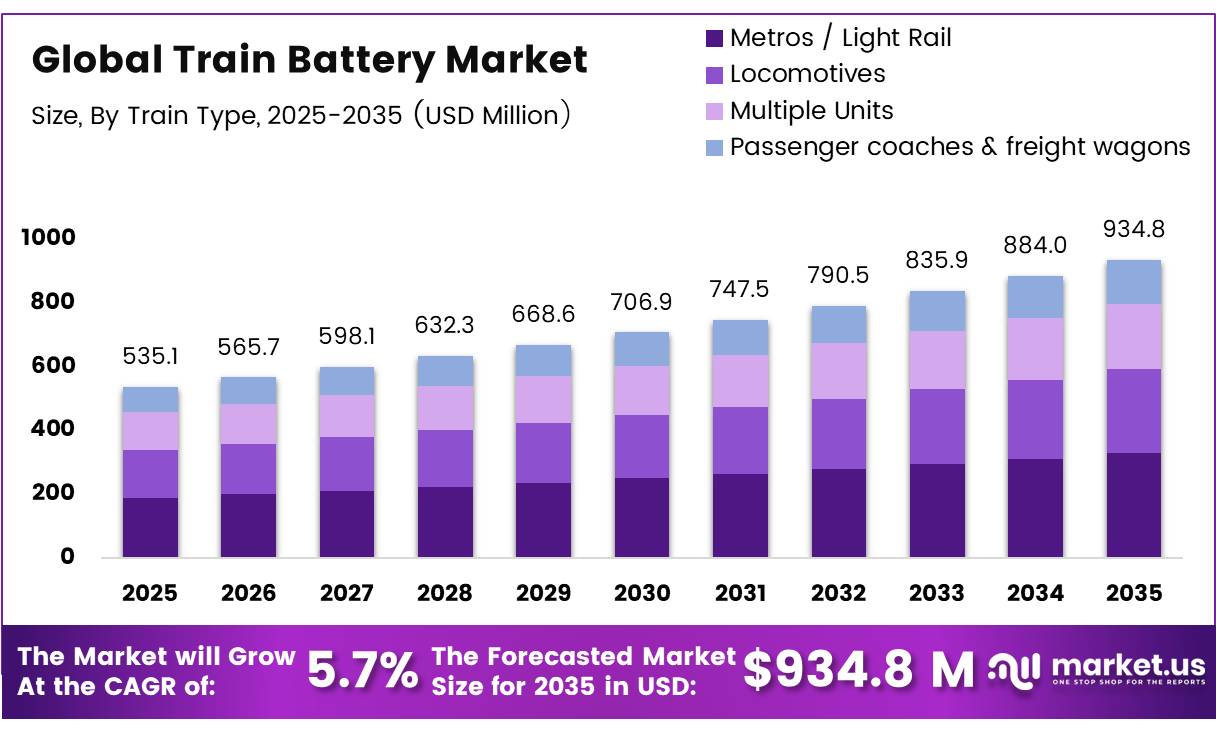
In 2025, the Global Train Battery Market was valued at USD 535.1 billion, and between 2026 and 2035, this market is estimated to register a CAGR of 5.7%, reaching about USD 934.8 billion by 2035. In 2025, North America held a dominant market position, capturing more than a 40.2% share, holding USD 215.10 Billion revenue.
The train battery industry includes onboard energy-storage systems used for traction on non-electrified sections, auxiliary power, emergency operation and regenerative-energy recovery. The sector is shifting toward lithium-ion packs supported by battery-management systems, thermal controls, fire protection and remote diagnostics
- In September 2025, New Zealand approved NZD 802.9 million for 18 battery-electric multiple-unit trains serving the Wairarapa and Manawatū corridors. The programme will replace diesel rolling stock dating from the 1970s and improve service frequency, reliability, and journey times.
- The International Energy Agency reports that rail carries 8% of global passengers and 7% of freight while using only 2% of transport energy, and about three-quarters of passenger rail activity already uses electric trains.
Ireland expanded railway electrification in December 2025 by funding 100 energy-efficient DART carriages for EUR 173.9 million. This raised the total order to 285 carriages, equal to 57 five-carriage trains, and increased cumulative government fleet investment to approximately EUR 670 million. The first 95 carriages are scheduled to enter service from the first half of 2027, followed by 90 more from 2028.
- In 2025, the United Kingdom supported a Class 230 battery-electric fast-charge trial for the West Ealing–Greenford branch, demonstrating how non-electrified sections can operate without continuous overhead wiring. A 2026 public procurement study indicated that a 100 kWh battery could move a train across power-supply gaps of up to 2 kilometres.
Europe’s Rail planned 38 demonstrations, including 6 alternative-energy rolling-stock demonstrations and a battery-electric multiple unit targeted at technology readiness level 6/7 in 2025. The UK Department for Transport supported Great Western Railway’s fast-charge trial, where a 3-car battery unit had completed 18 months of non-passenger testing by September 2025. The European Commission’s Battery Booster framework also proposed €1.5 billion in interest-free loans for European cell producers, supporting stronger supply chains and advanced battery technologies.
Future opportunities will come from battery retrofits, regenerative braking, terminal charging, modular packs, thermal-control systems, and recycling services. The European Commission’s 2025 Battery Booster allocated EUR 1.8 billion, including EUR 1.5 billion in interest-free loans, while targeting 170,000 jobs and EUR 365 billion in added EU GDP by 2030.
Key Takeaways
- The global Train Battery market was valued at USD 535.1 billion in 2025.
- The global market is projected to grow at a CAGR of 5.7% and is estimated to reach USD 934.8 billion by 2035.
- On the basis of battery type, the lithium-ion batteries dominated the market, constituting 55.6% of the total market share.
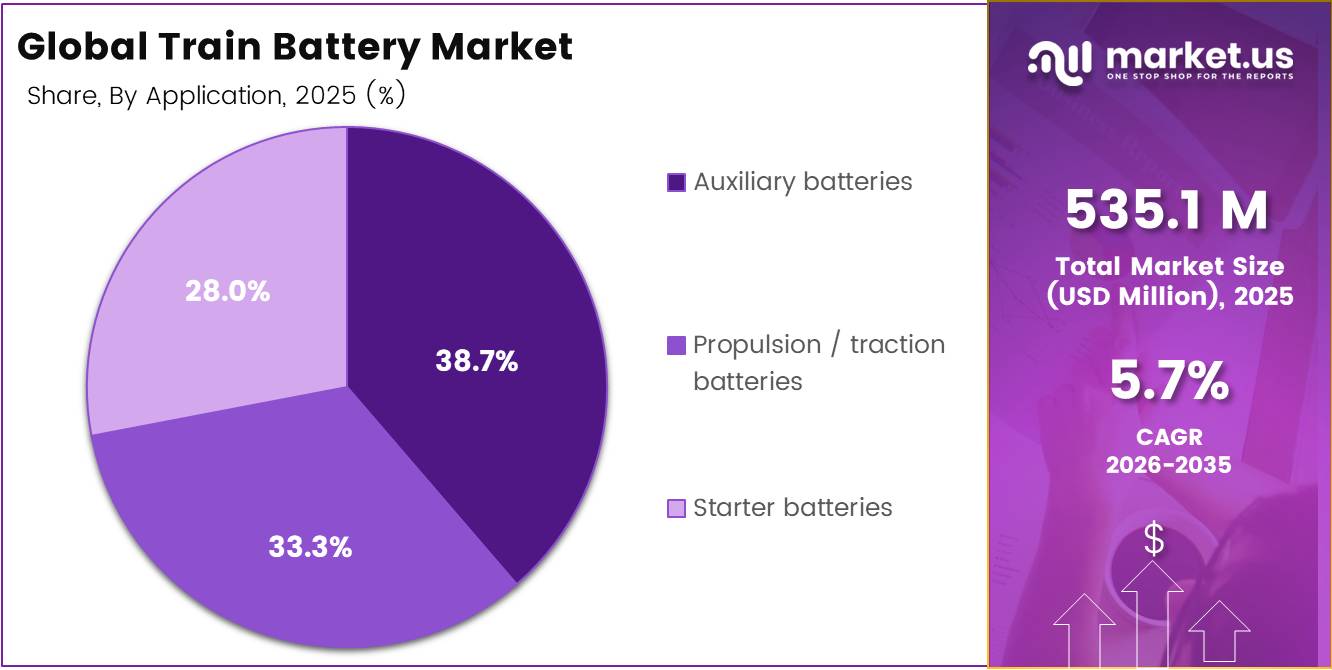
- Based on the application, the Auxiliary batteries dominated the Train Battery market, with a substantial market share of around 38.7%.
- Based on the train type, Metros / Light Rail led the market, comprising 35.2% of the total market.
- Among the Advanced Train Type, the Battery-powered trains (BEMUs) held a major share in the Train Battery market, 35.9% of the market share.
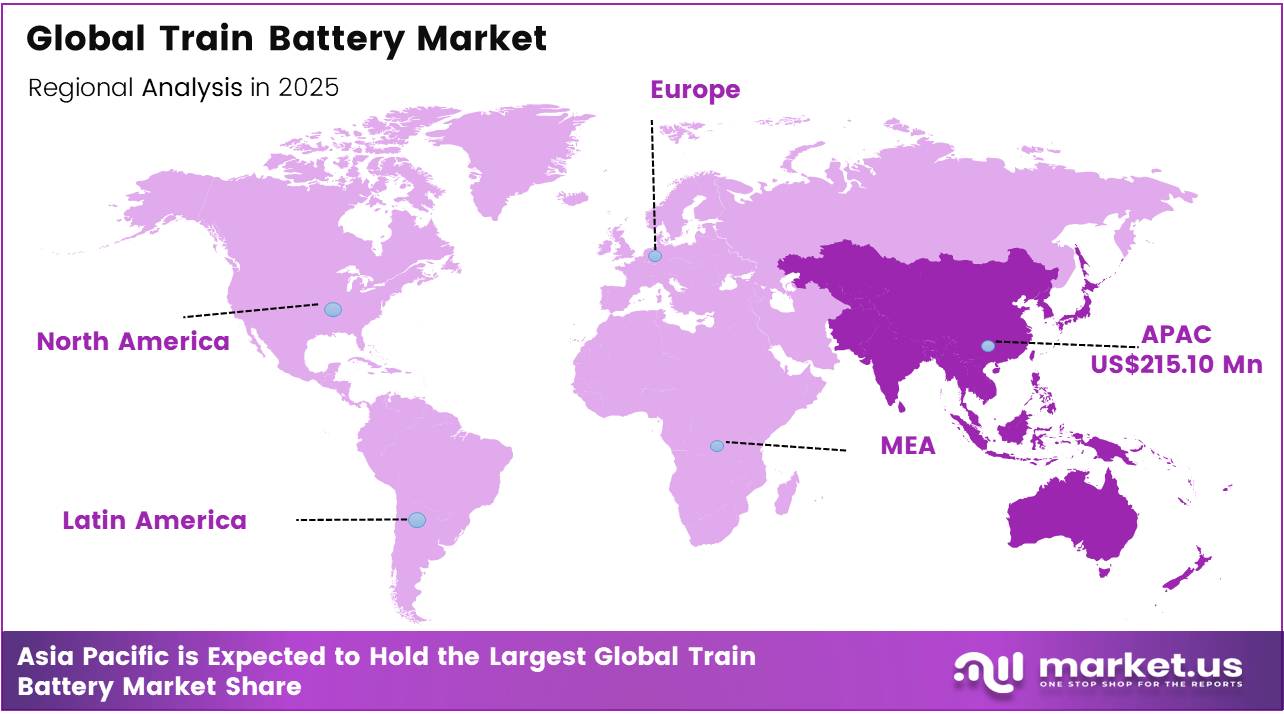
- In 2025, the Asia Pacific was the most dominant region in the Train Battery market, accounting for 40.2% of the total global consumption.
Battery Type Analysis
Lithium-ion batteries represents dominant Segment in the Market.
Lithium-ion batteries held the leading position in the train battery market, capturing a 55.6% share. Their high energy density, lighter weight and rapid charging support battery-electric trains operating across partially electrified railway networks.
- In September 2025, the Scottish Government announced an investment exceeding £342 million to electrify selected Fife and Borders routes and procure 69 new trains. The programme includes around 140 km of railway electrification, creating stronger demand for traction batteries, charging equipment and thermal-management systems.
Nickel-cadmium batteries are the growing segment, supported by their rugged construction, long service life and reliable auxiliary power during harsh operating conditions. Transport Canada requires railway crossing battery systems to provide backup for 8 hours of continuous warning activation and 24 hours of normal operation. Such demanding safety requirements support the continued use of durable nickel-cadmium systems in signalling, emergency lighting, communications and onboard control equipment.
Application Analysis
Auxiliary batteries a significant Application.
Auxiliary batteries held the leading position in the train battery market, capturing a 38.7% share. Their dominance is supported by the continuous need to power emergency lighting, communication equipment, signaling, doors, ventilation and control systems when the main supply is interrupted. Transport Canada requires automatic battery-powered emergency lighting in every passenger carriage.
Propulsion and traction batteries represent the growing segment as governments move toward battery-electric trains on routes without complete overhead electrification. A 2025 UK public procurement notice included eight battery-electric multiple units, each containing four vehicles, with passenger service expected in 2032. Demand is being strengthened by diesel replacement, regenerative braking and the ability to recharge while travelling on electrified sections.
Train Type Analysis
Metros / Light Rail Held a Major Share of the Train Battery Market.
In 2025, Metros and Light Rail held the leading position in the train battery market, capturing a 35.2% share. Frequent stops and intensive daily operations create steady demand for batteries supporting emergency lighting, doors, communication equipment, braking controls and other onboard systems.
- The UK Department for Transport recorded 231.2 million light-rail and tram journeys in England during the year ending March 2025. These networks operated 22.4 million vehicle miles using 537 vehicles across 418 stops, showing the operating scale that supports regular battery installation and replacement.
Multiple Units represent the growing segment as railway authorities increasingly adopt electric and battery-electric trainsets for partially electrified routes. A Scottish public procurement notice outlined plans for approximately 28 battery-electric multiple units and 41 electric multiple units, with initial deliveries expected by late 2031. Battery-equipped units can recharge beneath overhead wires and continue across unwired sections, helping operators retire diesel trains without electrifying every kilometre of track.
Advanced Train Type Analysis
Train Batterys Are Mostly Utilized in the Hybrid trains.
Hybrid trains held the leading position in the advanced train battery market, capturing a 38.1% share. Their ability to alternate between electric and onboard power makes them practical for railway networks where electrification remains incomplete.
- UK government statistics recorded 1,278 bi-mode railway vehicles in operation as of March 2025, representing a 16% annual increase. Around 9,547 kilometres, or 61% of Britain’s railway route, remained non-electrified, creating a strong operational case for flexible hybrid traction.
Battery-powered trains, or BEMUs, represent the growing segment as governments seek cleaner alternatives to diesel without installing overhead wires across entire routes. In 2026, Fife Council reported a £311.5 million rail-modernization programme designed to introduce new battery-electric trains. These trains can recharge on electrified sections and use stored energy elsewhere, opening opportunities for traction packs, charging stations, battery monitoring and thermal-management systems.
Key Market Segments
By Battery Type
- Lithium-ion batteries
- Lead-acid batteries
- Nickel-cadmium (Ni-Cd) batteries
By Application
- Starter batteries
- Auxiliary batteries
- Propulsion / traction batteries
By Train Type
- Metros / Light Rail
- Locomotives
- Multiple Units
- Passenger coaches & freight wagons
By Advanced Train Type
- Battery-powered trains (BEMUs)
- Hybrid trains
- Conventional trains with battery backup only
Driver Analysis
Diesel-to-Battery Retrofit Mandates on Non-Electrified Corridors
The EU’s Alternative Fuels Infrastructure Regulation now formally brings rail into scope, requiring member states to publish National Policy Frameworks assessing battery-electric or hydrogen alternatives for line segments that cannot be cost-effectively electrified, with overview obligations that came due around 2025 and recommendation cycles running through 2027. This regulatory push is compounding with the EU’s “Fit for 55” and Sustainable and Smart Mobility Strategy, which envisions phase-out of diesel-only rolling stock progressing through the 2030s and full modal-shift targets by 2050.
Operationally, this reshapes rail OEM business models away from one-time diesel-drivetrain sales toward retrofit-as-a-service contracts bundling battery packs with multi-year maintenance: ABB’s deal with Škoda Group for 195 Traction Battery Pro Series packs across 15 BEMUs for Czech Railways, valued at under USD 20 million, included a 15-year service agreement signed in Q4 2024, illustrating how unit economics are shifting from hardware margin to recurring service revenue.
Hitachi Rail’s battery-hybrid retrofits already demonstrate up to 50% fuel-consumption reduction on mixed-power fleets and can cover roughly 70km of non-electrified intercity track per charge cycle, giving operators a bridge technology that defers full catenary capex by 8-12 years per corridor. For market participants, this driver converts diesel MU replacement cycles (typically 20-25 year asset lives) into earlier, regulation-forced battery-retrofit windows, pulling forward capital deployment into the 2026-2029 window across EU secondary lines.
Drivers Impact Analysis
| Driver | (~) % Impact on CAGR | Geographic Relevance | Impact Timeline |
|---|---|---|---|
| Diesel-to-battery retrofit mandates on non-electrified rail corridors | +2.2% | EU core (Germany, France, UK), APAC secondary corridors | Medium term (2-4 years) |
| Falling lithium-ion (LFP) pack costs enabling traction-grade economics | +1.9% | Global, China cost-leadership spill-over to APAC and EU | Short term (≤ 2 years) |
| Shift from nickel-cadmium/lead-acid legacy chemistries to Li-ion retrofits | +1.6% | North America core, EU replacement cycles | Medium term (2-4 years) |
| BEMU (Battery Electric Multiple Unit) fleet procurement by national operators | +2.6% | EU (Germany, Czech Republic, Croatia), India, China | Short term (≤ 2 years) |
| Full electrification programs reducing addressable traction-battery scope | -1.1% | India core, China, selective EU spill-over | Long term (≥ 4 years) |
| Freight and industrial locomotive electrification (steel, mining, ports) | +1.4% | China core, South America spill-over, APAC | Medium term (2-4 years) |
Restraint Analysis
High upfront battery and charging capex
High initial capex for traction-grade batteries and associated charging infrastructure remains the single largest drag on train battery adoption, particularly in emerging markets where rail operators run on thin operating margins and rely heavily on public subsidies: multiple EV and battery adoption studies show that packs account for 35–40% of the capital cost of a vehicle and over 60% of some transport assets, and similar ratios translate into rail where replacing a diesel MU with a battery-electric configuration typically lifts vehicle-level capex by 25–35% versus a conventional train when both onboard storage and wayside charging are included.
For smaller regional operators and state railways in India, Southeast Asia or Latin America, this means a single 4-car battery EMU with fast-charge support can require an incremental USD 4–6 million of upfront investment, compared with 10–15% lower ticket prices for proven diesel stock, while the cost of high-power charging points and substation upgrades frequently adds another 20–30% to corridor-level project budgets, echoing broader guidance that high-speed rail networks and advanced battery infrastructure see capital intensity as a core barrier in developing economies.
Statutory constraints compound this: in India, for example, 18% GST on commercial charging services and lack of targeted subsidies for rail batteries, contrasted with more generous incentives for road EVs, materially worsens the cash-cost profile of rail electrification and battery deployment.
Restraint Impact Analysis
| Restraint | (~) % Impact on CAGR Forecast | Geographic Relevance | Impact Timeline |
|---|---|---|---|
| High upfront battery and charging capex | -2.3% | Emerging APAC, LATAM, Africa, EU periphery | Medium term (2-4 years) |
| Critical-mineral price and supply volatility | -1.7% | Global supply chains, EU and NA importers | Short term (≤ 2 years) |
| Rail safety, fire and certification hurdles | -1.4% | EU core, North America, Japan | Medium term (2-4 years) |
| Limited energy density, range and lifecycle | -1.6% | Global, acute on long regional routes | Long term (≥ 4 years) |
| Grid and charging infrastructure constraints | -1.2% | Urban EU, India, dense APAC corridors | Long term (≥ 4 years) |
| Recycling, hazardous waste and ESG risk | -0.9% | EU, NA, China, regulatory-driven markets | Medium term (2-4 years) |
Opportunity Analysis
Stationary rail-side energy storage
This is an untapped opportunity because most train battery programs in 2026 focus narrowly on onboard traction and auxiliary systems, while rail-side depots and substations increasingly require stationary storage to smooth peak loads from electrification and fast-charging that are currently handled by grid upgrades or diesel backup rather than batteries: academic work on hybrid renewable systems for railway electrification shows that integrating BESS with PV and wind at stations can shave peak demand and reduce operational costs, but these systems are still in early deployment stages with very limited penetration across the tens of thousands of substations and depots globally.
If train battery suppliers repurpose their traction-grade platforms into standardized 2–10 MWh stationary units co-located with rail infrastructure, the adjacent TAM could realistically reach low-single-digit billions of dollars by 2030 given the number of medium and large depots, and margins in stationary storage provide additional value creation. Unit economics are attractive because the same LFP-based modules used in trains can be stacked into containerized BESS, reusing engineering, certification and supply chains; CAPEX per kWh for stationary storage has fallen toward USD 70–90/kWh in 2025–2026, and rail operators with high evening peaks or constrained substations can achieve 10–15% reductions in demand charges and line losses by localizing storage.
Opportunity Impact Analysis
| Opportunity | (~) % Potential CAGR Upside | Geographic Relevance | Execution Window |
|---|---|---|---|
| Stationary rail-side energy storage (depot & substation BESS) | +2.3% | EU core, UK, Japan, urban India | Medium term (2-4 years) |
| V2G / grid services from train battery fleets | +1.9% | EU, North America, advanced APAC grids | Long term (≥ 4 years) |
| Industrial and freight rolling-stock battery platforms | +2.1% | China core, South America mining, APAC ports | Medium term (2-4 years) |
| Tram, LRT and catenary-free urban transit batteries | +1.8% | EU cities, UK, Middle East urban rail | Short term (≤ 2 years) |
| Battery leasing and performance-based service models | +1.7% | Global, strongest in capital-constrained APAC & LATAM | Medium term (2-4 years) |
| Rail battery recycling, second-life and ESG-linked financing | +1.5% | EU, North America, China | Long term (≥ 4 years) |
Challenges Analysis
Rail-electrification and battery skills gap
The rail-electrification and battery skills gap is a systemic challenge rather than a hard restraint because projects continue, but at inflated costs and elongated timelines: World Bank commentary and specialist training bodies highlight insufficiently trained manpower as a top barrier to electrification, with acute shortages in OHE design, traction power engineering, RAMS experts and digital twin/IoT professionals, while national skills academies in Europe estimate that more than 120,000 new recruits will be needed by 2030 just to sustain operations, construction and digital systems in rail.
For battery-heavy projects, this translates into a limited pool of engineers who can concurrently handle 25 kV overhead design, MW-scale substations, safety standards like EN 50126/28/29, and high-power battery integration; in some countries, reports note only hundreds of specialists capable of safely working with high-voltage overheads and complex rail electronics, forcing tenders to rely on imported expertise and leading to premium labor rates 20–30% above standard engineering costs.
Transit authorities routinely report 6–12 month schedule slippages on electrification and battery retrofits due to design bottlenecks, shortage of commissioning engineers, and slow RAMS certification; these delays compound into 5–10% capex overruns and deferred revenue from new services. Strategically, operators and OEMs have to invest heavily in training pipelines, international recruitment and digital tools to partially offset the skills deficit, but demographic trends (ageing workforce, competing tech/energy sectors) mean normalization will take at least one talent cycle (4–8 years), imposing a persistent drag on how fast battery projects can realistically scale.
Challenges Impact Analysis
| Challenge | (~) % CAGR Friction | Geographic Relevance | Mitigation Horizon |
|---|---|---|---|
| Rail-electrification and battery skills gap | -1.4% | EU hubs, UK, APAC corridors | Long term (≥ 4 years) |
| Critical-mineral logistics and transit delays | -1.2% | EU importers, North America, APAC | Medium term (2-4 years) |
| Complex multi-standard safety and permitting | -1.1% | EU regulatory hubs, US, Japan | Medium term (2-4 years) |
| Integration with legacy signalling and control | -1.0% | Global brownfield networks | Long term (≥ 4 years) |
| High-complexity battery/BMS R&D cycles | -0.9% | Global OEM clusters, China, EU | Medium term (2-4 years) |
| Energy-price volatility and capex planning risk | -0.8% | EU, UK, India, power-intensive corridors | Long term (≥ 4 years) |
Geopolitical Impact Analysis
Critical Mineral Concentration and Government Funding Reshaping Train Battery Supply
Train battery manufacturers face growing geopolitical exposure because several essential materials are concentrated in a small number of countries. In 2024, China supplied 82% of global natural graphite production, the Democratic Republic of the Congo accounted for an estimated 75% of cobalt output, and Indonesia produced 62% of mined nickel. These materials are important for battery anodes, cathodes and energy-storage components. Export controls, political disputes or shipping disruption in these countries could increase material costs, extend delivery schedules and make battery replacement planning more difficult for railway operators.
- Governments are responding by financing alternative processing and manufacturing capacity. In March 2026, the U.S. Department of Energy announced up to USD 500 million for critical-material processing, battery manufacturing and recycling. Australia and the United States also reported government support totalling USD 1.4 billion from Australia and USD 2.2 billion from the United States for critical-mineral projects. This policy shift is encouraging train battery suppliers to diversify sourcing, expand recycling and develop regional production networks.
Beyond raw-material availability, geopolitical uncertainty is changing how train battery suppliers manage procurement and production. Manufacturers are increasingly favouring multi-country sourcing, long-term supply agreements, local recycling partnerships and battery chemistries that rely less on constrained minerals. Rail operators are also placing greater importance on traceability, maintenance support and replacement-part security when selecting suppliers. These shifts are expected to strengthen regional manufacturing networks and reduce exposure to sudden trade restrictions or transport disruptions.
Regional Analysis
Asia Pacific Held the Largest Share of the Global Train Battery Market.
Asia Pacific held the leading position in the train battery market, capturing a 40.2% share. Its dominance is supported by extensive railway networks, rapid fleet additions and continued investment in electrified transport.
- China’s railway network reached 165,000 kilometres at the end of 2025, including more than 50,000 kilometres of high-speed lines. During the year, 3,109 kilometres of new railway were placed into operation. This expanding fleet base creates steady demand for traction, auxiliary, signalling and emergency battery systems.
Europe represents the fastest-growing region as public funding increasingly supports cleaner rail infrastructure and rolling-stock upgrades. In July 2025, the European Commission selected 94 transport projects for nearly EUR 2.8 billion in grants. Rail received 77% of the total funding, the largest allocation among transport modes. This investment supports network modernisation and creates stronger opportunities for battery-electric trains, onboard energy storage, charging equipment and replacement battery services.
Key Regions and Countries Covered
- North America
- The US
- Canada
- Europe
- Germany
- France
- The UK
- Spain
- Italy
- Russia & CIS
- Rest of Europe
- APAC
- China
- Japan
- South Korea
- India
- ASEAN
- Rest of APAC
- Latin America
- Brazil
- Mexico
- Rest of Latin America
- Middle East & Africa
- GCC
- South Africa
- Rest of MEA
Key Players Analysis
Train battery manufacturers focus on strengthening technological differentiation, production efficiency, and supply chain resilience to maintain competitiveness. A key priority is continuous battery innovation, including the development of high-energy lithium-ion systems, advanced battery management solutions, and temperature-resistant cell designs that improve safety, charging performance, and operational life across rail applications. Companies further invest in modular battery packs and fast-charging technologies, as these systems support battery-electric trains operating on partially electrified routes.
Closer integration with cell suppliers, railway equipment producers, and rolling-stock manufacturers helps secure critical materials, improve system compatibility, and control costs during periods of raw material volatility. Strategic production expansion near major rail manufacturing hubs enables suppliers to respond faster to demand from metro, locomotive, multiple-unit, and passenger rail projects.
Manufacturers also emphasize thermal management, predictive maintenance, automated assembly, and railway-specific quality testing to ensure dependable performance under vibration, temperature changes, and intensive operating cycles. Long-term supply and maintenance agreements with train manufacturers and public transport operators further improve revenue visibility, strengthen customer relationships, and support positioning in high-value traction and auxiliary battery applications.
The Major Players In The Industry
- Saft (TotalEnergies)
- EnerSys
- GS Yuasa International Ltd.
- Exide Industries Ltd.
- Exide Technologies
- Amara Raja Batteries Ltd.
- Hoppecke Batterien GmbH & Co. KG
- East Penn Manufacturing Company
- HBL Power Systems Ltd.
- Hitachi Rail Limited
- AEG Power Solutions
- Leclanché SA
- SEC Battery
- First National Battery
- Power & Industrial Battery Systems GmbH
Key Development
- In May 2025, Saft began delivering MRX battery systems for 92 trains serving Cairo Metro Line 4. Each system provides 130 Ah at 110 V, with completion scheduled by November 2026.
- In February 2025, Leclanché completed due diligence with Pinnacle for a 50:50 joint venture covering railway batteries. Pinnacle could receive up to 40% of Leclanché equity through newly issued company shares and acquire another 30% for CHF 240 million.
Report Scope
| Report Features | Description |
|---|---|
| Market Value (2025) | USD 535.1 Mn |
| Forecast Revenue (2035) | USD 934.8 Mn |
| CAGR (2026-2035) | 5.7% |
| Base Year for Estimation | 2025 |
| Historic Period | 2020-2024 |
| Forecast Period | 2026-2035 |
| Report Coverage | Revenue Forecast, Market Dynamics, Competitive Landscape, Recent Developments |
| Segments Covered | By Battery Type (Lithium-ion batteries, Lead-acid batteries and Nickel-cadmium (Ni-Cd) batteries), By Application (Starter batteries, Auxiliary batteries and Propulsion / traction batteries), By Train Type (Metros / Light Rail, Locomotives, Multiple Units and Passenger coaches & freight wagons), By Advanced Train Type (Battery-powered trains (BEMUs), Hybrid trains and Conventional trains with battery backup only) |
| Regional Analysis | North America – The US & Canada; Europe – Germany, France, The UK, Spain, Italy, Russia & CIS, Rest of Europe; APAC– China, Japan, South Korea, India, ASEAN & Rest of APAC; Latin America– Brazil, Mexico & Rest of Latin America; Middle East & Africa– GCC, South Africa, & Rest of MEA |
| Competitive Landscape | Saft (TotalEnergies), EnerSys, GS Yuasa International Ltd., Exide Industries Ltd., Exide Technologies, Amara Raja Batteries Ltd., Hoppecke Batterien GmbH & Co. KG, East Penn Manufacturing Company, HBL Power Systems Ltd., Hitachi Rail Limited, AEG Power Solutions, Leclanché SA, SEC Battery, First National Battery, Power & Industrial Battery Systems GmbH. |
| Customization Scope | Customization for segments, region/country-level will be provided. Moreover, additional customization can be done based on the requirements. |
| Purchase Options | We have three licenses to opt for: Single User License, Multi-User License (Up to 5 Users), Corporate Use License (Unlimited Users and Printable PDF) |





































