


Introduction
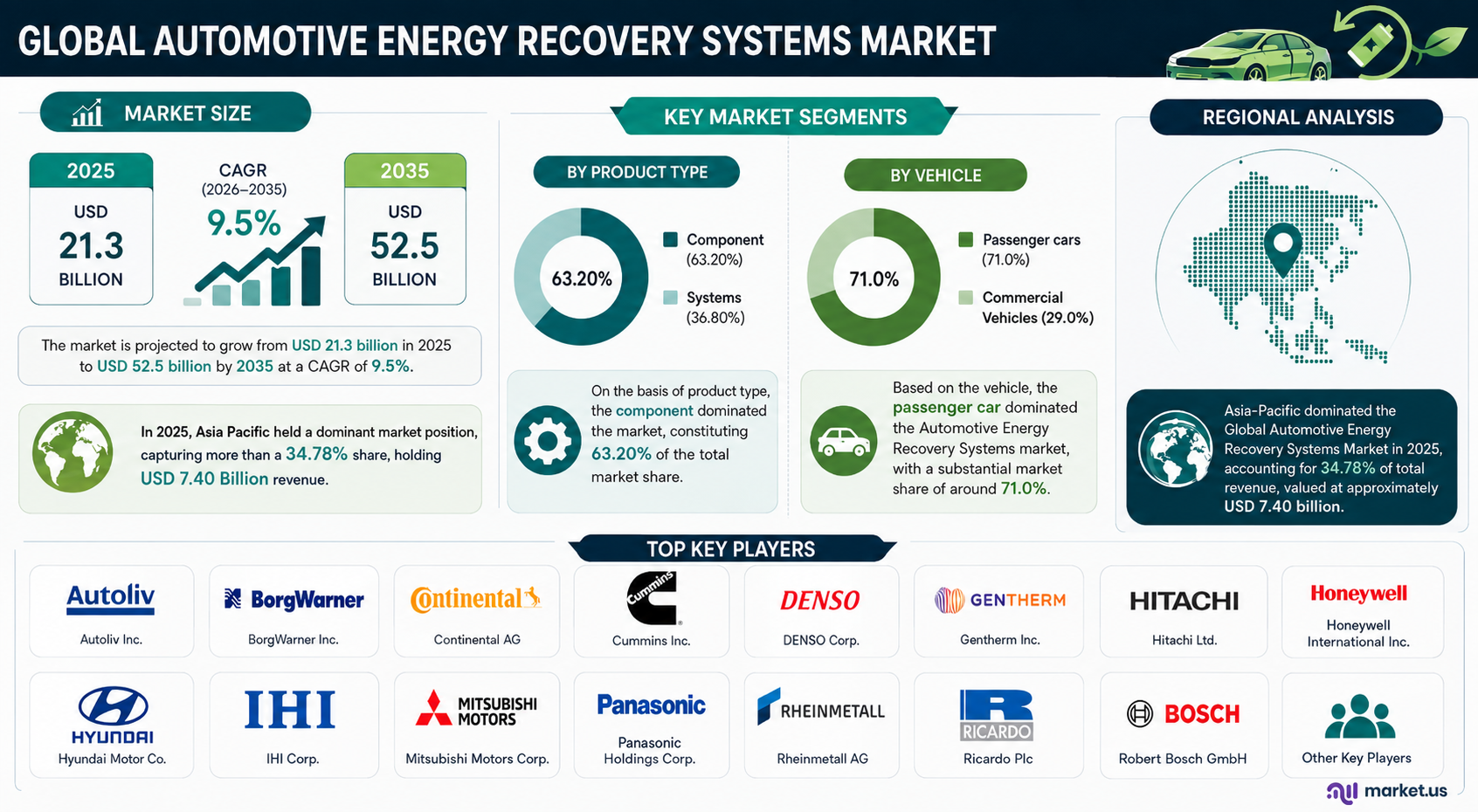
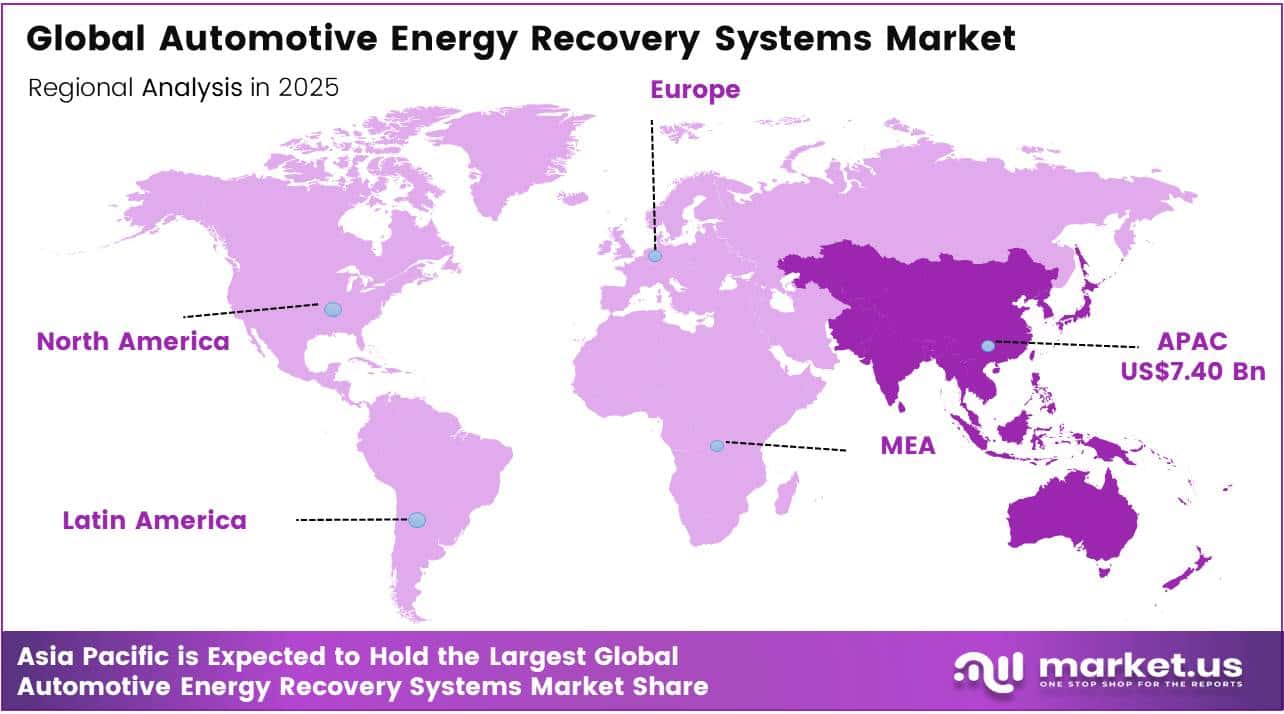
In 2025, the Global Automotive Energy Recovery Systems Market was valued at USD 21.3 billion, and between 2026 and 2035, this market is estimated to register a CAGR of 9.5%, reaching about USD 52.5 billion by 2035. In 2025, Asia Pacific held a dominant market position, capturing more than a 34.78% share, holding USD 7.40 Billion revenue.
Automotive energy recovery systems are gaining importance as vehicle manufacturers focus on improving efficiency by capturing braking, exhaust, and thermal energy that would otherwise be lost. Key technologies include regenerative braking, 48-volt mild-hybrid systems, electric turbo-compounding, thermoelectric generators, and exhaust-heat recovery. The U.S. Department of Energy reports that regenerative braking recovers about 22% of energy on the combined city-highway drive cycle, helping electric vehicles achieve 87%–91% efficiency, compared with roughly 30% for conventional gasoline vehicles. The IEA recorded 21 million electric-car sales in 2025, up more than 20%, representing 1 in 4 new cars, while production approached 22 million units, rising over 25%.
Regulatory pressure is further supporting adoption. EU targets require 93.6 g CO₂/km during 2025–2029, falling to 49.5 g CO₂/km during 2030–2034 and 0 g CO₂/km from 2035. Van targets decline from 153.9 g CO₂/km to 90.6 g CO₂/km. The IEA expects 23 million electric-car sales in 2026, equal to 28% of global sales, while the EV fleet could exceed 450 million units by 2035, more than five times the 2025 level.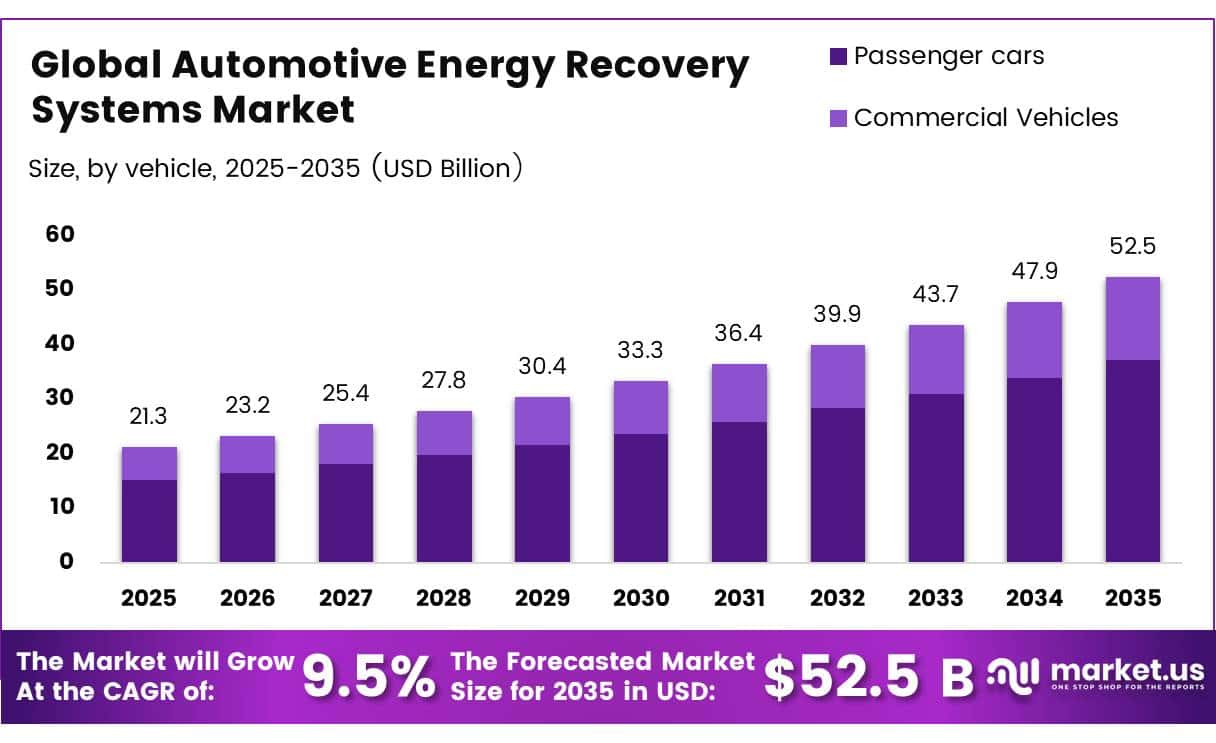
Key Takeaways
- The global Automotive Energy Recovery Systems market was valued at USD 21.3 billion in 2025.
- The market is expected to expand at a CAGR of 9.5%, reaching approximately USD 52.5 billion by 2035.
- By product type, the component segment led the market, accounting for 63.20% of the total market share.
- By vehicle type, passenger cars dominated the Automotive Energy Recovery Systems market with a significant share of around 71.0%.
- In 2025, Asia Pacific emerged as the leading regional market, representing 34.78% of total global consumption.
Market Segmentation Overview
Product Type Analysis
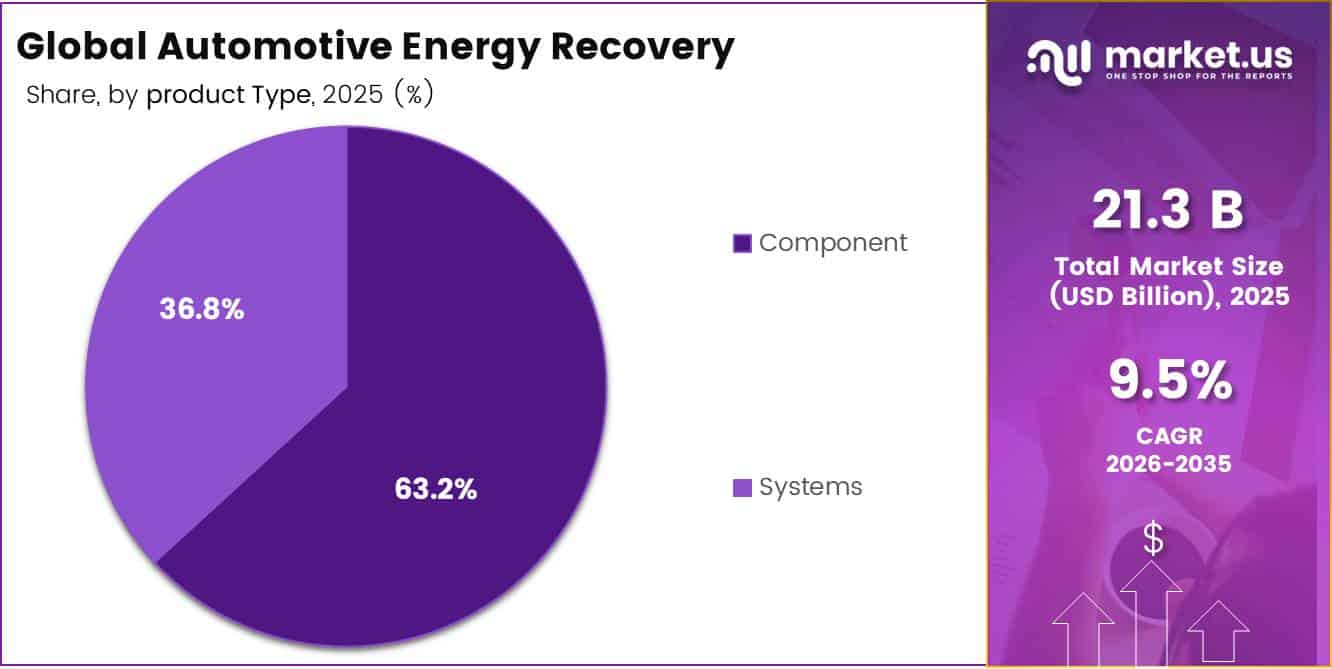
Components lead the Automotive Energy Recovery Systems Market with a 63.20% share.
Components held a dominant position in the Automotive Energy Recovery Systems Market, accounting for more than 63.20% of the market. Demand is supported by the widespread use of motor-generators, batteries, inverters, sensors, control units, and braking electronics across hybrid and electric vehicles. The U.S. Environmental Protection Agency reported that hybrids represented 15% of new vehicle production in model year 2024 and are projected to reach 19% in model year 2025. Average new-vehicle fuel economy also reached 27.2 miles per gallon, supporting greater use of efficient power-management components.
Vehicle Analysis
Passenger Cars dominate the market with a 71.00% share.
Passenger Cars held a leading position in the Automotive Energy Recovery Systems Market, capturing more than 71.00% of the market. Growth is supported by high vehicle production and wider adoption of regenerative braking, start-stop systems, motor-generators, and battery controls. In 2025, the European Environment Agency recorded 10.8 million new passenger-car registrations across the EU, Norway, and Iceland. Fully electric cars accounted for 18.9% of registrations, while plug-in hybrids represented 9.7%, strengthening demand for energy-recovery and power-management technologies.
Drivers
Regulatory Emission Compliance Pressure Strengthens Energy-Recovery Adoption
The European Union’s fleet-wide CO2 target of 93.6 g/km for cars during 2025-2029 continues to increase pressure on automakers to adopt energy-recovery technologies. Under Regulation (EU) 2025/1214, compliance is now averaged across the 2025-2027 period instead of being assessed annually. Adopted by the European Parliament and Council on 17 June 2025, the three-year averaging mechanism gives manufacturers greater flexibility while encouraging planned integration of regenerative braking and waste-heat recovery systems across vehicle platforms by 2027.
This regulatory shift is turning energy recovery from an optional efficiency feature into an important part of vehicle compliance strategies. Major Tier-1 suppliers, including Bosch and Continental, are increasingly supporting standardized recovery modules across wider vehicle ranges. Similar emission-tightening measures in India and fleet-average fuel-consumption requirements in China are also encouraging suppliers to develop common global platforms, helping reduce engineering complexity and spread R&D costs across larger production volumes.
Major Challenges
Multi-Domain Calibration Complexity Challenges System Deployment
Automotive energy recovery systems require coordinated calibration across motor torque, hydraulic braking, battery charge, inverter temperature, tire-road friction, vehicle mass, ADAS functions, and thermal limits. This growing complexity can extend launch readiness by an internally modelled 6-12 months for a new vehicle platform, increasing development pressure on automakers and suppliers.
The challenge becomes greater when a global platform must be validated across 20-40 vehicle variants, different drivetrain layouts, weather conditions, battery ageing stages, and vehicle loads. Suppliers are therefore increasing the use of digital twins, hardware-in-the-loop testing, reusable control software, and shared system data. Without a 30-50% reduction in calibration iterations, approved energy-recovery technologies may still miss scheduled vehicle production windows.
Business Opportunities
Fleet Energy-as-a-Service
High-utilization commercial vehicles, including buses, urban delivery vehicles, refuse trucks, port drayage fleets, and regional freight vehicles, offer strong opportunities for automotive energy recovery systems because frequent braking increases measurable energy recuperation. In 2025, electric-truck sales in China more than doubled, reaching 9% of global truck sales, while one in four trucks sold in China was electric.
This opportunity depends on stronger telematics integration, data rights, fleet-finance partnerships, warranty-risk management, and standardized performance measurement. Suppliers converting even 10-15% of commercial-system shipments into managed-service contracts could potentially increase lifecycle revenue per installed system by 25-40% and raise portfolio CAGR by an estimated 2.2 percentage points, creating a recurring revenue opportunity beyond initial component sales.
Use Cases
Regenerative Braking in Passenger Electric Vehicles
Regenerative braking is one of the most established use cases for automotive energy recovery systems. During deceleration, the electric motor operates as a generator and converts vehicle motion into electricity that is stored in the battery. The U.S. Department of Energy reports that regenerative braking can recover about 22% of energy on the combined city/highway drive cycle. Including this recovered energy, a typical EV achieves around 87%–91% efficiency, compared with approximately 30% for a conventional gasoline vehicle. This makes regenerative braking particularly valuable in passenger EVs used in urban and stop-and-go driving.
Hybrid and Mild-Hybrid Vehicle Energy Recovery
Hybrid vehicles use motor-generators and regenerative braking to recover energy and recharge their batteries without depending entirely on external charging. These systems also support engine start-stop operation, acceleration assistance, and auxiliary electrical loads. According to the U.S. EPA, hybrids accounted for 15% of U.S. new-vehicle production in model year 2024 and are projected to reach 19% in model year 2025. Average new-vehicle fuel economy reached a record 27.2 mpg in model year 2024, supporting greater integration of energy-saving powertrain technologies.
Regional Analysis
North America Leads the Solar Energy Systems Market
In 2025, North America dominated the Solar Energy Systems Market, accounting for 52.4% of the global market and generating USD 161.7 billion in revenue. According to the International Renewable Energy Agency (IRENA), the region recorded 230,471 MW of installed solar capacity at the end of 2025. This leadership was supported by continued expansion of utility-scale solar projects, wider adoption of distributed solar generation, increasing corporate renewable energy procurement, growing integration of battery storage systems, and strong financing availability. These factors continue to strengthen North America’s position as a major market for solar energy deployment and related system investments.
Recent Developments
- In October 2025, DENSO Corporation introduced a new SiC inverter designed to improve the efficiency of electrified vehicle powertrains. The inverter reduced power loss by 70% while cutting the core-module size by about 30%, supporting higher power density, improved energy efficiency, and more compact vehicle power-electronics systems.
- In November 2025, Hyundai Motor launched the all-new NEXO equipped with its Smart Regenerative System. Battery output increased from 40 kW to 80 kW, while total system output rose from 135 kW to 190 kW. The vehicle also achieved a projected driving range of 826 km, highlighting continued improvements in regenerative energy management and electrified powertrain performance.
Conclusion
The Automotive Energy Recovery Systems Market is positioned for steady expansion as automakers increase the use of regenerative braking, hybrid powertrains, advanced inverters, and intelligent energy-management systems. Global electric-car sales exceeded 20 million units in 2025, representing one-quarter of all new cars sold, while the IEA expects sales to reach 23 million units and 28% of global car sales in 2026. The global EV fleet could exceed 450 million vehicles by 2035, more than five times its 2025 level, creating a larger installed base for energy-recovery technologies. The U.S. Department of Energy reports that regenerative braking can recover about 22% of vehicle energy, helping typical EVs reach 87%–91% efficiency, compared with about 30% for gasoline vehicles. With hybrids projected to represent 19% of U.S. new-vehicle production in model year 2025, energy recovery is becoming an important part of future vehicle efficiency strategies.
Looking for data tailored to your specific market, region, or business need? Request a custom report or consultation — write to us at [email protected]




















