Overview
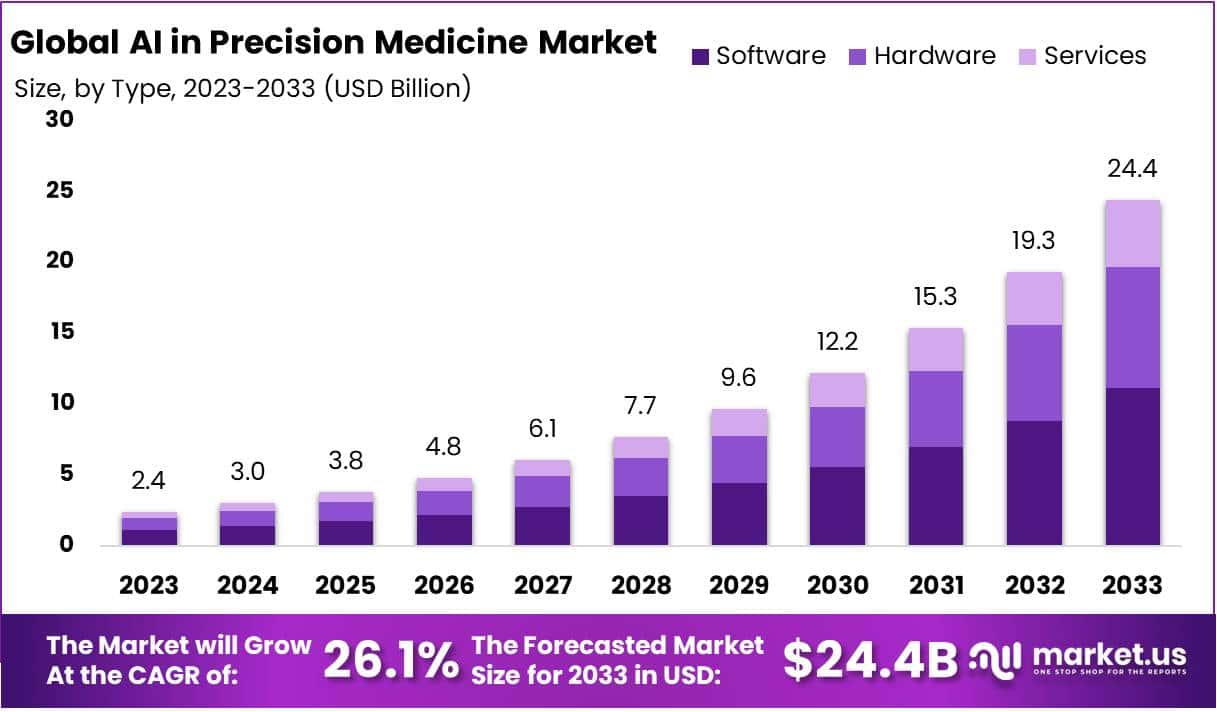
The Global AI In Precision Medicine Market size is expected to be worth around USD 24.4 Billion by 2033, from USD 2.4 Billion in 2023, growing at a CAGR of 26.1% during the forecast period from 2024 to 2033.
Artificial intelligence is emerging as a transformative technology in precision medicine by enabling healthcare professionals to analyze complex biological, clinical, and genomic information to support more personalized treatment decisions. AI-driven solutions are helping researchers identify disease patterns, predict treatment responses, improve diagnostics, and accelerate the development of targeted therapies. Precision medicine focuses on understanding individual differences in genes, environments, and lifestyles to deliver more effective healthcare approaches.
The integration of AI with electronic health records, medical imaging, laboratory data, and genomic information is creating new opportunities for data-driven healthcare. The National Institutes of Health (NIH) highlights the importance of making biomedical datasets accessible and AI-ready to support advanced research and clinical applications. AI technologies are increasingly being explored in areas such as oncology, rare disease research, pharmacogenomics, and personalized treatment planning.
Government initiatives are also supporting the advancement of AI-powered precision medicine. The NIH Common Fund’s PRIMED-AI program is focused on developing reliable AI tools that combine medical imaging with multiple health data sources to improve personalized medicine applications. Additionally, the NIH All of Us Research Program aims to collect health data from more than 1 million participants to advance precision medicine research.
Growing adoption of AI-based analytics, increasing availability of healthcare data, and advancements in genomics are expected to strengthen the role of artificial intelligence in delivering personalized, efficient, and evidence-based healthcare solutions worldwide.
Key Takeaways
- The Global AI In Precision Medicine Market size is expected to be worth around USD 24.4 Billion by 2033.
- The market is growing at a CAGR of 26.1% during the forecast period from 2024 to 2033.
- AI-based software solutions have demonstrated strong potential in disease diagnosis, enabling the software segment to capture a 45.2% market share.
- The deep learning segment holds a significant market share of 36.2%, driven by advancements in AI technologies.
- The oncology segment accounts for a 47.6% market share, supported by the increasing adoption of AI-driven solutions for the diagnosis and treatment of various cancer types.
- In 2023, North America held a notable market position, capturing a 32.4% share of the global AI in Precision Medicine Market.
Statistical Information
- The NIH All of Us Research Program has collected health data from more than 633,000 participants, including information from surveys, electronic health records, genomic analyses, physical measurements, and wearable devices to support precision medicine research.
- The NIH All of Us initiative was designed to enroll 1 million or more participants across the United States to create one of the largest and most diverse health databases for advancing personalized prevention, diagnosis, and treatment.
- The All of Us Research Program has generated whole genome sequencing data for more than 414,000 participants, helping researchers study genetic factors linked with disease risk and treatment response.
- Researchers using NIH precision medicine data identified 275 million previously unreported genetic variants, expanding knowledge of human genetic diversity and supporting future personalized healthcare applications.
- Chronic diseases account for approximately 90% of the United States’ $5.3 trillion annual healthcare expenditure, increasing the need for AI-based predictive analytics and personalized disease management solutions.
- Around 3 in 4 U.S. adults have at least one chronic condition, while more than half of adults have two or more chronic conditions, creating demand for advanced precision medicine approaches.
- More than 850,000 Americans died from heart disease and stroke in 2024, representing over 1 in 4 deaths in the country and highlighting opportunities for AI-driven risk prediction and individualized treatment strategies.
- The U.S. FDA continues expanding its AI-enabled medical device database, which includes AI technologies that have completed regulatory review for safety and effectiveness across multiple healthcare applications.
Regional Analysis
North America is expected to maintain strong growth in the AI in precision medicine market, supported by advanced healthcare infrastructure, strong research capabilities, and increasing adoption of artificial intelligence across clinical and genomic applications.
The region benefits from extensive healthcare data availability, advanced biotechnology ecosystems, and collaborations between technology providers, research institutions, and healthcare organizations. The U.S. National Institutes of Health (NIH) continues to support precision medicine initiatives through large-scale programs focused on integrating genomic, clinical, and lifestyle data to improve individualized healthcare.
The rising burden of chronic diseases is further encouraging investments in AI-driven healthcare solutions. According to global health estimates, noncommunicable diseases remain a major contributor to mortality worldwide, increasing demand for predictive analytics, early diagnosis, and personalized treatment strategies. AI technologies are being increasingly applied in oncology, drug development, and treatment optimization.
Emerging Trends
- Integration of Multimodal AI Healthcare Data: AI is moving toward combining genomic information, medical imaging, electronic health records, and lifestyle data to create more complete patient profiles. The NIH PRIMED-AI program focuses on developing AI tools that integrate imaging with multiple health data sources to improve personalized care.
- Growth of Explainable and Trustworthy AI Models: Healthcare regulators are increasingly emphasizing transparent AI systems that clinicians can understand and validate. The FDA has proposed frameworks to evaluate AI models used in drug and biological product development, supporting safer adoption in precision healthcare applications.
- Expansion of AI in Genomic Medicine: AI is improving the interpretation of complex genetic information by identifying disease-related patterns and supporting individualized treatment decisions. Precision medicine programs are increasingly using genomic sequencing and AI analytics to understand how genetic differences influence disease risks and therapy responses.
- AI Adoption in Regulatory and Drug Development Processes: Regulatory organizations are exploring AI to improve scientific review and accelerate healthcare innovation. The FDA completed an AI-assisted scientific review pilot where certain review tasks that previously required days could be completed in minutes, highlighting efficiency improvements.
- Personalized Healthcare Ecosystems Using Real-World Data: AI platforms are increasingly using real-world healthcare information from clinical records, genomic databases, and patient-generated data. These systems aim to improve prediction, prevention, and treatment decisions by moving healthcare from population-based approaches toward individualized care.
Use Cases
- AI-Based Cancer Treatment Selection: AI is helping oncologists analyze tumor genetics, molecular profiles, and clinical information to identify suitable treatment options. Precision oncology uses molecular characteristics of cancers to classify disease subtypes and support targeted therapy decisions for individual patients.
- AI-Assisted Drug Discovery and Development: Pharmaceutical researchers are using AI models to identify potential drug targets, analyze biological data, and improve therapy development timelines. The FDA is supporting the responsible use of AI in drug development through regulatory frameworks focused on safety, effectiveness, and quality evaluation.
- AI for Rare Disease Diagnosis: AI-driven genomic analysis is helping physicians identify rare diseases by detecting patterns within complex genetic datasets. NIH estimates that approximately 25–30 million Americans are affected by rare diseases, creating significant demand for faster and more accurate diagnosis methods.
- AI-Based Clinical Decision Support: Healthcare providers are using AI tools to analyze patient-specific information and support diagnosis, risk assessment, and treatment planning. These systems help clinicians interpret complex medical data while maintaining human oversight in healthcare decision-making.
- AI in Personalized Imaging and Diagnostics: AI is being applied to medical imaging analysis by combining image data with other patient information for improved diagnosis and treatment planning. NIH’s PRIMED-AI initiative supports development of AI solutions that connect imaging with multimodal health data for precision healthcare.
Frequently Asked Questions About AI in Precision Medicine
- How does AI support personalized healthcare?
AI supports personalized healthcare by processing large volumes of biological and medical information to identify relationships between patient characteristics and treatment outcomes. These insights help healthcare professionals develop more targeted prevention strategies, improve diagnosis accuracy, and provide individualized treatment approaches. - What are the major applications of AI in precision medicine?
AI applications in precision medicine include genomic analysis, cancer treatment planning, biomarker discovery, medical imaging analysis, drug development, and clinical decision support. These technologies help researchers and healthcare providers use complex datasets for improved patient-specific healthcare management. - How is AI used in cancer precision medicine?
AI helps cancer precision medicine by analyzing tumor characteristics, molecular biomarkers, and clinical information to support personalized treatment decisions. AI models can assist researchers in predicting treatment responses, identifying patient groups, and improving targeted therapy development for different cancer types. - What is driving the growth of the AI in precision medicine market?
The AI in precision medicine market is being driven by increasing healthcare data availability, advancements in genomics, rising adoption of AI-based diagnostic tools, and growing demand for personalized therapies. Government initiatives supporting biomedical AI research are also accelerating innovation in healthcare applications. - How is AI used in drug discovery and development?
AI supports drug discovery by analyzing biological datasets, identifying potential therapeutic targets, predicting drug responses, and improving research efficiency. The FDA is exploring AI applications in drug development, including clinical data analysis and prediction of patient responses to therapies. - What role does AI play in clinical decision support?
AI-based clinical decision support systems analyze patient-specific information to provide insights for diagnosis, risk prediction, and treatment planning. These tools help clinicians interpret complex healthcare data while supporting evidence-based decisions in precision medicine workflows. - What is the future outlook for AI in precision medicine?
The future of AI in precision medicine includes greater use of multimodal data integration, advanced genomic analysis, and AI-supported treatment optimization. Programs such as NIH PRIMED-AI are developing reliable AI tools that combine imaging with multiple health data sources for personalized healthcare.
Conclusion
AI in precision medicine is reshaping the future of healthcare by enabling more accurate diagnosis, personalized therapies, and data-driven clinical decisions. The combination of artificial intelligence, genomics, medical imaging, and real-world health data is creating new opportunities for improving patient outcomes. Government initiatives such as NIH PRIMED-AI and All of Us are accelerating innovation by supporting advanced AI research and healthcare data integration.
As healthcare systems continue adopting AI-powered solutions, precision medicine is expected to become more efficient, targeted, and patient-focused, supporting the transition toward individualized healthcare worldwide.