


Overview
The Global AI In Cancer Market size is expected to be worth around USD 19,815 Million by 2033, from USD 985.5 Million in 2023, growing at a CAGR of 35% during the forecast period from 2024 to 2033.
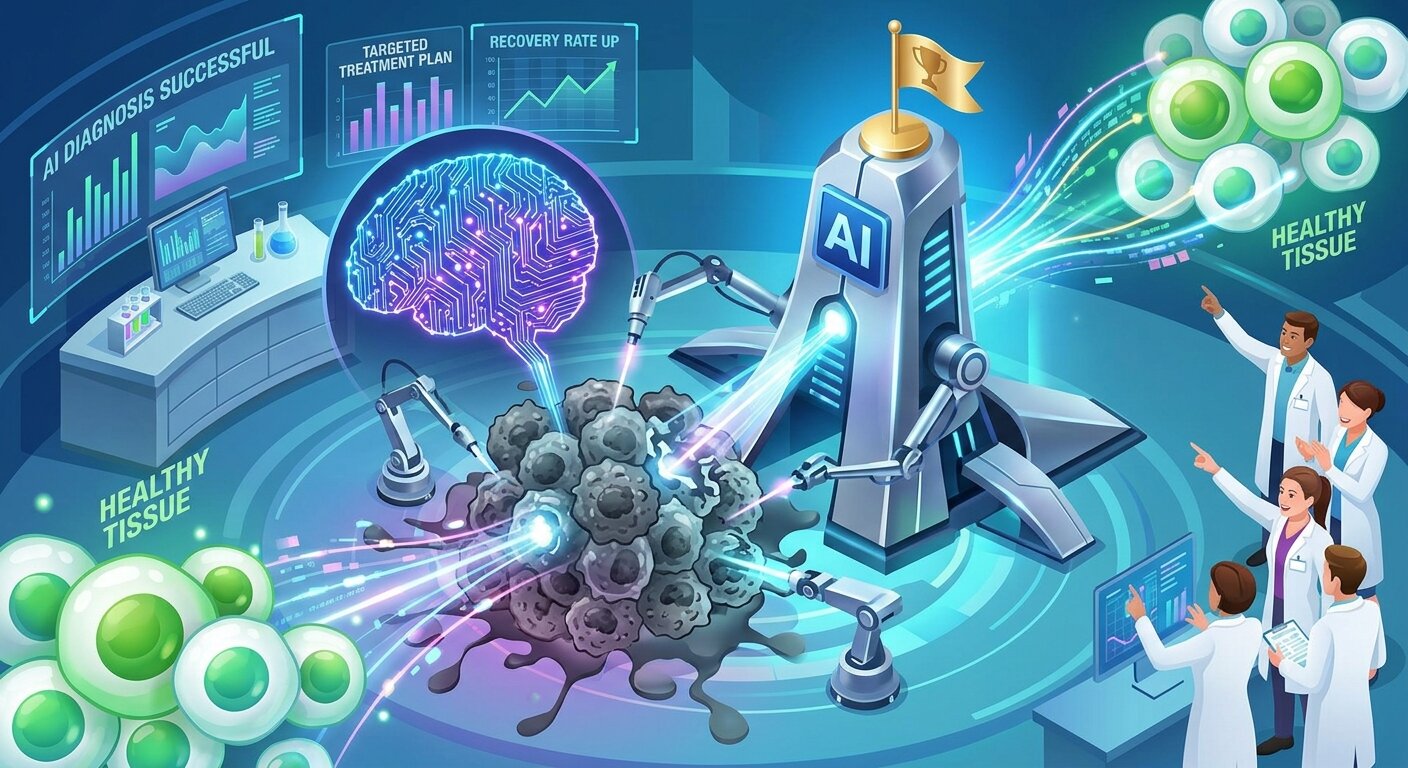
Artificial intelligence (AI) is rapidly transforming cancer care by improving the speed and accuracy of disease detection, supporting clinical decision-making, and enabling more personalized treatment strategies. AI-powered tools are increasingly being integrated into medical imaging, digital pathology, genomics, and oncology workflows to assist healthcare professionals in identifying cancers at earlier stages and optimizing patient management.
Governments, healthcare providers, and technology developers are expanding investments in AI-enabled healthcare infrastructure to improve outcomes while addressing the growing global burden of cancer.
According to the World Health Organization (WHO), cancer remained one of the world’s leading causes of death, accounting for nearly 10 million deaths in 2024, while lung cancer recorded approximately 2.6 million new cases, making it the most commonly diagnosed cancer worldwide. These figures highlight the urgent need for advanced diagnostic technologies capable of supporting earlier intervention and more efficient clinical workflows.
Regulatory agencies are also strengthening the adoption of AI in oncology. The U.S. Food and Drug Administration (FDA) established its Oncology Artificial Intelligence Program to advance the safe and effective use of AI across oncology drug development and regulatory science. Additionally, the FDA continues to authorize AI-enabled oncology devices that assist physicians in cancer detection and surgical decision-making, reflecting growing confidence in clinically validated AI technologies.

Key Takeaways
- In 2023, software solutions emerged as the leading segment in the global AI in cancer market, accounting for 58% of the total market share.
- Breast cancer represented the largest application area for AI-based solutions in 2023, securing a 41% market share due to increasing adoption for early detection and treatment planning.
- Based on treatment type, the chemotherapy segment dominated the global AI in cancer market, capturing 49% of the overall market share in 2023.
- Hospitals remained the primary end users of AI in cancer technologies, contributing 45.3% of the market share, supported by the expanding integration of AI-driven clinical solutions.
- North America held the leading regional position in the global AI in cancer market in 2023, accounting for 59.7% of total market revenue.
Statistical Information
- The U.S. SEER Program collects cancer incidence and survival data covering approximately 48% of the U.S. population, making it one of the world’s largest real-world oncology datasets used for developing and validating AI algorithms.
- The American Cancer Society estimates that 2,041,910 new cancer cases and 618,120 cancer deaths will occur in the United States in 2025, increasing the need for AI-assisted screening, diagnosis, and treatment planning.
- According to the American Cancer Society, the U.S. cancer mortality rate has declined by 34% since 1991, resulting in nearly 4.5 million fewer cancer deaths, reflecting the impact of earlier detection and improved treatment technologies that increasingly incorporate AI.
- A 2024 National Cancer Institute (NCI) workshop reported that only three AI/ML Software as a Medical Device (SaMD) tools had received FDA clearance for digital pathology applications in cancer research and clinical practice, highlighting significant opportunities for future AI innovation.
- The NCI SEER-Medicare database links cancer registry information with Medicare claims for patients diagnosed through 2021, with healthcare claims available through 2022, providing one of the largest longitudinal datasets for AI-based oncology research.
- A global survey of pathologists published in 2025 found responses from professionals across more than 60 countries, indicating growing worldwide interest in adopting AI tools for pathology workflows and cancer diagnosis.
- A 2025 quantitative study on AI-assisted pathology reported survey data from more than 500 pathologists, showing increasing acceptance of AI as a clinical decision-support tool rather than a replacement for specialists.
- The National Cancer Institute held a 2-day international workshop (March 6–7, 2024) bringing together experts in oncology, pathology, radiology, AI, and regulatory science to define priorities for integrating AI into cancer clinical trials and research.
Regional Analysis
North America dominated the global AI in cancer market in 2023, supported by its advanced healthcare infrastructure, high adoption of artificial intelligence technologies, and strong regulatory framework. The United States continues to lead AI innovation in oncology through extensive research investments, widespread deployment of digital pathology and medical imaging platforms, and the growing use of precision medicine.
The U.S. Food and Drug Administration (FDA) further strengthened the regional ecosystem by establishing its Oncology Artificial Intelligence Program to advance the safe integration of AI in oncology drug development and regulatory science. These initiatives are accelerating the adoption of AI-powered solutions across hospitals, cancer centers, and research institutions.
Asia-Pacific is expected to witness the fastest growth during the forecast period due to its expanding healthcare infrastructure, rising cancer burden, and increasing government investments in digital health technologies. According to the World Health Organization (WHO), Asia accounted for 50.7% of global cancer cases and 56.5% of cancer-related deaths in 2024, highlighting the urgent need for advanced diagnostic and treatment technologies. Growing adoption of AI-enabled imaging, pathology, and clinical decision-support systems across China, Japan, South Korea, and India is expected to further drive regional market expansion.
Emerging Trends
- Foundation AI models are becoming a major focus in oncology. In March 2026, the U.S. National Cancer Institute (NCI) organized a 3-day workshop (March 24–26) on foundation models that combine pathology, radiology, genomics, and electronic health records to improve diagnosis, treatment response prediction, and clinical decision-making.
- AI is increasingly powered by multimodal cancer data. The NCI’s Genomic Data Commons (GDC) now provides harmonized genomic, clinical, biospecimen, and whole-slide pathology image datasets, enabling developers to build more accurate AI models that analyze several types of patient data together instead of relying on a single source.
- Governments are creating AI quality standards for cancer care. In May 2025, the National Cancer Institute requested public input to develop standardized AI benchmarks and validation datasets, helping ensure future oncology AI systems are reliable, transparent, and clinically safe before wider adoption.
- AI research funding continues to expand across oncology. The National Cancer Institute supports AI projects through dedicated funding programs, workshops, and research resources that encourage collaboration between cancer researchers, clinicians, and AI developers to accelerate innovation in diagnosis, drug discovery, and precision medicine.
- Digital pathology is moving toward routine AI integration. Clinical research published in 2025 shows AI is increasingly being incorporated into pathology workflows to assist specialists with cancer detection, biomarker assessment, and workflow efficiency, while emphasizing the importance of rigorous clinical validation before widespread deployment.
Use Cases
- AI is improving brain tumor surgery decisions. National Cancer Institute-supported researchers have developed AI tools that rapidly identify genetic subtypes of brain tumors during surgery, allowing clinicians to make faster treatment decisions while patients remain in the operating room.
- AI helps predict survival in breast cancer patients. NCI-funded researchers developed AI models using digital pathology slide images to estimate survival outcomes for patients with invasive, non-metastatic breast cancer, supporting more personalized treatment planning and follow-up strategies.
- AI combines pathology and molecular data for better predictions. Researchers supported by the National Cancer Institute have shown that integrating two major data sources histopathology and molecular information produces more accurate outcome predictions for brain cancer patients than using either dataset independently.
- AI is accelerating cancer genomics research. The NCI Genomic Data Commons enables AI systems to analyze large genomic datasets to identify mutation patterns, classify tumors, predict disease progression, and support the discovery of new targeted cancer therapies using high-quality harmonized data.
- AI is reducing manual work in cancer surveillance. The National Cancer Institute uses AI within its cancer surveillance programs to automatically extract important tumor information from large volumes of unstructured clinical records, improving data quality while reducing the manual workload for cancer registries.
Frequently Asked Questions About AI In Cancer
- What is driving the growth of the AI in cancer market?
Growth is driven by increasing cancer cases, advances in machine learning, wider availability of digital health data, expanding precision medicine initiatives, and government investments in AI research. Improved computing capabilities and access to large clinical datasets are also accelerating market development. - Which healthcare settings benefit the most from AI in cancer?
Hospitals, cancer centers, diagnostic laboratories, and research institutions are the leading adopters of AI technologies. They use AI to improve cancer screening, pathology interpretation, imaging analysis, treatment planning, clinical research, and patient management while enhancing workflow efficiency. - What are the major applications of AI in the cancer market?
Major applications include early cancer detection, digital pathology, medical imaging analysis, precision oncology, genomic interpretation, drug discovery, radiation therapy planning, and cancer surveillance. These applications help clinicians deliver more personalized and data-driven cancer care. - What challenges does the AI in cancer market face?
The market faces challenges related to data privacy, algorithm bias, limited availability of diverse clinical datasets, regulatory compliance, and the need for extensive clinical validation. Addressing these issues is essential to ensure safe, transparent, and reliable AI adoption in oncology. - What is the future outlook for the AI in cancer market?
The future outlook is positive as AI continues to advance precision oncology, early diagnosis, biomarker discovery, and drug development. Ongoing government funding, research collaborations, and new AI resources are expected to support broader clinical adoption and continued market expansion. - Why is AI becoming important in cancer research?
AI enables researchers to analyze vast amounts of genomic, imaging, molecular, and clinical data more efficiently than traditional methods. This accelerates biomarker discovery, improves disease prediction, supports precision medicine, and helps develop innovative therapies for a wide range of cancers.
Conclusion
The global AI in cancer market is entering a phase of rapid innovation as healthcare providers increasingly adopt AI to improve cancer detection, diagnosis, treatment planning, and clinical research. Growing investments in digital pathology, medical imaging, genomics, and precision oncology are accelerating the integration of AI across the cancer care continuum.
Support from organizations such as the U.S. National Cancer Institute (NCI), the U.S. Food and Drug Administration (FDA), and the World Health Organization (WHO) is fostering the development of safe, reliable, and clinically validated AI solutions. As research advances and healthcare systems continue embracing data-driven technologies, AI is expected to play a pivotal role in enhancing clinical outcomes, improving operational efficiency, and enabling more personalized and accessible cancer care worldwide.




















