



Overview
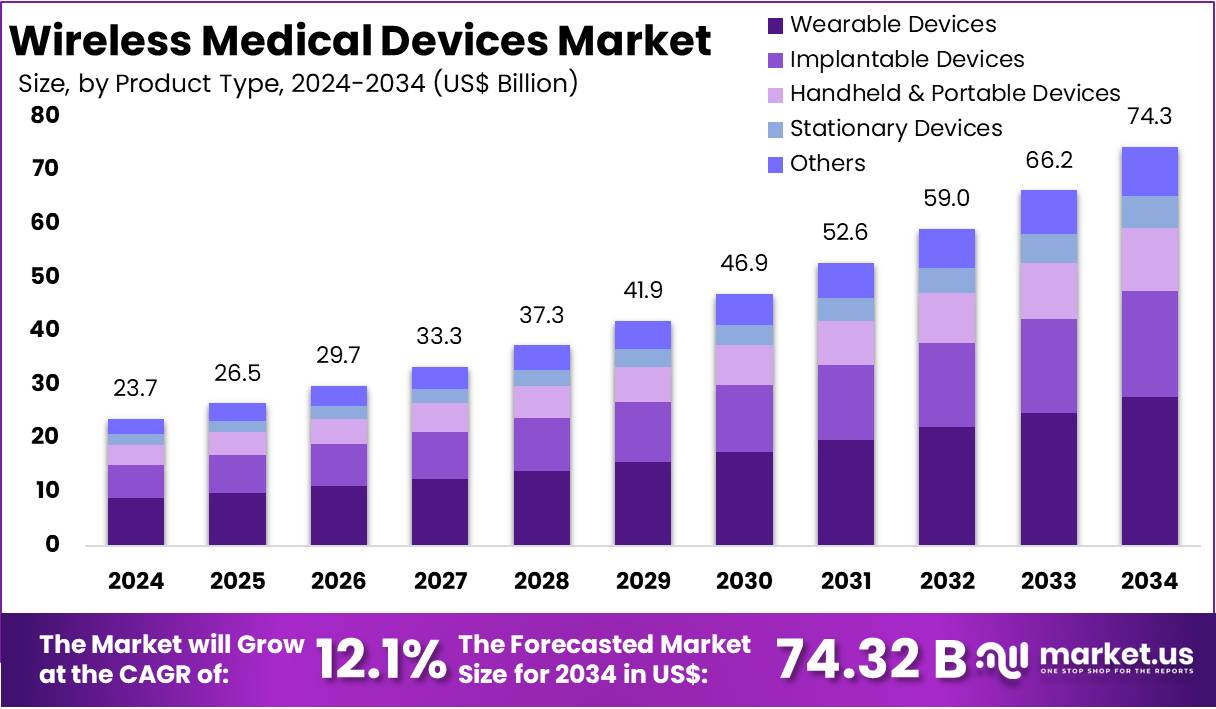
The Global Wireless Medical Devices Market size is expected to be worth around US$ 74.3 Billion by 2034 from US$ 23.7 Billion in 2024, growing at a CAGR of 12.1% during the forecast period 2025 to 2034. North America held a dominant market position, capturing more than a 38.7% share and holds US$ 9.33 Billion market value for the year.
The wireless medical devices market is gaining momentum as healthcare providers increasingly adopt connected technologies for remote monitoring, patient-data transmission, and digitally enabled care. According to the U.S. Food and Drug Administration (FDA), wireless medical devices can use Wi-Fi, Bluetooth, and cellular technologies to support functions such as remote patient monitoring, medical-device programming, and transferring patient information to other platforms.
A key indicator of rising adoption is the expansion of remote patient monitoring within the U.S. healthcare system. The U.S. Department of Health and Human Services Office of Inspector General reported that Medicare payments for remote patient monitoring exceeded US$ 500 million in 2024, highlighting the increasing use of connected devices to collect health information and transmit it to healthcare providers.
Wireless connectivity is also increasing the importance of interoperability and cybersecurity. The FDA states that connected medical devices can exchange information with other devices, healthcare systems, and technologies, supporting the display, storage, interpretation, and analysis of medical information.
Cybersecurity has consequently become an important consideration for manufacturers and healthcare organizations. In February 2026, the FDA issued updated guidance covering cybersecurity design, labeling, and premarket documentation for medical devices with cybersecurity risks. The combination of remote monitoring, connected care, interoperability, and stronger cybersecurity requirements is expected to support continued adoption of wireless medical technologies across hospitals, home healthcare, and outpatient environments.
Key Takeaways
- In 2024, the Wireless Medical Devices market generated US$ 23.7 billion in revenue and is projected to reach US$ 74.3 billion by 2034, expanding at a 12.1% CAGR during the forecast period.
- By product type, the market includes wearable, implantable, handheld & portable, stationary, and other devices. Wearable devices dominated the segment in 2024, accounting for a 37.4% market share.
- Based on type, the market is categorized into Diagnostic & Monitoring and Therapeutic devices. Diagnostic & Monitoring devices held the leading position, capturing a 55.5% share of the market.
- By technology, the market encompasses Bluetooth, Wi-Fi, NFC, Zigbee, RFID, UWB, and others. Bluetooth emerged as the dominant technology segment, securing a 29.7% revenue share.
- By application, the market covers Cardiology, Neurology, Respiratory, Diabetes Management, Point of Care, and others. Point of Care represented the largest application segment, with a 32.2% market share.
- By end-user, the market is segmented into Hospitals & Clinics, Home Healthcare, Ambulatory Surgical Centers, Diagnostic Centers, Long-Term Care & Assisted Living Facilities, and others. Hospitals & Clinics led the segment with a 31.7% share.
- Regionally, North America maintained its leading position in the Wireless Medical Devices market, accounting for a 38.7% market share in 2023.
Statistical Information
- 41.1% of U.S. adults used wearable devices to monitor their health in 2024, equivalent to approximately 108 million people.
- 45.6% of U.S. wearable users reported using their device every day in 2024, demonstrating substantial ongoing engagement with connected health-monitoring technologies.
- 19.2% of U.S. wearable users reported actually sharing their wearable-generated health information with clinicians in 2024, compared with 14.2% in 2020.
- 73.4% of U.S. wearable users said they were willing to share their device-generated health information with healthcare professionals in 2024, indicating considerable potential for clinical integration.
- Apple’s Heart and Movement Study has more than 200,000 participants across the United States, providing a large-scale data source for research involving activity, heart health, sleep, and wellbeing.
- Participants who frequently closed their Apple Watch Activity rings were 48% less likely to experience poor sleep quality than those who infrequently closed their rings, according to an analysis of more than 140,000 participants.
- The EU-27’s average eHealth maturity score reached 87% in 2025, increasing by 4 percentage points from 2024, reflecting broader digital-health infrastructure and electronic health-record accessibility.
- In 2025, 59% was the EU average maturity level for availability of medical-device and implant data within electronic health-record systems, highlighting continued opportunities for connected-device interoperability.
- 22 EU Member States, or 81%, reported using an authentication method based on an EUDI-compliant electronic identification system in 2025, strengthening secure digital access to health information.
- Under Medicare remote patient monitoring requirements, connected medical devices must collect and electronically transmit health data at least 2 days within a 30-day period for eligible monitoring services.
Market Segmentation Analysis
Product Type Analysis
The Wireless Medical Devices Market is segmented into wearable devices, implantable devices, handheld & portable devices, stationary devices, and others. Wearable devices dominated the market in 2024, accounting for 37.4% of the market share, supported by growing demand for continuous health monitoring and convenient access to real-time health data. Smartwatches, fitness bands, wireless ECG monitors, and other wearable technologies are increasingly used for tracking vital signs and supporting preventive healthcare.
Implantable devices, including wireless pacemakers and neurostimulators, are gaining adoption in chronic disease management, although regulatory requirements and higher costs can limit growth. Handheld and portable devices offer mobility for point-of-care applications, while stationary wireless systems remain important in clinical environments where advanced monitoring and diagnostic capabilities are required.
Type Analysis
By type, the Wireless Medical Devices Market is categorized into Diagnostic & Monitoring and Therapeutic devices. Diagnostic & Monitoring devices held the leading position with a 55.5% market share, reflecting increasing demand for continuous monitoring, early detection, and real-time access to patient information. Wireless diagnostic technologies enable healthcare professionals to monitor vital signs and other health parameters while supporting remote patient management.
Wearable monitoring systems, wireless ECG devices, connected glucose monitors, and other diagnostic technologies are contributing to adoption across healthcare settings. Therapeutic wireless devices are also gaining importance as connected technologies become increasingly integrated into treatment and disease-management workflows. The growing emphasis on personalized care, remote monitoring, and connected healthcare infrastructure is expected to support continued demand for wireless diagnostic and monitoring solutions.
Technology Analysis
The Wireless Medical Devices Market is segmented by technology into Bluetooth, Wi-Fi, Near Field Communication (NFC), Zigbee, RFID, Ultra-wideband (UWB), and others. Bluetooth led the market with a 29.7% revenue share, supported by its low power consumption, affordability, broad device compatibility, and ease of integration. Bluetooth is widely incorporated into wearable medical devices, smartwatches, wireless glucose monitors, fitness trackers, and other connected healthcare technologies.
Wi-Fi remains important for applications requiring higher data transmission capabilities, including remote patient monitoring and connected clinical systems. NFC and RFID support short-range communication and identification applications, while Zigbee and UWB serve specialized healthcare requirements. The widespread availability of Bluetooth-enabled smartphones and connected devices further strengthens its position across consumer and professional healthcare applications.
Application Analysis
By application, the Wireless Medical Devices Market encompasses Cardiology, Neurology, Respiratory, Diabetes Management, Point of Care, and other applications. Point of Care emerged as the leading application segment, capturing a 32.2% market share, driven by increasing demand for convenient, rapid, and decentralized healthcare services. Wireless devices such as portable ECG monitors, glucose monitoring systems, and pulse oximeters allow healthcare professionals to obtain patient information quickly while supporting continuous monitoring outside conventional hospital environments.
Cardiology remains an important application due to the growing use of connected cardiac monitoring technologies. Neurology and respiratory care are also adopting wireless neurostimulators and connected respiratory devices. Diabetes management continues to benefit from wireless glucose monitoring and insulin-delivery technologies, while expanding remote-care models are creating additional opportunities across applications.
End-User Analysis
The Wireless Medical Devices Market is divided by end-user into Hospitals & Clinics, Home Healthcare, Ambulatory Surgical Centers, Diagnostic Centers, Long-Term Care & Assisted Living Facilities, and others.
Hospitals & Clinics represented the largest end-user segment, accounting for 31.7% of the market share, supported by their extensive adoption of connected technologies for monitoring, diagnosis, treatment, and workflow management. Hospitals increasingly utilize wireless patient monitors, connected infusion systems, wearable technologies, and wireless diagnostic equipment to improve care delivery and operational efficiency.
Home healthcare is also expanding as healthcare systems increasingly emphasize remote monitoring and decentralized care. Ambulatory surgical centers and diagnostic centers are adopting wireless technologies to support efficient clinical workflows, while long-term care facilities are using connected devices to improve monitoring of elderly and chronically ill patients.
Regional Analysis
North America remains the leading region in the Wireless Medical Devices Market, supported by advanced healthcare infrastructure, strong digital-health adoption, and the presence of major medical-device manufacturers. The U.S. FDA recognizes wireless technologies such as Wi-Fi, Bluetooth, and cellular connectivity for remote patient monitoring and patient-data transfer.
The FDA’s sensor-based digital-health database also listed multiple devices receiving authorization in 2026, including continuous glucose monitoring, cardiovascular monitoring, and neurological devices, demonstrating ongoing innovation in connected healthcare.
Europe represents the second-largest regional market, supported by established healthcare systems, digital transformation, and a comprehensive regulatory framework for medical devices. The European Commission continues to focus on simplifying medical-device regulations while promoting digitalization, innovation, and patient safety.
In December 2025, the Commission proposed targeted revisions to the EU medical-device framework to make regulatory processes more efficient and support innovation. Countries including Germany, the UK, and France continue to provide opportunities for wireless monitoring, connected diagnostics, and digitally enabled healthcare solutions.
Business Opportunities
The Wireless Medical Devices Market offers strong business opportunities in wearable monitoring, connected diagnostics, remote-care platforms, and intelligent medical equipment. The FDA’s current sensor-based digital-health database includes authorized wearable and minimally invasive devices designed for continuous or spot-check monitoring in non-clinical settings, creating opportunities for manufacturers developing next-generation connected devices.
Remote monitoring solutions represent an important opportunity, particularly for cardiac, neurological, glucose, respiratory, and sleep-related applications. The FDA’s database recorded 18 sensor-based digital-health device decisions during 2025 across areas including cardiovascular monitoring, neurology, sleep monitoring, and continuous glucose monitoring, demonstrating continued product development activity.
Companies can also capitalize on interoperable device platforms that connect wireless monitors with smartphones, clinical systems, and healthcare-provider workflows. The FDA highlights remote access to patient data and real-time monitoring as key benefits of wireless medical technologies.
Another opportunity lies in cybersecurity, device connectivity, and wireless risk-management services, as manufacturers must address security, electromagnetic compatibility, coexistence, and reliability when developing connected medical devices.
Emerging Trends
- AI-enabled wireless devices: AI is increasingly being built into medical-device software to support detection, prediction, and clinical decision-making. The FDA listed AI-enabled device software functions as a dedicated 2025 regulatory area, encouraging manufacturers to develop wireless devices with more intelligent data analysis.
- FHIR-connected medical devices: Wireless devices are moving toward direct integration with healthcare IT systems through standardized APIs. ONC describes FHIR as a widely used API-focused standard for exchanging health information, creating opportunities for devices that can send structured data directly into clinical workflows.
- Real-time event-driven monitoring: Healthcare technology is shifting from simply collecting data toward automatically responding to important patient changes. ONC’s 2025–2027 LEAP project is exploring FHIR Subscriptions for real-time hypertension monitoring, showing the direction toward proactive connected-care systems.
- Stronger cybersecurity-by-design: Cybersecurity is becoming part of wireless-device development rather than an after-launch feature. The FDA issued updated cybersecurity guidance in February 2026, covering device design, labeling, and premarket documentation for products with cybersecurity risks.
- Expansion beyond hospitals: Wireless medical technologies are increasingly designed for home and community-based care. The FDA highlights remote monitoring and wireless data transfer as ways physicians can access patient information regardless of whether the patient is at a hospital, home, or office.
Use Cases
- Connected hypertension management: Wireless blood-pressure devices can automatically transmit readings to healthcare providers, allowing clinicians to track patients without requiring every measurement to be taken during a clinic visit. CMS specifically recognizes connected blood-pressure cuffs as devices used in remote patient monitoring.
- Cardiac-device remote follow-up: Wireless cardiac devices can transmit information from implanted systems to clinicians, supporting remote assessment of patients with heart conditions. The FDA notes that connected implanted heart devices can be monitored remotely, potentially reducing unnecessary visits to physicians’ offices.
- Automated diabetes-device communication: Connected glucose meters and insulin pumps can communicate with one another, creating more integrated diabetes-management workflows. The FDA specifically identifies this device-to-device communication as an example of how connected medical technologies can support patient care.
- Hospital device interoperability: Wireless equipment can exchange information with other medical devices and healthcare systems for display, storage, interpretation, analysis, or automated actions. FDA guidance identifies interoperability as a way to improve care, reduce errors, and enable broader clinical datasets.
- Time-sensitive clinical alerts: Wireless devices connected through modern health-data standards can support automated alerts when patient measurements cross predefined thresholds. ONC’s current interoperability work includes FHIR-based subscriptions designed to identify patients and generate real-time responses to elevated blood-pressure readings.
Recent Developments
- In August 2026, Philips announced new collaborations with Blue Spark Technologies, Caretaker Medical, Cuviva, LifeSignals, Respiree, and smartQare to expand its open patient-monitoring ecosystem. The partnerships integrate wearable and out-of-hospital technologies, including continuous temperature, blood pressure, ECG, SpO₂, respiration, and activity monitoring, into Philips’ monitoring infrastructure.
- In June 2026, Medtronic expanded its strategic distribution agreement with Corsano Health into the U.S. The agreement adds Corsano’s multi-parameter wearable to Medtronic’s Acute Care & Monitoring portfolio, following its Western European launch in 2025 and extending connected monitoring across hospital and digital-care environments.
- In June 2026, Samsung Electronics partnered with Alcedis to advance clinical research using wearable-based endpoints. The collaboration combines Samsung wearable technology and biometric data with Alcedis’ clinical-trial capabilities to generate evidence that can support research and drug-development programs.
- In June 2026, Philips and University Health in San Antonio entered a long-term strategic contract to modernize patient monitoring. The agreement will transition the health system to Philips’ Enterprise Monitoring as a Service model, integrating monitoring technology across sites and supporting standardized, data-driven clinical workflows.
- In October 2025, BIOTRONIK and the University of Sydney signed a three-year partnership to develop and clinically evaluate digital cardiac-care technologies. The collaboration focuses on remote patient monitoring, AI, and clinical decision support, with testing in real-world settings and particular attention to remote and underserved populations.
- In October 2025, Samsung Electronics completed its acquisition of Xealth, a U.S. digital-health platform. The acquisition connects Samsung’s wearable technology with Xealth’s healthcare-integration capabilities; Xealth’s network covers 500+ hospitals and 70+ digital-health solutions, strengthening Samsung’s connected-care strategy.
- In September 2025, Philips announced an innovation partnership with Masimo to expand access to patient-monitoring measurement technologies. The collaboration focuses on integrating advanced clinical measurements into Philips’ monitoring ecosystem, supporting broader interoperability and reducing complexity associated with multiple monitoring technologies.
- In July 2025, Medtronic and Philips signed a multi-year strategic partnership agreement focused on patient monitoring. The renewed collaboration builds on more than 30 years of cooperation and expands access to Medtronic monitoring technologies, including pulse oximetry, capnography, and brain-monitoring measurements through Philips systems.
Conclusion
The Wireless Medical Devices Market is evolving rapidly as healthcare systems increasingly adopt connected monitoring, wearable technologies, interoperable platforms, and digitally enabled care. Strong adoption of wearable devices, remote patient monitoring, Bluetooth connectivity, and diagnostic technologies is creating opportunities across hospitals, home healthcare, and outpatient settings. North America continues to lead, while Europe benefits from expanding digital-health infrastructure and regulatory support.
Growing consumer engagement with health wearables, increasing willingness to share health data, and advances in AI, FHIR interoperability, and cybersecurity are further supporting market development. Strategic partnerships, acquisitions, and investments by leading healthcare and technology companies are also accelerating innovation and expanding connected medical-device ecosystems.




















