



Introduction
The Global On-Device AI Market represents a structural shift in artificial intelligence architecture, moving inference and model execution directly onto end-user hardware rather than centralized cloud infrastructure. Valued at USD 14.87 billion in 2024 and projected to expand at a 27.9% CAGR through 2034, the sector is propelled by rising enterprise and consumer demands for sub-millisecond latency, data privacy compliance, and lower cloud-inference expenditures. Breakthroughs in dedicated Neural Processing Units (NPUs), 3nm/2nm process nodes, and compact multimodal foundation models have transformed smartphones, PCs, wearables, and automotive systems into autonomous edge intelligence platforms.
Market Size & Statistics
- The Global On-Device AI Market was valued at USD 14.87 billion in the 2024 base year.
- Global market revenue is projected to reach USD 174.19 billion by 2034, expanding at a compound annual growth rate (CAGR) of 27.9% from 2025 to 2034.
- North America dominated the global landscape in 2024 with a 34.9% market share, generating USD 5.18 billion in regional revenue.
- Within North America, the U.S. On-Device AI Market stood at USD 4.97 billion in 2024 and is forecast to grow at a 26.3% CAGR.
- By component, hardware commanded the largest share at 64.3% in 2024, fueled by demand for specialized neural processing units and AI accelerators.
- By deployment mode, the on-premises model captured 72.1% of the market in 2024 as enterprises prioritized local data governance and security.
- By technology, computer vision held the leading share at 34.8% in 2024, driven by local facial recognition, object detection, and video analytics.
- By device type, smartphones and tablets accounted for 48.3% of total market revenue in 2024 as the primary consumer execution platform.
- By end-use vertical, consumer electronics led all industries with a 44.6% market share in 2024, supported by smart home devices and wearables.
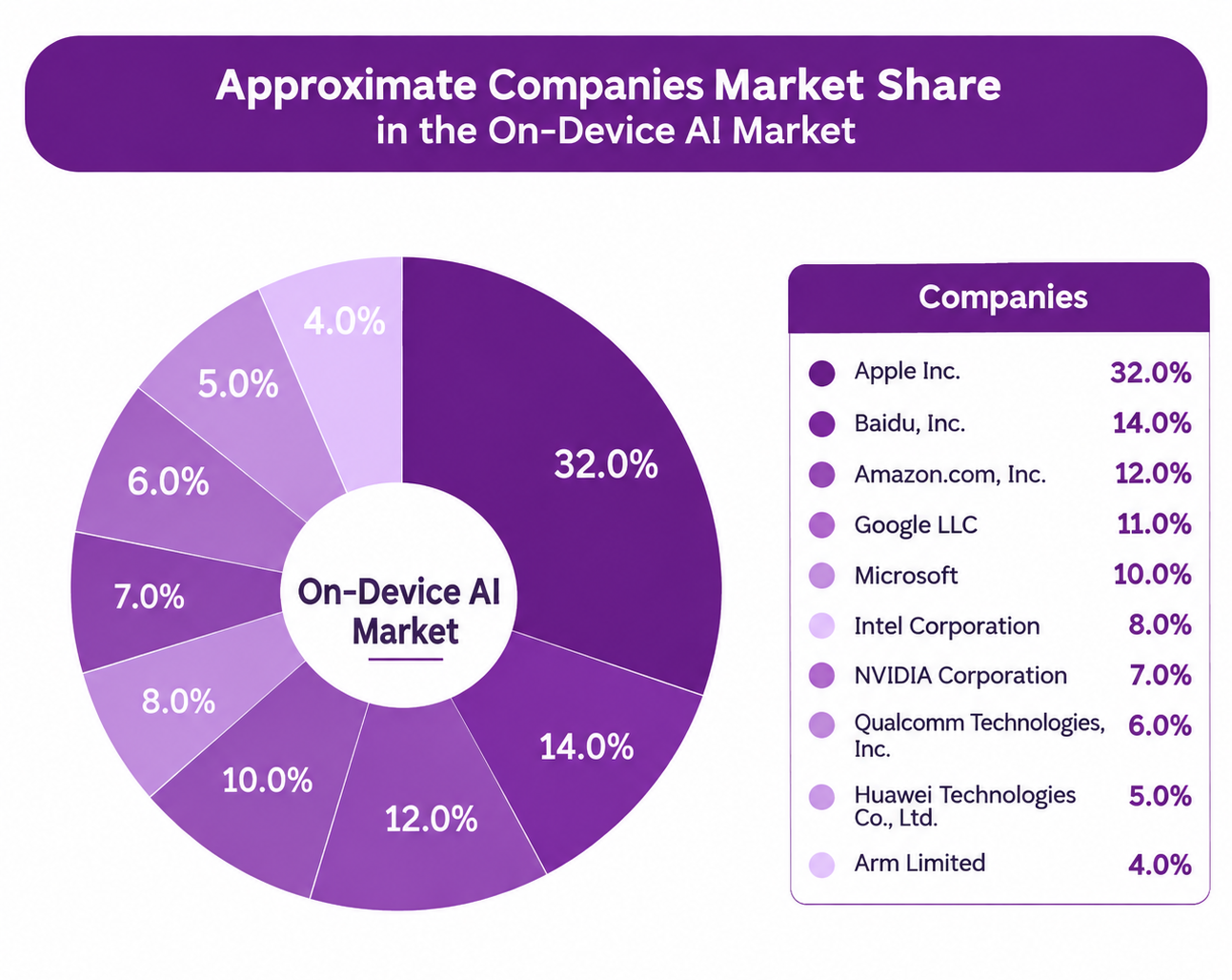
Because the On-Device AI sector spans foundational instruction set architectures (ISAs), merchant edge silicon, vertically integrated hardware ecosystems, and on-device runtime models, market share is bifurcated across architectural layers rather than a single monolithic pool:
Apple Inc.
About Apple Inc.: Apple Inc. is a vertically integrated consumer technology leader whose technological moat rests on custom unified-memory silicon (A-series and M-series Neural Engines) tightly coupled with iOS and macOS. In the On-Device AI sector, Apple executes a 3-billion-parameter foundation model locally across its active device base.
a) Company Overview Table
| Attribute | Company Data |
|---|---|
| Company Name | Apple Inc. |
| Ticker Symbol | NASDAQ: AAPL |
| Industry | Consumer Electronics & Vertically Integrated Edge Silicon |
| Headquarters | Cupertino, California, United States |
| Founded | April 1, 1976 |
| Founders | Steve Jobs, Steve Wozniak, Ronald Wayne |
| Current CEO | John Ternus |
| Latest Quarterly Revenue | $114.48 billion (Q4 FY2026, ended September 26, 2026) |
| YoY Revenue Growth | +12% |
| Primary Segments | iPhone, Services, Mac, Wearables/Home/Accessories, iPad |
b) Financial Details
In Q4 FY2026, Apple posted record September-quarter revenue of $114.48 billion (+12% YoY), propelled by AI-driven hardware upgrades across iPhone ($57.58 billion, +17% YoY) and Mac ($10.79 billion, +24% YoY). While Apple does not disaggregate standalone on-device AI revenue, its active installed base reached an all-time high, though management warned that surging DRAM/NAND memory costs required for local LLM execution will compress Q1 FY2027 gross margins to 45%–46%.
c) Strategic Developments
- Expanded the Apple Intelligence developer framework, enabling third-party iOS and macOS applications to tap directly into on-device foundation models without cloud inference calls.
- Deployed third-generation 3nm M-series and A-series Neural Engines featuring 153 GB/s unified memory bandwidth capable of 133 TOPS for local multimodal inference.
- Committed $33 billion in increased manufacturing purchase obligations and initiated hybrid intelligence integrations blending local Siri execution with external frontier models.
Qualcomm Technologies, Inc.
About Qualcomm Technologies, Inc.: Qualcomm Technologies, Inc. is the premier merchant fabless semiconductor supplier for mobile, automotive, and PC edge compute. Its technological moat stems from custom Oryon CPUs, low-power Hexagon NPUs, and the Qualcomm AI Hub runtime stack, powering on-device generative AI across flagship Android handsets, Windows laptops, and connected vehicles.
a) Company Overview Table
| Attribute | Company Data |
|---|---|
| Company Name | Qualcomm Technologies, Inc. (Subsidiary of QUALCOMM Incorporated) |
| Ticker Symbol | NASDAQ: QCOM |
| Industry | Semiconductors & Wireless Telecommunications |
| Headquarters | San Diego, California, United States |
| Founded | July 1985 |
| Founders | Irwin M. Jacobs, Andrew Viterbi, Franklin Antonio, Adelia Coffman, Andrew Cohen, Klein Gilhousen, Harvey White |
| Current CEO | Cristiano R. Amon |
| Latest Quarterly Revenue | $10.44 billion Non-GAAP / $10.32 billion GAAP (Q4 FY2026, ended September 27, 2026) |
| YoY Revenue Growth | -7% Non-GAAP / -8% GAAP |
| Primary Segments | Qualcomm CDMA Technologies (QCT: Handsets, Automotive, IoT), Qualcomm Technology Licensing (QTL) |
b) Financial Details
In Q4 FY2026, Qualcomm reported QCT semiconductor revenue of $9.02 billion (-8% YoY). While handset chip revenue declined 26% YoY to $5.14 billion amid customer modem transitions, non-handset edge AI segments surged: Automotive revenue rose 89% YoY to $1.99 billion (reaching $6.00 billion for full-year FY2026, +52% YoY), and IoT/PC edge revenue grew 4% YoY to $1.89 billion. Management reiterated a $22 billion combined automotive and IoT revenue target by FY2029, including $4 billion from AI PCs.
c) Strategic Developments
- Launched the Snapdragon 8 Elite Gen 5 mobile platform and Snapdragon X2 Elite Extreme PC processor, delivering 80 TOPS of NPU compute for local multi-agent execution.
- Scaled Qualcomm AI Hub to support over 1,800 enterprise developers and 175+ pre-optimized quantized models across mobile, automotive, and industrial IoT endpoints.
- Renewed long-term QTL patent license agreements with Apple, Huawei, and Transsion while expanding its Snapdragon Digital Chassis ADAS partnerships.
Arm Limited
About Arm Limited: Arm Limited architects the dominant energy-efficient processor instruction set (Armv9) and neural compute subsystems (Ethos NPUs) underlying the global edge ecosystem. Its structural moat is an unmatched licensing and per-chip royalty model that captures value across virtually every smartphone, microcontroller, wearable, and automotive infotainment unit worldwide.
a) Company Overview Table
| Attribute | Company Data |
|---|---|
| Company Name | Arm Limited (Arm Holdings plc) |
| Ticker Symbol | NASDAQ: ARM |
| Industry | Semiconductor Intellectual Property (IP) & Architecture Licensing |
| Headquarters | Cambridge, United Kingdom |
| Founded | November 27, 1990 |
| Founders | Acorn Computers, Apple Computer, VLSI Technology (Hermann Hauser, Robin Saxby, et al.) |
| Current CEO | Rene Haas |
| Latest Quarterly Revenue | $1.44 billion (Q2 FYE27, ended September 30, 2026) |
| YoY Revenue Growth | +27% |
| Primary Segments | Licensing and Other, Royalty Revenue |
b) Financial Details
Arm delivered record Q2 FYE27 revenue of $1.44 billion (+27% YoY), marking its fifth consecutive quarter of >20% top-line expansion. Licensing and other revenue surged 50% YoY to $773 million on strong demand for AI-capable Compute Subsystems (CSS), while royalty revenue reached $670 million, propelled by higher royalty rates from Armv9 adoption (now 25% of total chip shipments) across smartphones, Windows-on-Arm PCs, and edge inference devices.
c) Strategic Developments
- Extended CEO Rene Haas’s contract for seven years through 2033 to anchor Arm’s independent architectural roadmap across mobile, automotive, and edge AI.
- Expanded KleidiAI software library integrations across PyTorch, ExecuTorch, and MediaPipe to accelerate quantized LLM inference natively on Armv9 CPUs and Ethos NPUs.
- Surpassed 310 billion cumulative Arm-based chips shipped globally, establishing new automotive autonomous compute partnerships and edge inference startup alliances.
Google LLC
About Google LLC: Google LLC, the primary subsidiary of Alphabet Inc., anchors on-device AI across the global Android ecosystem through its proprietary Tensor G-series silicon and the Gemini Nano model family. Its moat combines deep mobile OS integration (Android AICore) with full-stack model compression, enabling real-time local agentic workflows across Pixel and partner smartphones.
a) Company Overview Table
| Attribute | Company Data |
|---|---|
| Company Name | Google LLC (Subsidiary of Alphabet Inc.) |
| Ticker Symbol | NASDAQ: GOOGL, GOOG |
| Industry | Internet Services, Mobile Operating Systems & AI Silicon |
| Headquarters | Mountain View, California, United States |
| Founded | September 4, 1998 |
| <Founders | Larry Page, Sergey Brin |
| Current CEO | Sundar Pichai |
| Latest Quarterly Revenue | $127.58 billion (Alphabet Consolidated, Q3 2026, ended September 30, 2026) |
| YoY Revenue Growth | +25% (+24.65%) |
| Primary Segments | Google Services (Search, YouTube, Android/Devices), Google Cloud, Other Bets |
b) Financial Details
Alphabet reported consolidated Q3 2026 revenue of $127.58 billion (+25% YoY) and operating income of $40.58 billion (+30% YoY). Within Google Services ($96.3 billion, +11% YoY), hardware and Play ecosystem monetization benefited from Pixel device adoption powered by Tensor G4/G5 NPUs and on-device Gemini features, while the broader Gemini consumer app reached 1 billion users. Standalone on-device AI revenue is not separately disclosed.
c) Strategic Developments
- Released the open-source Gemma 3N architecture and updated Gemini Nano runtimes optimized for local multimodal processing, on-device speech transcription, and Chrome browser inference.
- Developed Project COSMO, a background proactive Android AI agent utilizing Gemini Nano for local screen-context recall, event extraction, and hybrid cloud-device task execution.
- Expanded edge AI partnerships with Samsung to embed Gemini local multimodal intelligence into consumer robotics (Ballie) and Galaxy smartphones.
NVIDIA Corporation
About NVIDIA Corporation: NVIDIA Corporation dominates high-compute edge AI, autonomous vehicles, and industrial robotics through its Jetson embedded modules and Blackwell architecture. Its formidable moat is the unified CUDA and TensorRT software stack, which allows developers to train models in the data center and deploy quantized weights directly onto local edge systems.
a) Company Overview Table
| Attribute | Company Data |
|---|---|
| Company Name | NVIDIA Corporation |
| Ticker Symbol | NASDAQ: NVDA |
| Industry | Semiconductors, AI Computing & Embedded Robotics |
| Headquarters | Santa Clara, California, United States |
| Founded | April 5, 1993 |
| Founders | Jensen Huang, Chris Malachowsky, Curtis Priem |
| Current CEO | Jensen Huang |
| Latest Quarterly Revenue | $115.8 billion (Q3 FY2027, ended October 2026) |
| YoY Revenue Growth | +103% |
| Primary Segments | Data Center, Gaming & AI PC, Professional Visualization, Automotive & Robotics |
b) Financial Details
In Q3 FY2027, NVIDIA generated record total revenue of $115.8 billion (+103% YoY) and GAAP gross margins of 74.9%. While Data Center accounted for $107.6 billion (+110% YoY), NVIDIA’s remaining ~$8.2 billion in non-data-center revenue was anchored by RTX 50 Series AI PC GPUs executing local physical-AI vision models and accelerating enterprise shipments of Jetson AGX Thor robotics modules and DRIVE automotive platforms.
c) Strategic Developments
- Commenced commercial shipments of Jetson AGX Thor embedded robotics modules and DGX Spark (GB10 Grace Blackwell) desktop AI boxes, delivering 2,070 FP4 TFLOPS and 128 GB unified memory for local physical AI and model fine-tuning.
- Initiated U.S.-based Blackwell silicon production in Arizona to strengthen domestic AI supply-chain resilience.
- Partnered with General Motors on autonomous driving compute stacks and T-Mobile on an AI-native 6G edge wireless architecture.
Intel Corporation
About Intel Corporation: Intel Corporation is an integrated device manufacturer leading the x86 AI PC and industrial edge processor markets. Its moat relies on deep enterprise x86 software compatibility, the OpenVINO edge inference toolkit, and integrated NPU/GPU/CPU system-on-chip designs fabricated on its domestic Intel 18A process node.
a) Company Overview Table
| Attribute | Company Data |
|---|---|
| Company Name | Intel Corporation |
| Ticker Symbol | NASDAQ: INTC |
| Industry | Semiconductors & Integrated Foundry Services |
| Headquarters | Santa Clara, California, United States |
| Founded | July 18, 1968 |
| Founders | Gordon Moore, Robert Noyce |
| Current CEO | Lip-Bu Tan |
| Latest Quarterly Revenue | $16.5 billion (Q3 2026, ended September 2026) |
| YoY Revenue Growth | +21% |
| Primary Segments | Client Computing and Physical AI Group (CCPG), Data Center and AI (DCAI), Intel Foundry |
b) Financial Details
In Q3 2026, Intel posted total revenue of $16.5 billion (+21% YoY), driven by a 78% surge in Data Center and AI ($7.3 billion) and a 58% jump in Intel Foundry ($6.7 billion). However, Intel’s primary on-device AI division—the newly renamed Client Computing and Physical AI Group (CCPG)—recorded revenue of $8.1 billion, declining 5% YoY amid intense Windows AI PC competition from Arm-based rivals and memory supply constraints.
c) Strategic Developments
- Launched Intel Core Ultra Series 3 (“Panther Lake”) processors—the first consumer and edge SoCs built on the Intel 18A process—certified simultaneously for AI laptops and deterministic industrial robotics/smart-city edge deployments.
- Secured a foundry manufacturing agreement to fabricate Microsoft’s next-generation Maia 2 AI processor on Intel 18A and received a $5 billion strategic equity investment from NVIDIA.
- Raised $23 billion via a public equity offering in Q3 2026 to fund 18A/14A capacity expansion across client and edge silicon.
Microsoft
About Microsoft: Microsoft controls the enterprise desktop operating system layer through Windows 11 and Copilot+ PC architecture. Its moat in on-device AI centers on Windows Copilot Runtime APIs, DirectML, and ONNX Runtime, which standardize local NPU hardware abstraction across Intel, Qualcomm, and AMD client silicon for enterprise productivity workflows.
a) Company Overview Table
| Attribute | Company Data |
|---|---|
| Company Name | Microsoft Corporation |
| Ticker Symbol | NASDAQ: MSFT |
| Industry | Enterprise Software, Cloud Computing & Personal Computing |
| Headquarters | Redmond, Washington, United States |
| Founded | April 4, 1975 |
| Founders | Bill Gates, Paul Allen |
| Current CEO | Satya Nadella |
| Latest Quarterly Revenue | $92.28 billion (Q1 FY2027, ended September 30, 2026) |
| YoY Revenue Growth | +19% |
| Primary Segments | Agents and Infra, Devices and Consumer |
b) Financial Details
In Q1 FY2027, Microsoft reported consolidated revenue of $92.28 billion (+19% YoY) and operating income of $45.92 billion (+21% YoY). While Agents and Infra climbed 25% YoY to $76.8 billion (led by 48% Azure growth), the Devices and Consumer segment—which houses Windows OEM licensing and Surface Copilot+ hardware—contracted 3% YoY to $15.5 billion, with Windows OEM and Devices revenue falling 22% YoY due to PC shipment headwinds.
c) Strategic Developments
- Consolidated consumer Copilot and enterprise Microsoft 365 Copilot into a unified agentic client application capable of hybrid local-and-cloud workflow automation.
- Rolled out revised enterprise governance and privacy controls for Windows Recall and local semantic indexing on Copilot+ PCs.
- Contracted Intel Foundry on its 18A node to manufacture custom Maia 2 AI accelerators to support hybrid cloud-to-edge model inference.
Huawei Technologies Co., Ltd.
About Huawei Technologies Co., Ltd.: Huawei Technologies Co., Ltd. is China’s premier vertically integrated ICT and edge AI powerhouse. Its moat lies in full-stack domestic self-sufficiency—spanning proprietary Kirin mobile SoCs, Ascend edge accelerators, the HarmonyOS operating system, and Pangu edge foundation models—shielded from Western ecosystem dependencies.
a) Company Overview Table
YoY Revenue Growth+9.6% (H1 2026 YoY)
| Attribute | Company Data |
|---|---|
| Company Name | Huawei Technologies Co., Ltd. |
| Ticker Symbol | Private (Employee-Owned) |
| Industry | Telecommunications, Consumer Electronics & AI Silicon |
| Headquarters | Shenzhen, Guangdong, China |
| Founded | September 15, 1987 |
| Founders | Ren Zhengfei |
| Current CEO | Rotating Chairpersons (Meng Wanzhou, Eric Xu, Ken Hu) |
| Primary Segments | ICT Infrastructure, Consumer Business, Intelligent Automotive Solutions, Huawei Cloud, Digital Power |
b) Financial Details
Huawei does not publish standalone quarterly filings; in its most recent semi-annual report (H1 2026), total revenue increased 9.6% YoY to RMB 467.8 billion (~$70 billion), putting the company on pace to exceed RMB 900 billion annually. Profitability faced compression as R&D expenditure surged 25.2% YoY to a record RMB 121.38 billion (25.94% of revenue) to fund domestic Kirin/Ascend semiconductor fabrication and HarmonyOS on-device AI deployment.
c) Strategic Developments
- Surpassed 100 million active devices running its homegrown HarmonyOS ecosystem, embedding system-level on-device AI agents across Mate/Pura smartphones, tablets, and wearables.
- Pivoted HarmonyOS AI tooling toward open-source developer frameworks to accelerate third-party native edge AI application adoption.
- Expanded intelligent automotive cockpit and Qiankun ADS autonomous driving edge compute deployments across domestic Chinese electric vehicle OEMs.
Amazon.com, Inc.
About Amazon.com, Inc.: Amazon.com, Inc. anchors ambient smart-home and wearable on-device AI through its Echo, Fire, and Ring hardware ecosystem. Its technological moat combines custom ultra-low-power AZ-series neural edge processors with Alexa+ agentic orchestration, processing wake-word detection, acoustic events, and conversational transcription locally before cloud handoff.
a) Company Overview Table
| Attribute | Company Data |
|---|---|
| Company Name | Amazon.com, Inc. |
| Ticker Symbol | NASDAQ: AMZN |
| Industry | E-Commerce, Cloud Computing & Consumer Smart Devices |
| Headquarters | Seattle, Washington, United States |
| Founded | July 5, 1994 |
| Founders | Jeff Bezos |
| Current CEO | Andy Jassy |
| Latest Quarterly Revenue | $201.94 billion (Q3 2026, ended September 30, 2026) |
| YoY Revenue Growth | +12% (+13% constant currency) |
| Primary Segments | North America, International, Amazon Web Services (AWS) |
b) Financial Details
In Q3 2026, Amazon recorded net sales of $201.94 billion (+12% YoY) and record operating income of $28.08 billion (13.9% operating margin), led by AWS revenue accelerating 39% YoY to $45.98 billion. Amazon does not break out consumer smart-device revenue, which is consolidated within North America ($112.9 billion, +6% YoY) and International ($43.1 billion, +5% YoY) segments, while trailing 12-month capex surged to support $220 billion in full-year 2026 AI infrastructure investments.
c) Strategic Developments
- Acquired San Francisco wearable AI startup Bee, integrating its continuous local conversation-transcription and personal summarization wristband technology into the Alexa ambient ecosystem.
- Refreshed its smart speaker portfolio (including Echo Dot Max) with upgraded local neural processing for low-latency smart-home routines and conversational dialogue.
- Deployed AWS IoT Greengrass and custom Trainium/Inferentia cloud-to-edge pipelines to allow enterprise industrial devices to run distilled models locally.
Baidu, Inc.
About Baidu, Inc.: Baidu, Inc. is a leading Chinese AI and internet technology firm deploying on-device intelligence across autonomous mobility (Apollo) and smart home endpoints (Xiaodu). Its moat integrates quantized ERNIE compact language models with custom Kunlunxin inference silicon and China’s largest commercial robotaxi and smart-cockpit ecosystem.
a) Company Overview Table
| Attribute | Company Data |
|---|---|
| Company Name | Baidu, Inc. |
| Ticker Symbol | NASDAQ: BIDU; HKEX: 9888 |
| Industry | Internet Search, AI Cloud & Autonomous Mobility |
| Headquarters | Beijing, China |
| Founded | January 1, 2000 |
| Founders | Robin Li, Eric Xu |
| Current CEO | Robin Li |
| Latest Quarterly Revenue | RMB 30.81 billion / ~$4.6 billion (Q3 2026, ended September 30, 2026) |
| YoY Revenue Growth | -1% |
| Primary Segments | Baidu Core (Online Marketing, AI Cloud, Intelligent Driving), iQIYI |
b) Financial Details
In Q3 2026, Baidu reported total revenue of RMB 30.81 billion (-1% YoY), as a 22% YoY decline in traditional online marketing revenue (RMB 11.9 billion) offset rapid AI expansion. Broader AI-powered business revenue surged 37% YoY to RMB 13.2 billion (53% of Baidu Core general business revenue), underpinned by a 94% YoY jump in AI Cloud infrastructure (RMB 8.2 billion) and growing Apollo autonomous driving and edge inference deployments.
c) Strategic Developments
- Scheduled volume production of its next-generation Kunlunxin M100 AI inference chip by year-end 2026 to power high-throughput edge and data center inference workloads.
- Scaled Apollo Go autonomous vehicle fleets and Apollo Self-Driving (ASD) edge compute units across passenger EVs in China.
- Deployed compressed on-device ERNIE models into Xiaodu smart displays, earbuds, and third-party Chinese Android handsets for offline voice and vision assistance.
Conclusion
The On-Device AI market has transitioned from experimental hardware acceleration into a bifurcated, high-margin architectural battleground. Value capture is concentrating in two tiers: foundational IP and merchant silicon providers (Arm, Qualcomm, NVIDIA, Intel) monetizing higher royalty rates and NPU die area, and vertically integrated ecosystem owners (Apple, Google, Huawei) leveraging proprietary silicon-plus-OS control to lock in users through low-latency, privacy-preserving agentic workflows.



