


Overview
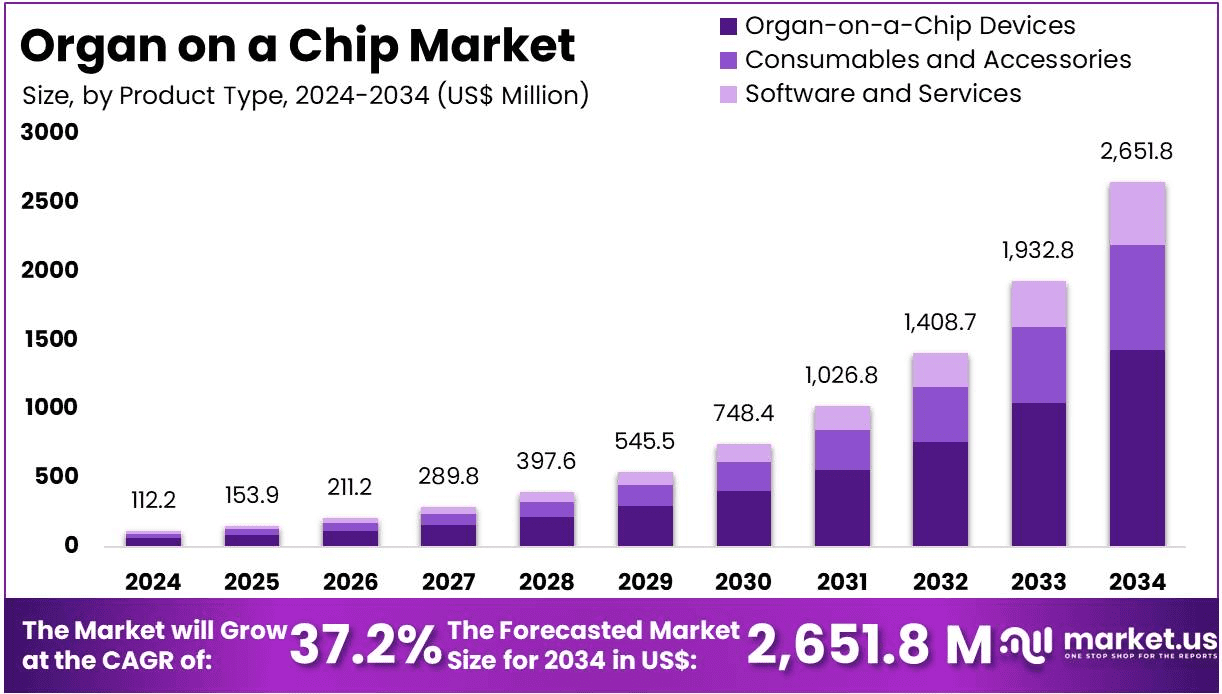
The Global Organ on a Chip Market size is expected to be worth around US$ 2651.8 Million by 2034, from US$ 112.2 Million in 2024, growing at a CAGR of 37.7% during the forecast period from 2025 to 2034. North America held a dominant market position, capturing more than a 54.6% share and holds US$ 61.26 Million market value for the year.
The global organ-on-a-chip market is gaining strategic importance as pharmaceutical companies, biotechnology researchers, and regulators increasingly explore human-relevant technologies for drug development and safety assessment. Organ-on-a-chip systems, also known as micro-physiological systems, combine microfluidics, engineered materials, human-derived cells, and biosensing technologies to recreate selected physiological functions in miniature laboratory platforms. Recent scientific literature highlights their potential for evaluating pharmacokinetics, toxicity, disease mechanisms, and therapeutic responses with more physiologically relevant models.
Regulatory momentum is also strengthening the market outlook. In March 2026, the U.S. Food and Drug Administration (FDA) issued draft guidance describing validation considerations for new approach methodologies (NAMs), explicitly identifying organs-on-chips among technologies that can support human-centric drug development. The framework emphasizes four areas: defined context of use, human biological relevance, technical characterization, and fitness for regulatory purpose.
Government investment is supporting broader development of human-based research models. In September 2025, the National Institutes of Health announced US$ 87 million in contracts for the first three years of its Standardized Organoid Modeling Center, aimed at developing reproducible organoid-based methodologies.
Together, regulatory progress, research funding, technological standardization, and demand for predictive alternatives to conventional testing are creating favorable conditions for wider adoption across pharmaceutical research, toxicology, personalized medicine, and biomedical innovation.
Key Takeaways
- The global Organ-on-a-Chip market is projected to reach approximately US$ 2,651.8 Million by 2034, increasing substantially from US$ 112.2 Million in 2024.
- The Organ-on-a-Chip market is expected to register a strong 37.7% CAGR during the forecast period from 2025 to 2034.
- Among product types, Organ-on-a-Chip Devices held the leading position in 2024, accounting for more than 54.1% of the global market share.
- By organ type, Heart-on-a-Chip represented the dominant segment in 2024, capturing over 28.5% of the segment’s market share.
- In terms of application, Drug Discovery & Development emerged as the leading segment in 2024, securing more than 44.2% of the market share.
- Among end users, Pharmaceutical & Biotechnology Companies dominated in 2024, accounting for over 51.3% of total market demand.
- Regionally, North America maintained its leading position in 2024, representing more than 54.6% of the global market and generating approximately US$ 61.26 Million in market value.
Statistical Information
- NIH has committed up to US$ 75 million over five years to its Tissue Chip for Drug Screening program, demonstrating significant public investment in organ-on-a-chip development.
- The NCATS Micro-physiological Systems Database contains 58 experimental tissue-chip models, providing an established foundation for research and technology validation.
- Those 58 models cover 11 different organ systems, illustrating the expanding scope of organ-on-a-chip applications beyond a single therapeutic area.
- The NCATS database houses data from 171 studies, including experimental information, images, and videos contributed by researchers.
- The 58 tissue-chip models were developed through 14 Tissue Chip Testing Centers, highlighting the breadth of the U.S. research ecosystem supporting micro-physiological systems.
- Pfizer entered a three-year collaboration with Javelin Biotech to develop an organ-on-a-chip platform for human pharmacokinetic predictions, integrating micro-physiological systems with computational software.
- Pfizer and Draper collaborated to develop three micro-physiological-system models covering liver, vascular, and gastrointestinal organs, demonstrating pharmaceutical interest in multi-organ platforms.
- In April 2025, CN Bio and Pharmaron established a strategic partnership to validate organ-on-chip technology for disease modeling, toxicity testing, and ADME studies, supporting commercial integration into life-science R&D.
Market Segmentation Analysis
Product Type Analysis
In 2024, Organ-on-a-Chip Devices maintained a leading position in the Product Type segment, accounting for more than 54.1% market share. Their growing adoption was driven by their ability to replicate key organ-level functions and provide more physiologically relevant results than conventional in-vitro approaches. These devices are increasingly used in pharmaceutical research, disease modeling, and preclinical testing.
Consumables and Accessories represented the next significant category, supported by recurring demand for microfluidic chips, reagents, culture media, and other laboratory supplies. Meanwhile, Software and Services remained the smallest segment but demonstrated strong growth potential through data analysis, real-time monitoring, artificial intelligence integration, customized chip design, and technical support services.
Organ Type Analysis
In 2024, Heart-on-a-Chip dominated the Organ Type segment, capturing more than 28.5% market share. Its strong position was supported by increasing use in cardiovascular drug screening, cardiac toxicity evaluation, and research requiring accurate simulation of heart tissues and physiological rhythms. Liver-on-a-Chip represented another major segment because of its importance in drug metabolism, detoxification, and hepatotoxicity testing during pharmaceutical development.
Lung-on-a-Chip also gained traction due to its ability to replicate respiratory functions and support research into asthma, COPD, and inhalation toxicity. Meanwhile, Kidney-on-a-Chip and Brain-on-a-Chip continued gaining attention for renal toxicity, filtration, neurological research, and blood–brain barrier studies, while skin and gut chips offered additional opportunities.
Application Analysis
In 2024, Drug Discovery & Development represented the leading application segment, accounting for more than 44.2% market share. Organ-on-a-Chip platforms are increasingly incorporated into pharmaceutical research because they can provide human-relevant insights into drug responses while supporting faster and more efficient candidate screening. Toxicology Research followed as another important application, with growing utilization for evaluating harmful effects and identifying potential safety concerns during preclinical development.
Disease Modeling gained importance because these systems can reproduce aspects of human disease environments and enable researchers to investigate disease mechanisms under controlled conditions. Regenerative Medicine also showed promising potential through integration with stem-cell research and tissue engineering. Additional applications, including personalized medicine and environmental testing, are expected to expand as the technology matures.
End User Analysis
In 2024, Pharmaceutical & Biotechnology Companies dominated the End User segment, representing more than 51.3% market share. Their leadership was supported by increasing demand for advanced platforms that can improve drug discovery, candidate screening, and preclinical evaluation. Organ-on-a-Chip technology also offers opportunities to reduce reliance on traditional animal models while generating more human-relevant biological data.
Academic & Research Institutes formed the second-largest end-user group, driven by increasing research into microfluidics, cell biology, disease modeling, and tissue engineering. Universities and public research laboratories are using these platforms for biomedical and translational studies. The Others category, including contract research organizations, hospitals, and environmental testing agencies, is also expanding as organ-on-chip applications extend into toxicity assessment, personalized medicine, and biosafety research.
Regional Analysis
In 2024, North America maintained a dominant position in the Organ-on-a-Chip market, accounting for more than 54.6% of the global market and representing approximately US$ 61.26 Million in value. The region benefits from strong biomedical research infrastructure, advanced pharmaceutical R&D capabilities, and extensive collaboration between universities, government agencies, and biotechnology companies.
The U.S. National Center for Advancing Translational Sciences (NCATS) has developed a dedicated Tissue Chip for Drug Screening program to improve prediction of drug safety and toxicity using human cells. In 2024, NIH also awarded approximately US$ 31 million over five years to four Translational Centers for Micro-physiological Systems, strengthening development and validation of tissue-chip technologies. Regulatory momentum is further supporting adoption, with the FDA advancing human-relevant New Approach Methodologies and issuing draft guidance on alternatives to animal testing in 2026.
Business Opportunities
The Organ-on-a-Chip Market presents substantial business opportunities across pharmaceutical research, biotechnology, contract research, and advanced laboratory technologies. Companies can capitalize on the growing demand for human-relevant preclinical models by developing specialized heart, liver, lung, kidney, and multi-organ platforms for drug discovery, toxicity testing, and disease modeling. NIH and FDA collaboration on micro-physiological systems highlights continued institutional interest in improving efficacy, bioavailability, and toxicity assessment.
A major opportunity exists in high-throughput and automated organ-on-a-chip systems, enabling pharmaceutical companies to evaluate larger numbers of compounds efficiently. Recent research identifies industrialization and high-throughput platforms as important areas for pharmaceutical adoption. Businesses can also generate recurring revenue through consumables, cell-based reagents, sensors, software, data analytics, maintenance, and technical services.
CRO partnerships represent another attractive model because pharmaceutical companies may prefer outsourcing specialized organ-on-chip studies rather than building internal capabilities. Additional opportunities include AI-powered analysis, personalized medicine, multi-organ/body-on-chip platforms, and regulatory validation services, creating potential for technology providers and specialized research companies.
Emerging Trends
- Miniaturization and Automation: Tissue-chip development is moving toward smaller, automated platforms that can handle experiments with less manual work. NIH’s MATChS program specifically supports miniaturization and automation, indicating a shift toward scalable systems suitable for repeatable research and higher-throughput testing.
- Organoids-on-a-Chip Integration: Researchers are increasingly combining stem-cell-derived organoids with microfluidic chips. This approach can improve organoid function by providing controlled fluid flow and environmental conditions, creating more realistic models for disease research, drug screening, and personalized medicine.
- Multi-Organ Platforms: Development is moving beyond individual organs toward connected multi-organ systems that reproduce interactions between tissues. NIH specifically supports multi-organ tissue-chip research for drug efficacy, toxicity testing, and personalized medicine, creating opportunities for more comprehensive human physiology models.
- Computational Modeling Integration: Organ-on-a-chip systems are increasingly being combined with mathematical and computational models. These tools can help optimize fluid flow, cellular environments, and experimental conditions, potentially improving reproducibility while reducing the time needed to develop and refine chip designs.
- Regulatory-Ready Development: Regulatory acceptance is becoming an important development priority. FDA and NIH established a formal partnership to advance micro-physiological systems as New Approach Methodologies, with the goal of supporting faster development of safer and more effective products.
Use Cases
- Drug Safety Testing: Organ-on-a-chip platforms can help researchers evaluate potential drug-related toxicity before clinical development. FDA research includes liver, gut, lung, and cardiac micro-physiological systems for safety assessment and pharmacokinetic studies, supporting their use as advanced preclinical testing tools.
- Cardiac Drug Screening: Cardiac chips can measure important heart-cell responses to drug candidates. FDA scientists developed a cardiac organ-on-a-chip using human stem-cell-derived cardiomyocytes to assess electrophysiology, calcium activity, and contractility, supporting improved evaluation of potential cardiac effects.
- Disease Modeling: Organ-on-a-chip platforms can reproduce selected features of human diseases under controlled laboratory conditions. Researchers can use these models to study disease progression, biological mechanisms, and treatment responses, including complex conditions that are difficult to reproduce using conventional cell cultures.
- Personalized Medicine: Patient-specific cells and organoids can potentially be incorporated into chip platforms to reproduce individual biological responses. This creates opportunities to compare therapies for particular patient groups and support more tailored treatment strategies in precision medicine research.
- Inhaled Drug Research: Human lung and airway chip models can support research into how inhaled medicines interact with respiratory tissues. FDA scientists have evaluated a 3D human lung-airway model using primary lung epithelial and endothelial cells to investigate absorption of inhaled drugs.
Recent Developments
- In July 2026, VivoSim Labs announced a US$ 4.0 million private placement with a healthcare-focused institutional investor, with proceeds intended to support the company’s growth in 3D human-tissue New Approach Methodologies (NAMs) and preclinical testing services.
- In July 2026, VivoSim Labs received a US$ 5 million milestone payment from Eli Lilly after the first patient was dosed in a Phase 2 study of the former Organovo FXR program. VivoSim remains eligible for up to US$ 45 million in additional development and commercial milestones.
- In July 2026, VivoSim Labs entered China with its first commercial NAMkind™ testing-service sales, securing two paid programs with Chinese biotechnology and pharmaceutical companies for gastrointestinal toxicology and efficacy profiling. This marked an expansion of its human-tissue testing services into the Chinese market.
- In May 2026, 28bio launched CNS-3D Inflammatory Organoids, an assay-ready human brain organoid model incorporating neurons, astrocytes, and microglia for neuroinflammation and anti-inflammatory drug-efficacy studies. The product is offered in 24-, 48-, 96-, and 384-replicate formats, with commercial availability beginning in Q3 2026.
- In May 2026, 28bio launched its CNS-3D Induced Alzheimer’s Model, combining inflammatory brain organoids with exogenous amyloid beta and a defined protocol to evaluate anti-amyloid-beta therapeutic efficacy and Alzheimer’s disease-related pathology.
- In April 2025, MIMETAS launched its OrganoPlate® UniFlow technology, introducing a pump-free, gravity-driven flow approach designed to simplify perfused 3D tissue research and support scalable organ-on-a-chip experimentation. The launch strengthened MIMETAS’ portfolio of human tissue models for drug discovery.
- In February 2025, Organovo announced that Eli Lilly would acquire its FXR program, including FXR314, giving Lilly worldwide development and commercial rights. Organovo was eligible for an upfront payment and milestone payments tied to regulatory and commercial progress.
Conclusion
The Organ-on-a-Chip market is entering a high-growth phase as pharmaceutical companies, research institutions, and regulators increasingly adopt human-relevant testing technologies. Strong government funding, FDA and NIH initiatives, advances in microfluidics, organoid integration, automation, and multi-organ platforms are strengthening commercialization opportunities. Pharmaceutical and biotechnology companies remain important users, while drug discovery, toxicity testing, disease modeling, and personalized medicine continue expanding the technology’s practical applications.
North America maintains a strong ecosystem supported by research infrastructure and regulatory activity. Overall, continued investment, technology validation, strategic partnerships, and development of scalable platforms are expected to support broader adoption of Organ-on-a-Chip solutions across biomedical research and pharmaceutical development.




















