


Overview
The Global Humanoid Healthcare Assistive Robot Market size is expected to be worth around US$ 17.4 Billion by 2034, from US$ 1.5 Billion in 2024, growing at a CAGR of 27.8% during the forecast period from 2025 to 2034.
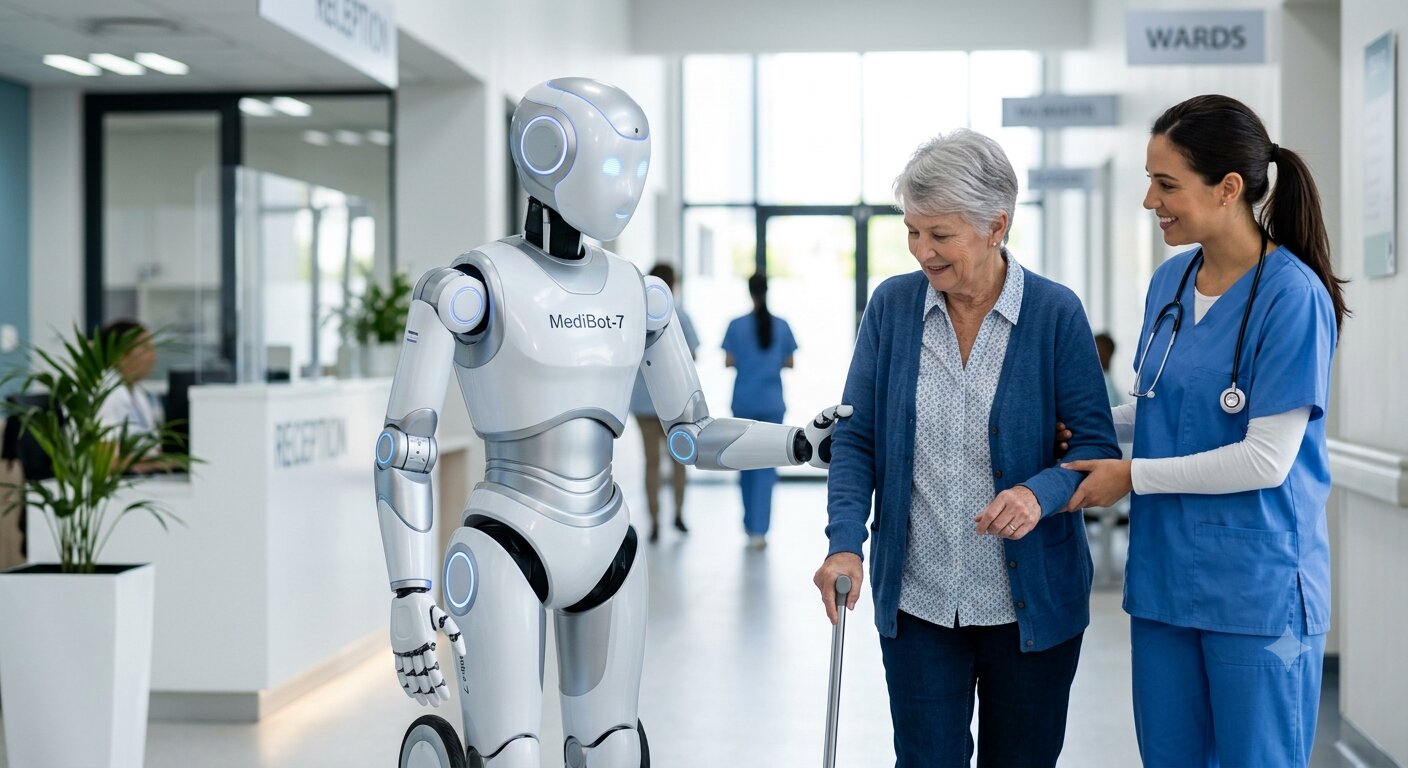
The growing adoption of robotics in healthcare is being supported by advances in artificial intelligence, computer vision, natural-language interaction, and mobility technologies. Humanoid healthcare assistive robots are being explored for applications including patient engagement, mobility assistance, cognitive support, routine reminders, rehabilitation, information delivery, and caregiver assistance.
The need for supportive technologies is particularly relevant as healthcare systems manage the needs of aging populations. According to the U.S. Centers for Disease Control and Prevention (CDC), more than 14 million U.S. adults aged 65 and older report falling each year, representing approximately one in four older adults. The agency also estimates around 3 million emergency department visits annually associated with falls among older adults.
Research is also expanding the potential role of human-like robots in supporting older adults. A 2026 systematic scoping review indexed by PubMed examined 59 studies, with 83% conducted in real-world settings, covering areas such as user experiences, preferences, implementation barriers, and healthcare applications.
The National Institutes of Health (NIH) reports that researchers are developing human-like social robots capable of interacting with users, providing information, supporting cognitive engagement, and potentially improving well-being. NIH also notes that many healthcare robotic technologies remain in research and development, highlighting the importance of clinical validation, safety, usability, privacy, and human oversight before broad deployment.
These developments are creating opportunities for healthcare providers, rehabilitation centers, assisted-living facilities, and technology developers to evaluate humanoid robots as complementary tools for patient support and caregiver assistance.

Key Takeaways
- In 2024, the global Humanoid Healthcare Assistive Robot Market generated US$ 1.5 billion in revenue and is projected to reach US$ 17.4 billion by 2033, expanding at a CAGR of 27.8% during the forecast period.
- By product type, the market is segmented into hardware, software, and services. Hardware dominated the segment in 2024, accounting for a 52.6% market share.
- Based on application, the market is categorized into rehabilitation, elderly care, patient monitoring, surgery assistance, and others. Elderly care emerged as the leading application segment in 2024, capturing a 39.4% share of the market.
- By end user, the market is segmented into hospitals and other healthcare settings. Hospitals held the largest position in 2024, representing 48.3% of the total market revenue.
- Regionally, North America dominated the global Humanoid Healthcare Assistive Robot Market in 2024, accounting for a 52.6% market share, supported by growing healthcare technology adoption and advancements in robotic systems.
Statistical Information
- U.S. home health and personal care aide employment is projected to grow 17% from 2024 to 2034, reaching approximately 5.09 million jobs by 2034. This supports the opportunity for assistive robots to complement human caregivers in home and community-based care.
- The U.S. is expected to have approximately 765,800 openings for home health and personal care aides annually during 2024–2034, highlighting sustained demand for technologies that can assist with routine caregiving activities.
- A 2026 systematic review of 27 studies found that 74.1% of the technologies used by older adults were robots, while remote patient monitoring represented 33.3% of applications.
- Approximately 89% of studies reported positive attitudes toward robotic and smart-home health technologies among older adults, with technology convenience identified as the leading acceptance factor at 22.2%.
- 53% of 85 older adults with disabilities surveyed in a 2025 study expressed willingness to use functional assistive robots. Safety, affordability, ease of use, and multifunctionality were the strongest factors influencing acceptance.
- Walking assistance and toilet-transfer support were identified as the most desired functions among older adults with disabilities, demonstrating demand for robots capable of supporting mobility and everyday activities.
- WHO reports that approximately 610 million people, or 1 in 3 people in the Western Pacific Region, have a health condition that could benefit from rehabilitation, creating substantial potential for assistive robotic technologies.
- U.S. employment of registered nurses is projected to increase from 3.39 million in 2024 to 3.56 million in 2034, while home health and personal care aide employment is projected to rise by nearly 740,000 jobs, reinforcing the need for technologies that can support healthcare workers.
- Intuitive Surgical performed approximately 3.15 million da Vinci procedures in 2025, an 18% increase from 2024, while its installed base reached 11,106 systems. Although these are surgical rather than humanoid assistive robots, the figures demonstrate continuing institutional adoption of robotic technologies within healthcare.
Market Segmentation Analysis
Product Type Analysis
The hardware segment dominated the Humanoid Healthcare Assistive Robot Market in 2024, accounting for 52.6% of the market. This leadership is attributed to rising demand for advanced robotic components, including sensors, actuators, processors, and mobility systems. Continuous developments in robotics and artificial intelligence are enabling more sophisticated hardware with improved precision, dexterity, responsiveness, and mobility.
Growing healthcare automation and the need for reliable assistive technologies are expected to further support hardware adoption. As healthcare providers increasingly explore robotic solutions for patient support, rehabilitation, monitoring, and routine assistance, demand for high-performance hardware is likely to remain strong throughout the forecast period.
Application Analysis
The elderly care segment held the leading position in 2024, capturing a 39.4% market share. Growth is driven by the expanding aging population and increasing demand for technologies that support independent living. Humanoid healthcare robots can assist older adults with mobility, daily activities, companionship, reminders, and basic monitoring.
Rising concerns surrounding age-related mobility limitations and cognitive challenges are encouraging healthcare providers and caregivers to explore robotic assistance. The growing preference for aging in place is also creating opportunities for humanoid robots outside traditional institutional settings. Their potential to improve quality of life while reducing caregiver workloads is expected to strengthen adoption in elderly care applications.
End-user Analysis
The hospitals segment accounted for the largest revenue share of 48.3% in 2024, supported by increasing healthcare automation and the need to improve operational efficiency. Humanoid assistive robots can support hospitals through patient monitoring, rehabilitation assistance, surgery-related activities, information delivery, and routine administrative functions. Their ability to provide consistent assistance and support healthcare professionals is encouraging hospitals to evaluate robotic technologies.
Growing demand for high-quality patient care, combined with workforce shortages and increasing operational pressures, is expected to accelerate adoption. Advances in artificial intelligence, sensors, and robotic mobility are further improving the capabilities of these systems, supporting their potential integration into hospital environments.
Regional Analysis
North America remains a leading region for humanoid healthcare assistive robots, supported by advanced healthcare infrastructure, technology investment, and growing demand for solutions addressing an aging population. The U.S. National Institute on Aging projects that the number of Americans aged 65 and older will reach 70.3 million by 2030, increasing demand for supportive and age-friendly healthcare technologies. Research published through PubMed also highlights the potential of humanoid robots to support older adults in healthcare, although technical, acceptance, and implementation challenges remain.
Asia Pacific is expected to record the fastest growth as population ageing and digital-health adoption accelerate. WHO reports that the Western Pacific Region has more than 245 million people aged 65 and older, with this number expected to double by 2050. WHO also emphasizes technological and social innovation as part of its healthy-ageing strategy. These demographic and technology trends are expected to create opportunities for humanoid robots in elderly care, rehabilitation, monitoring, and other assistive applications.
Business Opportunities
The Humanoid Healthcare Assistive Robot Market presents significant business opportunities as healthcare providers seek technologies that can support aging populations, improve care efficiency, and address caregiver shortages. Elderly care and assisted-living facilities offer strong opportunities for robots designed to provide companionship, reminders, mobility assistance, cognitive engagement, and support for daily activities. Research indicates that care robots can help older adults maintain independence and support aging in place.
Another opportunity lies in AI-enabled robotic platforms that combine computer vision, natural-language processing, sensors, and real-time monitoring. The FDA recognizes expanding applications for AI-enabled medical technologies while emphasizing safety, effectiveness, lifecycle management, and transparency.
Hospital-based services also offer potential through patient navigation, rehabilitation, monitoring, and routine assistance. Partnerships among robot manufacturers, hospitals, research institutions, and care providers can accelerate clinical validation and deployment. Additionally, opportunities exist in robot-as-a-service models, maintenance, software upgrades, cybersecurity, remote supervision, and customized robotic solutions. NIH research highlights social and caregiver-support applications, creating further opportunities for specialized robots addressing dementia care and caregiver assistance.
Emerging Trends
- Multimodal AI and Natural Interaction: Humanoid robots are increasingly combining speech, vision, movement, and touch to interact more naturally with patients. A 2025–2026 review identified 25 humanoid robot models across healthcare studies, indicating movement toward more flexible, human-like systems.
- Personalized Robot Behavior: Healthcare robots are moving toward individualized interactions based on users’ cognitive abilities, preferences, and care requirements. Recent research shows that user characteristics can influence preferences for robot-supported care, encouraging developers to build adaptive rather than one-size-fits-all systems.
- Human-Centered Robot Design: New designs increasingly emphasize comfort, emotional connection, and context-aware interaction instead of purely functional assistance. Research on integrated socially assistive robots highlights combinations of companionship, verbal prompts, and sensor-based activity monitoring for more personalized long-term care.
- Stronger AI Safety and Transparency: Regulatory attention is increasing around AI-enabled healthcare technologies. The U.S. FDA’s 2025 draft guidance addresses transparency, bias, product design, development, maintenance, and documentation across the AI-device lifecycle, encouraging safer robotic healthcare systems.
- Remote Rehabilitation With Robotic Telepresence: Humanoid and socially assistive robots are increasingly being explored as bridges between patients and remote clinicians. Research is evaluating robot-assisted telepresence for rehabilitation, helping patients receive guided care when direct physical access to therapists is difficult.
Use Cases
- Home-Based Exercise Coaching: AI-powered robots can guide older adults through personalized exercises at home, observe movements through computer vision, provide feedback, and track progress. This approach can help address transportation barriers and limited access to rehabilitation professionals.
- Dementia Support: Socially assistive robots are being investigated for people with mild cognitive impairment and dementia, providing structured interaction, prompts, and engagement. This creates opportunities for robots that complement not replace family members and professional caregivers.
- Group Therapy Engagement: Robots can participate in structured group activities for older adults, helping encourage interaction and participation. A 2025 systematic review found that socially assistive robots generally improved engagement and sociality, although outcomes depended on staff involvement and intervention design.
- Medication and Routine Support: Assistive robots can provide personalized reminders and instructions for everyday healthcare routines. Research has identified service robots as a category capable of supporting care activities such as medication reminders, creating opportunities for adherence-oriented home-care solutions.
- Emotional Well-Being Assistance: Humanoid and socially assistive robots are being evaluated for emotional-support applications, including loneliness and depressive symptoms. A recent study involving 278 older adults using Hyodol reported improvements in depressive symptoms, loneliness, and medication adherence after six months.
Recent Developments
- In August 2026, SoftBank Robotics America highlighted Sabra Healthcare REIT’s deployment of autonomous cleaning robots across multiple U.S. senior-living communities, showing the expansion of robotic automation into eldercare environments to improve operational efficiency and allow staff to focus on resident-facing services.
- In April 2026, SoftBank Robotics America partnered with Matternet to advance autonomous last-mile delivery, combining SoftBank Robotics’ automation capabilities with Matternet’s drone-delivery technology for applications across the U.S. and other markets.
- In March 2026, Toyota reported that 24 Potaro autonomous transport robots were operating at Toyota Memorial Hospital in Japan, with the robots transporting medicines and medical equipment between staff areas and wards. By January 2026, Potaro had achieved a 99% transport success rate and travelled 27,000 km.
- In January 2026, United Robotics Group showcased its uMe humanoid robot at CES 2026 in Las Vegas as a technological prototype, presenting selected core functions and its platform-based approach to humanoid robotics for future human-support applications.
- In January 2026, FANUC documented NKM’s deployment of robotic automation to address labor shortages and increase production capacity, with the manufacturer planning additional robotic applications. The development demonstrates FANUC’s continued expansion of autonomous workforce-support technologies.
Conclusion
The Humanoid Healthcare Assistive Robot Market is entering a high-growth phase as artificial intelligence, robotics, computer vision, and natural-language technologies advance. Rising healthcare workforce pressures and growing elderly populations are creating opportunities for robots that support rehabilitation, elderly care, monitoring, mobility, and routine assistance. North America currently maintains a strong market position, while Asia Pacific offers significant future growth potential.
Increasing investments, partnerships, hospital deployments, and technology development are strengthening the sector’s commercial outlook. However, safety, affordability, privacy, reliability, clinical validation, and user acceptance remain important considerations. Continued collaboration among technology companies, healthcare providers, researchers, and regulators will be essential for responsible market expansion.




















