


Overview
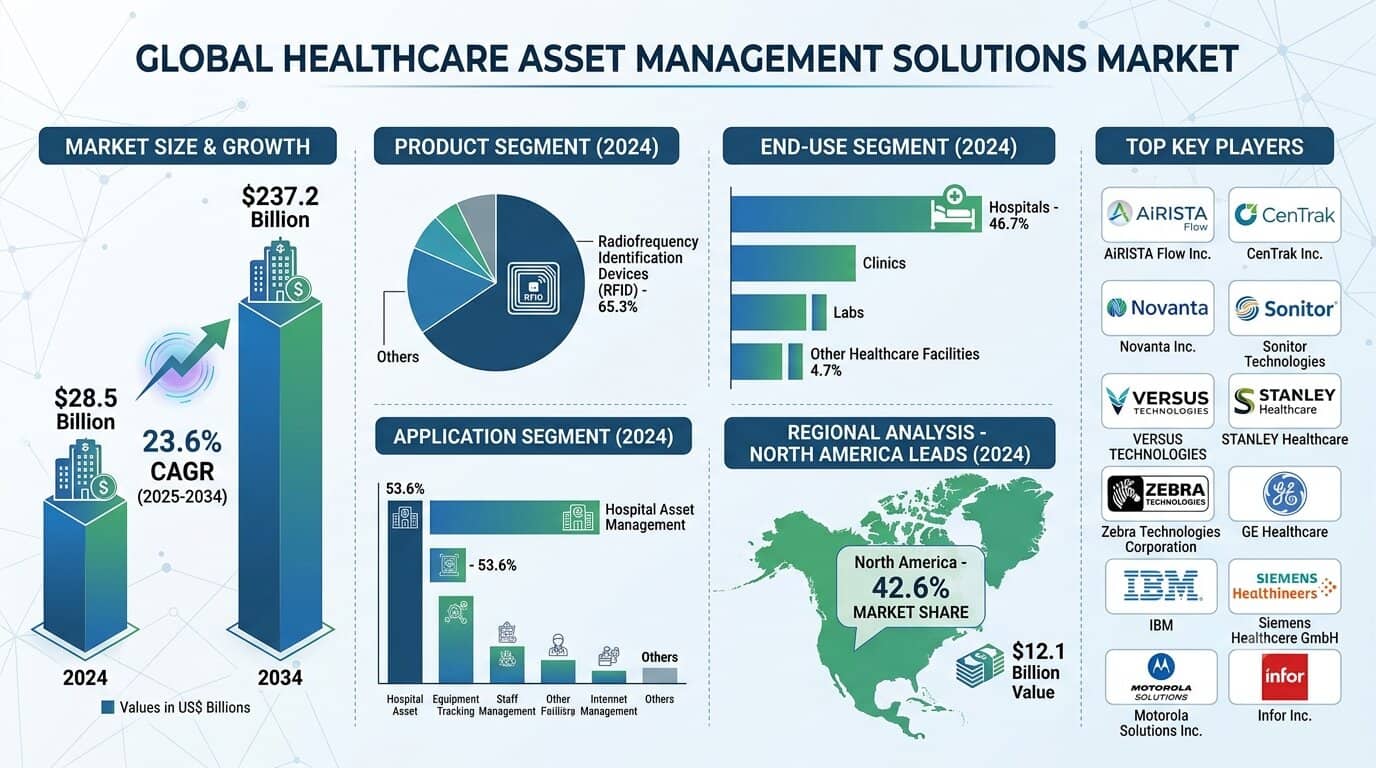
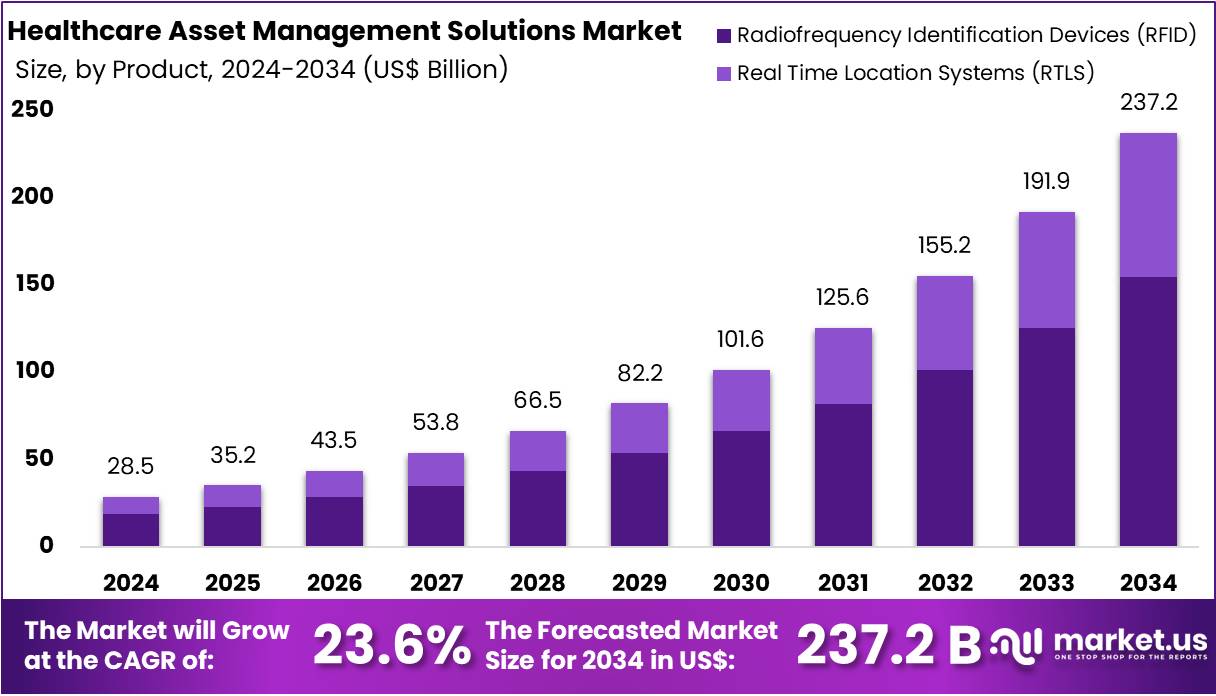
The Global Healthcare Asset Management Solutions Market size is expected to be worth around US$ 237.2 Billion by 2034, from US$ 28.5 Billion in 2024, growing at a CAGR of 23.6% during the forecast period from 2025 to 2034. North America held a dominant market position, capturing more than a 42.6% share and holds US$ 12.1 Billion market value for the year.
Healthcare providers are increasingly focusing on systematic management of medical equipment, infrastructure, and technology assets as hospitals expand their use of connected and digitally enabled devices. Effective asset management can help healthcare organizations maintain equipment availability, improve maintenance planning, strengthen compliance, and support efficient allocation of resources.
The World Health Organization (WHO) emphasized the importance of structured medical-device management in its 2025 guidance on inventory and maintenance management information systems. WHO states that health technology management covers the complete device lifecycle, including needs assessment, procurement, inspection, inventory, training, maintenance, and eventual decommissioning. The organization also highlights the role of modern digital systems, data-driven maintenance strategies, and improved inventory frameworks in healthcare technology management.
Regulatory requirements are also supporting stronger tracking capabilities. The U.S. Food and Drug Administration (FDA) requires tracking systems for certain medical devices when ordered under applicable regulations, helping manufacturers locate devices and facilitate safety notifications or recalls.
The FDA also reported that its Global Unique Device Identification Database (GUDID) provides publicly accessible information submitted under the Unique Device Identification framework, supporting greater visibility across medical-device identification and data management. In June 2025, WHO’s Global Forum on Medical Devices brought together 1,795 participants from 130 Member States, highlighting international attention toward effective medical-device management and healthcare technology.
Key Takeaways
- By 2034, the global Healthcare Asset Management Solutions Market is projected to reach US$ 237.2 Billion, increasing from US$ 28.5 Billion in 2024.
- The market is expected to grow at a strong CAGR of 23.6% during the forecast period from 2025 to 2034.
- In 2024, Radiofrequency Identification Devices (RFID) dominated the product segment, accounting for more than 65.3% of the total market share.
- Hospital Asset Management led the application segment in 2024, representing over 53.6% of the overall market share.
- The Hospitals category held the leading position in the end-use segment in 2024, capturing more than 46.7% of the total market share.
- North America emerged as the dominant regional market in 2024, securing a 42.6% share and reaching a market value of US$ 12.1 Billion.
Statistical Information
- 76% of U.S. hospitals engaged in all four electronic health-information exchange activities sending, receiving, finding, and integrating information in 2025, up from 70% in 2023.
- In 2024, 91% of U.S. hospitals integrated data from third-party technology into their EHR for at least one clinical purpose, while 83% provided EHR data to third-party technology.
- In 2024, 52% of U.S. hospitals used standards-based APIs to integrate third-party data into their EHR for at least one clinical purpose, creating opportunities for interoperable asset-management platforms.
- 97% of system-affiliated U.S. hospitals integrated third-party data into their EHR for at least one clinical purpose in 2024, compared with 77% of independent hospitals.
- The United States had 6,100 hospitals in 2024, including 5,121 community hospitals, representing a substantial installed healthcare infrastructure for asset-management technologies.
- U.S. hospitals recorded 907,216 staffed beds and approximately 35.66 million total admissions in 2024, highlighting the scale of healthcare operations requiring effective equipment and resource management.
- FDA regulations require applicable medical devices to carry UDIs in both human-readable and machine-readable formats, with machine-readable identification supporting automated data capture into electronic systems.
- In April 2026, FDA reported that CMS had proposed a UDI measure under the Medicare Promoting Interoperability Program, under which eligible hospitals would attest whether they captured complete UDI information for applicable implantable medical devices in certified EHRs.
Market Segmentation Analysis
Product Analysis
In 2024, Radiofrequency Identification Devices (RFID) dominated the product segment of the Healthcare Asset Management Solutions Market, capturing more than 65.3% market share. This leadership reflects the increasing adoption of RFID technology for tracking medical equipment, patients, staff, and other critical healthcare assets. RFID enables real-time visibility, faster equipment identification, and improved inventory management, helping hospitals reduce equipment loss, unnecessary purchases, and operational delays.
Unlike conventional barcode systems, RFID can identify multiple tagged items without requiring direct line-of-sight scanning. Its integration with hospital IT infrastructure also supports automated asset monitoring and workflow optimization. As healthcare providers increasingly prioritize digital transformation, connected asset tracking, and operational efficiency, RFID adoption is expected to remain strong throughout the forecast period.
Application Analysis
In 2024, Hospital Asset Management held the leading position in the application segment of the Healthcare Asset Management Solutions Market, accounting for more than 53.6% market share. The segment’s dominance is supported by increasing demand for efficient monitoring, utilization, and maintenance of medical equipment across hospitals. Asset management solutions provide real-time visibility into equipment locations, availability, and usage, helping healthcare facilities minimize downtime and improve resource allocation. These systems are particularly valuable for managing high-value equipment and reducing operational inefficiencies.
Meanwhile, Pharmaceutical Asset Management is gaining momentum as pharmaceutical organizations seek stronger inventory control, regulatory compliance, and traceability. Growing digitalization, RFID adoption, and IoT integration are expected to further strengthen asset management across healthcare applications.
End Use Analysis
In 2024, Hospitals dominated the end-use segment of the Healthcare Asset Management Solutions Market, capturing more than 46.7% market share. The strong position of hospitals is attributed to their extensive use of medical equipment, increasing operational complexity, and growing need for real-time asset visibility. Healthcare asset management solutions help hospitals track equipment, reduce downtime, improve utilization, and ensure critical devices are available when required.
Technologies such as RFID and RTLS are increasingly being deployed to streamline workflows and enhance resource management. Large hospitals and healthcare networks are also accelerating digital transformation initiatives to improve operational efficiency and control costs. Meanwhile, pharmaceutical companies are adopting asset management systems to strengthen inventory accuracy, regulatory compliance, safety, and supply-chain traceability.
Regional Analysis
In 2024, North America held a dominant position in the Healthcare Asset Management Solutions Market, capturing more than 42.6% share and reaching US$ 12.1 Billion. The region benefits from strong healthcare digitization, advanced hospital infrastructure, and increasing adoption of connected technologies. In the United States, the FDA’s Unique Device Identification framework supports accurate identification and documentation of medical devices, strengthening device visibility and safety management. Canada is also accelerating digital healthcare development.
In 2026, the Government of Canada announced a US$ 100 million investment in the VITAL health data platform to connect hospital data and strengthen digital infrastructure. Additionally, Canada’s Connected Care initiative is promoting interoperability and secure information exchange across healthcare systems. These developments are supporting demand for asset tracking, digital monitoring, connected infrastructure, and automated healthcare management solutions across North America.
Business Opportunities
The Healthcare Asset Management Solutions Market presents significant business opportunities as healthcare providers seek greater visibility, safety, and efficiency across medical-device lifecycles. The World Health Organization’s 2025 guidance emphasizes digital inventory systems, data-driven maintenance, and improved management frameworks, creating opportunities for software providers offering cloud-based asset tracking, predictive maintenance, inventory management, and lifecycle analytics.
RFID, RTLS, and IoT solution providers can expand by developing interoperable platforms that connect equipment-location data with hospital information systems. Opportunities also exist in AI-enabled predictive maintenance, which can help identify equipment servicing requirements before failures disrupt clinical operations. The FDA’s UDI framework further supports opportunities for solutions that capture, manage, and integrate standardized medical-device identification data.
Healthcare organizations can also benefit from specialized platforms for asset utilization analytics, compliance monitoring, mobile equipment management, and automated inventory reconciliation. Vendors offering scalable solutions for hospitals, laboratories, pharmaceutical facilities, and outpatient centers may gain additional opportunities as healthcare systems increasingly prioritize connected, data-driven asset management.
Emerging Trends
- Lifecycle-based asset management: Healthcare organizations are moving beyond simple equipment tracking toward complete asset lifecycle management. WHO’s 2025 guidance covers procurement, inspection, inventory, training, maintenance, and decommissioning, encouraging providers to use digital systems that manage equipment from acquisition through retirement.
- Cybersecurity becomes part of asset management: Connected medical devices increasingly communicate with hospital networks and other devices. FDA’s February 2026 cybersecurity guidance emphasizes security throughout the device lifecycle, creating demand for asset platforms that can monitor device software, connectivity, vulnerabilities, and security status.
- Risk-based equipment management: Hospitals are placing greater attention on identifying high-risk equipment and applying appropriate maintenance strategies. The Joint Commission requires accredited hospitals to maintain written medical-equipment inventories and identify high-risk devices, supporting automated maintenance and compliance-management tools.
- Data-driven maintenance: Maintenance management is shifting toward using equipment information to support better servicing decisions. WHO specifically identifies data-driven maintenance strategies as an emerging healthcare technology-management approach, creating opportunities for systems that combine equipment histories, service schedules, utilization information, and maintenance records.
- Connected medical-device ecosystems: Medical devices are increasingly networked to exchange information and support care delivery. FDA notes that connected devices can improve healthcare while also introducing cybersecurity risks. This is encouraging hospitals to seek centralized visibility across physical devices, software, connectivity, and associated security requirements.
Use Cases
- Medical equipment inventory: Hospitals can use asset-management platforms to maintain centralized records of medical devices, including equipment identity, location, status, maintenance history, and risk classification. This supports the written inventory requirements emphasized by The Joint Commission and helps organizations manage large equipment portfolios more systematically.
- Preventive maintenance scheduling: Asset-management systems can automatically organize inspection and servicing schedules for medical equipment. By connecting equipment records with maintenance requirements, hospitals can identify upcoming service activities, document completed work, and reduce the risk of equipment remaining in use beyond required maintenance intervals.
- Device cybersecurity monitoring: Asset platforms can create centralized inventories of connected medical devices and associate them with cybersecurity information. This becomes increasingly important as devices connect to hospital networks. FDA’s 2026 guidance highlights the need to address cybersecurity risks throughout the medical-device lifecycle.
- Equipment safety and risk control: Healthcare providers can classify equipment according to clinical risk and apply different monitoring or maintenance strategies. High-risk devices, including life-support equipment, require particular attention because equipment failure can create serious risks for patients or staff.
- Procurement and replacement planning: Asset-management data can help hospitals determine when equipment should be repaired, replaced, or retired. WHO’s lifecycle approach connects procurement and supply decisions with inventory, maintenance, and eventual decommissioning, supporting more structured long-term equipment planning.
Recent Developments
- In July 2026, Novanta completed its acquisition of Riverpoint Medical, following the previously announced agreement for US$ 1.2 billion in upfront cash plus a US$ 250 million milestone payment. Novanta said the transaction unlocks an estimated US$ 2 billion incremental addressable market through shared OEM relationships and strengthens its U.S. manufacturing footprint.
- In May 2026, Securitas Healthcare acquired ZulaFly, a healthcare-focused RTLS and staff-safety technology company. The transaction strengthens Securitas Healthcare’s cloud-based RTLS capabilities and expands its ability to provide real-time visibility and safety solutions across healthcare environments.
- In March 2026, GE HealthCare completed its acquisition of Intelerad for US$ 2.3 billion in cash, expanding its cloud-first enterprise imaging capabilities across hospitals, ambulatory facilities, and teleradiology. GE HealthCare expects Intelerad to contribute approximately US$ 270 million in first-full-year revenue, with about 90% recurring revenue.
- In March 2026, CenTrak debuted its next-generation AI-powered location-intelligence platform at HIMSS 2026 in Las Vegas. The new capabilities are designed to convert real-time location information into actionable intelligence for healthcare organizations, supporting staff safety, patient protection, asset visibility, and operational efficiency.
- In October 2025, Zebra Technologies completed its acquisition of Elo Touch Solutions, expanding Zebra’s connected-frontline portfolio across healthcare and other industries. Zebra stated that the acquisition increased its addressable market by approximately US$ 8 billion and strengthened its capabilities for connected workflows and frontline automation.
- In July 2025, Siemens Healthineers and Prisma Health expanded their long-term Value Partnership with a US$ 50 million investment in radiation therapy. The investment includes acquisition of Varian’s Ethos adaptive radiotherapy system and additional clinical and operational support for oncology services in South Carolina and Tennessee.
- In May 2025, Siemens Healthineers announced US$ 150 million of investments in new and expanded U.S. facilities, including manufacturing expansion in Palo Alto, California, and new mega supply depots in New Jersey and California. The company said the depots would increase parts availability by nearly one-third, strengthening equipment-service and supply-chain responsiveness.
Conclusion
The Healthcare Asset Management Solutions Market is advancing rapidly as healthcare providers prioritize equipment visibility, maintenance efficiency, regulatory compliance, and connected operations. RFID, RTLS, IoT, UDI, and AI-enabled technologies are strengthening asset tracking and lifecycle management across hospitals and other healthcare facilities. North America remains a leading regional market, supported by advanced digital infrastructure, interoperability initiatives, and continued investment in healthcare technology.
Recent acquisitions, partnerships, and product developments from major technology and healthcare companies further demonstrate industry momentum. As healthcare organizations increasingly adopt data-driven maintenance, cybersecurity monitoring, automated inventory management, and predictive analytics, asset management solutions are expected to become increasingly important for improving operational efficiency and supporting safer healthcare delivery.




















