


Overview
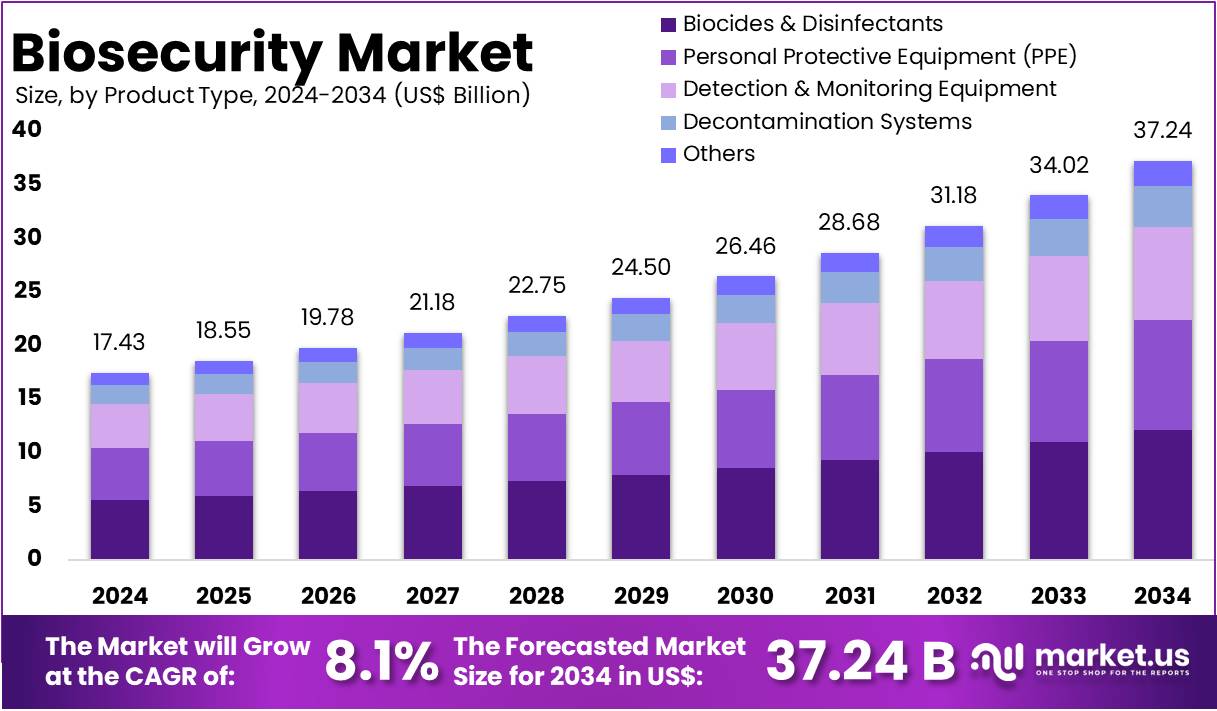
The Biosecurity Market size is expected to be worth around US$ 37.24 Billion by 2034 from US$ 17.43 Billion in 2024, growing at a CAGR of 8.1% during the forecast period 2025 to 2034. North America held a dominant market position, capturing more than a 38.4% share and holds US$ 6.69 Billion market value for the year.
Growing attention to biological risk management is encouraging governments, healthcare organizations, research institutions, and laboratories to strengthen biosecurity capabilities. Biosecurity focuses on preventing the unauthorized access, loss, theft, misuse, diversion, or release of biological materials, equipment, skills, and related information.
The World Health Organization (WHO) recommends stronger surveillance and response systems, improved biosafety and biosecurity across the health sector, and closer coordination among public health, animal health, food safety, law enforcement, and security organizations. WHO’s 2024 Laboratory Biosecurity Guidance also emphasizes risk-based assessments, regulatory oversight, institutional responsibilities, and emerging challenges involving cybersecurity, artificial intelligence, and molecular technologies.
In the United States, the Centers for Disease Control and Prevention (CDC) continues to strengthen laboratory and emergency preparedness capabilities. The CDC’s Laboratory Response Network for Biological Threats includes approximately 120 domestic state and local public health, military, veterinary, agriculture, and food laboratories, supporting rapid detection and characterization of biological threats. In March 2026, CDC released the sixth edition of Biosafety in Microbiological and Biomedical Laboratories, reinforcing protocol-driven risk assessment as a core principle for laboratory safety.
These initiatives highlight the growing importance of secure laboratory infrastructure, pathogen monitoring, workforce training, risk assessment, data protection, and rapid-response capabilities. Continued investment in these areas is expected to support stronger health security and preparedness against emerging and re-emerging biological threats.
Key Takeaways
- In 2024, the Biosecurity Market generated revenue of US$ 17.43 billion and is projected to reach US$ 37.24 billion by 2034, expanding at a CAGR of 8.1% during the forecast period.
- By product type, Biocides & Disinfectants emerged as the leading segment in 2024, accounting for a 32.5% market share, driven by their importance in infection prevention and biological risk management.
- Based on application, Quarantine and Disease Surveillance represented the largest segment in 2024, capturing a 31.1% market share amid growing emphasis on monitoring and controlling biological threats.
- Among end users, Government & Regulatory Bodies held the leading position in 2024, accounting for a 31.2% revenue share, supported by their role in biosecurity regulation and emergency preparedness.
- Regionally, North America dominated the Biosecurity Market in 2024 with a 38.4% share, representing a market value of approximately US$ 6.69 billion.
Statistical Information
- WHO’s global Joint External Evaluation dashboard shows an average 40% capacity score for biosafety and biosecurity, indicating substantial room for strengthening national laboratory-security systems worldwide.
- The same WHO assessment shows an average 54% score for national laboratory systems, highlighting continuing requirements for laboratory infrastructure, testing capacity, quality management, and secure biological-material handling.
- Global surveillance capacity averaged 64% in WHO’s Joint External Evaluation data, demonstrating the continuing need for stronger early-warning, pathogen detection, and outbreak-monitoring systems.
- WHO’s Epidemic Intelligence from Open Sources screened more than 13,000 information sources and expanded its network to over 100 countries and 25 international organizations, strengthening global detection of emerging health threats.
- WHO’s epidemic-intelligence system triaged more than 1.2 million raw signals and generated initial risk assessments for 494 events, demonstrating the enormous volume of information involved in modern global biological-threat surveillance.
- 69% of verified signals were assessed within 24–48 hours under the International Health Regulations, highlighting the importance of rapid information verification and response capabilities in global biosecurity.
- WHO supported 179 laboratories through external quality assurance for mpox diagnostics and distributed 259,000 mpox tests to 32 countries, demonstrating international demand for reliable diagnostic capacity.
- Through the International Pathogen Surveillance Network, WHO worked with 200 partners across 71 countries to strengthen pathogen genomic surveillance and rapidly identify viruses and their mutations.
- WHO established a US$ 4 million catalytic grant fund through the International Pathogen Surveillance Network to help low- and middle-income countries develop pathogen-genomics capabilities and strengthen global health security.
- WHO’s Laboratory Biosecurity Guidance had been downloaded more than 15,000 times, indicating substantial international interest in risk-based laboratory biosecurity practices covering biological materials, technologies, information security, cybersecurity, and emerging technologies.
Market Segmentation Analysis
Product Type Analysis
The Biocides & Disinfectants segment dominated the Biosecurity Market in 2024, accounting for a 32.5% market share. This segment represents a critical component of biosecurity because biocides and disinfectants help control microorganisms and reduce the risk of biological contamination across healthcare, agriculture, food processing, and other sensitive environments. Their use supports hygiene management, infection prevention, and the maintenance of controlled conditions where microbial threats can create significant health and operational risks.
In healthcare facilities, disinfectants are widely applied to surfaces, equipment, and high-contact areas to support infection-control protocols. Increasing emphasis on sanitation, biological risk reduction, and safe operating environments continues to reinforce the importance of biocides and disinfectants within the broader biosecurity landscape.
Application Analysis
The Quarantine and Disease Surveillance segment held the largest position in the Biosecurity Market in 2024, capturing a 31.1% market share. This segment plays an important role in identifying, monitoring, and containing biological threats before they develop into wider outbreaks. Quarantine measures help restrict the movement of potentially infected people, animals, plants, or materials, while surveillance systems support the early identification of emerging diseases and pathogens. These capabilities are particularly relevant across public health, agriculture, livestock management, and wildlife protection.
Effective surveillance can provide authorities with timely information for evaluating biological risks and implementing appropriate containment measures. As governments and organizations place greater emphasis on preparedness, monitoring, and rapid response, quarantine and disease surveillance remain central components of biosecurity strategies.
End-User Analysis
Government & Regulatory Bodies represented the largest end-user segment in the Biosecurity Market in 2024, accounting for a 31.2% market share. Government agencies and regulatory institutions play a central role in developing policies, establishing safety standards, monitoring biological risks, and coordinating responses to potential threats. Their responsibilities extend across public health, agriculture, food safety, environmental protection, and laboratory oversight.
Regulatory authorities also support surveillance programs, establish compliance requirements, and coordinate preparedness activities involving biological incidents. Through these functions, government institutions contribute to strengthening national and institutional biosecurity frameworks.
Their significant market position reflects the importance of public-sector involvement in managing biological risks and maintaining preparedness. Continued attention to regulatory oversight and coordinated response capabilities supports their leading role among biosecurity end users.
Regional Analysis
North America led the Biosecurity Market in 2024 with a 38.4% share, supported by established regulatory systems, laboratory capabilities, disease surveillance, and coordinated public-sector preparedness. In the United States, agencies such as the CDC and USDA support biological threat monitoring, laboratory networks, and response activities across human and animal health. These capabilities continue to strengthen the region’s biosecurity infrastructure and preparedness for emerging biological risks.
Asia-Pacific is expected to record the highest CAGR during the forecast period, supported by increasing attention to disease prevention, agricultural protection, border controls, diagnostics, and surveillance. Australia provides a strong regional example, with its national biosecurity system integrating pre-border, border, and post-border measures.
In 2025, Australia also introduced faster diagnostic technologies capable of identifying certain foreign pests in under seven hours, compared with up to a week previously. The region’s continued investment in preparedness, monitoring, and rapid response is expected to support market expansion.
Business Opportunities
The Biosecurity Market presents significant business opportunities across laboratory security, surveillance, diagnostics, decontamination, and risk-management solutions. The WHO’s 2024 Laboratory Biosecurity Guidance emphasizes risk-based assessment, cybersecurity, information security, emerging technologies, and stronger institutional oversight, creating opportunities for companies offering integrated biosecurity management platforms, secure data systems, and compliance solutions.
Rapid biological threat detection is another attractive opportunity. The U.S. CDC’s Laboratory Response Network for Biological Threats includes states and local public-health member laboratories, creating demand for advanced diagnostic equipment, testing technologies, laboratory supplies, training, and secure specimen-management systems.
Companies can also expand into AI-enabled surveillance, automated risk assessment, pathogen monitoring, laboratory cybersecurity, and secure biological-material tracking. WHO specifically identifies AI, molecular technologies, and cybersecurity as emerging biosecurity considerations.
Additional opportunities exist in biosafety infrastructure, containment equipment, PPE, decontamination technologies, cold-chain logistics, and specialized consulting. Partnerships with governments, hospitals, laboratories, agricultural organizations, and research institutions can further support market penetration and recurring service revenues.
Emerging Trends
- Metagenomic Surveillance: Metagenomics is emerging as a broader pathogen-detection approach because it can sequence DNA or RNA directly from samples without requiring culture. WHO notes that more countries are considering metagenomics for public-health surveillance, creating opportunities for broader and faster biological-threat detection.
- Decentralized Genomic Testing: Smaller, portable sequencing systems are gaining attention for locations where centralized laboratories are difficult to access. WHO-supported projects are testing decentralized genomic surveillance models, including portable sequencing, to bring pathogen analysis closer to outbreak locations.
- Genomic Data-Sharing Platforms: Biosecurity is increasingly moving toward connected genomic-data systems that allow laboratories to securely store, analyze, standardize, and share pathogen information. WHO is developing principles for genomic data-sharing platforms to improve international surveillance and outbreak response.
- Wastewater Genomic Monitoring: Wastewater surveillance is expanding beyond basic pathogen detection toward genomic analysis, allowing authorities to identify genetic changes and emerging variants. WHO established a dedicated community of practice in 2025 to advance genomic wastewater and environmental surveillance.
- Integrated One-Health Surveillance: Biosecurity programs are increasingly connecting human, animal, environmental, and food surveillance rather than operating separately. WHO’s current approach promotes genomic surveillance across these areas, helping authorities understand pathogen movement and evolution more comprehensively.
Use Cases
- Foodborne Pathogen Traceback: Whole-genome sequencing can connect pathogens found in food, production environments, and patients, helping regulators identify contamination sources. The FDA’s GenomeTrakr program uses genomic information for traceback, outbreak investigations, inspections, recalls, and other food-safety actions.
- Antimicrobial Resistance Monitoring: Genomic surveillance can identify genetic characteristics associated with drug resistance and help track resistant pathogens. WHO highlights sequencing as an important tool for monitoring drug-resistant tuberculosis and supporting clinical case management and public-health surveillance.
- Early Variant Detection: Wastewater genomic analysis can identify pathogen mutations before widespread clinical detection. CDC research demonstrated that wastewater sequencing can monitor viral lineages and provide information about emerging variants circulating within communities.
- Pathogen-Origin Investigations: Genomic information can help investigators study how emerging pathogens arise and move between populations. WHO’s framework supports studies that can identify transmission pathways, investigate pathogen spillover, and assess potential laboratory biosafety or biosecurity incidents.
- Agricultural Disease Monitoring: Genomic surveillance can be applied to animal and agricultural environments to detect pathogens and understand their spread. WHO-supported initiatives include environmental genomic surveillance of avian influenza in live-bird markets, strengthening early identification of agricultural biological risks.
Recent Developments
- In June 2026, Thermo Fisher Scientific completed the sale of its Microbiology business to Astorg, following the previously announced agreement. The business generated US$ 645 million in 2025 revenue and provides antimicrobial susceptibility testing and culture-media solutions for clinical, pharmaceutical, and food-safety applications.
- In May 2026, Ginkgo Bioworks completed the divestiture of its Biosecurity business, while shifting strategic focus toward autonomous laboratory technologies. The company subsequently highlighted government-supported autonomous-lab programs at institutions including MIT, Caltech, and Northwestern University.
- In October 2025, Lonza agreed to acquire Redberry SAS, adding the Red One™ solid-phase cytometry platform to its bioscience testing portfolio. The technology supports rapid sterility and bioburden testing for pharmaceutical quality control, with testing time reduced from 14 days to 4 days.
- In October 2025, Flyttr, formerly Oxitec, commissioned its mosquito-production complex in São Paulo, Brazil, with capacity for up to 190 million Wolbachia-carrying mosquito eggs per week. The facility is designed to support dengue-control programs and can potentially protect up to 100 million people annually through disease-blocking replacement technology.
- In February 2025, Bio-Rad Laboratories agreed to acquire Stilla Technologies for approximately US$ 225 million, strengthening its digital PCR capabilities. The transaction adds digital PCR technology applicable to infectious-disease testing and other molecular-analysis workflows.
- In January 2025, Agilent Technologies showcased an automated viral-infectivity workflow using high-resolution cell imaging and AI/ML analysis through its BioTek Cytation platform. The technology was presented at SLAS2025 for improving viral-infectivity measurement and virology research workflows.
Conclusion
The Biosecurity Market is gaining importance as governments, healthcare organizations, laboratories, and research institutions strengthen capabilities to manage biological risks. Market expansion is supported by rising investment in surveillance, diagnostics, laboratory security, disinfection, genomic technologies, and rapid-response infrastructure. North America remains the leading regional market, while Asia-Pacific is positioned for strong future growth.
Emerging technologies such as metagenomic surveillance, decentralized sequencing, wastewater monitoring, AI-enabled analysis, and integrated One-Health systems are creating new opportunities. Continued government initiatives, strategic partnerships, technological innovation, and greater emphasis on preparedness are expected to strengthen biosecurity infrastructure and support sustained market development through the forecast period.




















