


Overview
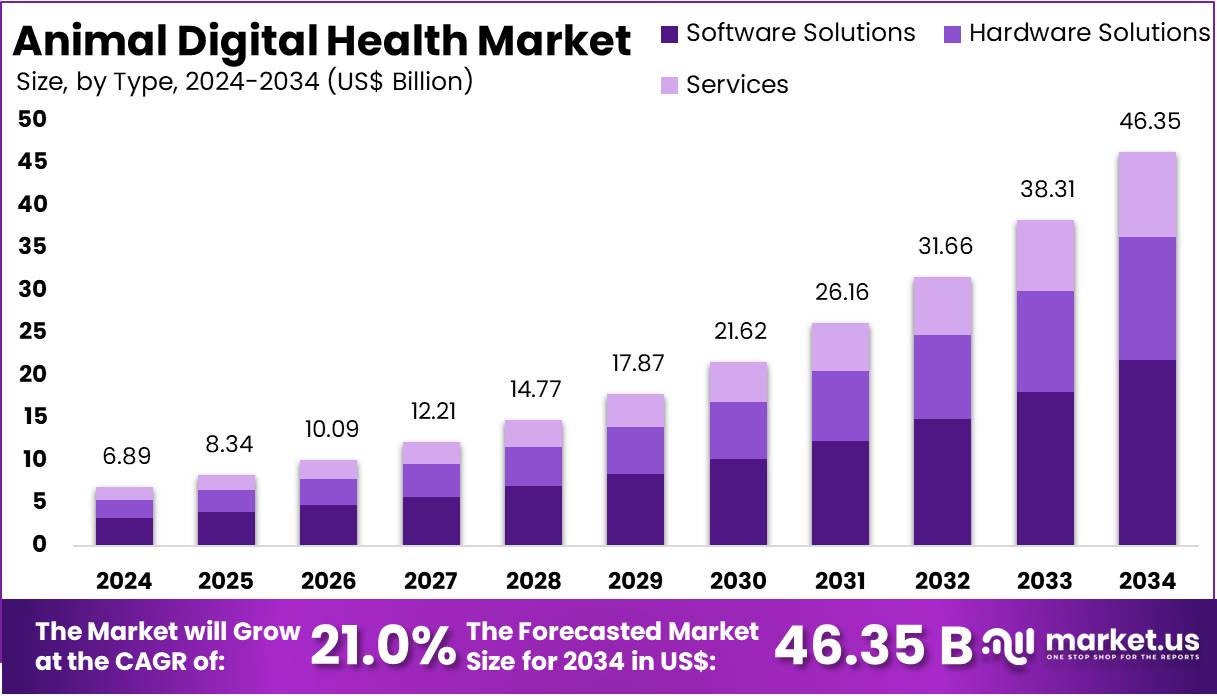
The Global Animal Digital Health Market size is expected to be worth around US$ 46.35 Billion by 2034, from US$ 6.89 Billion in 2024, growing at a CAGR of 21% during the forecast period from 2025 to 2034. North America held a dominant market position, capturing more than a 41.2% share and holds US$ 2.64 Billion market value for the year.
The growing adoption of digital tools across veterinary practices is strengthening the foundation for the global Animal Digital Health Market, as veterinarians increasingly use connected platforms to improve clinical workflows, communication, monitoring, and animal health management.
According to the American Veterinary Medical Association (AVMA) 2025 Report on the Economic State of the Veterinary Profession, 76.5% of represented veterinary practices had practice management information systems in place in 2024, highlighting the expanding role of digital infrastructure in everyday veterinary operations. The report also found that 29.2% of practices used telehealth, indicating continued opportunities for virtual consultations and digitally enabled veterinary care.
Government initiatives are also supporting the digital transformation of animal health services. The U.S. Department of Agriculture’s Animal and Plant Health Inspection Service (USDA APHIS) has expanded electronic veterinary documentation, including digitally endorsed health certificates through its Veterinary Export Health Certification System.
These systems help veterinarians manage animal health documentation and facilitate movement and trade. Meanwhile, USDA APHIS continues to strengthen animal disease surveillance, monitoring, epidemiological analysis, and information systems as part of its national animal-health infrastructure.
The U.S. Food and Drug Administration’s Center for Veterinary Medicine (FDA CVM) is likewise encouraging innovation through its Animal and Veterinary Innovation Centers initiative, targeting critical animal, human, and environmental health needs. Together, advances in telehealth, electronic records, connected monitoring, data analytics, and digital surveillance are creating new opportunities for more proactive, accessible, and data-driven animal healthcare worldwide.
Key Takeaways
- The global animal digital health market is anticipated to reach approximately US$ 46.35 billion by 2034, rising significantly from US$ 6.89 billion in 2024.
- The market is forecast to register a strong 21% CAGR over the period from 2025 to 2034, reflecting accelerating adoption of digital technologies in animal healthcare.
- In 2024, software solutions represented the leading segment by type, capturing more than 47.2% of the overall animal digital health market.
- By application, livestock health management held the largest position in 2024, accounting for over 59.2% of the total market share.
- Among end users, farmers and livestock owners held the dominant position in 2024, representing more than 52.0% of the global animal digital health market.
- North America remained the leading regional market in 2024, accounting for over 41.2% of the global share and reaching an estimated market value of US$ 2.64 billion.
Statistical Information
- 76.5% of represented U.S. veterinary practices had practice-management information systems (PIMS) in place in 2024, demonstrating substantial adoption of digital infrastructure in veterinary operations.
- 59.9% of represented veterinary practices used client-communication software integrated with PIMS, including appointment reminders and personalized text or email communication.
- 43.5% of represented veterinary practices used digital inventory-management systems in 2024, showing the expansion of digital tools beyond clinical records into operational management.
- 33.4% of represented veterinary practices used online appointment scheduling, creating opportunities for integrated booking, digital communication, electronic records, and virtual-care platforms.
- 91% of surveyed U.S. pet owners said they take their pets to a veterinarian at least once a year, while general check-ups accounted for 58% of reported veterinary visits.
- 38% of surveyed U.S. pet owners said telemedicine availability is an important consideration when choosing a veterinarian, indicating growing consumer interest in digitally enabled veterinary services.
- 31% of U.S. pet owners reported increasing spending on pet health and wellness during the previous three months, despite economic pressures, supporting opportunities for digital preventive-care and monitoring solutions.
- Only one in five pet visits currently includes diagnostics, according to Elanco’s 2026 consumer research, highlighting an opportunity for accessible digital diagnostics, AI-assisted screening, and connected monitoring technologies.
Market Segmentation Analysis
Type Analysis
In 2024, Software Solutions dominated the Type segment of the Animal Digital Health Market, accounting for more than 47.2% market share. Its leadership was supported by increasing adoption of digital veterinary platforms for managing medical records, vaccination schedules, treatment histories, and animal health data. Cloud-based systems and AI-enabled features are further improving accessibility, automation, and remote monitoring capabilities.
Hardware Solutions, including wearable devices, smart tags, and health-monitoring sensors, also gained traction by enabling real-time tracking of animal behavior and vital indicators. Meanwhile, Services such as telemedicine, mobile health platforms, and remote diagnostics are expanding access to veterinary expertise, particularly in underserved areas, supporting broader digitalization across animal healthcare.
Application Analysis
In 2024, Livestock Health Management led the Application segment of the Animal Digital Health Market, capturing more than 59.2% market share. Its strong position was driven by rising adoption of smart farming technologies designed to monitor animal health, behavior, feeding, and productivity in real time. Wearable sensors, automated feeding systems, and digital monitoring platforms are helping livestock producers identify health issues earlier while reducing operational losses.
Companion Animal Health represented another important application, supported by increasing pet ownership and greater emphasis on preventive healthcare. Digital health apps, wearable trackers, and veterinary telehealth platforms are improving routine monitoring and access to professional care. Aquatic Animal Health and Veterinary Services are also advancing through smart monitoring, remote consultations, and data-driven diagnostics.
End-User Analysis
In 2024, Farmers & Livestock Owners held the leading position in the End-User segment of the Animal Digital Health Market, accounting for more than 52.0% market share. Their dominance reflects increasing use of GPS tracking, automated feeding technologies, disease-monitoring platforms, and connected devices to improve livestock health and farm productivity.
Veterinary Clinics ranked as the second-largest end-user group, with growing adoption of telemedicine, electronic medical records, AI-supported diagnostics, and remote monitoring solutions. These technologies help streamline clinical workflows and support faster disease identification.
Pet Owners are increasingly using wearable trackers and mobile applications for preventive health monitoring, while the Aquaculture Industry is adopting smart sensors and automated systems to manage feeding, water quality, and aquatic animal health more efficiently.
Regional Analysis
In 2024, North America maintained a leading position in the Animal Digital Health Market, accounting for more than 41.2% of the market and reaching approximately US$ 2.64 billion. The region benefits from established veterinary infrastructure, advanced animal-health surveillance, and increasing use of digital technologies. In the U.S., USDA APHIS operates integrated surveillance programs and supports electronic systems for animal-health reporting, laboratory submissions, identification, and disease monitoring.
In April 2025, USDA awarded more than US$ 15.3 million for 68 projects focused on animal disease prevention, early detection, and response, reinforcing technology-enabled animal health management. FDA initiatives are also encouraging innovation through the Animal and Veterinary Innovation Centers and modern, data-driven regulatory approaches. These developments, combined with growing digital adoption among veterinarians, producers, and animal owners, continue to strengthen North America’s regional leadership.
Business Opportunities
The Animal Digital Health Market offers broad opportunities for companies developing connected technologies for veterinary care, livestock management, companion animals, and aquaculture. AI-powered monitoring and predictive analytics can support earlier identification of health problems by analyzing behavioral, physiological, and environmental data. Wearable sensors, smart tags, connected cameras, and remote monitoring platforms can provide continuous information to veterinarians and animal owners, creating opportunities for hardware-software integrated solutions.
Veterinary telehealth and digital practice-management platforms represent another attractive area, particularly for remote consultations, follow-up care, electronic records, and communication between veterinarians and animal owners. However, providers must design services around applicable veterinary-client-patient relationship requirements.
There is also potential in aquaculture monitoring, disease surveillance, digital diagnostics, and specialized solutions for underserved animal species. FDA initiatives are encouraging innovation addressing unmet veterinary needs, emerging diseases, animal biotechnology, and improved product-development pathways. Companies combining IoT, AI, cloud platforms, analytics, and veterinary expertise can build scalable solutions focused on preventive care, operational efficiency, disease management, and animal welfare.
Emerging Trends
- AI-Based Animal Monitoring: AI is increasingly being combined with GPS, accelerometers, and animal-mounted sensors to understand grazing, movement, and feeding behavior. This supports earlier identification of changes in animal condition and enables producers to make more informed livestock-management decisions.
- Virtual Fencing Technology: GPS-enabled collars connected to software are creating digital boundaries for livestock. Ranchers can remotely influence animal movement and manage grazing areas without relying entirely on physical fences, supporting more flexible and technology-driven pasture management.
- Computer Vision in Animal Health: Camera-based AI is emerging as a non-invasive way to observe animals continuously. Computer vision can help identify animals, monitor behavior, assess feeding activity, and detect physical changes without requiring frequent manual handling.
- Connected Precision Ranching: IoT networks are increasingly linking animal collars with water sensors, soil probes, weather equipment, and other farm technologies. USDA research is testing platforms that transmit large volumes of information in real time across extensive grazing operations.
- AI-Enabled Aquaculture: Digital health technology is expanding beyond livestock into fish farming. USDA researchers are using underwater cameras and AI models to monitor fish condition, size, and numbers, creating new possibilities for non-invasive health management and production optimization.
Use Cases
- Early Health-Risk Detection: Animal-mounted sensors can continuously capture movement and behavioral patterns. Changes in grazing activity, movement, or resting behavior can provide useful signals for identifying potential health problems before producers would normally notice visible symptoms.
- Remote Grazing Management: Virtual fencing allows producers to establish grazing and exclusion zones digitally. GPS collars communicate with software platforms, allowing livestock movement to be managed remotely while supporting pasture utilization and environmental-management objectives.
- Automated Fish Monitoring: AI-powered underwater vision can detect whole and partial fish in aquaculture systems. USDA research has demonstrated more than 85% precision in fish detection, supporting automated counting and non-invasive monitoring of fish populations.
- Real-Time Ranch Intelligence: Precision ranching platforms can combine livestock-location data with water levels, rainfall, and soil conditions. This gives producers a centralized view of animals and their surrounding environment, helping improve grazing and resource-management decisions.
- AI-Based Wildlife Protection: Computer vision can also support animal-farming operations by identifying threats around aquaculture facilities. USDA researchers are developing AI cameras that recognize predatory birds and trigger non-lethal deterrent systems automatically.
Recent Developments
- In June 2026, Elanco announced a US$ 25 million multi-year commitment to launch Elanco Ventures, a corporate venture-capital platform focused on investing in early-stage animal-health technologies, therapeutics, and One Health solutions, with investments initially targeting Pre-Seed, Seed, and Series A companies.
- In June 2026, Merck Animal Health agreed to acquire TARGAN, a U.S. animal-health technology company developing automated biotechnology and delivery systems, with the transaction expected to close in Q3 2026 subject to regulatory approvals.
- In April 2026, Virbac signed an agreement with New Zealand-based MACSO to distribute its AI-powered acoustic livestock-monitoring technology exclusively across Europe, Latin America, and Asia, enabling continuous detection of early respiratory problems in pigs through sound, temperature, and humidity analysis.
- In March 2026, Zoetis agreed to acquire Neogen’s animal genomics business for US$ 160 million, strengthening its Precision Animal Health portfolio with genomics capabilities designed to expand predictive insights and support individualized livestock-health management worldwide.
- In February 2026, IDEXX reported that its Veterinary Software, Services and Diagnostic Imaging recurring revenue grew approximately 10% during 2025, demonstrating continued expansion of software-enabled veterinary workflows alongside its diagnostic business.
- In July 2025, Tractive acquired Whistle from Mars Petcare, combining Whistle’s connected-pet technology and customer base with Tractive’s GPS and health-monitoring platform; the transaction expanded Tractive’s U.S. presence and added resting-heart-rate and respiratory-rate monitoring capabilities.
- In June 2025, Boehringer Ingelheim and Eko Health developed CANINEBEAT AI, a canine-specific digital auscultation algorithm trained and validated using more than 4,500 annotated heart-sound recordings from over 3,500 dogs, supporting veterinary detection and grading of heart murmurs.
- In May 2025, Merck Animal Health announced a US$895 million expansion of its De Soto, Kansas, site, including US$ 860 million for manufacturing and US$ 35 million for research-and-development laboratories, strengthening its U.S. animal-health production and innovation infrastructure.
Conclusion
The Animal Digital Health Market is advancing as veterinary care increasingly adopts connected software, AI, wearable devices, digital diagnostics, telehealth, and real-time monitoring. Growing digitalization across veterinary practices, livestock operations, companion-animal care, and aquaculture is creating opportunities for more proactive and data-driven healthcare. Government initiatives and industry investments are further supporting innovation in disease surveillance, diagnostics, precision animal health, and automated monitoring.
Emerging applications such as virtual fencing, computer vision, AI-enabled aquaculture, and predictive health analytics are expanding the market beyond traditional veterinary software. With continued technology development and investment, digital solutions are expected to play an increasingly important role in improving animal health, operational efficiency, disease detection, and welfare globally.




















