


Overview
The Global AI in Life Science Analytics Market size is expected to be worth around USD 5.6 Billion by 2033, from USD 1.7 Billion in 2023, growing at a CAGR of 12.7% during the forecast period from 2024 to 2033.
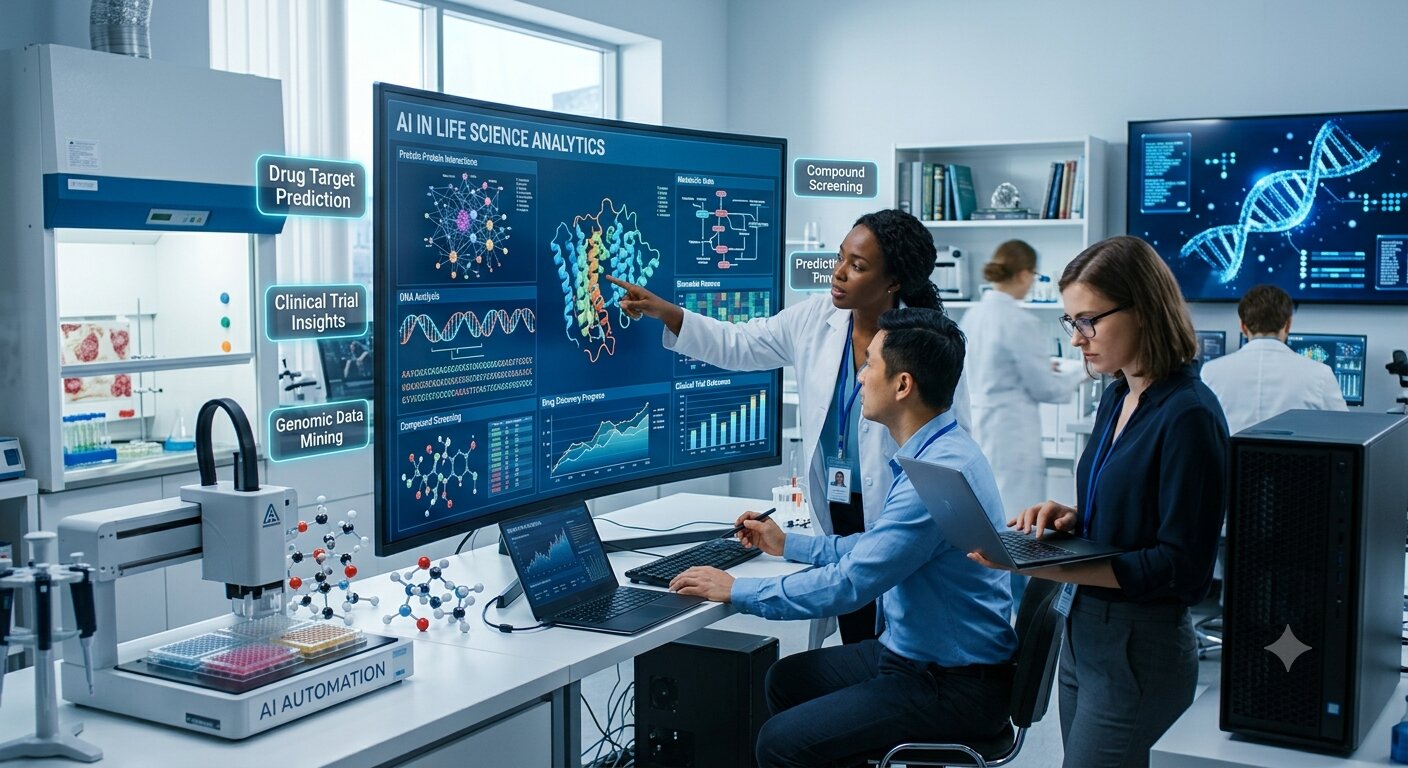
Artificial intelligence is becoming a vital technology across the life sciences sector, enabling researchers, pharmaceutical companies, biotechnology firms, and healthcare organizations to extract meaningful insights from increasingly complex biological and clinical datasets. AI-powered analytics are supporting faster biomarker identification, optimizing drug discovery workflows, improving genomic interpretation, and enhancing clinical trial design through advanced predictive modeling.
As precision medicine continues to evolve, organizations are investing in AI-driven platforms that improve research efficiency while supporting evidence-based decision-making. Government and healthcare institutions are also accelerating AI adoption through data-sharing initiatives and responsible AI frameworks. The U.S. National Institutes of Health (NIH) is advancing programs such as Bridge2AI and AIM-AHEAD to develop high-quality, AI-ready biomedical datasets and promote trustworthy AI research across diverse health domains.
The U.S. Food and Drug Administration (FDA) is further strengthening the ecosystem by establishing guidance for the responsible use of AI in regulatory submissions for drug and biological products. The agency reported that the use of AI in drug development and regulatory submissions has increased exponentially since 2016, highlighting AI’s expanding role in improving safety, effectiveness, and product quality assessments. In January 2025, the FDA released its first draft guidance outlining a risk-based framework for evaluating AI models used in regulatory decision-making.

Key Takeaways
- The global AI in Life Science Analytics market was valued at USD 1.7 billion in 2023 and is projected to reach USD 5.6 billion by 2033, expanding at a CAGR of 12.7% during the forecast period.
- The service segment accounted for the largest share of the market by component, capturing 38.8% of the total revenue in 2023.
- Based on deployment, the cloud segment held the leading position, representing 53.6% of the global market share in 2023.
- In terms of application, the sales and marketing segment dominated the market, accounting for 35.8% of the total share in 2023.
- Among end users, the pharmaceutical sector emerged as the largest contributor, securing 47.9% of the market revenue in 2023.
- From a regional perspective, North America remained the leading market, holding the highest regional share of 53.1% in 2023.
Statistical Information
- 130 trainees were selected from 1,346 applications submitted by 775 unique applicants for the 2025–2026 AIM-AHEAD AI/ML training programs, demonstrating rapidly growing demand for AI skills in biomedical and life science research.
- The AIM-AHEAD & NCATS Health Data Science Training Program admitted 50 trainees into its third cohort for 2025–2026 to strengthen the AI-enabled biomedical research workforce.
- The AIM-AHEAD Bridge2AI Clinical Care Training Program selected 30 researchers for its second cohort in 2025 to expand AI applications in clinical and life science analytics.
- The AIM-AHEAD Bridge2AI AI-READI Training Program accepted 25 trainees from 241 applications for its second cohort, reflecting strong interest in AI-ready biomedical data science.
- The AIM-AHEAD All of Us Training Program received 483 applications and selected 25 participants, including applicants for its new genomics track.
- The NIH Networking and Information Technology Research and Development (NITRD) initiative coordinates AI and information technology research across 23 U.S. federal agencies, supporting large-scale biomedical AI innovation.
- The NIH reported that some investigators submitted more than 40 research applications in a single review cycle using AI-assisted drafting, prompting new guidance to protect research integrity and originality.
- According to the NIH, principal investigators submitting more than six applications per year represent only a small percentage of applicants, leading the agency to introduce new AI-related application policies in 2025.
Regional Analysis
North America dominated the AI in Life Science Analytics market in 2023, supported by its advanced healthcare infrastructure, robust digital ecosystem, and widespread adoption of artificial intelligence across pharmaceutical and biotechnology research. The region benefits from significant investments in biomedical data science, precision medicine, and cloud-based analytics platforms.
The U.S. National Institutes of Health (NIH) continues to accelerate AI innovation through initiatives such as Bridge2AI, AIM-AHEAD, and multimodal AI research programs, promoting the development of high-quality, FAIR biomedical datasets for AI-driven discovery. These initiatives strengthen collaboration among research institutions, healthcare providers, and technology companies, reinforcing North America’s leadership in AI-enabled life science analytics.
Asia Pacific is projected to register the fastest growth during the forecast period, driven by expanding biotechnology research, increasing healthcare digitalization, and supportive government initiatives encouraging AI adoption. Countries including China, India, Japan, South Korea, and Singapore are investing heavily in AI-powered healthcare and life science innovation.
The region also benefits from a rapidly growing pharmaceutical manufacturing base and rising demand for advanced analytics to accelerate drug discovery and clinical research. Scientific studies indicate that Asia has become the global leader in AI-related life science publications, while continued investments in AI infrastructure and cross-border collaborations are expected to further strengthen regional market growth.
Emerging Trends
- AI-ready biomedical datasets are becoming a major industry focus. In January 2026, the NIH advanced its Bridge2AI program to Stage 2, shifting from dataset creation to developing AI-powered research tools and launching a Network for AI Health Science for responsible AI innovation.
- Multimodal data integration is accelerating life science analytics. The NIH is expanding AI applications by combining electronic health records, genomics, imaging, and disease-specific datasets into unified AI models, helping researchers generate more accurate insights for precision medicine and biomedical discovery.
- Trusted and explainable AI is becoming a regulatory priority. The latest Bridge2AI program emphasizes building frameworks for trustworthy, reproducible, and explainable AI, ensuring that AI systems used in biomedical research produce transparent and reliable scientific outcomes.
- Large-scale federal collaboration is strengthening AI research. The NIH’s NITRD initiative coordinates AI and information technology research across 23 U.S. federal agencies, creating stronger collaboration for biomedical innovation, advanced analytics, and next-generation life science research infrastructure.
- Workforce development is emerging as a key growth trend. The Bridge2AI program now provides AI training resources, best practices, and workforce development initiatives, helping researchers gain practical AI skills required for modern biomedical and pharmaceutical analytics.
Use Cases
- AI is improving drug discovery research. The NIH invested US$ 130 million through the Bridge2AI program to create AI-ready biomedical datasets that help scientists identify disease mechanisms and accelerate the discovery of new therapeutic targets.
- AI is enhancing genomic data analysis. The Bridge2AI consortium has developed recommendations for preparing AI-ready genomic datasets, allowing researchers to improve machine learning performance and generate more reliable genomic insights for disease research and precision medicine.
- AI is supporting biomarker discovery using voice analytics. One Bridge2AI research initiative is developing AI models that analyze human voice recordings to identify early signs of disease, creating new opportunities for non-invasive health monitoring and clinical decision support.
- AI is enabling advanced cellular mapping. Through the MuSIC Maps initiative, researchers use AI to combine cellular and molecular information, helping scientists better understand disease progression and identify potential therapeutic targets for complex disorders.
- AI is improving biomedical data standardization. Bridge2AI researchers are developing standardized metadata, documentation practices, and AI-ready data formats to make biomedical datasets more consistent, reusable, and interoperable across research organizations and healthcare institutions.
Frequently Asked Questions About AI in Life Science Analytics
- Why is AI becoming important in life science analytics?
AI enables organizations to process large volumes of biological and clinical data much faster than traditional methods. It supports precision medicine, biomarker discovery, genomic analysis, and predictive modeling, allowing pharmaceutical and biotechnology companies to improve research efficiency and innovation. - What are the major applications of AI in life science analytics?
AI is widely used for drug discovery, clinical trial optimization, genomic sequencing, disease prediction, medical imaging analysis, real-world evidence generation, and biomarker identification. These applications help researchers shorten development timelines while improving the quality and accuracy of scientific outcomes. - Which industries are the primary users of AI in life science analytics?
Pharmaceutical companies, biotechnology firms, contract research organizations (CROs), academic research institutes, healthcare providers, and government research agencies are the leading adopters. These organizations use AI to improve research productivity, data management, and evidence-based decision-making. - What factors are driving the AI in Life Science Analytics market?
Growing biomedical datasets, increased investment in precision medicine, expanding cloud computing infrastructure, and government-supported AI initiatives are driving market growth. Organizations are also adopting AI to improve operational efficiency and accelerate scientific research while reducing development costs. - How is the FDA supporting AI adoption in life sciences?
The U.S. FDA has introduced guidance and scientific frameworks for the responsible use of AI in drug development and medical products. These efforts help ensure that AI-generated evidence used in regulatory submissions is reliable, transparent, and scientifically credible. - What challenges does the AI in Life Science Analytics market face?
Key challenges include maintaining high-quality datasets, protecting patient privacy, ensuring interoperability across healthcare systems, addressing algorithm bias, and complying with evolving regulatory requirements. Organizations must also establish trustworthy and explainable AI systems before widespread deployment. - What is the future outlook for the AI in Life Science Analytics market?
The market is expected to benefit from continued advances in multimodal AI, genomic analytics, cloud computing, and AI-ready biomedical datasets. Ongoing investments by healthcare organizations and government agencies are likely to expand AI adoption across research, diagnostics, and therapeutic development.
Conclusion
The AI in Life Science Analytics market is evolving rapidly as artificial intelligence reshapes biomedical research, pharmaceutical development, and clinical decision-making. Increasing investments in AI-ready datasets, cloud-based analytics, precision medicine, and regulatory frameworks are strengthening the market’s long-term growth potential.
Government initiatives led by organizations such as the NIH and FDA are promoting responsible AI adoption while improving data quality, transparency, and research efficiency. As pharmaceutical companies, biotechnology firms, and research institutions continue integrating AI into their workflows, demand for advanced analytics solutions is expected to rise. Continuous innovation, skilled workforce development, and collaborative research efforts will further accelerate market expansion and scientific breakthroughs worldwide.




















