


Overview
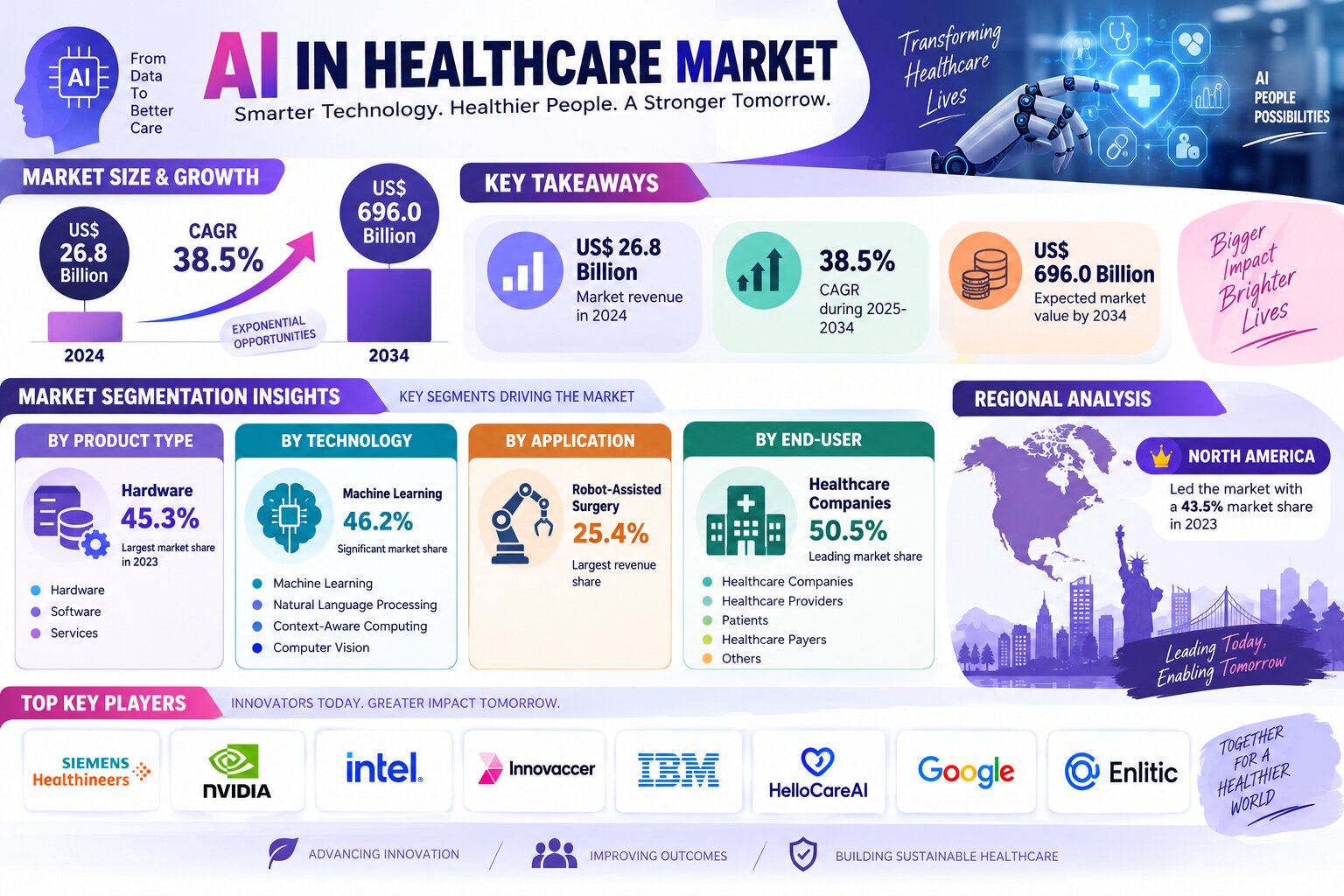
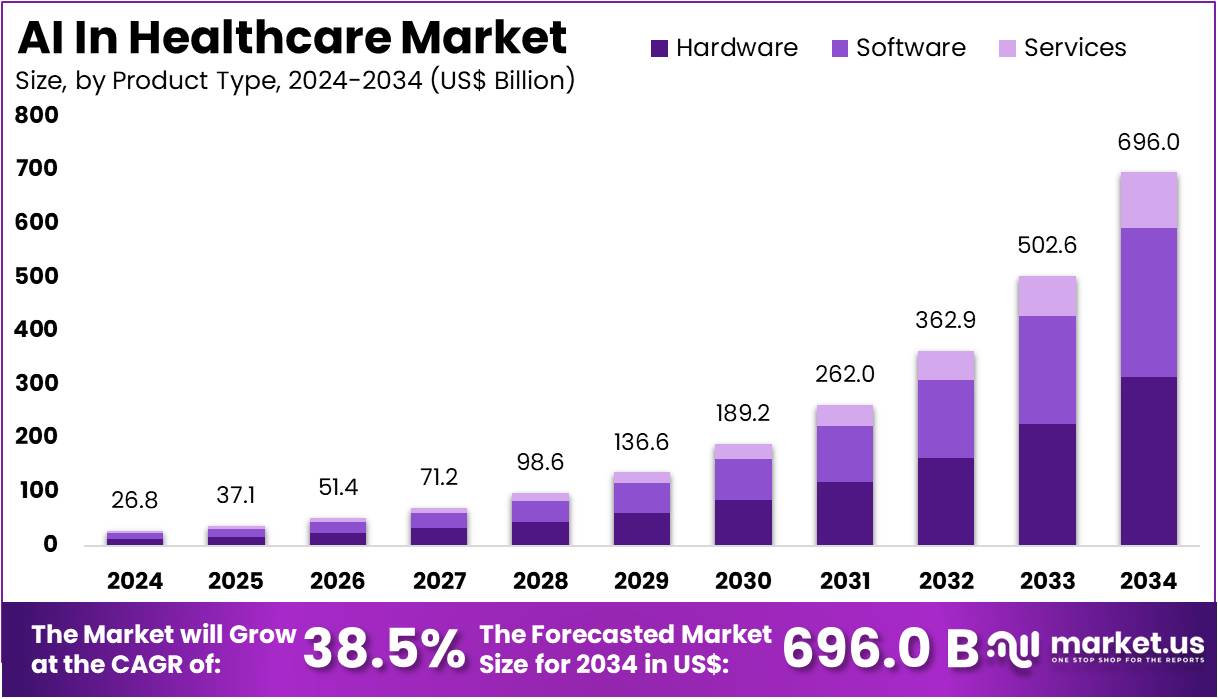
The AI In Healthcare Market Size is expected to be worth around US$ 696.0 Billion by 2034 from US$ 26.8 Billion in 2024, growing at a CAGR of 38.5% during the forecast period 2025 to 2034.
Artificial intelligence (AI) is emerging as a key technology in healthcare, supporting advancements in medical diagnosis, clinical research, patient care management, and healthcare operations. AI-driven tools are being used to analyze medical images, identify disease patterns, assist healthcare professionals with decision-making, and improve the efficiency of healthcare delivery.
The World Health Organization (WHO) highlights that AI can strengthen health systems by enabling better use of health data, improving evidence-based decision-making, and supporting innovative digital health solutions when implemented responsibly.
The adoption of AI in healthcare is expanding as healthcare organizations focus on automation, predictive analytics, and personalized medicine approaches. AI applications are being explored in areas such as early disease detection, medical imaging, drug development, and population health management.
According to the U.S. Food and Drug Administration (FDA), AI-enabled medical devices continue to grow, with regulatory frameworks supporting the evaluation of safety and effectiveness for AI-based healthcare technologies.
In November 2025, WHO reported that its assessment of AI readiness across 50 countries in the European Region examined national strategies, governance models, legal frameworks, workforce preparedness, and data governance approaches for integrating AI into healthcare systems. Additionally, the FDA maintains a dedicated database of AI-enabled medical devices authorized for marketing in the United States, helping improve transparency for healthcare providers and patients.
Key Takeaways
- In 2024, the AI in healthcare market generated US$ 26.8 billion in revenue and is projected to reach US$ 696.0 billion by 2034, expanding at a CAGR of 38.5%.
- The hardware segment dominated the product type category in 2023, accounting for a 45.3% market share, driven by rising adoption of AI-enabled healthcare devices.
- The machine learning segment led the technology category with a 46.2% share, supported by its widespread use in healthcare analytics, diagnostics, and predictive solutions.
- The robot-assisted surgery segment emerged as the leading application area, capturing the largest revenue share of 25.4% in the AI in healthcare market.
- The healthcare companies segment dominated the end-user category with a 50.5% revenue share, fueled by increasing investments in AI-based healthcare solutions.
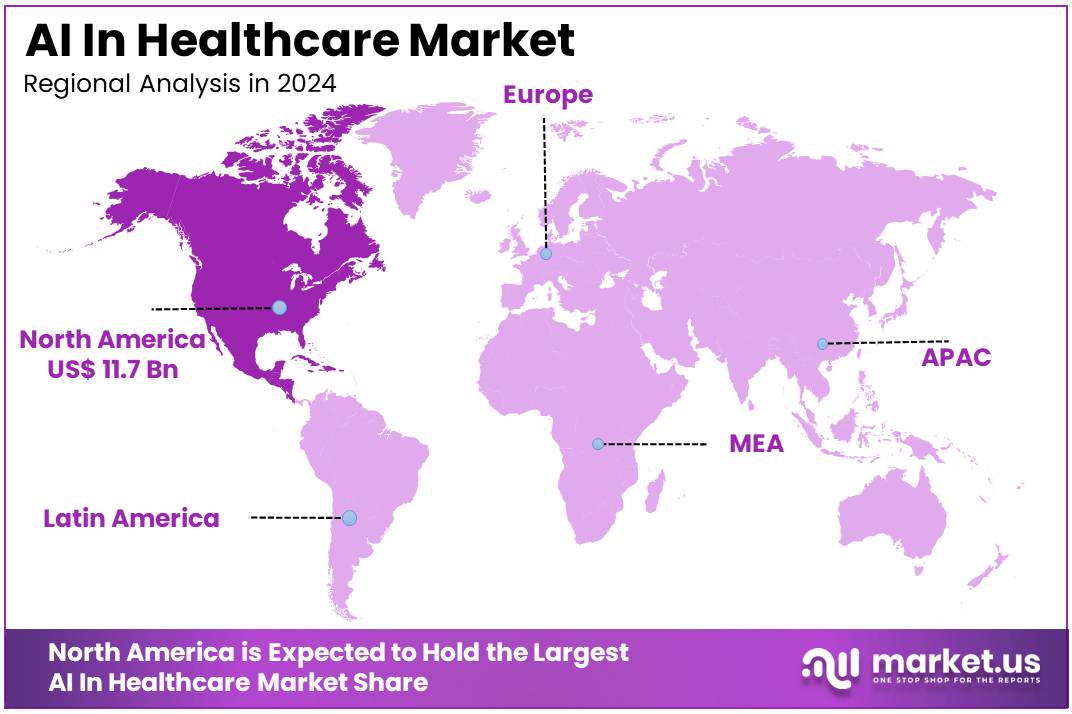
- North America held the leading position in the AI in healthcare market in 2023, accounting for a 43.5% market share due to strong technology adoption and healthcare innovation.
Statistical Information
- 66% of physicians reported using AI tools in their medical practice in 2024, compared with 38% in 2023, representing a significant increase in healthcare professionals adopting AI for documentation, care planning, research support, and workflow improvement.
- 68% of physicians stated that AI provides definite or some advantages in healthcare, highlighting growing confidence among clinicians regarding AI-assisted decision support and operational improvements.
- 57% of physicians identified reducing administrative workload through automation as the top opportunity for AI, showing strong demand for AI solutions focused on documentation, workflow management, and efficiency improvement.
- 88% of physicians emphasized the need for AI feedback channels, 87% required data privacy assurances, and 84% highlighted EHR integration as important factors for wider AI adoption in healthcare.
- 64% of countries in the WHO European Region are already using AI-assisted diagnostics, particularly for medical imaging and disease detection, demonstrating increasing adoption of AI in clinical applications.
- 50% of countries in the WHO European Region have introduced AI-powered chatbots for patient engagement and healthcare support, indicating rising use of conversational AI technologies in healthcare delivery.
- 98% of countries identified improving patient care as a major reason for adopting AI in healthcare, while 92% highlighted reducing healthcare workforce pressure and 90% focused on improving efficiency and productivity.
- The U.S. FDA maintains a dedicated list of AI-enabled medical devices authorized for marketing, with AI applications expanding across areas such as radiology, cardiovascular care, ultrasound, and clinical decision support, reflecting increasing regulatory acceptance of AI-based healthcare technologies.
Market Segmentation Analysis
Product Type Analysis
Hardware is expected to dominate the AI in healthcare market, accounting for a 45.3% market share. The segment growth is driven by increasing adoption of AI-enabled medical equipment, including advanced diagnostic imaging systems, robotic surgery platforms, and wearable healthcare devices. AI-powered hardware solutions help healthcare providers process large volumes of real-time patient data, improving diagnostic accuracy, treatment planning, and operational efficiency.
Growing investments in healthcare infrastructure, along with advancements in AI processors, sensors, and computing technologies, are further supporting market expansion. As hospitals and medical institutions continue integrating artificial intelligence into clinical workflows, demand for high-performance hardware solutions is expected to increase significantly.
Technology Analysis
Machine learning is projected to hold the leading position in the AI in healthcare market, capturing a 46.2% market share. The dominance of this technology is attributed to its ability to analyze complex healthcare datasets, identify patterns, and generate predictive insights for improved clinical outcomes.
Machine learning is widely utilized in medical imaging, disease detection, drug discovery, patient monitoring, and personalized treatment planning. The growing availability of healthcare data and advancements in algorithms are accelerating adoption across healthcare systems. Additionally, increasing demand for automation, predictive analytics, and data-driven decision-making is expected to strengthen the role of machine learning as a key technology in AI-powered healthcare solutions.
Application Analysis
Robot-assisted surgery is expected to be the leading application segment in the AI in healthcare market, accounting for a 25.4% market share. The segment growth is supported by increasing demand for minimally invasive surgical procedures that offer improved precision, reduced recovery time, and lower complication risks.
AI-integrated robotic systems enable surgeons to perform complex procedures with enhanced accuracy, flexibility, and real-time assistance. Growing adoption of robotic platforms across hospitals and surgical centers is further contributing to market expansion. Continuous advancements in surgical robotics, combined with increasing focus on improving patient outcomes and operational efficiency, are expected to drive the adoption of AI-powered robot-assisted surgery applications globally.
End-User Analysis
Healthcare companies are projected to represent the largest end-user segment in the AI in healthcare market, holding a 50.5% market share. This segment includes pharmaceutical companies, biotechnology firms, and medical device manufacturers that are increasingly adopting AI technologies to enhance research, development, and healthcare solutions.
AI is being utilized for drug discovery, clinical trial optimization, medical innovation, and personalized medicine development. The growing need for faster research processes, improved operational efficiency, and advanced data analysis capabilities is driving AI adoption among healthcare companies. Increasing investments in artificial intelligence by healthcare organizations are expected to further support segment growth and strengthen their role in shaping future healthcare advancements.
Regional Analysis
North America dominated the AI in healthcare market with a 43.5% revenue share, supported by strong healthcare infrastructure, advanced digital health adoption, and significant investments in artificial intelligence technologies. The region benefits from widespread implementation of AI solutions in medical imaging, clinical decision support, drug discovery, and healthcare automation.
Government initiatives and private-sector investments continue to accelerate AI innovation across the healthcare ecosystem. In Canada, the government announced a US$2.4 billion AI investment package under Budget 2024, including US$2 billion to enhance computing capabilities and AI infrastructure for researchers and startups. The presence of leading technology companies, healthcare organizations, and AI-focused research institutions further strengthens North America’s position in the global AI healthcare landscape.
Asia Pacific is expected to register the fastest growth rate in the AI in healthcare market during the forecast period, driven by increasing digital transformation, government support, and rising demand for efficient healthcare delivery. Countries across the region are investing in AI infrastructure, smart healthcare systems, and advanced medical technologies to improve accessibility and patient outcomes.
China, Japan, India, and other emerging economies are actively promoting AI adoption in healthcare through innovation programs and technology initiatives. Healthcare providers are increasingly implementing AI solutions for diagnostics, disease monitoring, and personalized medicine. The growing availability of healthcare data, expanding digital health platforms, and increasing investments from technology companies are expected to accelerate AI adoption across the Asia Pacific region.
Business Opportunities
The AI in healthcare market presents significant business opportunities across medical diagnostics, drug discovery, clinical decision support, and healthcare automation. Companies developing AI-powered imaging solutions, predictive analytics platforms, and personalized medicine tools can benefit from rising demand for faster and more accurate healthcare services. The World Health Organization (WHO) highlights AI applications in areas such as diagnosis, clinical care, drug development, disease surveillance, and healthcare system management, creating opportunities for technology providers and healthcare innovators.
Pharmaceutical and biotechnology companies have opportunities to leverage AI for accelerating drug discovery, optimizing clinical trials, and improving research outcomes. The U.S. Food and Drug Administration (FDA) has also introduced guidance supporting the responsible use of AI models in drug and biological product development, encouraging innovation in healthcare research.
Additional opportunities exist in AI-enabled medical devices, remote patient monitoring, administrative automation, and healthcare data platforms. Government initiatives focused on responsible AI adoption, digital health infrastructure, and healthcare modernization are expected to support partnerships between technology companies, healthcare providers, and research organizations. As healthcare systems increasingly prioritize efficiency, accessibility, and personalized care, businesses investing in secure, transparent, and clinically validated AI solutions are positioned for long-term growth.
Emerging Trends
- Generative AI Adoption in Healthcare: Generative AI is becoming a major trend in healthcare as organizations explore AI assistants for clinical documentation, patient communication, and workflow automation. Hospitals are using large language models to reduce repetitive tasks and improve healthcare staff productivity. WHO highlights generative AI governance and safe deployment as key priorities for future healthcare systems.
- AI Integration with Electronic Health Records (EHRs): AI integration with EHR systems is increasing as healthcare providers focus on extracting meaningful insights from patient data. AI tools are being developed to summarize medical histories, support clinical decisions, and improve information accessibility. WHO reports that countries are focusing on stronger health data governance to enable responsible AI adoption.
- Growth of AI Governance and Regulatory Frameworks: Healthcare AI development is shifting toward safer and more transparent models due to increasing regulatory attention. WHO’s assessment across 50 countries identified AI strategies, legal frameworks, and data governance as important areas for healthcare AI readiness.
- AI for Drug Development and Scientific Research: AI is becoming an important research tool for pharmaceutical and biotechnology companies. The technology is being applied to analyze scientific data, accelerate discoveries, and support regulatory processes. In 2025, the FDA completed its first AI-assisted scientific review pilot to reduce repetitive review tasks and improve efficiency.
- Expansion of AI-Based Clinical Decision Support: AI-powered clinical decision support systems are growing as healthcare providers seek faster and more accurate decision-making tools. These systems assist clinicians by analyzing patient information, identifying risks, and supporting diagnosis and treatment planning. WHO recognizes AI applications in diagnosis, clinical care, and health system management as important healthcare advancements.
Use Cases
- AI-Assisted Radiology and Medical Imaging: AI is widely used in radiology to analyze medical images, prioritize urgent cases, and assist physicians in diagnosis. Hospitals are implementing AI systems that detect conditions from CT scans and imaging data, helping reduce response times for critical cases such as stroke.
- AI-Based Clinical Documentation: Healthcare organizations are using AI tools to automatically create medical notes from physician-patient conversations. These solutions help reduce documentation workload, improve record accuracy, and allow healthcare professionals to spend more time on patient care.
- AI-Powered Patient Engagement Platforms: AI chatbots and virtual assistants are being used to improve patient communication, provide health information, and support healthcare access. WHO reported that 50% of countries surveyed in the WHO European Region have introduced AI chatbots for patient engagement and support.
- AI-Based Disease Surveillance: AI is being applied for monitoring disease patterns, analyzing health data, and supporting public health decision-making. WHO highlights AI’s role in disease surveillance and outbreak response by helping health systems process large volumes of information more efficiently.
- AI-Enabled Medical Device Development: Medical device companies are increasingly integrating AI into diagnostic and monitoring technologies. The FDA maintains a database of AI-enabled medical devices authorized for marketing, showing continued expansion of AI applications across healthcare specialties.
Recent Developments
- In April 2026, Siemens Healthineers’ Varian business received up to US$60 million from ARPA-H to advance photon FLASH radiotherapy development, while Siemens committed an additional US$23 million investment, creating a combined US$83 million project focused on next-generation cancer treatment technology.
- In October 2025, IBM introduced new AI capabilities through its watsonx platform, including tools designed to help enterprises deploy and manage AI agents at scale with improved governance, monitoring, and operational control.
- In July 2025, Siemens Healthineers and Prisma Health expanded their healthcare technology partnership through a US$50 million investment in radiation therapy, including AI-driven adaptive radiotherapy solutions from Varian to support personalized cancer treatment planning.
- In May 2025, Enlitic announced a strategic collaboration with GE HealthCare for AI-driven medical imaging data migration and cloud solutions, with the agreement potentially generating up to A $50 million revenue over five years and supporting enterprise imaging transformation.
- In March 2025, Siemens Healthineers partnered with the Government of Alberta and Alberta Cancer Foundation under an 800 million CAD cancer care investment program, with Siemens Healthineers committing 175 million CAD toward AI-enabled cancer care innovation, research infrastructure, and training centers.
Conclusion
The AI in healthcare market is undergoing rapid transformation as artificial intelligence becomes increasingly integrated into diagnosis, treatment planning, medical research, and healthcare operations. Growing adoption of machine learning, generative AI, AI-enabled devices, and clinical decision-support solutions is creating new opportunities for healthcare providers, technology companies, and researchers.
Supportive regulatory frameworks, rising investments, and advancements in healthcare data analytics are further accelerating innovation. As organizations focus on improving efficiency, personalization, and patient outcomes, AI is expected to play a critical role in shaping the future of healthcare delivery while emphasizing safety, transparency, and responsible implementation.




















