


Overview
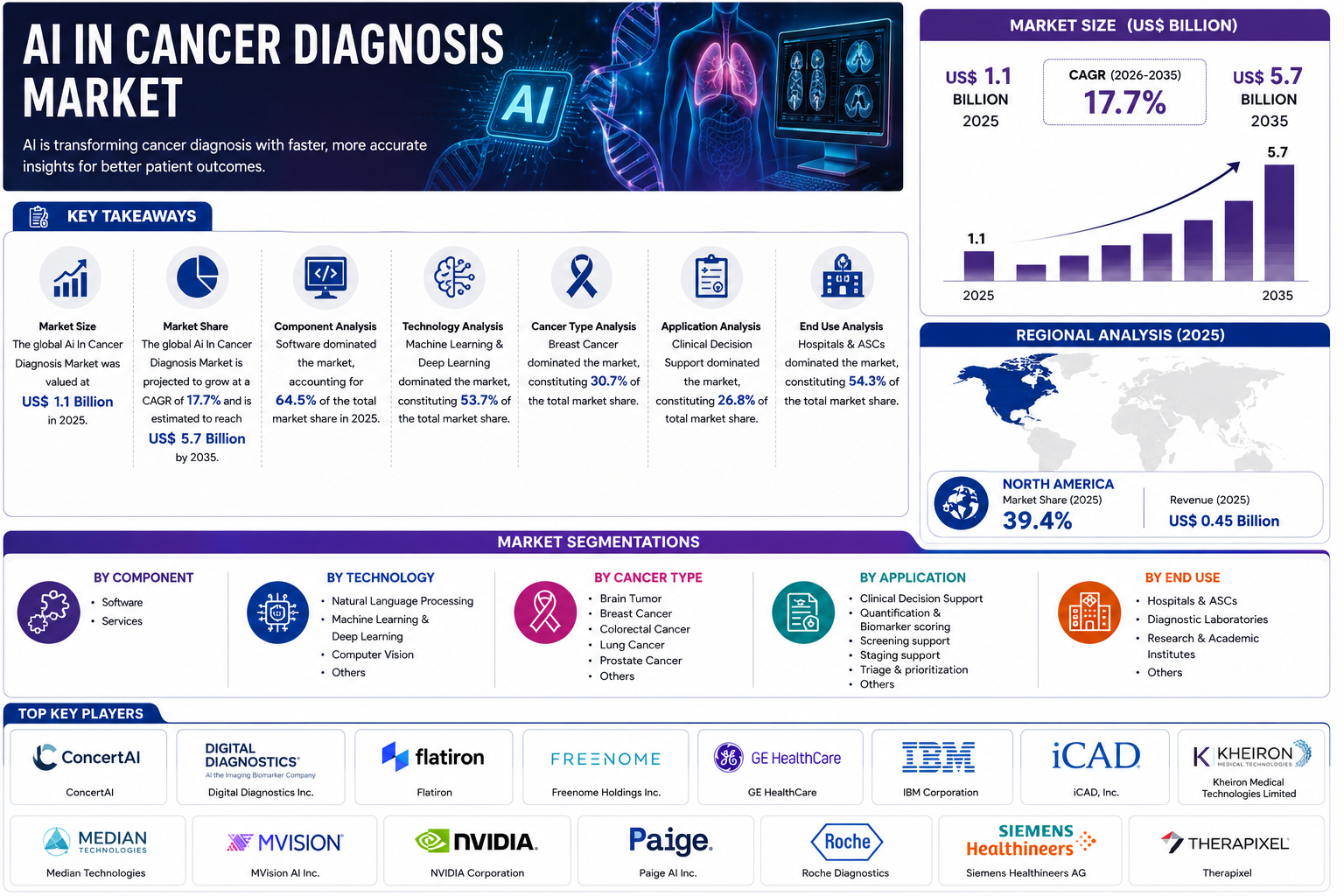
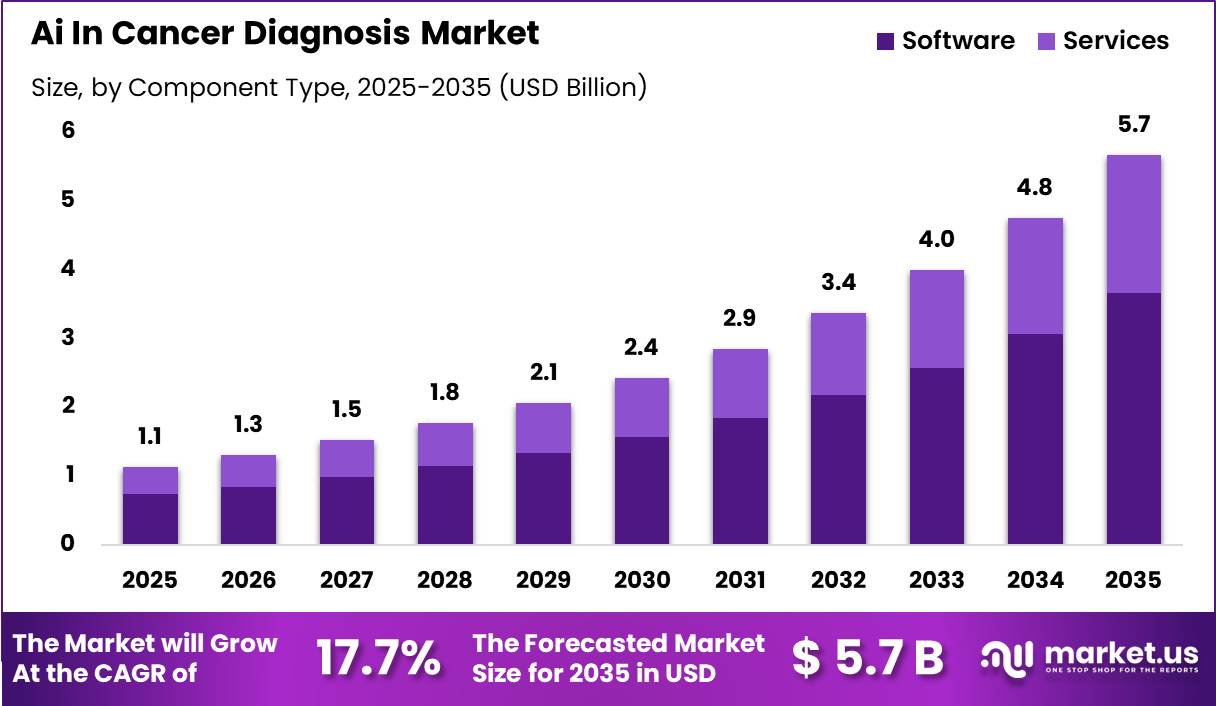
Global Ai In Cancer Diagnosis Market size is expected to be worth around US$ 5.7 Billion by 2035 from US$ 1.1 Billion in 2025, growing at a CAGR of 17.7% during the forecast period from 2026 to 2035. In 2025, North America led the market, achieving over 39.4% share with a revenue of US$ 0.45 Billion.
Artificial intelligence is rapidly transforming cancer diagnosis by enabling clinicians to analyze medical images, pathology slides, genomic data, and electronic health records with greater speed and consistency. AI-powered diagnostic tools are increasingly being integrated into clinical workflows to support earlier detection, improve diagnostic accuracy, and reduce the workload on healthcare professionals.
Rather than replacing physicians, these systems function as clinical decision-support tools that help identify subtle disease patterns that may be difficult to detect through conventional methods. The growing availability of digital pathology, advanced imaging technologies, and cloud-based healthcare infrastructure is further accelerating AI adoption in oncology.
Government agencies and leading healthcare organizations continue to strengthen the foundation for AI-driven cancer diagnostics. In 2025, the U.S. National Cancer Institute (NCI) invited public input to establish standardized benchmarks for artificial intelligence in cancer research and care, aiming to improve the evaluation and validation of AI models before broader clinical implementation.
Additionally, the National Cancer Institute estimates that 2,041,910 new cancer cases and 618,120 cancer-related deaths will occur in the United States in 2025, highlighting the need for more efficient diagnostic technologies. The World Health Organization (WHO) also reported in 2025 that its global cancer R&D analysis covers more than 120,000 cancer clinical trials, while noting that 63 countries have no registered cancer clinical trials, underscoring the importance of expanding access to innovative diagnostic solutions worldwide. These initiatives are expected to support the continued advancement and responsible adoption of AI in cancer diagnosis.
Key Takeaways
- The global AI in Cancer Diagnosis Market was valued at US$ 1.1 billion in 2025.
- The global AI in Cancer Diagnosis Market is anticipated to grow at a CAGR of 17.7%, reaching US$ 5.7 billion by 2035.
- In 2025, the Software segment emerged as the leading component, capturing 64.5% of the global market share.
- The Machine Learning & Deep Learning segment led the technology category, accounting for 53.7% of the market share in 2025.
- Among cancer types, Breast Cancer held the largest share, representing 30.7% of the global market in 2025.
- The Clinical Decision Support segment dominated the application category, securing 26.8% of the total market share in 2025.
- By end use, Hospitals & Ambulatory Surgery Centers (ASCs) accounted for the largest share, contributing 54.3% of the global market in 2025.
- North America maintained its leading position in 2025, capturing 39.4% of the global market and generating US$ 0.45 billion in revenue.
Statistical Information
- Nearly 20 million new cancer cases and 9.7 million cancer-related deaths were recorded worldwide in 2022, highlighting the growing need for AI-enabled early diagnosis and screening technologies.
- The U.S. National Cancer Institute (NCI) estimates that 38.9% of men and women will be diagnosed with cancer at some point during their lifetime, reinforcing the demand for advanced AI-assisted diagnostic tools.
- The NCI SEER Program collects cancer incidence and survival data covering approximately 48% of the U.S. population, providing one of the world’s largest datasets for developing and validating AI models in oncology.
- According to the WHO Europe 2024–2025 AI for Health Survey, 64% of participating countries are already using AI-assisted diagnostics, particularly for medical imaging and disease detection.
- The same WHO survey found that 98% of countries identified improving patient care as the primary reason for adopting AI in healthcare.
- 92% of surveyed countries reported that they are implementing AI to help reduce healthcare workforce pressures, reflecting strong demand for AI-enabled clinical support.
- 90% of countries cited improving healthcare efficiency and productivity as a key driver for AI adoption across healthcare systems.
- Despite growing adoption, only 25% of surveyed countries have allocated dedicated funding to implement their national AI health priorities, indicating significant investment opportunities for AI healthcare technologies.
Market Segmentation Analysis
Component Analysis
The software segment accounted for 64.5% of the AI in Cancer Diagnosis market in 2025, driven by growing adoption of AI platforms for medical imaging, pathology, and clinical decision support. Healthcare providers increasingly deploy software that integrates with electronic health records and diagnostic workflows to improve efficiency and accuracy.
Guidance from the U.S. Food and Drug Administration (FDA) on AI-enabled medical devices has supported broader clinical implementation of software-based diagnostic solutions. Meanwhile, demand for implementation, integration, and maintenance services continues to complement software adoption.
Technology Analysis
Machine Learning (ML) and Deep Learning (DL) led the technology segment with a 53.7% market share in 2025. These technologies are widely used to analyze radiology images, pathology slides, and genomic datasets, enabling earlier cancer detection and improved diagnostic confidence.
The National Cancer Institute (NCI) highlights AI and machine learning as key technologies advancing cancer research, imaging, and precision oncology. Computer vision and natural language processing further enhance clinical workflows by supporting image interpretation and extracting insights from unstructured medical records.
Cancer Type Analysis
Breast cancer dominated the market with a 30.7% share in 2025, supported by established screening programs and increasing use of AI-assisted mammography. AI helps clinicians improve lesion detection, reduce false positives, and identify cancers at earlier stages.
According to the National Cancer Institute (NCI), breast cancer remains one of the most commonly diagnosed cancers, driving continuous innovation in diagnostic technologies. AI adoption is also expanding across lung, colorectal, prostate, and other cancer types to strengthen diagnostic precision.
Application Analysis
Clinical Decision Support (CDS) accounted for 26.8% of the AI in Cancer Diagnosis market in 2025. AI-powered CDS platforms assist clinicians by combining imaging, pathology, and patient information to support diagnosis, staging, and treatment planning. The Office of the National Coordinator for Health Information Technology (ONC) recognizes clinical decision support as an important tool for improving healthcare quality and evidence-based decision-making. Growing integration with hospital information systems continues to strengthen the adoption of AI-driven diagnostic applications.
End Use Analysis
Hospitals and Ambulatory Surgery Centers (ASCs) held the largest end-use share at 54.3% in 2025, reflecting strong investment in advanced diagnostic technologies and digital healthcare infrastructure. These facilities increasingly implement AI solutions to improve workflow efficiency, diagnostic accuracy, and patient outcomes.
The U.S. Food and Drug Administration (FDA) continues to support the safe adoption of AI-enabled medical devices through evolving regulatory frameworks. Diagnostic laboratories and research institutions are also expanding AI use for pathology, molecular diagnostics, and oncology research.
Regional Analysis
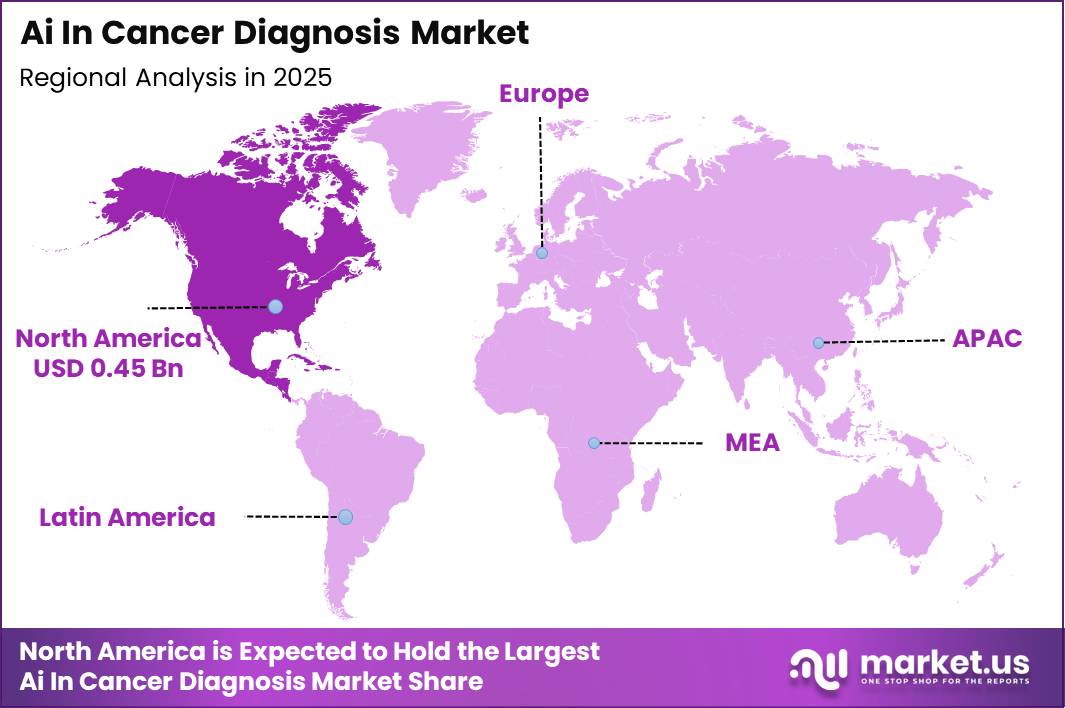
In 2025, North America accounted for 39.4% of the global AI in Cancer Diagnosis market, generating approximately US$ 0.45 billion in revenue. The region’s leadership is supported by advanced healthcare infrastructure, widespread adoption of digital health technologies, and increasing use of AI-enabled diagnostic software in oncology.
The U.S. Food and Drug Administration (FDA) continues to advance regulatory frameworks for AI-enabled medical devices, while the National Cancer Institute (NCI) promotes AI research through initiatives focused on cancer imaging, pathology, and precision oncology.
Europe remains a significant market due to strong investments in digital health and collaborative cancer research programs supported by healthcare institutions and governments. The Asia-Pacific region is experiencing rapid growth as countries expand digital healthcare infrastructure and implement national AI strategies to improve cancer detection.
Meanwhile, Latin America and the Middle East & Africa are gradually adopting AI-based diagnostic technologies through healthcare modernization efforts, increasing digitalization, and collaborations with international healthcare organizations to improve access to cancer care.
Business Opportunities
The AI in Cancer Diagnosis market presents significant business opportunities as healthcare systems increasingly invest in digital diagnostics and precision oncology. Companies can develop AI-powered software for medical imaging, digital pathology, and clinical decision support, helping healthcare providers improve diagnostic accuracy and workflow efficiency.
The U.S. Food and Drug Administration (FDA) continues to strengthen regulatory science for AI-enabled oncology technologies, creating opportunities for developers to commercialize validated diagnostic solutions.
Another major opportunity lies in partnerships with hospitals, cancer centers, and research institutions to develop AI models using multimodal datasets, including imaging, pathology, and genomics.
The National Cancer Institute (NCI) actively supports AI innovation through funding programs such as PRIMED-AI, SBIR, and Informatics Technology for Cancer Research, encouraging collaboration between academia and industry. These initiatives create favorable conditions for startups and established companies to accelerate product development and clinical validation.
Growing demand for cloud-based AI platforms, explainable AI, cybersecurity, and data interoperability also creates opportunities for software vendors and healthcare IT providers. Organizations offering scalable, regulatory-compliant solutions that integrate seamlessly with existing clinical workflows are well positioned to capitalize on the expanding adoption of AI across global oncology care.
Emerging Trends
- Multimodal AI is becoming a major trend, combining medical images, pathology slides, genomic information, and clinical records into a single AI model. The U.S. National Cancer Institute (NCI) states that integrating multiple data sources improves diagnostic accuracy and supports more personalized cancer care decisions.
- Digital pathology is rapidly expanding as laboratories transition from glass slides to whole-slide digital imaging. An NCI workshop report noted that only three AI/ML Software as a Medical Device (SaMD) tools for digital pathology had received FDA clearance, highlighting strong opportunities for future product development and clinical validation.
- Liquid biopsy combined with AI is emerging as a promising approach for earlier cancer detection. The NIH reports that researchers are testing blood, saliva, and urine-based liquid biopsies to detect cancer earlier and guide treatment decisions, creating new opportunities for AI-powered biomarker analysis.
- Explainable AI (XAI) is gaining importance as healthcare providers seek transparent and trustworthy diagnostic systems. The National Cancer Institute emphasizes that responsible AI deployment requires models that clinicians can interpret, helping improve confidence in AI-assisted diagnosis and supporting broader regulatory acceptance.
- AI validation and regulatory readiness are becoming strategic priorities. Recent oncology research highlights increasing focus on robust validation, reproducibility, and real-world clinical performance before AI systems are widely deployed, helping improve patient safety and accelerate adoption across cancer care.
Use Cases
- Brain tumor diagnosis during surgery is an expanding AI application. According to the National Cancer Institute, AI can rapidly analyze tumor tissue during surgical procedures, enabling clinicians to make faster treatment decisions and reduce delays in selecting appropriate therapies.
- Digital pathology for cancer grading is increasingly used to identify tumors, classify cancer subtypes, and predict patient outcomes. AI automates slide interpretation, helping pathologists improve diagnostic consistency while managing growing pathology workloads across healthcare systems.
- AI-assisted medical imaging is widely applied in CT, MRI, and digital pathology to detect lesions, segment tumors, and identify subtle abnormalities. The NCI supports AI research that enhances imaging-based cancer diagnosis and improves clinical decision-making across multiple cancer types.
- Precision oncology is using AI to combine molecular, genomic, and pathology information for individualized treatment planning. The National Cancer Institute reports that AI models integrating diverse patient datasets outperform approaches relying on a single source of clinical information.
- Clinical trial support is an emerging use case as AI helps analyze large-scale pathology images and research datasets. The NCI identifies AI-enabled digital pathology as an important tool for improving clinical trial efficiency, biomarker discovery, and evaluation of new cancer therapies.
Recent Developments
- In March 2025, GE HealthCare expanded its AI-enabled oncology imaging portfolio through new imaging workflow and precision diagnostics innovations showcased for cancer imaging applications
- In March 2025, Siemens Healthineers expanded AI-enabled imaging capabilities for oncology through new diagnostic imaging software enhancements supporting cancer detection and workflow automation.
- In January 2025, iCAD continued expanding deployment of its AI-powered breast cancer detection technologies through new healthcare provider implementations and commercialization initiatives for mammography AI solutions.
Conclusion
The AI in Cancer Diagnosis market is entering a period of strong growth as healthcare providers increasingly adopt artificial intelligence to improve cancer detection, diagnostic accuracy, and clinical decision-making. Advances in machine learning, digital pathology, medical imaging, and clinical decision support are accelerating the integration of AI into oncology workflows.
Supportive initiatives from organizations such as the U.S. Food and Drug Administration (FDA), the National Cancer Institute (NCI), and the World Health Organization (WHO) are fostering innovation and encouraging responsible AI deployment. As hospitals continue investing in digital healthcare infrastructure and precision oncology, the market is expected to create substantial opportunities for software developers, healthcare providers, and technology companies worldwide.




















