


Overview
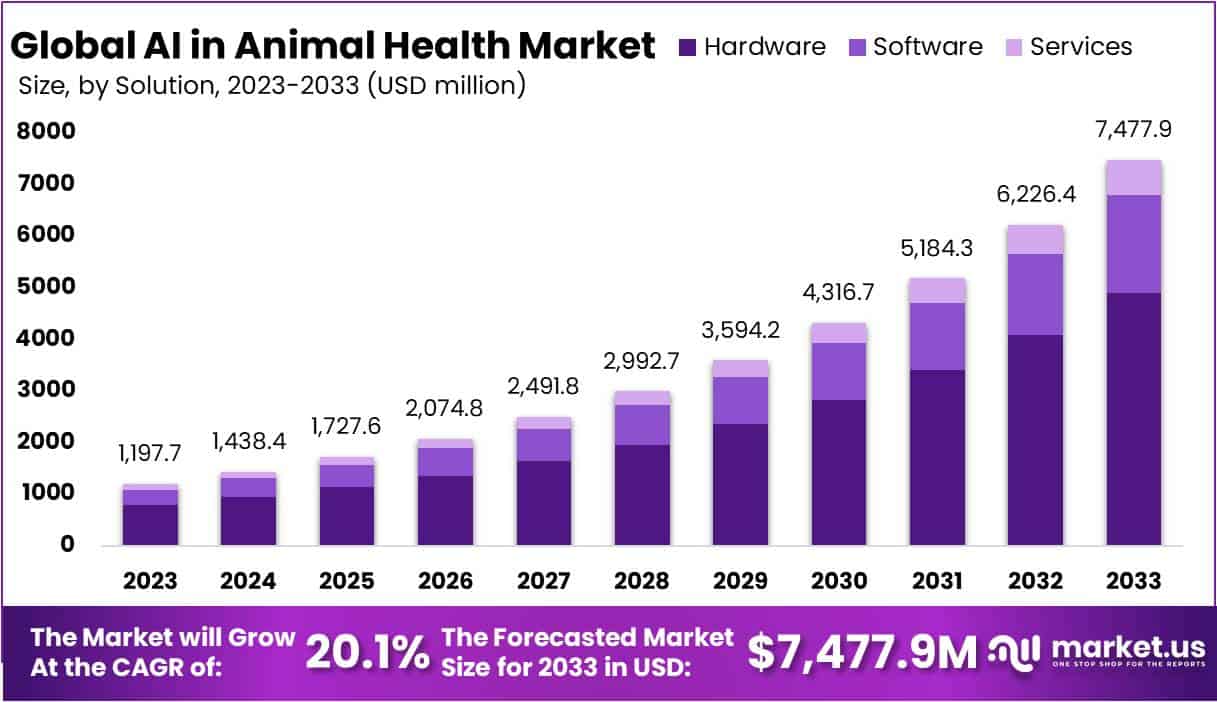
The Global AI in Animal Health Market was valued at the USD 1,197.7 million in 2023 and is expected to register a substantial growth of the USD 7,477.9 million by 2033, with a CAGR of 20.1%.
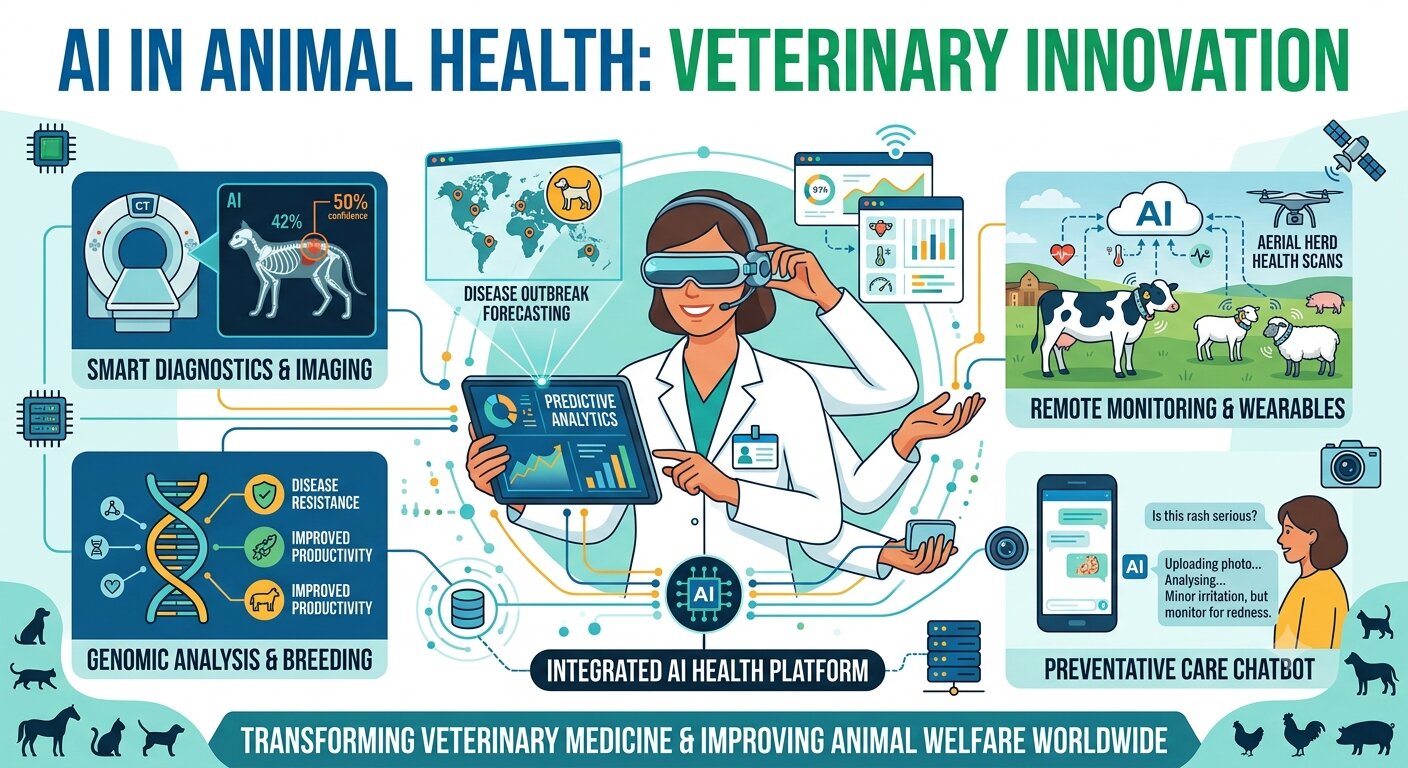
The global AI in animal health industry is witnessing rapid transformation as artificial intelligence becomes an essential tool for improving disease detection, veterinary decision-making, livestock monitoring, and animal welfare.
AI-powered technologies are helping veterinarians, farmers, and researchers analyze large volumes of clinical and behavioral data, enabling faster diagnoses, continuous health monitoring, and more efficient disease surveillance. These capabilities support the broader One Health approach by strengthening the connection between animal, human, and environmental health.
Growing concerns over infectious animal diseases, antimicrobial resistance, and food security are encouraging greater adoption of digital technologies across veterinary care and livestock production. AI applications are increasingly being integrated with smart sensors, wearable devices, diagnostic imaging, and predictive analytics to identify health risks earlier and improve treatment outcomes.
Trusted organizations such as the World Organisation for Animal Health (WOAH) continue to emphasize stronger surveillance systems, digital reporting, and investment in veterinary services to improve global animal health resilience.
According to WOAH, around 60% of known human infectious diseases originate in animals, while 75% of emerging infectious diseases have an animal origin, highlighting the importance of advanced technologies for early detection and prevention.
Additionally, the organization notes that animal health receives only 0.6% of global health spending, despite its critical role in protecting food systems, public health, and economic stability. These factors are expected to support continued innovation and long-term adoption of AI solutions across the animal health ecosystem.
Key Takeaways
- Based on solution, the market is segmented into hardware, software, and services. Among these, the hardware segment dominated the global AI in animal health market, accounting for a 65.6% share in 2023.
- Based on application, the market is segmented into diagnostics and other applications. The diagnostics segment held the leading position, capturing a 52.4% market share in 2023.
- Based on animal type, the market is divided into companion animals and livestock animals. The companion animals segment dominated the market with a 73.9% share in 2023, driven by rising pet spending and the adoption of AI-based pet healthcare solutions.
- North America led the global AI in animal health market, accounting for a 37.8% market share in 2023.
Statistical Information
- USDA reports that automated livestock monitoring systems can help producers avoid approximately USD 316 in indirect costs per infected cow each year by detecting health problems earlier and enabling faster veterinary intervention.
- According to USDA, Bluetooth-enabled livestock wearables can reduce medication use by 15% per animal and shorten the cattle finishing period by 4–6 weeks, improving both productivity and animal health management.
- USDA states that AI-powered cameras and monitoring systems can reduce labor requirements by 2.27 labor hours per 1,000 pounds of broiler production per day, helping poultry farms improve operational efficiency.
- USDA estimates that digital herd management software can lower production costs by around USD 6 per 20 kilograms of output through real-time livestock monitoring and AI-assisted decision-making.
- USDA highlights that biosensor-based fertility monitoring achieves 95%–97% estrus detection success, enabling livestock producers to improve breeding efficiency and pregnancy rates using AI-enabled precision farming technologies.
- According to USDA, robotic milking systems can increase milking frequency and improve milk production by approximately 8%, supporting wider adoption of AI-driven dairy automation.
- WOAH estimates that less than USD 1 billion per year is invested globally in Veterinary Services development, while approximately USD 2.3 billion annually is required to bring veterinary systems up to international standards, creating opportunities for AI-supported efficiency improvements.
- WOAH reports that 95% of Member countries have maintained or improved continuing veterinary education capacity, strengthening the workforce’s ability to adopt AI-based diagnostics, digital surveillance, and intelligent veterinary decision-support systems.
Regional Analysis
North America dominated the AI in animal health market in 2023, supported by its advanced veterinary healthcare infrastructure, high adoption of digital technologies, and strong investment in animal disease surveillance.
The United States benefits from the USDA’s Animal and Plant Health Inspection Service (APHIS), which operates the National Animal Health Laboratory Network (NAHLN), a nationwide network of 60 state and university laboratories that strengthens disease detection, diagnostic testing, and emergency response capabilities. The widespread use of AI-enabled imaging, predictive analytics, and digital diagnostic platforms is improving the accuracy and speed of veterinary decision-making across companion and livestock animals.
Asia Pacific is projected to register the fastest growth during the forecast period due to its expanding livestock population, rising pet ownership, and increasing government focus on animal disease surveillance. Countries such as China, Japan, India, and Australia are investing in digital agriculture, AI-powered livestock monitoring, and smart veterinary solutions to improve productivity and animal welfare.
The World Organisation for Animal Health (WOAH) continues to support countries across the region by strengthening veterinary services, promoting disease surveillance, and enhancing emergency preparedness for transboundary animal diseases, creating a favorable environment for AI adoption in animal health.
Emerging Trends
- AI-powered disease surveillance is becoming a priority across veterinary systems. Digital surveillance platforms are helping veterinary authorities detect and report disease outbreaks faster using real-time data. According to WOAH, the UAE’s Bio-Security Early Notification System recorded 360 animal disease reports in 2025, demonstrating how AI and digital reporting strengthen early warning systems and improve outbreak response.
- AI is strengthening veterinary services through smarter data integration. Governments and international organizations are investing in connected animal health databases that combine laboratory findings, field reports, and surveillance records. WOAH reports that 93% of member countries said its Performance of Veterinary Services recommendations helped improve national veterinary systems, creating stronger foundations for AI-enabled decision-making.
- Wildlife health monitoring is expanding with AI-supported surveillance. AI and digital technologies are increasingly used to monitor wildlife diseases before they spread to livestock or humans. WOAH’s Wildlife Health Strategy promotes integrated surveillance, with 81 listed diseases monitored across wildlife reporting systems, supporting earlier risk detection through intelligent analytics.
- Precision livestock farming is driving greater AI adoption. Farms are increasingly using AI with cameras, sensors, and computer vision to monitor animal behavior, movement, feeding, and health continuously. These technologies help identify abnormalities earlier, improve welfare, reduce manual observation, and support more efficient livestock management in commercial farming operations.
- AI-ready animal health databases are improving veterinary innovation. Standardized animal health records are becoming more important for machine learning applications. Researchers have developed the Vertebrate Breed Ontology containing more than 19,500 livestock and companion animal breed concepts across 49 species, enabling better AI model training and data interoperability.
Use Cases
- AI-assisted veterinary imaging improves diagnostic accuracy. Artificial intelligence is increasingly used to analyze X-rays, CT scans, MRI images, and ultrasound data, helping veterinarians detect fractures, tumors, and internal diseases more quickly while supporting consistent clinical decisions and reducing diagnostic workload.
- Smart livestock monitoring supports early disease detection. AI-powered cameras and wearable sensors continuously monitor livestock activity, feeding patterns, movement, and behavior. Machine learning algorithms identify unusual changes that may indicate illness, allowing farmers to respond earlier and reduce production losses.
- AI enables automated animal identification and traceability. Computer vision systems can recognize individual animals without physical tags by analyzing natural body markings. Research has demonstrated 93.8% identification accuracy for dairy cattle, supporting health monitoring, breeding management, and disease traceability across livestock farms.
- AI enhances outbreak prediction and emergency response. Veterinary authorities are using AI with surveillance databases to analyze disease trends, identify high-risk regions, and improve response planning. Connected reporting platforms provide faster access to outbreak information, enabling timely disease control measures across countries.
- AI supports animal welfare through behavior analysis. Deep learning models analyze animal posture, movement, and daily behavior to identify stress, discomfort, or health problems before visible clinical symptoms appear. Researchers reviewed 44 high-quality studies covering 13 livestock behavior recognition applications, highlighting AI’s growing role in welfare monitoring.
Frequently Asked Questions About AI in Animal Health
- How is AI used in veterinary diagnostics?
AI assists veterinarians by interpreting X-rays, CT scans, MRI images, laboratory results, and clinical records. These tools help identify diseases earlier, improve diagnostic accuracy, prioritize urgent cases, and support treatment planning while reducing the time required for manual analysis. - What factors are driving the AI in animal health market?
Growing livestock production, increasing pet ownership, rising demand for precision livestock farming, and the need for early disease detection are major growth drivers. Governments and veterinary organizations are also encouraging digital surveillance and advanced technologies to strengthen animal health systems. - How does AI improve livestock management?
AI monitors animal behavior, feeding patterns, movement, and health through smart sensors, cameras, and wearable devices. It helps detect abnormalities early, supports breeding management, improves productivity, reduces disease outbreaks, and enhances overall farm efficiency with real-time insights. - Which end users benefit most from AI in animal health?
Veterinary hospitals, animal clinics, livestock farms, research institutions, diagnostic laboratories, and pet care providers are among the primary users. These organizations use AI to improve disease detection, automate routine tasks, optimize treatments, and strengthen animal health monitoring programs. - What challenges does the AI in animal health market face?
The market faces challenges such as high implementation costs, limited availability of standardized animal health data, data privacy concerns, and the need for skilled professionals to manage AI systems. Regulatory compliance and transparent AI models are also important considerations. - Why is AI becoming important for disease surveillance?
AI enables continuous monitoring of disease patterns, analyzes large datasets quickly, and identifies unusual health events earlier than traditional methods. This supports faster outbreak detection, improves veterinary responses, and strengthens biosecurity measures for both livestock and companion animals. - What is the future outlook for the AI in animal health market?
The market is expected to expand as AI becomes more integrated with wearable devices, cloud platforms, precision farming, digital diagnostics, and predictive analytics. Continued investments in veterinary innovation and smart farming technologies are likely to support long-term adoption worldwide.
Conclusion
The global AI in animal health market is poised for strong growth as veterinary care increasingly embraces artificial intelligence to improve diagnostics, disease surveillance, livestock management, and animal welfare. Rising demand for precision livestock farming, expanding use of smart sensors and wearable devices, and growing investments in digital veterinary infrastructure are accelerating market adoption.
Support from organizations such as the World Organisation for Animal Health (WOAH) and government agencies including the USDA is further strengthening AI integration through improved surveillance systems, veterinary capacity, and data-driven decision-making. As AI technologies continue to evolve, the market is expected to play a vital role in advancing animal health, improving farm productivity, and supporting global One Health initiatives.




















